

Patent Cases, MONOLITHIC POWER SYSTEMS, INC. v. REED SEMICONDUCTOR CORP., U.S. District Court, D. Delaware, (Oct. 13, 2026)
MONOLITHIC POWER SYSTEMS, INC. v. REED SEMICONDUCTOR CORP.
MONOLITHIC POWER SYSTEMS, INC. v. NENGDA MICROELECTRONICS (SHENZHEN) CO., LTD., NENGDA SEMICONDUCTOR TECHNOLOGY (SHENZHEN) CO., LTD.
U.S. District Court, D. Delaware. Civil Action No. 23-1155, Civil Action No. 24-165, Civil Action No. 24-166. October 13, 2026.
Murphy, J.
MURPHY, J. [1]
MEMORANDUM
This is a patent infringement case about power management circuitry. Earlier, Reed filed a summary judgment motion arguing a technical basis for noninfringement of Monolithic's U.S. Patent No. 9,590,608 (the “608 patent”) that revealed an unresolved claim construction dispute concerning “the presence or absence of a temporal or causal link” in the claims. DI 377 at 1 and 5 n.2. [2] We denied Reed's motion for summary judgment with the observation that Reed may need to seek clarification of the apparent claim-construction dispute before trial, which is set to begin on November 2, 2026. DI 377 at 5 n.2. Reed then filed a motion seeking a clarifying claim construction and reconsideration of summary judgment. Monolithic opposed. Having examined the parties' briefs and evidence in considerable depth, we agree with Reed's interpretation of the claims for the reasons set out below, but again deny summary judgment of noninfringement of the 608 patent.
I. Background
In these related actions, Monolithic accuses Reed of, among other things, infringing claims 1, 2, 6, 11, 12, 15, and 16 of its 608 patent. DI 385-2 ¶1; DI 337 at Appx. 714. During claim construction, the parties disputed the scope of the 608 patent and advanced different meanings for the phrase “when the feedback signal is smaller than.” DI 161 at 1. In short, Reed argued that the term “when” should mean “during” while Monolithic argued that the term “when” should mean “once.” DI 161 at 1. We decided that Monolithic had the better argument and construed “when the feedback signal is smaller than the reference voltage signal” to mean “once the feedback signal becomes smaller than the reference voltage signal.” DI 180 at 4-5 (emphasis in original). We explained that “the claim's overall structure is one of triggering events, not durations,” and that the specification describes the sequence as starting with a voltage drop: “[o]nce the output voltage (Vout) drops lower than the desired value, the control module 131 is configured to start to switch.” Id. at 5-6 (quoting 608 patent at 14:49-55; emphasis in original). We issued our Markman decision on January 10, 2025.
Claims 1 and 11 distinguish the circuit that performs the overall operation from the modules within it. The “bootstrap refresh control circuit” includes a “bootstrap refresh module” and a “voltage difference module.” The bootstrap refresh module, in turn, contains the “first comparing module.” We use “output voltage” as shorthand for the claims' phrase “output voltage of the voltage converter.” The module names identify different claimed components; the signal names identify their respective inputs and outputs. 608 patent at claims 1 and 11.
The first comparing module compares the “bootstrap voltage signal” with the “bootstrap refresh threshold” and produces the “first comparing signal.” The claim assigns that signal its “first logic state” when the bootstrap voltage signal is lower than the bootstrap refresh threshold. The later reference to the first logic state therefore incorporates a condition already defined by the claim. The bootstrap refresh module is configured to decrease output voltage when that condition exists. 608 patent at claims 1 and 11.
The voltage difference module makes the other comparison. It receives the “feedback signal representing the output voltage” and the “reference voltage signal representing a desired value of the output voltage,” and produces the “difference signal.” Once the feedback signal becomes smaller than the reference voltage signal, the claimed circuit controls the high side switch and the low side switch based on the difference signal to charge the bootstrap capacitor for refreshing the bootstrap voltage signal. Thus, the first comparing signal and the difference signal come from different comparisons and perform different roles in the clause reproduced below. 608 patent at claims 1 and 11; DI 180 at 4-6.
During summary judgment, the parties once again advocated for different interpretations of claims 1 and 11 of the 608 patent in their respective arguments. This complicated the infringement analysis. The new claim construction dispute concerns whether the identical last clause of claims 1 and 11 requires a temporal or causal link between its two enumerated claim limitations, [C] and [D]. [3] The “shared clause” of claims 1 and 11 — with its first enumerated claim limitation [C] in bold and its second enumerated claim limitation [D] in italics — reads as follows:
[C] when the first comparing signal has the first logic state, the bootstrap refresh module is configured to decrease the output voltage of the voltage converter; and [D] wherein when the feedback signal is smaller than the reference voltage signal, the bootstrap refresh control circuit is configured to control the high side switch and the low side switch to switch on and off based on the difference signal so as to charge the bootstrap capacitor for refreshing the bootstrap voltage signal.
See 608 patent at claims 1 and 11 (the “shared clause”). Claim 1 of the 608 patent contains the shared clause and reads as follows:
1. A bootstrap refresh control circuit for a voltage converter, wherein the voltage converter comprises a high side switch, a low side switch and a bootstrap capacitor for providing a bootstrap voltage signal to supply a high side driver of the high side switch, and wherein the voltage converter is configured to receive an input voltage at an input terminal and to provide an output voltage at an output terminal based on driving the high side switch and the low side switch to switch on and off, and wherein the bootstrap refresh control circuit comprising:
a bootstrap refresh module, wherein the bootstrap refresh module comprises a first comparing module having a first input terminal, a second input terminal and an output terminal, and wherein the first input terminal of the first comparing module is configured to receive the bootstrap voltage signal, the second input terminal of the first comparing module is configured to receive a bootstrap refresh threshold, and the first comparing module is configured to compare the bootstrap voltage signal with the bootstrap refresh threshold to provide a first comparing signal having a first logic state and a second logic state at the output terminal, and wherein the first comparing signal has the first logic state when the bootstrap voltage signal is lower than the bootstrap refresh threshold, and wherein the first comparing signal has the second logic state when the bootstrap voltage signal is larger than the bootstrap refresh threshold; and a voltage difference module having a first input terminal, a second input terminal and an output terminal, wherein the first input terminal of the voltage difference module is configured to receive a feedback signal representing the output voltage of the voltage converter, the second input terminal of the voltage difference module is configured to receive a reference voltage signal representing a desired value of the output voltage of the voltage converter, the voltage difference module is configured to compare the feedback signal with the reference voltage signal so as to provide a difference signal at the output terminal; and wherein
[C] when the first comparing signal has the first logic state, the bootstrap refresh module is configured to decrease the output voltage of the voltage converter; and [D] wherein when the feedback signal is smaller than the reference voltage signal, the bootstrap refresh control circuit is configured to control the high side switch and the low side switch to switch on and off based on the difference signal so as to charge the bootstrap capacitor for refreshing the bootstrap voltage signal.
608 patent at claim 1 (emphases added). Claim 11 of the 608 patent also contains the shared clause and reads as follows:
11. A voltage converter, comprising:
a switching circuit having a high side switch and a low side switch, wherein the switching circuit is configured to receive an input voltage, and further configured to provide an output voltage based on switching the high side switch and the low side switch on and off;
a bootstrap circuit comprising a bootstrap capacitor, wherein the bootstrap capacitor is charged for providing a bootstrap voltage signal for the high side switch; and
a bootstrap refresh control circuit comprising:
a bootstrap refresh module, wherein the bootstrap refresh module comprises a first comparing module having a first input terminal, a second input terminal and an output terminal, and wherein the first input terminal of the first comparing module is configured to receive the bootstrap voltage signal, the second input terminal of the first comparing module is configured to receive a bootstrap refresh threshold, and the first comparing module is configured to compare the bootstrap voltage signal with the bootstrap refresh threshold to provide a first comparing signal having a first logic state and a second logic state at the output terminal, and wherein the first comparing signal has the first logic state when the bootstrap voltage signal is lower than the bootstrap refresh threshold, and the first comparing signal has the second logic state when the bootstrap voltage signal is larger than the bootstrap refresh threshold; and
a voltage difference module having a first input terminal, a second input terminal and an output terminal, wherein the first input terminal of the voltage difference module is configured to receive a feedback signal representing the output voltage of the voltage converter, the second input terminal of the voltage difference module is configured to receive a reference voltage signal representing a desired value of the output voltage of the voltage converter, the voltage difference module is configured to compare the feedback signal with the reference voltage signal so as to provide a difference signal at the output terminal; and wherein
[C] when the first comparing signal has the first logic state, the bootstrap refresh module is configured to decrease the output voltage of the voltage converter; and [D] wherein when the feedback signal is smaller than the reference voltage signal, the bootstrap refresh control circuit is configured to control the high side switch and the low side switch to switch on and off based on the difference signal so as to charge the bootstrap capacitor for refreshing the bootstrap voltage signal.
608 patent at claim 11 (emphases added).
Based on its understanding of our claim construction order (DI 180), Reed interpreted the shared clause as requiring a drop in the output voltage (Vout) to initiate the recharging of the bootstrap capacitor and therefore moved for summary judgment of noninfringement because in its accused products, “recharging the bootstrap capacitor is not initiated by any decrease of the output voltage of the voltage converter.” DI 336 at 12 (statement of fact 18); DI 335 at 2-3 (discussing the same); DI 377 at 4. In opposition, Monolithic argued that the shared clause imposes no temporal sequence on its recited limitations and thus permits concurrency between the drop in “output voltage of the voltage converter” and the initiation of recharging the bootstrap capacitor. DI 348 at 13-20; DI 385 at 3-6. Although the parties framed the issue as an infringement dispute, we acknowledged a potential underlying disagreement about claim scope, and directed Reed (as movant) to seek a clarifying claim construction, if needed for trial. DI 377 at 5 n.2. In the interim, we denied Reed's summary judgment motion for noninfringement with the understanding that the prospective supplemental construction could alter the infringement inquiry. DI 377 at 1 and 5 n.2.
Reed elected to pursue not only a clarifying claim construction but also reconsideration of our denial of summary judgment. To that end, Reed filed a combined motion for supplemental claim construction and reconsideration of the Court's denial of summary judgment. DI 380. Monolithic opposed, DI 385, Reed filed a reply brief, DI 392, and Monolithic filed a sur-reply brief, DI 396. We address claim construction, reconsideration, and infringement in that order below.
I. Standards of Review
A. Claim Construction
The purpose of claim construction is to “determin[e] the meaning and scope of the patent claims asserted to be infringed.” Markman v. Westview Instruments, Inc., 52 F.3d 967, 976 (Fed. Cir. 1995) (en banc), affd 517 U.S. 370 (1996). When the parties raise an actual dispute regarding the proper scope of the claims, the court, not the jury, must resolve that dispute. O2 Micro Int'l Ltd. v. Beyond Innovation Tech. Co., 521 F.3d 1351, 1360 (Fed. Cir. 2008). Accordingly, “a district court may (and sometimes must) revisit, alter, or supplement its claim constructions (subject to controlling appellate mandates) to the extent necessary to ensure that final constructions serve their purpose of genuinely clarifying the scope of claims for the finder of fact.” In re Papst Licensing Digital Camera Pat. Litig., 778 F.3d 1255, 1261 (Fed. Cir. 2015) (citing O2 Micro, 521 F.3d at 1359 and Pfizer, Inc. v. Teva Pharm., USA, Inc., 429 F.3d 1364, 1377 (Fed. Cir. 2005)). Therefore, “a district court may engage in claim construction during various phases of litigation, not just in a Markman order.” Conoco, Inc. v. Energy & Env't L.C., 460 F.3d 1349, 1359 (Fed. Cir. 2006).
B. Reconsideration
A party seeking reconsideration must show one of three grounds: (1) an intervening change in controlling law, (2) the availability of new evidence, or (3) the need to correct a clear error of law or fact or to prevent manifest injusticé. Max's Seafood Cafe ex rel. Lou-Ann, Inc. v. Quinteros, 176 F.3d 669, 677 (3d Cir. 1999); N. River Ins. Co. v. CIGNA Reinsurance Co., 52 F.3d 1194, 1218 (3d Cir. 1995); Brambles USA, Inc. v. Blocker, 735 F. Supp. 1239, 1240-41 (D. Del. 1990); D. Del. LR 7.1.5. Motions for reargument are granted only when the court has patently misunderstood a party, made a decision outside the adversarial issues presented by the parties, or made an error not of reasoning but of apprehension. See Schering Corp. v. Amgen, Inc., 25 F. Supp. 2d 293, 295 (D. Del. 1998) (citing Brambles, 735 F. Supp. at 1241). “A motion for reconsideration is not properly grounded on a request that a court rethink a decision already made.” Smith v. Meyers, 2009 WL 5195928, at *1 (D. Del. Dec. 30, 2009). Motions for reargument or reconsideration should not be granted if the “proponent simply rehashes materials and theories already briefed, argued and decided.” Sentient Sensors, LLC v. Cypress Semiconductor Corp., 2021 WL 1966406, at *1 (D. Del. May 17, 2021). A district court's order construing the disputed terms of a patent is an interlocutory order and therefore may be revised by the court at any time before a final judgment is entered. See Fed. R. Civ. P. 54(b) (providing that for non-final judgments, not certified under 54(b), the “order or other form of decision is subject to revision at any time before the entry of judgment adjudicating all the claims and the rights and liabilities of all the parties.”). Whether the circumstances, including the timing of a motion for reconsideration and the substance of the motion, justify a reconsideration of a prior claim construction order must generally be decided on a case-by-case basis. The decision to grant a motion for reargument or reconsideration is squarely within the discretion of the district court. AgroFresh Inc. v. Essentiv LLC, C.A. No. 16-662 (MN), 2019 WL 2745723, at *1 (D. Del. July 1, 2019); Brambles, 735 F. Supp. at 1241.
C. Summary Judgment
We “grant summary judgment if the movant shows that there is no genuine dispute as to any material fact and the movant is entitled to judgment as a matter of law.” Fed. R. Civ. P. 56(a). A factual dispute is genuine and material if a reasonable jury could find for the nonmoving party. Anderson v. Liberty Lobby, Inc., 477 U.S. 242, 248 (1986). We view the evidence and draw reasonable inferences in Monolithic's favor; we do not weigh credibility or choose between reasonably supported competing accounts. Id. at 255.
On a noninfringement motion, the defendant “bears the initial responsibility of informing the district court of the basis for its motion, and identifying those portions of the pleadings, depositions, answers to interrogatories, and admissions on file, together with the affidavits, if any, which it believes demonstrate the absence of a genuine issue of material fact.” Celotex Corp. v. Catrett, 477 U.S. 317, 323 (1986) (citation modified). Alternatively, defendant may show that there is no genuine issue of material fact by pointing out “an absence of evidence to support the nonmoving party's case.” Id. at 325. After that, the patent owner must “come forward with specific facts showing that there is a genuine issue for trial.” Matsushita Elec. Indus. Co. v. Zenith Radio Corp., 475 U.S. 574, 587 (1986) (citation modified).
Infringement is analyzed in two steps: (1) claim construction, then (2) comparison of the properly construed claim to the accused product. Markman v. Westview Instruments, Inc., 517 U.S. 370, 384 (1996); Bai v. L & L Wings, Inc., 160 F.3d 1350, 1353 (Fed. Cir. 1998); see also Cole v. Kimberly—Clark Corp., 102 F.3d 524, 528, 41 USPQ2d 1001, 1004 (Fed.Cir.1996). When the first step changes, the second often must be re-done. See, e.g., Wi-LAN USA, Inc. v. Apple Inc., 830 F.3d 1374, 1382-84 (Fed. Cir. 2016) (affirming district court's supplemental claim construction and grant of summary judgment for noninfringement on reconsideration); TomTom, Inc. v. Adolph, 790 F.3d 1315, 1322-23 (Fed. Cir. 2015) (noting district court properly considered post-construction reconsideration motion before entering judgment of noninfringement).
An expert's conclusion must rest on a sufficiently detailed factual account of how the accused product meets the disputed limitation. Intellectual Science & Technology, Inc. v. Sony Electronics, Inc., 589 F.3d 1179, 1183-85 (Fed. Cir. 2009). That case concerned the absence of identified corresponding structure for a means-plus-function limitation; it does not require every infringement opinion to use that form of analysis. Likewise, Treehouse Avatar LLC v. Valve Corp., 54 F.4th 709, 715 (Fed. Cir. 2022), upheld judgment after the proper exclusion of expert analysis applying a materially different construction. These decisions require attention to the particular opinion and the actual evidentiary gap, if any. Rejecting a party's proposed construction does not, without that examination, establish that all of its expert's factual testimony is unusable.
II. Analysis
We address the supplemental claim construction issue first, the propriety of reconsidering summary judgment second, and the issue of noninfringement last.
A. Claims 1 and 11 require a temporal and causal link between limitations [C] and [D]
The summary judgment proceedings revealed a material dispute about the proper scope of claims 1 and 11 of the 608 patent. DI 377 at 5 n.2. Although we already construed the related claim term “when the feedback signal is smaller than,” as this case progressed it became clear that our construction did not resolve all the parties' claim construction disputes. See GE Lighting Sols., LLC v. AgiLight, Inc., 750 F.3d 1304, 1310 (Fed. Cir. 2014) (“[P]arties in patent cases frequently stipulate to a construction or the court construes a term, only to have their dispute evolve to a point where they realize that a further construction is necessary.”). Because it is the duty of the court — not the jury — to resolve all claim construction disputes necessary for judgment, we are supplementing our prior constructions to address whether claims 1 and 11 of the 608 patent require a temporal or causal link between limitations [C] and [D]. See, e.g., Papst, 778 F.3d at 1261.
In its supplemental briefing, Reed proposes that the shared clause should be construed as requiring “an A→B→C causal sequence: (A) decrease output voltage; (B) feedback signal falls below reference voltage signal; (C) switching the high side switch and the low side switch on and off so as to charge the bootstrap capacitor.” DI 380 at 5. In support, Reed points to “the claim language, this Court's existing ‘once’ construction, Monolithic's own successful claim construction arguments, and Monolithic's statements to the PTAB.” Id.
Monolithic responds that the plain language of the shared clause does not require a causal sequence for the two “when” limitations and that the prior claim construction is sufficient. DI 385 at 4-5. As Reed points out and we address in some detail below, Monolithic's current position on the shared clause — [C] and [D] are “two separate ‘when’ limitations,” that may occur independently, simultaneously, or overlappingly — is diametrically opposed to Monolithic's Markman position — limitations “[C] and [D] recite a cause-and-effect relationship” where “[D] is a consequence of [C].” Compare id, with DI 161 at 14. Monolithic's inconsistency is important because we expressly adopted Monolithic's reasoning in our claim construction order. DI 180 at 5; DI 385 at 10. That is a very good reason to reconsider our claim construction. [4]
For the reasons explained below, we agree with Reed's interpretation of the shared clause and adopt its proposed construction. DI 380 at 5 and 11-12. The shared clause links limitations [C] and [D] together in a cause-and-effect relationship where limitation [D] must be a consequence of limitation [C]. Accordingly, the output-voltage decrease recited in limitation [C] must cause the feedback signal to become smaller than the reference voltage signal, triggering the switching recited in limitation [D]. The feedback signal need not be physically identical to the output voltage but cannot misrepresent the output voltage either. Earlier charging or overlapping activity is not categorically excluded, however, the recited causal connection must exist.
i) Intrinsic evidence supports temporal and causal link
“When construing claim terms, we first look to, and primarily rely on, the intrinsic evidence, including the claims themselves, the specification, and the prosecution history of the patent, which is usually dispositive.” Google LLC v. EcoFactor, Inc., 92 F.4th 1049, 1058 (Fed. Cir. 2024); Personalized Media Commc'ns, LLC v. Apple Inc., 952 F.3d 1336, 1340 (Fed. Cir. 2020). We start with the language of the claims. Immunex Corp. v. Sanofi-Aventis U.S. LLC, 977 F.3d 1212, 1218 (Fed. Cir. 2020) (“We begin claim construction by looking to the language of the claim itself.”).
Generally, the asserted claims of the 608 patent are directed to electronic power-management circuits, and more specifically to voltage converters that include a “bootstrap refresh control circuit” used to recharge a bootstrap capacitor that drives the converter's high-side transistor. Recharging the bootstrap capacitor is necessary because it provides the voltage required to operate the high-side transistor and, in turn, enables the converter to regulate its output voltage efficiently. In the claimed operation, decreasing the output voltage of the voltage converter (Vout) causes the feedback signal to become smaller than the reference voltage signal, which causes the voltage converter to perform normal switching cycle(s) — i.e., switching the high side switch and the low side switch on and off, which in turn recharges the bootstrap capacitor. See 608 patent at Fig. 5, 2:35-37, 8:34–40, 11:18-23, 15:16-21, 15:42-49.
The overall claimed bootstrap refresh control circuit includes a bootstrap refresh module, which itself includes the first comparing module, and a voltage difference module. The first comparing module does not compare output voltage with the reference voltage signal. It compares the bootstrap voltage signal with the bootstrap refresh threshold and produces the first comparing signal. The voltage difference module performs the other comparison: feedback signal against reference voltage signal, producing the difference signal. These distinctions explain why [C] refers to the first comparing signal while [D] refers to the feedback signal and the difference signal. 608 patent at claims 1 and 11. Limitation [C] takes the first comparison's result as its condition. When the first comparing signal has the first logic state — i.e., the state that the preceding language assigns when the bootstrap voltage signal is lower than the bootstrap refresh threshold — the bootstrap refresh module is configured to decrease the output voltage. That is the link between the words “bootstrap voltage signal” earlier in the claim and the words of limitation [C]. Limitation [D], in turn, specifies what the bootstrap refresh control circuit is configured to do once the feedback signal becomes smaller than the reference voltage signal: control the high side switch and low side switch to switch on and off, based on the difference signal, to charge the bootstrap capacitor.
We take a small detour to answer whether the claim term “representing” requires the “feedback signal” to track the “output voltage of the voltage converter.” Reed argues that the “feedback signal”/“output voltage of the voltage converter” distinction is legally irrelevant to its causal theory because the claims require “feedback signal” to represent Vout. DI 380 at 11-12. It asserts that the “feedback signal” represents and tracks Vout, such that “feedback signal” cannot fall below VREF without “output voltage of the voltage converter” falling. DI 380 at 11–12. Monolithic argues that [D] is keyed to “feedback signal” not “output voltage of the voltage converter” and that “output voltage of the voltage converter” may correspond to “feedback signal” “but it does not have to” so Reed's A→B linkage improperly assumes equivalence. DI 385 at 6-9. [5] But the issue is whether that comparison responds to the decrease required by [C], not whether we may replace the words “feedback signal” with “output voltage.”
The claim requires a feedback signal that represents the output voltage, and the specification describes that feedback signal decreasing as “output voltage of the voltage converter” decreases. 608 patent 8:30-31, 11:15-16. Therefore, we agree with Reed because the feedback signal represents the “output voltage of the voltage converter” and would reflect any decrease in “output voltage of the voltage converter” required by limitation [C]. We also agree with Reed that the intrinsic evidence establishes that there is significant overlap between the meaning of the relative terms “feedback signal” and “the output voltage” in the patent that using “feedback signal” refers to the same concept as “the output voltage.” Hewlett-Packard Co. v. Mustek Sys., Inc., 340 F.3d 1314, 1327 (Fed. Cir. 2003); In re PersonalWeb Technologies LLC, No. 2020-1566, 2021 WL 3557196, at *4 (Fed. Cir. Aug. 12, 2021) (“The patents' written description proceeds to describe the invention, interchangeably using the terms ‘licensed’ and ‘authorized’ to refer to the same concept.”). The specification explicitly teaches that the feedback signal and the output voltage are positively correlated. 608 patent at 8:30-40 (“Meanwhile, the feedback signal (FB) is decreased with the drops of the output voltage (Vout).”), 11:15-25 (“Meanwhile, the feedback signal (FB) drops with the decreasing of the output voltage (Vout).”). And Monolithic has provided nothing to suggest that the feedback signal could fall below the reference voltage without a corresponding drop in the output voltage. Nystrom v. TREX Co., 424 F.3d 1136, 1143 (Fed. Cir. 2005) (“Different terms or phrases in separate claims may be construed to cover the same subject matter where the written description and prosecution history indicate that such a reading of the terms or phrases is proper.”). Therefore, it is inconsequential that the “output voltage of the voltage converter” is represented by the feedback signal (FB) because the feedback signal's representation is relative to the actual value of the Vout. Hewlett-Packard, 340 F.3d at 1327 (holding that by displaying a representation of the selected portion of the image relative to two rulers the scanner displayed the dimensions of the selected portion of the image).
Having established a general understanding of the claim, and the meaning of “representing,” we next consider in more depth whether limitations [C] and [D] of the shared clause impose interrelated functional limitations on the claimed bootstrap refresh control circuit. Reed proposes: “The claims require an A→B→C causal sequence: (A) decrease output voltage; (B) feedback signal falls below reference voltage signal; (C) switching the high side switch and the low side switch on and off so as to charge the bootstrap capacitor.” Its longer formulation requires the bootstrap refresh module first to decrease Vout, thereby causing “feedback signal” to cross the reference, and then causing the recited switching. Reed treats [C] as a predicate action and [D] as its threshold-triggered consequence. DI 380 at 4-6. Monolithic argues that the claim lacks “and as a result, then,” “only after,” “followed by,” or other linking language. In its reading, each “when” has its own trigger and response; neither clause requires the other's function to occur first. Monolithic's proposal expressly allows simultaneous, overlapping, or immediately successive operation and Monolithic says that the existing construction is sufficient. DI 385 at 3-6. [6]
We agree with Reed. Limitations [C] and [D] are written as a single indented subsection, suggesting that they recite connected limitations, rather than separate, independent limitations. Both have one Vout-related functional limitation, and limitation [C]'s function inevitably causes limitation [D]'s triggering event to occur. Put another way, a temporal and causal link inherently exists between the limitations because limitation [C] recites two predicate actions — (1) detecting that the bootstrap voltage has dropped too low and then (2) decreasing the “output voltage of the voltage converter” — that need to be performed to cause limitation [D]'s triggering event — the “output voltage of the voltage converter” dropping too low — to occur, thereby initiating limitation [D]'s two responsive actions — (3) detecting that the “output voltage of the voltage converter” has dropped too low and then (4) toggling the high-side and low-side switches to charge the bootstrap capacitor — to also be performed.
This matches our Markman reasoning (adopted from Monolithic) that “the claim's overall structure is one of triggering events, not durations.” DI 180 at 5. Based on that rationale, we also construed “when the feedback signal is smaller than” to mean “once the feedback signal becomes smaller than.” Id. Therefore, the claim language of the shared clause describes the following temporal and causal sequence of events:
Claim language | Explanation using the same terms |
|---|---|
“first comparing module” configured to “compare the bootstrap voltage signal with the bootstrap refresh threshold” and provide a “first comparing signal.” | The bootstrap refresh module contains this comparison circuitry. Its inputs are the bootstrap voltage signal and bootstrap refresh threshold. Its output is the first comparing signal — not the difference signal. |
“the first comparing signal has the first logic state when the bootstrap voltage signal is lower than the bootstrap refresh threshold.” | This sentence defines the condition later used in [C]. “First logic state” identifies the result of the bootstrap-voltage comparison; it is not a measurement of output voltage. |
[C]: “when the first comparing signal has the first logic state, the bootstrap refresh module is configured to decrease the output voltage of the voltage converter.” | (1-3): When bootstrap voltage drops too low, the bootstrap refresh module is configured to decrease output voltage. The reference to the first comparing signal is how [C] incorporates the preceding bootstrap-voltage comparison. |
“a voltage difference module” receives a “feedback signal representing the output voltage” and a “reference voltage signal representing a desired value of the output voltage,” and compares them to provide a “difference signal.” | This is the other comparison. Its inputs are the feedback signal and reference voltage signal. Its output is the difference signal. Both claims describe the reference voltage signal as representing the desired value of output voltage. |
[D]: “when the feedback signal is smaller than the reference voltage signal,” the circuit is configured to control the high side and low side switches “based on the difference signal so as to charge the bootstrap capacitor for refreshing the bootstrap voltage signal.” | (4-6): The condition is the feedback comparison, not output voltage compared directly with the reference voltage signal. The specified response is switching both named switches based on the difference signal, for the stated charging purpose. |
In the chart above, (1-3) reflect the following: (1) the bootstrap voltage drops too low → (2) the bootstrap refresh control circuit detects that the bootstrap voltage signal — which represents the bootstrap voltage — is lower than the bootstrap refresh threshold → (3) the bootstrap refresh control circuit decreases the Vout. That in turn leads to (4-6), which reflect the following: (4) because “output voltage of the voltage converter” is being decreased, at some point the “output voltage of the voltage converter” drops too low → (5) the bootstrap refresh control circuit detects that the feedback signal — which represents the “output voltage of the voltage converter” — falls below the reference voltage signal → (6) the bootstrap refresh control circuit starts toggling the high side switch and the low side switch on and off to charge the bootstrap capacitor.
The sequential nature of the claimed functions is apparent from the plain meaning of the claim language. The specification further endorses our conclusion. “[T]he specification is always highly relevant to the claim construction analysis, is the single best guide to the meaning of a disputed term and can make plain what the patentee did and did not invent.” Regeneron Pharms., Inc. v. Mylan Pharms. Inc., 130 F.4th 1372, 1381 (Fed. Cir. 2025) (citation modified). “Thus, claims must be construed so as to be consistent with the specification, of which they are a part.” Id.
For example, Figure 5, reprinted below with helpful annotations, illustrates how the “output voltage of the voltage converter” (and thus the feedback signal) drops when turning on the low side switch; eventually causing the “output voltage of the voltage converter” to drop too low and triggering the high side switch to turn on to increase the Vout; eventually causing the “output voltage of the voltage converter” to rise above the reference voltage and triggering the high side switch to turn off, the low side switch to turn on, and the bootstrap capacitor to charge. See, e.g., 608 patent at Fig. 5, 7:19-20, 11:15-25, 12:6-14, 14:47-53, 15:9-67, 16:3-16, and 19:39-41.
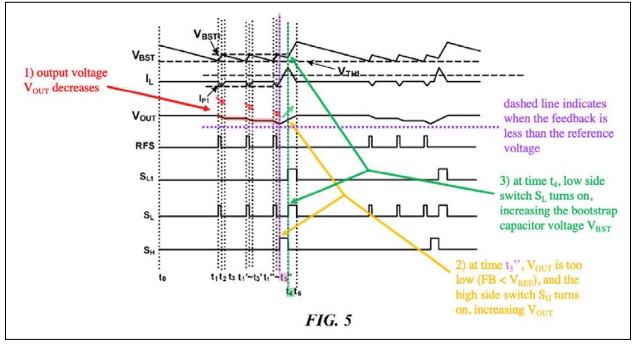
DI 161 at 5 (annotations provided by Monolithic, which we adopt).
Further, the patent expressly teaches that “[o]nce the output voltage (Vout) drops lower than the desired value, the control module 131 is configured to start to switch the high side switch 11 and the low side switch 12 on and off until the output voltage (Vout) recovers to the desired value.” 608 patent at 12:8-14; see, e.g., id. at 8:26-40, 11:11-31, 14:49-55, 15:51-59, 15:65-16:13, and 16:58-67; see also id. at 3:23-30 (explaining invention's goal is to increase “output voltage of the voltage converter” after it drops while maintaining bootstrap capacitor charge). That passage of the specification ties the normal switching to the preceding voltage decrease. It does not require the complete switching sequence to occur while “feedback signal” remains below the reference. DI 161 at 17; DI 180 at 5-6. We have not found a single provision in the specification — nor has Monolithic pointed to one — that contemplates limitation [D]'s high-and low-side toggling event as independently or simultaneously occurring with limitation [C]'s “output voltage of the voltage converter” decreasing event. See id. at 14:49-55.
ii) Monolithic's claim construction arguments support temporal and causal link
In its summary judgment arguments, Reed finds itself applying and extending Monolithic's reasoning from claim construction, arguing that the logical conclusion of limitation [C] needing to trigger limitation [D] is that the claim requires Reed's A → B → C sequence. DI 380 at 6; DI 161 at 28 (“Ignoring that [D] must follow [C] also means ignoring the preceding event→trigger context by which [D] occurs only when (once') limitation [C] causes the voltage to drop too low.”). To disagree, Monolithic seems to have no choice but to contradict itself.
During claim construction, Monolithic argued that the intrinsic evidence requires the term “when” to mean “once” in claim limitation [D] because “‘when’ recites a triggering condition culminating from the preceding context.” DI 161 at 14. In Monolithic's own words:
The claim language requires that “when” means “once” because it describes that limitation [D] is a consequence of [C]. Limitation [C] recites that during a certain condition, the output voltage Vout decreases. Because Vout decreases, at some point it drops too low. Thus, [D] kicks in. Limitation [D] recites that when the output voltage (represented by a “feedback signal” or “FB” (′608 Pat. at 3:66-67)) is too low, a sequence begins where the high and low side switches are turned on and off, which eventually results in the bootstrap capacitor charging …. Thus, limitations [C] and [D] recite a cause-and-effect relationship where ([C]) the output voltage is decreased and ([D]) at some point gets too low such that toggling the switches must begin, which later results in charging the bootstrap capacitor. Monolithic's construction that “when” means “once” describes this relationship.
DI 161 at 14-15 (citation modified). Monolithic repeatedly reinforced that limitations [C] and recite a cause-and-effect relationship where the output voltage is decreased (limitation [C]) and then at some point gets too low such that toggling the switches must begin (limitation [D]). DI 161 at 15. Monolithic argued that construing “when” as “once” was necessary to capture this sequential, cause-and-effect relationship because “when the output voltage (represented by a ‘feedback signal’ or ‘FB’) is too low, a sequence begins” that charges the bootstrap capacitor. Id. The tables below provide juxtaposed quotations from Monolithic's briefs and oral arguments that illustrate the inconsistencies between its positions:
Issue: Relationship between Limitations [C] and [D] | |
|---|---|
Prior Position – Causal | Current Position - Independent |
For term 1, Defendants exploit the natural ambiguity in the word “when” by arguing it is used here to mean “during” a condition instead of “once” a triggering condition occurs following a preceding context, both improperly broadening (severing the cause-effect requirement) and narrowing (requiring the entire process to complete “during” the condition) the claim at the same time. DI 161 at 1. The ′608 Patent refers to a specific situation where a change in the feedback signal triggers the subsequent switching. DI 161 at 13. Thus, limitations [C] and [D] recite a cause-and-effect relationship where ([C]) the output voltage is decreased and ([D]) at some point gets too low such that toggling the switches must begin, which later results in charging the bootstrap capacitor. DI 161 at 15. But the Patent only contemplates that the [D] switching sequence is triggered, i.e. started, by the feedback signal falling below the reference voltage signal (the Vout decrease). DI 161 at 17. As described in Plaintiff's opening, [C] implicitly requires that the output voltage/feedback is well above a reference voltage and is intentionally decreased until the point when (“once”) it drops too low ([D]), triggering the switches, starting with the high-side switch, to increase output voltage/feedback well above the reference (and later the low-side switch to refresh the bootstrap). DI 161 at 28. | The plain language of the last clause of claims 1 and 11 does not have any explicit language indicating a specific causal sequencing of the two independent “when” elements, whereby, e.g., [C] causes [D] or vice versa. DI 385 at 1. The plain language of the last clause of claims 1 and 11 does not require a specific causal sequence of the two “when” elements [C] and [D]. There is no language between the two “when” elements requiring a causal sequencing, such as “and as a result, then” or “only after” or “followed by,” or the like. Instead, each of the “when” elements are preceded with the terms “and wherein when …,” expressly contemplating that these “when” elements happen independent of any timing and not caused or triggered by one of the “when” elements. DI 385 at 4. Next, Reed improperly links the two independent “when” elements [C] and [D] to fabricate a required “causal sequence.” DI 385 at 7. Reed's motion should be denied because Reed cannot show the claim language that requires element [C] to precede element [D]. DI 396 at 1. |
Issue: Order of Occurrence for [C] and [D] | |
|---|---|
Prior Position — Sequential | Current Position — None |
Ignoring that [D] must follow [C] also means ignoring the preceding event→trigger context by which [D] occurs only when (“once”) limitation [C] causes the voltage to drop too low. DI 161 at 28. The claim language requires that “when” means “once” because it describes that limitation [D] is a consequence of [C]. DI 161 at 14. And the specification never contemplates this high-and low-side toggling event apart from following the [C] voltage drop. DI 161 at 17. First, Defendants’ use of the “during” definition of “when” improperly untethers the [D] trigger from the [C] preceding voltage drop in contravention of the intrinsic evidence. DI 161 at 16. | A circuit that possesses both recited capabilities meets the claims, regardless of which effect occurs first. DI 385 at 6. Neither “when” element cross-references the other nor requires its function to occur before the other, or that both functions cannot occur simultaneously or overlap with each other. DI 385 at 4. Indeed, MPS's prior statements were responding to Reed's “duration” argument that focused on each “when” element separately, not an alleged causal linkage between two separate “when” elements and whether the first “when” element must occur before the second “when” element or vice versa. DI 385 at 11. |
Issue: Correlation between Vora and Feedback Signal | |
|---|---|
Prior Position - Equivalent | Current Position - None |
Thus, a “voltage difference module” compares the output signal Vout (i.e., feedback signal (FB)) with a reference voltage (VREF)) that represents the voltage converter's desired output. DI 161 at 4. Limitation [D] recites that when the output voltage (represented by a “feedback signal” or “FB” (′608 Pat. at 3:66-67)) is too low, a sequence begins where the high and low side switches are turned on and off, which eventually results in the bootstrap capacitor charging …. DI 161 at 14. At some point, Vout (and thus FB) drops too low. DI 161 at 15. | The output voltage may correspond to the feedback signal, but it does not have to. DI 385 at 9. The claim language uses “when” and “wherein when” — there is no requirement that the feedback signal be a function of Vout. DI 396 at 3. A signal that “represents” another signal may track it in general operation, but, as explained in MPS's Opposition and again below, the claims do not require the feedback voltage to rise and fall with Vout. DI 396 at 4-5. |
Issue: Monolithic's Focus in Prior Arguments | |
|---|---|
Prior Position - Inter-clause relationship | Current Position - Duration only |
MPS dedicated most of its opening to explaining how the [C]→[D] chain of events compels that “when” means “once,” yet Defendants answer without ever discussing [C]'s relationship to [D] or even just discussing the [C] voltage drop at all. DI 161 at 27. | Indeed, MPS's prior statements were responding to Reed's “duration” argument that focused on each “when” element separately, not an alleged causal linkage between two separate “when” elements and whether the first “when” element must occur before the second “when” element or vice versa. MPS did not argue for a strict “sequence” between the two “when” elements that Reed now seeks to impose. DI 385 at 11. |
Issue: Intrinsic Evidence Support | |
|---|---|
Prior Position - Causal | Current Position - None |
While it is true that “when” could mean either of these things in different contexts, the claim terms and intrinsic evidence of the ′608 Patent mandate the latter defmition applies here, as the former definition is contrary to the teachings of the patent. DI 161 at 1. The claim language requires that “when” means “once” because it describes that limitation [D] is a consequence of [C]. DI 161 at 14. Limitations [C] and [D] are combined as one indented subsection in the Patent, further illustrating that they are connected and not separate and independent limitations. DI 161 at 15 n.4. The specification also illustrates this cause-effect relationship. DI 161 at 15. And the specification never contemplates this high-and low-side toggling event apart from following the [C] voltage drop. DI 161 at 17. First, Defendants’ use of the “during” definition of “when” improperly untethers the [D] trigger from the [C] preceding voltage drop in contravention of the intrinsic evidence. DI 161 at 16. | The plain language of the last clause of claims 1 and 11 does not require a specific causal sequence of the two “when” elements [C] and [D]. There is no language between the two “when” elements requiring a causal sequencing, such as “and as a result, then” or “only after” or “followed by,” or the like. Instead, each of the “when” elements are preceded with the terms “and wherein when …,” expressly contemplating that these “when” elements happen independent of any timing and not caused or triggered by one of the “when” elements. DI 385 at 4. So, they're trying to connect these two separate requirements of the claim, and they're not — you know, they don't have to be connected. DI 385-1 at 19:20-22 (Patariu). But describing one example for how the claimed system may work is not a position on whether the claims impose the rigid construction Reed offers between elements [C] and [D]. DI 396 at 6-7. Reed impermissibly seeks to read an embodiment from the specification into the claims. Reed's only reference to the specification cites “[o]nce the output voltage (Vout) drops lower than the desired value, the control module 131 is configured to start to switch.” Motion at 6 … Even with this improper reading of an embodiment into the claims, noticeably absent is any causal sequencing language. DI 385 at 6. |
Compare DI 161 at 14-18, 27-28 (citations modified). with DI 385 at 1-12 (citations modified) and DI 396 at 3-7 (citations modified).
iii) Monolithic's rebuttal is unpersuasive
Monolithic's attempts to untangle the knot that it tied are unsuccessful. Monolithic tries to isolate its prior arguments that “when” means “once” rather than “during” from any broader principle about the relationship between [C] and [D]. DI 385 at 11. But Monolithic's reason for rejecting “during” included the concern that Reed's construction would untether [D] from the preceding [C] decrease. DI 161 at 16-17. Thus, Monolithic's current arguments erode the basis for the claim construction that it (correctly and successfully) advocated for, and would sever the relationship between limitations [C] and [D] that it (correctly and successfully) demonstrated. As the litany of argument detailed in the previous section shows, the claim construction of “when” was not just about substituting one word for another; it was about the integrated logic of the shared clause.
Monolithic also argues that claims 1 and 11 require circuits possessing the recited capabilities, “regardless of which effect occurs first” because the claim term “configured to” describes capability rather than temporal order. DI 385 at 5-6. It cites In re Blue Buffalo Enterprises, Inc., No. 2024-1611, 2026 WL 100470, at *1 (Fed. Cir. Jan. 14, 2026) (nonprecedential), for its proposition that “configured to” describes capability rather than event order. Reed does not expressly discuss Blue Buffalo or provide a separate construction of “configured to.” DI 392 at 1-9. But in any event, Monolithic's argument is off the mark. Blue Buffalo does not establish a categorical rule to that effect, or even address a situation like the one here. It construed the particular claim language in light of the pertinent patent application's written description; it did not hold that capability language erases relationships among recited functions. In re Blue Buffalo Enters., Inc., No. 2024-1611, 2026 WL 100470, at *1 (Fed. Cir. Jan. 14, 2026). Here, the relevant capability is the connected operation required by the construction, not merely possession of two unrelated functions. In fact, Monolithic previously explained why its claims and written description suggest that “configured to” should be construed narrowly to require its circuits to be specifically designed or constructed to achieve its sequential functions. See supra; DI 161 at 28.
B. We may, and do, reconsider Reed's motion for summary judgment
Clarifying the claims and revisiting the disposition are separate decisions. The first resolves the claim-scope disagreement identified in DI 377 at 5 n.2. The second requires application of that construction to the record under Rule 56. In Wi-LAN USA, Inc. v. Apple Inc., 830 F.3d 1374, 1384-86 (Fed. Cir. 2016), the Federal Circuit upheld the district court's discretion to consider a late construction argument on its merits rather than deem it barred. That discretion does not itself establish either the absence of a material factual dispute or the adequacy of the opportunity to present evidence under the construction selected.
Our memorandum addressing Reed's motion for summary judgment acknowledged and left open the temporal-or-causal-link question. DI 377 at 5 n.2. Exercising our discretion to resolve the dispute now allows the infringement evidence to be evaluated under a single, correct construction. See Ballard Med. Prods. v. Allegiance Healthcare Corp., 268 F.3d 1352, 1358 (Fed. Cir. 2001) (“As long as the trial court construes the claims to the extent necessary to determine whether the accused device infringes, the court may approach the task in any way that it deems best.”); Wi-LAN, 830 F.3d at 1384-86 (“Here, the district court used its case-management discretion to decline to find Wi-LAN's new construction barred and instead to make a merits determination. We find that it did not abuse its discretion in deciding to resolve Wi-LAN's motion for reconsideration on its merits.”). At a minimum, we must avoid presenting a claim construction dispute — even one disguised as an infringement dispute — to the jury. O2 Micro Intl Ltd. v. Beyond Innovation Tech. Co., 521 F.3d 1351, 1362 (Fed. Cir. 2008) (“When the parties present a fundamental dispute regarding the scope of a claim term, it is the court's duty to resolve it.”); Wi-LAN, 830 F.3d at 1380-81. Monolithic nevertheless characterizes Reed's motion as an untimely second summary judgment opportunity and requests supplementation if the construction changes. DI 385 at 12-14 & n.4; DI 396 at 8-10.
We disagree with Monolithic because, as Reed explains, all we are asked to do here is extend the logic that Monolithic itself established. See Wi-LAN, 830 F.3d at 1380-81, 1384-86; Routel Inc. v. AirWatch LLC, 829 F. App'x 957, 959 (Fed. Cir. 2020) (nonprecedential). Monolithic had notice of the claim-construction and infringement issues and a fair opportunity to present evidence regarding both. See Cordis Corp. v. Boston Scientific Corp., 658 F.3d 1347, 1356 (Fed. Cir. 2011); Intellectual Ventures II LLC v. Ericsson Inc., 686 F. App'x 900, 906 (Fed. Cir. 2017) (nonprecedential); TQ Delta, LLC v. DISH Network LLC, 929 F.3d 1350, 1355–56 (Fed. Cir. 2019). Reconsideration of our summary judgment ruling is therefore appropriate to complete the infringement analysis under the clarified claim construction for Rule 56 purposes. Routel Inc. v. AirWatch LLC, 829 F. App'x 957, 959 (Fed. Cir. 2020) (affirming district court's combined memorandum opinion on supplemental construction and summary judgment of noninfringement).
C. Even with the correct understanding of the claims, Reed did not carry its burden of establishing that summary judgment is warranted
Reed's opening brief advances three related noninfringement arguments: (i) the charging it identifies occurs before the output-voltage decrease; (ii) the decrease is too small to make the feedback signal smaller than the reference voltage signal; and (iii) describing the events as integrated or nearly simultaneous cannot cure the wrong order. DI 380 at 12-13. Monolithic's response is not limited to its rejected independent-capabilities construction. It identifies earlier low side pulses that decrease the output voltage and later switching after the feedback signal becomes smaller than the reference voltage signal. Its expert, Mr. McAlexander, explains that the later switching also refreshes the bootstrap voltage signal. DI 385 at 14-17; DI 396 at 7-8. Reed responds that later switching is ordinary output regulation; pulse-skip evidence is unrelated and late; and the wrong-order argument succeeds regardless of what the feedback signal represents. DI 392 at 7-10. Reed also relies separately on claim 12. Id. at 8-9. We address each contention below.
Reed has the better argument about what Monolithic must prove. The question is not whether Reed's products sometimes decrease output voltage and sometimes charge a bootstrap capacitor. It is whether the accused circuitry is configured to perform those functions consistent with the cause-and-effect relationship required by the claims. Under the construction explained above, the decrease attributable to [C] must produce the feedback condition that triggers the difference-signal-controlled switching in [D]. Separate proof of the individual functions is insufficient.
Monolithic answers at two levels. Setting aside its claim construction position, Monolithic argues that the complete cycle satisfies the claims even under our claim construction explained above. Monolithic points to repeated low-side pulses, an ensuing decline in “output voltage of the voltage converter” and feedback, and later high-side and low-side switching. It also relies on Mr. McAlexander's schematic analysis and his opinions concerning prebias startup and pulse-skip operation. DI 385 at 4-6, 14-17; DI 396 at 7-8. These are nontrivial arguments. Mr. McAlexander's paragraph 391 expressly states that feedback-responsive switching includes a later low-side turn-on that refreshes the bootstrap voltage. His paragraph 414 describes a high-side/low-side sequence with the same refresh result. And his paragraphs 381-384 address low-bootstrap-triggered pulsing and a decrease in output voltage. DI 385-2 ¶¶381-384, 391, 414-419. Thus, Monolithic offers more than a bare assertion that the products regulate voltage. And its report is not limited to prebias startup.
Those opinions also expose the precise point of comparison. Reed says the evidence does not connect the [C] decrease to the condition initiating the [D] switching. Monolithic says the report and complete-cycle testimony provide that connection. We have given a great deal of consideration to Reed's arguments. They are not without merit. But summary judgment of noninfringement requires a clear basis, and despite many opportunities and many, many pages of briefing, Reed has not clearly shown that no reasonable jury adopting Monolithic's expert's views could find infringement. This is a close decision, complicated by the need to map a clarified claim construction onto pre-existing evidence. Ultimately, to end the case for the 608 patent on Rule 56, we have no choice but to look to Reed to clear the fog, and this it has not done. For that reason, Monolithic will be permitted to try its case under the claim construction as clarified in this memorandum.
D. Claim 12 shares some, but not all, of the structure of claims 1 and 11
Buried in the briefing, there is discussion of independent claim 12, which is an asserted claim of the 608 patent. The parties never addressed claim 12 during claim construction, except to say that its preamble was limiting by agreement. DI 161; DI 180 at 3. On summary judgment, Reed lumped claim 12 in with 1 and 11, arguing that it recited a “specific sequential order of operations” similar to claims 1 and 11. DI 335 at 9. And Monolithic responded similarly by arguing that “claim 12 is also satisfied, whether the decrease precedes or overlaps the switching in time.” DI 348 at 16. But claim 12's language is different. It recites “decreasing the output voltage of the voltage converter by a bootstrap refresh circuit once the bootstrap voltage signal is determined to have dropped to be smaller than the bootstrap refresh threshold,” followed by “wherein when the output voltage of the voltage converter is decreased, switching the high side switch and the low side switch on and off so as to refresh the bootstrap voltage signal.” 608 patent cl. 12.
Reed argues that claim 12's language expressly orders the decrease before the switching and defeats Monolithic's independent-clause interpretation. DI 380 at 4, 6; DI 392 at 8-9. Monolithic answers that claim 12 is a differently worded method claim, does not expressly prohibit overlap, and requires switching “so as to refresh the bootstrap voltage signal,” whereas claims 1 and 11 require switching “so as to charge the bootstrap capacitor for refreshing the bootstrap voltage signal.” DI 396 at 5-6. In our view, claim 12 does not share the feedback-signal/reference-voltage-signal comparison of claims 1 and 11. But claim 12's final step is nevertheless expressly conditioned on the preceding decrease: “when the output voltage of the voltage converter is decreased,” the high side and low side switches switch to refresh the bootstrap voltage signal. Read with the specification's description of the output-voltage decrease initiating switching, this language requires the recited switching to result from that decrease. 608 patent cl. 12, 12:8-14, 14:49-55. It does not forbid all overlap or earlier charging. To the extent the jury needs to be specially instructed on claim 12, we trust that the parties can navigate that together consistent with the above observations.
IV. Conclusion
We clarify the meaning of the shared clause of claims 1 and 11 as explained above. Aside from the claim construction guidance provided in this memorandum, Reed's motion for reconsideration is denied.
|
|