Go to Wolters Kluwer VitalLaw.comGo to Wolters Kluwer VitalLaw.com
VitalLaw®
  • Find answers to your questions
  • Log in to access your subscriptions
In depth. On point.
In depth. On point.
  • Home
  • Legal Directory
  • Home
  • Legal Directory
In depth. On point.
  • Articles
  • Articles
    • ZOOMINFO TECHNOLOGIES LLC, Plaintiff, v. ZENLEADS INC., d/b/a APOLLO.IO, Defendant., U.S. District Court, D. Delaware, (May 6, 2026)
    • ZOOMINFO TECHNOLOGIES LLC, Plaintiff, v. ZENLEADS INC., d/b/a APOLLO.IO, Defendant., U.S. District Court, D. Delaware, (Dec. 15, 2025)
    • ZIP TOP, INC., Plaintiff-Appellant v. SC JOHNSON & SON INCORPORATED, Defendant-Appellee, U.S. Court of Appeals, Federal Circuit, (Dec. 30, 2025)
    • DUKE W. ZINSER, Plaintiff, v. VIVINT, LLC and VIVINT, INC., Defendants., U.S. District Court, E.D. Texas, (Aug. 27, 2026)
    • ZILKR CLOUD TECHNOLOGIES, LLC, Appellant v. CISCO SYSTEMS, INC., Appellee, U.S. Court of Appeals, Federal Circuit, (Aug. 26, 2026)
    • YUKON PACKAGING, LLC, Plaintiff, v. JONES SUSTAINABLE PACKAGING, LLC, Defendant., U.S. District Court, W.D. North Carolina, (May 8, 2026)
    • WYETH LLC, Plaintiff-Appellant v. ASTRAZENECA PHARMACEUTICALS LP, ASTRAZENECA AB, Defendants-Appellees, U.S. Court of Appeals, Federal Circuit, (Jul. 9, 2026)
    • WOODWAY USA, INC., Plaintiff-Appellant v. LIFECORE FITNESS, INC., DBA ASSAULT FITNESS, Defendant-Appellee, U.S. Court of Appeals, Federal Circuit, (Jul. 21, 2026)
    • WOODWAY USA, INC., Appellant v. LIFECORE FITNESS, LLC, DBA ASSAULT FITNESS, Appellee, U.S. Court of Appeals, Federal Circuit, (Jul. 17, 2026)
    • WONDERLAND SWITZERLAND AG, Plaintiff-Cross-Appellant v. EVENFLO COMPANY, INC., Defendant-Appellant, U.S. Court of Appeals, Federal Circuit, (Dec. 17, 2025)
    • WOLVERINE BARCODE IP LLC, Plaintiff, v. ALBERTSONS COMPANIES, INC., Defendant., U.S. District Court, N.D. Texas, (Jul. 9, 2026)
    • WIRELESSWERX IP, LLC, Plaintiff, v. AUDI OF AMERICA, INC., Defendant., U.S. District Court, E.D. Michigan, (Mar. 26, 2026)
    • WINVIEW IP HOLDINGS, LLC, Plaintiff, v. FANDUEL, INC., et al., Defendants., U.S. District Court, D. New Jersey, (Jun. 9, 2026)
    • WILLIS ELECTRIC CO., LTD., Plaintiff-Appellee v. POLYGROUP LTD. (MACAO COMMERCIAL OFFSHORE), POLYGROUP MACAU LIMITED BVI, POLYTREE (HK) CO. LTD., POLYGROUP TRADING LTD., Defendants-Appellants, U.S. Court of Appeals, Federal Circuit, (Feb. 17, 2026)
    • WILDSEED MOBILE, LLC, Appellant v. GOOGLE LLC, Appellee, U.S. Court of Appeals, Federal Circuit, (Apr. 30, 2026)
    • WEPLE IP HOLDINGS LLC, Plaintiff, v. META PLATFORMS, INC., Defendant., U.S. District Court, W.D. Washington, (Jan. 9, 2026)
    • VLSI TECHNOLOGY LLC, Plaintiff-Appellant v. INTEL CORPORATION, Defendant-Appellee, U.S. Court of Appeals, Federal Circuit, (Apr. 14, 2026)
    • VL COLLECTIVE IP, LLC, Appellant v. UNIFIED PATENTS, LLC, Appellee, U.S. Court of Appeals, Federal Circuit, (Feb. 20, 2026)
    • VL COLLECTIVE IP, LLC, Appellant v. NETFLIX, INC., Appellee, U.S. Court of Appeals, Federal Circuit, (Aug. 10, 2026)
    • VIR2US, INC., Plaintiff – Appellee, v. SOPHOS INC.; INVINCEA, INC., Defendants – Appellants, and SOPHOS LIMITED; SOPHOS GROUP PLC, Defendants., U.S. Court of Appeals, Fourth Circuit, (Jun. 23, 2026)
    • VINEYARD INVESTIGATIONS, Plaintiff, v. E. & J. GALLO WINERY, Defendant., U.S. District Court, E.D. California, (Jul. 2, 2026)
    • VINCENT SYSTEMS GMBH, Plaintiff, v. FILLAUER COMPANIES, INC. and MOTION CONTROL, INC., Defendants., U.S. District Court, E.D. Tennessee, (Jul. 30, 2026)
    • VIAVI SOLUTIONS INC., Plaintiff-Appellant v. PLATINUM OPTICS TECHNOLOGY INC., Defendant-Appellee, U.S. Court of Appeals, Federal Circuit, (Sept. 8, 2026)
    • VIASAT, INC., Appellant v. WESTERN DIGITAL TECHNOLOGIES, INC., Appellee, U.S. Court of Appeals, Federal Circuit, (Jan. 7, 2026)
    • VERTEX PHARMACEUTICALS INC., Plaintiff, v. LUPIN LIMITED and LUPIN PHARMACEUTICALS, INC, Defendants., U.S. District Court, D. Delaware, (Aug. 24, 2026)
    • VDPP, LLC, Plaintiff-Appellant v. VOLKSWAGEN GROUP OF AMERICA, INC., Defendant-Appellee, U.S. Court of Appeals, Federal Circuit, (Aug. 19, 2026)
    • VALTRUS INNOVATIONS LTD., et al., Plaintiffs, v. GOOGLE LLC, Defendant., U.S. District Court, N.D. California, (Aug. 10, 2026)
    • VALTRUS INNOVATIONS, LTD., Plaintiff, v. GOOGLE LLC, Defendant., U.S. District Court, N.D. California, (Mar. 16, 2026)
    • LAURI VALJAKKA, Plaintiff, v. NETFLIX, INC., Defendant., U.S. District Court, N.D. California, (Jul. 13, 2026)
    • EDWARD VALDEZ and WILD WEST SECURITY SHUTTERS, LLC, Plaintiffs, v. DANIEL HAMILTON and GERBRIG VANDERWOUDE, Defendants., U.S. District Court, M.D. Florida, (Aug. 20, 2026)
    • US PATENT NO. 7,679,637 LLC, Petitioner, v. GOOGLE LLC, Respondent., U.S. Supreme Court
    • US PATENT NO. 7,679,637 LLC, Plaintiff-Appellant v. GOOGLE LLC, Defendant-Appellee, U.S. Court of Appeals, Federal Circuit, (Jan. 22, 2026)
    • US INVENTOR, INC., INVENTOR'S ASSOCIATION OF SOUTH CENTRAL KANSAS, INVENTORS NETWORK OF MINNESOTA, SAN DIEGO INVENTORS FORUM, INC., MERCEXCHANGE, L.L.C., PAUL MORINVILLE, Plaintiffs-Appellants v. JOHN A. SQUIRES, UNDER SECRETARY OF COMMERCE FOR INTELLECTUAL PROPERTY AND DIRECTOR OF THE UNITED STATES PATENT AND TRADEMARK OFFICE, UNITED STATES PATENT AND TRADEMARK OFFICE, Defendants-Appellees, U.S. Court of Appeals, Federal Circuit, (Aug. 21, 2026)
    • UNIVERSAL ELECTRONICS, INC., Appellant v. ROKU, INC., Appellee, U.S. Court of Appeals, Federal Circuit, (May 13, 2026)
    • UNIVERSAL ELECTRONICS, INC., Appellant v. ROKU, INC., Appellee, U.S. Court of Appeals, Federal Circuit, (Apr. 10, 2026)
    • UNIVERSAL CONNECTIVITY TECHNOLOGIES INC., Plaintiff, v. HP INC., Defendant., U.S. District Court, N.D. California, (Feb. 9, 2026)
    • TWINSTRAND BIOSCIENCES, INC. & UNIVERSITY OF WASHINGTON, Plaintiffs, v. GUARDANT HEALTH, INC., Defendant., U.S. District Court, D. Delaware, (Jun. 16, 2026)
    • THE TRUSTEES OF COLUMBIA UNIVERSITY IN THE CITY OF NEW YORK, Plaintiff-Appellee v. GEN DIGITAL INC., FKA SYMANTEC CORPORATION, FKA NORTONLIFELOCK, INC., Defendant QUINN EMANUEL URQUHART & SULLIVAN, LLP, Sanctioned Party-Appellant, U.S. Court of Appeals, Federal Circuit, (Mar. 11, 2026)
    • THE TRUSTEES OF COLUMBIA UNIVERSITY IN THE CITY OF NEW YORK, Plaintiff-Appellee v. GEN DIGITAL INC., FKA SYMANTEC CORPORATION, FKA NORTONLIFELOCK, INC., Defendant-Appellant, U.S. Court of Appeals, Federal Circuit, (Mar. 11, 2026)
    • TREE DEFENDER, LLC, Plaintiff, v. MIKE HURST CITRUS SERVICE, INC., Defendant., U.S. District Court, M.D. Florida, (Feb. 11, 2026)
    • TRACKTIME, LLC, Plaintiff-Appellant v. AMAZON.COM SERVICES LLC, AUDIBLE, INC., Defendants-Appellees, U.S. Court of Appeals, Federal Circuit, (Jul. 2, 2026)
    • T-MOBILE US, INC., T-MOBILE USA, INC., Plaintiffs-Appellants v. KAIFI LLC, Defendant-Appellee, U.S. Court of Appeals, Federal Circuit, (Aug. 28, 2026)
    • TJTM TECHNOLOGIES, LLC, Plaintiff-Appellant v. GOOGLE LLC, Defendant-Appellee, U.S. Court of Appeals, Federal Circuit, (May 5, 2025)
    • TIR TECHNOLOGIES LTD., Plaintiff, v. COMCAST CABLE COMMUNICATIONS, LLC, COMCAST CABLE COMMUNICATIONS MANAGEMENT, LLC, NBCUNIVERSAL MEDIA, LLC, AND PEACOCK TV LLC, Defendants., U.S. District Court, D. Delaware, (Jun. 24, 2026)
    • TIANMA MICROELECTRONICS CO., LTD., Petitioner, v. LG DISPLAY CO., LTD., Patent Owner., U.S Patent and Trademark Office, Trademark Trial and Appeal Board, (Mar. 18, 2026)
    • TEVA PHARMACEUTICALS USA, INC., Plaintiff-Appellant, v. ELI LILLY AND COMPANY, Defendant-Appellee., U.S. Court of Appeals, Seventh Circuit, (Jul. 13, 2026)
    • TEVA PHARMACEUTICALS INTERNATIONAL GMBH, TEVA PHARMACEUTICALS USA, INC., Plaintiffs-Appellants v. ELI LILLY AND COMPANY, Defendant-Appellee, U.S. Court of Appeals, Federal Circuit, (Apr. 16, 2026)
    • TESLA, INC., Appellant v. CHARGE FUSION TECHNOLOGIES, LLC, Appellee, U.S. Court of Appeals, Federal Circuit, (Feb. 25, 2026)
    • TESLA, INC., Appellant v. CHARGE FUSION TECHNOLOGIES, LLC, Appellee, U.S. Court of Appeals, Federal Circuit, (Mar. 31, 2026)
    • TECHNOLOGY IN ARISCALE, LLC, Plaintiff-Appellant v. RAZER USA LTD., Defendant-Appellee, U.S. Court of Appeals, Federal Circuit, (Jan. 6, 2026)
    • TAPP MFG, INC., Plaintiff, v. SPEED UTV, LLC, Defendant., U.S. District Court, M.D. North Carolina, (Jan. 27, 2026)
    • SYNQOR, INC., Plaintiff-Appellee v. VICOR CORPORATION, Defendant-Appellant, U.S. Court of Appeals, Federal Circuit, (Feb. 13, 2026)
    • SYNOPSYS, INC., Plaintiff, v. REAL INTENT, INC., Defendant., U.S. District Court, N.D. California, (Aug. 10, 2026)
    • SYNGENTA LIMITED et al., Plaintiffs, v. JOHN A. SQUIRES, Defendant., U.S. District Court, E.D. Virginia, (Sept. 10, 2026)
    • SUNOCO PARTNERS MARKETING & TERMINALS L.P., Plaintiff-Appellant v. POWDER SPRINGS LOGISTICS, LLC, MAGELLAN MIDSTREAM PARTNERS L.P., Defendants-Cross-Appellants, U.S. Court of Appeals, Federal Circuit, (Jan. 16, 2026)
    • STRYKER EUROPEAN OPERATIONS HOLDINGS LLC and HOWMEDICA OSTEONICS CORP., Plaintiffs, v. TREACE MEDICAL CONCEPTS, INC., Defendant., U.S. District Court, D. Delaware, (Jan. 29, 2026)
    • ST CASE1TECH, LLC, Appellant v. JOHN A. SQUIRES, UNDER SECRETARY OF COMMERCE FOR INTELLECTUAL PROPERTY AND DIRECTOR OF THE UNITED STATES PATENT AND TRADEMARK OFFICE, Intervenor, U.S. Court of Appeals, Federal Circuit, (Feb. 18, 2026)
    • ST CASE1TECH, LLC, Appellant v. JOHN A. SQUIRES, UNDER SECRETARY OF COMMERCE FOR INTELLECTUAL PROPERTY AND DIRECTOR OF THE UNITED STATES PATENT AND TRADEMARK OFFICE, Intervenor, U.S. Court of Appeals, Federal Circuit, (Feb. 18, 2026)
    • SPIN MASTER, LTD, Plaintiff, v. AOMORE-US ET AL., Defendants., U.S. District Court, S.D. New York, (Jan. 27, 2026)
    • SPACETIME3D, INC., Appellant v. APPLE INC., GOOGLE LLC, Appellees, U.S. Court of Appeals, Federal Circuit, (Aug. 31, 2026)
    • SOUND VIEW INNOVATIONS, LLC, Plaintiff-Appellant v. HULU, LLC, Defendant-Appellee, U.S. Court of Appeals, Federal Circuit, (Jan. 29, 2026)
    • SOLBELLO, INC., Plaintiff, v. SHORESHADE, LLC, Defendant., U.S. District Court, S.D. Georgia, (May 18, 2026)
    • SOCKET SOLUTIONS, LLC, Plaintiff-Appellee v. IMPORT GLOBAL, LLC, Defendant-Appellant, U.S. Court of Appeals, Federal Circuit, (Aug. 4, 2026)
    • SMITH INTERFACE TECHNOLOGIES, LLC, Plaintiff, v. APPLE INC., Defendant., U.S. District Court, S.D. California, (Sept. 3, 2026)
    • SMITH INTERFACE TECHNOLOGIES, LLC, Plaintiff, v. APPLE INC., Defendant., U.S. District Court, S.D. California, (Jan. 28, 2026)
    • SLINGSHOT PRINTING LLC, Appellant v. CANON U.S.A., INC., CANON INC., Appellees, U.S. Court of Appeals, Federal Circuit, (Jul. 21, 2026)
    • SLINGSHOT PRINTING LLC, Appellant v. CANON U.S.A., INC., CANON INC., Appellees, U.S. Court of Appeals, Federal Circuit, (Apr. 23, 2026)
    • SLINGSHOT PRINTING LLC, Appellantit v. CANON U.S.A., INC., CANON INC., Appellees, U.S. Court of Appeals, Federal Circuit, (Jul. 16, 2026)
    • SLINGSHOT PRINTING LLC, Appellant v. CANON U.S.A., INC., CANON INC., Appellees, U.S. Court of Appeals, Federal Circuit, (Jul. 16, 2026)
    • SLICK SLIDE LLC, Plaintiff, v. ZACHARY WITTMAN and V2 ADVENTURE PRODUCTS USA, LLC, Defendants., U.S. District Court, E.D. Wisconsin, (Feb. 25, 2026)
    • Signify North America Corporation, et al., Plaintiffs v. Lepro Innovation Inc., et al., Defendants, U.S. District Court, D. Nevada, (Aug. 7, 2026)
    • SIGHT SCIENCES, INC., Plaintiff, v. IVANTIS, INC., ALCON RESEARCH LLC, ALCON VISION, LLC, and ALCON INC., Defendants., U.S. District Court, D. Delaware, (Mar. 27, 2026)
    • SHOPIFY INC., SHOPIFY (USA) INC., Plaintiffs-Appellees v. EXPRESS MOBILE, INC., Defendant-Appellant, U.S. Court of Appeals, Federal Circuit, (Dec. 8, 2025)
    • SHENZHEN JISU TECHNOLOGY CO., LTD., Plaintiff-Appellant v. THE ENTITIES AND INDIVIDUALS IDENTIFIED IN ANNEX A, VHJWPDYD DRONE, STORES FOKELYI, MYSTIGUE, ADXSHOP, BRILLIRARE, CHIDA3D, CRAWFORD RICH, ERLEEQING, FLUFUNM, GDQ STORE, GEOLINCA, GONGYI, JAMONXI, KASX-US, KEKEROSE, MARCHSAN, MRWALK DIRECT, NEZYLAF, OMNIGOODS STORE, ONECASE, PRIME DIRECT NY, RAY-US, STORE NO. 9, SUBLIME_SHOP, V&JGLOBAL BUSINESS LLC, AMOUSA, DENGMORE, KAWELL, KIPLYKI, MAG DEPARTMENT STORE LLC, MANNYA CO., LTD., MSNF CO. LTD., OAVQHLG3B, POMOKO, QILIAN TRADING CO., LTD., ROYALLOVE, SGDL HOLDINGS INC., SHENZHEN COLOR SHENG LONG SILK TRADING CO., LTD., SHENZHEN HONGFU WUZHOU TECHNOLOGY CO., LTD., SHENZHEN HUI XI TECHNOLOGY CO., LTD., SHENZHEN QUSHI TECHNOLOGY CO., LTD., SYNERGY INC., WSBDENLK CLEARANCE, YOHOME PRODUCTS, KWSKY, MMWUS, MEIBEIBEAUTY, BEAUTYSALON, E-EMALL, COOL ELECTRONICS SHENZHEN, HXSTARTINGLINE, WUXIAO2, BABAQINL009, XHGSM3-32, GAIATOP DIRECT, BEST LIFE NEED, SPLENDID ENERGY LIGHTING, SILDURX THI, SWEETFULL TECHNOLOGY, EKOUSN, ENTASSER, FIUDX CO. LTD., FRSARA, HELDIG, JSQBD, B BREATHTAKING, CHENPULUOS, COLORED FLAG, DO MORE WITH LESS, HONHEY DIRECT, MILTONRE, NARDENM, PRIYAITTAL, RIANLEY, SHENZHEN HONGHAO RUIXIN TECHNOLOGY CO., LTD., SPARK INNOVATORS, TANOMI, VITONG, WOPE, COMERSS, ICOLORFULED, Defendants ZHOUTY, KAZEBLAST, ZSLST, SHENZHEN MAIMI ELECTRONIC TECHNOLOGY CO., LTD., XINYI LIU, Defendants-Appellees, U.S. Court of Appeals, Federal Circuit, (Jul. 22, 2026)
    • SEOUL SEMICONDUCTOR CO., LTD., SEOUL VIOSYS CO., LTD., Plaintiffs v. FINELITE, INC., Defendant/Third Party Plaintiff-Appellant v. SAMSUNG SEMICONDUCTOR, INC., Third-Party Defendant-Appellee, U.S. Court of Appeals, Federal Circuit, (May 13, 2026)
    • SCILEX PHARMACEUTICALS INC., ITOCHU CHEMICAL FRONTIER CORP., OISHI KOSEIDO CO., LTD., Plaintiffs-Appellants v. AVEVA DRUG DELIVERY SYSTEMS, INC., Defendant-Appellee, U.S. Court of Appeals, Federal Circuit, (Aug. 4, 2026)
    • SCHMEISSER GMBH, Plaintiff-Appellant v. AC-UNITY D.O.O., Defendant-Appellee, U.S. Court of Appeals, Federal Circuit, (Jul. 30, 2026)
    • SCALE BIOSCIENCES, INC. and ROCHE SEQUENCING SOLUTIONS, INC., Plaintiffs, v. PARSE BIOSCIENCES, INC., Defendant., U.S. District Court, D. Delaware, (Aug. 18, 2026)
    • SCALE BIOSCIENCES, INC. and ROCHE SEQUENCING SOLUTIONS, INC., Plaintiffs, v. PARSE BIOSCIENCES, INC., Defendant., U.S. District Court, D. Delaware, (Aug. 4, 2026)
    • SCALE BIOSCIENCES, INC. and ROCHE SEQUENCING SOLUTIONS, INC., Plaintiffs, v. PARSE BIOSCIENCES, INC., Defendant., U.S. District Court, D. Delaware, (Jun. 17, 2026)
    • STANLEY A. SANSONE, Plaintiff-Appellant v. UNITED STATES PATENT AND TRADEMARK OFFICE, UNITED STATES PATENT AND TRADEMARK OFFICE DIRECTOR, JOHN A. SQUIRES, UNDER SECRETARY OF COMMERCE FOR INTELLECTUAL PROPERTY AND DIRECTOR OF THE UNITED STATES PATENT AND TRADEMARK OFFICE, Defendants-Appellees, U.S. Court of Appeals, Federal Circuit, (Jun. 24, 2026)
    • MARK H. SANDSTROM, Appellant v. INTERNATIONAL TRADE COMMISSION, Appellee XENOGENIC DEVELOPMENT LLC, Intervenor, U.S. Court of Appeals, Federal Circuit, (Jan. 9, 2026)
    • SAMESURF, INC., Appellant v. INTUIT INC., Appellee, U.S. Court of Appeals, Federal Circuit, (May 21, 2026)
    • SAMESURF, INC., Plaintiff, v. INTUIT INC., Defendant., U.S. District Court, S.D. California, (May 28, 2026)
    • ROBERT BOSCH LLC, MERCEDES-BENZ USA, LLC, Appellants V. WESTPORT FUEL SYSTEMS CANADA INC., Appellee, U.S. Court of Appeals, Federal Circuit, (Aug. 18, 2026)
    • THE RIDGE WALLET, LLC, Plaintiff, -against- BEMMO INC., Defendant., U.S. District Court, E.D. New York, (Dec. 9, 2025)
    • RIDGE CORP., COLD CHAIN, LLC, Plaintiffs-Appellees v. KIRK NATIONALEASE CO., TRUCK & TRAILER PARTS SOLUTIONS, INC., ALTUM LLC, Defendants-Appellants, U.S. Court of Appeals, Federal Circuit, (Jul. 13, 2026)
    • RICOH COMPANY, LTD., Plaintiff, v. ZOOM COMMUNICATIONS, INC., Defendant., U.S. District Court, D. Delaware, (May 1, 2026)
    • RFC LENDERS OF TEXAS, LLC, Plaintiff-Appellant v. SMART CHEMICAL SOLUTIONS, LLC, Defendant-Appellee, U.S. Court of Appeals, Federal Circuit, (Apr. 29, 2026)
    • RENSSELAER POLYTECHNIC INSTITUTE, CF DYNAMIC ADVANCES LLC, Plaintiffs-Appellants v. AMAZON.COM, INC., Defendant-Appellee, U.S. Court of Appeals, Federal Circuit, (Feb. 24, 2026)
    • REGENXBIO INC., TRUSTEES OF THE UNIVERSITY OF PENNSYLVANIA, Plaintiffs-Appellants v. SAREPTA THERAPEUTICS, INC., SAREPTA THERAPEUTICS THREE, LLC, Defendants-Appellees, U.S. Court of Appeals, Federal Circuit, (Feb. 20, 2026)
    • THE REGENTS OF THE UNIVERSITY OF MICHIGAN, Plaintiff-Appellant v. LEICA MICROSYSTEMS, INC., Defendant-Appellee, U.S. Court of Appeals, Federal Circuit, (Jul. 31, 2026)
    • THE REGENTS OF THE UNIVERSITY OF CALIFORNIA, UNIVERSITY OF VIENNA, and EMMANUELLE CHARPENTIER Junior Party (Applications 15/947,680; 15/947,700; 15/947,718; 15/981,807; 15/981,808; 15/981,809; 16/136,159; 16/136,165; 16/136,168;16/136,175; 16/276,361; 16/276,365; 16/276,368; and 16/276,374), v. THE BROAD INSTITUTE, INC., MASSACHUSETTS INSTITUTE OF TECHNOLOGY, and PRESIDENT AND FELLOWS OF HARVARD COLLEGE, Senior Party (Patents 8,697,359; 8,771,945; 8,795,965; 8,865,406; 8,871,445; 8,889,356; 8,895,308; 8,906,616; 8,932,814; 8,945,839; 8,993,233; 8,999,641, 9,840,713, and Application 14/704,551)., U.S Patent and Trademark Office, Trademark Trial and Appeal Board, (Mar. 26, 2026)
    • RECOR MEDICAL, INC., Plaintiff-Appellee v. MEDTRONIC IRELAND MANUFACTURING UNLIMITED CO., Defendant-Appellant MEDTRONIC VASCULAR, INC., MEDTRONIC, INC., Defendants, U.S. Court of Appeals, Federal Circuit, (May 19, 2026)
    • RAVIN CROSSBOWS, LLC, Appellant v. JOHN A. SQUIRES, UNDER SECRETARY OF COMMERCE FOR INTELLECTUAL PROPERTY AND DIRECTOR OF THE UNITED STATES PATENT AND TRADEMARK OFFICE, Intervenor, U.S. Court of Appeals, Federal Circuit, (Aug. 6, 2026)
    • RANGE OF MOTION PRODUCTS, LLC, Plaintiff-Appellant v. ARMAID COMPANY INC., Defendant-Appellee, U.S. Court of Appeals, Federal Circuit, (Feb. 2, 2026)
    • RANGE OF MOTION PRODUCTS, LLC, Plaintiff-Appellant v. ARMAID COMPANY INC., Defendant-Appellee, U.S. Court of Appeals, Federal Circuit, (Aug. 11, 2026)
    • RANDOM CHAT, LLC, Plaintiff, v. ALTRA FEDERAL CREDIT UNION, Defendant., U.S. District Court, E.D. Texas, (Mar. 6, 2026)
    • RALLY AG LLC, Plaintiff, v. APPLE, INC., Defendant., U.S. District Court, D. Delaware, (Aug. 7, 2026)
    • Q TECHNOLOGIES, INC., Plaintiff-Appellant v. WALMART, INC., Defendant-Appellee, U.S. Court of Appeals, Federal Circuit, (Feb. 5, 2026)
    • PURADIGM, LLC, Plaintiff-Appellant v. DBG GROUP INVESTMENTS LLC, AP SCIENCES GROUP, LLC, FKA ACTIVEPURE TECHNOLOGIES, LLC, ACTIVEPURE MEDICAL LLC, AERUS LLC, AERUS FRANCHISING LLC, ARS HOME SOLUTIONS LLC, AERUS ENTERPRISE LLC, VOLLARA LLC, VOLLARA CONCEPTS LLC, Defendants-Appellees, U.S. Court of Appeals, Federal Circuit, (Apr. 1, 2026)
    • POM GROUP INC, Plaintiff; v. SCHEDULE A DEFENDANTS, Defendants., U.S. District Court, W.D. Pennsylvania, (Apr. 16, 2026)
    • PICTOMETRY INTERNATIONAL CORPORATION, Appellant v. ROOFR INC., Appellee, U.S. Court of Appeals, Federal Circuit, (May 22, 2026)
    • PICTOMETRY INTERNATIONAL CORPORATION, Appellant v. ROOFR INC., Appellee, U.S. Court of Appeals, Federal Circuit, (May 22, 2026)
    • PFIZER INC., Appellant v. SANOFI VACCINES US INC., SK BIOSCIENCE CO., LTD., Appellees, U.S. Court of Appeals, Federal Circuit, (Jul. 31, 2026)
    • KIRK PEMBERTON, Plaintiff, v. JACK IN THE BOX INC., Defendant., U.S. District Court, S.D. California, (Jan. 13, 2026)
    • PETER HENRIK PEDERSEN, Appellant v. UNIFIED PATENTS, LLC, Appellee, U.S. Court of Appeals, Federal Circuit, (Mar. 26, 2026)
    • PARTNER ONE ACQUISITIONS INC., ASSIMA USA LLC v. WHATFIX PRIVATE LIMITED, WHATFIX, INC., U.S. District Court, D. Delaware, (Jan. 27, 2026)
    • THE PARALLAX GROUP INTERNATIONAL, LLC, Plaintiff-Appellee v. INCSTORES LLC, Defendant-Appellant, U.S. Court of Appeals, Federal Circuit, (Mar. 20, 2026)
    • OTSUKA PHARMACEUTICAL CO., LTD., Plaintiff-Appellant v. LUPIN LTD., LUPIN PHARMACEUTICALS, INC., Defendants-Appellees, U.S. Court of Appeals, Federal Circuit, (May 21, 2026)
    • OTSUKA AMERICA PHARMACEUTICAL, INC., AVANIR PHARMACEUTICALS, LLC, FKA AVANIR PHARMACEUTICALS INC., Plaintiffs-Appellees v. HETERO LABS LIMITED, HETERO LABS LIMITED UNIT-III, CAMBER PHARMACEUTICALS INC., Defendants-Appellants, U.S. Court of Appeals, Federal Circuit, (Jul. 1, 2026)
    • ORTIZ & ASSOCIATES CONSULTING, LLC, Plaintiff-Appellant v. VIZIO, INC., Defendant-Appellee, U.S. Court of Appeals, Federal Circuit, (Dec. 17, 2025)
    • ORION LABS TECH, LLC, Plaintiff, v. TALKDESK, INC., Defendant., U.S. District Court, N.D. California, (Apr. 30, 2026)
    • ORANGE ELECTRONIC CO. LTD., Plaintiff-Appellant v. AUTEL INTELLIGENT TECHNOLOGY CORP., LTD., Defendant-Cross-Appellant, U.S. Court of Appeals, Federal Circuit, (Jan. 23, 2026)
    • ONEPASS DATA TECHNOLOGY LLC, Plaintiff, v. VERIZON COMMUNICATIONS INC. AND CELLCO PARTNERSHIP D/B/A VERIZON WIRELESS, Defendants., U.S. District Court, D. Delaware, (May 26, 2026)
    • ONEPASS DATA TECHNOLOGY LLC, Plaintiff, v. AT&T MOBILITY LLC AND AT&T SERVICES, INC., Defendants., U.S. District Court, D. Delaware, (May 26, 2026)
    • OLLNOVA TECHNOLOGIES LTD., Plaintiff-Appellant v. ECOBEE TECHNOLOGIES ULC, DBA ECOBEE, Defendant-Cross-Appellant, U.S. Court of Appeals, Federal Circuit, (Jun. 4, 2026)
    • OASIS TOOLING, INC., Plaintiff-Appellant v. SIEMENS INDUSTRY SOFTWARE INC., GLOBALFOUNDRIES U.S. INC., Defendants-Appellees, U.S. Court of Appeals, Federal Circuit, (Feb. 26, 2026)
    • NST Global, LLC, d/b/a SB Tactical v. SIG Sauer Inc., U.S. District Court, D. New Hampshire, (May 5, 2026)
    • NOVAPLAST CORPORATION, Plaintiff, v. INPLANT, LLC, et al., Defendants., U.S. District Court, D. New Jersey, (Dec. 15, 2025)
    • In re Entresto (Sacubitril/Valsartan) Patent Litigation, U.S. District Court, D. Delaware, (Jan. 21, 2026)
    • NORWICH PHARMACEUTICALS, INC., APPELLANT v. ROBERT F. KENNEDY, JR., IN HIS OFFICIAL CAPACITY AS SECRETARY OF HEALTH AND HUMAN SERVICES, ET AL., APPELLEES, U.S. Court of Appeals, District of Columbia Circuit, (Jun. 26, 2026)
    • NORMA U.S. HOLDING LLC, Plaintiff, v. XINGTAI JINWO COMMERCIAL TRADING CO., LTD., Defendant., U.S. District Court, E.D. Michigan, (May 5, 2026)
    • NOKIA TECHNOLOGIES OY, Plaintiff, v. WARNER BROS. ENTERTAINMENT INC., WARNER BROS DISCOVERY, INC., and HOME BOX OFFICE, INC., Defendants., U.S. District Court, D. Delaware, (Mar. 5, 2026)
    • NIMBELINK CORP., Plaintiff-Appellant v. DIGI INTERNATIONAL INC., Defendant-Appellee, U.S. Court of Appeals, Federal Circuit, (Feb. 23, 2026)
    • NIKE, INC., Appellant v. LULULEMON ATHLETICA CANADA INC., LULULEMON USA INC., Appellees, U.S. Court of Appeals, Federal Circuit, (Aug. 5, 2026)
    • Nike, Inc., Plaintiff, v. lululemon usa inc., Defendant., U.S. District Court, S.D. New York, (Mar. 31, 2026)
    • THE NIELSEN COMPANY (US), LLC, Appellant v. TVISION INSIGHTS, INC., Appellee, U.S. Court of Appeals, Federal Circuit, (Aug. 14, 2026)
    • THE NIELSEN COMPANY (US), LLC, Plaintiff, v. TVISION INSIGHTS, INC., Defendant., U.S. District Court, D. Delaware, (May 29, 2026)
    • NETWORK-1 TECHNOLOGIES, INC., Plaintiff-Appellant v. GOOGLE LLC, YOUTUBE, LLC Defendants-Appellees, U.S. Court of Appeals, Federal Circuit, (Apr. 23, 2026)
    • NETLIST, INC., Appellant v. MICRON TECHNOLOGY, INC., MICRON SEMICONDUCTOR PRODUCTS, INC., MICRON TECHNOLOGY TEXAS, LLC, Appellees, U.S. Court of Appeals, Federal Circuit, (Sept. 2, 2026)
    • NETLIST, INC., Appellant v. MICRON TECHNOLOGY, INC., MICRON SEMICONDUCTOR PRODUCTS, INC., MICRON TECHNOLOGY TEXAS, LLC, Appellees, U.S. Court of Appeals, Federal Circuit, (Sept. 2, 2026)
    • NETLIST, INC., Appellant v. MICRON TECHNOLOGY, INC., MICRON SEMICONDUCTOR PRODUCTS, INC., MICRON TECHNOLOGY TEXAS, LLC, Appellees, U.S. Court of Appeals, Federal Circuit, (Sept. 2, 2026)
    • NETFLIX, INC., Appellant v. DIVX, LLC, Appellee, U.S. Court of Appeals, Federal Circuit, (Feb. 13, 2026)
    • ASHLESHA A. NESARIKAR, ANIKA A. NESARIKAR, ABHIJIT R. NESARIKAR, Plaintiffs-Appellants v. THE UNITED STATES PATENT AND TRADEMARK OFFICE, JOHN A. SQUIRES, UNDER SECRETARY OF COMMERCE FOR INTELLECTUAL PROPERTY AND DIRECTOR OF THE UNITED STATES PATENT AND TRADEMARK OFFICE, Defendants-Appellees, U.S. Court of Appeals, Federal Circuit, (May 12, 2026)
    • NEONODE SMARTPHONE LLC, Plaintiff, v. APPLE INC, Defendant., U.S. District Court, N.D. California, (Jun. 8, 2026)
    • NEC CORPORATION, Plaintiff, v. ANKER INNOVATIONS TECHNOLOGY CO., LTD., and ANKER INNOVATIONS LTD. (d/b/a eufy), Defendants., U.S. District Court, E.D. Texas, (Jun. 3, 2026)
    • NANTWORKS, LLC, NANT HOLDINGS IP, LLC, Plaintiffs-Appellants v. NIANTIC, INC., Defendant-Appellee, U.S. Court of Appeals, Federal Circuit, (Apr. 23, 2026)
    • MULTIMEDIA TECHNOLOGIES PTE. LTD., Plaintiff, v. LG ELECTRONICS INC. and LG ELECTRONICS USA, INC., Defendant., U.S. District Court, E.D. Texas, (Mar. 18, 2026)
    • MPH TECHNOLOGIES OY, Plaintiff-Appellant v. APPLE INC., Defendant-Appellee, U.S. Court of Appeals, Federal Circuit, (Aug. 3, 2026)
    • MOTOROLA SOLUTIONS, INC., Plaintiff, v. HYTERA COMMUNICATIONS CORPORATION LTD., Defendant., U.S. District Court, N.D. Illinois, (May 14, 2026)
    • MOTOROLA SOLUTIONS, INC., Plaintiff, v. HYTERA COMMUNICATIONS CORPORATION LTD., Defendant., U.S. District Court, N.D. Illinois, (Apr. 8, 2026)
    • MITII, INC., Plaintiff, v. OPENAI OPCO, LLC, Defendant., U.S. District Court, N.D. California, (May 8, 2026)
    • MICRON TECHNOLOGY, INC., MICRON SEMICONDUCTOR PRODUCTS, INC., MICRON TECHNOLOGY TEXAS, LLC, Appellants v. NETLIST, INC., Appellee, U.S. Court of Appeals, Federal Circuit, (Feb. 20, 2026)
    • MICRON TECHNOLOGY, INC., MICRON SEMICONDUCTOR PRODUCTS, INC., MICRON TECHNOLOGY TEXAS, LLC, STATE OF IDAHO, Plaintiffs-Appellees v. LONGHORN IP LLC, Defendant-Appellant, U.S. Court of Appeals, Federal Circuit, (Dec. 18, 2025)
    • MICRO-GAMING VENTURES, LLC, Plaintiff, v. DRAFTKINGS, INC., Defendant., U.S. District Court, D. New Jersey, (Mar. 30, 2026)
    • METROM RAIL, LLC, Appellant v. SIEMENS MOBILITY, INC., HITACHI RAIL GTS USA INC., FKA GROUND TRANSPORTATION SYSTEMS USA INC., HUMATICS CORP., PIPER NETWORKS, INC., Cross-Appellants, U.S. Court of Appeals, Federal Circuit, (May 11, 2026)
    • MEMORYWEB, LLC, Appellant v. SAMSUNG ELECTRONICS CO., LTD., Appellee, U.S. Court of Appeals, Federal Circuit, (Dec. 19, 2025)
    • MELINTA THERAPEUTICS, LLC, MELINTA SUBSIDIARY CORP., REMPEX PHARMACEUTICALS, INC., Plaintiffs-Appellees v. NEXUS PHARMACEUTICALS, INC., Defendant-Appellant, U.S. Court of Appeals, Federal Circuit, (Jun. 5, 2026)
    • MEDMIX SWITZERLAND AG, Appellant v. JOHN A. SQUIRES, UNDER SECRETARY OF COMMERCE FOR INTELLECTUAL PROPERTY AND DIRECTOR OF THE UNITED STATES PATENT AND TRADEMARK OFFICE, Intervenor, U.S. Court of Appeals, Federal Circuit, (Jun. 15, 2026)
    • MEDIVIS, INC., Appellant v. NOVARAD CORP., Appellee, U.S. Court of Appeals, Federal Circuit, (Mar. 3, 2026)
    • MEDITECH DEVELOPMENT, INC., Plaintiff v. SOLVENTUM CORPORATION and 3M COMPANY, Defendants, U.S. District Court, W.D. Texas, (Aug. 31, 2026)
    • MCP IP, LLC, Plaintiff, v. RAVIN CROSSBOWS, LLC, Defendant., U.S. District Court, W.D. Wisconsin, (Mar. 26, 2026)
    • MCOM IP, LLC, Plaintiff-Appellant VICTORIA E. BRIEANT, Sanctioned Party-Appellant v. CITY NATIONAL BANK OF FLORIDA, Defendant-Appellee, U.S. Court of Appeals, Federal Circuit, (May 15, 2026)
    • MASIMO CORPORATION, a Delaware corporation; and CERCACOR LABORATORIES, INC., a Delaware corporation, Plaintiffs, v. APPLE INC., a California corporation, Defendant., U.S. District Court, C.D. California, (Jul. 20, 2026)
    • MAQUET CARDIOVASCULAR LLC, Plaintiff/Counterdefendant, v. ABIOMED, INC., ABIOMED R&D, INC., and ABIOMED EUROPE GMBH, Defendants/Counterclaimants, U.S. District Court, D. Massachusetts, (May 4, 2026)
    • MAQUET CARDIOVASCULAR LLC, Plaintiff/Counterdefendant, v. ABIOMED, INC., ABIOMED R&D, INC., and ABIOMED EUROPE GMBH, Defendants/Counterclaimants, U.S. District Court, D. Massachusetts, (May 1, 2026)
    • MAQUET CARDIOVASCULAR LLC, Plaintiff/Counterdefendant, v. ABIOMED, INC., ABIOMED R&D, INC., and ABIOMED EUROPE GMBH, Defendants/Counterclaimants, U.S. District Court, D. Massachusetts, (Apr. 15, 2026)
    • MAQUET CARDIOVASCULAR LLC, Plaintiff/Counterdefendant, v. ABIOMED, INC., ABIOMED R&D, INC., and ABIOMED EUROPE GMBH, Defendants/Counterclaimants, U.S. District Court, D. Massachusetts, (Apr. 8, 2026)
    • MANUFACTURING RESOURCES INTERNATIONAL, INC., Appellant v. JOHN A. SQUIRES, UNDER SECRETARY OF COMMERCE FOR INTELLECTUAL PROPERTY AND DIRECTOR OF THE UNITED STATES PATENT AND TRADEMARK OFFICE, Intervenor, U.S. Court of Appeals, Federal Circuit, (Apr. 7, 2026)
    • MANUFACTURING RESOURCES INTERNATIONAL, INC., Appellant v. JOHN A. SQUIRES, UNDER SECRETARY OF COMMERCE FOR INTELLECTUAL PROPERTY AND DIRECTOR OF THE UNITED STATES PATENT AND TRADEMARK OFFICE, Intervenor, U.S. Court of Appeals, Federal Circuit, (Mar. 31, 2026)
    • JOSH MALONE, Plaintiff - Appellant, v. UNITED STATES PATENT AND TRADEMARK OFFICE, Defendant - Appellee., U.S. Court of Appeals, Fourth Circuit, (May 5, 2026)
    • MAGNOLIA MEDICAL TECHNOLOGIES, INC., Plaintiff-Appellant v. KURIN, INC., Defendant-Appellee, U.S. Court of Appeals, Federal Circuit, (Mar. 6, 2026)
    • MAGNOLIA MEDICAL TECHNOLOGIES, INC., Petitioner, v. KURIN, INC., Patent Owner., U.S Patent and Trademark Office, Trademark Trial and Appeal Board, (May 14, 2026)
    • MAGNOLIA MEDICAL TECHNOLOGIES, INC., Plaintiff, v. KURIN, INC., Defendant., U.S. District Court, D. Delaware, (Sept. 9, 2026)
    • FA-HSING LU, Plaintiff-Appellant v. HYPER BICYCLES, INC., Defendant-Appellee, U.S. Court of Appeals, Federal Circuit, (May 6, 2026)
    • LOYAL-T SYSTEMS LLC, Plaintiff, v. AMERICAN EXPRESS COMPANY & AMERICAN EXPRESS TRAVEL RELATED SERVICES COMPANY INC., Defendants., U.S. District Court, S.D. New York, (Jul. 6, 2026)
    • LONE STAR SCM SYSTEMS, LTD., Appellant v. ZEBRA TECHNOLOGIES CORPORATION, Appellee, U.S. Court of Appeals, Federal Circuit, (Dec. 12, 2025)
    • LITTLE GIANT LADDER SYSTEMS, LLC, Plaintiff-Appellant v. TRICAM INDUSTRIES, INC., Defendant-Appellee, U.S. Court of Appeals, Federal Circuit, (Feb. 5, 2026)
    • Linfo IP LLC, Plaintiff, v. ZipRecruiter Incorporated, Defendant., U.S. District Court, D. Arizona, (Aug. 26, 2026)
    • LINDA'S LEATHER, LLC, Plaintiff, v. VICTOR ZAMBRANO, et al., Defendants., U.S. District Court, E.D. Kentucky, (Jan. 27, 2026)
    • LIGHT & WONDER, INC., Petitioner, v. EVOLUTION MALTA LIMITED, Patent Owner., U.S Patent and Trademark Office, Trademark Trial and Appeal Board, (Jun. 22, 2026)
    • LIFE SPINE, INC., Appellant v. GLOBUS MEDICAL, INC., Appellee, U.S. Court of Appeals, Federal Circuit, (Jun. 4, 2026)
    • LG ELECTRONICS INC., Plaintiff Below, Appellant/Cross-Appellee, v. INVENTION INVESTMENT FUND I, L.P., INVENTION INVESTMENT FUND II, LLC, INTELLECTUAL VENTURES I LLC, and INTELLECTUAL VENTURES II LLC, Defendants Below, Appellees/Cross-Appellants., Supreme Court of Delaware, (Apr. 7, 2026)
    • LEXOS MEDIA IP, LLC, Plaintiff, v. OVERSTOCK.COM, INC., Defendant., U.S. District Court, D. Kansas, (Feb. 2, 2026)
    • LEGO A/S; LEGO SYSTEMS, INC.; and LEGO JURIS A/S, Plaintiffs, v. ZURU INC., Defendant., U.S. District Court, D. Connecticut, (Apr. 2, 2026)
    • LED WAFER SOLUTIONS LLC, Plaintiff, v. SAMSUNG ELECTRONICS CO. LTD., et al., Defendants., U.S. District Court, N.D. California, (Jun. 16, 2026)
    • LEADING TECHNOLOGY COMPOSITES, INC., Plaintiff-Appellant v. MV2, LLC, Defendant-Cross-Appellant, U.S. Court of Appeals, Federal Circuit, (Feb. 10, 2026)
    • LA JOLLA PHARMA, LLC, Plaintiff, v. JOHN A. SQUIRES, Under Secretary of Commerce for Intellectual Property and Director of the United States Patent and Trademark Office, Defendant., U.S. District Court, E.D. Virginia, (Jan. 21, 2026)
    • Lab Technology LLC, Plaintiff, v. Greenlight Financial Technology, Inc., Defendant., U.S. District Court, D. Delaware, (Jul. 23, 2026)
    • KURARAY AMERICA INC., Plaintiff, v. SEKISUI CHEMICAL CO., LTD., Defendants., U.S. District Court, E.D. Virginia, (May 12, 2026)
    • KOSS CORPORATION, Plaintiff, v. SKULLCANDY, INC., Defendant., U.S. District Court, D. Utah, (Mar. 25, 2026)
    • Kohler Co., Plaintiff, v. Signature Plumbing Specialties LLC, Defendant., U.S. District Court, S.D. New York, (Jul. 24, 2026)
    • KNOA PHARMA LLC, KNOA PHARMACEUTICALS LLC, FKA PURDUE PHARMACEUTICALS L.P., Plaintiffs-Appellants v. ACCORD HEALTHCARE, INC., Defendant-Appellee, U.S. Court of Appeals, Federal Circuit, (Jun. 8, 2026)
    • KEYSIGHT TECHNOLOGIES, INC., Appellant v. CENTRIPETAL NETWORKS, LLC, Appellee, U.S. Court of Appeals, Federal Circuit, (Jul. 21, 2026)
    • KATANA SILICON TECHNOLOGIES LLC, Appellant v. MICRON TECHNOLOGY, INC., Appellee, U.S. Court of Appeals, Federal Circuit, (Apr. 21, 2026)
    • KANEKA CORPORATION, Plaintiff, v. COCRYSTAL TECHNOLOGY (JIAXING) CO., LTD. and COCRYSTAL HEALTH INDUSTRY (ZHEJIANG) CO., LTD., Defendants., U.S. District Court, E.D. New York, (Sept. 2, 2026)
    • JOHNSON & JOHNSON, a New Jersey corporation; JANSSEN BIOTECH, INC., a Pennsylvania corporation, Appellants v. SAMSUNG BIOEPIS CO. LTD., a Korean corporation., U.S. Court of Appeals, Third Circuit, (Apr. 14, 2026)
    • JBF Interlude 2009 Ltd., Plaintiff, v. Artisan Technologies LLC, Defendant., U.S. District Court, D. Delaware, (May 26, 2026)
    • JACKI EASLICK, LLC, JE CORPORATE LLC, Plaintiffs-Appellants v. ACCENCYC US Defendant-Appellee CJ EMERALD, ET AL. Defendants, U.S. Court of Appeals, Federal Circuit, (Aug. 14, 2026)
    • IRONSOURCE LTD., Appellant v. DIGITAL TURBINE, INC., Appellee, U.S. Court of Appeals, Federal Circuit, (Apr. 7, 2026)
    • IRONBURG INVENTIONS LTD., Plaintiff-Appellee v. VALVE CORPORATION, Defendant-Appellant, U.S. Court of Appeals, Federal Circuit, (Jun. 18, 2026)
    • INTERNATIONAL MEZZO TECHNOLOGIES INC, Plaintiff, v. AIRBORNE ECS LLC, Defendant., U.S. District Court, W.D. Washington, (Dec. 8, 2025)
    • INTERNET PAYMENTS PATENTS LTD., Plaintiff, v. PAYPAL INC, Defendant., U.S. District Court, N.D. California, (Jan. 27, 2026)
    • INTELLECTUAL PIXELS LIMITED, Appellant v. SONY INTERACTIVE ENTERTAINMENT LLC, Appellee, U.S. Court of Appeals, Federal Circuit, (Jul. 10, 2026)
    • IN RE WAG ACQUISITION, LLC, Appellant, U.S. Court of Appeals, Federal Circuit, (Aug. 7, 2026)
    • IN RE: KWANGJIN SONG, Appellant, U.S. Court of Appeals, Federal Circuit, (Feb. 18, 2026)
    • IN RE: KWANGJIN SONG, Appellant, U.S. Court of Appeals, Federal Circuit, (Feb. 18, 2026)
    • IN RE: BRIAN MCFADDEN, Appellant, U.S. Court of Appeals, Federal Circuit, (Apr. 7, 2026)
    • IN RE MAGNOLIA MEDICAL TECHNOLOGIES, INC., Appellant, U.S. Court of Appeals, Federal Circuit, (Jul. 9, 2026)
  • Articles
  • Articles

    Patent Cases, MAGNOLIA MEDICAL TECHNOLOGIES, INC., Plaintiff-Appellant v. KURIN, INC., Defendant-Appellee, U.S. Court of Appeals, Federal Circuit, (Mar. 6, 2026)

    MAGNOLIA MEDICAL TECHNOLOGIES, INC., Plaintiff-Appellant v. KURIN, INC., Defendant-Appellee

    U.S. Court of Appeals, Federal Circuit. 2024-2001. Decided: March 6, 2026.

    Appeal from the United States District Court for the District of Delaware in No. 1:19-cv-00097-CFC-CJB, Chief Judge Colm F. Connolly.

    Mark Andrew Perry, Weil, Gotshal & Manges LLP, Washington, DC, argued for plaintiff-appellant. Also represented by Rocco Joseph Recce, New York, NY; Micah Block, Davis Polk & Wardwell LLC, Redwood City, CA; Ashok Ramani, Menlo Park, CA; Rodger D. Smith, II, Morris, Nichols, Arsht & Tunnell LLP, Wilmington, DE.

    John C. O'Quinn, Kirkland & Ellis LLP, Washington, DC, argued for defendant-appellee. Also represented by Ariella Barel, Nicholas P. Groombridge, Allison Penfield, Joshua D. Reich, Groombridge, Wu, Baughman & Stone LLP, New York, NY; Catherine Nyarady, Kripa Raman, Paul, Weiss, Rifkind, Wharton & Garrison LLP, New York, NY.

    Before Lourie and Hughes, Circuit Judges, and Freeman, District Judge. [1]

    Lourie, Circuit Judge.

    Magnolia Medical Technologies, Inc. (“Magnolia”) filed suit in the United States District Court for the District of Delaware, asserting that Kurin, Inc. (“Kurin”) infringed claims 1 and 24 of its U.S. Patent 10,039,483 (“the ′483 patent”) and claims 1, 21, and 48 of its U.S. Patent 9,855,001 (“the ′001 patent”). Based on the district court's construction that the claims of the ′001 patent contained a means-plus-function term, the parties entered into a stipulation of no infringement as to that patent. See Magnolia Med. Techs., Inc. v. Kurin, Inc., No. 19-cv-00097-CFC-CJB, 2020 WL 2559795 (D. Del. May 20, 2020) (“Markman Decision”); J.A. 17759. The case then proceeded to trial solely on the ′483 patent. A jury found that Kurin infringed the asserted claims of the ′483 patent, but the district court granted Ku-rin's post-trial motion for judgment as a matter of law (“JMOL”) that Kurin did not infringe and entered final judgment in favor of Kurin. Magnolia Med. Techs., Inc. v. Kurin, Inc., No. 19-cv-00097-CFC, 2024 WL 2153134 (D. Del. May 14, 2024) (“JMOL Decision”). Because we conclude that the district court did not err in construing the ′001 patent as containing a means-plus-function term and granting JMOL of no infringement as to the ′483 patent, we affirm.

    Background

    This case concerns devices designed to improve the accuracy of blood tests. When diagnosing a patient, healthcare practitioners often collect blood to test for the presence of pathogenic microbes. ′483 patent col. 1, ll. 34–39; ′001 patent col. 1, ll. 61–63. Traditionally, a clinician would draw blood by inserting a needle into a patient's vein, and then test the entire sample collected for microbes. See ′483 patent col. 1, ll. 55–61. This approach, however, had a recurring problem. Microbes on the skin were often dislodged and transferred into the blood sample collected for testing; such contamination was most likely to occur in the initial portion of collected blood. ′483 patent col. 1, ll. 55–61; ′001 patent col. 1, ll. 63–67. Testing of the entire sample would thus often yield a false-positive microbial test, incorrectly indicating the presence of pathogenic microbes in the patient. ′483 patent col. 1, ll. 63–66; ′001 patent col. 1, ll. 63–67. This would result in the patient receiving unnecessary anti-microbial therapies with potentially deleterious side effects and the actual cause of the symptoms prompting the test going undiagnosed. ′483 patent col. 2, ll. 1–7; ′001 patent col. 1, l. 65–col. 2, l. 5.

    Magnolia's ′483 and ′001 patents are directed to devices designed to counter that contamination problem. ′483 patent col. 2, ll. 14–17; ′001 patent col. 1, ll. 53–57. By separating and excluding the initial portion of blood collected from the patient, the patented devices aim to reduce the likelihood that false-positive-causing skin microbes are included in the tested blood sample. ′483 patent col. 3, ll. 25–29.

    Independent claim 1 is representative of the ′483 patent, and in relevant part recites: “A blood sequestration device, comprising … a fluid reservoir disposed in the housing and at least partially defined by a seal member … and a vent … configured to allow air to exit the housing as blood enters the fluid reservoir.” ′483 patent col. 20 ll. 48–57 (emphases added). Independent claim 1 is representative of the ′001 patent, and in relevant part recites: “An apparatus for obtaining a bodily fluid sample from a patient with reduced contamination, the apparatus comprising … a diverter having an inlet, a first outlet in fluid communication with the reservoir, and a second outlet, the inlet configured to be fluidically coupled to the patient.” ′001 patent col. 11, ll. 10–32 (emphasis added).

    Kurin manufactures and sells the Kurin Lock, a small plastic device incorporated into a typical blood-collection kit that “sequesters the initial draw of blood” and separates it from the rest of the blood collected for testing. See J.A. 27133. The Kurin Lock's functionality is grounded in the basic principle that fluids—liquids and gasses—generally flow to areas that offer the least resistance, i.e., those at the lowest relative pressure. A visual representation of how blood flows through the Kurin Lock is depicted below.
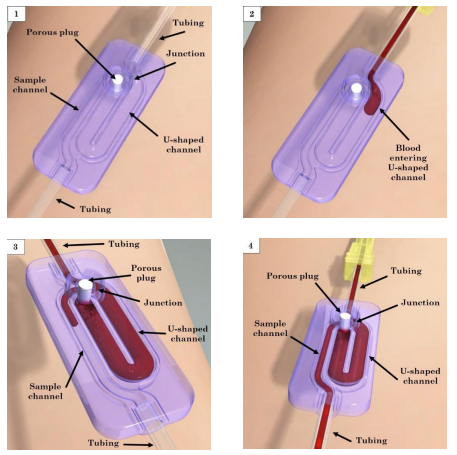
    J.A. 28834 (stills from video); Resp. Br. at 12–13.

    When a medical practitioner inserts a needle into a pa-tient's vein, the difference between the patient's blood pressure and the atmospheric pressure causes blood to enter the Kurin Lock. See J.A. 25575. This pressure difference causes blood to flow into the Kurin Lock through the inlet tubing (the tubing labeled at the top of each image). J.A. 25575. As blood enters, it encounters a junction with two separate channels: (1) a sample channel and (2) a U-shaped side channel. See J.A. 25641. The sample channel leads to the outlet tubing (the tubing labeled at the bottom of each image), which is at that point sealed. J.A. 25641. The U-shaped side channel terminates at a cap, which contains several structures, including: (1) a porous plug made of absorbent material, and (2) a piece of plastic called an umbrella valve (not depicted in the above images). See J.A. 25807. The porous plug, as the name suggests, contains small holes that permit air to flow into the surrounding atmosphere when the porous plug is dry. See J.A. 25517.

    Initially, the air in the U-shaped side channel can freely pass through the dry porous plug, so the resistance to flow in the U-shaped side channel is less than the resistance to flow in the sealed sample channel. J.A. 24120. Thus, as blood initially enters the inlet tubing, it flows into the U-shaped side channel rather than the sample channel. J.A. 25517; image 2. As blood proceeds through the U-shaped channel, it displaces the air in that channel, which escapes through the porous plug. See J.A. 25517.

    Blood continues to fill the U-shaped side channel until it contacts the porous plug, causing the material in the porous plug to expand, sealing the pores. J.A. 25516–17; see image 3. That expansion is the key feature of the Kurin Lock's functionality. When the pores seal, air cannot reenter the U-shaped side channel and displace the blood back into the junction or inlet tubing, thus causing the blood most likely to contain contaminating skin microbes to remain in the U-shaped channel. See J.A. 25641–42. A clinician then unseals the outlet tubing connected to the sample channel, causing the sample channel to fall to atmospheric pressure. See J.A. 25642. As a result, new blood flows solely through the lower pressure sample channel and into a collection bottle. See J.A. 25642; image 4. The upshot is that the sample of blood collected is less likely to yield a false positive microbial test result. J.A. 25642.

    Crucial to this appeal is the dual functionality of the porous plug. Prior to contact with the patient's blood, the porous plug acts as a “vent.” Once its polymeric material expands and its pores shut, it becomes a “seal.” In other words, there is only one structure in the Kurin Lock corresponding to two limitations in the asserted claims of the ′483 patent—the “vent” and “seal” limitations. J.A. 25574.

    Magnolia filed suit against Kurin, asserting infringement of claims 1 and 24 of the ′483 patent and claims 1, 21, and 48 of the ′001 patent. J.A. 180–81 (original complaint), 331–32 (amended complaint). At claim construction, the parties disputed, inter alia, whether the term “diverter,” as used in the claims of the ′001 patent, should be construed as a means-plus-function term, invoking 35 U.S.C. §112(f). See J.A. 1358–59. The district court concluded that it should be construed as such and thus limited the recited “diverter” to cover only the corresponding structures disclosed in the specification. Markman Decision at *3–5. Because the Kurin Lock undisputedly does not meet the “diverter” limitation under the means-plus-function construction adopted by the district court, the parties stipulated to non-infringement as to the ′001 patent. See J.A. 25–26. The parties did not seek construction of the “vent” and “seal” limitations of the ′483 patent.

    The case then proceeded to trial solely on the ′483 patent. At the conclusion of the four-day trial, the jury found that the Kurin Lock infringed the asserted claims of the ′483 patent. J.A. 27–29. Kurin moved for JMOL, arguing, in relevant part, that the Kurin Lock did not infringe the claims of the ′483 patent because it did not contain two separate structures corresponding to the “vent” and “seal” limitations in claim 1. See J.A. 24185–91. The district court granted the motion. JMOL Decision at *7.

    Magnolia timely appealed. We have jurisdiction under 28 U.S.C. §1295(a)(1).

    Discussion

    We review rulings on motions for JMOL under the law of the regional circuit. Arctic Cat Inc. v. Bombardier Recreational Prods. Inc., 876 F.3d 1350, 1358 (Fed. Cir. 2017). In the Third Circuit, JMOL is appropriate only where, “viewing the evidence in the light most favorable to the non-movant and giving it the advantage of every fair and reasonable inference, there is insufficient evidence from which a jury could reasonably find liability.” Gagliardo v. Connaught Lab'ys, Inc., 311 F.3d 565, 568 (3d Cir. 2002). Federal Circuit law applies to issues of substantive patent law, such as claim construction. See, e.g., Wash World Inc. v. Belanger Inc., 131 F.4th 1360, 1368 (Fed. Cir. 2025).

    When the district court relies only on intrinsic evidence to construe a claim term, including whether claim language invokes 35 U.S.C. §112(f), we review that construction de novo. Teva Pharms. USA, Inc. v. Sandoz, Inc., 574 U.S. 318, 331 (2015); Williamson v. Citrix Online, LLC, 792 F.3d 1339, 1346 (Fed. Cir. 2015) (en banc). To the extent that the district court, in construing the claims, makes underlying findings of fact based on extrinsic evidence, we review such findings of fact for clear error. Teva Phrams., 574 U.S. at 326–27; Williamson, 792 F.3d at 1346. Clear error exists when “we are left with a definite and firm conviction that a mistake has been committed.” Advanced Ground Info. Sys., Inc. v. Life360, Inc., 830 F.3d 1341, 1347 (Fed. Cir. 2016).

    Magnolia makes three main arguments challenging the district court's grant of JMOL of no infringement of the ′483 patent. First, Magnolia contends that the district adopted an untimely claim construction by concluding that the “vent” and “seal” limitations of the ′483 patent must be met by separate structures. Open. Br. 33–38. Second, Magnolia argues that even if the district court's separate-structure construction was not untimely, the construction was incorrect. Open. Br. 38–44. Third, Magnolia asserts that JMOL was improper even when relying on the district court's separate-structure construction because the jury had sufficient evidence to support its finding of infringement under that construction. Open. Br. 44–46.

    Separately, Magnolia argues that the district court erred in construing “diverter” as used in the ′001 patent as a means-plus-function term. Open. Br. 48–57. We address each argument in turn.

    I. The ′483 Patent
    A

    We start with Magnolia's untimeliness argument. As noted, the parties did not ask the district court to construe the “vent” and “seal” limitations of the ′483 patent. Accordingly, the jury was instructed that the terms should be given their plain and ordinary meanings as understood by a person of ordinary skill in the art. J.A. 44. In its decision granting Kurin's JMOL motion, the district court, relying on this court's decision in Becton, Dickinson & Co. v. Tyco Healthcare Group, LP, 616 F.3d 1249 (Fed. Cir. 2010), concluded that because the “vent” and “seal” limitations are listed separately in claim 1, the patented invention requires two separate corresponding structures for those limitations. JMOL Decision at *6 (citing Becton, 616 F.3d at 1254 (“Where a claim lists elements separately, ‘the clear implication of the claim language’ is that those elements are ‘distinct component[s]’ of the patented invention.”)). And because the evidence presented at trial was undisputed that the “vent” and “seal” limitations were met by the same structure in the Kurin Lock, the porous plug, the district court concluded that Kurin could not infringe the claims of the ′483 patent as a matter of law. Id.; see J.A. 25573–74 (Magnolia expert: “[The] porous plug … is initially a vent” that “first allows air,” and “then it seals and then it's a shut seal.”), 25841 (Kurin expert: “[B]efore the porous plug has been wetted, the porous plug is a vent. Once it's been wetted, that causes the plug to swell and it becomes a seal.”).

    Magnolia asserts that it was too late in its JMOL decision for the district court to “announce[] … for the first time” that the “vent” and “seal” limitations should be construed as requiring two separate corresponding structures under Becton. Open. Br. 34. According to Magnolia, adopting such a construction was prejudicial because it “never had an opportunity to argue infringement under this new, fundamentally different construction to the jury.” Open. Br. 47. In Magnolia's view, the issue should have been limited to whether sufficient evidence supported the jury's finding of infringement under the plain and ordinary meaning of “vent” and “seal,” which includes devices with either separate or the same structures corresponding to those limitations. See Open. Br. 26–30; Oral Arg. at 8:33–43 (Court: “Your view is that because there was no specific claim construction, the jury was free to find that the vent and seal could be in the same structure?” Magnolia counsel: “Correct.”). [2] And because the evidence showed that the porous plug meets the same structure construction, Magnolia contends that the jury's finding of infringement should not have been disturbed. Open. Br. 27–33.

    We disagree. Indeed, Magnolia is correct that where parties agree that the plain and ordinary meaning of a claim term applies, it is improper for the district court to adopt a materially different claim construction at JMOL. See Hewlett-Packard Co. v. Mustek Sys., Inc., 340 F.3d 1314, 1321 (Fed. Cir. 2003) (“[I]t is too late at the JMOL stage to … adopt a new and more detailed interpretation of the claim language and test the jury verdict by that new and more detailed interpretation.”). But, it is permissible for a district court to “elaborat[e]” on its construction post-verdict when it “only clarifie[s] what was inherent in the construction.” Cordis Corp. v. Bos. Sci. Corp., 658 F.3d 1347, 1356 (Fed. Cir. 2011). We conclude that the district court engaged in such permissible clarification here. We explain.

    In Becton, the claim listed two limitations separately, but the accused product contained the corresponding elements within a single structure. Becton, 616 F.3d at 1254–56. Specifically, the claim recited: “A shieldable needle assembly comprising … a hinged arm … and spring means.” Id. at 1254 (emphasis omitted). And there, like here, the jury was not instructed that the separately listed claim limitations meant that the claim required two separate corresponding structures. See id. at 1252. The district court denied the accused infringer's post-trial motion for JMOL that the jury did not have sufficient evidence to support its finding of infringement. Id. at 1253. We reversed, explaining that where a claim lists limitations separately, “the clear implication of the claim language is that those elements are distinct components in the patented invention.” Id. at 1254 (cleaned up). We also looked to the specification, explaining that it “comport[ed] with the plain language” of the claims that the two limitations implied two separate corresponding structures in the patented invention. Id. at 1255. (emphasis added). Because the accused product did not have separate structures corresponding to the two claim limitations, it could not infringe as a matter of law. Id. at 1257.

    Becton thus stands for the proposition that when claim limitations are separately listed within a claim, that implies that the claim's plain and ordinary meaning requires separate corresponding structures. Id. at 1254. In Regen-eron Pharmaceuticals, Inc. v. Mylan Pharmaceuticals Inc., we confirmed that Becton merely expounded upon the plain and ordinary meaning of a claim with separately listed limitations. See 130 F.4th 1372, 1378–79 (Fed. Cir. 2025) (determining that the “plain language” of a claim with four separately listed components established the “clear implication” that the components are distinct in the patented invention under Becton”).

    The district court here thus did not impermissibly “announce … for the first time” that the “vent” and “seal” limitations should be construed as requiring two separate corresponding structures in granting Kurin's JMOL of no infringement. See Open. Br. 34. Rather, by adhering to the plain and ordinary meaning of claim 1, the construction agreed upon by the parties, the district court, as we detail below, “only clarified what was inherent in the construction” under Becton. Cordis, 658 F.3d at 1356. Magnolia's claims of prejudice are therefore unwarranted—it was always incumbent upon Magnolia to provide a theory of infringement in accord with the plain and ordinary meaning of claim 1.

    B

    We now turn to whether the district court correctly determined the “vent” and “seal” limitations of claim 1 to require separate corresponding structures under Becton. We conclude that it did. Claim 1 of the ′483 patent reads as follows:

    A blood sequestration device, comprising:

    a housing having an inlet port configured to be fluidically coupled to a patient and an outlet port configured to be fluidically coupled to a sample reservoir;

    a fluid reservoir disposed in the housing and at least partially defined by a seal member, the fluid reservoir configured to receive an initial volume of blood withdrawn from the patient; and

    a vent disposed in the housing and configured to allow air to exit the housing as blood enters the fluid reservoir,

    the blood sequestration device configured to allow the initial volume of blood to flow from the inlet port to the fluid reservoir,

    the blood sequestration device further configured to allow a subsequent volume of blood to flow from the inlet port toward the outlet port via a sampling flow path, thereby bypassing the fluid reservoir and the initial volume of blood sequestered therein.

    ′483 patent col. 20, ll. 48–65 (emphases added).

    The text and structure of claim 1 demonstrate the separateness of the “vent” and “seal” limitations. First, when a claim is written in the “comprising … a” format, the article “a” means “one or more than one.” Elkay Mfg. Co. v. Ebco Mfg. Co., 192 F.3d 973, 977 (Fed. Cir. 1999). Here, claim 1 uses the transitional phrase “comprising,” and both the “vent” and “seal” limitations are preceded by the word “a,” see ′483 patent col. 20, ll. 52–57, meaning that one or more of each structure is required in the patented invention. Elkay 192 F.3d at 977; see also Becton, 616 F.3d at 1254 (separate-structure implication applied even though second structure not preceded by “a”). Second, just as in Becton, the two limitations are connected by the word, “and,” suggesting that the “vent” structure is in addition to, i.e., separate, from the “seal” structure. ′483 patent col. 20, ll. 52–58. Nothing in the text of claim 1 is to the contrary. Becton, 616 F.3d at 1255 (“There is nothing in the asserted claims to suggest that the [two separately listed limitations] can be the same structure.”). The Becton implication therefore applies.

    The specification is consistent with the separate-structure construction. The two limitations are described together only once, and as separate structures. Specifically, the specification provides that a “first plunger 255” forms a “substantially fluid tight seal with the inner surface of the walls,” while the “vents 214 … can allow the air to exit the portion of the inner volume” of the housing. ′483 patent col. 13, ll. 22–29; cf. Powell v. Home Depot U.S.A., Inc., 663 F.3d 1221, 1231–32 (Fed. Cir. 2011) (specification's disclosure that one structure “may also function” as another structure “cut[] against” argument that two limitations should be construed to require two separate structures). The district court therefore correctly concluded that the plain and ordinary meaning of claim 1 requires separate corresponding structures for the “vent” and “seal” limitations under Becton. JMOL Decision at *6–7.

    Magnolia's primary argument against the application of Becton is based on the doctrine of claim differentiation. Under that doctrine, “it is presumed that different words used in different claims result in a difference in meaning and scope for each of the claims.” Clearstream Wastewater Sys., Inc. v. Hydro-Action, Inc., 206 F.3d 1440, 1446 (Fed. Cir. 2000). Magnolia points to dependent claim 6, which recites: “[t]he blood sequestration device of claim 1, wherein the seal members [are] configured to prevent the flow of air through the vent into the fluid reservoir.” ′483 patent col. 21, ll. 8–10 (emphases added). According to Magnolia, claim 1 “cannot require the vent and seal to be separate components” or else claim 6's separate “vent” and “seal” limitations would lack “any meaning” beyond what is recited in claim 1. Open. Br. 42.

    We are not convinced. Although the “vent” and “seal” are explicitly recited as separate structures in claim 6, that does not mean that claim 1 must be broader in that respect and therefore include the situation in which “vent” and “seal” are not separate. A dependent claim may focus on one limitation of a broader claim that has multiple claim limitations and not be forced to be broader than the claim from which it depends from in all respects.

    Moreover, claim 6 does not cover every configuration in which the “vent” and “seal” are separate structures. Rather, it merely specifies one way in which the two limitations interact with one another, requiring the “seal” to prevent air flow through the “vent.” See ′483 patent col. 21, ll. 8–10. Therefore, claim 6's recitation of separate “vent” and “seal” structures does not require claim 1 to permit the limitations to be met by the same structure for claim 6 to have independent meaning.

    C

    Magnolia's last argument in challenging the district court's grant of JMOL is that the jury had sufficient evidence to find infringement even under the separate-structure construction of the “vent” and “seal” limitations. Open. Br. 44–46. Magnolia contends that a different part of the Kurin Lock, the umbrella-valve, operates as a “seal” while the porous plug satisfies the “vent” requirement. Open. Br. 44–46. But Magnolia did not present this theory of infringement to the jury. We accordingly will not consider the argument. Sage Prods., Inc. v. Devon Indus., Inc., 126 F.3d 1420, 1426 (Fed. Cir. 1997) (declining to consider new infringement argument that was not first presented to the trial court).

    II. The ′001 Patent

    We last address Magnolia's argument that the district court erred in construing “diverter” as used in the ′001 patent to be a means-plus-function term.

    Claim 1 of the ′001 patent reads as follows:

    An apparatus for obtaining a bodily fluid sample from a patient with reduced contamination, the apparatus comprising:

    a reservoir configured to receive an initial volume of bodily fluid withdrawn from the patient; and

    a diverter having an inlet, a first outlet in fluid communication with the reservoir, and a second outlet, the inlet configured to be fluidically coupled to the patient, the di-verter operable in a first operating mode in which an initial volume of bodily fluid can flow from the inlet to the first outlet, and a second operating mode in which: a) a subsequent volume of bodily fluid can flow from the inlet to the second outlet, and b) the initial volume of bodily fluid is prevented from flowing to the second outlet,

    the diverter configured to transition from the first operating mode to the second operating mode as a result of the initial volume of bodily fluid flowing from the patient and substantial pressure equalization, thereby sequestering in the reservoir contaminants present in the initial volume of bodily fluid, thereby reducing contamination of the subsequent volume of bodily fluid withdrawn from the patient.

    ′001 patent col. 11 ll. 10–32 (emphases added).

    At claim construction, Magnolia argued that claim 1 recited sufficient structure to perform the function of the recited “diverter.” J.A. 1359–63, 1368–77. Kurin disagreed, asserting that an additional structural mechanism was also required to perform the function of the “diverter.” J.A. 1363–68. The district court agreed with Kurin, concluding that a person of ordinary skill in the art would not understand claim 1 to recite sufficient structure for performing the function of the recited “diverter,” and therefore it should be construed as a means-plus-function claim limited to the corresponding structures in the specification. Markman Decision at *3–5. Magnolia did not, nor does it here, argue that the specification disclosed corresponding structures that were in the Kurin Lock. Based on that construction, the parties stipulated that the Kurin Lock does not infringe the asserted claims of the ′001 patent. J.A. 25–26.

    We conclude that the district court did not err in determining “diverter,” as used in the ′001 patent, to be a means-plus-function term.

    Means-plus-function claiming occurs when a claim term is drafted in a manner that invokes 35 U.S.C. §112(f), which states:

    An element in a claim for a combination may be expressed as a means or step for performing a specified function without the recital of structure, material, or acts in support thereof, and such claim shall be construed to cover the corresponding structure, material, or acts described in the specification and equivalents thereof.

    (emphasis added).

    Under our en banc decision in Williamson, the first inquiry in determining whether a claim term invokes §112(f) is whether the claim limitation uses the word “means.” 792 F.3d at 1348. “If so, there is a rebuttable presumption that §112[(f)] applies; if not, there is a rebuttable presumption that the provision does not apply.” Diebold Nixdorf, Inc. v. Int'l Trade Comm'n, 899 F.3d 1291, 1298 (Fed. Cir. 2018) (citing Williamson, 792 F.3d at 1348–49). Where, as here, the claim limitation does not use the word “means,” the presumption that §112(f) does not apply will be overcome “if the challenger demonstrates that the claim term fails to recite sufficiently definite structure or else recites function without reciting sufficient structure for performing that function.” Williamson, 792 F.3d at 1349 (cleaned up). The “essential inquiry is not merely the presence or absence of the word ‘means’ but whether the words of the claim are understood by persons of ordinary skill in the art to have a sufficiently definite meaning as the name for structure.” Id. at 1348.

    Magnolia and Kurin agree that the functionality of the recited “diverter” is to “direct[] bodily fluid down one of two paths.” Open. Br. 48 (A diverter “diverts or directs bodily fluid down one of two paths.”); Resp. Br. 63 (adopting Mag-nolia's stated functionality of the “diverter”). For the presumption that §112(f) does not apply to be overcome, Kurin must show that claim 1 does not recite sufficient structure to perform that function. Kurin has done so.

    It is true that claim 1 recites some structural elements of the “diverter.” It first recites an “inlet configured to be fluidically coupled to [a] patient,” i.e., an inlet that receives bodily fluid from the patient. ′001 patent col. 11, ll. 16–17. It also recites two “outlet[s],” both of which are connected to the “inlet.” The first “outlet” receives “an initial volume of bodily fluid from the inlet,” id. at col. 11, 19–20, and the second “outlet” receives “a subsequent volume of bodily fluid from the inlet.” Id. at col. 11, ll. 21–22.

    As is evident, however, neither the “inlet” nor the two “outlet[s]” are structures that direct the bodily fluid down one of two paths. Rather, the structures operate passively, by receiving and facilitating the flow of bodily fluid through a defined path. See id. at col. 11, ll. 19–22. That reading of claim 1 is bolstered by the specification, which only depicts “diverter[s]” capable of directing the bodily fluid down one of two paths with additional structures to the recited “inlet” and two “outlet[s].” See id. col. 2, ll. 43–54 (describing Figures 6 and 7, which depict diverters with structural mechanisms in addition to an “inlet” and “two outlet[s]”). Accordingly, without additional structure, claim 1 is alone insufficient to perform its directing function, rebutting the presumption that claim 1's lack of the word “means” does not invoke §112(f).

    Magnolia does not meaningfully dispute the above. Rather, Magnolia contends that the “inlet” and “outlet[s],” when taken collectively, are sufficient to perform the functionality of the “diverter” limitation, without the need for additional structure, and therefore the presumption that §112(f) does not apply has not been rebutted. See Open. Br. 49–50. In support, Magnolia primarily relies on the report prepared by its expert, Dr. Juan Santiago, in which he opined that a person of ordinary skill would understand the “inlet” and “outlet[s]” recited in claim 1, taken together, to be sufficient structure to perform the function of the recited “diverter.” See J.A. 1454–59. The highlight of that report is Dr. Santiago's statement that a person of ordinary skill would understand a “diverter” that directs flow down one of two paths to include “at least one inlet and two outlets branches.” J.A. 1454. But that statement undermines, rather than supports, Magnolia's argument that the presumption against §112(f) has not been overcome.

    It does so because all “diverter[s]” in this context include “at least” one “inlet” and two “outlet[s]”; the issue is whether an additional structure is needed to direct fluid down one of two paths. See J.A. 1454. Dr. Santiago's statement is therefore an admission that the term “diverter” would not be understood by a person of ordinary skill to have a “sufficiently definite” structural meaning, see Williamson, 792 F.3d at 1348, but rather as a generic term that captures any structure that performs that function. See Diebold, 899 F.3d at 1300–01 (concluding that expert testimony that a person of ordinary skill would understand a claim term “to be any structure capable of performing the claimed function” was insufficient to establish that the claim term has sufficiently definite meaning). Accordingly, the district court did not err in construing “diverter” as used in claim 1 to be a means-plus-function term, invoking §112(f).

    Conclusion/

    We have considered Magnolia's remaining arguments but find them unpersuasive. For the reasons provided, we affirm the decision of the district court.

    AFFIRMED

    Footnotes

    1

    Honorable Beth Labson Freeman, District Judge, United States District Court for the Northern District of California, sitting by designation.

    2

    Oral Argument available at https://www.cafc.uscourts.gov/oral-arguments/24-2001_01 072026.mp3.

    © 2026 CCH Incorporated and its affiliates and licensors. All rights reserved.

    • Manage Cookie Preferences
    • Privacy Statement
    • Terms of Use