

Patent Cases, Signify North America Corporation, et al., Plaintiffs v. Lepro Innovation Inc., et al., Defendants, U.S. District Court, D. Nevada, (Aug. 7, 2026)
Signify North America Corporation, et al., Plaintiffs v. Lepro Innovation Inc., et al., Defendants
U.S. District Court, D. Nevada. Case No.: 2:22-cv-02095-JAD-EJY, [ECF Nos. 290, 291, 295, 296]. August 7, 2026.
Jennifer A. Dorsey, District Judge
Jennifer A. Dorsey, District Judge
Order Denying Signify's Motion for Attorneys' Fees, Denying Lepro's Motion for Judgment as a Matter of Law, Granting in Part Signify's Motion to Amend Judgment, and Granting in Part Signify's Bill of Costs
Jennifer A. Dorsey, District Judge
In February 2026, plaintiffs Signify North America Corporation and Signify Holding B.V. (collectively, “Signify”) and defendants Lepro Innovation Inc., LE Innovation Inc., Innovation Rules Inc., Home Ever Inc., and Letianlighting Inc (collectively, “Lepro”) went to trial on Signify's claims that Lepro infringed six of Signify's patents covering various light-emitting diode (LED) technologies. The jury sided with Signify on all counts and awarded it $410,544.00 for infringement damages that Signify incurred through September 2025.
Lepro moves for judgment as a matter of law, contending that substantial evidence doesn't support the jury's findings that Lepro infringed the ′604, ′320, and ′336 patents, that the ′604 patent wasn't invalid based on anticipation or obviousness, and that the damages figure that Signify's expert supplied was calculated incorrectly. I deny that motion in its entirety because there was sufficient evidence presented at trial to support each of the jury's conclusions.
For its part, Signify moves to amend the judgment to add supplemental damages, enhanced damages, pre- and post-judgment interest, and ongoing royalties. It also asks that Lepro be ordered to submit to a forensic accounting of its sales to supply the supplementaldamages totals, citing Lepro's failure to provide evidence of some sales data until the middle of trial. I grant that motion in part. Signify is entitled to supplemental damages—to include damages related to sales data that wasn't included in discovery but should have been, as well as damages incurred after September 2025 through the date of judgment—but a forensic accounting isn't warranted. Counsel must meet and confer to determine the proper damages total, and Signify must file a renewed motion to amend judgment to be awarded those damages. Signify hasn't shown that treble damages are warranted in this case either, so I deny that request. I also deny Signify's requests for pre- and post-judgment interest and ongoing royalties, though I permit Signify to refile a motion related to those requests in light of the findings in this order.
Signify further moves for more than $4 million in attorney's fees under 35 U.S.C. §285. Because this case does not present exceptional circumstances as required for such an award under that statute, I deny Signify's request. And Signify seeks costs of $231,689.24. Most of those costs are permitted by this court's local rules and Ninth Circuit precedent, but Signify's request for $41,373.35 for “trial graphics” is not. So I excise those costs and tax Signify's costs at $190,315.81.
Discussion [1]
A. Lepro is not entitled to judgment as a matter of law.
Federal Rule of Civil Procedure 50 permits a defendant to bring a motion for judgment as a matter of law if the plaintiff “has been fully heard on an issue during a jury trial” and the defendant believes that “a reasonable jury would not have a legally sufficient evidentiary basis to find for the [plaintiff] on that issue.” [2] If the court does not grant the motion prior to a jury verdict, the movant may file a renewed motion for judgment as a matter of law within 28 days after entry of judgment. [3] Lepro moved for judgment as a matter of law at the close of Signify's case and again at the close of its case. [4] I denied those motions, finding that there was sufficient evidence for a reasonable jury to find against Lepro based on the extensive testimony of Signify's witnesses. [5]
“A renewed motion for judgment as a matter of law is properly granted only if the evidence, construed in the light most favorable to the nonmoving party, permits only one reasonable conclusion, and that conclusion is contrary to the jury's verdict.” [6] The trial court must uphold the jury's verdict “if it is supported by substantial evidence, which is evidence adequate to support the jury's conclusion, even if it is possible to draw a contrary conclusion.” [7] The court may not re-weigh the evidence the jury considered; it must “simply ask whether the plaintiff has presented sufficient evidence to support the jury's conclusion.” [8]
1. Substantial evidence supports the jury's infringement findings.
a. The ′604 patent
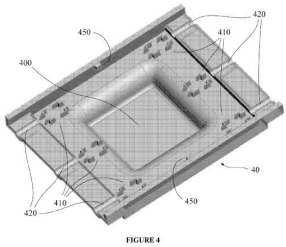
As relevant to this motion, claim 1 of the ′604 patent includes “a housing element including fastening means for detachably coupling the housing element to the heat dissipation element[.]” [9] The jury was instructed that “fastening means” is a means-plus-function term that “covers only the corresponding structure described in the patent specification and drawings that perform this recited function, which I have determined is ′the tabs 450 shown in Figure 4 and described at 7:42–51; or an equivalent of this corresponding structure.” [10] The description at 7:42–51 in the ′604 patent states:
In one embodiment, the housing may be made of a material which has a degree of flexibility such that under a controlled applied mechanical force, the housing assumes a strained shape and its fastening means can assume a position which enables the housing to be slid over the heat dissipation element. Upon removal of the force the housing element can assume its unstrained shape, thereby causing the fastening elements to clutch the heat dissipation element and secure a releasable connection between the housing element and the heat dissipation element. [11]
Figure 4 in the 604 patent looks like this:
At trial, Signify's expert witness Michael Krames testified that the screws used to hold together Lepro's products are substantially the same as the tabs referenced in the ′604 patent:
… [A]s the screws come down as you assemble the module, they will mate with the heat sink element. And as the thread of the screws go through, that will pull a normal force and compress those components together. It's the same as if the tabs are going down in the module on the right and grabbing the heat sink and bringing it forward. [12]
Krames also testified that Signify's tabs and Lepro's screws “achieve substantially the same result,” opining that, with both, “[y]ou end up with a detachable modular assembly just like the patent described, a lighting product that you can modularize, adapt to high-volume manufacturing, and detach or attach over and over again depending on what you're building.” [13]
On cross-examination, Krames admitted that the tabs described in the patent “generate force by flexing,” while the screws in Lepro's product “generate force by threads in rotation.” [14] He acknowledged that, though tabs and screws “have a different mechanical action to actuate,” they “achieve, again, the same function, same result.” [15] Lepro's expert John Curran acknowledged on cross-examination that screws and tabs both “are a fastening means that can detachably couple the housing element to the heat dissipation element.” [16]
Lepro contends that Krames's testimony acknowledging that screws and tabs “have a different mechanical action to actuate” is fatal to Signify's infringement claim for claim 1 of the ′604 patent. [17] “A structure in [an] accused device constitutes an equivalent to the corresponding structure in the patent only if the accused structure performs the identical function ‘in substantially the same way, with substantially the same result.’” [18] Signify responds that Kramer's testimony was sufficient for the jury to conclude that screws and tabs perform the assigned function in substantially the same way: they both “exert compressive forces to attach and detach the module.” [19]
I find Kramer's testimony sufficient for a jury to conclude that Lepro's screws are substantially equivalent to the patent's tabs. He testified that both methods function the same way (compressive force) to achieve the same result (detachably coupling and uncoupling the housing element). Kramer's testimony supports the finding that screws and tabs both create “controlled applied mechanical force” on the housing element, which makes the housing “assume[] a strained shape” when force is applied and releases that strained shape when the force is removed, as described in 7:42–51 of the ′604 patent. [20] The Federal Circuit has found that similarly distinguishable fastening means are substantially equivalent, [21] and I find no reason to overturn the jury's verdict concluding the same.
b. The ′320 patent
Claim 1 of the ′320 patent describes the patented lighting device as having “a heat sink comprising a metal with an electrical resistivity being less than 0.01 Um. and configured for removing heat produced by the light source, the heat sink forming at least a portion of the outer enclosure.” [22] During the claim-construction phase of litigation, Lepro maintained the position that its accused products don't infringe because they do not contain a metal heat sink exposed to the outside and thus do not meet the specification that the heat sink forms “at least a portion of the outer enclosure.” [23] I rejected that interpretation and construed the phrase according to its plain and ordinary meaning. [24] And in response to Signify's motion in limine to preclude Lepro's expert from testifying that the specification required that the heat sink is exposed to outside air, Lepro averred that it would not elicit that testimony and would focus instead on “why the qualities of the accused product's metal lining is not an infringing heat sink for reasons that relate to, but do not necessarily require, exposure to outside air.” [25]
Lepro's at-issue products have internal metallic liners within a plastic cover. At trial, Signify's expert David Ricketts showed the jury a cut-open Lepro bulb and explained that the interior metal lining, which is attached to the outer plastic lining, functions as a heat sink. [26] He described the plastic outer layer of the housing as a “cosmetic cover” and testified that the plastic covering did not prevent heat from escaping the bulb. [27] Based on the fact that the plastic got hot to the touch when the lightbulb was on, Ricketts opined that the plastic was not an insulator that prevented the internal metal layer from being considered a heat sink. [28]
Lepro contends that it “presented unrebutted testimony [at trial] that the metal liner in the accused bulbs is covered entirely by plastic and thus metal, heat sink or otherwise, does not form any portion of the outer enclosure.” [29] It contends that Rickett's concession that the metal portion of Lepro's bulbs that functions as a heat sink is “inside” the product “defeats the requirement that the metal itself form part of the ‘outer enclosure.’” [30] Lepro also takes issue with Ricketts's “hot to the touch” testimony, averring that his testimony does not constitute substantial evidence because he did not conduct any “quantitative heat-transfer testing to show that the metal he points to actually forms the outer enclosure (as opposed to being within the enclosure beneath a plastic shell).” [31]
Lepro's argument again presses the argument I rejected at claim construction: that the metal comprising the heat sink on the accused products must be exposed to the outside. But the plain and ordinary meaning of the claim does not require that the metal be exposed to air, it need only “compris[e] at least a portion of the outer enclosure.” An outer enclosure can have layers, and Ricketts testified that the plastic covering did not prevent the entire enclosure from functioning as a heat sink. The patent specification does not require that an infringing heat sink be comprised only of metal, nor does it require that the metal portion of the heat sink must necessarily be exposed to outside air. Ricketts's testimony opining that Lepro's outer enclosure, which was comprised of a metal liner wrapped in a plastic liner, qualified as a heat sink is sufficient for the jury to conclude that it meets the ′320 patent's specification that the heat sink comprises “at least a portion of the outer enclosure.” So I deny Lepro's motion for judgment on infringement of the ′320 patent.
c. The ′336 patent
Signify's ′336 patent was referred to during trial as the “tunable white” patent. [32] The invention allows a user to “control the shade[,] hue[], or … color temperature of a white light.” [33] Claim 132 of the patent specifies that the patented design has at least two white LEDs configured to “generate electromagnetic radiation of at least two different spectrums,” that a mounting holding allows “said spectrums … to mix and form a resulting spectrum,” and that “visible portion of the resulting spectrum has intensity greater than the background noise at its lowest spectral valley.” [34] I construed the term “background noise” to mean “electromagnetic radiation produced independent of the lighting fixture.” [35] Signify's expert Paul Pattison testified that he conducted spectral measurements of Lepro's accused products and concluded that they infringed the background-noise claim element. [36] He explained that he conducted the test in his basement, where “background noise” was zero because there was little light in that room. Pattison said that he “always measure[s] [light sources] in a dark room” partially because “that's … where people use lights.” [37] He also did a test “in a room with some daylight coming in” and concluded again that the Lepro bulb's “spectral valley was greater than the background noise.” [38]
Lepro contends that Pattison's testimony does not provide substantial evidence to support the jury's infringement finding for the ′336 patent. By testing in a dark room, Lepro theorizes, Pattison “artificially drove background noise to zero, ensuring [that] the claim limitation was always satisfied, regardless of the bulb's actual spectral performance in realistic conditions.” [39] And because Pattison admitted on cross-examination that his testing was “subject to significant variability,” Lepro insists that his testing testimony “was materially flawed and lacked scientific certainty.” [40]
Pattison's testimony constitutes substantial evidence to support the jury's conclusion that Lepro's products infringe the ′336 patent. Lepro's dissatisfaction with Pattison's testing goes to the weight to be given his testimony, not whether it can be relied upon to support a jury verdict. And its primary contention—that Pattison only did one test in a dark room that virtually ensured that the bulb's spectral valley would be greater than a background noise of zero—misstates the testimony. Pattison also performed a test in a room with sunlight, and in that test Lepro's bulbs still produced a spectral valley greater than the background noise. Lepro's insistence that the testing Pattison performed could produce different results under different circumstances does not invalidate the findings that Pattison presented for the tests he did perform. So I conclude that substantial evidence supports the jury's infringement finding for the ′336 patent.
Lepro separately contends that “a new trial is warranted on infringement for the ′336 patent because the [c]ourt incorrectly prohibited Lepro's counsel from conducting full cross-examination using the exact same nanoLambda spectrophotometer sensor that Dr. Pattison used for his own testing.” [41] Some context: before trial, I granted Signify's motion to preclude Lepro's expert John Curran from “demonstrat[ing] at trial testing that he did not perform for his rebuttal report.” [42] Because Curran did not perform any tests to refute Pattison's findings before trial, I concluded that it would “be unfair surprise to permit Dr. Curran to perform tests without having done so during discovery.” [43] At trial, Lepro's counsel expressed his intention to use Pattison's spectrometer to conduct testing “live on the fly in the courtroom” during Pattison's cross-examination to show that the tests were unreliable. [44] I precluded him from doing so, finding that counsel was essentially attempting to conduct the same testing that I precluded Curran from demonstrating on the stand. [45]
Lepro has not shown that prohibiting counsel from performing his own testing as part of Pattison's cross-examination was legally improper. During Lepro's cross-examination, counsel elicited testimony demonstrating that the results of Pattison's testing would change depending on the distance of the spectrometer from the bulb, as well as “th[e] specific angle of the detector and … the specific angle of the bulb….” [46] Pattison admitted on cross-examination that “[t]his measurement is highly contextual” and “depends on the room geometry and the geometry of the two sources of light, the ambient lights, and the electric light.” [47] Pattison also admitted that field testing cannot “represent every situation.” [48] Lepro was sufficiently able to achieve the purpose of its on-the-fly testing by getting Pattison to admit that his measurements would change depending on numerous factors. Prohibiting counsel from conducting testing to arrive at the same result was not error and does not warrant a new trial.
2. Substantial evidence supports the jury's validity finding for the ′604 patent.
Lepro next contends that it is entitled to judgment on its invalidity defense on the ′604 patent, arguing that the prior-art Stimac reference renders the patent invalid by anticipation or obviousness. [49] The Stimac patent was issued in 2004 and covers the invention for an “LED based modular lamp.” [50] At trial, Dr. Curran opined that the Stimac reference anticipated Signify's ′604 patent because it also had “a fastening means that performs the function of detachably coupling the housing element to the heat dissipation element.” [51] He also testified that the Stimac reference met the ′604 patent's limitation that the “thermally conductive substrate” described in claim one is “enclosed between the heat dissipation element and … housing element.” [52]
Signify's expert Michael Krames testified that neither of the limitations in claim 1 of the ′604 patent—a detachable fastening means and an enclosed substrate—are present in the Stimac reference. [53] He explained that the “detachable fastening means” Curran identified in the Stimac patent was actually “a retaining ring for the lens element” of that design, which is “secured to the heat sink to hold the lens element as you zoom the lens in and out” and thus is not a detachable element. [54] Krames testified that the Stimac structure “either twists or push[es] but does not detach.” [55] He also opined that the Stimac invention's substrate was not enclosed because the invention's design allowed the lens of the lamp to “push in and out,” and when the invention was “in its out position,” there would be a gap around the substrate that would be exposed to the outside. [56]
The jury concluded that Stimac did not invalidate claim 1 of the ′604 patent. Lepro contends that substantial evidence doesn't support that finding, relying on the figures and drawings in Stimac and Curran's testimony. [57] But Lepro's arguments essentially amount to the complaint that, in the battle of the experts between Curran and Krames, the jury chose Krames's explanation of the Stimac reference over Curran's. It is not this court's role to reweigh the evidence that the jury considered. The question of whether the ′604 patent was invalid in light of the Stimac reference was “fully explored at trial, with explanations and opinions of technical experts, who presented conflicting viewpoints.” [58] Lepro has not shown that Kramer's testimony concluding that the Stimac reference didn't include two of the claim elements in the ′604 patent could not legally be relied upon by the jury to make its conclusions. So I deny Lepro's motion as to the jury's finding that the ′604 patent is not invalid.
3. Signify's damages expert supplied sufficient evidence to support the royalty rates that the jury used to calculate damages.
a. Mr. Schoettelkotte testified extensively about his damages calculations.
Lepro next contends that “[n]o reasonable jury would have a legally sufficient basis to award the damages returned in favor of Signify.” [59] It takes issue with the testimony of Signify's damages expert Todd Schoettelkotte, contending that he didn't properly apportion the value of the patents and that he unreasonably concluded that the licensing fees Signify charged for participants in its EnabLED program were not comparable to what would be charged in a hypothetical negotiation with Lepro. Signify contends that Schoettelkotte's opinions were sufficient to support the verdict.
Schoettelkotte testified that he assessed what would be a reasonable royalty for Lepro's use of the patents at issue in this case. He assigned royalty percentages to each patent based on “the value of the use by Lepro of each patent and what that value was at a hypothetical negotiation.” [60] Schoettelkotte arrived at those value indicators using the “income approach” and the “cost approach.” [61]
Schoettelkotte described the income approach as a method to determine “the profitability of the product … that uses the [patented] technology” and then to apportion “how much of that profit is related specifically to the patent.” [62] He explained that he used an “analytical” income approach when determining the value of the’320 and ′336 patents and relied on the opinions of Signify's technical experts to determine how much of the value of each infringing product was driven by the patented technology. [63] For the ′604, ′399, and ′138 patents, Schoettelkotte used the “technical apportionment” income approach to “determine how much of [Lepro's] profit from a technical perspective is attributable to the patented technology.” [64] He again used the findings of Signify's experts to calculate those values. [65]
Schoettelkotte described the cost approach as a method to compare the cost of an infringing product with the cost of “the next available non-infringing way to create a product.” [66] He used this model to calculate a value indicator for the ′577 patent. Relying on Jonathan Wood's expert opinions, Schoettelkotte determined that it would cost Lepro $1.42 after adjusting for inflation “to move from the accused design to a non-infringing design.” [67] He then converted that to a value indicator of .79% to 1.18%, “which would be the value associated with Lepro's use of the ′577 patent.” [68]
After calculating the value indicator for each patent, Schoettelkotte testified that he then applied the “Georgia-Pacific factors” to determine a reasonable royalty rate that would result from a hypothetical negotiation. [69] He walked through the factors and explained how he evaluated the impact of each relevant one on the parties' negotiation. [70] Schoettelkotte testified that, by applying the value indicators and the Georgia-Pacific factors, he arrived at a reasonable royalty rate for each individual patent, ranging from 1% for the ′577 patent to 6.5% for the ′320 patent. [71]
Schoettelkotte also testified about Signify's EnabLED program, which gives licensees access to Signify's entire patent portfolio—consisting of more than 4,000 patents—for set rates: 3% for single-color luminaires, 4% of tunable-white luminaires, and 5% for color-changing luminaires. [72] He opined that those rates were not comparable ones to utilize when calculating a reasonable royalty rate in this hypothetical negotiation because (1) “EnabLED rates … are not based upon use” and (2) Lepro had demonstrated that it “wasn't interested in” joining the EnabLED program, so it “would have been off the table.” [73] During cross-examination, Schoettelkotte expanded on his consideration of the EnabLED rates, explaining that though some things in that licensing program “could be considered comparable …, there wasn't enough similarity” to conclude that “use of those licenses was a reasonable outcome to a hypothetical” negotiation between Lepro and Signify. [74] He further maintained that his hypothetical-negotiation analysis was based on the positions of the parties after Lepro rejected the EnabLED program by failing to respond to any of Signify's letters offering that as an option to resolve its infringement claims, so the hypothetical negotiation was “divorced from the EnabLED program.” [75]
b. Schoettelkotte's apportionment opinions are sufficient to support the jury's award.
Lepro first contends that Schoettelkotte “failed to properly apportion for technical value and portfolio.” [76] It argues that Schoettelkotte “adopted the assumptions of Signify's technical experts wholesale, performed no independent analysis to determine the incremental value of the alleged inventions, and failed to perform any analysis that apportions across patents Signify admitted covered similarly technology areas, much less as compared to the EnabLED program as a whole, for the purposes of assigning value only to the asserted patents.” [77]
But Schoettelkotte's testimony clearly assessed the value of each patent's technological value separate from the value of all other unpatented features. The fact that he relied on a technical expert's assessment of that value from a technological perspective does not demonstrate any error on his part, and Lepro doesn't sufficiently explain why it would for five of the six patents. Lepro provides a cogent argument only for the testimony related to the ′320 patent, in which Schoettelkotte “assigned between 50% and 100% of the value of the [accused products'] ‘smart functionality’ to the ′320 patent based upon his adoption of Dr. Ricketts's technical say-so, despite the undisputed facts that (1) the patent did not invent smart functionality, and (2) smart functionality depends on numerous components unrelated to the ′320 patent.” [78]
Dr. Ricketts opined that, to determine the technical benefits of the ′320 patent, he performed a comparison of an infringing bulb with smart functionality and a nearly identical bulb, with the only exception being that the comparator bulb did not have smart functionality. [79] He testified that “[t]he majority, if not all, of the technical benefits” between the bulbs “would be attributable to the smart functionality enabled by the ′320 patent.” [80] During cross-examination, Lepro didn't question Ricketts specifically about this comparison. [81] Based on Ricketts's testimony, Schoettelkotte properly apportioned the value of the smart functionality in the infringing bulbs to the technology afforded by the ′320 patent.
Lepro's separate concern that Schoettelkotte failed to apportion the value of the six at-issue patents from the thousands available through the EnabLED program misunderstands either Schoettelkotte's analysis or the Federal Circuit's precedent on this issue. The Federal Circuit's precedent conveys the principle that if a plaintiff relies on a comparable licensing agreement to supply a reasonable royalty rate in litigation, the plaintiff must apportion “the value of the asserted patents relative to the unasserted patents in the portfolio.” [82]
What Lepro appears to contend is that Schoettelkotte should have used the “market approach”—which examines comparable licenses to determine what a willing licensor and licensee would negotiate—to assign value to the patents. [83] But Schoettelkotte expressly considered whether the EnabLED program was comparable for use in this case, concluded that it was not, and relied on alternative methods to calculate a reasonable royalty rate. He was permitted to do so. A “hypothetical negotiation is not constrained by the patentee's own licensing practices,” [84] and there is “more than one reliable method for estimating a reasonable royalty.” [85] So I do not conclude that Schoettelkotte erred as a matter of law when he did not apportion the relative value of the other patents in Signify's patent portfolio.
Lepro relatedly argues that Schoettelkotte “improperly disregarded established royalties”—the rates applied to licensees enrolled in the EnabLED program—and insists that the licenses are sufficiently comparable. [86] An “established royalty rate is used in a case in which prior negotiated royalties to the time of infringement are paid by sufficient persons to indicate the reasonableness of the rate, are uniform, are not paid under threat of litigation, and are for comparable rights under the patent.” [87] The evidence did not establish that Lepro was seeking rights comparable to those available under the EnabLED program. That program grants licensees access to thousands of Signify's patents, while the hypothetical negotiation between Lepro and Signify covered only the six patents at issue at trial. So I cannot conclude as a matter of law that Signify was required to rely on the EnabLED program rates to calculate a reasonable royalty rate. I find that Schoettelkotte's testimony applying the cost and income approaches to determine a reasonable royalty rate constitutes sufficient evidence supporting the jury's damages award.
4. Signify's notice letters support the jury's findings of infringement starting on November 23, 2018, for the ′336 patent and June 1, 2017, for the ′604 patent.
Lepro next argues that the jury's conclusions as to the start date of infringement for the ′336 and ′604 patents cannot stand as a matter of law. [88] It contends that the email Signify sent on November 23, 2018, regarding infringement of the ′336 patent, and the June 1, 2017, letter Signify sent regarding infringement of the ′604 patent were insufficient to put Lepro on notice that the accused products infringed those particular patents. [89] Signify responds that both letters were specific enough “to support an objective understanding that the recipient may be an infringer” [90] and that Signify was thereafter permitted to sweep related products into the scope of their notice.
a. The 2018 email put Lepro on notice of its infringement of the ′336 patent.
The 2018 email informed Lepro that its product “‘LE Lighting Ever’-brand wireless ceiling light with Bluetooth speaker is read on at least” four of Signify's patents, including the ′336 patent. [91] That particular product is not one of the accused products in this litigation. Signify instead accused two of Lepro's other products, both described as “WiFi Smart LED Bulb[s],” as infringing the ′336 patent. [92] Lepro alleges that the 2018 email “did not and could not provide notice for entirely different products, such as the WiFi Smart LED Bulbs.” [93] To serve as actual notice, a letter “must communicate a charge of infringement of specific patents by a specific product or group of products.” [94] But once that “threshold specificity is met, the ensuing discovery of other models and related products may bring those products within the scope of the notice.” [95]
Signify's witness Aaron Rugh testified that the 2018 later was not intended to be “an exhaustive list of all the products” that infringed the ′336 patent, noting that the Bluetooth light was an “exemplary product[]” for other infringing products that “are utilizing the same technology.” [96] And Signify's expert Morgan Pattison testified that he analyzed the Bluetooth light mentioned in the 2018 letter and concluded that it infringed the ′336 patent. [97] He then testified that the analysis and conclusions he made related to the Bluetooth light were “the same” as for the accused products. [98] I find that this evidence was sufficient to support the conclusion that the accused products infringed in the same way as the Bluetooth light listed in the 2018 notice and thus that the accused products were brought within the scope of that notice. So I deny Lepro's motion for judgment as a matter of law on the notice date for the ′336 patent.
b. The 2017 letter put Lepro on notice of infringement of the ′604 patent.
Signify's June 1, 2027, letter to Lepro alleged that several of Lepro's LED-based lights, including its “UFO LED High Bays, RGB Flood Lights, Flood Lights, Motion Sensor Security Lights, LED Work Lights, LED Retrofit Recessed Lights, E12 candle bulbs, A19 dimmable bulbs, PAR20 dimmable bulbs, and A60 RGB dimmable bulbs” infringed Signify's patented technologies “set forth in” 13 patents, including Claim 1 of the ′604 patent. [99] At trial, Signify alleged that several Lepro products infringed the ′604 patent, including products named LED Wall Pack, LED Shoe Box/LED Parking Lot Light, LED Street Lamp/LED Parking Lot Light, UFO LED High Bay Light, and LED Ceiling Light. [100] Lepro contends that the letter “does not convey a specific charge of infringement of the ′604 patent” and “does not identify any features or functionalities of Lepro products allegedly covered by a single claim of any patent.” [101] It points to cases in which district courts found that a letter listing several products and several patents, with no explanation as to what claims were infringed by what products, insufficient to provide actual notice of infringement of a specific patent. [102]
The nonbinding cases that Lepro relies on are easily distinguishable from this case. In Toshiba Corp. v. Imation Corp., for example, the notice letter that the plaintiff sent to the defendant did not list any specific products accused of infringement and attached a list of 1800 patents, 360 of which were deemed “essential” to the technology at issue. [103] The court concluded that the letter could not serve as actual notice of infringement because it failed to identify any specific product or any manageable group of patents that may have been infringed. [104] Signify's 2017 letter does not suffer from those defects. [105] It lists a manageable number of products (10) and identifies specific claims within the 13 patents that those products are alleged to have infringed. A jury could reasonably conclude that the letter sufficiently provided notice that the UFO LED High Bay Lights may infringe a specific claim of the ′604 patent.
Lepro also takes issue with the fact that the letter didn't list some of the accused products that Signify advanced at trial. [106] But as discussed supra with respect to notice for the ′336 patent, once the threshold notice requirement is met, discovery of other related products that infringe in the same way are considered within the scope of the notice. And Lepro's expert witness agreed that each of the accused products should be considered the exact same for purposes of determining infringement. [107] So a reasonable jury could conclude that the 2017 letter provided actual notice to cover the products accused of infringing the ′604 patent.
5. The court will not exclude damages related to Klite sales.
Lepro also contends that the court should exclude damages awarded for Lepro's purchase of LED products from Klite, [108] a Chinese company “in which Signify has a 51% stake.” [109] Lepro contends that, because it purchased patented products from a Signify company, the sale of those products cannot be considered infringing under the doctrine of patent exhaustion. [110] Lepro sprung its patent-exhaustion defense on Signify for the first time on the eve of trial, so I granted Signify's motion to exclude argument and evidence related to that defense. [111] Lepro did not raise this issue in its oral Rule 50 motion, and it appears to drop the argument in its reply. [112] Because Lepro doesn't contend with my finding that it waived its affirmative defense, I deny its motion to exclude from the damages award money that derived from those Klite purchases.
6. Substantial evidence supports the jury's willfulness finding.
Lepro's final argument in support of its motion concerns the jury's finding that it engaged in willful patent infringement. [113] It contends that “[t]he trial record falls woefully short of providing sufficient evidence of the egregious, deliberately wrongful state of mind that is required under the law for willfulness.” [114] “To establish willfulness, the patentee must show [that] the accused infringer had a specific intent to infringe at the time of the challenged conduct.” [115] Willfulness “requires deliberate or intentional infringement;” “[k]nowledge of the asserted patent and evidence of infringement” alone is insufficient to support a willfulness finding. [116]
Though evidence of Lepro's willful infringement is thin, I find that there was just enough evidence from which a jury could conclude that Lepro deliberately infringed Signify's patents. The jury heard evidence establishing that Signify sent several letters to Lepro informing it of the alleged infringement, but Lepro ignored that correspondence. [117] Text messages introduced though the video testimony of Lepro president Ji Wu's wife established that Wu knew about Signify's claims and determined that it wasn't worth it to negotiate with Signify because the patent fee would outweigh the costs of producing its products. [118] The statements of Lepro's representatives could be construed as demonstrating intent to continue selling its products despite an awareness that they infringed Signify's patents. So I deny Lepro's motion for judgment as a matter of law on the jury's willfulness finding.
B. Signify may seek supplemental damages, but this case does not support enhanced damages or ongoing royalties at the rates Signify proposes.
Signify seeks to amend the judgment to add damages not disclosed in discovery, treble damages for willful infringement, ongoing royalties, and pre- and post-judgment interest. [119] It also seeks to have a neutral forensic accounting of Lepro's sales performed to ensure that it has unearthed any additional sources of income derived from Lepro's infringing products. Lepro does not dispute awarding supplemental damages to cover the sales that were testified to at trial but not disclosed in discovery, as well as reasonable pre- and post-judgment interest. But it does oppose Signify's request for treble damages, ongoing royalties, and a forensic accounting, along with Signify's method of calculating interest.
1. Signify is entitled to damages omitted from the jury award, but a forensic accounting isn't warranted.
During discovery in this case, Lepro's employee Jiangyu Zhou collected Lepro's sales data for disclosure. He represented that Lepro sold products through its own website (Lepro.com) and Amazon.com; Lepro's representative at trial, Zhikang Huang, testified that the accused products were sold only through those two sites. [120] But when Huang was confronted with evidence from Lepro's own website advertising that its products were also available at Best Buy, Walmart, Target, Costco, Lowe's, Macy's, and Home Depot, Lepro's counsel asked for a sidebar and contended that he had not seen the documents Signify was relying on. [121] I allowed questioning to continue on this topic, and Signify elicited testimony from Huang showing that many of the accused products were indeed sold through sources other than Lepro.com and Amazon.com. [122] He further explained that his colleague collected the data and he just helped summarize it. [123]
After a weekend of investigation and outside the presence of the jury, Lepro's counsel represented that it had now produced additional data related to sales from Walmart and other sources, those sources represented a small number of sales, and Lepro's failure to provide this information sooner was unintentional. [124] The parties agreed that I should instruct the jury that “the Court will handle any math related to the missing sales. So when deliberating and considering your verdict in this case, you should not calculate any damages relating to the missing sales. The Court will handle that later, if necessary.” [125] Huang returned to the stand and testified further about the missing sales data. [126]
Signify now seeks damages based on this missing sales data, as well as any supplemental damages from infringing sales after September 2025. It also seeks a forensic accounting of Lepro's sales data, contending that Lepro's failure to disclose accurate sales data during discovery justifies that step. [127] “Lepro does not contest that supplemental damages should be awarded at the rates requested by Signify and adopted by the jury for the sales not included in the jury's verdict,” but it disputes the need for a forensic accounting. [128]
“The party seeking a forensic examination bears the burden of showing that such relief is warranted based on the circumstances of a particular case.” [129] Compelling a forensic accounting “is an extraordinary remedy that requires substantial support.” [130] This step is “appropriate when there are serious questions about the reliability and completeness of the materials produced, or about the candor of the producing party's assertions.” [131] “Although cases describe various approaches and considerations pertinent to this issue, there is no precise formulation describing exactly when discovery misconduct crosses the Rubicon into territory warranting a forensic examination.” [132]
Signify argues that Lepro admitted to defaulting on its discovery obligation to produce all of its sales data related to the accused products during trial. [133] It claims that Lepro “cannot be trusted to gather and report its own data,” citing Lepro's failure to provide this data earlier in discovery and Huang's testimony at trial that he checked the data before it was produced in this case and he didn't notice that it was deficient. [134] Lepro responds that its failure to produce this data earlier was a mistake and that no evidence supports the conclusion that Lepro intentionally withheld data. It notes that, as soon as the issue was made known during trial, Lepro immediately investigated, found the missing data, and had one of its witnesses explain what happened on the stand. [135]
I exercise my discretion to deny Signify's request for a forensic accounting of Lepro's sales data. Through Lepro's failure to uncover this data earlier than it did was certainly problematic, Lepro demonstrated its intent to correct that mistake as soon as it was made known to counsel and to those responsible for collecting the sales data. Lepro immediately investigated and produced data relevant to sales made through Walmart, Home Depot, Best Buy, and other outlets. [136] So I direct the parties to engage in amicable post-judgment discovery to determine the extent of supplemental damages that should be awarded. Signify may file a renewed motion to amend judgment to include those damages.
2. A treble damages award isn't supported by the record.
Signify seeks treble damages for Lepro's willful infringement of its patents. [137] 35 U.S.C. §285 instructs that “the court may increase the damages up to three times the amount found or assessed.” The Supreme Court has recognized that such “enhanced damages are generally appropriate under §284 only in egregious cases.” [138] It has explained that “the sort of conduct warranting enhanced damages has been variously described in [its] cases as willful, wanton, malicious, bad-faith, deliberate, consciously wrongful, flagrant, or—indeed—characteristic of a pirate.” [139] While a jury finding of willfulness “is a component of enhancement, an award of enhanced damages does not necessarily flow from a willfulness finding.” [140] “Discretion remains with the district court to determine whether the conduct is sufficiently egregious to warrant enhanced damages.” [141] Courts consider the following factors to determine whether, and by how much, damages should be enhanced:
(1) whether the infringer deliberately copied the ideas or design of another; (2) whether the infringer, when he knew of the other's patent, investigated the patent and formed a good faith belief that it was invalid or that it was not infringed; (3) the infringer's behavior in the litigation; (4) the infringer's size and financial condition; (5) the closeness of the case; (6) the duration of the misconduct; (7) the remedial action by the infringer; (8) the infringer's motivation for harm; and (9) whether the infringer attempted to conceal its misconduct. [142]
“The paramount determination in deciding to grant enhancement and the amount thereof is the egregiousness of the defendant's conduct based on all the facts and circumstances.” [143] Signify concedes that the first factor weighs in Lepro's favor because no evidence of deliberately copying of ideas or design was adduced at trial. [144] The remaining eight factors are heavily contested.
a. The second and third factors do not clearly support enhanced damages.
The second factor cuts both ways. Though Lepro does not deny that it didn't present evidence that it conducted an investigation of Signify's claims before this lawsuit that formed the basis of a good-faith belief that its products did not infringe, it advanced reasonable defenses to Lepro's infringement of the ′604 and ′320 patents (the damages from which represented 95% of Signify's total requested damages in this case). [145] I also conclude that Lepro's litigation conduct does not warrant enhanced damages (factor three). Signify contends that Lepro “unnecessarily prolonged litigation by refusing to drop defenses that had no evidentiary support, by raising some defense the week before trial began, and by relying on substantively weak defenses through trial.” [146] But Lepro's litigation conduct did not push past zealous advocacy into the realm of punishable misconduct. It held Signify to its burden on several of its infringement claims, and raised substantive defenses to the three of six patents from which most of Signify's requested damages flowed. Lepro's mid-trial decision not to present evidence contesting validity of the three remaining patents—the damages from which would total less than $4,500—was a reasonable strategy in a trial that gave each side a finite amount of time to make its case.
Signify lambasts several other Lepro litigation moves that it contends show bad litigation behavior. For example, Lepro raised its patent-exhaustion defense too late, raised a Daubert challenge to Signify's damages expert after the motion-in-limine cutoff, and failed to disclose sales of infringing products from sources other than Lepro.com and Amazon. But I cannot conclude that any of these blunders amounts to bad-faith litigation conduct or behavior warranting enhanced sanctions. Though Lepro's patent-exhaustion defense was not properly raised, Lepro established that it had sought assurances that Klite products were licensed by Signify in January 2025, and it began buying those products in July 2025. [147] It wasn't until December 2025 that Lepro realized that Signify was including Klite sales in its damages calculations. [148] Though Lepro should have amended its pleading to include a patent-exhaustion defense based on this sequence of events earlier, the fact that the defense only became relevant in the months leading up to trial demonstrates that this was oversight, not bad faith. I also do not find that Lepro's failure to raise its objections to Signify's damages expert on the first day of trial warrant enhanced damages. Though it would have been more convenient to the court for those issues to be raised earlier, Lepro reasonably construed its objections as a request for a voir dire hearing before Mr. Schoettelkotte was permitted to testify, and though I ultimately denied that motion, I cannot conclude that it was frivolous or raised on the first day of trial for any nefarious purpose.
b. Lepro's size and financial condition does not clearly support enhanced damages.
The fourth factor (the infringer's size and financial condition) doesn't obviously favor enhanced damages. Courts generally consider the infringer's financial condition “both relative to the [p]laintiff and individually to ensure that enhanced damages would ‘not unduly prejudice the defendant's non-infringing business.’” [149] Lepro boasts annual sales exceeding $100 million per year, which certainly indicates that it is an established business. [150] And Lepro's president made statements indicating that the cost of infringing Signify's patents amounted to “not much money,” [151] indicating that it was able to absorb at least some damages resulting from its infringement. But Signify dwarfs Lepro in size and annual revenue—a fact that Signify does not dispute. [152] So I cannot conclude that this factor obviously favors enhancement on this record.
c. This case was close, so the fifth factor doesn't support enhanced damages.
The fifth factor, closeness of the case, also doesn't support enhanced damages. The Federal Circuit instructs district courts to consider the reasonableness of the defendants' non-infringement theories, affirmative defenses, and claim-construction arguments when assessing this factor. [153] Lepro's claim-construction arguments and non-infringement arguments for the ′604 and ′320 patents were reasonable ones. With respect to the ′604 patent, Federal Circuit caselaw abounds with conflicting assessments of whether an alternative fastening means could be considered structurally equivalent to the means used in a patent. [154] Lepro maintained its argument that the screws in its accused products were not structurally equivalent to the tabs in the ′604 patent throughout claim construction and through expert testimony at trial. While not ultimately successful, that infringement defense was reasonable.
Lepro's contention that the plastic outer enclosure on its accused products was not part of the “heat sink” as described in the ′320 patent was also a reasonable interpretation of the claim language. Though rejected by this court at claim construction and by the jury at trial, Lepro presented expert testimony supporting its interpretation and relying on what it believed was a common-sense reading of “comprising at least of the outer enclosure” to mean that the metal the heat sink was comprised of would be visible from the outside. A reasonable jury could have bought that line of logic.
Signify contends that Lepro's failure to adduce evidence at trial in defense of infringement for the other four contested patents demonstrates that the case was not close. But Lepro did raise reasonable defenses to each patent during the pre-trial stages. Lepro advanced claim-construction arguments related to the ′399 and ′138 patents that, had they been adopted, may have supported a finding of noninfringement. [155] And Lepro had valid disputes with Signify's expert testimony concerning the ′336 patent, which it explored on cross-examination at trial. Viewed as a whole, this complex case was close, and Lepro raised legitimate, substantive defenses to infringement that a reasonable jury could have credited. So the fifth factor does not weigh in favor of enhanced damages.
d. The remaining factors don't support enhanced damages.
The remaining factors don't clearly support enhanced damages either. Signify contends that the sixth factor, length of misconduct, favors damages because Lepro had notice of at least some infringement allegations in 2017 but continued selling the infringing products throughout this lengthy litigation. [156] Lepro responds that its “continuation of sales while contesting infringement reflects a lawful decision to stand on its defenses—not malicious disregard.” [157] I conclude that Lepro's continued sales do not demonstrate long-running misconduct. Though Signify notified Lepro that it may be infringing some patents as early as 2017, and that notice is sufficient to satisfy the actual-notice standard to find infringement, Signify's initial notice letters targeted several products and alleged infringement of numerous patents that Signify no longer advanced once litigation began. On these facts and in light of all the circumstances of this case, I cannot conclude that Lepro engaged in misconduct by continuing to sell the infringing products.
Lepro also took some remedial action to mitigate its potential infringement. In July 2025, it began purchasing Klite products after receiving assurances from counsel that those purchases would not be infringing. [158] But those purchases only covered a subset of infringing products, and it appears that Lepro continues to sell (or at least list) at least one infringing product on its website. [159] So this factor may weigh slightly in favor of enhanced damages. And finally, there was no evidence that Lepro attempted to conceal its misconduct. Signify points again to the missing sales data that Lepro providing during trial, but as discussed supra, the evidence supports Lepro's contention that this was mere mistake, not active concealment.
On balance, I conclude that Signify is not entitled to enhanced damages here. Though Lepro's president had occasionally demeaning things to say about Signify and this litigation, as a whole I find that Lepro's defenses were substantial, its trial conduct was within reasonable limits, and its decision to continue selling allegedly infringing products during this lawsuit does not bear any indica of bad faith or malicious misconduct. This is not a case in which Lepro's conduct could be described as “willful, wanton, malicious, bad-faith, deliberate, consciously wrongful, flagrant, or—indeed—characteristic of a pirate,” so I decline to award Signify treble damages.
3. Signify is not entitled to the prejudgment interest that it seeks.
Signify next contends that it is entitled to $416,071 in prejudgment interest on its $410,544 damages award. [160] 35 U.S.C. §284, the damages provision of the federal patent scheme, instructs that the court “shall” award damages for infringement “together with interest and costs as fixed by the court.” [161] Though the court retains some discretion in awarding prejudgment interest, it “should ordinarily be awarded under §284.” [162] When awarding prejudgment interest, the court is guided by the general purpose of damages in patent cases: “to ensure that the patent owner is placed in as good a position as he would have been in had the infringer entered into a reasonable royalty agreement.” [163]
Signify proposes that prejudgment interest be calculated “from the first act of infringement to the entry of judgment.” [164] Lepro responds that using the first date of infringement to calculate the total prejudgment interest on the damages amount would result in a windfall that is not supported by Signify's damages theory at trial. Signify relied upon a running-royalty calculation of damages, meaning the hypothetical negotiation Mr. Schoettelkotte testified about would result in the imposition of royalty fees upon every sale of an infringing product. Calculating interest on the total damages amount from the first date of infringement for each patent, Lepro argues, would require it “to pay 7–9 years of interest on the royalties it owes for sales made in 2025.” [165] It contends that interest “should only be added to money owed from the time it comes due,” and because Signify chose to advance a running-royalty theory—as opposed to a lump-sum theory, which would have assumed that the negotiated amount would become due on the date of the hypothetical negotiation [166] —Signify cannot retroactively get interest from the first date of infringement.
Lepro's position aligns more closely with the purpose of patent damages. If Signify were awarded prejudgment interest on the entire damages amount from the date of first infringement, it would receive more than those damages “adequate to compensate for the infringement.” [167] That method would overcompensate for the “forgone use of the money between the time of infringement and the date of the judgment” that prejudgment interest is meant to cover. [168] So because Signify seeks more than “[a]n award of interest from the time that the royalty payments would have been received,” I deny without prejudice its request for prejudgment interest, and I do not resolve the remaining issues that must be determined to award such interest. If Signify wishes to seek a modified award for prejudgment interest within the confines of this ruling, it must file a renewed motion to alter or amend judgment. And because prejudgment interest remains unresolved and additional calculations on postjudgment interest will be beneficial to the court, I reserve ruling on postjudgment interest until that motion and order Signify to recalculate the postjudgment amount owed by that time.
4. Signify's ongoing-royalties request cannot be adjudicated on this record.
Signify additionally seeks ongoing royalties at triple the rate awarded by the jury: 19.5% for the ′320 patent, 18% for the ′604 patent, and 3% for the ′577 patent. [169] “Under some circumstances, awarding an ongoing royalty for patent infringement in lieu of an injunction may be appropriate.” [170] “[W]hen calculating an ongoing royalty rate, the district court should consider the ‘change in the parties' bargaining positions, and the resulting change in economic circumstances, resulting from the determination of liability.’” [171] The Federal Circuit has also “instructed district courts to consider changed economic circumstances, such as changes related to the market for patented products.” [172] The court should consider “what a hypothetical negotiation would like look after the prior infringement verdict.” [173]
Lepro objects to Signify's ongoing-royalties request for many reasons, but one of its arguments prevents me from going any further. It contends that its sales of products found to be infringing now stem from its purchases from Klite, a Signify-owned company. Because those products are purchased from a licensed seller, Lepro argues, selling them does not infringe and should not be subject to ongoing royalties. Signify responds that Lepro should not be able to rely on Klite sales because it waived its patent-exhaustion defense at trial and, even if Klite sales can be determined then those sales “would simply be excluded from the ongoing royalty.” [174]
Signify's insistence that the court should not make any findings related to the Klite sales is not well taken. When I determined that Lepro had waived its patent-exhaustion defense, I relied almost exclusively on the fact that Lepro sprung this defense on Signify just two business days before the start of trial. [175] At this post-trial stage, the parties have the luxury of time to determine whether Lepro's Klite purchases are bona fide and whether they consist of the entirety of Lepro's sales of the otherwise infringing products. Allowing Lepro to show that its sales consist of licensed products before ruling on the possibility of ongoing royalties is consistent with patent law's purpose to compensate the patent owner for his losses and no more. So I direct the parties to meet, confer, and exchange relevant post-trial discovery related to those Klite sales and the status of Lepro's sales of other potentially infringing products.
Following this discovery and conference, Signify may file a renewed motion for ongoing royalties if they still appear warranted. In any such motion, Signify must explain the economic circumstances that justify a 300% rise in royalty rates. Relying on other cases that have approved such an amount is insufficient; Signify should assess what a hypothetical negotiation between the parties would like in this post-verdict posture, taking into account the source of Lepro's products and any other relevant factors, and explain why a higher royalty rate would be warranted under those circumstances.
C. This case lacks the exceptional circumstances required to give Signify attorneys' fees that are 900% more than the jury's damages award.
Signify also moves for $4,326,019.88 in attorneys' fees under 35 U.S.C. 285. [176] That provision states that the “court in exceptional cases may award reasonable attorneys fees to the prevailing party.” [177] An exceptional case “is simply one that stands out from others with respect to the substantive strength of a party's litigating position (considering both the governing law and the facts of the case) or the unreasonable manner in which the case was litigated.” [178] District courts determine whether a case is exceptional “in the case-by-case exercise of their discretion, considering the totality of the circumstances.” [179] “Relevant considerations may include ‘frivolousness, motivation, objective unreasonableness (both in the factual and legal components of the case) and the need in particular circumstances to advance considerations of compensation and deterrence.’” [180] When willful infringement has been found, the district court must explain its decision not to award attorneys' fees. [181]
For largely the same reasons I find that enhanced damages aren't warranted in this case, I likewise find that this case isn't an exceptional one warranting attorneys' fees. Signify contends that Lepro's “callous disregard” for its patent rights, Lepro's “substantively weak” case, and its litigation conduct support such an award. Lepro urges the court to look at the whole picture of this case, in which Lepro engaged in litigation because Signify demanded Lepro's agreement to license Signify's patent portfolio through the EnabLED program, and Lepro didn't believe that was a square deal for alleged infringement of only seven (at trial, six) patents. Lepro thus made strategic decisions related to the costs of putting on certain defenses, withdrawing others, and offering settlements that it believed fairly compensated Signify for any alleged infringement, while still believing that it had meritorious defenses.
I have considered the totality of circumstances in this case, including Lepro's disinterest in joining the EnabLED program, Signify's rejection of seemingly reasonable settlement offers during and after discovery, [182] Lepro's continued sales of allegedly infringing products throughout litigation, Lepro's attempts to source its products from a licensed source in mid-2025, and the relative strength of Lepro's defenses. Overall, I find that Lepro's positions with respect to these issues—though understandably frustrating to Signify—were not malicious, unreasonable, or advanced in bad faith.
I've also considered Signify's allegations of litigation misconduct. Signify accuses Lepro of sandbagging by waiting until summary judgment and trial to drop some of its defenses. But I cannot conclude that any of those actions rise to the level of misconduct that would make this case exceptional. As I explained supra, Lepro's defenses were largely reasonable. And its decision to hold Signify to its burden of proof until the cost calculus or time limitations at trial made it unreasonable to continue advancing those defenses does not demonstrate the misconduct Signify alleges. So I deny Signify's motion for attorneys' fees.
D. Signify is entitled to a slightly trimmed award of costs.
Finally, Signify moves for $231,689.24 in costs. [183] Lepro objects to four categories of requests: deposition transcript and videography costs, printing costs, translator services, and costs associated with trial graphics. Signify responds that each of its costs is supported by its exhibits, this district's local rules, and relevant precedent.
Lepro first contends that Signify hasn't supported its request for $71,527.32 for deposition transcripts and $40,010.50 for videography costs. It contends that Signify has failed to show that any of those deposition costs were “necessarily obtained for use in the case” [184] and calls into question Signify's need to have racked up costs related to 31 deposition transcripts and 21 instances of videography services. Lepro further avers that Signify should not get reimbursed for depositions of witnesses who were not called at trial. [185]
This district's local rules allow for reimbursement of “the cost of a deposition transcript, either the original or a copy, but not both, whether taken solely for discovery or for use at trial” and “reasonable costs for videography.” [186] Signify has sufficiently demonstrated in its reply that each of those depositions was necessarily obtained because Lepro's corporate structure was opaque and Signify needed to “decipher and untangle all the companies, individuals, sales of infringing products and on which sales platforms, and relationships of the owners, directors, and employees of each of the defendant entities.” [187] The fact that many of those witnesses weren't called at trial has no legal effect on Signify's ability to get reimbursed for costs related to those witnesses, as long as the depositions of those witnesses were necessarily obtained at the time they were taken. Signify has shown that they were.
Signify has also shown that using video services to record some of those depositions was reasonable. After being forced to seek a motion to compel the defendants to appear for their depositions in the United States, Signify was concerned that they would not appear for trial. Indeed, two witnesses did not appear, and their video depositions were played for the jury. I also reject Lepro's contention that Signify should be limited to two days of deposition costs for each witness because that objection is not based in any authority and does not reflect the reality of costs that Signify incurred. I find that an award of Signify's requested transcript and videography costs is allowed by the local rules and supported by the record.
Lepro next objects to the $20,104.75 [188] Signify seeks for printing costs, arguing that Signify failed “to explain the scope and purpose of the print jobs and … offers no explanation as to why each print job was necessarily incurred in the case.” [189] It's apparent from the dates and content of the print invoices that these costs were associated with exhibit binders created for use at trial. Local Rule 54-6 permits reimbursement of costs “of copies of trial exhibits for the judge and opposing parties.” [190] By court order, Signify was required to provide three sets of trial exhibits, including “one courtesy set of exhibits from the opposing side and one courtesy set for the judge,” [191] and that is what these costs cover. Those costs are allowed.
Lepro objects to costs associated with interpreter services. Those costs are also permitted by the local rules. [192] Lepro's objection to interpreter fees associated with non-trial witnesses has no basis in law, so it is overruled. And Lepro's request that the court limit the costs of interpreters being present at trial for four days, when they were only needed for portions of two, is also rejected. Trial schedules are unpredictable, and the court will not penalize Signify for being prepared.
Lepro's last objection is to the $41,373.35 that Signify seeks for the preparation of “trial graphics.” Lepro asserts that Signify “provides no explanation or authority to support its request for reimbursement of such costs” and “[t]hat failure alone bars reimbursement.” [193] Signify responds that “Ninth Circuit case law” permits these costs, citing two unpublished, nonbinding cases from the Central District of California in support. [194] I am not persuaded by those opinions and cannot conclude that Signify's “trial graphics” costs can or should be reimbursed. So I excise those costs from the award. Signify is thus entitled to $190,315.89 in costs.
Conclusion
IT IS THEREFORE ORDERED that Signify's motion for attorney fees [ECF No. 291] is DENIED.
IT IS FURTHER ORDERED that Lepro's motion for judgment as a matter of law or alternatively for a new trial [ECF No. 295] is DENIED.
IT IS FURTHER ORDERED that Signify's motion to amend judgment [ECF No. 296] is GRANTED in part and DENIED in part:
Signify is entitled to supplemental damages, but I do not order a forensic accounting of Lepro's sales to determine the appropriate damages award. The parties must engage in reasonable post-judgment discovery to determine the supplemental damages amount.
Signify's request for prejudgment interest is denied without prejudice to refiling a motion seeking prejudgment interest in accordance with the findings in this order. Signify may renew its request for postjudgment interest in that renewed motion and must include updated calculations for that award.
Signify's request for ongoing royalties is denied without prejudice to refiling a motion seeking those damages in accordance with the findings in this order.
If Signify wishes to file a renewed motion on any of these issues, it must do so within 60 days of the date of this order.
IT IS FURTHER ORDERED that Signify is awarded $190,315.89 in costs [ECF No. 290]. The Clerk of Court is directed to enter an amended judgment, adding this cost award.
|
|