

Patent Cases, THE REGENTS OF THE UNIVERSITY OF CALIFORNIA, UNIVERSITY OF VIENNA, and EMMANUELLE CHARPENTIER Junior Party (Applications 15/947,680; 15/947,700; 15/947,718; 15/981,807; 15/981,808; 15/981,809; 16/136,159; 16/136,165; 16/136,168;16/136,175; 16/276,361; 16/276,365; 16/276,368; and 16/276,374), v. THE BROAD INSTITUTE, INC., MASSACHUSETTS INSTITUTE OF TECHNOLOGY, and PRESIDENT AND FELLOWS OF HARVARD COLLEGE, Senior Party (Patents 8,697,359; 8,771,945; 8,795,965; 8,865,406; 8,871,445; 8,889,356; 8,895,308; 8,906,616; 8,932,814; 8,945,839; 8,993,233; 8,999,641, 9,840,713, and Application 14/704,551)., U.S Patent and Trademark Office, Trademark Trial and Appeal Board, (Mar. 26, 2026)
THE REGENTS OF THE UNIVERSITY OF CALIFORNIA, UNIVERSITY OF VIENNA, and EMMANUELLE CHARPENTIER Junior Party (Applications 15/947,680; 15/947,700; 15/947,718; 15/981,807; 15/981,808; 15/981,809; 16/136,159; 16/136,165; 16/136,168;16/136,175; 16/276,361; 16/276,365; 16/276,368; and 16/276,374), v. THE BROAD INSTITUTE, INC., MASSACHUSETTS INSTITUTE OF TECHNOLOGY, and PRESIDENT AND FELLOWS OF HARVARD COLLEGE, Senior Party (Patents 8,697,359; 8,771,945; 8,795,965; 8,865,406; 8,871,445; 8,889,356; 8,895,308; 8,906,616; 8,932,814; 8,945,839; 8,993,233; 8,999,641, 9,840,713, and Application 14/704,551).
U.S Patent and Trademark Office, Trademark Trial and Appeal Board. Patent Interference No. 106,115. March 26, 2026.
BEFORE THE PATENT TRIAL AND APPEAL BOARD
Decision on Priority 37 C.F.R. §41.125(a)
Before Rae Lynn P. Guest, Deborah Katz, and David Cotta, Administrative Patent Judges.
KATZ, Administrative Patent Judge.
I. INTRODUCTION
Junior party, The Regents of the University of California, University of Vienna, and Emmanuelle Charpentier (“CVC”), and senior party, The Broad Institute, Inc., Massachusetts Institute of Technology, and President and Fellows of Harvard College (“Broad”), are before us following remand by the Court of Appeals for the Federal Circuit of the Board's prior determination of priority in this interference. See Regents of the Univ. of Cal. v. Broad Inst. 136 F.4th 1367 (Fed. Cir. 2025) (“Regents”).
Previously, the Board entered judgment against CVC (see Judgment, Paper 2864) in light of the Decision on Motions (“Motions Decision,” Paper 877) and the Decision on Priority (“Priority Decision,” Paper 2863). Both parties appealed certain aspects of the Board's decisions. (See Junior Party's Notice of Appeal, Paper 2866; Broad Notice of Cross-Appeal, Paper 2868.)
The court remanded the Board's determination of priority to reconsider the issue of conception “under the proper application of the legal framework.” Regents, 136 F.4th at 1382. In addition, the court affirmed the Board's determination that a person of ordinary skill in the art would not have understood the CVC inventors to have possessed an embodiment of the count from the written description of CVC's earliest provisional applications (“P1” filed 25 May 2012 and “P2” filed 19 October 2012). See id. at 1383. Specifically, the court did not disturb the Board's holding that CVC's P1 and P2 provisional applications fail to disclose specific instructions or conditions necessary for CRISPR-Cas9 activity in a eukaryotic cell. See id. (“Given that the P1 applicants failed to disclose specific instructions or conditions necessary for CRISPR-Cas9 activity in a eukaryotic cell, or an indication that no specific instructions or conditions were necessary, the Board ruled that a person of ordinary skill in the art would not understand P1 to show or establish possession.”). Thus, the Federal Circuit affirmed the Board's determination that neither the P1 nor the P2 application is a constructive reduction to practice of Count 1.
The court's remand requires us to reconsider whether the CVC inventors were the first to conceive of the invention and whether the CVC inventors exercised reasonable diligence in later reducing the invention to practice. See id. at 1382. The court provided that, alternatively, CVC may show that it was the first to conceive of the invention and there was communication of the conception to the Broad inventors. See id.
Both parties submitted briefing regarding conception under the court's remand. (See CVC Brief, Paper 2903; Broad Brief, Paper 2904; CVC Opp., Paper 2905; Broad Opp., Paper 2906; CVC Reply, Paper 2907, Broad Reply, Paper 2908.)
As discussed below, we are not persuaded that CVC has met its burden as junior party of showing that its inventors conceived of an embodiment of Count 1 before the Broad inventors had reduced the invention to practice.
A. Conception
The court's remand decision reiterated the standard for conception provided in Burroughs Wellcome Co. v. Barr, Inc., 40 F.3d 1223, 1228 (Fed. Cir. 1994), as “the formation in the mind of the inventor, of a definite and permanent idea of the complete and operative invention, as it is hereafter to be applied in practice,” wherein “[c]onception is complete only when the idea is so clearly defined in the inventor's mind that only ordinary skill would be necessary to reduce the invention to practice, without extensive research or experimentation” Regents, 136 F.4th at 1378.
The court then held that the Board legally erred in applying this standard to determine that CVC did not conceive of an embodiment of the count before Broad had actually reduced the invention to practice. In general, the court held that the Board legally erred by “conflating the distinct legal standards for conception and reduction to practice,” by not considering routine methods and skill, focusing instead on the CVC scientists' statements of uncertainty about whether their experiments had succeeded and suggestions for modifications to the system they were using. See id. at 1378–79. Specifically, the court enumerated three errors: (1) expressly refusing to consider whether a person of ordinary skill in the art could have reduced the invention to practice (id. at 1380); (2) failing to consider evidence of purported experimental success by others presented on the record (id. at 1381); and (3) failing to consider whether CVC's scientists described routine methods or skill in their disclosures at asserted conception dates and whether they used routine methods or skill in subsequent, purportedly successful experiments (id.).
B. Burden
The Federal Circuit did not disturb the Board's holding that the Broad inventors actually reduced to practice an embodiment of Count 1 by 5 October 2012 or that the CVC inventors' first actual reduction to practice was later. (See Priority Decision, Paper 2863, 24:3–9 (“Accordingly, we are not persuaded that the CVC inventors or Dr. Raible actually reduced to practice an embodiment of Count 1 by 9 August 2012…. As discussed below, we are persuaded that the Broad inventors reduced to practice an embodiment of Count 1 by 5 October 2012—a date prior to any of CVC's other asserted dates.”). Because the Federal Circuit affirmed the Board's determination that CVC's P1 and P2 applications do not provide a written description of the count, CVC's earliest constructive reduction to practice is later than Broad's accorded date of 5 October 2012. (See Redeclaration, Paper 878; Motions Decision, Paper 877, 80:9–107:3.) Accordingly, as senior party, the Broad inventors are presumed to have invented the subject matter of the count and the junior party, CVC, retains the burden on remand of proving priority. See 37 C.F.R. §41.207(a); Cooper v. Goldfarb, 154 F.3d 1321, 1327 (Fed. Cir. 1998) (“[P]riority of invention goes to the first party to reduce an invention to practice unless the other party can show that it was the first to conceive of the invention and that it exercised reasonable diligence in later reducing that invention to practice.”). Thus, in revisiting conception, we must first determine if the CVC inventors conceived of an embodiment of Count 1 before 5 October 2012.
C. Standard of Review
We determine whether the preponderance of the evidence shows that CVC conceived of an embodiment of the count before Broad's actual reduction to practice on 5 October 2012. See 37 C.F.R. §41.207(a)(2) (“Priority may be proved by a preponderance of the evidence except a party must prove priority by clear and convincing evidence if the date of its earliest constructive reduction to practice is after the issue date of an involved patent or the publication date under 35 U.S.C. 122(b) of an involved application or patent.”); see Brown v. Barbacid, 276 F.3d 1327, 1332 (Fed. Cir. 2002) (“In interferences, such as this case, with an application whose effective filing date antedates the patent issuance, the junior party must show priority by a preponderance of the evidence.”). That is, we consider all of the evidence presented by the parties before determining conception as directed by the Federal Circuit.
CVC asserts that evidence of any one of (1) the purported experimental success by others, (2) contemplation by the CVC inventors of routine skill or methods or use of such skill or methods during subsequent, successful experimentation, or (3) lack of actual and substantive modification of the system is sufficient to prove conception. (See CVC Brief, Paper 2903, 1:9–2:2.) We find nothing in the Federal Circuit's remand, though, that changes our standard from the determination of a preponderance of the totality of evidence on the record before us to consideration of only certain evidence in our determination of priority. The court stated that “[t]he Board erred in its analysis by failing to consider routine methods or skill, and, instead, focusing almost entirely on Regents' scientists' statements about perceived experimental difficulties and doubts about success,” but the court did not say that the Board erred in considering the CVC inventors' statements and the extent of their research or experimentation at all in the determination of the preponderance of the evidence of conception. Regents, 136 F.4th at 1380.
None of the cases CVC cites indicate that conception should be determined only on the basis of only certain types of evidence. (See CVC Brief, Paper 2903, 1:18–22 (citing Dolbear v. Am. Bell Tel. Co., 126 U.S. 1, 535–36 (1888) (evaluating, inter alia, the effect of both the success and failure of others in reproducing Bell's invention, as well as the clearness and precision of Bell's specification that enabled one of ordinary skill to make and use it, in determining whether Bell was deserving of a patent), and Lazo v. Tso, 480 F.2d 908, 911 (CCPA 1973) (“The evidence establishes that Tso [to whom priority was awarded] not only had developed a master plan which contemplated future testing of such a compound but also had carried out research with related fatty acid derivatives and obtained encouraging results.”).) We are not persuaded that on remand we should not consider all of the evidence presented by the parties, including: evidence of experimental success by others, whether the inventors contemplated routine skill or methods or used such skill or methods during subsequent, successful experimentation, and whether the inventors actually and substantively modified the system after the asserted date of conception, as well as the inventors' statements and experimental failures.
D. Count
Count 1 includes a claim of an involved Broad application and a claim of an involved CVC application directed to a CRISPR-Cas9 system having a single RNA component, which along with the protein Cas9, can cleave a DNA molecule to alter gene expression or modulate transcription of a targeted gene in a eukaryotic environment. (See Declaration, Paper 1, 12–13.) Briefly, a CRISPR-Cas9 system uses two RNAs and a protein to target a DNA molecule and cleave it at a specific sequence. Count 1 is limited to a system in which the two RNAs are fused into a single RNA molecule, sometimes referred to as a “single guide RNA,” “sgRNA,” or “chimeric RNA.” In Broad's terminology the single guide or chimeric fused RNA comprises a “guide sequence” fused to a “tracr sequence” and in CVC's terminology it comprises a “targeter-RNA” (also called a “crRNA”) fused to an “activator-RNA” (also called a “tracrRNA”). Under both parties' terminology, the fused RNA hybridizes to the targeted DNA to achieve specific cutting of the targeted DNA. Jinek 2012 [1] (Ex. 3202) provides a schematic figure of the system, which is reproduced below.
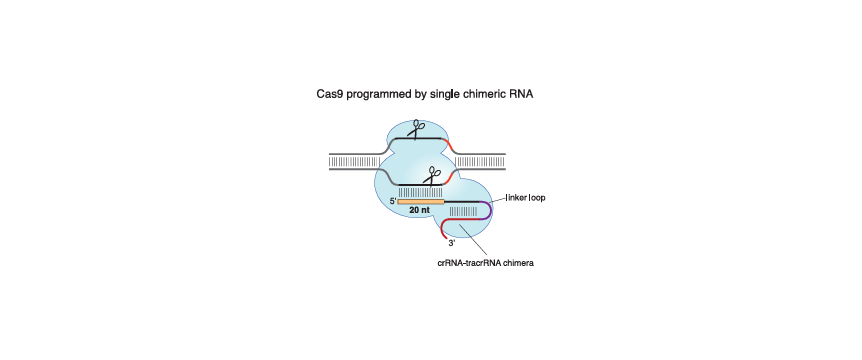
(Jinek 2012, Ex. 3202, 820, Fig. 5A.)
Count 1 recites Broad patent 8,697,359, claim 18, or CVC application 15/981,807, claim 156. (See Declaration, Paper 1, 12.) Broad patent 8,697,359, claim 18 recites: The CRISPR-Cas system of claim 15, wherein the guide RNAs comprise a guide sequence fused to a tracr sequence. (Id. at 12.) Broad patent 8,697,359, claim 15 recites:
An engineered, programmable, non-naturally occurring Type II CRISPR-Cas system comprising a Cas9 protein and at least one guide RNA that targets and hybridizes to a target sequence of a DNA molecule in a eukaryotic cell, wherein the DNA molecule encodes and the eukaryotic cell expresses at least one gene product and the Cas9 protein cleaves the DNA molecules, whereby expression of the at least one gene product is altered; and, wherein the Cas9 protein and the guide RNA do not naturally occur together.
(Id. at 13.) CVC application 15/981,807, claim 156, recites:
A eukaryotic cell comprising a target DNA molecule and an engineered and/or non-naturally occurring Type II Clustered Regularly Interspaced Short Palindromic Repeats (CRISPR) — CRISPR associated (Cas) (CRISPR-Cas) system comprising
a) a Cas9 protein, or a nucleic acid comprising a nucleotide sequence encoding said Cas9 protein; and
b) a single molecule DNA-targeting RNA, or a nucleic acid comprising a nucleotide sequence encoding said single molecule DNA-targeting RNA; wherein the single molecule DNA-targeting RNA comprises:
i) a targeter-RNA that is capable of hybridizing with a target sequence in the target DNA molecule, and
ii) an activator-RNA that is capable of hybridizing with the targeter-RNA to form a double-stranded RNA duplex of a protein-binding segment,
wherein the activator-RNA and the targeter-RNA are covalently linked to one another with intervening nucleotides; and
wherein the single molecule DNA-targeting RNA is capable of forming a complex with the Cas9 protein, thereby targeting the Cas9 protein to the target DNA molecule, whereby said system is capable of cleaving or editing the target DNA molecule or modulating transcription of at least one gene encoded by the target DNA molecule.
(Id.)
The CVC and Broad portions of Count 1 both recite a eukaryotic CRISPR-Cas9 system. (See id. (claim 156 of CVC application 15/981,807 (a “eukaryotic cell comprising” a CRISPR-Cas9 system) and claim 18 of Broad patent 8,697,359 (a CRISPR-Cas9 system “in a eukaryotic cell”)). Both portions also recite the ability of the CRISPR-Cas9 system to cleave or edit DNA in the eukaryotic cell to alter gene expression. The Broad portion of Count 1 recites “wherein … the Cas9 protein cleaves the DNA molecules, whereby expression of the at least one gene product is altered” and the CVC portion of Count 1 recites “whereby said system is capable of cleaving or editing the target DNA molecule or modulating transcription of at least one gene encoded by the target DNA molecule.” (Id.) Thus, an embodiment within the scope of Count 1 must include a CRISPR-Cas9 system that can cleave or edit target DNA in a eukaryotic cell.
Claims to methods of using CRISPR-Cas9 systems to cleave or edit targeted DNA in a eukaryotic cell were held by the Federal Circuit to be patentably distinct from claims to methods of using CRISPR-Cas9 systems to cleave or edit DNA without restriction to the environment (e.g., encompassing in vitro environments outside of a cell). See Regents of Univ. of California v. Broad Inst., Inc., 903 F.3d 1286 (Fed. Cir. 2018) (“Regents I”) (affirming the Board's determination of no interference-in-fact between claims to methods of editing DNA with a CRISPR-Cas9 system in a eukaryotic cell and claims to methods of editing DNA with a CRISPR-Cas9 system without restriction to the environment). In that case, the prior interference between CVC and Broad was terminated without a determination of priority. (See Interference 106,048, Decision on Motions, Paper 893, 2:2–13.) That is, the Federal Circuit affirmed the Board's determination that CVC's claims to an in vitro CRISPR-Cas9 system and Broad's claims to a eukaryotic CRISPR-Cas9 system were not the same patentable invention and a determination of priority between these separate inventions was not appropriate.
CVC argues that the Federal Circuit's holding is irrelevant to conception of an embodiment of the count before us now. (See CVC Reply, Paper 2907, 5:9–18.) The court's holding in Regents I, though, is binding precedent and indicates that because the current count is limited to eukaryotic CRISPR-Cas9 systems, the evidence of priority must demonstrate conception of a CRISPR-Cas9 system that can cleave or edit target DNA in a eukaryotic cell, as distinguished from a CRISPR-Cas9 system that cleaves or edits target DNA in vitro.
Furthermore, the holding in Regents, affirming the Board's determination that CVC's P1 and P2 applications are not constructive reductions to practice of Count 1, highlights the relevance of the holding of Regents I to the issues before us now because demonstration of DNA editing in vitro in P1 and P2 was held to be an insufficient description of eukaryotic CRISPR-Cas9 systems recited in Count I in this interference. See Regents, 136 F.4th at 1382–1385.
As the Board determined in the Decision on Priority, and the Federal Circuit did not disagree, although Count 1 does not recite the various technical features that are needed for cleaving or editing DNA in a eukaryotic cell, conception of an embodiment of Count 1 requires conception of any technical features necessary to achieve that function. (See Priority Decision, Paper 2863, 68:17–69:10.) Thus, the necessary technical features of a system within the scope of Count 1 are not irrelevant to conception. (See id.)
II. ANALYSIS
CVC asserts that its inventors made a witnessed laboratory notebook entry of the elements of the CRISPR-Cas9 complex and “its use for gene editing” in eukaryotic cells on 1 March 2012. (CVC Brief, Paper 2903, 3:18–4:1 (citing Ex. 4381, 65).) A copy of the notebook entry, as annotated by CVC, is reproduced below.
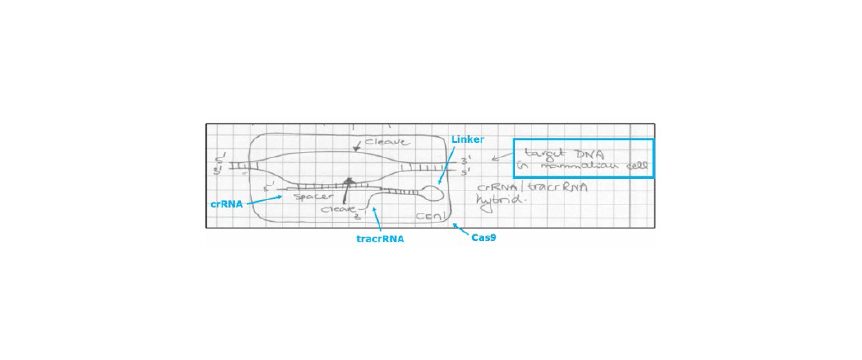
The notebook entry depicts a schematic diagram of nucleic acids annotated with the labels “crRNA,” “tracrRNA,” “linker,” and “Cas9,” along with a label “target DNA in mammalian cell.”
CVC asserts that it “announced its discovery on 21 June 2012,” at “UC Berkeley's annual invitation-only CRISPR research conference,” disclosing the “three necessary components.” (CVC Brief, Paper 2903, 4:10–11.) CVC asserts that the linkage of the crRNA and the tracrRNA to form the sgRNA was shown only briefly and only onscreen. (See CVC Brief, Paper 2903, 13–15 (citing Ex. 4768, 26).) CVC does not assert that it disclosed results of using these three components to edit or cleave DNA in a eukaryotic cell during the research conference. In addition, CVC does not assert that the information presented by the CVC inventors was indicated as being confidential or that the attendees understood it was confidential.
CVC asserts that “[a] few days later” its inventors “disclosed to the world” the three components of the CRISPR-Cas9 gene-editing system: mature tracrRNA, mature crRNA, and Cas9 protein, citing a paper published in the journal Science (Exhibit 3202 (“Jinek 2012”)). (See CVC Brief, Paper 2903, 3:11–14, 4:20–21.) CVC asserts that Jinek 2012 discloses the ability to engineer the CRISPR-Cas9 system to cut any DNA at a predetermined site and that the tracrRNA and the crRNA could be linked to form a single-guide RNA (“sgRNA”). (See CVC Brief, Paper 2903, 3:14–17.) Jinek 2012 discloses cutting DNA at a predetermined site with a CRISPR-Cas9 gene-editing system in an in vitro environment. (See Ex. 3202.) CVC does not dispute that Jinek 2012 does not disclose cutting DNA at a predetermined site with a CRISPR-Cas9 gene-editing system in a eukaryotic cell. (See Broad Brief, Paper 2904, 6:5–6.)
Below, we evaluate the “key question” identified by the court in Regents: “‘whether [Regents’ scientists] had formed the idea of [the invention's] use for [its intended] purpose in sufficiently final form that only the exercise of ordinary skill remained to reduce it to practice' ‘without extensive research or experimentation,’” as of CVC's asserted conception dates. Regents, 136 F.4th at 1379.
A. Evidence of Whether an Ordinarily Skilled Artisan Could Have Reduced the Invention to Practice
The Federal Circuit held that the Board erred in “expressly refusing to consider whether a person of ordinary skill in the art could have reduced the invention to practice.” Regents, 136 F.4th at 1380. According to the court, “[t]he appropriate analysis should turn on whether Regents' scientists ‘had formed the idea of their use for that purpose in sufficiently final form that only the exercise of ordinary skill remained to reduce it to practice’-more than a ‘general hope,’ but less than knowing with certainty that the invention would work.” Id. (citing Burroughs, 40 F.3d at 1230–31 (emphasis added)).
CVC argues that the scientific community understood that implementation of a CRISPR-Cas9 system in eukaryotes would be straightforward requiring only “routine genome-editing techniques,” once the CVC inventors disclosed the results of in vitro experiments on 21 June 2012. (See CVC Brief, Paper 2903, 6:22–7:4.) CVC cites the testimony of Luciano Marraffini regarding efforts in the laboratory of one of the Broad inventors (Dr. Zhang) to achieve DNA editing with a CRISPR-Cas9 system in eukaryotic cells:
Q On your June 26, 2012, phone call with Dr. Zhang, did you discuss with him what the next steps may be for using a single-guide RNA in any of your experiments?
A I don't — I don't think so. I think also that was pretty straightforward. It's just a matter of trying it. Again, he was doing those experiments in eukaryotic cells, and I — the expertise to — to make that work was in his hands. On the bacterial gene editing, the single-guide RNA is not required really, so we never focus on my lab on that.
Q Is there anything else you recall from your conversation with Dr. Zhang on June 26th?
A No, nothing except that it was an important development, and that it needed to be tried. And it was — it will be wise to try it in his system.
(Ex. 5265, 31:8–32:3.) CVC emphasizes Dr. Marraffini's testimony that trying a CRISPR-Cas9 system in eukaryotic cells would have been “straightforward” and “just a matter of trying it,” but Dr. Marraffini also testifies that the “expertise” to do so was “in [Dr. Zhang's] hands” and that it was “wise to try it in his system.” (Id.) Dr. Marraffini's testimony supports Broad's argument that Dr. Zhang had been working on CRISPR-Cas9 systems since 2011 and, thus, had particular experience in CRISPR-Cas9 systems. (See Broad Opp., Paper 2904, 17:13–23 (citing Zhang Decl., Ex. 3424, ¶¶87–91).)
CVC also cites Dr. Erik Sontheimer's testimony about his understandings after attending the presentation by the CVC inventors on 21 June 2012:
I knew then that it would trigger competition in the field to apply the CVC inventors' sgRNA CRISPR-Cas9 system in eukaryotic cells for genome editing. I appreciated that after the Chylinski and Jinek presentation, scientists in the field would be able to quickly apply the CVC inventors' sgRNA CRISPR-Cas9 system for genome editing in eukaryotic cells, because the process for doing so was straightforward and required only routine genome-editing techniques (e.g., techniques to deliver and express the components of the CRISPR-Cas9 system into eukaryotic cells and techniques to read out genome editing in eukaryotic cells). I also appreciated that laboratories that had already been set up to use genome-editing systems in eukaryotes, such as ZFNs and TALENs, could easily pivot to using the CVC inventors' sgRNA CRISPR-Cas9 system more quickly than laboratories that were not already set up for eukaryotic genome editing. This is not because those genome-editing laboratories possessed unique knowledge or insights, but because those laboratories had ready access to the laboratory equipment, reagents, and personnel experienced in the techniques previously used for carrying out genome editing in eukaryotic cells, which could also be used with the CVC inventors' sgRNA CRISPR-Cas9 system (e.g., eukaryotic cell tissue culture equipment, constructs for expressing RNAs and proteins in eukaryotic cells, and experimental readouts of editing outcomes in eukaryotic cells). In 2012, I viewed these scientists as including Dr. George Church (at Harvard University), Dr. Jin-Soo Kim (at Seoul National University), and Dr. Keith Joung (at Harvard University).
(Ex. 5018 ¶21.) Thus, according to Dr. Sontheimer, the process for achieving genome editing with an sgRNA CRISPR-Cas9 system in eukaryotic cells was “straightforward,” requiring “only routine genome-editing techniques,” but some scientists could have done so more easily. (Id.) Dr. Sontheimer testifies that these particular scientists would not have possessed unique knowledge or insight, but that they would have had, for example, eukaryotic cell tissue culture equipment, constructs for expressing RNAs and proteins in eukaryotic cells, and experimental readouts of editing outcomes in eukaryotic cells, that could have been used. Dr. Sontheimer lists three laboratories he considers to have had such capability, specifically the Church, Kim, and Joung labs.
In addition, CVC relies on the testimony of Dr. Randolphe Barrangou about his experiences after attending the presentation by the CVC inventors on 21 June 2012. (See CVC Brief, Paper 2903, 6:23–71 (citing Ex. 5016 ¶¶16–17).) Dr. Barrangou testifies:
Before the Jinek-Chylinski presentation, I understood that there were suggestions to potentially use a CRISPR-Cas system as a genome-editing tool in eukaryotes. For example, in June 2012, I was aware that Dr. Sontheimer in his U.S. Patent Publication No. 2010/0076057 proposed using other CRISPR systems, such as the Type I CRISPR system, for genome editing in eukaryotic cells, but such proposed systems required RNA processing and were cumbersome. Ex. 3054, U.S. Patent Publication 2010/0076057. With the Jinek-Chylinski presentation, CRISPR-Cas9-mediated genome editing in eukaryotes (and other organisms) became feasible, as its implementation now only required straightforward, routine techniques that were known in the field (for example, techniques to deliver and express the three (mature crRNA, mature tracrRNA, and Cas9) or two (sgRNA and Cas9) components of the system to the eukaryotic cells). After the CVC inventors' disclosure, the race was on to become the first one to apply their CRISPR-Cas9 system in eukaryotic cells and publish the data. The question at the time was not whether the CRISPR-Cas9 system would work in eukaryotes-my colleagues and I all expected it would work and someone would get that first paper-the real question was whether it could outcompete the existing genome-editing technologies, such as TALENs and ZFNs.
(Ex. 5016 ¶17.) Dr. Barrangou testifies that only “straightforward, routine techniques that were known in the field” would be needed to deliver and express the CRISPR-Cas9 components identified in Jinek 2012 in eukaryotic cells. (Id.)
In summary, CVC's witnesses indicate that routine techniques could have been used for achieving successful editing or cleavage of DNA in eukaryotic cells with a CRISPR-Cas9 system. Dr. Marraffini and Dr. Sontheimer testify further that some labs had particular capabilities for achieving CRISPR-Cas9 editing or cleavage of DNA in eukaryotic cells. None of CVC witnesses, though, provide express testimony about whether one of ordinary skill in the art could have successfully used these techniques to edit or cleave DNA in eukaryotic cells with a CRISPR-Cas9 system without extensive research or experimentation.
To further investigate what could have been done, we look to the level of skill possessed by the ordinarily skilled artisan. CVC acknowledges the Board's finding that the level of skill in the art was “high, at least at the level of a practicing Ph.D. research scientist.” CVC Opp. Paper 2905, 15:7–8 (quoting Motions Decision, Paper 877, 78, n. 32).) Neither CVC nor Broad elaborates on this finding, though, for example by explaining what the proper scope of the art to be considered is. That is, it is not clear if CVC or Broad considers the art to include only CRISPR-Cas9 researchers or to include genome editing researchers or even molecular biologists and cell biologists in general. Thus, although CVC's witnesses testify about routine techniques available for a eukaryotic CRISPR-Cas9 system, it is not clear if their testimony is that any practicing Ph.D. research scientist could have successfully used these routine techniques without further guidance. Dr. Marraffini and Dr. Sontheimer testify that some labs had particular capabilities, but it is not clear if the abilities of the Church, Kim, Joung, and Zhang (Broad) labs to easily achieve success in cleaving or editing DNA with a CRISPR-Cas9 complex in eukaryotic cells is indicative of what any “Ph.D. research scientist” or any ordinarily skilled artisan could have done.
The Federal Circuit's decision on written description in the CVC P1 and P2 priority applications provides us some insight. See Regents, 136 F.4th at 1383. According to the Federal Circuit, the subject matter of Count 1 was “highly unpredictable and complex” at the time. Id. The court held that because the earlier CVC priority applications failed to disclose specific instructions or conditions necessary for CRISPR-Cas9 activity in eukaryotic cells (or that no specific conditions were necessary) and failed to provide working examples showing successful cleavage or editing in eukaryotic cells, the ordinarily skilled artisan would not have understood that the CVC inventors had possessed an operative eukaryotic CRISPR-Cas9 system. See id. Although the court's holding was not that the provisional applications lacked enablement, we understand that the court held that the level of ordinary skill in the art at the time required some level of instruction or explanation of the necessary conditions to show that the inventors were in possession of an operative eukaryotic CRISPR-Cas9 system as of 19 October 2012, when the P2 application was filed.
In light of the evidence and determinations on the record before us, we find that one of ordinary skill in the art would have been a practicing Ph.D. research scientist who would have known about the routine techniques and methods available but would have been less capable than the Zhang, Church, Kim, and Joung labs to reduce an embodiment of Count 1 to practice. The person of ordinary skill in the art would also have required instruction or explanation of the modifications and conditions necessary to reduce to practice a CRISPR-Cas9 system that was able to cleave or edit DNA in a eukaryotic cell without undergoing extensive research and experimentation.
On balance, the evidence cited by the parties shows that one of ordinary skill in the art could not have reduced the invention to practice without extensive research or experimentation. We find that although Drs. Sontheimer and Barrangou testify that only routine genome-editing techniques were necessary to achieve cleavage or editing of DNA by a CRISPR-Cas9 complex in a eukaryotic cell, only some researchers had the particular expertise or capabilities needed to be successful. Dr. Marraffini testified that Dr. Zhang had certain “expertise” in making these techniques work and Dr. Sontheimer testified that the Church, Kim, and Joung labs had the laboratory equipment, reagents, and experienced personnel to make these techniques work more easily. (See Ex. 5265, 31:8–32:3; Ex. 5018 ¶21.) We find that the evidence indicates that because the level of skill of the ordinarily skilled Ph.D. research scientist would have required some instruction or explanation of how to use the routine methods and techniques, the ordinarily skilled artisan would not have been as capable as Drs. Zhang, Church, Kim, or Joung and thus would have been unable to have easily achieve success with a eukaryotic CRISPR-Cas9 system based on the CVC inventors' in vitro results. We find that, instead, the ordinarily skilled artisan would have required some instruction or explanation of the necessary conditions or would have had to undertake extensive research or experimentation to make an operative eukaryotic CRISPR-Cas9 system.
B. Evidence of Experimental Success and Failure of Others
The Federal Circuit requires us to consider “evidence of purported experimental success by others presented on the record” in determining whether the CVC inventors had sufficiently conceived of an embodiment of Count 1. See Regents, 136 F.4th at 1381. CVC asserts that within months of the CVC inventors' announcement of the in vitro experiments, six labs reported cleaving DNA in eukaryotic cells using the sgRNA CRISPR-Cas9 complex proposed by the CVC inventors in Jinek 2012. (See CVC Brief, Paper 2903, 4:22–5:7.) According to CVC, each of these labs previously had experience editing DNA using prior-art techniques reported in prior publications regarding the zinc fingers (“ZFNs”) and transcription activator-like effector nucleases (“TALENs”) gene editing systems. (See id.) ZFN and TALEN systems are systems that achieve eukaryotic genome editing, but they differ from CRISPR-Cas9 system in that they are smaller, protein-only systems and do not involve RNA or an RNA:protein complex like the CRISPR-Cas9 complex. (See Broad Opp. Paper 2906, 23:5–7 (citing Third Declaration of Technical Expert Rondald Breaker in Support of Broad, Ex. 3448, ¶¶41, 93–101; Yannick Doyon (CVC's technical expert) Depo., Ex. 6205, 131:16–151:7).) Thus, they achieve specific DNA cleavage or editing through a different mechanism. (See id.)
CVC argues that four laboratories (the Church, Kim, Joung, and Chen labs), in addition to the labs of the CVC and Broad inventors, each reported using CRISPR-Cas9 to cleave DNA in eukaryotic cells. (See CVC Brief, Paper 2903, 7:5–8:4.) CVC argues that these labs credited the CVC inventors with discovering the “necessary components” for CRISPR-Cas9 editing and that they each used only routine methods from their prior published work on ZFN and TALEN experiments to achieve success with a CRISPR-Cas9 system in eukaryotic cells. (Id. at 7:7–9.) We are not persuaded that the evidence supports CVC's argument that ZFN and TALENs experiments completely informed the groups' successes with CRISPR-Cas9 in eukaryotic cells or provided enough information that the labs did not undergo extensive research or experimentation to achieve success.
For example, the evidence that CVC cites for the Church group includes a publication about using the TALEN systems (Ex. 5281 (“Briggs 2012,”)) and a publication reporting successful RNA-guided human genome engineering with a CRISPR-Cas9 system (Ex. 3623 (“Mali 2013”). (See CVC Brief, Paper 2903, 7:13–14.) In Mali 2013, the Church group stated:
A recent in vitro reconstitution of the Streptococcus pyogenes type II CRISPR system demonstrated that crRNA fused to a normally trans-encoded tracrRNA is sufficient to direct Cas9 protein to sequence-specifically cleave target DNA sequences matching the crRNA. [citing Jinek 2012, Ex. 3202] The fully defined nature of this two-component system suggests that it might function in the cells of eukaryotic organisms such as yeast, plants, and even mammals…. Here, we engineer the protein and RNA components of this bacterial type II CRISPR system in human cells.
(Mali 2013, Ex. 3623, 823.) Thus, in Mali 2013 the Church group credits the CVC inventors with an in vitro CRISPR-Cas9 system, but we do not find a citation to Briggs 2012 (Ex. 5281) in Mali 2013. (See Ex. 3623, 826 (cited references).) Thus, we are not persuaded that the Church group used its prior TALENs methods to achieve the results reported in Mali 2013. CVC fails to cite other evidence to support that the Church group used its prior TALENs methods to achieve cleavage or editing of DNA with a CRISPR-Cas9 system in eukaryotic cells.
Regarding the success achieved by the Kim group, CVC cites a publication about using the ZFN systems (Ex. 5239 (“Kim 2012,”)) and a publication reporting targeted genome engineering with a CRISPR-Cas9 system (Ex. 4076 (“Cho 2013”). (See CVC Brief, Paper 2903, 7:15–16.) In their report of an operative eukaryotic CRISPR-Cas9 system, the Kim group stated:
A single-chain chimeric RNA produced by fusing crRNA and tracrRNA sequences can replace the two RNAs in the Cas9-RNA complex to form a single-guide-RNA:Cas9 endonuclease (sgRNA:Cas9) [citing Jinek 2012, Ex. 3202]. Thus, in contrast to the widely used genome-editing technologies based on zinc finger nucleases (ZFNs) and transcription activator–like effector nucleases (TALENs), the specificity of RNA-guided endonucleases (RGENs) can be customized by replacing a short synthetic RNA molecule without changing the protein component. Here we show that sgRNA:Cas9 can induce site specific genome modifications in human cells at high frequencies.
(Cho 2013, Ex. 4076, 230.) Thus, in Cho 2013 the Kim group credits the CVC inventors for the basic components of a CRISPR-Cas9 complex, but contrasts ZFN and TALEN systems from CRISPR-Cas9. Kim 2012 (Exhibit 5239) is not cited in the methods section of Cho 2013 and there is no indication that methods previously used with ZFN systems were used with the eukaryotic CRISPR-Cas9 system of Cho 2013. (See Ex. 4076, s2–3.) Rather, Kim 2012 (Exhibit 5239) is cited in Cho 2013 to distinguish the merits of ZFN editing. (See Ex. 4076, 230 (“Both ZFNs and TALENs are associated with off-target effects. [citing Ex. 5239].”).) CVC fails to cite other evidence that the Kim group used its prior ZFN methods to achieve success cleaving or editing eukaryotic DNA with a CRISPR-Cas9 system.
Turning to the Joung group, CVC also cites a publication about TALEN systems (Ex. 5236 (“Sander 2011,”)) and a publication reporting targeted genome engineering with a CRISPR-Cas9 system (Ex. 4233 (“Hwang 2013”). (See CVC Brief, Paper 2903, 7:17–18.) In the publication of successful eukaryotic targeting with a CRISPR-Cas9 system, the Joung group states:
Recent in vitro work showed that a synthetic single guide RNA (sgRNA) consisting of a fusion of crRNA and tracrRNA can direct Cas9 endonuclease-mediated cleavage of target DNA [citing Jinek 2012, Ex. 3202] (Fig. lb). In addition, Cas9 can function with either crRNA and tracrRNA together or sgRNA to efficiently induce targeted alterations in cultured human cells [citing Mali 2013, Ex. 3623, and Cong et al., “Multiplex Genome Engineering Using CRISPR/CasSystems,” 339 Science 819 (2013) (“Cong 2013”), Ex. 3201]. However, whether CRISPR-Cas-based RNA-guided endonucleases (RGENs) can be used like zinc finger nucleases (ZFNs) [citation omitted] or transcription activator-like effector nucleases (TALENs) [citation omitted] for genome editing in whole organisms is not known.
(Hwang 2013, Ex. 4233, 227.) Thus, in Hwang 2013 the Joung group cites Jinek 2012 for the in vitro work with CRISPR-Cas9 and the work of the Church group (Mali 2013, Ex. 3623) and the Broad inventors (Cong 2013, Ex. 3201) for CRISPR-Cas9 editing in eukaryotic human cells. The Joung group further cites Sander 2011 (Exhibit 5236), but not in the methods section. (See Ex. 4233, s5–7.) Rather, Sander 2011 is cited in the discussion of toxicity caused by ZFNs and TALENs. (See Ex. 4233, 229.) CVC fails to cite other evidence that the Joung group used its prior TALEN system methods to achieve success cleaving or editing eukaryotic DNA with a CRISPR-Cas9 system.
CVC also cites Chen 2011 (Exhibit 5022) in support of the assertion that the Chen group used routine methods from their prior published ZFN experiments for the eukaryotic CRISPR-Cas9 system reported in their U.S. patent application 61/734,256 (Ex. 5020). (See CVC Brief, Paper 2903, 7:19–20.) But CVC does not indicate where Exhibit 5022 is cited in the patent application, and we do not find that it is cited. It is not clear how Exhibit 5022 relates to the Chen group's patent application because we do not find any mention of ZFN systems in the patent application's specification.
CVC summarizes the work of the Church, Kim, Joung, and Chen labs, as well as by the Broad inventors (Zhang lab), by providing a table of vectors, cell types, and delivery methods the groups reported for their eukaryotic CRISPR-Cas9 systems. (See CVC Brief, Paper 2903, 8:1–4.) According to CVC, these labs reduced to practice the CVC inventors' conception “in such rapid succession, using routine, ordinary techniques” that the CVC inventors' conception must have been complete and that one of ordinary skill in the art could have reduce it to practice without unduly extensive research or experimentation. (Id. at 8:5–9.) CVC argues further that because each of the four labs used different methods, “no single method or combination of methods was necessary to reduce the invention to practice.” (Id. at 8:11–9:1.)
CVC's mere citation to prior ZFN and TALEN system work by the Church, Kim, Joung, and Chen labs and CVC's accompanying table do not persuade us that the methods these lab groups used to achieve success with a eukaryotic CRISPR-Cas9 system did not require anything beyond what was used for ZFN and TALEN systems or what one of ordinary skill in the art could have achieved. CVC does not direct us to a discussion in the publications or patent application that the groups used combinations of specific methods and components available in the prior art. And the table only provides a listing of some of the components the groups used (vector, cell type, and delivery method), not a thorough review of how successful eukaryotic CRISPR-Cas9 editing was achieved. We are not persuaded that knowledge of some known components is sufficient to show that the successful lab groups did not have to conduct extensive research or experimentation to find the right combinations of conditions and components that worked with a CRISPR-Cas9 complex in eukaryotic cells.
Furthermore, even if the Church, Kim, Joung, and Zhang (Broad) labs achieved success using techniques that were previously available, we are not persuaded that one of ordinary skill in the art could have achieved success without extensive research or experimentation. As discussed above, these labs had particular capabilities to make it easier to pivot to an operative eukaryotic CRISPR-Cas9 system. (See Sontheimer Decl., Ex. 5018 ¶21; Marraffini Depo, Ex. 5265, 31:8–32:3.) Given the lack of evidence that ZFN or TALEN systems provided a direct roadmap to success with a CRISPR-Cas9 system in eukaryotic cells, we are not persuaded that the ordinarily skilled artisan would have been able to also achieve success without extensive research or experimentation.
In addition, Broad argues that the Church, Joung, and Zhang labs were “closely interconnected,” wherein Church and Zhang were collaborators when Zhang was a Junior Fellow at Harvard and Joung worked at the Broad Institute along with Zhang. (See Broad Opp., Paper 2906, 5:11–18 (citing Declaration of Le Cong, Ex. 3425, ¶¶1, 3–7 (testifying that he was advised by both George Church and Feng Zhang as a graduate student at Harvard).) Given this relationship, which CVC does not dispute, CVC's evidence of purported success by others should be considered to refer to only two other lab groups, besides the Broad inventors and their collaborators, not four, as CVC asserts. (See CVC Brief, Paper 2903, 6:22–9:8).) We note, too, that the Kim group and the Chen group are represented by parties (ToolGen, Inc. and Sigma-Aldrich Co., LLC, respectively) who are currently asserting priority over the same subject matter claimed by CVC and Broad. (See Interferences 106,126, 106,127, 106,132, and 106,133.) Thus, the lab groups that CVC identifies as “third-party labs” are parties that are asserting priority of a eukaryotic CRISPR-Cas9 system and, thus, do not necessarily represent ordinarily skilled artisans.
Broad argues further that the Zhang, Church, and Joung labs modified the CRISPR-Cas9 complex identified by the CVC inventors in their in vitro experiments to achieve successful editing in eukaryotic cells. (See Broad Opp. Paper 2906, 23:11–19 (citing Hwang 2013, Ex. 4233; Zhang Decl., Ex. 3424, ¶¶17–19, 119–128).) Specifically, Broad cites the statement in Hwang 2013 (Ex. 4233) by the Joung lab that “[t]he sequence of our sgRNA, like that of another recently described [citing Mali 2013 (Ex. 3623)], differs from an sgRNA used in vitro [citing Jinek 2012 (Ex. 3202)] in that our sgRNA contains additional tracrRNA-derived sequences at its 3' end (Fig. 1b,c and Supplementary Table 1).” (Hwang 2013, Ex. 4233, 227.)
Figure 1(b) of Hwang 2013, depicting the “[e]ngineered sgRNA:Cas9 system previously used in vitro,” is reproduced below:
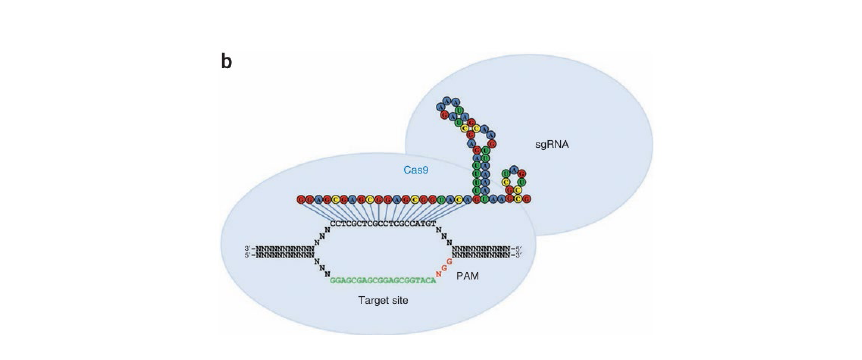
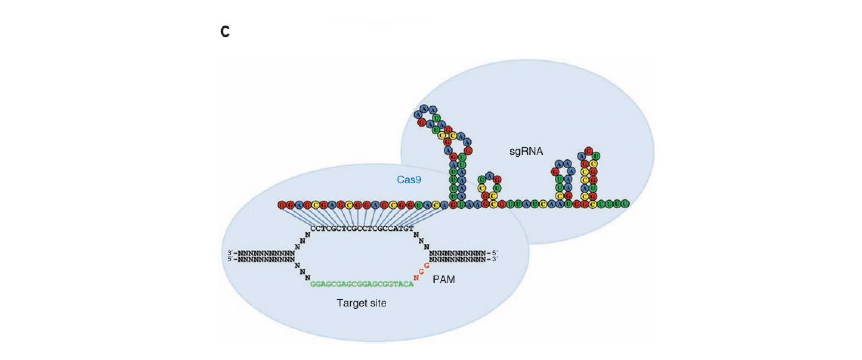
Figure 1(b) depicts a Cas9 protein and an sgRNA having two loop structures. Hwang 2013 contrasts Figure 1(b) with Figure 1(c), which depicts the “Modified engineered sgRNA:Cas9 system used in vivo in this study,” and is reproduced below:
|
|
Figure 1(c) depicts a Cas9 protein and an sgRNA having four loop structures, that is, two more loop structures on the 3' end of the RNA than depicted in the sgRNA of Figure 1(b). The legend to Figures 1(b) and (c) in Hwang 2013 states:
(b) Engineered sgRNA:Cas9 system previously used in vitro. sgRNA composed of portions of the crRNA and tracrRNA from [panel (a)] is illustrated interacting with the DNA target site …. (c) Modified engineered sgRNA:Cas9 system used in vivo in this study. Components are illustrated the same way as in [panel (b)], except the sgRNA contains additional sequence from the 3' end of the tracrRNA…. The sgRNA depicted is essentially identical to that previously described [citing Mali 2013 (Ex. 3623)].
(Ex. 4233, 228 (legend to Figures 1B and 1C (citations omitted)).) Thus, the Joung lab reported success with an sgRNA that was modified from the sgRNA used by the CVC inventors in their in vitro experiments. This modified sgRNA is reported to have also been used by the Church lab in Mali 2013. (See Hwang 2013, Ex. 4233, 228.)
Broad cites further to the testimony of its inventor, Dr, Zhang:
Based on my understanding of the interactions between RNA and the proteins of the natural CRISPR Cas9 system, I recognized that removal of the two stem loop structures on the 3' end on the tracrRNA of the natural system could have an impact on the loading/complexing of Cas9 onto the hybridized crRNA-tracrRNA duplex. But it could not be known whether a chimeric RNA with a 26-nt tracrRNA segment (tracrRNA 23-48) would load and function in the eukaryotic cell environment, given the removal of a significant part of the tracrRNA.
(Zhang Decl., Ex. 3424, ¶120.) Along with this modification, Dr. Zhang testifies to other experimental details and modifications he chose in his experiments in June 2012, including an additional four nucleotides on the 3' end of the chimeric RNA. (See id. at ¶¶119–128.)
CVC counters Broad's argument by asserting that the Church and Joung labs “simply used sgRNA with an additional wild-type tracrRNA sequence from Jinek 2012” and that “no ‘extension’ was necessary; Kim used CVC's sgRNA with no extension.” (CVC Reply, Paper 2907, 6:7–9 (citing Mali 2013, Ex. 3623, 824; Hwang 2013, Ex. 4233, 228; Jinek 2012, Ex. 3202, 817; Cho 2013, Ex. 4076, 231).) CVC argues further that the U6 promoter, a commonly used promoter at the time, was known to add four nucleotides to the 3' end of the RNAs and that, thus, Zhang's choice to include these extra nucleotides was not beyond what one of ordinary skill in the art would have done. (See CVC Opp., Paper 2905, 15:21–16:7.)
We appreciate that the evidence indicates there may have been more than one way to achieve success with a eukaryotic CRISPR-Cas9 system. Nevertheless, the evidence also indicates that at least the Joung, Church, and Zhang (Broad) labs considered additional aspects in developing their eukaryotic system, beyond the components identified by the CVC inventors for an in vitro CRISPR-Cas9 system. Broad's evidence demonstrates that even these labs, which had particular capabilities for achieving successful eukaryotic DNA editing, were not able to simply apply the teachings reflected in CVC's conception documents, together with routine skill, to achieve success with CRISPR-Cas9; rather these labs undertook a certain amount of research and experimentation to achieve success with CRISPR-Cas9. CVC does not cite sufficient evidence to show that these labs relied on the set of elements and conditions used in ZFN or TALEN systems or other systems that had worked for other editing systems. The evidence shows that they worked on problems unique to the RNA:protein CRISPR-Cas9 complex.
CVC argues that evidence of success by the Church, Kim, Chen, Joung, and Zhang (Broad) groups is dispositive of CVC's complete conception, regardless of whether others failed. (See CVC Brief, Paper 2903, 9:2–8.) We disagree. Although the Federal Circuit considered it legal error for the Board not to have considered the purported experimental success of others presented in the record, the court also said that “[t]hird party evidence of experimental difficulties is relevant to this inquiry.” See Regents, 136 F.4th at 1379 (citing Amgen, Inc. v. Chugai Pharma Co., 927 F.2d 1200, 1207 (Fed. Cir. 1991)).
CVC argues further that because it is easy to find people who do not succeed, “[i]f one succeeds, that is enough, no matter how many others fail,” citing Dolbear v. Am. Bell Tel. Co., 126 U.S. 1, 536 (1888). (See CVC Brief, Paper 2903, 9:2–5.) The facts of Dolbear, though, are that even though Bell had not reduced the invention to practice,
in his specification he did describe accurately, and with admirable clearness, his process,-that is to say, the exact electrical condition that must be created to accomplish his purpose,-and he also described, with sufficient precision to enable one of ordinary skill in such matters to make it, a form of apparatus which, if used in the way pointed out, would produce the required effect, receive the words, and carry them to and deliver them at the appointed place.
Dolbear, 126 U.S. at 535. CVC argues that Dolbear does not suggest that an inventor needs a plan that leaves nothing for good mechanics to do, but because Bell's specification provided such a clear plan, including the exact electrical conditions necessary, that issue was moot under the facts before the Court. (See CVC Reply, Paper 2907, 4:20–23.)
The facts before us now are not as clear. No finding has been made that CVC's P1 and P2 specifications filed in 2012 provided a clear and precise description that would enable one of ordinary skill in the art to make and use a eukaryotic CRISPR-Cas9 system. Instead, the Federal Circuit affirmed the Board's holding that the written description of CVC's May and October 2012 applications would not have indicated to one of ordinary skill in the art that the CVC inventors possessed an embodiment of Count 1 because the specifications failed to disclose the specific instructions or conditions necessary or that no specific instructions or conditions were necessary. See Regents, 136 F.4th at 1384–85. Accordingly, we are not persuaded that, given the fact-intensive nature of the court's remand, instances of successful eukaryotic DNA with a CRISPR-Cas9 complex by a third party indicate that only routine methods or skill were needed to reduce the invention to practice and that the CVC inventors' conception was complete. Instead, we evaluate the totality of the evidence cited by the parties.
In opposition to CVC's argument that multiple groups were successful shortly after the CVC inventors announced their in vitro results, Broad argues that other lab groups failed to edit eukaryotic DNA with a CRISPR-Cas9 complex before Broad's actual reduction to practice. (See Broad Opp., Paper 2906, 14:12–16:20; Broad Brief, Paper 2904, 10:11–12:6.) Broad cites the difficulties that Florian Raible, Ph.D., an experienced researcher in the field of ZFN and TALENs technology in the eukaryotic cells of the zebrafish, encountered in his collaboration with the CVC inventors to achieve editing of eukaryotic zebrafish DNA with CRISPR-Cas9. (See Broad Opp., Paper 2906, 15:12–22; CVC Motion 2, Paper 1579, 22:1–27:15.) The Board previously found that Dr. Raible's zebrafish experiments demonstrated “at best” one unrecognized positive result and several failures in July and August 2012, resulting in the project being dropped with no publication of a success. (Decision on Priority, Paper 2863, 9:21–24:16.) Although CVC argues that the “zebrafish experiments succeeded,” the Federal Circuit did not disrupt the Board's previous finding that these experiments were not a reduction to practice of an embodiment of Count 1. Thus, before the Broad inventors published their successful eukaryotic CRISPR-Cas9 editing, Dr. Raible's work in zebrafish was an experimental failure. (See id. at 24:3–4; CVC Brief, Paper 2903, 21:7–8.)
Broad also cites the collaboration between Dr. Meyer, a purported expert in genome editing in the eukaryotic cells of the C. elegans worm, which included unsuccessful experiments in 2012. (See Broad Opp., Paper 2906, 14:22–15:11; Broad Brief, Paper 2904, 10:17–11:16.) Broad cites an e-mail between CVC inventors Jinek and Chylinski dated 25 July 2012 in which Dr. Jinek comments: “The first round of worm experiments also didn't work, but there are just too many parameters to optimize at this point. Fingers crossed for the next round.” (Ex. 5119.) In an e-mail dated 20 August 2012, CVC inventor Doudna responded to news from Dr. Meyer's lab of “no mutants,” commenting: “I do wonder if the Cas9:RNA complex is either falling apart during or after injection or if the concentration is too low. Martin is Cas9:guide RNA assembly dependent on Mg? Also how did the injected worms tolerate the new buffer (with the 2 mM MgC12)?).” (Ex. 4941.) Thus, as of late August 2012, Dr. Meyer's lab failed in their efforts to achieve editing or cleavage with CRISPR-Cas9 in eukaryotic C. elegans cells and CVC inventor Doudna was contemplating modifications to the system.
Dr. Meyer and Dr. Doudna acknowledged these failures when they eventually submitted a manuscript reporting successful genome editing in C. elegans in July 2013. Specifically, they explained:
Our initial attempts at genome editing using Cas9 sgRNA complexes to target the ben-1 locus with three different sgRNAs in multiple experiments were unsuccessful. We reasoned that dual crRNA:tracrRNA RNA guides might be more effective in vivo for C. elegans than single chimeric sgRNA guides, as observed in some cases for mammalian cells (Cong et al. 2013 [Ex. 3201]). We therefore made use of dual RNA guides to target a single-copy, integrated transgene encoding a bifunctional GFP::histone 2B fusion protein expressed solely in the C. elegans germline. We simultaneously introduced tracrRNA, mRNA encoding Cas9, and four different crRNAs to target different sites in gfp. We recovered one gfp mutant carrying a 5-bp deletion that eliminated GFP function (Figure 7, A-C). The general small brood size of the transgenic strain made it difficult to recover the three other independent mutants detected by molecular phenotyping of gfp.
After determining the crRNA that was successful in the dual crRNA:tracrRNA guide experiment from DNA sequence analysis of the mutant, we performed an experiment to compare the efficiency of mutagenesis in vivo of a dual crRNA:tracrRNA guide vs. a single chimeric sgRNA guide with identical DNA target sequence (Figure 7A).
(Lo 2013, Ex. 3656, 343.) Thus, crediting the work of the Broad inventors (Cong 2103, Ex. 3201) with a method, albeit using two RNAs not the sgRNA, that was eventually successful, Drs. Meyer and Doudna reviewed the extent of their considerable research and experimentation (including four different versions of the crRNA) to achieve success with an sgRNA CRISPR-Cas9 complex in eukaryotic C. elegans cells. (See id.)
The evidence before us shows that some labs had experimental success in achieving cleavage or editing of eukaryotic DNA with CRISPR-Cas9, whereas other labs had difficulty. The Church, Kim, Joung, Chen, and Zhang labs reported success, even if by different methods, within a few months of the publication of Jinek 2012, whereas the Raible, Meyer, and CVC labs did not report success until after a eukaryotic CRISPR-Cas9 system had been disclosed by the Broad inventors. And when at least the Meyer and CVC labs reported success, it was only after extensive research and experimentation. As discussed above, CVC does not direct us to evidence that any of the groups that attempted editing of eukaryotic DNA with CRISPR-Cas9 did so by using only ordinary skill, such as by using known ZFNs or TALENs systems. Furthermore, as discussed above, the Church, Kim, Joung, Chen, and Zhang labs, who reported early success, had capabilities superior to those of the ordinarily skilled artisan.
On balance, the evidence of purported experimental successes cited by the parties supports the conclusion that more than ordinary skill was required to achieve a successful eukaryotic CRISPR-Cas9 system without extensive research or experimentation. The evidence shows that at least some labs significantly modified the components of the CRISPR-Cas9 system used for successful cleaving or editing of DNA in vitro and that some modification of CVC's original disclosure for achieving in vitro success was likely necessary.
C. Evidence of CVC Inventors' Work After Their Purported Conception
The Federal Circuit requires us to consider “whether [CVC's] scientists described routine methods or skill in their disclosures at asserted conception dates, and whether they used routine methods or skill in subsequent, purportedly successful experiments.” Regents, 136 F.4th at 1381. According to the court,
“what matters for conception is whether the inventors had a definite and permanent idea of the operative inventions,” as evidenced in Burroughs by the fact that “no prolonged period of extensive research, experiment, and modification followed the alleged conception.” [40 F.3d] at 1230. The Board therefore legally erred by focusing on Regents' scientists' statements of uncertainty, without considering whether those statements led to modifications in their experiments that substantively changed their original idea, when determining whether they had a “definite and permanent idea.” See id.
Regents, 136 F.4th at 1379. The court acknowledged the Board's previous finding that the CVC inventors encountered many failures and doubts during a prolonged period of extensive research, experimentation, and modification after 1 March 2012, but the court noted that the existence of research or experimentation does not necessarily indicate by itself that conception is not complete. See Regents, 136 F.4th at 1381–82 (citing Priority Decision, Paper 2863, at 45:17–20). Rather, the court held that the Board erred by focusing on these difficulties and expressions of doubt only, without considering whether the CVC inventors also described the use of routine methods or skill by their asserted conception dates. See id.
CVC argues that its inventors identified every detail of how they would reduce their invention to practice by May 2012, indicating that they had a complete conception and never substantively changed their original idea when they achieved success. (See CVC Motion, Paper 2903, 12:5–18:8.) CVC argues that the inventors developed a system including a crRNA-tracrRNA fusion (sgRNA) and Cas9 protein and that the inventors had decided to use it to cleave DNA in eukaryotic mammalian cells by 1 March 2012 and 11 April 2012. (See CVC Brief, Paper 2903, 12:16–19.) According to CVC, this system included each element of Count 1. (See CVC Brief, Paper 2903, 12:19.)
As discussed above, Count 1 is limited to a CRISPR-Cas9 systems that can cleave or edit target DNA in a eukaryotic cell to alter gene expression or modulate transcription. Thus, a system that includes crRNA-tracrRNA fusion (sgRNA) and Cas9 protein but cannot cleave or edit DNA in a eukaryotic cell to alter gene expression or modulate transcription, does not meet the limitations of Count 1. We look to whether the CVC inventors had described routine methods or skills that would achieve cleavage or editing with a CRISPR-Cas9 complex in the eukaryotic cell to alter gene expression or modulate transcription. See Amgen, 927 F.2d at 1206 (“Conception requires both the idea of the invention's structure and possession of an operative method of making it.”).
CVC argues that the inventors' April 2012 Information Disclosure Form indicated the inventors had “envisioned” that what had worked for ZFN and TALEN systems could be used for a eukaryotic CRISPR-Cas9 system and that “[t]hat proved correct” because “[l]ab after lab reported success using the routine methods” the CVC inventors had identified. (CVC Brief, Paper 2903, 12:19–13:6 (citing E-mail of 11 April 2012 and Information Disclosure Statement, Ex. 5105, 3–4).) As discussed above, though, CVC does not direct us to evidence that any of the identified groups used ZFN or TALEN systems for a CRISPR-Cas9 complex.
CVC argues further that its inventors used the routine methods they described in their April 2012 Information Disclosure Form when they attempted to use a CRISPR-Cas9 complex to edit eukaryotic DNA. (See CVC Brief, Paper 2903, 13:7–14:21.) Specifically, CVC argues that by 28 May 2012 the inventors created a vector (“pMJ874”) to express the sgRNA and that this vector used the same target, the CLTA gene locus, which had been previously used in ZFN experiments, along with the commonly known U6 promoter. (See CVC Brief, Paper 2903, 13:13–20 (citing Jinek Decl., Ex. 4349, ¶¶78, 124).) CVC argues that the pMJ874 vector is the same vector the CVC inventors used to successfully reduce to practice an embodiment of Count 1. (See CVC Brief, Paper 2903, 13:19–20 (citing Doyon Decl., Ex. 4345, ¶¶182–184).) CVC argues further that by 28 May 2012 its inventors created a vector to express Cas9 (“pMJ887”) using the CMV promoter and two copies of a common nuclear localization signal (“NLS”), called the “SV40” NLS. (See CVC Brief, Paper 2903, 13:21–14:1 (citing Jinek Decl., Ex. 4349, ¶109).) CVC asserts that this Cas9 expression vector is the same one that was used to reduce to practice an embodiment of Count 1 in October 2012, except that the vector used in the successful experiments also included a sequence of Cas9 that was codon-optimized for better protein expression. (See CVC Brief, Paper 2903, 14:2–6 (citing Doyon Decl., Ex. 4345, ¶182).) CVC argues that the inventors had contemplated a codon-optimized Cas9 vector as early as 28 May 2012 and had ordered one by 26 June 2012. (See CVC Brief, Paper 2903, 14:4–6 (citing E-mail dated 26 June 2012, Ex. 4444).)
According to CVC, the specific features of the sgRNA vector and the Cas9 vector, such as the promoters, NLS sequences, and codon optimization, were known in the art and the techniques associated with these vectors were routinely used in the same “basic strategy” and “general approach” as in the prior art. (CVC Brief, Paper 2903, 14:7–21.) CVC asserts that this general approach was the same as that disclosed in the publication “Doyon 2011” (Ex. 4384) regarding ZFN editing. (See CVC Brief, Paper 2903, 14:7–12.) CVC asserts further that these techniques were the same ones described in its January 2013 priority application (61/757,640, “P3”), which was found to be a constructive reduction to practice of an embodiment of Count 1. (See CVC Brief, Paper 2903, 14:22–16:3.) CVC argues that “[i]f that disclosure was ‘adequate to establish a constructive reduction to practice,’ it must also establish conception.” (CVC Brief, Paper 2903, 15:7–16:3.)
Even if the P3 application establishes conception as of its filing date, 28 January 2013, the disclosures of the P3 application establish neither constructive reduction to practice nor conception as of any earlier date. The Federal Circuit affirmed the Board's determination that the P1 application, filed 25 May 2012, and the P2 application, filed 19 October 2012, both after CVC's asserted conception dates of 1 March and 11 April 2012, are not constructive reductions to practice of an embodiment of Count 1. See Regents, 136 F.4th at 1382–1386. CVC does not explain how a later disclosure establishes conception at an earlier date when the earlier disclosure would not have been understood by one of ordinary skill in the art to show that the inventors were in possession of an embodiment of the count.
Nevertheless, we understand CVC's argument to be that the P3 application demonstrates that the inventors had a complete idea in their original disclosure. The issue before us, though, is what the inventors' original idea for a successful eukaryotic CRISPR-Cas9 system was at the asserted dates of conception and whether that idea was definite and permanent enough to not require a prolonged period of extensive research, experiment, and modification of that idea to achieve success during subsequent experimentation. See Regents, 136 F.4th at 1379. We note that CVC does not direct us to disclosures in the P1 or P2 provisional applications that demonstrate the complete method or all of the techniques that made up the inventors' original idea. (See, e.g., CVC Brief, Paper 2903, 13:13–20 (not citing to the P1 or P2 applications for disclosure of the pMJ874 or U6 promoter).)
CVC argues that its inventors “used that same strategy, with the same vectors (with Cas9 sequence codon optimized) to reduce to practice on 31 October 2012,” referring to the vectors, and other reagents and techniques CVC included in disclosures as of 28 May 2012. (See CVC Brief, Paper 2903, 16:5–12.) CVC argues further that its inventors never substantively changed their original idea of using an sgRNA CRISPR-Cas9 complex comprising the three components of a crRNA, tracrRNA, and Cas9, as a system capable of clearing target DNA in a eukaryotic cell. (See id. at 17:2–13.) CVC provides a table listing the delivery mechanism, sgRNA vector and promoter, Cas9 vector and promoter, NLS, and codon optimization, with citations alleging their disclosure on 28 May 2012, as well as their use on 31 October 2012. (See id. at 15–16.) It is not clear, though, what this strategy was, other than to use the sgRNA and Cas9 in a eukaryotic cell.
According to CVC, inventors Doudna and Jinek “never stopped using their original ‘pMJ874’ sgRNA vector in experiments,” citing the testimony of Dr. Jinek, as well as Aaron Cheng and Alexandra East-Seletsky, graduate students who worked on the project. (CVC Brief, Paper 2903, 17:15–16, and CVC Reply, Paper 2907, 7:4–9 (citing East-Seletsky Decl., Ex. 4353, ¶¶17–23, 30, 50, 83; Jinek Decl., Ex. 4349, ¶¶238, 242, 246, 252–253; Cheng Decl., Ex. 4352, ¶¶26, 28, 37, 59, 98, 99, 110, 124).) We note that although pMJ874 is reported to have been used throughout the CVC inventors' experiments, other sgRNA vectors were also reported to have been used, even as late as 24 October 2012. (See East-Seletsky Decl., Ex. 4353, ¶83 (“On Wednesday, October 24, 2012, I began my fourth cleavage experiment by transfecting cells with 6 μg of Cas9 protein and 6 μg of chimeric sgRNA (pMJ835) using protein transfection reagent, ProteoJuiceTM.” (emphasis added)); see Jinek Decl., Ex. 4349, ¶246 (“Near the end of October 2012, I was aiding Ms. East in performing an experiment using cell lysates I prepared on Friday, October 26, 2012. As discussed above, I transfected HEK 293T cells on Wednesday, October 24, 2012, with 2 μg codon-optimized Cas9 (either GFP tagged/MJ920 or mCherry-tagged/MJ921) and 4 μg CLTA sgRNA (either U6-driven/MJ874 or CMV-driven/MJ944). Ex. 4382, 29.” (emphasis added)).) Thus, although the CVC inventors used the pMJ874 vector to express the sgRNA from their asserted conception dates to their reduction to practice, they were also trying other vectors and other promoters over the course of their experiments.
Broad argues that the CVC inventors were searching for the right combination of vectors and conditions from the large number of possible combinations in the summer and early fall, after 28 May 2012. (See Broad Opp., Paper 2906, 17:8–16 (citing Cheng Decl., Ex. 4352, ¶¶24–136; Jinek Decl., Ex. 4349, ¶¶47–244, East-Seletsky Decl., Ex. 4353, ¶¶15–86).) Specifically, Broad argues that the CVC inventors tried four different sgRNA vectors (MJ920, MJ889, MJ921, and MJ918) under various conditions, after the development of pMJ874, over the seven months that the CVC inventors attempted to achieve a successful eukaryotic CRISPR-Cas9 system. (See id.) In addition, Broad argues that even though CVC asserts its inventors contemplated using codon-optimized Cas9 expression vectors in May 2012, they failed to achieve successful cleavage or editing of eukaryotic DNA with codon-optimized Cas9 vectors in October 2012. (See Broad Opp., Paper 2906, 17:17–18:2 (citing Cheng Decl., Ex. 4352 ¶¶124, 130).)
According to Broad, the CVC inventors had to make substantive modifications to their CRISPR-Cas9 system on their quest to find the right combination among the possibilities of components. (See Broad Opp. Paper 2906, 16:21–18:2.) In support, Broad cites an e-mail exchange about negative results between Dr. Doudna and graduate students Cheng and East-Seletsky dated 24 October 2012, in which Dr. Doudna proposed that “[w]e should perhaps also be preparing some of the other Cas9's for mammalian expression in case they work better for some reason (i.e. folding or faster better RNP assembly),” as well as noting that “we know the problem is with the RNA and are working on several strategies to fix this and then we should re-try this experiment I think it will work once we have a suitable RNA construct.” (Ex. 5070.) In this e-mail Dr. Doudna proposed that the graduate students try different versions of Cas9 and the sgRNA, the major components of the CRISPR-Cas9 complex, as late as 24 October 2012.
Broad cites other contemporaneous descriptions of the CVC inventors' experiments and their reactions to the results. For example, in an e-mail dated 25 July 2012, Dr. Jinek characterized a failure in worm experiments as involving “just too many parameters to optimize at this point.” (Ex. 5119; see Broad Brief, Paper 2904, 7:15–21.) In an e-mail dated 14 September 2012, after a codon-optimized version of Cas9 did not produce positive results, Dr. Doudna noted that “[s]ince there are so many variables in these experiments I think we have to try to move forward in a stepwise fashion as much as possible.” (Ex. 4988; see Broad Brief, Paper 2904, 13:8–14.) In an e-mail dated 11 October 2012 regarding experiments in human cells, Dr. Jinek stated that “we should switch to CMV vectors (cloning today) and explore alternatives to our first-generation RNA design - e.g. modify the hairpin length, introduce extensions at the 5' and 3' termini. Or possibly block potential degradation from either end by introducing hairpins etc.” and noted that he and graduate student East-Seletsky were “cloning the first-generation RNA constructs into the CMV vectors today.” (Ex. 5040; see Broad Brief, Paper 2904, 14:14–18.) Furthermore, in a response dated 11 October 2012, Dr. Doudna stated: “I agree that we should explore various alternate RNA designs for targeting in cells.” (Ex. 5041; Broad Brief, Paper 2904, 14:17–18.) On 11 October 2012 Dr. Doudna also questioned “[i]s it worth trying the transfections again with the codon optimized Cas9?” (Ex. 5044, 1.) These communications indicate that the CVC inventors were still identifying significant features of the proper structure of the sgRNA and whether additional aspects, such as codon-optimization, were needed for a successful eukaryotic CRISPR-Cas9 system.
CVC argues that its inventors “identified the exact combination of routine methods it would later use to reduce to practice” by 28 May 2012, and that “all that remained was to order materials and execute,” but the contemporaneous statements by the CVC inventors do not indicate that they had settled on a combination of vectors and conditions by October 2012. (CVC Reply, Paper 2907, 2:19–23 (citing CVC Brief, Paper 2903, 13:10–16:3).) CVC cites to its arguments about the inventors having designed the vectors that would ultimately work, but as discussed above, the CVC inventors had also designed other vectors and even in October 2012 they were discussing the merits of different versions of the sgRNA and Cas9 vectors. (See CVC Brief, Paper 290313:10–16:3; e-mail of 24 October 2012, Ex. 5070.)
CVC acknowledges that inventors Doudna and Jinek discussed “explor[ing] alternatives to our first-generation RNA design,” but argues that they never stopped using their original pMJ874 vector in experiments. (CVC Brief, Paper 2903, 17:14–17 (quoting e-mail dated 11 October 2012, Ex. 5040).) CVC argues that any discussion of changes “is meaningless unless they ‘led to modifications … that substantively changed [CVC's] original idea.’” (CVC Brief, Paper 2903, 17:19–21 (quoting Regents, 136 F.4th at 1379).)
The e-mails of the CVC inventors do not indicate that by October 2012 they had a definite and permanent idea of what was necessary to achieve a CRISPR-Cas9 systems capable of cleaving or editing target DNA in a eukaryotic cell. Although the inventors may have been in possession of the necessary vectors in March 2012, they had not developed a complete system for cleaving or editing eukaryotic DNA with a CRISPR-Cas9 complex because they were continuing to contemplate modifications to significant elements, including the sgRNA, as well as additional aspects critical to an operative system in eukaryotes. CVC argues that any redesigned RNAs were still sgRNA, having the covalently linked crRNA and tracrRNA, but CVC does not dispute that other features of the entire system were still being contemplated, such as the design of the RNA and which loops to include, the use of codon-optimization, and the optimization of other parameters. That the CVC inventors continued to discuss significant modifications to their experiments long after their asserted conception in March, April, or May 2012, supports that more was necessary for a successful eukaryotic CRISPR-Cas9 system than just the generalized sgRNA and Cas9 protein first described for use in vitro. See Rey-Bellet v. Engelhardt, 493 F.2d 1380, 1387 (C.C.P.A. 1974) (“That which determines if the mental formulation of the invention rises to the level of conception is whether or not the inventor has also conceived the means of putting that formulation in the hands of the public where no more than routine skill would be required to do so.”).
The e-mails by the CVC inventors contradict CVC's argument that by May 2012 the CVC inventors had selected all of the necessary components of a CRISPR-Cas9 systems capable of cleaving or editing target DNA in a eukaryotic cell. The e-mails do not indicate that by October 2012 the idea of a CRISPR-Cas9 system capable of cleaving or editing target DNA in a eukaryotic cell was so clearly defined in the CVC inventors' minds that only ordinary skill would be needed to reduce it to practice without extensive research or experimentation. See Burroughs, 40 F.3d at 1228; Regents, 136 F.4th at 1378, 1381. Instead, the e-mails demonstrate the “highly unpredictable and complex” nature of the subject matter of Count 1 at the time. See Regents, 136 F.4th at 1383. As discussed above we find that an ordinarily skilled artisan at the time would have needed some level of instruction or explanation of the necessary conditions to understand that a eukaryotic CRISPR-Cas9 system could successfully cleave or edit eukaryotic DNA, but the e-mails exchanged between the inventors and other researchers even by October 2012 do not indicate that the inventors had developed a sufficiently definite and permanent plan including such instructions.
CVC argues that changes to conditions or factors such as plasmid concentration and cell-harvest timing are not elements within the count and therefore are not substantive changes to CVC's system. (See CVC Brief, Paper 2903, 18:1–6.) We disagree that changes to elements other than the presence of sgRNA and Cas9 in a CRISPR-Cas9 complex cannot be substantive changes to a CRISPR-Cas9 system as recited in Count 1 because such elements are not expressly recited in Count 1. Because Count 1 includes the ability of the CRISPR-Cas9 system to cleave or edit DNA in the eukaryotic cell to alter gene expression, we consider any additional requirements that affected the ability of the CRISPR-Cas9 system to cleave or edit DNA in the eukaryotic cell to alter gene expression to be a substantive aspect of the inventors' conception of an embodiment within the scope of Count 1. See Burroughs, 40 F.3d at 1229–30 (“The idea must be definite and permanent in the sense that it involves a specific approach to the particular problem at hand.”).
The Federal Circuit stated that the Board “legally erred by focusing on Regents' scientists' statements of uncertainty, without considering whether those statements led to modifications in their experiments that substantively changed their original idea, when determining whether they had a ‘definite and permanent idea,’” but we do not find evidence that the CVC inventors had a definite and permanent idea of a complete CRISPR-Cas9 system that can cleave or edit target DNA in a eukaryotic cell, as required in Count 1. Regents, 136 F.4th at 1379. And, to the extent CVC had an original idea as of its alleged date of conception, it modified that idea by adding to it aspects necessary in order to cleave or edit target DNA in a eukaryotic cell.
CVC argues that Broad “twists the conception standard to require that CVC have demonstrated a ‘plan’ akin to a constructive reduction to practice ….” (CVC Opp., Paper 2905, 1:20–21.) Although “generally conception can occur without an inventor actually reducing the invention to practice…. [t]here are exceptions, including where “an inventor is unable to envision the detailed [structure of his invention] so as to distinguish it from other materials, as well as a method for obtaining it. [citing Amgen, 927 F.2d at 1206].” Global Health Solutions LLC v. Selner, 148 F.4th 1363, 1375 (Fed. Cir. 2025) (noting that this was not a holding that actual reduction to practice is always necessary for complete conception to occur in unpredictable fields of invention). “If after the claimed conception date extensive research was found necessary before achieving minimum satisfactory performance obviously the mental embodiment of that date was a mere hope or expectation, a statement of a problem, but not an inventive conception.” Meitzner v. Corte, 410 F.2d 433, 437 (C.C.P.A. 1969).
CVC argues that the inventors' failures were because their experiments were executed by graduate students and because “[i]n science, ordinary experiments sometimes fail because of bad luck, bad hands, or poor detection.” (CVC Reply, Paper 2907, 8:11–12; CVC Brief, Paper 2903, 19:6–17.) We are not persuaded, though, that the multiple failures encountered by the CVC researchers were not at least in part due to the direction and guidance of the named inventors. (See Cheng Decl., Ex. 4352, ¶143 (“I performed all of the experiments shown above at the request of or in consultation with either Dr. Doudna or Dr. Jinek.”); Jinek Decl., Ex. 4349, ¶80 (“As discussed below, Dr. Doudna and I subsequently directed Mr. Cheng in performing experiments to test the CRISPR Cas9 system in human cells starting shortly after the April 19, 2012 meeting when I was able to provide him with the necessary reagents.”), 85; Broad Opp., Paper 2906, 20:21–21:2.) The CVC inventors could have given the graduate students different directions if the inventors had wanted them to perform different tasks. Instead, as discussed above, the CVC inventors' communications to both graduate students indicates that the inventors were recommending significant changes to the system, not merely encouraging the graduate students to keep trying the same vectors, conditions, etc. without modification.
CVC argues that its inventors were diligent from before 1 March 2012 through RTP in October and November 2012. (See CVC Brief, Paper 2903, 23:10–18; CVC Substantive Motion 2, Paper 1579, 45:12–13.) The fact that the CVC inventors worked diligently for seven months to achieve success is consistent with our other findings that they were substantively modifying the systems to achieve successful cleaving or editing of eukaryotic DNA, including the use of several different sgRNA and Cas9 vectors and the investigation of codon-optimization up to October 2012. The need for seven months of diligent work is not consistent with the CVC inventors having conceived of and described a complete system that would have required only ordinary skill, without extensive research or experimentation, to reduce to practice.
In general, after considering the totality of the evidence cited by the parties, we are not persuaded that the CVC inventors had described complete methods in their disclosures at the asserted conception dates that they used in their purportedly successful experiments. The CVC inventors may have described isolated routine methods, reagents, and skills that they later used in their successful experiments, but they did not have a complete method for cleaving or editing DNA with a CRISPR-Cas9 complex in a eukaryotic cell that one of ordinary skill in the art could have carried out without extensive research or experimentation.
D. Conclusion of the Evidence of Conception
After reviewing the totality of the evidence cited by the parties in light of the factors of conception the Federal Circuit identified we are not persuaded that, on balance, the CVC inventors conceived of an embodiment of Count 1 before the Broad inventors' reduction to practice. Given the level of skill of the ordinarily skilled artisan, determined from the testimony of CVC's witnesses, the other evidence cited by the parties, and the Federal Circuit's decision on written description, we find that one of ordinary skill at the time could not have reduced an operative eukaryotic CRISPR-Cas9 system to practice based on the information reflected in CVC's alleged conception without extensive research or experimentation.
We find from the testimony of CVC's witnesses and the Federal Circuit's decision on written description that an ordinarily skilled artisan would have needed some instruction or explanation of the modifications and conditions necessary for an operative CRISPR-Cas9 system in a eukaryotic cell, whereas labs that had particular expertise or capabilities may have had the capability to do so successfully without extensive research or experimentation. (See, e.g. Marraffini Depo., Ex. 5265, 31:8–32:3; Sontheimer Decl., Ex. 5018 ¶21.) We find that the balance of the evidence of the purported experimental successes and failures of third-party lab groups does not indicate that those labs used ordinary skill, such as the use of known methods, without undertaking their own extensive research and experimentation. (See, e.g., Mali 2013, Ex. 3623; Cho 2013, Ex. 4076; Hwang 2013, Ex. 4233; appl. 61/734,256, Ex. 5020; Decision on Priority, Paper 2863, 9:21–24:16; E-mail, Ex. 5119.)
In addition, the balance of the evidence indicates that the invention was not so clearly defined in the CVC inventor's minds at the asserted conception dates that only ordinary skill was needed to carry out cleaving or editing DNA by a CRISPR-Cas9 complex in a eukaryotic cell without extensive research or experimentation. Instead, we find that the evidence shows that the CVC inventors were still identifying significant aspects of the invention for the system to be operative in eukaryotic cells, including the details of the sgRNA, even after the Broad inventors had reduced the invention to practice. (See, e.g. Jinek Decl., Ex. 4349; East-Seletsky Decl., Ex. 4353; Cheng Decl., Ex. 4352; E-mails Exs. 4988, 5119, 5040, 5070.)
Because conception is “the formation in the mind of the inventor, of a definite and permanent idea of the complete and operative invention, as it is hereafter to be applied in practice,” wherein “[c]onception is complete only when the idea is so clearly defined in the inventor's mind that only ordinary skill would be necessary to reduce the invention to practice, without extensive research or experimentation,” we are not persuaded that CVC has met its burden of showing its inventors conceived of an embodiment of Count 1 before Broad's reduction to practice. Burroughs, 40 F.3d at 1228; Regents, 136 F.4th at 1378.
E. Derivation
CVC argues that it is entitled to priority because Broad inventor Zhang derived the invention. (See CVC Brief, Paper 2903, 23:23–25:19; CVC Opp., Paper 2905, 2:4–4:10.) Specifically, CVC argues that two days before Jinek 2012 was published, “Zhang received CVC's sgRNA sequence- clipped from the then-still-unpublished Jinek 2012 paper-from a peer reviewer, Marraffini,” “told Zhang of mature tracrRNA's previously unknown role in the final DNA cleavage complex,” and “that CVC used processed RNA, obviating the need to replicate cumbersome pre-processing steps.” (CVC Brief, Paper 2903, 24:7–11 (citing Marraffini Depo., Ex. 5265, 37:17–38:7, 24:17–25:3, 29:20–30:3; E-mail of 26 June 2012, Ex. 3713, 29).) CVC asserts that Zhang received every element of the count from CVC via Marraffini, including the necessary and sufficient components of the CRISPR-Cas9 cleavage complex (Cas9, mature crRNA, and mature tracrRNA), the ability to join the crRNA and mature tracrRNA in an sgRNA, and the knowledge that the complex could be used for gene editing in eukaryotic cells. (See CVC Brief, Paper 2903, 24:15–19.) According to CVC, Zhang reduced CVC's inventive idea to practice using ordinary skill and a basic protocol lifted directly from his prior TALEN papers. (See CVC Brief, Paper 2903, 24:19–21.)
“To prove derivation in an interference proceeding, the party asserting derivation must establish prior conception of the claimed subject matter and communication of the conception to the adverse claimant.” Cooper v. Goldfarb, 154 F.3d 1321, 1332 (Fed. Cir. 1998). “Communication of a complete conception must be sufficient to enable one of ordinary skill in the art to construct and successfully operate the invention.” See Hedgewick v. Akers, 497 F.2d 905, 908 (CCPA 1974). Thus, to prove derivation, CVC must first establish that its inventors conceived of the claimed subject matter before the Broad inventors.
As discussed above, the preponderance of the evidence presented by the parties demonstrates that the CVC inventors did not conceive of a CRISPR-Cas9 system able to cleave or edit DNA in eukaryotic cells before the Broad inventors actually reduced the invention to practice. Because we find that the CVC inventors did not conceive of every element of Count 1 by October 2012, we are not persuaded that the CVC inventors could have divulged the complete subject matter of Count 1 to the Broad inventors in June 2012. Contra Alexander v. Williams, 342 F.2d 466, 468 (CCPA 1965) (“One undisputed fact of great significance, we think, is that the General Electric inventors were the first to conceive the invention defined by the count.”), see also id. at 471 (“In this case Bendix had not even rendered partial aid since the General Electric inventors had first conceived every element of the count.”). As the Board previously found, in a holding undisturbed by the Federal Circuit,
[u]nlike the facts of Alexander, and as explained above, we determine that to show conception of Count 1 a party must show conception of the count element of a CRISPR-Cas9 system that achieves cleavage or editing of a gene to alter expression from a gene in a eukaryotic cell…. Because we find that the CVC inventors did not conceive of every element of Count 1 on 1 March 2012, we are not persuaded that the CVC inventors could have divulged the complete subject matter of Count 1 to the Broad inventors.
(Priority Decision, Paper 2863, 70:15–24.)
Accordingly, we are not persuaded that priority of invention should be awarded to CVC because of derivation by Broad.
III. CONCLUSION
After considering the Federal Circuit's remand and CVC's and Broad's briefing on priority, we determine that the preponderance of the evidence shows that the CVC inventors did not conceive of an embodiment of Count 1 before the Broad inventors' actual reduction to practice on 5 October 2012. Accordingly, we deny CVC's motion for priority.
We enter judgment separately in accordance with this decision.
FOR CVC:
Eldora L. Ellison
Eric K. Steffe
David H. Holman
Byron L. Pickard,
John Christopher Rozendaal,
Paul A. Ainsworth
Michael E. Joffre
Pratibha Khanduri
Tyler C. Liu,
STERNE, KESSLER, GOLDSTEIN & FOX PLLC
Li-Hsien Rin-Laures RINLAURES LLC
Sandip H. Patel
MARSHALL GERSTEIN & BORUN LLP
Jeffrey A. Lamken
Sara Margolis
Elizabeth Clarke
MOLOLAMKEN LLP
eellison-PTAB@sternekessler.com
esteffe-PTAB@sternekessler.com
dholman-PTAB@sternekessler.com
bpickard-PTAB@sternekessler.com
jcrozendaal-PTAB@sternekessler.com
painsworth-PTAB@sternekessler.com
mjoffre-PTAB@sternekessler.com
pkhanduri-PTAB@sternekessler.com
tliu-PTAB@sternekessler.com
lily@rinlauresip.com
spatel@marshallip.com
jlamken@mololamken.com
smargolis@mololamken.com
eclarke@mololamken.com
FOR BROAD:
Raymond N. Nimrod
Matthew D. Robson
QUINN EMANUEL URQUHART & SULLIVAN, LLP
Steven R. Trybus
TROUTMAN PEPPER LOCKE LLP
raynimrod@quinnemanuel.com
matthewrobson@quinnemanuel.com
steven.trybus@troutman.com