

Patent Cases, SLICK SLIDE LLC, Plaintiff, v. ZACHARY WITTMAN and V2 ADVENTURE PRODUCTS USA, LLC, Defendants., U.S. District Court, E.D. Wisconsin, (Feb. 25, 2026)
SLICK SLIDE LLC, Plaintiff, v. ZACHARY WITTMAN and V2 ADVENTURE PRODUCTS USA, LLC, Defendants.
U.S. District Court, E.D. Wisconsin. Case No. 23-C-1486. February 25, 2026.
William C. Griesbach, District Judge
William C. Griesbach, District Judge
DECISION AND ORDER ON MOTIONS FOR SUMMARY JUDGMENT
Plaintiff Slick Slide LLC brought this action alleging design patent infringement and inducement of design patent infringement against Defendants Zachary Wittman and his company, V2 Adventure Products USA, LLC (V2). Slick Slide accuses Defendants of infringing and inducing infringement of its recreational slide design patent, U.S. Design Patent No. D973,821 (the ′821 patent). Defendants counterclaimed, seeking a declaratory judgment that Defendants did not infringe the ′821 patent, that they did not induce infringement of the ′821 patent, and that the ′821 patent is unenforceable due to Slick Slide's patent misuse.
Presently before the court are Slick Slide's motion for partial summary judgment, Dkt. No. 23, and Defendants' motion for summary judgment, Dkt. No. 27. Slick Slide moves for partial summary judgment on the issues of patent infringement, patent validity, patent enforceability, and availability of lost profit damages, leaving only the full damage determination for trial. Defendants' motion seeks dismissal of the action in its entirety on the grounds that (1) Slick Slide lacks Article III standing to bring the suit and (2) the ′821 patent is invalid due to failure to name all of the inventors. For the following reasons, Slick Slide's motion will be granted in part and denied in part, and Defendants' motion will be denied.
BACKGROUND
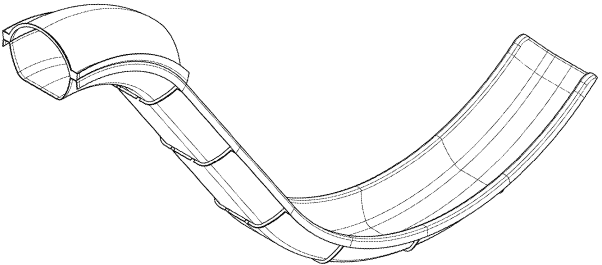
Gary Robert Schmit is a co-owner of Slick Slide and the named inventor on the ′821 patent. Slick Slide is a business that provides entertainment for children and adults in the form of customized recreational slides. Slick Slide designs and sells its slides throughout the United States. Slick Slide's “Launch Slide” design, which is at the center of this dispute, is protected by the ′821 patent. The ′821 patent was issued by the United States Patent and Trademark Office on December 27, 2022. Dkt. No. 1-1 at 2. The ′821 patent contains seven figures showing a recreational slide from different angles and claims “[t]he ornamental design for a recreational slide, as shown and described.” Id. at 2–9. Figure 1 is shown below:
Id. at 2. On February 9, 2023, Schmit assigned “the entire worldwide right, title, and interest in and to the” ′821 patent to Slick Slide. Dkt. No. 29-3 at 3.
Zachary Wittman was employed by Big Air Franchising, LLC, which sells franchises for indoor trampoline parks. Wittman was Big Air's Director of Field Operations with duties that included the design and building of all locations for the franchise system. Dkt. No. 42-13 at 2. In March 2023, Wittman formed V2 Adventure Products USA, LLC. Dkt. No. 33 at ¶13. According to Wittman, V2 did not become operational until October 2023, id., though there is evidence that Wittman was representing to others that V2 was operational as early as November 2022. Dkt. No. 42-5 at ¶¶5–7.
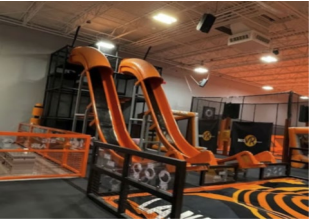
One of Big Air's franchisees is located in Charlotte, North Carolina (Big Air Charlotte). Jon Cox, the owner of Big Air Charlotte, testified that he decided to include two launch slides in his park at the suggestion of his business partner in January 2022. Dkt. No. 42-2 at 23. Cox then sent the layout of the park via email to Wittman, who was facilitating the design. Id. at 24. According to Wittman, sometime in February 2022, Cox also sent a picture of the slide he had in mind, which was an online picture of Slick Slide's launch slide. Dkt. Nos. 42-7 at 4–5 & 42-16 at 6. Cox testified that he intended to purchase the slides from Slick Slide, but Wittman arranged to have the slides manufactured by Big Air's preferred vendor, a Chinese company called Zhejian Zhongshen Amusement Equipment Co., Ltd., d/b/a Dreamland Playground (Dreamland). The two slides were shipped from China and installed at Big Air Charlotte prior to its opening in late March 2023. Dkt. No. 42-2 at 25–27, 31. Below is a photo of the slides as installed:
Cox testified that Wittman worked with Dreamland on the design of the entire park, including the design of the location of the slides. Id. at 16–17, 29. He was the “go-between” for Big Air Charlotte and Dreamland for that portion of the project. Id. at 5, 33. Even after the slides were installed, according to Cox, Wittman and/or V2 continued to assist Big Air Charlotte with the operation of its park and use of the slides by arranging for the purchase of slide sacks or mats, lubricant for the slides, and air bags. Id. at 27, 29, 35.
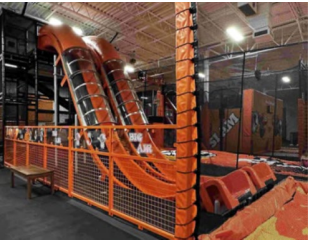
Another of Big Air's franchisees located in Greenville, South Carolina (Big Air Greenville) also installed two launch slides at its facility. Dustin Pelletier, the corporate representative of Big Air Greenville, testified that V2 and Wittman were responsible for the installation of the two slides, as well as the selection of the slides and coordination of the purchase from Dreamline. Dkt. No. 42-3 at 4. The installation occurred in June 2023, though the ordering of the slides appeared to have occurred the previous year. Id. at 7, 11. Below is a photo of the slides installed at Big Air Greenville:
Pelletier understood that Wittman was Big Air's employee responsible for construction and development of parks for franchisees. Wittman also had contacts with Dreamland and could help with new equipment purchases. Pelletier testified that Wittman suggested putting in the launch slides and Pelletier agreed. Wittman then arranged for the manufacture and shipment of the slides by Dreamland with Big Air Greenville paying Dreamland directly. Id. at 9. Wittman told Pelletier that the slides would be installed by V2 and identified Angel Hernandez as the V2 employee who would be doing the work. Id. at 27–28.
Sometime after he had received the picture of Slick Slide's launch slide from Cox and apparently forwarded it to Dreamland, Wittman initiated contact with Bron Launsby, Schmit's partner and part owner of Slick Slide, purportedly for the purpose of obtaining employment or a business relationship with Slick Slide. Dkt. Nos. 42-5 at ¶¶5–6 & 42-13. The interaction began in November 2022, weeks before the ′821 patent issued, and continued over the next several months in a series of emails. Dkt. Nos. 42-8, 42-9, & 42-13. Wittman represented to Launsby that he handled all distributions and installment for Big Air projects, including Big Air Charlotte and Big Air Greenville, through his company V2. He told Launsby that V2 had several employees, including an office manager, accountant, and maintenance/installation supervisor, and sent Launsby materials showing V2 products, pricing, and marketing materials. Dkt. No. 42-5 at ¶¶7–8. Wittman also arranged for Slick Slide representatives to travel to China and meet with Dreamland. Wittman represented to Launsby that V2 was the U.S. distributor for Dreamland and that Big Air purchased all its equipment from V2. Wittman further represented to Launsby that his work with V2 and Dreamland was separate from his work with Big Air. Id. ¶¶9–14.
On or about February 17, 2023, Jon Cox of Big Air Charlotte emailed a copy of the ′821 patent to Big Air and Wittman. Cox had been told of the patent by another franchisee of Big Air. In his email accompanying the patent, Cox stated: “Since Big Air is assisting in putting these in multiple parks, we need to get legal advice on how enforceable this design patent is and is there an associated utility patent that may be in the patent pending process.” Dkt. No. 29-4 at 4–5. Big Air Greenville's Pelletier testified that sometime thereafter (it is unclear when), Wittman told him and others in a conference call that Big Air had worked out an arrangement with Slick Slide allowing it to manufacture the slides. Dkt. No. 42-3 at 20.
Wittman denies that he was involved in the selection of the launch slides for Big Air Charlotte. He states that he was asked by Cox to assist in obtaining new attractions, including the slides, at his facility. In his role as an employee of Big Air, Wittman states, he contacted Dreamland, Big Air's preferred contractor for park equipment, and sent to Dreamland the information Cox had provided him for the new attractions, including the slides, that he wanted to add to his facility. Wittman states that his only role after that time was to pass documents and drawings back and forth between Cox and Dreamland, and to keep everyone informed as to timing and status of shipping. Dkt. No. 33. The same was true of his role in helping Big Air Greenville add slides to its facility, according to Wittman's deposition testimony. Dkt. No. 29-5 at 17–20.
Both Big Air Charlotte and Big Air Greenville, as well as Big Air itself, were sued by Slick Slide in separate actions for infringement of the ′821 patent. Those lawsuits have since settled, and the slides have since been removed from both parks. The current suit against Wittman and V2 arises out of Wittman's involvement in overseeing the manufacture, shipping, and installation of the slides at Big Air Charlotte and Big Air Greenville during his employment at Big Air Franchising. Slick Slide alleges that Defendants directly infringed and induced others to infringe its ′821 patent.
SUMMARY JUDGMENT LEGAL STANDARD
Summary judgment is proper when the moving party shows that there is no genuine dispute as to any material fact and that the movant is entitled to judgment as a matter of law. Fed. R. Civ. P. 56(a); Celotex Corp. v. Catrett, 477 U.S. 317, 322 (1986). In deciding a motion for summary judgment, the court must view the evidence and make all reasonable inferences in the light most favorable to the non-moving party. Johnson v. Advocate Health & Hosps. Corp., 892 F.3d 887, 893 (7th Cir. 2018) (citation omitted). The party opposing the motion for summary judgment must “submit evidentiary materials that set forth specific facts showing that there is a genuine issue for trial.” Siegel v. Shell Oil Co., 612 F.3d 932, 937 (7th Cir. 2010) (citations omitted). “The nonmoving party must do more than simply show that there is some metaphysical doubt as to the material facts.” Id. Stated differently, summary judgment “is the ‘put up or shut up’ moment in a lawsuit, when a party must show what evidence it has that would convince a trier of fact to accept its version of events.” Schacht v. Wis. Dep't of Corr., 175 F.3d 497, 504 (7th Cir. 1999); see also Butts v. Aurora Health Care, Inc., 387 F.3d 921, 924 (7th Cir. 2004) (“The mere existence of an alleged factual dispute will not defeat a summary judgment motion; instead, the nonmovant must present definite, competent evidence in rebuttal.”). Summary judgment is properly entered against a party that fails to “set forth specific facts showing that there is a genuine issue for trial.” Anderson v. Liberty Lobby, Inc., 477 U.S. 242, 250 (1986).
ANALYSIS
A. Standing
Defendants seek summary judgment on the issue of standing. They contend that Slick Slide lacks Article III standing to sue them for patent infringement because Slick Slide did not own the ′821 patent at the time of Defendants' alleged infringement. “To establish standing, a plaintiff must show an injury in fact caused by the defendant and redressable by a court order.” United States v. Texas, 599 U.S. 670, 676 (2023) (citing Lujan v. Defs. of Wildlife, 504 U.S. 555, 560–61 (1992)). As a general rule, “only he who is the owner of the patent at the time of the infringement can sue for damages ….” Crown Die & Tool Co. v. Nye Tool & Mach. Works, 261 U.S. 24, 43 (1923). This is because “[i]nfringement … harms only the owner of the patent at the time of the infringing acts.” Minco, Inc. v. Combustion Eng'g, Inc., 95 F.3d 1109, 1117 (Fed. Cir. 1996) (citing United States v. Loughrey, 172 U.S. 206, 211–12 (1898)). However, “[a] party may sue for past infringement transpiring before it acquired legal title if a written assignment expressly grants the party a right to do so.” Abraxis Bioscience, Inc. v. Navinta LLC, 625 F.3d 1359, 1367 (Fed. Cir. 2010) (citing Moore v. Marsh, 74 U.S. 515, 522 (1868); Arachnid, Inc. v. Merid Indus., Inc., 939 F.2d 1574, 1580–81 (Fed. Cir. 1991)).
Schmit assigned the ′821 patent to Slick Slide on February 9, 2023. Defendants point to the assignment's language and note that it is a type of general transfer of rights and does not specifically mention the right to sue for past infringement. This assignment, Defendants contend, does not “manifest intent to grant the ability to sue for any alleged activities that may have occurred prior to the Assignment.” Dkt. No. 28 at 9–10. Because the assignment failed to provide for transfer of pre-assignment infringement rights, Defendants argue, Slick Slide can only sue for post-assignment infringement. Id. at 10. And since the infringing conduct Slick Slide alleges Defendants engaged in occurred prior to the assignment, Defendants argue that Slick Slide lacks standing to assert a claim based on that conduct.
Slick Slide does not dispute Defendants' summary of the law governing standing to sue for patent infringement. Slick Slide also concedes that Schmit's assignment of the ′821 patent to Slick Slide did not include an assignment of pre-assignment claims for infringement and thus it cannot recover for any infringing conduct that took place prior to the assignment. Slick Slide insists, however, that it is not asserting any claims against Defendants based on their pre-assignment conduct. It is conduct that Defendants engaged in after February 9, 2023, that Slick Slide claims infringed the ′821 patent, both directly and indirectly, and for which Slick Slide seeks damages in this case.
In deciding Defendants' motion for summary judgment, the court must view the evidence in the light most favorable to Slick Slide, the non-movant. Johnson, 892 F.3d at 893. Viewed in this light, Slick Slide has offered sufficient evidence to establish its standing to sue Defendants for infringing and inducing others to infringe the ′821 patent. As noted above, assembling a patented invention may constitute direct infringement. Centrak, Inc. v. Sonitor Techs., Inc., 915 F.3d 1360, 1372 (Fed. Cir. 2019). Slick Slide has introduced evidence that Wittman and/or V2 installed the slides at Big Air Charlotte and Big Air Greenville. Big Air Charlotte's Cox, Big Air Greenville's Pelletier, and Wittman himself have all stated that Wittman handled all equipment distribution and installation for all Big Air franchises. Dkt. Nos. 42-2 at 17, 42-3 at 4, & 42-5 at ¶7. Although it is unclear precisely when installation of the slides at Big Air Charlotte occurred, Defendants have introduced no evidence in support of their motion that it occurred before Schmit assigned the ′821 patent to Slick Slide. Big Air Charlotte did not open until the end of March 2023, and thus it is more than possible that the slides were not installed until after the assignment, which would mean Slick Slide has standing to assert a direct infringement claim against Wittman and/or V2 for such installation.
Regardless of whether Slick Slide has standing to assert a direct infringement claim against Defendants based on assembly of the launch slides at Big Air Charlotte, however, it clearly has standing to assert its inducement of infringement claims against Defendants. Using a patented invention without authorization constitutes patent infringement, 35 U.S.C. §271(a), and knowingly facilitating the use of a patented invention constitutes inducement of infringement. Commil USA, LLC v. Cisco Sys., Inc., 575 U.S. 632, 639 (2015). Slick Slide has presented evidence that after Wittman learned of the ′821 patent on February 17, 2023, he both directly and through V2 facilitated Big Air Charlotte's use of the launch slides by actively assisting Big Air Charlotte in obtaining the slide sacks, lubricant, and air bags needed for use of the slides. There is even evidence that Wittman falsely told franchisees after he learned of the ′821 patent that Big Air had worked out an agreement with Slick Slide authorizing Big Air to make the slides. Dkt. No. 42-3 at 20. This evidence is sufficient to establish Slick Slide's standing to sue Defendants for their actions relating to Big Air Charlotte.
As to Big Air Greenville, there is no question of standing. Defendants do not dispute that the installation of the slides at Big Air Greenville occurred after February 9, 2023, and there is clear evidence, though it is disputed, that Wittman, through V2, installed the slides. Dkt. No. 42-3 at 6–7. Defendants argue, however, that the slides installed at Big Air Greenville cannot be considered in this case because Slick Slide did not assert any claim relating to Big Air Greenville in its complaint and has not amended its complaint to include such claims. Defendants argue that Slick Slide's attempt to bring Big Air Greenville into the case amounts to an improper de facto amendment of its pleadings and cannot be allowed. Dkt. No. 46 at 5.
Evidence relating to Big Air Greenville, however, is not a separate claim against Defendants; it is simply additional evidence in support of Slick Slide's claims that Defendants infringed the ′821 patent and induced others to infringe. There is no rule that a patentholder must file an amended complaint every time it learns that an alleged infringer has produced another infringing product. Defendants argue that although the allegations relating to the Big Air Greenville slides “fall under the same legal theories of direct and indirect infringement named in the Complaint, … they are predicated on different factual theories than the Big Air Charlotte allegations.” Id. at 6. They contend that “the Greenville slides were ordered by a different franchisee (BA Greenville), at a different time, and as part of a different shipment of differing equipment.” Id. That may be true, but the evidence suggests that the actions of Wittman and V2 were the same in both cases. For these reasons, and because Defendants will suffer no prejudice as a result, the court concludes that it may properly consider the evidence relating to Big Air Greenville.
For the foregoing reasons, even if an amendment of the complaint was required, the result would be the same. In other words, the court would allow the amendment. The Seventh Circuit described the analysis that governs such a determination in Chessie Logistics Co. v. Krinos Holdings, Inc.:
When a new argument is made in summary judgment briefing, the correct first step is to consider whether it changes the complaint's factual theory, or just the legal theories plaintiff has pursued so far. In the former situation, the plaintiff may be attempting in effect to amend its complaint, and the district court has discretion to deny the de facto amendment and to refuse to consider the new factual claims. In the latter, the court should consider the consequences of allowing the plaintiff's new theory. If it would, for example, cause unreasonable delay, or make it more costly or difficult to defend the suit, the district court can and should hold the plaintiff to his original theory. The district judge who is managing the case is ordinarily in the best position to answer these questions and to exercise sound discretion.
867 F.3d 852, 860 (7th Cir. 2017) (citations omitted).
Here, the court concludes that Defendants will suffer no prejudice if the facts relating to Big Air Greenville are considered in this case. Defendants have direct knowledge of those facts and Big Air Greenville has been a focus of discovery in the case since as early as June 2024. No trial date is currently set and so considering such evidence will not delay the case. Any prejudice can be avoided by allowing additional discovery if good cause is shown. And, finally, if the court disallowed the evidence, Slick Slide would simply start a second action, thereby increasing the time and expense needed to resolve this dispute. For all of these reasons, the court concludes that it can properly consider evidence relating to Big Air Greenville and based upon that evidence, as well as the evidence relating to Big Air Charlotte, the court is satisfied that Slick Slide has standing to sue in this case. Defendants' motion for summary judgment on this issue is denied.
B. Validity
Slick Slide has moved for summary judgment on Defendants' defense of patent invalidity. Slick Slide notes that Defendants failed to disclose any evidence or argument that the ′821 patent was invalid in response to its discovery requests. The presumption of validity, together with the absence of evidence or argument that the ′821 patent is invalid, Slick Slide argues, is sufficient to warrant summary judgment on patent validity in its favor. Dkt. No. 24 at 15. Before addressing Slick Slide's argument, it will be helpful to explain what design patents are and how they differ from utility patents.
Design patents are not like utility patents. A utility patent is issued to one who “invents or discovers any new and useful process, machine, manufacture, or composition of matter, or any new and useful improvement thereof.” 35 U.S.C. §101. A utility patent protects an inventor's exclusive right to his invention, the outer bounds of which must be described in written claims. See Markman v. Westview Instruments, Inc., 517 U.S. 370, 373–74 (1996) (“The claim defines the scope of a patent grant and functions to forbid not only exact copies of an invention, but products that go to the heart of an invention but avoids the literal language of the claim by making a noncritical change.”).
A design patent, by contrast, is granted to one who “invents any new, original and ornamental design for an article of manufacture.” 35 U.S.C. §171. “A design patent protects the nonfunctional aspects of an ornamental design as shown in the patent.” Elmer v. ICC Fabricating, Inc., 67 F.3d 1571, 1577 (Fed. Cir. 1995). “Design patents are claimed visually rather than verbally.” Mark A. Lemley and Mark P. McKenna, Design Patents Aren't Patents (And It's A Good Thing Too), 92 GEO. WASH. L. REV. 811, 819 (2024). Design patents “typically are claimed as shown in drawings, and … claim construction is adapted accordingly.” Egyptian Goddess, Inc. v. Swisa, Inc., 543 F.3d 665, 679 (Fed. Cir. 2008) (en banc). In other words, the preferable course in design patent cases “is not to attempt to ‘construe’ a design patent claim by providing a detailed verbal description of the claimed design.” Id. “To define the scope of a design patent, [courts] have traditionally focused on the figures illustrated in the patent.” Curver Luxembourg, SARL v. Home Expressions Inc., 938 F.3d 1334, 1339 (Fed. Cir. 2019).
A design that is essential to the use of an article, however, cannot be the subject of a design patent. Ethicon Endo-Surgery, Inc. v. Covidien, Inc., 796 F.3d 1312, 1328 (Fed. Cir. 2015) (citing L.A. Gear, Inc. v. Thom McAn Shoe Co., 988 F.2d 1117, 1123 (Fed. Cir. 1993)). A design is essential to the use of an article when the claimed design is dictated by the use or purpose of the article. Id. “Design patents on such primarily functional rather than ornamental designs are invalid.” Id. (citing PHG Techs. v. St. John Cos., 469 F.3d 1361, 1366 (Fed. Cir. 2006)); see also Bonito Boats, Inc. v. Thunder Craft Boats, Inc., 489 U.S. 141, 148 (1989) (“To qualify for protection, a design must present an aesthetically pleasing appearance that is not dictated by function alone, and must satisfy the other criteria of patentability.”).
According to Lemley and McKenna, the difference between utility patents and design patents is also reflected in the manner in which the applications for each are treated in the Patent and Trademark Office. “Design patents,” they write, “for all intents and purposes, are not examined in the Patent and Trademark Office (‘PTO’), as utility patents are; our design patent system is effectively a registration system.” Design Patents Aren't Patents, 92 GEO. WASH. L. REV. at 815. They explain the difference:
Utility patents are examined by technically skilled examiners who search for prior art and compare it to the claimed invention. There is room to doubt how good examiners are at doing prior art searches and whether they should devote more time to it, but the basic approach is well-established, and it differs from copyright law, which registers virtually every work without substantive examination. In theory, design patent applications are examined like utility patents. But in practice, in part because of central claiming, in part because it is currently so hard to search for designs, and in part because of the strange rules for anticipation and obviousness discussed in the last Section, the design patent prosecution process may as well be a registration system. Virtually every design patent application is allowed; only about 2% face anticipation or obviousness rejections. And there is nothing in design patent prosecution that is analogous to the narrowing of utility patent claims by amending them to add new elements.
Id. at 828–29. Nevertheless, “[d]esign patents enjoy the same presumption of validity as utility patents under 35 U.S.C. §282.” Ethicon Endo-Surgery, 796 F.3d at 1328. Defendants have the burden to prove invalidity of the ′821 patent by clear and convincing evidence. Id.
Returning to the question of whether Slick Slide is entitled to summary judgment on the issue of validity, Defendants suggest that the ′821 patent is invalid because it is dictated by function. In response to Slick Slide's argument for summary judgment on the issue of infringement, for example, Defendants state that “the ′821 Patent design is clearly dictated by function or at least contains so many functional elements that the scope of the ′821 Patent is extremely limited.” Dkt. No. 37-1 at 16. Notwithstanding this contention, however, Defendants surprisingly did not assert this invalidity defense in their answer or in discovery and, even now, do not contend that the ′821 patent is invalid for this reason. Although they offer a cursory argument in their brief in opposition to Slick Slide's motion for partial summary judgment that the patent is invalid under 35 U.S.C. §103 for obviousness, Dkt. No. 37-1 at 22–23, Defendants abandoned that argument at the hearing on the motions. Instead, their sole challenge to the validity of the ′821 patent at this stage of the litigation is that it fails to disclose all of the inventors.
In their own motion for summary judgment, Defendants argue that the ′821 patent is invalid for failing to list all the true inventors. Defendants contend that Gary Schmit's wife, Serena Schmit, who runs the design department at Slick Slide, should have also been named as at least a co-inventor on the patent. Dkt. No. 28 at 13. They base this argument on the deposition testimony of Gary Schmit describing the design process used at Slick Slide. Schmit testified that the process “starts off with a cocktail napkin that I create putting some ideas together. Then it would graduate to Serena to bring that to a drawing similar to what you're looking at on the screen, which is the patent drawing.” Dkt. No. 38-5 at 8. Defendants argue from this that Serena Schmit worked together with Gary Schmit at every stage of the development of the launch slide and was so integrally involved in its conception, execution, and registration that she should have been included as a co-inventor. Because she was not, Defendants argue, the patent is invalid and the case should be dismissed. Id. at 14.
As a threshold response, Slick Slide argues that failure to raise this issue as an affirmative defense in their answer or in their responses to discovery requests constitutes waiver. Dkt. No. 41 at 21. Slick Slide argues that Defendants waived its invalidity argument because the defense of improper inventorship is an affirmative defense to a claim of patent infringement that must be raised in Defendants' first responsive pleading. Slick Slide notes that Defendants did not even reference the relevant code section, 35 U.S.C. §101, anywhere in their answer or counterclaims. Id. Further, Slick Slide contends that Defendants' attempt to raise it at the summary judgment stage is prejudicial to Slick Slide because (1) Slick Slide is unable to depose any party regarding inventorship status now that discovery has closed; (2) Slick Slide could not inquire of Defendants the basis of their argument during written discovery; (3) Slick Slide is unable to present expert testimony regarding inventorship; (4) Slick Slide would have asked questions regarding this defense during its depositions and relied upon information obtained; and (5) Slick Slide would have addressed the issue in its own motion for summary judgment had it been raised earlier in the case. Id. at 21–22.
The inventorship defense is not waived. “A defendant's failure to plead an affirmative defense may result in a waiver of the defense if the defendant has relinquished it knowingly and intelligently, or forfeiture if the defendant merely failed to preserve the defense by pleading it.” Reed v. Columbia St. Mary's Hosp., 915 F.3d 473, 478 (7th Cir. 2019). Courts will generally find that the failure to plead an affirmative defense in the answer works a forfeiture, however, “only if the plaintiff is harmed by the defendant's delay in asserting it.” Id. This is especially true where, as here, the basis for the affirmative defense only surfaces at or after the close of discovery and the court can avoid prejudice to the plaintiff by reopening discovery. In this case, the court finds that Slick Slide is not harmed by allowing Defendants to assert the affirmative defense of inventorship. The facts relating to the conceptualization of the patented design are uniquely within the knowledge of Gary and Serena Schmit, and they have responded to Defendants' argument with declarations setting forth those facts. The court will therefore proceed to consider this defense.
Assuming the issue is not waived, Slick Slide argues that Gary is the only person responsible for the slide's conception, and that relevant patent law instructs that only he should be listed. Dkt. No. 41 at 14, 22. According to their declarations, Gary was the only person who conceived of the design and Serena simply created three-dimensional drawings at Gary's direction. Serena states in her declaration:
I did not conceive of any aspect of the design claimed in the ′821 patent. I also did not contribute to the conception of any aspect of the design claimed in the ′821 patent. Rather, as an employee of Slick Slide involved in the design department, I prepared the CAD drawings and the drawings shown in the ′821 patent, and did so at the instruction of Gary Schmit.
Dkt. No. 42-11 at ¶10. Serena further states that if she was determined to be an inventor, she would assign all her rights to Slick Slide. Id. ¶11. Similarly, Gary states in his declaration that he conceived of the design claimed in the ′821 patent, that he provided the idea for that design to Serena, and that he instructed her to create three-dimensional CAD drawings of his design and the drawings that appear in the ′821 patent. Dkt. No. 42-12 at ¶8.
It is questionable whether Defendants have standing to assert a defense of inventorship under these circumstances, though the parties have not raised that issue. Defendants claim no ownership interest in the patent themselves. See Chou v. Univ. of Chicago, 254 F.3d 1347, 1357 (Fed. Cir. 2001). Regardless of whether Defendants have standing, however, the sworn declarations of Gary and Serena Schmit, the named inventor and alleged co-inventor, are sufficient to defeat Defendants' motion for summary judgment based on lack of inventorship. To be a joint inventor, one must:
(1) contribute in some significant manner to the conception or reduction to practice of the invention, (2) make a contribution to the claimed invention that is not insignificant in quality, when that contribution is measured against the dimension of the full invention, and (3) do more than merely explain to the real inventors well-known concepts and/or the current state of the art.
Pannu v. Iolab Corp., 155 F.3d 1344, 1351 (Fed. Cir. 1998). “Where these requisites are satisfied but a patent fails to name the joint inventor, that patent may be invalid for non-joinder, [and] [w]hile inventorship is evaluated on a claim-by-claim basis, the failure to join an inventor of any claim invalidates the entire patent.” Plastipak Packaging, Inc. v. Premium Waters, Inc., 55 F.4th 1332, 1340 (Fed. Cir. 2022).
Gary states he conceived of the design and Serena has denied any contribution to the design of the slides. Serena states that she performed her work at the direction of Gary. The law is clear that “[o]ne may not qualify as a joint inventor … by ‘merely assisting the actual inventor after conception of the claimed invention.’” Hoop v. Hoop, 279 F.3d 1004, 1007 (Fed. Cir. 2002) (quoting Ethicon, Inc. v. U.S. Surgical Corp., 135 F.3d 1456, 1460 (Fed. Cir. 1998)). Defendants offer no evidence, let alone clear and convincing evidence, that would overcome the statements of the inventor and alleged co-inventor and the presumption of validity that attends a properly issued patent. Defendants' motion for summary judgment based on inventorship is therefore denied.
But the evidence offered by Slick Slide is also not dispositive of the issue so as to entitle Slick Slide to summary judgment. The difficulty with Slick Slide's argument that Gary is the true inventor because he came up with the concept of the design and Serena only created the drawings is that we do not know what concept Gary came up with; we don't know what Gary drew on the cocktail napkin. As noted above, design patents protect ornamental designs, and the design protected by such a patent consists of the drawings. “Where a design is claimed ‘as shown and described’ …, then the patent's scope of protection is limited by the drawings and accompanying description in the patent.” Smartrend Mfg. Grp. (SMG), Inc. v. Opti-Luxx Inc., 159 F.4th 1322, 1329 (Fed. Cir. 2025). The sole claim of the ′821 patent consists of the seven drawings contained in the patent, and Serena is the person who created those drawings. By Gary's own admission, “Serena Schmit created the design shown in the ′821 patent.” Dkt. No. 42-12 at ¶9. Serena likewise states that she prepared the CAD drawings and the drawings shown in the ′821 patent. Dkt. No. 42-11 at ¶10. A factfinder could find from this evidence that Serena is at least a co-inventor.
This is not to say that Gary could not have conceived of the design concept. In Hoop, for example, “Jeffrey and Stephen Hoop (‘Hoop brothers') conceived of a pair of eagle-shaped motorcycle fairing guards.” 279 F.3d at 1005. The Hoop brothers created sketches of the eagle design (figures 1 and 2 below), but because they lacked drawing and casting expertise, they hired Lisa Hoop, a graphic designer, and Mark Hoop (their cousin and Lisa's ex-husband), a metal die-caster (“Mark and Lisa”), to create drawings and a three-dimensional model (figure 3) for a patent application. Id.
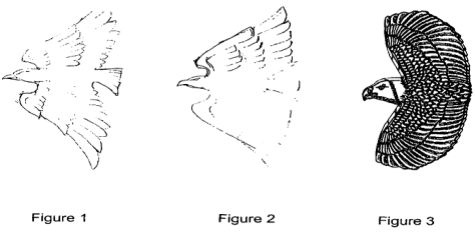
Id. at 1006. The Hoop brothers applied for and were issued a patent for the design. The drawing Mark and Lisa submitted differed from the sketches the Hoop brothers created, and after discussions over a manufacturing agreement between the parties failed, Mark and Lisa applied for their own design patent, using the same drawings they had prepared for the Hoop brothers. Both patent applications were initially granted, but during reexamination, Mark and Lisa's patent was rejected as anticipated by the Hoop brothers' patent. Id.
In the lawsuit that followed, the question presented was “whether the refinements made by Mark and Lisa rose to the level of inventorship, so as to displace the Hoop brothers as patentees.” Id. at 1007. The district court granted a preliminary injunction enjoining Mark and Lisa from making, using, or selling the motorcycle fairing guard, and Mark and Lisa appealed. In affirming the district court's finding that the Hoop brothers were likely to prevail on their claim that they were the true inventors, the Federal Circuit concluded that, based on the strong similarities between the drawings, which were part of the record, “the trial court could permissibly conclude at the preliminary injunction stage that the second design was likely to be found to be merely a more refined version of the first.” Id. at 1008.
In this case, however, we do not have the sketch that Gary made, nor does a description of the sketch appear in the record. As a result, the court is unable to compare the drawings Serena created with the design that Gary conceived. Absent more, the court is unable to determine as a matter of law that Serena was not an inventor. See Plastipak Packaging, 55 F.4th at 1343–44 (reversing summary judgment where there were factual disputes over inventorship). And while Slick Slide contends that any error could be corrected under 35 U.S.C. §256 and Serena has indicated her willingness to assign any interest she has in the ′821 patent to Slick Slide, no such correction has been requested and no assignment has been made. Slick Slide's motion for summary judgment on validity is therefore denied.
C. Patent Enforceability
Slick Slide has also moved for summary judgment on Defendants' claim that its patent is unenforceable due to misuse. “The doctrine of patent misuse is an affirmative defense to a suit for patent infringement … and requires that the alleged infringer show that the patentee has impermissibly broadened the physical or temporal scope of the patent grant with anticompetitive effect.” Windsurfing Int'l Inc. v. AMF, Inc., 782 F.2d 995, 1001 (Fed. Cir. 1986) (cleaned up). Defendants assert that Slick Slide has misused the ′821 patent in attempting to impermissibly broaden the temporal scope of the patent by alleging infringing acts that precede the issuance of the patent. Defendants also claim that Slick Slide has impermissibly attempted to broaden the physical scope of the patent by seeking damages for the amount paid for unpatented products purchased for use on the patented slides. The arguments are without merit.
As the previous discussion of the issue of standing shows, Slick Slide has made clear that it is not seeking damages for Defendants' conduct that preceded the assignment of the ′821 patent to Slick Slide. In other words, Slick Slide is not attempting to enforce its patent for conduct that occurred prior to the ′821 patent being issued. As the standing discussion also shows, there is ample evidence of infringing conduct that occurred after the patent was issued and assigned to Slick Slide.
Nor is Slick Slide improperly attempting to “tie its sales of slides based on the ′821 patent with multitudes of other products.” Dkt. No. 37-1 at 27. “Tying” arrangements may rise to the level of patent misuse if a complaining party can show that the patent owner has linked two separate products and that linking the products has an anticompetitive effect in the market for the second product. U.S. Philips Corp. v. ITC, 424 F.3d 1179, 1194 (Fed. Cir. 2005) (citing Jefferson Parish Hosp. Dist. No. 2 v. Hyde, 466 U.S. 2, 12 (1984)). Here, the only evidence of unlawful tying with anticompetitive effect that Defendants present is Slick Slide's expert report where the expert included closely related products commonly purchased with the Launch Slide in its damage calculation. Dkt. No. 37-1 at 27. The fact that Slick Slide's damage calculation includes amounts it believes it would have received for unpatented products it sold with its slides, however, does not constitute misuse of a patent. Defendants' argument to the contrary is cursory at best and is unsupported by either logic or authority. Slick Slide's motion for summary judgment on Defendants' patent unenforceability defense is therefore granted. The fact that Slick Slide's damage calculation includes amounts it believes it would have received for unpatented products it sold with its slides does not constitute misuse of a patent.
D. Infringement
Slick Slide also seeks summary judgment on the issue of infringement. A patent is infringed by one who “without authority makes, uses, offers to sell, or sells any patented invention, within the United States or imports into the United States any patented invention during the term of the patent therefor.” 35 U.S.C. §271(a). “[A] final assembler can be liable for making an infringing combination.” Centrak, Inc., 915 F.3d at 1372 (citing Cross Med. Prods., Inc. v. Medtronic Sofamor Danek, Inc., 424 F.3d 1293 (Fed. Cir. 2005); Lifetime Indus., Inc. v. Trim-Lok, Inc., 869 F.3d 1372 (Fed. Cir. 2017)). “Direct infringement is a strict-liability offense.” Commil USA, 575 U.S. at 639 (citing Global-Tech Appliances, Inc. v. SEB S.A., 563 U.S. 754, 760 n.2 (2011)).
One who induces the infringement of a patent can also be held liable for patent infringement. 35 U.S.C. §271(b) (“Whoever actively induces infringement of a patent shall be liable as an infringer.”). But inducement of patent infringement is not a strict liability offense; it requires knowledge that one's conduct will induce another to infringe. Global-Tech Appliances, 563 U.S. at 766 (holding that “induced infringement under §271(b) requires knowledge that the induced acts constitute patent infringement”); see also Commil USA, 575 U.S. at 639 (“In contrast to direct infringement, liability for inducing infringement attaches only if the defendant knew of the patent and that ‘the induced acts constitute patent infringement.’”); DSU Med. Corp. v. JMS Co., Ltd., 471 F.3d 1293, 1305 (Fed. Cir. 2006) (“To establish liability under section 271(b), a patent holder must prove that once the defendants knew of the patent, they ‘actively and knowingly aid[ed] and abett[ed] another's direct infringement.’” (quoting Water Techs. Corp. v. Calco, Ltd., 850 F.2d 660, 668 (Fed. Cir. 1988))).
There are factual disputes over the timing and extent of Defendants' involvement in the installation and use of the accused slides at Big Air Charlotte and Big Air Greenville that preclude summary judgment in Slick Slide's favor on the issue of whether Defendants directly infringed or induced infringement of the ′821 patent. Slick Slide contends that Wittman and/or V2 directly infringed the ′821 patent by installing the slides and induced Big Air Charlotte and Big Air Greenville to infringe by arranging for the purchase of items (slide lubricant, slide sacks, air bags) needed for the use of the slides. Wittman denies that either he or V2 installed the slides. He contends that the lubricant, slide sacks, and air bags he is accused of providing are commodities generally available on the open market, they were purchased by Big Air Charlotte and Big Air Greenville directly from Dreamland, and his only involvement in procuring these articles was providing updates regarding shipment dates pursuant to his duties as an employee of Big Air.
A trial will be needed to resolve these factual disputes. But these factual disputes are only material if the slides installed at the Big Air franchises in Charlotte and Greenville infringed the ′821 patent. Unless the slides themselves infringed the ′821 patent, Defendants' involvement in the installation or use of the slides cannot constitute direct or induced infringement. “Absent direct infringement of the patent claims, there can be neither contributory infringement, … nor inducement of infringement.” Met-Coil Sys. Corp. v. Korners Unlimited, Inc., 803 F.2d 684, 687 (Fed. Cir. 1986). It is this issue—that the slides installed at Big Air Charlotte and Big Air Greenville infringed the ′821 patent—that Slick Slide seeks to resolve in its favor on summary judgment.
“Determining whether a design patent has been infringed is a two-part test: (1) the court first construes the claim to determine its meaning and scope; (2) the fact finder then compares the properly construed claim to the accused design.” Lanard Toys Ltd. v. Dolgencorp LLC, 958 F.3d 1337, 1341 (Fed. Cir. 2020) (citing Elmer, 67 F.3d at 1577). The first step, construction of the patent claims, is a question of law to be decided by the court. Markman, 517 U.S. at 384–90. A claimed design is better represented by an illustration than a description. Egyptian Goddess, 543 F.3d at 679 (citing Dobson v. Dornan, 118 U.S. 10, 14 (1886)). For this reason, the Federal Circuit has instructed district courts that, unlike utility patents, “the preferable course ordinarily will be for a district court not to attempt to ‘construe’ a design patent claim by providing a detailed verbal description of the claimed design.” Id. (emphasis added); see also Lanard Toys, 958 F.3d at 1342 (approving of the lower court “reproducing the five exemplary figures from the patent and noting its reliance on those drawings”). But “[w]here a design contains both functional and nonfunctional elements, the scope of the claim must be construed in order to identify the nonfunctional aspects of the design as shown in the patent.” OddzOn Prods., Inc. v. Just Toys, Inc., 122 F.3d 1396, 1405 (Fed. Cir. 1997). This is because the scope of the claim “must be limited to the ornamental aspects of the design, and does not extend to ‘the broader general design concept.’” Ethicon Endo-Surgery, 796 F.3d at 1333 (quoting OddzOn Prods., 122 F.3d at 1405).
As for the second step, “[d]esign patent infringement is a question of fact, which a patentee must prove by a preponderance of the evidence.” Richardson v. Stanley Works, Inc., 597 F.3d 1288, 1295 (Fed. Cir. 2010). In comparing the patented and accused design, the “ordinary observer” test is applied. Infringement is found “[i]f, in the eye of an ordinary observer, giving such attention as a purchaser usually gives, two designs are substantially the same, if the resemblance is such as to deceive such an observer, inducing him to purchase one supposing it to be the other.” Egyptian Goddess, 543 F.3d at 670.
As noted above, Defendants argue that “the ′821 Patent design is clearly dictated by function or at least contains so many functional elements that the scope of the ′821 Patent is extremely limited.” Dkt. No. 37-1 at 16. Defendants further argue that given the limited scope of the ′821 patent, the relatively minor differences in several features of the accused slides, i.e., the length of the hood and the angle at which it is attached to the flume, the number of seams connecting the sections of the flume, the presence of flanges on the undercarriage, and the shape of the exit section, preclude the finding on summary judgment that the accused slides infringe the ′821 patent. From this court's review of the Federal Circuit decisions addressing these issues, including Lanard Toys, Ethicon Endo-Surgery, Richardson, and OddzOn Products, Defendants' arguments appear to have merit. The problem Defendants face, however, is that they failed to raise those issues until their response to Slick Slide's motion for partial summary judgment.
Slick Slide argues that Defendants waived all non-infringement defenses by failing to identify them in response to an interrogatory served during the discovery period. Dkt. Nos. 24 at 3, 14 & 43 at 2. In Interrogatory No. 4 of its First Set of Interrogatories, Slick Slide asked Defendants to “[s]eparately for each Accused Product, provide a claim chart identifying an explanation of all facts, documents, witnesses, and other detail on which Defendants relies [sic] to show how and why the recreational slide does not purportedly infringe the ′821 patent.” Dkt. No. 25-7 at 11. After asserting a series of boilerplate objections, Defendants responded that they “will provide their contentions on or before the deadline set by the Court.” Id. No deadline was ever set by the court, however, which means Defendants were required to provide their answer “within 30 days of being served with the interrogatories.” Fed. R. Civ. P. 33(b)(2). Defendants never provided the requested claim chart, and as a result, Slick Slide argues that Defendants waived any non-infringement defense.
Slick Slide's argument is not without merit. “Contention interrogatories … serve an important purpose in helping to discover facts supporting the theories of the parties. Answers to contention interrogatories also serve to narrow and sharpen the issues thereby confining discovery and simplifying trial preparation.” Woods v. DeAngelo Marine Exhaust, Inc., 692 F.3d 1272, 1280 (Fed. Cir. 2012) (citing Fed. R. Civ. P. 33, advisory committee's note (1970 Amendment, Subdivision (b))). This is especially true in patent cases where claim construction plays such an important role in the disposition of the case. As a result, many districts have adopted local patent rules that set specific times by which the parties are required to file claim charts setting out their respective positions on claim construction and infringement. Such rules “are designed to require parties to crystallize their theories of the case early in the litigation and to adhere to those theories once they have been disclosed.” Atmel Corp. v. Info. Storage Devices Inc., No. C 95–1987 FMS, 1998 WL 775115, at *2 (N.D. Cal. Nov. 5, 1998). These rules “advance[ ] this purpose by making it difficult subsequently to revise claim charts through eleventh hour ‘discovery’ of facts. Unlike the liberal policy for amending pleadings, the philosophy behind amending claim charts is decidedly conservative, and designed to prevent the ‘shifting sands’ approach to claim construction.” Id.
Although the Eastern District of Wisconsin has not adopted local rules specific to patent cases, the Federal Rules of Civil Procedure, as noted above, likewise require litigants to disclose relevant information requested by the opposing party in response to discovery requests. And while it is true that answers to contention interrogatories evolve over time as theories of liability and defense begin to take shape, parties have an obligation to supplement discovery responses as the case proceeds. Fed. R. Civ. P. 26(e). Defendants never answered Interrogatory No. 4, nor supplemented their response. “If a party fails to provide information or identify a witness as required by Rule 26(a) or (e), the party is not allowed to use that information or witness to supply evidence on a motion, at a hearing, or at a trial, unless the failure was substantially justified or is harmless.” Fed. R. Civ. P. 37(c)(1). Application of this Rule in the context of this case is governed by Federal Circuit law. Wi-LAN USA, Inc. v. Apple Inc., 830 F.3d 1374, 1384 (Fed. Cir. 2016) (“We review procedural issues specific to patent law under our law and those not specific to patent law under the regional circuit's law.”); see also O2 Micro Int'l Ltd. v. Monolithic Power Sys., Inc., 467 F.3d 1355, 1367–68 (Fed. Cir. 2006) (holding that given the plaintiff's delay in moving to amend its infringement contentions and its lack of adequate explanation for this delay, the district court did not abuse its discretion in finding a lack of diligence and therefore a lack of “good cause”).
District courts have case-management discretion to allow or disallow claim construction and non-infringement contentions that were not disclosed even as late as on motions for reconsideration of a court's summary judgment order. Wi-LAN USA, 830 F.3d at 1385. Moreover, courts generally prefer to resolve matters on the merits rather than upon procedural grounds when they can do so without causing any additional undue prejudice to a party-opponent. See United States v. Funds From Prudential Sec., 300 F. Supp. 2d 99, 105 (D.D.C. 2004) (“The dignity of a court derives from the respect accorded to its judgments. That respect is eroded, not enhanced, by too free a recourse to rules foreclosing consideration of claims on the merits.” (citation omitted)). The problem in this case, however, is that not only did Defendants fail to respond to Slick Slide's contention interrogatory, they offered no explanation as to why they failed to respond, nor have they argued that Slick Slide is not prejudiced by their failure to do so. In their brief in opposition to Slick Slide's motion for partial summary judgment, Defendants do not even address the argument. Dkt. No. 37-1. It is well-established in both the Seventh Circuit and the Federal Circuit that failure of a litigant to offer an argument in the district court constitutes a waiver of that argument. Fednav Int'l Ltd. v. Cont'l Ins. Co., 624 F.3d 834, 841 (7th Cir. 2010) (“[A] party who fails to adequately present an issue to the district court has waived the issue for purposes of appeal.”); Fresenius USA, Inc. v. Baxter Int'l, Inc., 582 F.3d 1288, 1296 (Fed. Cir. 2009) (“If a party fails to raise an argument before the trial court, or presents only a skeletal or undeveloped argument to the trial court, we may deem that argument waived on appeal, and we do so here.”).
Based on the foregoing, the court concludes that Defendants have waived any argument over the scope of the ′821 patent and the issue of noninfringement. Not only did Defendants waive their defense to Slick Slide's infringement allegations by failing to respond to its Interrogatory No. 4, they also waived any argument that they had not done so by failing to respond to Slick Slide's waiver argument in support of its motion for partial summary judgment. As a result, Slick Slide is entitled to summary judgment on the issue of whether the accused slides infringe the ′821 patent. Absent any argument to the contrary, Slick Slide's evidence for infringement in the form of the report of its expert, Mr. Win Cook, stands alone as evidence that the accused slides infringe the ′821 patent. Slick Slide's motion for summary judgment on infringement in this respect is therefore granted.
E. Damages
Finally, Slick Slide seeks partial summary judgment on the issue of lost profit damages. Slick Slide is not asking the court to determine the amount of such damages, only that they are available. “A lost profits award is appropriate only if the patent owner can prove there was a reasonable probability that ‘but for’ the infringement, it would have made the infringer's sales.” Kearns v. Chrysler Corp., 32 F.3d 1541, 1551 (Fed. Cir. 1994). “To recover under that test, the patent owner must prove (1) a demand for the patented product, (2) an absence of acceptable noninfringing substitutes, (3) manufacturing and marketing capability to exploit the demand, and (4) the amount of profit the patent owner would have made,” id., commonly referred to as the Panduit factors. Panduit Corp. v. Stahlin Bros. Fibre Works, Inc., 575 F.2d 1152, 1156 (6th Cir. 1978). It is the plaintiff's burden to prove damages by a preponderance of the evidence.
In support of this part of its motion, Slick Slide relies upon the report of Juli Saitz, a Senior Managing Director in the Forensic and Litigation Consulting Practice in the New York office of FTI Consulting, Inc. Saitz has more than twenty-five years of experience providing forensic accounting and financial and economic analysis to attorneys in litigation and has provided expert testimony in both litigation and arbitration settings. Dkt. No. 25-8 at 3. In the course of a 13-page report, Slick Slide's financial expert concludes both from application of the Panduit factors and from the fact that there was only a two-supplier market, that Slick Slide likely would have made the sales of the slides to Big Air Charlotte and Big Air Greenville but for Defendants' alleged infringing conduct. Slick Slide also points to the testimony of Jon Cox, the owner of Big Air Charlotte, that his original intention was to purchase the slides from Slick Slide. Dkt. No. 42-2 at 31. This evidence would permit a jury to find that but for the infringement, Slick Slide would have made the sales. But a jury would not be required to so find.
“The finding of the amount of damages for patent infringement is a question of fact on which the patent owner bears the burden of proof.” BIC Leisure Prods., Inc., v. Windsurfing Int'l, Inc., 1 F.3d 1214, 1217 (Fed. Cir. 1993) (citations omitted); see also SmithKline Diagnostics, Inc. v. Helena Labs. Corp., 926 F.2d 1161, 1164 (Fed. Cir. 1991) (“[T]he amount of a prevailing party's damages is a finding of fact on which the plaintiff bears the burden of proof by a preponderance of the evidence.”). Although Defendants summarily argue that the assertions in Saitz's report are “flawed” and the report should be excluded as unhelpful, no motion to exclude Saitz's opinions was filed. Defendants' arguments essentially challenge the weight of the evidence for the damage components claimed, not whether damages are available upon proof of infringement.
The fact that Defendants have not offered evidence that Slick Slide would not have made the sales, absent infringement, does not mean Slick Slide must prevail. Credibility, including credibility of expert witnesses, is an issue for the factfinder to decide. In other words, a jury would not be required to accept Cox's testimony or that of Saitz as true. Whether Slick Slide is entitled to such damages and the amount, if any, thereof are for the factfinder to determine. It thus follows that Slick Slide is not entitled to summary judgment that it is entitled to lost profits.
The parties have raised two other issues relating to damages that the court will briefly address. The damage calculation provided by Saitz includes not only the profits lost on the sale of the slides but also profits that would have been gained from the sale of products and services commonly sold with the slides, such as installation, tower systems, sliding matts, ground railings, and slide lubricant. Dkt. No. 25-8 at 11. Defendants argue that Saitz erred in including in the lost profits calculation sales for services and products not covered by the ′821 patent.
“When a patentee seeks damages on unpatented components sold with a patented apparatus, courts have applied a formulation known as the ‘entire market value rule’ to determine whether such components should be included in the damage computation ….” Rite-Hite Corp. v. Kelley Co., Inc., 56 F.3d 1538, 1549 (Fed. Cir. 1995). “[T]he entire market value rule permits recovery of damages based on the value of a patentee's entire apparatus containing several features when the patent-related feature is the ‘basis for customer demand.’” Id. The rule does not extend to “items that have essentially no functional relationship to the patented invention and that may have been sold with an infringing device only as a matter of convenience or business advantage.” Id. at 1550. Here, Saitz notes that there is evidence that the additional items for which lost profits are sought are “part of an overall integrated system.” Dkt. No. 25-8 at 10. While Defendants seek to challenge that evidence, the dispute is one for a jury to resolve.
Defendants also argue that Saitz failed to consider the amounts Slick Slide recovered in settlements of its earlier lawsuits involving the accused slides against Big Air and its franchisees in Charlotte and Greenville. Unless the settlement amounts Slick Slide has already recovered are set off against any damages it is awarded in this case, Defendants argue that Slick Slide would receive a double recovery for the same loss. In response to Defendants' argument for a set-off, Slick Slide contends that Defendants waived this affirmative defense by failing to include it in their answer to the complaint.
The court declines to find waiver under the facts of this case, at least as the record now stands. Slick Slide has already sued Big Air, Big Air Charlotte, and Big Air Greenville for damages resulting from infringement of its ′821 patent by the manufacture, sales, and installation of the slides at Big Air Charlotte and Big Air Greenville. It is not clear when the settlement of those lawsuits occurred or when Defendants would have first learned of the amounts Slick Slide recovered. In any event, Slick Slide is not prejudiced by allowing a set-off, assuming it is otherwise appropriate.
CONCLUSION
For the above reasons, Slick Slide's motion for partial summary judgment (Dkt. No. 23) is GRANTED-IN-PART. Except for the defense of inventorship, Slick Slide's motion is granted on Defendants' challenges to the validity of the ′821 patent and its enforceability. Summary judgment is also granted as to Slick Slide's claim that the Big Air Charlotte and Big Air Greenville slides infringe the ′821 patent. Slick Slide's motion for partial summary judgment is denied as to damages. Defendants' motion for summary judgment (Dkt. No. 27) is DENIED in full. The Clerk shall place this matter on the court's calendar for a telephone conference to address further proceedings.
SO ORDERED.