

Patent Cases, SOUND VIEW INNOVATIONS, LLC, Plaintiff-Appellant v. HULU, LLC, Defendant-Appellee, U.S. Court of Appeals, Federal Circuit, (Jan. 29, 2026)
SOUND VIEW INNOVATIONS, LLC, Plaintiff-Appellant v. HULU, LLC, Defendant-Appellee
U.S. Court of Appeals, Federal Circuit. 2024-1092. Decided: January 29, 2026.
Appeal from the United States District Court for the Central District of California in No. 2:17-cv-04146-JAK-PLA, Judge John A. Kronstadt.
Frederick Ding, Desmarais LLP, New York, NY, argued for plaintiff-appellant. Also represented by Alan Kellman.
Bradley M. Berg, O'Melveny & Myers LLP, Newport Beach, CA, argued for defendant-appellee. Also represented by Cameron William Westin, Brett Johnston Williamson; John C. Kappos, Dallas, TX; Jason Zarrow, Los Angeles, CA.
Before Prost, Wallach, and Chen, Circuit Judges.
Chen, Circuit Judge.
Sound View Innovations, LLC (Sound View) appeals a decision of the United States District Court for the Central District of California granting summary judgment of noninfringement in favor of Hulu, LLC (Hulu). See Sound View Innovations, LLC v. Hulu, LLC, No. 17-cv-04146-JAK-PLA, 2023 U.S. Dist. LEXIS 171867 (C.D. Cal. Sep. 25, 2023). The district court determined that Hulu does not infringe method claim 16 of U.S. Patent No. 6,708,213 (′213 patent) because (1) the accused products do not perform the claim limitations in the required sequence; and (2) the accused products do not have the claimed specialized buffer. Because we agree with the district court that claim 16 requires that its first two steps be performed in the order that they appear in the claim, we affirm.
Background
I. The ′213 Patent
The now-expired ′213 patent—titled “Method for Streaming Multimedia Information over Public Net-works”—discloses methods and apparatuses that reduce network latency while increasing the quality of media streamed to the devices of end-user customers. ′213 patent, Abstract. The invention improves upon prior streaming and caching techniques by using intermediate helper servers (HSs) [1] to cache content, coordinate distribution, and adjust data transfer rates. See id. at col. 2, l. 64–col. 3, l. 10. This results in faster content availability and enhances perceived quality for end-users.
Figure 2 of the ′213 patent depicts an exemplary network using the invention.
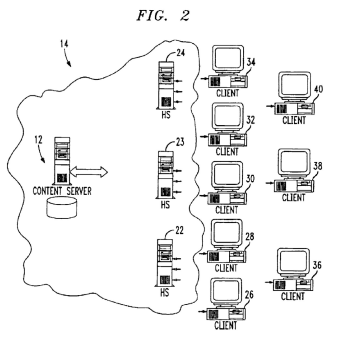
Id. at Fig. 2. This illustrative network has a content server 12, which serves multimedia content including text, audio, video, and graphic images. Id. at col. 5, ll. 3–4. The network also includes HSs 22–24, which “cache Internet resources, such as those requested by client computers 26–40 that have been downloaded from the content server 12 to allow localized serving of those resources.” Id. at col. 5, ll. 10–13. When an HS receives a Streaming Media (SM) object request, only “one part of the requested SM object will typically be stored in the local cache” of the HS. Id. at col. 5, ll. 21–23. “[U]pon receiving a request for an SM object from a client, the HS is [therefore] required to retrieve the non-stored portions of the SM object from the other HSs in the network 22–24.” Id. at col. 5, ll. 25–29.
Claim 16 of the ′213 patent recites:
16. A method of reducing latency in a network having a content server which hosts streaming media (SM) objects which comprise a plurality of time-ordered segments for distribution over said network through a plurality of helpers (HSs) to a plurality of clients, said method comprising:
receiving a request for an SM object from one of said plurality of clients at one of said plurality of helper servers;
allocating a buffer at one of said plurality of HSs to cache at least a portion of said requested SM object;
downloading said portion of said requested SM object to said requesting client, while concurrently retrieving a remaining portion of said requested SM object from one of another HS and said content server; and
adjusting a data transfer rate at said one of said plurality of HSs for transferring data from said one of said plurality of helper servers to said one of said plurality of clients.
Id. at claim 16.
II. Prior Proceedings
Sound View brought the present case against Hulu on June 2, 2017, alleging infringement of six patents. Only claim 16 of the ′213 patent remains at issue. Sound View contended that Hulu infringed claim 16 by directing third-party edge servers (the claimed “helper servers”) to perform every step of the asserted claim. Sound View argued that Hulu directed or controlled the content delivery networks to allocate a local buffer at an edge server. This local buffer then caches at least a portion of a Hulu video and downloads (i.e., sends) that video portion to a client while concurrently pre-fetching (i.e., retrieving) another portion of the same video. After construing several claim terms, the district court granted summary judgment of non-infringement because Hulu's edge servers do not download and retrieve subsequent portions of the same SM object in the same buffer.
On appeal, we affirmed the relevant claim constructions, holding the applicants' statements during prosecution of the ′213 patent “limited claim 16 to using the same buffer for the required concurrent downloading and retrieval of portions of a requested SM object.” Sound View Innovations, LLC v. Hulu, LLC, 33 F.4th 1326, 1334–35 (Fed. Cir. 2022) (Hulu I). We also vacated the district court's summary judgment order and remanded with instructions to adopt “an affirmative construction of ‘buffer’” that “could then be compared to the accused-component ‘caches.’” Id. at 1336. We observed that “[i]t appears that ‘buffer’ should be given the ordinary meaning proposed by Sound View here and in the district court based on a dictionary definition: ‘temporary storage for data being sent or received.’” Id.
On remand, the district court construed the term “buffer” to mean “short term storage associated with said requested SM object,” Sound View Innovations, LLC v. Hulu, LLC, No. 17-cv-04146-JAK-PLA, 2022 WL 20275657, at *1 (C.D. Cal. Oct. 3, 2022) (Remanded Claim Construction Order), and granted Hulu leave to file a new motion for summary judgment, J.A. 1587. In its summary judgment ruling, the district court made two additional claim construction determinations: (1) the first limitation of claim 16 must be performed before the second limitation; and (2) claim 16 requires a specialized buffer, not a generic one. See J.A. 22–24. Finding that the accused products do not satisfy claim 16 as construed, the district court again granted summary judgment of noninfringement in favor of Hulu. Id. at 25.
Sound View now appeals. We have jurisdiction under 28 U.S.C. §1295(a)(1).
Standards of Review
We review a district court's grant of summary judgment under the law of the regional circuit. Vasudevan Software, Inc. v. MicroStrategy, Inc., 782 F.3d 671, 676 (Fed. Cir. 2015). The Ninth Circuit reviews an order granting summary judgment de novo. Comite de Jornaleros de Redondo Beach v. City of Redondo Beach, 657 F.3d 936, 942 (9th Cir. 2011). In the Ninth Circuit, “summary judgment is appropriate when, even ‘draw[ing] all reasonable inferences in favor of the non-moving party,’ there is no ‘genuine issue of material fact.’” Vasudevan, 782 F.3d at 676 (alteration in original and citations omitted).
When reviewing a district court's claim construction, we review de novo “the ultimate question of the proper construction of patent claims and the evidence intrinsic to the patent.” Id. When considering extrinsic evidence, “we review the subsidiary factual findings underlying the district court's claim construction for clear error.” Id.
“Whether an accused device infringes requires a two-step analysis—the court first ‘determines the scope and meaning of the patent claims asserted, and then the properly construed claims are compared to the allegedly infringing device.’” Hulu I, 33 F.4th at 1335 (quoting CommScope Techs. LLC v. Dali Wireless Inc., 10 F.4th 1289, 1295 (Fed. Cir. 2021)). The second step of the analysis is a question of fact. Absolute Software, Inc. v. Stealth Signal, Inc., 659 F.3d 1121, 1129–30 (Fed. Cir. 2011).
Discussion
The district court granted summary judgment of noninfringement on two independent grounds. Sound View must therefore prevail on both grounds to prevail in this appeal. For reasons explained below, we hold the district court (1) erred in its construction of the claimed term “buffer,” but (2) correctly construed claim 16 to require a specific order of operation. Because the second ground independently supports the grant of summary judgment, we affirm.
I. General Purpose Buffer
As we noted in our prior opinion, the ordinary meaning of “buffer” is “temporary storage for data being sent or received.” Hulu I, 33 F.4th at 1336 (internal quotation marks omitted). The district court, however, construed the term “buffer” to mean “short term storage associated with said requested SM object.” Remanded Claim Construction Order, 2022 WL 20275657, at *1. It noted that the language of claim 16—e.g., “allocating a buffer … to cache at least a portion of the requested SM object”—indicates that the buffer is “necessarily associated with the requested SM object.” Id. at *5 (citing ′213 patent, col. 14, ll. 39–40). The district court further observed that several embodiments and the prosecution history disclose allocating a buffer associated with the same SM object. Id. at *6. According to the district court, this association transforms the claimed buffer into a specialized buffer dedicated to a single SM object. J.A. 23–24. Because the buffers in the accused products are general purpose, the district court determined they cannot be the specialized buffers required by claim 16. Id. at 24. The district court therefore concluded that the accused products do not infringe claim 16. Id. We disagree that claim 16 requires a specialized buffer.
“We generally give words of a claim their ordinary meaning in the context of the claim and the whole patent document.” World Class Tech. Corp. v. Ormco Corp., 769 F.3d 1120, 1123 (Fed. Cir. 2014) (citations omitted). “[T]he specification particularly, but also the prosecution history, informs the determination of claim meaning … and even if the meaning is plain on the face of the claim language, the patentee can, by acting with sufficient clarity, disclaim such a plain meaning or prescribe a special definition.” Id. This means that “a claim term may be clearly redefined without an explicit statement of redefinition” and “[e]ven when guidance is not provided in explicit definitional format, the specification may define claim terms by implication such that the meaning may be found in or ascertained by a reading of the patent documents.” Trs. of Columbia Univ. in City of New York v. Symantec Corp., 811 F.3d 1359, 1364 (Fed. Cir. 2016) (alteration in original) (quoting Phillips v. AWH Corp., 415 F.3d 1303, 1320–21 (Fed. Cir. 2005) (en banc)).
Nothing in the claim language describes the buffer as a specialized buffer that must be associated with only one SM object. See Hulu I, 33 F.4th at 1336 (“[T]here is no definition [of a ‘buffer’] … in the ′213 patent itself.”). Claim 16 merely recites “a buffer” that can “cache at least a portion of” a requested SM object. ′213 patent, col. 14, ll. 39–40. The claim language does not suggest that this buffer is exclusively assigned to store SM objects, much less require the buffer to be exclusively reserved for a single SM object. See id. at claim 16.
The specification does not clearly indicate a deviation from the ordinary and customary meaning of the term “buffer.” The “Client Request Aggregation” and
“RTP/RTSP” embodiments describe a “ring buffer” and “buffer pool,” not a “buffer.” See id. at col. 5, ll. 55–65; id. at col. 10, ll. 57–67. A ring buffer differs from a generic buffer because it is allocated in anticipation that the “same SM object” would be frequently requested. Id. at col. 5, ll. 63–65. To that end, a ring buffer maintains a sliding window of a certain size, allowing it to more efficiently service the same SM object within a time interval. See id. at col. 6, l. 59–col. 7, l. 27. Similarly, a buffer pool is different from a single buffer, as only the former has a “management module” that specifically “attaches each new incoming SM object request to an existing buffer.” Id. at col. 10, ll. 33–36. To the extent that these specialized buffers are associated with only one SM object, they are structurally distinct from a generic buffer and do not provide a clear and unmistakable disclaimer that the general-purpose buffer in claim 16 should also be associated with only one SM object. See Luminara Worldwide, LLC v. Liown Elecs. Co., 814 F.3d 1343, 1353 (Fed. Cir. 2016) (citing Trs. of Columbia, 811 F.3d at 1362–64).
Hulu points to one statement in the prosecution history, but it does not move the needle. During prosecution, the patentee distinguished its invention from the prior art by pointing out that its “invention concurrently empties and fills the buffer, while the DeMoney reference teaches filling the buffer only after the buffer is empty.” Hulu I, 33 F.4th at 1334 (citation omitted); J.A. 925. Though this statement describes using the same buffer to concurrently download and retrieve an SM object, it does not exclude the use of the same buffer to store multiple requested SM objects.
In light of the intrinsic evidence, we see no reason to depart from the plain and ordinary meaning of the word “buffer.” The district court thus erred in narrowing the claimed buffer to be a specialized buffer that is “associated with” an SM object.
II. Implicit Ordering in Method Claim
The district court determined that claim 16 requires a specific sequence for the first two recited steps: first “receiving a request for an SM object from one of said plurality of clients at one of said plurality of helper servers,” then “allocating a buffer at one of said plurality of HSs to cache at least a portion of said requested SM object.” J.A. 22. It explained that “[a] buffer cannot be allocated to cache a portion of a requested SM object if there is no requested SM object.” Id. Because the accused products do not perform the claim limitations in the correct sequence, the district court concluded they do not infringe claim 16. Id. at 24.
On appeal, neither party disputes that the accused products do not perform the claim limitations in the order required by the district court. See Appellant Br. 45–57; Appellee Br. 18–19. The parties instead disagree on whether claim 16 requires an order of steps. We conclude that it does.
As a general rule, “[u]nless the steps of a method [claim] actually recite an order, the steps are not ordinarily construed to require one.” Interactive Gift Express, Inc. v. Compuserve Inc., 256 F.3d 1323, 1342 (Fed. Cir. 2001) (citation omitted). However, “a claim ‘requires an ordering of steps when the claim language, as a matter of logic or grammar, requires that the steps be performed in the order written, or the specification directly or implicitly requires’ an order of steps.” Mformation Techs., Inc. v. Rsch. in Motion Ltd., 764 F.3d 1392, 1398 (Fed. Cir. 2014) (citation omitted). Here, both the grammar and logic of claim 16 require the first limitation to be performed before the second.
The first limitation of method claim 16 recites “receiving a request for an SM object …,” where the SM object is initially a general SM object. ′213 patent, col. 14, l. 36. The second limitation recites “allocating a buffer … to cache … said requested SM object.” Id. at col. 14, ll. 39–40. Grammatically, “a request for an SM object” in the first limitation provides an antecedent basis for “said requested SM object” in the second. [2] The past participle— “requested”—acts as an adjective modifying the noun “SM object,” describing a logical relationship: for “requested SM object” to make sense, a request must have occurred before the object can be described as “requested.” Indeed, only after a request is received does the SM object acquire the status of being “requested.”
In other words, “requested” is not only a grammatical descriptor, but also is a status indicator reflecting a completed action—the receiving of a request. Because the second limitation expressly references “said requested SM object,” it necessarily depends on the first limitation having been performed. The buffer cannot be allocated to cache a “requested” SM object if no request has been received. “[B]ecause the language of … the step[] of its method claim refer[s] to the completed results of the prior step, … all of those steps [must be] performed in order.” E-Pass Techs., Inc. v. 3Com Corp., 473 F.3d 1213, 1222 (Fed. Cir. 2007).
Sound View argues that claim 16, unlike other unasserted claims, does not recite an order. Appellant Br. 46. It points to claims 10 and 13 as examples of when the grammar of the claims clearly envisioned the steps to be performed in a specific sequence. According to Sound View, claim 10, for example, uses numbers and letters to set out the sequence of which the steps must be performed. See ′213 patent at claim 10. Claim 13, on the other hand, uses conditional language to specify when “allocating a first ring buffer” occurs—“upon receiving said first request.” Id. at col. 13, ll. 63–65. Because the language of claim 16 does not possess such grammatical structures, Sound View contends that claim 16 is not limited in the same manner as the other claims. Appellant Br. 46–47.
Sound View also asserts that a claim mandates a specific sequence of the recited steps only if the latter step cannot be performed, as written, without first performing the earlier step. Id. at 48 (citing Interactive Gift, 256 F.3d at 1343; Altiris, Inc. v. Symantec Corp., 318 F.3d 1363, 1371 (Fed. Cir. 2003)). Sound View relies on Loral Fairchild Corp. v. Sony Corp., which held that the claim at issue required an order because “the insulation layer must already be in place in order to align the barrier regions with it during ion implantation.” 181 F.3d 1313, 1321 (Fed. Cir. 1999). Here, Sound View argues that it is permissible to allocate a buffer before receiving a client request for an SM object because the request merely identifies which existing SM object to place into the buffer. Appellant Br. 52–53. Thus, Sound View believes that the grammar and logic of the claim language do not compel a specific sequence for the steps of claim 16.
Finally, Sound View points to Figure 7B in the specification to support its position that the steps of claim 16 could be performed in any order. Id. at 54–55. According to Sound View, Figure 7B shows a single buffer embodiment where the HS (i.e., H 75) uses a pre-allocated buffer (i.e., B1 79) that initially stores K1 second (i.e., a portion) of a SM object before receiving a request for either the same or another SM object. Appellant Br. 55. Once it receives a request from the client, it immediately sends the K1 second of SM object to the client “while concurrently retrieving” more data. Id. Sound View asserts that this embodiment follows an order of operations where the buffer was already allocated before receiving a request for a SM object. Id. Sound View argues that the district court's order-of-steps construction excludes this embodiment and therefore must be erroneous. Id. at 55–57.
We disagree with all three of Sound View's arguments. Claims 10 and 13 do not establish that claim 16's steps can be performed in any order. As a threshold matter, there is “a presumption that distinct claims … have different scopes.” World Class Tech., 769 F.3d at 1125 (citation omitted). This presumption means “that the difference between claims is significant,” and we should be wary of importing limitations of one claim into another. Andersen Corp. v. Fiber Composites, LLC, 474 F.3d 1361, 1369–70 (Fed. Cir. 2007) (citing Tandon Corp. v. U.S. Int'l Trade Comm'n, 831 F.2d 1017, 1023 (Fed. Cir. 1987)). Claim 10 uses numbering and lettering for a specific purpose: to cross-reference its own steps. The absence of such markers in claim 16, however, does not compel the conclusion that its steps may be performed in any sequence. Claim 13, on the other hand, establishes a particular ordering of some steps through conditional language, such as allocating a buffer “upon receiving [a] first request.” ′213 patent, col. 13, ll. 64–65. Such conditional phrasing is unnecessary in claim 16 because its grammar and logic, as explained above, already impose an ordering. In sum, claims 10, 13, and 16 simply use different ways to indicate that certain claimed steps must be performed in a particular order.
Our caselaw on implicit ordering does not help Sound View, as it does not require a finding that the performance of the claimed steps would be inoperable if the steps are not followed in the order they appear in the claim. Instead, we look to the claim language and specification to determine whether “the steps of a method claim had to be performed in their written order because each subsequent step referenced something logically indicating the prior step had been performed.” Altiris, 318 F.3d at 1370 (citing Mantech Env't Corp. v. Hudson Env't Servs., Inc., 152 F.3d 1368, 1375–76 (Fed. Cir. 1998)). In other words, implicit ordering exists when there are inherent logical dependencies or functional relationships between the recited steps of a method claim.
Sound View's reliance on Figure 7B is misplaced because that figure does not provide the necessary information that maps onto the relevant portions of claim 16. [3] As Sound View concedes, “nothing in the embodiment describes any allocation occurring in response to a client request.” Appellant Reply 14 (emphasis added). Indeed, Figure 7B describes the “data transfer rate control” involved in filling and draining an already pre-allocated buffer. See ′213 patent, col. 8, ll. 20–21 (“FIGS. 7a and 7b illustrate two network configurations which describe data transfer rate control.”). The embodiment is therefore not directly applicable to how to understand the claimed “allocating a buffer … to cache … said requested SM object” limitation.
Even if this embodiment is relevant to our analysis, Sound View does not describe how that embodiment's pre-allocated buffer “already contains the K1 portion of the requested SM object.” Appellant Br. 12; see also id. at 54–55. Indeed, the written description simply “assume[s] that the HS 75 initially has K1 seconds of data in its buffer.” ′213 patent, col. 8, ll. 47–48. Because this embodiment description skips over the relevant portion of the overall process that potentially could map onto the first two steps of claim 16, Figure 7B and its corresponding description does not show an example of allocating a buffer to cache a portion of an SM object before a request is made for that SM object.
Conclusion
The district court did not err in construing claim 16 to require a specific sequence of steps. Because the accused products do not perform the claim limitations in the required sequence, they do not infringe claim 16 of the ′213 patent.
We have considered Sound View's remaining arguments and find them unpersuasive. For the foregoing reasons, we affirm.
AFFIRMED
|
|