

Patent Cases, SCALE BIOSCIENCES, INC. and ROCHE SEQUENCING SOLUTIONS, INC., Plaintiffs, v. PARSE BIOSCIENCES, INC., Defendant., U.S. District Court, D. Delaware, (Jun. 17, 2026)
SCALE BIOSCIENCES, INC. and ROCHE SEQUENCING SOLUTIONS, INC., Plaintiffs, v. PARSE BIOSCIENCES, INC., Defendant.
PARSE BIOSCIENCES, INC. and UNIVERSITY OF WASHINGTON, Counterclaim-Plaintiffs, v. SCALE BIOSCIENCES, INC., Counterclaim-Defendant.
U.S. District Court, D. Delaware. Civil Action No. 22-1597-CJB. June 17, 2026.
Kelly E. Farnan and Sara M. Metzler, RICHARDS, LAYTON & FINGER, PA, Wilmington, DE; Stephen S. Rabinowitz, WOLF, GREENFIELD, & SACKS, P.C., New York, NY; Chelsea A. Loughran, Stuart V.C. Duncan Smith, Emma L. Frank, and Arden E. Bonzo, WOLF, GREENFIELD, & SACKS, P.C., Boston, MA, Attorneys for Plaintiff and Counterclaim-Defendant Scale Biosciences, Inc.
Karen L Pascale and Robert M. Vrana, YOUNG, CONAWAY, STARGATT & TAYLOR LLP, Wilmington, DE; Byron L. Pickard, R. Wilson Powers III (argued), Chandrika Vira, Christopher M. Gallo, Brady P. Gleason, David Y. Wang, Louis P. Panzica, Jr., Ryan N. Kaiser, and Cristen A. Corry, STERNE, KESSLER, GOLDSTEIN & FOX, P.L.L.C., Washington, D.C., Attorneys for Defendant and Counterclaim-Plaintiff Parse Biosciences, Inc. and Counterclaim-Plaintiff University of Washington.
Burke, Magistrate Judge
Burke, Magistrate Judge
MEMORANDUM OPINION
In this action filed by Plaintiff and Counterclaim-Defendant Scale Biosciences, Inc. (hereafter, “Scale”) against Defendant and Counterclaim-Plaintiff Parse Biosciences, Inc. (hereafter, “Parse”), Parse, along with Counterclaim-Plaintiff University of Washington (“UW”), brings counterclaims of infringement of United States Patent Nos. 10,900,065 (the “′065 patent”), 11,168,355 (the “′355 patent”), and 11,427,856 (the “′856 patent” and collectively, the “challenged patents” or Parse's “patents-in-suit”). Presently before the Court [1] is Scale's “Motion for Summary Judgment of Invalidity of the Challenged Parse Claims[,]” filed pursuant to Federal Rule of Civil Procedure 56 (“Motion”). (D.I. 302) For the reasons set forth below, the Motion is GRANTED. [2]
I. BACKGROUND
The Court incorporates by reference its discussion of the factual and procedural background of this case found in its Memorandum Opinions dated October 8, 2025 (the “October 8 MO”) and November 4, 2025 (the “November 4 MO”), to the extent it is relevant to the instant Motion. (D.I. 466 at 2-5; D.I. 499 at 2-6) Below the Court includes additional background information that is also relevant to the Motion.
A. Procedural Background
Scale filed the Motion on February 24, 2025, which was the same date that the parties each also filed various other summary judgment and Daubert motions. [3] (D.I. 302) With the Motion, Scale argues, inter alia: (1) that the asserted (or “challenged”) claims of the ′065 patent are invalid for lack of written description in the application from which the patent issued; (2) that the lack of description in that application means that the challenged claims of the ′355 and ′856 patents cannot claim priority by relying on this application; and (3) without the ability to claim the priority date of this application, the challenged claims of the ′355 and ′856 patents are anticipated by a prior art journal article. (D.I. 307 at 33, 40)
At this point in the case, the Court has already granted Scale's summary judgment motion of non-infringement for all of the challenged claims of the challenged patents identified herein. (D.I. 500) However, the invalidity arguments raised via the present Motion still require resolution, because Scale raises counterclaims of invalidity (in addition to non-infringement) in response to Parse's assertions of patent infringement, (D.I. 87 at 26-28, at ¶¶14-20; id. at 28-29, at ¶¶27-33; id. at 30-31, at ¶¶40-46), and because Scale has not indicated that it no longer intends to pursue those counterclaims, (see D.I. 498 at 212-13).
The Motion was fully briefed as of April 17, 2025. (D.I. 391) In a prior order, the Court denied a portion of this Motion on grounds separate from and independent of those discussed herein. (D.I. 472) The Court then heard very lengthy oral argument on the remainder of the Motion—i.e., the portion that is at issue herein—on October 10, 2025 and October 20, 2025. (D.I. 496 (hereinafter, “Tr.”); D.I. 498) [4]
B. Factual Background
The challenged patents claim “[m]ethods of uniquely labeling or barcoding molecules within a cell, a plurality of cells, and/or a tissue[.]” (See, e.g., ′065 patent, Abstract) [5] Such a method is further described in claim 1 of the ′065 patent (hereafter referred to as “claim 1”), which is representative of the general method claimed in all of the challenged patents. Claim 1 recites as follows:
1. A method of uniquely cell-specifically labeling RNA molecules within a plurality of cells, the method comprising:
(a) providing a plurality of permeabilized cells in admixture, wherein each of the plurality of cells comprises ribonucleic acid (RNA) molecules;
(b) without lysing the cells, reverse transcribing the RNA molecules within the plurality of cells, thereby generating complementary deoxyribonucleic acid (cDNA) molecules within the plurality of cells, wherein primers used to reverse transcribe the RNA molecules comprise a poly(T) sequence, a mix of random sequences, or both a poly(T) sequence and a mix of random sequences;
(c) dividing the plurality of cells comprising the cDNA molecules into a plurality of primary aliquots, wherein the plurality of primary aliquots comprises a first primary aliquot and a second primary aliquot;
(d) providing primary nucleic acid tags to the plurality of primary aliquots, wherein the primary nucleic acid tags provided to the first primary aliquot are different in sequence from the primary nucleic acid tags provided to the second primary aliquot;
(e) coupling the provided primary nucleic acid tags of (d) to the cDNA molecules from each of the plurality of primary aliquots, thereby tagging the cDNA molecules with the primary nucleic acid tags and producing primary nucleic acid-tagged cDNA molecules, whereby the primary nucleic acid-tagged cDNA molecules of the first primary aliquot are tagged with a different primary nucleic acid tag than the primary nucleic acid-tagged cDNA molecules of the second primary aliquot;
(f) combining the plurality of primary aliquots;
(g) dividing the combined primary aliquots of (f) into a plurality of secondary aliquots, wherein the plurality of secondary aliquots comprises a first secondary aliquot and a second secondary aliquot;
(h) providing secondary nucleic acid tags to the plurality of secondary aliquots, wherein the secondary nucleic acid tags provided to the first secondary aliquot are different in sequence from the secondary nucleic acid tags provided to the second secondary aliquot; and
(i) coupling the provided secondary nucleic acid tags of (h) to the primary nucleic acid-tagged cDNA molecules of (e) thereby tagging the primary nucleic acid-tagged cDNA molecules with the secondary nucleic acid tags and producing secondary nucleic acid-tagged cDNA molecules, whereby the secondary nucleic acid-tagged cDNA molecules of the first secondary aliquot are tagged with a different secondary nucleic acid tag than the secondary nucleic-acid tagged cDNA molecules of the second secondary aliquot.
(′065 patent, cols. 29:44-31:3 (emphasis added)) All of the challenged patents recite similar steps in laying out their method claims. However, as will be discussed further below, claim 1 of the ′355 patent modifies step (b), by including a reference to barcodes, as shown below:
(b) without lysing the cells, reverse transcribing the RNA molecules within the plurality of cells, thereby generating complementary deoxyribonucleic acid (cDNA) molecules within the plurality of cells, wherein primers used to reverse transcribe the RNA molecules comprise a poly(T) sequence, a mix of random sequences, or both a poly(T) sequence and a mix of random sequences, wherein each primer further comprises a barcode sequence[.]
(′355 patent, col. 29:41-48 (emphasis added)) And so does the ′856 patent:
(b) without lysing the cells, reverse transcribing the RNA molecules within the plurality of cells, thereby generating complementary deoxyribonucleic acid (cDNA) molecules within the plurality of cells, wherein primers used to reverse transcribe the RNA molecules comprise a poly(T) sequence, a mix of random sequences, or both a poly(T) sequence and a mix of random sequences, wherein each primer further comprises a first barcode sequence; wherein the first barcode sequence is specific to each well or compartment[.]
(′856 patent, col. 29:42-52 (emphasis added))
Step (b), which describes the process of reverse transcription, is particularly relevant to the present Motion. Reverse transcription is a process for synthesizing a (more stable) cDNA molecule that is complementary to the (less stable) mRNA that is produced in the cell. (D.I. 313, ex. 23 at ¶¶59-60; D.I. 327 at ¶21) Claim 1 recites that certain “primers [are to be] used to reverse transcribe the RNA molecules[,]” which will sometimes be referred to herein as “RT primers.” (′065 patent, col. 29:52-53; see also ′355 patent, col. 29:44-45; ′856 patent, col. 29:45-46; D.I. 303 at ¶¶D6, D8) The parties agree that a “primer” is “[a] short sequence of nucleic acids that … is adapted to be extended in a template-dependent manner by a polymerase[.]” (D.I. 108-1 at 16) And, in order to facilitate reverse transcription, an RT primer must be complementary to a portion of the mRNA's sequence, such that the RT primer can anneal or bind to the mRNA through the pairing of their complementary nucleotides, as shown in the image below:
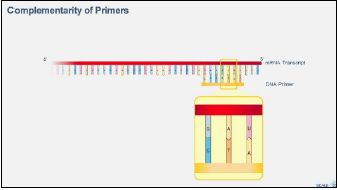
(D.I. 327, ex. 30 at ¶54)
It is these RT primers—and how they are represented in the challenged patents and the disclosures of the relevant patent applications—that are at issue in this portion of the Motion. Below, the Court sets out some additional facts regarding the challenged patents and the challenged claims that will be useful to know when assessing the issues discussed herein.
1. Some of the Challenged Claims Require the RT Primer to Include a Barcode Sequence.
Given the nature of Scale's written description arguments, it is helpful to split the challenged claims up into two different categories.
First, with regard to the ′065 patent, Parse asserts infringement of independent claim 1, as well as claims 12 and 20, which depend on claim 1. (D.I. 439 at 1) As was noted above, the method of these claims recites, in step (b), using “primers [] to reverse transcribe the RNA molecules[.]” (′065 patent, col. 29:52-53) Second, Parse also asserts infringement of claims 1, 5-6, and 22 of the ′355 patent and claims 1, 5-7, and 22 of the ′856 patent. (D.I. 439 at 1) This second group of challenged claims (“the Barcode Claims”) contains the additional limitation, referred to above, that the “primers used to reverse transcribe the RNA molecules … further comprise[] a [] barcode sequence” (the “barcode sequence limitation”). (′355 patent, col. 29:44-49; ′856 patent, col. 29:45-50; see also D.I. 303 at ¶D8) [6] The parties agree that a “barcode sequence” is “[a] sequence of nucleotides added to a molecule that is capable of identifying or aiding in identification of the cell from which the molecule originated[.]” (D.I. 108-1 at 16)
Therefore, all of the challenged claims recite the use of RT primers. But only some of the challenged claims explicitly require that the RT primer include a barcode sequence. [7]
2. The Challenged Claims of the ′065 Patent Were Amended During Prosecution to Exclude Language That Had Explicitly Required the RT Primers to Have a 5' Overhang Sequence.
Another important aspect of the RT primers of the claimed method (i.e., in addition to the fact that they may or may not be required to include a barcode sequence) is apparent upon examination of the prosecution history of the challenged patents. Claim 1 issued from U.S. Patent Application No. 14/941,433 (“the ′433 Application”) and asserts priority to U.S. Provisional Patent Application No. 62/080,055 (“the ′055 Provisional”). (′065 patent, cover page at (21), (60)) During prosecution of the ′065 patent, relevant portions of claim 1 were amended.
As originally filed in the ′433 Application, the initial claims therein that recited reverse transcription (including independent claims 24, 38, and 53) all required using a “reverse transcription primer comprising a 5' overhang sequence[.]” (D.I. 303 at ¶D4 (emphasis added); see, e.g., D.I. 309, ex. 20 at PARSE0000079, PARSE0000082, PARSE0000085) A 5' overhang sequence (hereafter, an “overhang”), when included in the RT primer, refers to the portion of the primer that does “not hybridize to [m]RNAs, but may instead provide an accessible binding” site for other molecules. (D.I. 327, ex. 29 at ¶102 n.1; see also D.I. 309, ex. 20 at PARSE0000063; D.I. 498 at 220) The image below, an annotated portion of Figure 2 from the ′065 patent, depicts an RT primer (highlighted in yellow) with an overhang (highlighted in green):
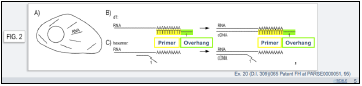
(Scale's Summary Judgment Presentation, Slide 5)
The language in the claims explicitly requiring an RT primer with an overhang was removed during prosecution. (D.I. 303 at ¶D6 (citing various amendments made during the prosecution history of the ′065 patent); D.I. 307 at 34; D.I. 327, ex. 29 at ¶100) As such, the ′065 patent issued without that language included in the claims. (D.I. 303 at ¶D6; D.I. 374 at ¶D6; see also ′065 patent, cols. 29:44-31:3) Additionally, none of the Barcode Claims of the later-filed patents include language explicitly stating that the RT primers referenced therein must have an overhang. (D.I. 303 at ¶D8; D.I. 374 at ¶D8)
3. The Rosenberg Reference Was Published Before the Applications for the ′355 Patent and the ′856 Patent Were Filed.
As was mentioned above, in support of its anticipation arguments regarding the ′355 and the ′856 patents, Scale relies on a journal article titled “Single-cell profiling of the developing mouse brain and spinal cord with split-pool barcoding[,]” which was authored by Alexander B. Rosenberg et al. (“Rosenberg”). (D.I. 307 at 40-42; D.I. 313, ex. 33) The parties stipulated that Rosenberg was published on April 13, 2018. (D.I. 303 at ¶D9 (citing D.I. 283 at 2, 9))
The ′065 patent issued from the ′433 Application, which was filed on November 13, 2015—i.e., before the later publication date of Rosenberg. (D.I. 303 at ¶D2; ′065 patent at 1) The ′355 patent and the ′856 patent, on the other hand, issued from applications that were filed on February 25, 2021, and November 8, 2021, respectively—i.e., dates that fall more than two years after the publication of Rosenberg. (D.I. 303 at ¶D10) However, both the ′355 patent and the ′856 patent purport to claim priority to the ′433 Application. (′355 patent at 1; ′856 patent at 1)
Additional facts relevant to resolution of the instant Motion will be discussed in Section III.
II. STANDARD OF REVIEW
The Court incorporates by reference its discussion of the legal standards relating to summary judgment motions, claim construction, invalidity generally, and the written description requirement—all of which were set out in its October 8 MO. (D.I. 466 at 5-8) Below, the Court will also discuss the legal standards relevant for addressing a motion for summary judgment of invalidity on anticipation grounds, which is also relevant to this portion of the Motion.
A patent claim is anticipated under 35 U.S.C. §102(a) if:
(1) the claimed invention was patented, described in a printed publication, or in public use, on sale, or otherwise available to the public before the effective filing date of the claimed invention; or
(2) the claimed invention was described in a patent issued under section 151, or in an application for patent published or deemed published under section 122(b), in which the patent or application, as the case may be, names another inventor and was effectively filed before the effective filing date of the claimed invention.
35 U.S.C. §102. To anticipate, a “reference must disclose each and every element of the claimed invention, whether it does so explicitly or inherently.” In re Gleave, 560 F.3d 1331, 1334 (Fed. Cir. 2009). This test mirrors, to some extent, the test for infringement, and “it is axiomatic that that which would literally infringe if later anticipates if earlier.” Bristol-Myers Squibb Co. v. Ben Venue Lab'ys, Inc., 246 F.3d 1368, 1378 (Fed. Cir. 2001). In order to anticipate, however, a reference must enable one of skill in the art to make and use the invention without undue experimentation, In re Gleave, 560 F.3d at 1334, and must also “show all of the limitations of the claims arranged or combined in the same way as recited in the claims,” Net MoneyIN, Inc. v. VeriSign, Inc., 545 F.3d 1359, 1370 (Fed. Cir. 2008).
“To antedate a prior art reference, a patentee must establish that it invented the subject matter recited in the patent claims before the reference's priority date.” Raytheon Co. v. Sony Corp., 727 F. App'x 662, 667-68 (Fed. Cir. 2018). But “[i]t is elementary patent law that a patent application is entitled to the benefit of the filing date of an earlier filed application [] if the disclosure of the earlier application provides support for the claims of the later application, as required by [the written description requirement of] 35 U.S.C. §112 [(‘Section 112’)].” PowerOasis, Inc. v. T-Mobile USA, Inc., 522 F.3d 1299, 1306 (Fed. Cir. 2008) (quoting In re Chu, 66 F.3d 292, 297 (Fed. Cir. 1995)); see also 35 U.S.C. §120. As was noted in the Court's October 8 MO, in order to satisfy this written description requirement, the disclosure of the prior application must “convey with reasonable clarity to those skilled in the art that, as of the filing date sought, [the inventor] was in possession of the invention.” Vas-Cath Inc. v. Mahurkar, 935 F.2d 1555, 1563-64 (Fed. Cir. 1991). “Compliance with the written description requirement is a question of fact but is amenable to summary judgment in cases where no reasonable fact finder could return a verdict for the non-moving party.” PowerOasis, 522 F.3d at 1307.
III. DISCUSSION
With this portion of the Motion, as was noted previously, Scale makes two different arguments for the invalidity of the challenged claims—i.e., arguments relating to lack of written description and to anticipation. Although the invalidity grounds at issue are different, the core issue underlying this portion of Scale's Motion is the same as to all three of the challenged patents: Is there sufficient support in the disclosure of the ′433 Application, such that: (1) the ′065 patent does not violate the written description requirement; and (2) the ′355 and ′856 patents can thus claim priority to the ′433 Application (and therefore avoid being anticipated by Rosenberg)? (D.I. 307 at 33; D.I. 359 at 36 & n.11)
Scale argues that there is not sufficient disclosure in the ′433 Application to cover the entire scope of RT primers encompassed by the challenged claims. (D.I. 307 at 34; D.I. 391 at 16-17) More specifically, Scale asserts that because the challenged claims recite “primers used to reverse transcribe the RNA molecules[,]” (see, e.g., ′065 patent, col. 29:52-53), and are silent as to whether the primers must include an overhang or not, both RT primers with an overhang and RT primers without an overhang necessarily fall within the scope of those claims. (D.I. 391 at 16) From there, Scale argues that the patentee, via its disclosure, is required to demonstrate possession of the invention utilizing both RT primers with and without an overhang. (D.I. 307 at 33-35) However, as Scale points out, the ′433 Application does not disclose any RT primers without an overhang. (D.I. 391 at 16; D.I. 498 at 218) And so, according to Scale, the relevant patent application fails to meet the written description requirement.
In response, Parse did not point to any evidence suggesting that any part of the ′433 Application discloses and demonstrates the inventors' possession of an invention utilizing RT primers without an overhang (again, a type of RT primer that Parse concedes would fall within the scope of the claims). (D.I. 359 at 36-41) Specifically, Parse and its expert did not: (1) identify an embodiment in the ′433 Application that described an example of using an RT primer without an overhang; nor (2) explain how the ′433 Application's disclosure of RT primers with an overhang somehow demonstrates the features or properties of said primers that could aid a person of ordinary skill in the art (“POSITA”) in determining which RT primers without an overhang are operative. (D.I. 498 at 225-26; Scale's Summary Judgment Presentation, Slides 7, 11) Instead, Parse argues that such primers without an overhang need not be disclosed because they would all be predictably inoperable if used in the claimed method. (Id.; Tr. at 99; D.I. 313, ex. 23 at ¶89; D.I. 498 at 217-18) Parse's response implicates the parties' first dispute, which is legal in nature: If a patent does not disclose an embodiment of an asserted claim, but that embodiment is inoperable, does this failure of disclosure render the claim invalid due to lack of sufficient written description? (D.I. 391 at 16-17; D.I. 498 at 218)
In their briefing, the parties then also addressed a second, related dispute—one predicated on the factual record before the Court. Here, Scale asserts that even if Parse is only required to disclose operable embodiments (and is not required to disclose inoperable ones), there is no genuine dispute of fact that a POSITA would find certain claimed embodiments of an RT primer without an overhang to in fact be operable in the claimed method; thus, because such operable embodiments would have to have been disclosed and were not, Scale says the Motion should still be granted. (D.I. 307 at 36-37; D.I. 391 at 19) In support of this position, Scale offers the testimony of its expert, Dr. Alex K. Shalek. (D.I. 327 at ¶¶83-101) To that, Parse responds with the testimony of its expert, Dr. Rahul Satija; Dr. Satija asserts that each of the various types of embodiments described by Dr. Shalek would be viewed by a POSITA as being predictably inoperable. (D.I. 359 at 40-41)
With all of this now laid out, below the Court will take up and resolve both of these written description-related disputes. After doing so, the Court will then address the implications of its written description decisions on the question of anticipation regarding the challenged claims of the ′355 patent and the ′856 patent.
A. Inoperable Embodiments and Written Description
The parties' first dispute is about whether and to what extent undisclosed but inoperable embodiments can render a patent's claims invalid for lack of written description. This issue was challenging, particularly in light of the dearth of case law that squarely addresses the question.
The Court starts with first principles. As a general matter, a patentee must “compl[y] with the written description requirement by describing the invention, with all its claimed limitations[.]” Regents of the Univ. of California v. Eli Lilly & Co., 119 F.3d 1559, 1566 (Fed. Cir. 1997) (internal quotation marks and citations omitted, emphasis added). As the Supreme Court of the United States has explained, “[w]hat is claimed by the patent application must be the same as what is disclosed in the specification; otherwise the patent should not issue.” Festo Corp. v. Shoketsu Kinzoku Kogyo Kabushiki Co., 535 U.S. 722, 736 (2002).
From there, the primary case that Scale relies on in support of its position is the Supreme Court's decision in Graver Tank & Manufacturing Co. v. Linde Air Products Co., 336 U.S. 271 (1949), adhered to on reh'g, 339 U.S. 605 (1950). (D.I. 307 at 36; D.I. 391 at 17-18; Tr. at 44-55) So below, the Court will examine the relevant portion of Graver Tank in some detail.
In Graver Tank, the Supreme Court addressed patent claims directed to “an electric welding process and for fluxes, or compositions, to be used therewith.” Graver Tank, 336 U.S. at 272. Of particular interest to the Court's opinion here are claims 24 and 26 of the patent-in-suit in Graver Tank; these two claims were claims to a “flux” for use in a welding process known as “flux welding[.]” Id. at 273, 276. The flux compositions at issue comprised, inter alia, “silicates” and “metal silicates.” Id. at 276. The district court held claims 24 and 26 invalid for lack of written description because they “were too broad and comprehended more than the invention.” Id. at 276-77. While there were only nine operative metallic silicates specifically named in the relevant patent specifications, the district court “declined to interpret the terms ‘silicates' and ‘metallic silicates' therein [i.e., as those terms were used in the patent's claims] as being limited or qualified by specifications to mean only th[ose] nine metallic silicates which had been proved operative.” Id. at 276. Instead, the district court found that the claim terms “silicates” and “metallic silicates” facially referred to a group that was “broad[er]” than just the nine listed silicates in the patent; the patent instead claimed all metal silicates, including silicates that were not then known to be operative. Id. at 276-77. In light of this, and in light of the fact that the patent only disclosed a narrower subset of nine operable embodiments, the district court invalidated these “claims … [for] comprehend[ing] more than the invention.” Id. at 276.
The appellate court later reversed the district court's decision as to these two claims, holding that the claims were valid. In doing so, the appellate court concluded that “because there was nothing in the record to show that the [patentee] intended by these claims to assert a monopoly broader than nine metallic silicates named in the specifications, the [district] court should have construed the claims as thus narrowed and limited by the specifications.” Id. at 276-77. With the scope of the claims understood in this more limited way, the Court of Appeals found there to be no invalidity problem, in light of what the patent disclosed. Id.
The Supreme Court ultimately agreed with the district court. Id. at 277. The relevant portion of its holding is brief, and reads as follows:
The [Patent Act] makes provision for specification separately from the claims and requires that the latter ‘shall particularly point out and distinctly claim the part, improvement, or co[m]bination which he claims as his invention or discovery.’ … It would accomplish little to require that claims be separately written if they are not to be separately read. While vain repetition is no more to be encouraged in patents than in other documents, and claims like other statements may incorporate other matter by reference, their text must be sufficient to ‘particularly point out and distinctly claim’ an identifiable invention or discovery. We have frequently held that it is the claim which measures the grant to the patentee…. While the cases more often have dealt with efforts to resort to specifications to expand claims, it is clear that the latter fail equally to perform their function as a measure of the grant when they overclaim the invention. When they do so to the point of invalidity and are free from ambiguity which might justify resort to the specifications, we agree with the District Court that they are not to be saved because the latter are less inclusive….
We think the District Court correctly applied this principle to claims 24 and 26.
Id. (internal citations omitted, emphasis added).
This excerpt begs a few questions relevant to our inquiry. What does the above portion (and particularly the italicized portion) of Graver Tank mean? And does it support Scale's argument that a patentee's claims will be invalid if the patent does not describe or disclose certain claimed embodiments that are nevertheless inoperative?
Surely, this excerpt from Graver Tank can at least be understood to mean that the Supreme Court agreed with the district court and concluded that the claim language at issue (i.e., “silicates” and “metal silicates”) was broad enough to include embodiments (i.e., silicates) that were either known to be inoperative or that were not yet known to be operative. Importantly, both the district court and the Supreme Court found this fact led to invalidity, because the claims “comprehended more than the invention” or “overclaim[ed] the invention.” Id. at 276-77. In other words, something about the asymmetry between what the claims claimed (“silicates” generally) and what the specification disclosed (only nine operative silicates)—led to the claims' “invalidity[.]” Id. at 276-77; cf. Pernix Ireland Pain DAC v. Alvogen Malta Operations Ltd., 323 F. Supp. 3d 566, 628-29 (D. Del. 2018) (finding claims invalid for lack of written description, where the claims encompassed all oral dosages of hydrocodone-only formulations containing at least some of the hydrocodone in extended-release form, but only disclosed one such embodiment of that genus in the specification—under circumstances where it was clear that undisclosed formulations existed that were covered by the claims and yet had not been disclosed), aff'd sub nom. on other grounds, Persion Pharms. LLC v. Alvogen Malta Operations Ltd., 945 F.3d 1184 (Fed. Cir. 2019).
In light of the above, it is possible to read Graver Tank as suggesting that patent claims must be invalidated for lack of written description when they “overclaim the invention” by including any inoperable embodiments within their scope. (Tr. at 44, 47) If that is the correct way to read Graver Tank, then the Court's analysis could stop here. Just as in Graver Tank, the challenged claims here include broad language reciting “primers used to reverse transcribe the RNA molecules”—i.e., claims undeniably encompassing all RT primers, regardless of whether they include or lack an overhang sequence. (D.I. 307 at 36) Just as in Graver Tank, the ′433 Application only provides sufficient written description support for some of that claim scope—i.e., only for the use of RT primers with an overhang (or what Parse asserts to be the operable portion of the claim scope) in the method. (Id.) Thus, in light of Graver Tank, one might conclude that here, the patentee “overclaim[ed] the invention” by claiming the use of certain RT primers that are not known to be operable (and that were thus not disclosed or described in the challenged patents' specification). (Id.; Tr. at 108-09)
Parse, however, argues that Graver Tank is distinguishable from the facts here. To that end, Parse asserts that the key thing about Graver Tank is that there, there were “many inoperative embodiments” that fell within the broad scope of the patent claims at issue. (D.I. 359 at 38-39 (citing Graver Tank, 336 U.S. at 276) (emphasis added)) In contrast, Parse states that that is not the case here. Parse argues that here, there are only two possible alternatives in the claimed genus: (1) the disclosed, operable primers with an overhang; and (2) the undisclosed, inoperable primers without an overhang. (D.I. 359 at 39; Tr. at 70-71 (Parse's counsel arguing that the RT primers in the challenged claims involve “a genus of two”)) Since the patents-in-suit here implicate a much less “significant” amount of undisclosed, inoperable embodiments (as compared to the circumstances in Graver Tank), Parse suggests the rationale of Graver Tank doesn't apply in this case. (D.I. 359 at 38-39; Tr. at 74-75)
One challenge with Parse's argument is that in Graver Tank, the Supreme Court never really made it plain or clear that the decision turned on the fact that there were a large number of inoperable embodiments claimed by the patent-in-suit. That is, the Graver Tank Court never explicitly indicates that the outcome turned on how many species of claimed silicates there were, and on how many of them were not known to be operable. (Tr. at 51-53, 55; see also id. at 83, 85 (Parse's counsel, acknowledging the same)) Indeed, as Scale notes, the Graver Tank “decision does not even mention how many such [inoperable] embodiments exist[.]” (D.I. 391 at 18; see also Tr. at 51-53, 55, 76)
During oral argument though, Parse's counsel made much of the fact that the district court opinion in Graver Tank includes at least some reference to the amount of inoperable embodiments that were claimed by claims 24 and 26. (Tr. at 77-80 (citing Linde Air Prods. Co. v. Graver Tank & Mfg. Co., 86 F. Supp. 191, 198 (N.D. Ind. 1947)) And that is true. At one point in the district court opinion, the court states that “[t]he evidence is clear and convincing that many silicates, even many metallic silicates, are inoperative[.]” Linde Air Prods. Co., 86 F. Supp. at 198 (emphasis added). But was that fact important to the Graver Tank Court's decision? If it was, one would think the Supreme Court would have made more of it in the opinion itself. (Tr. at 80 (Parse's counsel noting that this is a “fair point”); id. at 108)
But on the other hand, it is possible that Parse is right—and that Graver Tank should not be read so broadly as to invalidate patent claims where only some (or perhaps only a small number) of undescribed, inoperable embodiments fall within the claims' scope. In that vein, the Court returns to the portion of Graver Tank wherein the Supreme Court says the following:
While the cases more often have dealt with efforts to resort to specifications to expand claims, it is clear that the [claims] fail equally to perform their function as a measure of the [patent] grant when they overclaim the invention. When [the claims] do so to the point of invalidity and are free from ambiguity which might justify resort to the specifications, we agree with the District Court that [the claims] are not to be saved because the [specifications] are less inclusive.
Graver Tank, 336 U.S. at 277 (emphasis added). By noting that “overclaim[ing] the invention” only presents a problem when a patentee does so “to the point of invalidity[,]” id., Graver Tank could be read to suggest that it might be acceptable for claims to cover some inoperable embodiments under certain circumstances. So it might be that the Graver Tank Court was not concerned with the existence of any undisclosed, inoperable embodiments within the scope of the claims—and instead, that the decision meant to convey that broad claims should be understood to be invalid only when they unduly overclaim the invention (such as by reading on significant numbers of inoperable embodiments, or for some other reason). (D.I. 359 at 38-39)
That kind of a reading of Graver Tank would draw some support from subsequently issued opinions of the United States Court of Appeals for the Federal Circuit (or its predecessor courts). In In re Cook, 439 F.2d 730, 735 (C.C.P.A. 1971), for example, a decision issued by the United States Court of Customs and Patent Appeals (“Court of Customs and Patent Appeals”), the Court quoted that above-referenced language in Graver Tank and stated that in that case “[i]n 1949[,] the Supreme Court held that claims may be too broad ‘to the point of invalidity’ by reason of reading on significant numbers of inoperative embodiments.” 439 F.2d at 734 (quoting Graver Tank, 336 U.S. at 276-77) (emphasis added). The Cook Court further concluded that, in the instant case, the “appellants' claims [were] not too broad ‘to the point of invalidity’ just because they read on even a very large number of inoperative embodiments”—since there it was conceded that “a person skilled in the relevant art could determine which conceived but not-yet-fabricated embodiments would be inoperative with expenditure of no more effort than is normally required of a lens designer checking out a proposed set of parameters.” Id. (emphasis added). Other Federal Circuit opinions discussing Graver Tank seem to read similarly in this regard. See, e.g., Maxwell v. J. Baker, Inc., 86 F.3d 1098, 1107 (Fed. Cir. 1996) (“However, the Court [in Graver Tank] affirmed the district court's decision in which it held these broad claims to be invalid on the ground that many metal silicates embraced by the claims, but not disclosed in the specification, were inoperative.”) (emphasis added); Crown Operations Int'l, Ltd. v. Solutia Inc., 289 F.3d 1367, 1380 n.8 (Fed. Cir. 2002).
Indeed, in its briefing, Parse significantly focused on an additional, similar decision of the Court of Customs and Patent Appeals that discussed Graver Tank: In re Smythe, 480 F.2d 1376 (C.C.P.A. 1973). (D.I. 359 at 36-39; Tr. at 65-74, 99) As with the cases above, Smythe also contains some language that supports Parse's position here.
In Smythe, the Court of Customs and Patent Appeals took up an appeal from the Patent Office Board of Appeals (“Board”). Smythe, 480 F.2d at 1377. In that case, the Board had affirmed the rejection of several claims of a patent application, the relevant portion of which had claimed certain “inert fluid[s.]” Id. at 1377-78. The claims at issue were directed to systems and methods for analyzing discrete liquid samples, where the claimed “inert fluid” is used as a segmentizing medium (i.e., to separate the samples). Id. The Board affirmed the Examiner's rejection of the “inert fluid” claims on two written-description-related grounds: (1) that “additional structure is necessary to … employ fluids other than air[,]” since both gases and liquids were within the scope of the claims, but the specification had only disclosed the use of the former, not the latter; and (2) the claims were too broad because “the term ‘fluid’ is ‘so broad as to include inoperative fluids.’” Id. at 1382.
As to the first written description-related ground, the Smythe Court disagreed with the Board's decision. Id. at 1383-85. While it found that the use of “air or other gas[es]” as the segmentizing medium had been explicitly disclosed, the court also determined that “the specification clearly conveys to one skilled in the art that in this invention the characteristics of a fluid are what make the segmentizing medium work in th[e] invention.” Id. (emphasis added). More specifically, the Smythe Court opined as follows:
We are not saying that the disclosure of “air or other gas which is inert to the liquid” sample by itself is a description of the use of all “inert fluid” media [i.e., including liquids]. Rather, it is the description of the properties and functions of the “air or other gas” segmentizing medium described in appellants' specification which would suggest to a person skilled in the art that appellants' invention includes the use of “inert fluid” broadly.
Id. at 1384. In other words, here the Smythe Court was saying that although the specification at issue only explicitly discussed air or other gases functioning as a segmentizing medium, the manner in which it did so—i.e., by including a “description of the properties and functions of the ‘air or other gas' segmentizing medium[,]” id.—would have allowed a POSITA to readily understand that the invention also implicated a broader array of “inert fluids” capable of filling that role, including liquids (or, as will be seen below, at least those liquid inert fluids that were operable). (Tr. at 29-30, 33; id. at 37 (Scale's counsel noting that in Smythe, “there was a description that showed the inventors possessed more than just air and gas. They possessed a full range of inert fluids that were operable in the invention.”); D.I. 391 at 17)
As to the second written description-related ground for rejection, the Smythe Court again disagreed with the Board. Id. at 1385. In doing so, it said the following:
The [B]oard also rested the alleged failure of the specification to describe the invention on possible inclusion of inoperative embodiments of the invention using “inert fluids” which it conceived. The [B]oard stated (emphasis ours):
The term “inert fluid” e[n]compasses colored materials adherent to the walls of the sight tube, thus to render appellants' process inoperative, as well as liquid wetting agents, which appellants disclose [] must be absent for proper operation. Thus, not only does the specification fail to support the method and apparatus claimed, where a fluid other than air is to be introduced, but the noted term is so broad as to include inoperative fluids. Appellants' specification, in its failure to provide antecedent basis for “inert fluid,” renders it impossible for one skilled in this art to determine what classes of fluids are useful and which are not.
We can see no basis for either the [B]oard's premise that the use of the word fluid makes the claim so broad as to include inoperative fluids, or the [B]oard's conclusion that somehow any lack of antecedent basis for “inert fluid” makes it impossible to determine what classes of fluids are useful in the invention.
The use here of any particular “liquids” which would be inoperative, such as the examples given by the [B]oard–“colored materials,” materials “adherent to the walls of the sight tube,” and “liquid wetting agents”–would be predictably inoperative in the invention and thus would never be selected by one skilled in the art. As we have said before, it is almost always possible to so construe a claim as to have it read on inoperative embodiments. In re Cook, 439 F.2d 730, 734 [] (1971), but the alternative of requiring an applicant to be so specific in his claims “as to exclude materials known to be inoperative and [which] even those not skilled in the art would not try” would result in claims which would fail to comply with 35 U.S.C. §112, second paragraph, because they would be so detailed as to obscure, rather than to particularly point out and distinctly claim, the invention…. We therefore cannot agree with the [B]oard that the rejection under the first paragraph of §112 is any more sustainable because the broader term “fluid” includes some “liquids” which might not work.
Id. at 1385. What guidance does this portion of Smythe provide on the question of how the existence of inoperable embodiments within the scope of a claim impacts the validity of such a claim?
So far as the Court can tell, in this portion of its decision, the Smythe Court first seemed to be making a claim construction-related point. By saying, “We can see no basis for … the [B]oard's premise that the use of the word fluid makes the claim so broad as to include inoperative fluids,” Smythe could simply be read as concluding that the claim term “inert fluid” only included within its scope operable liquids and gases (and thus does not include liquid embodiments known to be inoperative, such as “colored materials” or “liquid wetting agents”). Id. If that were so, then there would be no written description problem, because the patentee would have claimed exactly what it possessed and described in the specification (i.e., all operable inert fluids, whether or not they are liquids or gases). Read that way, Smythe wouldn't really help much in resolving the present Motion.
However, the Smythe Court's analysis did not stop there. By ending with, “[w]e therefore cannot agree with the [B]oard that the rejection under the first paragraph of [Section] 112 is … sustainable because the broader term ‘fluid’ includes some ‘liquids' which might not work[,]” the Court seems to be blessing the idea that—at least in some circumstances—claims are permitted to include inoperable (undescribed) embodiments within their scope. In other words, as Parse argues, the Smythe Court seemed to be saying that so long as the undisclosed, inoperable embodiments at issue “would be predictably inoperative in the invention and thus would never be selected by one skilled in the art” their inclusion in a claim's scope should not lead to an invalidity finding. Id. at 1385; (see also D.I. 359 at 39; Tr. at 67-68)
In sum, the relevant caselaw discussed above, including Graver Tank, Cook, and Smythe: (1) dates from long ago; (2) is often sparse when discussing our key issue here; and (3) is not always a model of clarity. But when they are all read together, the cases do seem to jibe with Parse's understanding of the law of written description as applied to this factual circumstance. That is, the caselaw indicates as follows:
Claiming inoperable embodiments can render patent claims invalid for “overclaim[ing] the invention”—at least when the patentee does so to “the point of invalidity[.]” Graver Tank, 336 U.S. at 276-77.;
But patents that claim some inoperable embodiments may avoid being invalidated on written description grounds, so long as the embodiments at issue “would be predictably inoperative in the invention and thus would never be selected by” a POSITA, Smythe, 480 F.2d at 1385, or if a POSITA “could determine which conceived but not-yet-fabricated embodiments would be inoperative with expenditure of no more effort than is normally required of a [designer knowledgeable in the relevant field,]” Cook, 439 F.2d at 735; (Tr. at 69-70 (“[A]s long as the [POSITA] would see that a small genus, where one of the two members is predictably inoperative, then you have sufficiently described the invention under In Re Smythe.”)).
So where does all of this leave us as to the Motion? Here, again, it is both undisputed that: (1) RT primers without an overhang fall within the scope of the claims; and (2) such primers are not described or discussed at all in the ′433 Application. (D.I. 498 at 217-18; Tr. at 8-9) The patentee neither included a specific embodiment of an RT primer without an overhang, explaining that it would be inoperable, nor did it explicitly disclose any “principle” that a POSITA might use to aid in determining what makes the RT primer operable in this regard as to the claimed method. (Cf. Tr. at 102-04) Nevertheless, Parse argues that it did not need to disclose the use of RT primers without an overhang because, according to the testimony of its expert, a POSITA would already know that all such primers are predictably inoperable and would not be selected for use in the method of the asserted claims. (D.I. 359 at 38; D.I. 313, ex. 23 at ¶¶88-94)
In the Court's view then—in light of the above caselaw and the instant record—in order to resolve this Motion, it must determine whether Parse has demonstrated a genuine issue of material fact regarding whether, inter alia, in the relevant time period, a POSITA would have recognized all RT primers without an overhang as being predictably inoperable if utilized in the manner described in the claims. (D.I. 307 at 36 (Scale asserting that “Parse's expert is wrong that using a [RT] primer without ‘a 5' overhang sequence’ would be an inoperable embodiment of the claims.”); Tr. at 62-64, 94, 98-99; see also id. at 114-15 (Scale's counsel noting that if Scale demonstrates that if there is even one example of a claimed RT primer without an overhang that would be operable as used in the claims, then the claims would fail the written description test)) And so the Court takes up that dispute below.
B. Alleged Factual Disputes About Operability
As noted above, Scale can prevail on this Motion if it can identify a single RT primer without an overhang that a POSITA would find to be undisputedly operable when used in the claimed method. Were it to do so, then there would be no dispute that such an RT primer would not have been sufficiently disclosed in the patents' specifications—and this, in turn, would lead to the failure of the claims for lack of sufficient written description or anticipation. So how does Scale attempt to make such a showing here?
In this regard, Scale relies on the opinion of its expert, Dr. Shalek. Dr. Shalek, in turn, identified three ways to perform the claimed “coupling” (i.e., of nucleic acid tags to cDNA molecules) using an RT primer without an overhang. (D.I. 307 at 36-37; D.I. 327 at ¶¶83-96) These examples, which the Court will refer to as “Example 1,” “Example 2” and Example 3,” are as follows: (1) blunt-end ligation (“Example 1”), (D.I. 327 at ¶¶95-96; Tr. at 115), (2) sticky-end ligation with an overhang sequence on the nucleic acid tag (“Example 2”), (D.I. 327 at ¶¶84-92; Tr. at 134-37, and (3) TA cloning (“Example 3”), (D.I. 327 at ¶¶93-94; Tr. at 141-42). It is Scale's position that each of these techniques could be used in the claimed method with RT primers without an overhang in a manner that is undisputedly operable. (D.I. 391 at 19)
To this, Parse responded—in part by citing to its expert, Dr. Satija—by arguing that there are disputes of fact with regard to whether Examples 1-3 would have been predictably operable. (D.I. 359 at 39-41) Additionally, Parse and Dr. Satija argued that these three examples are insufficient to invalidate all of the challenged claims, in that the Barcode Claims (claims 1, 5-6, and 22 of the ′355 patent and claims 1, 5-7, and 22 of the ′856 patent), which make up most of the challenged claims, explicitly require the RT primer to contain a barcode sequence. (Id. at 41; see, e.g., ′355 patent, col. 29:47-48) On that score, Dr. Satija opined that a POSITA would know that if an RT primer included a barcode sequence, then “the only possibility would be for the barcode to be contained in [an] overhang.” (D.I. 313, ex. 23 at ¶93) And so, because the three examples provided by Dr. Shalek do not demonstrate the use of an operable RT primer that lacks an overhang but comprises a barcode sequence, Parse argued that even a finding that any one of Examples 1, 2, and 3 is operable would be insufficient to invalidate at least the Barcode Claims. (D.I. 359 at 41)
In response to that latter argument regarding the Barcode Claims, Scale asserted that each of Examples 1, 2, and 3 could also easily incorporate a barcode sequence into the primer and still remain operable. (D.I. 307 at 37) On this front, Dr. Shalek then proposed three additional examples (“Example A,” “Example B,” and “Example C”) of ways one could practice the challenged claims. (D.I. 327 at ¶¶97-98) As Scale's counsel explained, Examples A, B, and C demonstrate “how you could use those techniques [described in Examples 1, 2, and 3] to go ahead and have a primer with a barcode without a 5' overhang.” (Tr. at 154; see also id. at 150-51 (“[B]lunt-end ligation would work here even if you require there to be a barcode sequence as a part of the primer.”); D.I. 327 at ¶¶97-101) Essentially, Examples 1, 2, and 3 describe techniques for attaching tags to the target molecules without the use of an overhang sequence on the primer, while Examples A, B, and C demonstrate what the primer itself would look like when it lacks an overhang but contains a barcode sequence. (D.I. 327 at ¶99)
What this all means is that if Scale wishes to prevail on its Motion as to all challenged claims—including the Barcode Claims—then it needs to demonstrate why there is no genuine dispute of material fact as to the operability of at least one of Examples 1, 2, and 3 when those examples make use of an RT primer that contains a barcode sequence. (Tr. at 153-57) Parse argues that Scale cannot do so. (D.I. 359 at 40-41)
Below, the Court will ultimately find that Scale has met its burden here, and explain why Scale's Motion will be granted in its entirety.
1. Dr. Shalek's Examples 1, 2, and 3 of Techniques for Adding Tags Used in Conjunction with RT Primers Without an Overhang
The Court will first address Scale's Examples 1, 2, and 3. As an initial matter, if any of Examples 1, 2, and 3 were undisputedly operable as of the relevant time, then since challenged claims 1, 12, and 20 of the ′065 patent do not require a barcode sequence, at least those claims would be invalid for lack of written description support. Here, Parse's main critique of the examples raised by Dr. Shalek is that each of them would be so inefficient or impractical to use (for various reasons) that a POSITA would consider them inoperative and would not employ such methods. (D.I. 359 at 40-41; D.I. 391 at 19)
For the reasons set out below, the Court concludes that, at least with regard to Example 1, there is no genuine dispute of fact that this example would have been operative as of the relevant time period. This is because, as to that example, while Parse's contrary argument might establish that the use of such a method would be inefficient, there is no dispute on this record that the embodiment could work.
To further explain, the Court turns to Example 1. This example involves the use of blunt-end ligation. Scale argues, citing to the testimony of Dr. Shalek, that a POSITA would understand that the claimed method could be performed by using an RT primer without an overhang sequence if blunt-end ligation is used to ligate nucleic acid tags to the cDNA molecules. (D.I. 307 at 36-37; D.I. 327 at ¶¶95-96) Blunt-end ligation is the process of attaching two molecules without including overhanging ends on either of the molecules. (D.I. 313, ex. 23 at ¶91) It is undisputed for purposes of this Motion that blunt-end ligation is recognized generally as a less efficient method for ligating (or joining) two molecules together, as compared to sticky-end ligation (which requires portions of the molecules to have overhanging ends to facilitate their attachment). (Id.; see also D.I. 327, ex. 31 at ¶¶32(a), 33; cf. Tr. at 118 (Scale's counsel arguing that Dr. Satija's “opinion [as to the inefficiency of] blunt-end ligation does not result or create a material disputed fact about these claims … because the claims have no threshold for how efficient the tagging must be”))
In fighting against the Motion as to Example 1, (D.I. 359 at 40), Parse's expert Dr. Satija, asserts in his rebuttal report on validity that blunt-end ligation is “generally only used in instances when the sequence of one or both of the molecules to be ligated is unknown[,] because it is up to 100 times less efficient than sticky-end ligation, and does not ensure the molecules will be combined in the intended manner.” (D.I. 313, ex. 23 at ¶91) He notes for example that “[u]tilizing blunt-end ligation rather than sticky-end ligation may result in multiple cDNA molecules ligating together, multiple nucleic acid tags ligating together, nucleic acid tags ligating to the unintended end of the cDNA molecule, and nucleic acid tags ligating to cDNA in the incorrect orientation.” (Id.) Since part of the challenged claims require coupling nucleic acid tags to cDNA molecules, then if (at least some) of the above-referenced scenarios occurred, “the primary nucleic acid tags would not be coupled to the cDNA molecules in a manner useful in the claimed method of the Asserted Parse Patents.” (Id. at ¶92) Dr. Satija explains that the “end result of proceeding through multiple rounds of blunt-end ligation of nucleic acid tags to cDNA molecules would result in a vast percentage of cDNA molecules that are not coupled to a primary and secondary nucleic acid tag and, therefore, do not have a cell-specific barcode.” (Id. (emphasis added)) This approach then, in his view, “would be fundamentally useless in the method.” (Id.)
In his deposition testimony, Dr. Satija made similar statements. There, he would not say that blunt-end ligation of this type “is completely ineffective”; instead, his position was that it is “up to 100 times less efficient than sticky-end ligation [and] does not ensure that the molecules will be combined in the intended manner[.]” (D.I. 362, ex. I at 96 (emphasis added); see also id. at 136) He would not assert that “blunt-end ligation would never succeed” in any circumstance; instead, he said that it was “certainly possible that blunt-end ligation can fail entirely to attach a tag to a cDNA molecule”—such as in a scenario where there were “a very small number of … cDNA molecules available” to use. (Id. at 96-97 (emphasis added))
The Court agrees with Scale that this evidence is insufficient to preclude a grant of summary judgment as to the challenged claims of the ′065 patent. As can be seen above, in the key relevant portions of his expert report and deposition testimony, (see Tr. at 179, 184), Dr. Satija does not actually dispute Dr. Shalek's opinion that using blunt-end ligation could be operable. (D.I. 391 at 19; Tr. at 116-17 (Scale's counsel arguing that Dr. Satija “doesn't dispute the first part of Dr. Shalek's opinion that you can do [blunt-end ligation] as a technical matter. He says you could…. But he says its less efficient[.]”)) For example, in saying during his deposition that it is “certainly possible that blunt-end ligation can fail entirely to attach a tag to a cDNA molecule” it is clear that while Dr. Satija was noting concerns about the efficiency of blunt-end ligation and whether it would work in some instances, he was not stating that blunt-end ligation would never succeed in performing the claimed method. (Tr. at 127 (Scale's counsel noting that when Dr. Satija is saying that there are examples of blunt-end ligating failing entirely, he is “saying I could imagine a possibility that you do it one time, and you would end up not successfully [attaching to] the cDNA” but he is “not saying that [blunt-end ligation] would never work”)) That type of opinion then informs Dr. Satija's description of blunt-end ligation in his report as “fundamentally useless[.]” (D.I. 313, ex. 23 at ¶92) By calling it “fundamentally useless[,]” Dr. Satija was not conveying that blunt-end ligation would be inoperative in all instances—something he never states. (Tr. at 180, 191-92) The same can be said for the portions of Dr. Satija's report and deposition where he states that using blunt-end ligation in this way “is up to 100 times less efficient” than sticky-end ligation or may “result in a vast percentage” of cDNA molecules that do not have a cell-specific barcode. (D.I. 313, ex. 23 at ¶¶91-92) Saying a method is significantly “less efficient” than another is not stating that this method can never work; asserting that a “vast percentage” of molecules may not be joined with a tag is not a statement than none of them will. In the end, with his testimony, Dr. Satija is essentially acknowledging that blunt-end ligation could work in this context—even if in limited instances or with a much higher error rate than other methods might allow. (Tr. at 120-26) And with the claims not including any “efficiency” threshold, that means that even examples of less efficient, operative iterations of the claimed method would still meet the claims' limitations. (D.I. 327 at ¶¶95-96 (Dr. Shalek noting that the “claims do not require any level of efficiency, as long as some primary nucleic acid tags are ligated to the cDNA, which would be achieved by blunt-end ligation” and that “even if Dr. Satija is correct that blunt-end ligation is less efficient than sticky-end ligation, it is nevertheless an operable method of attaching primary nucleic acid tags to cDNA generated using reverse transcription primers that lack a 5' overhang”); see also id., ex. 31 at ¶¶32-33)
On a related note, Parse argues that the inefficiencies associated with blunt-end ligation highlighted above are further exacerbated by the fact that the claims inherently require starting with relatively low amounts of material—i.e., the number of RNA molecules in a single cell. (D.I. 359 at 40; D.I. 375 at ¶¶13-14; D.I. 362, ex. I at 136) On that front, Parse claims that this requirement of low amounts of starting material is inherent in the challenged claim's preamble's use of the term “cell-specifically labeling” (i.e., in reference to the “RNA molecules within a plurality of cells”). (Tr. at 187-89, 206-07; see ′065 patent, col. 29:44-45) To Parse, this means that the inefficiencies discussed by Dr. Satija might actually render the use of blunt-end ligation totally inoperable. Put another way, Parse is not asking the Court to further construe the preamble to require a small number of molecules to start with, (Tr. at 187-89), but is, instead, arguing as a factual matter the preamble's use of the term “cell-specifically labeling” means the claimed method must inherently be limited to starting with the small number of RNA molecules present in a given cell. (Tr. at 175, 187-89; id. at 204 (Parse's counsel describing this issue as a factual problem with Dr. Shalek's embodiments and not a claim construction dispute)) On the one hand, the Court is not actually convinced that the number of RNA molecules in a single cell is even that small. (Tr. at 203 (Parse's counsel describing the amount of RNA molecules in a single cell is “on the order of thousands”); id. at 230 (Scale's counsel noting that Parse's own infringement expert is of the opinion that a typical mammalian cell has about 100,000 to one million individual mRNA molecules per cell) (citing D.I. 328, ex. 14 at ¶137)) But even assuming that Parse is correct, and that the challenged claims require working with smaller amounts of material, ultimately the number of RNA molecules in a given cell does not impact the outcome here. That is because, at the very least, the claimed method still requires tagging a cDNA molecule (i.e., at least one) with a cell-specific label. And that is something that Dr. Satija cannot say for certain is impossible via blunt-end ligation, even if the challenged claims were to require starting with only a few thousand molecules. (Tr. at 230 (“Your Honor, it doesn't matter if it's a thousand, a hundred, a million. There is no requirement that all mRNA [in a] cell be tagged in these claims. There just isn't.”); id. at 238 (“[E]ven if [Parse] is correct that … 1,000 mRNA molecules is a miniscule amount, he cannot—Dr. Satija did not and cannot say that this method is inoperable because not one of those miniscule amounts of genetic material would be appropriately tagged. He never says that.”)
In the end, Scale has identified an undisputedly operable way to use RT primers without an overhang in the claimed method. Thus, at least some operable RT primers without an overhang are not disclosed in the ′065 patent or in the ′433 Application. Therefore, because at least some of this undisputedly operable portion of the claim scope remains undisclosed, challenged claims 1, 12, and 20 of the ′065 patent (i.e., the claims that do not require a barcode sequence) lack written description support and are invalid.
2. Dr. Shalek's Examples A, B, and C of RT Primers Without an Overhang but Comprising a Barcode Sequence
The Court will now address the parties' dispute as to the second category of embodiments introduced by Dr. Shalek. Because the remainder of the challenged claims explicitly require the inclusion of a barcode sequence within the primer, in its opening brief, Scale relied on Examples A, B, and C to respond to Dr. Satija's testimony, (D.I. 313, ex. 23 at ¶93), by showing (via citation to Dr. Shalek) how an RT primer that lacks an overhang but includes a barcode sequence is operable in the claimed methods. (D.I. 307 at 37; D.I. 327 at ¶¶97-102) And again, if after reviewing the record, the Court agrees with Scale that any one of Examples A, B, and C amount to an undisputedly operable embodiment of the claimed RT primer, then all of the challenged claims would lack written description support in the ′433 Application, and the Barcode Claims would thus be invalid on anticipation grounds. (Tr. at 158)
For the following reasons, the Court agrees that Scale has made this case. That is, the Court concludes that as to each of Dr. Shalek's exemplary RT primers, there is no dispute of fact that they represent operative embodiments of the type of claimed primer at issue.
To explain why, the Court starts first with Example C, which is depicted below:
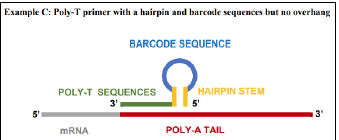
(D.I. 327 at ¶98) According to Dr. Shalek, Example C has “the barcode [] in a hairpin structure at the 5' end of the poly-T sequence” (wherein the hairpin structure is “not a 5' overhang because it has a double-stranded 5' end”). (Id.)
Parse counters that the RT primer in Example C cannot be an example of the type of primer at issue because it “actually does have a 5' overhang” sequence. (Tr. at 224-28) However, the only piece of evidence that Parse points to in support here—a portion of Dr. Satija's deposition testimony—is not persuasive. In that portion of the deposition, Dr. Satija stated that he did not agree that Example C “does not contain a 5-prime overhang” because “in contrast to [E]xample A and [E]xample B, the 5-prime end of the transcript is not hybridized to the template molecule, it is overhanging the template molecule.” (D.I. 362, ex. I at 187 (cited in Tr. at 225) (emphasis added)) At oral argument, Parse's counsel asserted that in giving this opinion, Dr. Satija misspoke in saying that “the 5-prime end of the transcript is not hybridized to the template molecule” when he really meant to say that the 5' end of the primer is not hybridized to the template molecule in Example C. (Tr. at 226) To Parse, this piece of testimony precludes granting summary judgment on account of Example C, because the experts have presented conflicting testimony as to whether Example C includes an overhang or not.
But the Court disagrees that this argument can save Parse. It is difficult for the Court to credit this portion of Dr. Satija's testimony because Parse did not submit any errata sheet correcting this alleged misstatement or error in the testimony. (Tr. at 246); see, e.g., Shire ViroPharma Inc. v. CSL Behring LLC, Civil Action No. 17-414 CONSOLIDATED, 2021 WL 1227097, at *12 (D. Del. Mar. 31, 2021). So the Court must consider Dr. Satija's statement above as it is. And, in its current state, this excerpt of Dr. Satija's deposition testimony fails to address RT primers entirely, instead talking about the transcript (i.e., the mRNA template molecule). Therefore, this snippet of deposition testimony fails to raise a dispute of fact as to whether the RT primer depicted in Example C includes an overhang. (Tr. at 227-28 (Parse's counsel acknowledging that other than this deposition testimony excerpt, there is no other place in the record where a witness clearly says that Example C utilizes a primer with a 5' overhang)) And so, the Court agrees with Scale that there is no dispute of fact that Dr. Shalek has identified an RT primer with a barcode sequence but lacking an overhang that is operable in the claimed methods.
Parse's attempts to raise a factual dispute with regard to Examples A and B on this score fare no better. (D.I. 359 at 41) With Example A, Dr. Shalek describes an RT primer wherein “the barcode … can be flanked on either side by poly-T sequences” and makes use of a “hairpin structure comprising a stem … that holds the hairpin together.” (D.I. 327 at ¶97) Example B similarly depicts a barcode sequence between poly-T sequences but lacks the “hairpin structure” of Example A. (Id.) Specifically here, Dr. Satija asserts that the inclusion of the barcode (blue) between poly-T sequences (green), as depicted in Examples A and B (shown below), “would present a serious and fatal technical challenge to Dr. Shalek's proposed method[s] because [of sequencing] errors[,]” (D.I. 375 at ¶¶15-16 (citing D.I. 362, ex. I at 192-93)):
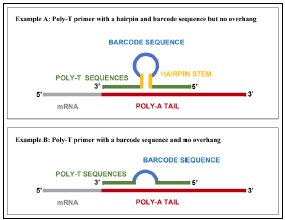
|
|
(D.I. 327 at ¶¶97-98)
Scale responds that the challenged claims do not recite a sequencing step; therefore, whether the product of the claimed method (i.e., a tagged cDNA molecule) would be difficult or even impossible to sequence would not be relevant to whether such an embodiment is operable in the claimed method. (Tr. at 164) Parse, however, counters that the parties' agreed-upon construction of “barcode sequence”—i.e., to mean “[a] sequence of nucleotides added to a molecule that is capable of identifying or aiding in identification of the cell from which the molecule originated”—indicates that subsequent sequencing is required by the challenged claims. (D.I. 108-1 at 16 (emphasis added); Tr. at 208-11, 222-23, 240, 244)
Even if Parse is correct that subsequent sequencing (or “identification” in the parlance of the parties' joint construction of “barcode sequence”) of the tagged cDNA molecules is required by the claims (and the Court is not saying Parse is correct), the Court finds Parse's arguments as to Examples A and B to be unpersuasive. Multiple pages of Dr. Satija's deposition transcript are devoted to a discussion of Examples A and B, throughout which he repeats the bare conclusion that they are inoperable. (D.I. 362, ex. I at 182-193; see also Tr. at 217-220) Eventually, Dr. Satija explains why he believes that Examples A and B are inoperable, and the entirety of his opinion in that regard comes down to a single point about sequencing. (D.I. 362, ex. I at 189-93; see also Tr. at 221) Essentially, Dr. Satija unduly focuses only on certain sequencing techniques, by saying that “next-generation sequencing methods … have very high error rates immediately after sequencing, both during and after sequencing homopolymer regions” such as the poly-T sequences shown above in Examples A and B. (D.I. 362, ex. I at 192 (emphasis added)) And yet there is no support for Dr. Satija's assertion that any sequencing of the tagged cDNA molecules must be done via those certain “next-generation” sequencing methods. (Tr. at 241-42 (Scale's counsel noting the problems with focusing only on next-generation sequencing techniques)) Even if any sequencing was required by the claims, it seems that such efforts would merely require “identification” of the cell from which the molecule originated, (D.I. 108-1 at 16); the claims do not specify the means by which the target molecule must be identified. (Id. at 241 (“That is not a statement that all forms or all techniques of sequencing would create an inoperable result.”); id. at 242 (“Dr. Satija would have been required, in order to make this argument, to first have said that any form of sequencing that might be performed would create error rates in order to create a material disputed fact. He didn't do that.”)) Thus, the Court finds that Parse does not actually dispute that Examples A and B could be operable; instead, it at best shows they are incompatible with certain types of sequencing that are not included in the claims.
For all of these reasons, the Court finds that Parse is unable to raise a genuine dispute of material fact as to the operability of each of the second category of examples offered by Dr. Shalek. As such, it is undisputed that the Barcode Claims include within their scope certain undisclosed operable embodiments. That means that the ′433 Application fails to provide a sufficient written description for the ′355 and ′856 patents.
C. Rosenberg and Anticipation
Finally, having assessed the entirety of the parties' dispute about whether the challenged patents have written description support in the ′433 Application, the Court can turn to the question of whether Scale has established that the challenged claims of the ′355 and ′856 patents are anticipated by Rosenberg. (D.I. 307 at 40-42; D.I. 391 at 20)
Scale argues that the Rosenberg reference discloses all elements of the challenged claims of these two patents. (D.I. 307 at 42 (citing D.I. 303 at ¶¶D12-D29)) As noted at the outset, the parties do not actually have a separate dispute as to whether Rosenberg, if it were to qualify as prior art, anticipates these two patents. (D.I. 391 at 20; D.I. 498 at 216-17) Rather, in responding to Scale's Motion, Parse argues that Rosenberg simply is not prior art to the ′355 and ′856 patents because those patents each claim priority to the ′433 Application, which undisputedly predates Rosenberg. (D.I. 359 at 42-43; D.I. 498 at 217 (“[Parse's] dispute is that [Rosenberg is] not prior art because [Parse] contend[s] that these patents can find written description support [in the ′433 Application.]”)
Above, the Court has dealt with the written description issue underlying this portion of the Motion—finding that the ′355 and ′856 patents cannot claim priority to the ′433 Application because that patent application fails to disclose the full scope of the claims (i.e., operable RT primers with a barcode sequence but lacking an overhang). Indeed, in light of the prosecution history, the reality that the ′433 Application does not disclose such embodiments is not all that surprising because, as originally filed, the claims only recited the use of “a reverse transcription primer comprising a 5' overhang sequence[.]” (See, e.g., D.I. 309, ex. 20 at PARSE0000079, PARSE0000082, PARSE0000085 (emphasis added)) Without the ability to claim priority to the ′433 Application, Rosenberg qualifies as prior art with respect to both the ′355 and ′856 patents, since those patents' applications were filed on February 25, 2021 and November 8, 2021 respectively. (D.I. 303 at ¶D10; ′355 patent at 1; ′856 patent at 1); see 35 U.S.C. §102(a)(1)). Therefore, the challenged claims of the ′355 and ′856 patents are invalidated as anticipated by Rosenberg, which was published more than two years earlier. (D.I. 303 at ¶D10)
IV. CONCLUSION
For the foregoing reasons, the Court GRANTS Scale's Motion as it relates to all of the challenged claims. An appropriate Order will issue.