

Patent Cases, SOLBELLO, INC., Plaintiff, v. SHORESHADE, LLC, Defendant., U.S. District Court, S.D. Georgia, (May 18, 2026)
SOLBELLO, INC., Plaintiff, v. SHORESHADE, LLC, Defendant.
U.S. District Court, S.D. Georgia, Augusta Division. CV 125-267.May 18, 2026.
Honorable J. Randal Hall, District Judge
Honorable J. Randal Hall, District Judge
ORDER
Presently before the Court are Plaintiff's second motion for preliminary injunction, motion for leave to file a first amended complaint, and motion for leave to file supplemental declaration regarding additional video exhibit. [1] (Docs. 49, 50, 56.) Plaintiff again seeks to enjoin Defendant from selling their allegedly infringing product and shield itself from continuing irreparable harm. (Doc. 49, at 2-3.) The Court held a preliminary injunction hearing on May 8, 2026 and took the matter under advisement. (Doc. 55.) For the reasons below, Plaintiff's second motion for preliminary injunction (Doc. 49) is DENIED, and Plaintiff's motion for leave to file a first amended complaint (Doc. 50) and motion for leave to file supplemental declaration regarding additional video exhibit (Doc. 56) are GRANTED.
I. BACKGROUND
The Court set forth the facts in its December 22, 2025 Order (the “Order”) regarding Plaintiff's patent, U.S. Patent No. RE50606 E (the “′606 Patent”), and Defendant's allegedly infringing product, (the “ShoreShade”). (Doc. 42, at 2-5.) The Court incorporates the facts as outlined in the Order and supplements them below.
Plaintiff is a North Carolina-based corporation, founded in 2019 by Paul James, that manufactures and sells the Solbello Shade. (Doc. 1, at 1-2.) The Solbello Shade is the subject of various patents including Plaintiff's 2025 reissued utility patent, the ′606 Patent, which is titled “Self-Adjusting Sun Shade Assembly.” (Id. at 6, 65.) Defendant is a Georgia-based corporation that manufacturers and sells the ShoreShade. (Id. at 1-2.) Side-by-side comparisons are pictured below:
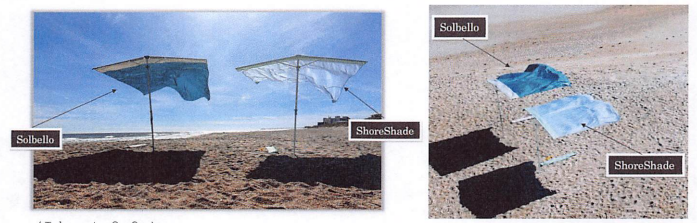
(Id. at 8-9.)
Both products feature a mast that stands in the sand on the beach and have two ribs attached to the top of the mast that carry a sail, which blows in the wind. (Id. at 2-3.) Both products look similar, provide shade, and are easy to transport to and set up on the beach. (Doc. 49, at 15.) However, their ribs and sails operate, or are at least intended to operate, differently regarding their rotation with the wind. (Doc. 53, at 8.) The Solbello Shade's ribs are constructed to rotate freely with the wind atop a stationary mast, so when the wind changes direction, the ribs automatically move and provide unobstructed shade. (Doc. 49, at 13-14.) Alternatively, the ShoreShade's ribs and mast are connected, so if it were to rotate with the wind, any rotation would be accomplished by the entire ShoreShade as opposed to only by the ribs. (Id.) Plaintiff filed a patent infringement claim against Defendant and alleged it has been damaged and irreparably harmed by Defendant's infringement of the ′606 Patent. (Doc. 1, at 36.)
The Order denied Plaintiff's first motion for preliminary injunction because Plaintiff failed to prove a likelihood of success on the merits without sufficient evidence that Defendant made an “offer to sell” its allegedly infringing product. (Doc. 42, at 10-12.) Defendant informed the Court that it ceased sales of its original ShoreShade and planned to launch a “Next Gen” ShoreShade that would not infringe the ′606 Patent. (Doc. 37-1, at 2-4.) The pertinent difference is that the ShoreShade now features an end cap on the bottom of the mast with four vertical fins. [2] (Doc. 53, at 14.)
On April 30, 2026, Plaintiff filed a second motion for preliminary injunction and request for hearing and a motion for leave to file a first amended complaint. (Docs. 49, 50.) On May 7, 2026, Defendant responded to Plaintiff's second motion for preliminary injunction. (Doc. 53.) Both Parties also filed various videos depicting the Solbello Shade and ShoreShade on the beach. (Docs. 52, 54, 56-2.) On May 8, 2026, the Court heard arguments from the Parties and took the matter under advisement. (Doc. 55.) On May 12, 2026, Plaintiff filed a motion for leave to file supplemental declaration regarding additional video exhibit. (Doc. 56.) On May 14, 2026, Defendant responded to Plaintiff's motion for leave to file a first amended complaint. (Doc. 59.)
II. SECOND MOTION FOR PRELIMINARY INJUNCTION
The Court first turns to Plaintiff's second motion for preliminary injunction.
A. Legal Standard
Preliminary injunctions are extraordinary remedies that are not granted unless the movant unequivocally establishes four required elements. See Redford v. Gwinnett Jud. Cir., 350 F. App'x 341, 345 (11th Cir. 2009)); see also United States v. Jefferson Cnty., 720 F.2d 1511, 1519 (11th Cir. 1983) (“The preliminary injunction is an extraordinary and drastic remedy not to be granted unless the movant ‘clearly carries the burden of persuasion’ as to the four prerequisites.” (citation omitted)). “The grant or denial of a preliminary injunction is a matter within the discretion of the district court.” Jefferson Cnty., 720 F.2d at 1519 (citation omitted). Granting a preliminary injunction is proper only if the moving party establishes the following four elements:
(1) a substantial likelihood of success on the merits; (2) that irreparable injury will be suffered if the relief is not granted; (3) that the threatened injury outweighs the harm the relief would inflict on the non-movant; and (4) that entry of the relief would serve the public interest.
Schiavo v. Schiavo, 403 F.3d 1223, 1225-26 (11th Cir. 2005).
The Court notes the Federal Circuit applies a more lenient standard to meet likelihood of success on the merits, being “more likely than not” to succeed rather than “substantial likelihood” as applied in the Eleventh Circuit. (Doc. 5, at 10 n.2); Revision Mil., Inc., v. Balboa Mfg. Co., 700 F.3d 524, 526 (Fed. Cir. 2012). Given the Federal Circuit has determined the district court should apply the Federal Circuit's standard when considering “[s]ubstantive matters of patent infringement [that] are unique to patent law,” the Court will utilize this standard in its analysis. Revision Mil., 700 F.3d at 526.
B. Discussion
The Parties' central dispute is whether Plaintiff has shown a likelihood of success on the merits. As a result, the Court focuses its analysis there and turns to Plaintiff's patent infringement claim.
To establish a direct patent infringement claim, one must show: (1) Plaintiff owns the patent in question; and (2) Defendant made, used, sold, or offered to sell the patented invention. 35 U.S.C. §271(a); Kanga Care, LLC v. Bumbum Babies, LLC, No. CV 122-009, 2022 WL 22650525, at *2 (S.D. Ga. Oct. 25, 2022). Additionally, every element of at least one of the patent's claims must be present in the potentially infringing product, either through literal infringement or the doctrine of equivalents. See Perkin-Elmer Corp. v. Westinghouse Elec. Corp., 822 F.2d 1528, 1533 (Fed. Cir. 1987) (citation omitted); UCB, Inc. v. Teva Pharms. USA, Inc., No. 1:12-CV-4420, 2015 WL 11199058, at *10 (N.D. Ga. Mar. 18, 2015) (“In a patent infringement lawsuit, the plaintiff has the burden to show that every element of the patent claim is present in the alleged infringing product, either through literal infringement or the doctrine of equivalents.”)
The Parties do not dispute that Plaintiff owns the ′606 Patent and Defendant is manufacturing, selling, or offering to sell the ShoreShade. (Doc. 49, 11-12; Doc. 53, at 2-3; Court's recording system, For the Record (“FTR”) 09:55:58-09:53:52 (May 8, 2026).) The Court turns to whether Plaintiff demonstrates a likelihood of success on the merits for infringement.
To establish a likelihood of success, the movant must provide proof of “both [patent] validity and infringement.” Sofamor Danek Grp., Inc. v. DePuy-Motech, Inc., 74 F.3d 1216, 1219 (Fed. Cir. 1996). “If [the defendant] raises a substantial question concerning either infringement or validity, i.e., asserts an infringement or invalidity defense that the patentee cannot prove ‘lacks substantial merit,’ the preliminary injunction should not issue.” Amazon.com, Inc. v. Barnesandnoble.com, Inc., 239 F.3d 1343, 1350-51 (Fed. Cir. 2001) (citation omitted). Validity need not be established beyond question, but the patentee is required to “present a clear case supporting the validity of the patent in suit.” Abbott Labs. v. Andrx Pharm., Inc., 452 F.3d 1331, 1335 (Fed. Cir. 2006); Titan Tire Corp. v. Case New Holland, Inc., 566 F.3d 1372, 1379 (Fed. Cir. 2009) (“[T]he trial court, after considering all the evidence available at this early stage of the litigation, must determine whether it is more likely than not that the challenger will be able to prove at trial, by clear and convincing evidence, that the patent is invalid.”).
In their response to Plaintiff's second motion for preliminary injunction, Defendant challenges the validity of the ′606 Patent regarding novelty and enablement. (Doc. 53, at 5-13; FTR 10:25:10-10:27:13.) If the alleged infringer submits evidence of invalidity in response to the preliminary injunction motion, “[t]he patentee … has the burden of responding with contrary evidence, which of course may include analysis and argument.” Titan Tire, 566 F.3d at 1377. During the May 8, 2026 Hearing, Plaintiff argued the ′606 Patent has a presumption of validity and does not lack novelty, distinguishing it from the prior art submitted by Defendant. (FTR 10:46:26-10:51:27.) For the purposes of deciding this motion, the Court finds Plaintiff successfully rebutted Defendant's challenges to validity with contrary evidence. (See id.) Although the Court finds Defendant did not create a substantial question as to validity at the preliminary injunction stage, Defendant is not precluded from challenging validity in future briefing or at trial.
Moreover, analysis of infringement involves two steps. “First, the claim must be properly construed to determine its scope and meaning. Second, the claim as properly construed must be compared to the accused device or process.” Ethicon Endo-Surgery, Inc. v. U.S. Surgical Corp., 149 F.3d 1309, 1315 (Fed. Cir. 1998) (citations omitted). The Parties agree the pertinent element is the ′606 Patent's Claim 44, element 4 (“Element 4”): “at least one rib located proximate the top end of said mast, and configured to rotate relative to the supporting surface.” (Doc. 49, at 11-12; Doc. 53, at 9.) Defendant proposes a claim construction of “at least one rib located proximate the top end of said mast, and specifically designed to rotate relative to the mast,” and Plaintiff adopts Defendant's construction for the purpose of this motion. (Doc. 53, at 11 (emphasis added); Doc. 32, at 2; FTR) 09:53:22-09:53:52.) Based on this agreed claim construction, the Court turns to infringement and notes that Plaintiff does not argue literal infringement. (Doc. 49, at 12; FTR 09:53:55-09:54:08.) As such, the issue before the Court is whether the ShoreShade infringes the ′606 Patent under the doctrine of equivalents. (FTR 11:10:54-11:11:52.)
Under the doctrine of equivalents, “a product or process that does not literally infringe upon [sic] the express terms of patent claim may nonetheless be found to infringe if there is ‘equivalence’ between the elements of the accused product or process and the claimed elements of the patented invention.” Warner-Jenkinson Co., Inc. v. Hilton Davis Chem. Co., 520 U.S. 17, 21 (1997). “Infringement may be found under the doctrine of equivalents if every element of the asserted claim, or its ‘equivalent,’ is found in the accused subject matter, where an ‘equivalent’ differs from the claimed element only insubstantially.” Ethicon Endo-Surgery, 149 F.3d at 1315. “The theory on which the doctrine of equivalents is founded is that if two devices do the same work in substantially the same way, and accomplish substantially the same result, they are the same, even though they differ in name, form or shape.” MDS (Canada) Inc. v. Rad Source Techs., Inc., 720 F.3d 833, 846 (11th Cir. 2013) (quoting Graver Tank & Mfg. Co. v. Linde Air Products Co., 339 U.S. 605, 608 (1950)) (alterations adopted).
The Parties vigorously dispute whether the ShoreShade rotates with the wind. Upon discovering that Defendant was selling the ShoreShade, Plaintiff motioned for a second preliminary injunction because the ShoreShade allegedly still self-rotates with the wind and infringes the ′606 Patent, even with the new end cap. (Doc. 49, at 2.) Defendant states the newly added end cap adheres to the base of the mast and has fins that are designed to prevent rotation of the mast in the direction of the wind. (Doc. 53, at 13.) Specifically, Defendant states that the fins of the end cap prevent rotation by engaging the surrounding sand when the mast is installed according to the instructions. (Id. at 14.) Further, Defendant states that the ribs are secured to the mast to prevent rotation relative to the mast under normal conditions. (Id.) Plaintiff's founder, an experienced sunshade designer and inventor of the Solbello shade, argues that the newly added end cap fails to prevent the ShoreShade from rotating because the fins are too small to engage the sand in a meaningful way to resist rotation. (Doc. 49-1, at 4.) Defendant responds that the end cap dimensions were chosen to be inobtrusive but capable of preventing rotation, which was accomplished during their product testing. (Doc. 53-1, at 2.) Defendant further states that, when following the sand tool instructions [3] to properly dig the hole, the end cap will be seated in tightly packed sand at the bottom of an 11.5-inch hole where the fins engage with the sand to prevent rotation. (Id. at 4.)
As to infringement, Plaintiff argues that the ShoreShade infringes Element 4 of the ′606 Patent under the doctrine of equivalents. (Doc. 49, at 12.) First, Plaintiff argues that “the rib and mast fit together to perform effectively the same function as Element 4.” (Id. at 13.) Plaintiff argues the ShoreShade “facilitates the rib's rotation to match the direction of the wind, and the new end cap feature does nothing to prevent that rotation.” (Id. at 13-14 (internal quotations omitted).) Second, Plaintiff argues the ShoreShade accomplishes its rotational function in substantially the same way as Element 4 — by rotating around one vertical axis — with the only distinction being “where the rotation happens.” (Id. at 14-15 (emphasis omitted).) The ShoreShade's “entire mast rotates around a vertical axis when placed in the sand” whereas on Element 4, “the ribs are able to rotate around the mast itself.” (Id. at 14.) Plaintiff argues it is insignificant that one rotates at the ribs and one rotates at the mast. (FTR 10:10:18-10:10:26.) Third, Plaintiff argues the ShoreShade achieves the same result as Element 4 because the ShoreShade's ribs and mast rotate freely in the sand, automatically turning to face the wind and providing consistent shade. (Doc. 49, at 15.)
In response, Defendant argues that, due to the end cap feature, neither the mast nor the ribs of the ShoreShade are rotatable, further supporting a finding of noninfringement. (Doc. 53, at 14.) Under the doctrine of equivalents, Defendant argues that the ShoreShade does not infringe Element 4 under the claim construction because the ShoreShade's ribs are specifically designed not to rotate relative to the mast. (Id.) Further, Defendant argues that Plaintiff essentially vitiates the claim construction that it agreed to by arguing the ribs designed to rotate are equivalents of ribs designed not to rotate. (Id.) Moreover, Defendant argues the ′606 Patent language admits that “because the sail rotates relative to the mast[,] it prevents loosening the auger position and thereby causing failure of the assembly” to support that the ShoreShade cannot be equivalent because any rotation would not be relative to the mast. (Id. at 18.)
After considering the Parties' briefings and oral arguments, the Court concludes that Plaintiff has failed to establish a likelihood of success on its claim of infringement of Element 4 of Claim 44 and, thus, is not entitled to a preliminary injunction. It is axiomatic that “[t]o infringe, an accused device must embody each claim limitation or its equivalent.” Sofamor Danek Grp., 74 F.3d at 1220. Here, the dispute over infringement centers on whether the ShoreShade rotates with the wind and whether the doctrine of equivalents applies.
The Parties submitted videos to support their arguments. In Plaintiff's videos, the ShoreShade rotated with the wind, and in Defendant's videos, it did not. (See generally Docs. 52; 54; 56–2.) The Parties criticized each other's installation, positioning, and characteristics of the sand for affecting whether the ShoreShade rotated in the videos. (Doc. 53, at 21-22; 56-1, at 2-3; FTR 10:14:57-10:20:44.) Based on the evidence submitted, the issue of whether the ShoreShade rotates is, at best, a draw. With the Plaintiff's burden of proof, a draw in the evidence is not a winning hand. The Court cannot determine it is more likely than not that the ShoreShade rotates with the wind. The ShoreShade was designed and underwent testing to resist rotation from the wind, and when the ShoreShade and its sand tool were used appropriately by Defendant on a windy beach, the product did not rotate. (Doc. 53-1, at 2-3; Doc. 53, at 20-21; see generally Doc. 54.) Although Plaintiff submitted various videos showing the ShoreShade installed in sand on a beach and blowing in the wind, the Court cannot discern that the ShoreShade is more likely than not to infringe the ′606 Patent based on this evidence.
Because Plaintiff has not established that the ShoreShade rotates with the wind, the Court finds the ShoreShade does not infringe the ′606 Patent under the doctrine of equivalents. Plaintiff is not more likely than not to succeed on the merits of its patent infringement claim and fails to satisfy the first element for a preliminary injunction. Accordingly, Plaintiff has not established its likelihood of success on the merits as necessary to warrant such extraordinary and drastic relief. The Court emphasizes that these findings are preliminary and may change with further factual development and argument. With the likelihood of success element decided in Defendant's favor, the Court need not further analyze the remaining three preliminary injunction elements. Thus, Plaintiff's second motion for a preliminary injunction is DENIED.
III. MOTION FOR LEAVE TO FILE FIRST AMENDED COMPLAINT
The Court turns to Plaintiff's motion for leave to file first amended complaint. (Doc. 50.)
A. Legal Standard
As a general rule, leave to amend under Federal Rule of Civil Procedure 15(a) should be given freely. Foman v. Davis, 371 U.S. 178, 182 (1962); Saewitz v. Lexington Ins. Co., 133 F. App'x 695, 699 (11th Cir. 2005) (per curiam). That said, leave to amend is not automatic, and a trial court may deny such leave “in the exercise of its inherent power to manage the conduct of litigation before it.” Reese v. Herbert, 527 F.3d 1253, 1263 (11th Cir. 2008); Hargett v. Valley Fed. Say. Bank, 60 F.3d 754, 761 (11th Cir. 1995). However, “[u]nless there is a substantial reason to deny leave to amend, the discretion of the district court is not broad enough to permit denial.” Burger King Corp. v. Weaver, 169 F.3d 1310, 1319 (11th Cir. 1999) (quoting Dussouy v. Gulf Coast Inv. Corp., 660 F.2d 594, 598 (5th Cir. 1981)).
In Foman, the Supreme Court identified several reasons that may justify denying leave: “undue delay, bad faith or dilatory motive on the part of the movant, repeated failure to cure deficiencies by amendments previously allowed, undue prejudice to the opposing party by virtue of allowance of the amendment, [and] futility of amendment.” 371 U.S. at 182; see also Jameson v. Arrow Co., 75 F.3d 1528, 1534-35 (11th Cir. 1996). “An amendment is futile when the complaint would still be subject to dismissal.” Chen v. Lester, 364 F. App'x 531, 538 (11th Cir. 2010) (citing Hall v. United Ins. Co. of Am., 367 F.3d 1255, 1262-63 (11th Cir. 2004)). Courts also consider whether undue prejudice to the movant will result from denying leave to amend. Lockett v. Gen. Fin. Loan Co. of Downtown, 623 F.2d 1128, 1131 (5th Cir. 1980) [4] .
B. Discussion
Plaintiff seeks leave to file a first amended complaint with allegations directed to the “Next Gen” ShoreShade. (Doc. 50, at 1.) Plaintiff seeks to include allegations directed to Defendant's manufacture, use, sale, offers to sell, and importation of the ShoreShade, and to assert claims of direct, contributory, induced, and willful infringement of the ′606 Patent based on that product. (Id. at 4.) Plaintiff states that the factual basis did not exist at the time of their initial complaint, so there is no undue delay, bad faith, or dilatory motive. (Id.) Also, Plaintiff argues there is no prejudice against Defendant because the case is in its early stages and discovery is stayed pending Defendant's motion to dismiss. (Id.) Further, Plaintiff argues the amended complaint “does not introduce a new defendant, a new patent, or an unrelated dispute.” (Id. at 5.) Defendant filed a response and does not oppose Plaintiff's motion for leave to file its proposed amended complaint. (Doc. 59, at 1.) The Court finds no reason to justify denying Plaintiff leave to amend. Upon due consideration, the Court GRANTS Plaintiff's motion for leave to file a first amended complaint. (Doc. 50.)
IV. CONCLUSION
Based on the foregoing, Plaintiff's second motion for preliminary injunction (Doc. 49) is DENIED, and Plaintiff's motion for leave to file first amended complaint (Doc. 50) and motion for leave to file supplemental declaration regarding additional video exhibit (Doc. 56) are GRANTED. Plaintiff's first amended complaint dated April 30, 2026 (Doc. 50-1) is the operative complaint, and no additional filing of this complaint is necessary. Because Plaintiff's first amended complaint supersedes its original complaint, Defendant's motion to dismiss (Doc. 21) is DENIED AS MOOT. [5] Regular briefing and response deadlines shall be in place.
ORDER ENTERED.
|
|