

Patent Cases, VINCENT SYSTEMS GMBH, Plaintiff, v. FILLAUER COMPANIES, INC. and MOTION CONTROL, INC., Defendants., U.S. District Court, E.D. Tennessee, (Jul. 30, 2026)
VINCENT SYSTEMS GMBH, Plaintiff, v. FILLAUER COMPANIES, INC. and MOTION CONTROL, INC., Defendants.
U.S. District Court, E.D. Tennessee, at Chattanooga. Case No. 1:23-cv-2. July 30, 2026.
Judge Atchley Magistrate Judge Dumitru
Charles E. Atchley, Jr., District Judge
MEMORANDUM OPINION AND ORDER
Before the Court is Defendants' Motion for Summary Judgment [Doc. 217] [1] and Plaintiff's Motion for Summary Judgment of Infringement [Doc. 222]. Because the Court can consider only admissible evidence when deciding a motion for summary judgment, the Court must also consider and decide Defendants' Motion to Exclude the Opinions and Related Testimony of Steven H. Collins, Ph.D. [Doc. 207] and Defendants' Motion to Exclude the Opinions and Related Testimony of Steven H. Collins, Ph.D. under Rule 37 [Doc. 211]. For the following reasons, Defendant's Motion to Exclude the Opinions and Related Testimony of Steven H. Collins, Ph.D. [Doc. 207] is GRANTED IN PART and DENIED IN PART; Defendants' Motion to Exclude the Opinions and Related Testimony of Steven H. Collins, Ph.D. under Rule 37 [Doc. 211] is DENIED; Defendants' Motion for Summary Judgment [Doc. 217] is GRANTED IN PART and DENIED IN PART; and Plaintiff's Motion for Summary Judgment of Infringement [Doc. 222] is DENIED.
I. BACKGROUND
This patent infringement controversy arises out of the production and sale of prosthetic hands. In 2008, Plaintiff Vincent Systems GMBH's (“Vincent”) founder, Dr. Stefan Schulz, invented a new mechanical design for a motor assembly to be used in the finger element of a prosthetic hand. [Doc. 222 at 5]. [2] The issue with existing hand prostheses was that traditional finger elements did not have independent movement capability, and if they did, they were too large for small hands. [Doc. 24 at ¶16–17]. Dr. Schulz's design solved that problem by allowing for a small, active finger element that may be used individually or as part of a prosthetic hand, as well as increased life-span and fewer maintenance intervals. [Id. at ¶18; Doc. 222 at 5].
A. The Asserted Patent and Court's Claim Construction
The asserted patent claims priority to a 2008 German patent application. In 2011, Vincent applied for a patent at the United States Patent and Trademark Office. The application was granted, and the asserted patent was issued in 2013 as U.S. Patent No. 8,491,666 (the “Asserted Patent”). [Doc. 24-1 at 2]. At issue in this case is the finger element of Vincent's product, described in Claim 1 of the Asserted Patent. Claim 1 of the Asserted Patent reads as follows:
1. A finger element, comprising:
a) a carrier component,
b) a first phalanx with a first hinge connection to the carrier component,
c) a second phalanx with a second hinge connection to the first phalanx,
d) a servo drive for the first hinge connection with a motor with a drive shaft and a worm gearing with a threaded screw and a cog segment that engages to the threaded screw, and
e) a coupling mechanism between the first hinge connection and the second hinge connection, wherein
f) the threaded screw is supported on the drive shaft form fittingly and axially movable as well as guided in axial direction by separate guidances.
‘666 Patent, col. 5:40–6:11. [3] Importantly, the parties only dispute centers around whether Defendants' products meet claim limitation 1(f) of the Asserted Patent. [Doc. 222 at 9; Doc. 218 at 12].
To better understand the technical and engineering aspects of the Asserted Patent, a brief explanation of how the finger element works is warranted. The novelty of the Asserted Patent comes from the mechanical structure of the finger and motor, which allows for an incredibly small motor that fits within the finger and can drive the movement of each finger separately and independently of the other fingers. [Doc. 91 at 5]. However, because the motor is small, it is vital to ensure the force that results when the finger is lifted and lowered is not transmitted to the motor. [Id.]. To accomplish this, the Asserted Patent uses “guidances” to support a threaded screw that moves the finger by rotating in connection with a cog wheel. [Id.]. Figure 2 of the Asserted Patent, shown below, provides an illustration of the finger element.
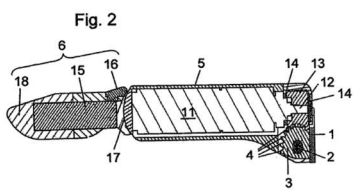
[Doc. 24-1 at 2]. The threaded screw (13) surrounds and encircles the drive shaft (12), which is connected to the motoric (or “servo”) drive (11). [Doc. 91 at 5]. Because the threaded screw is mounted on the drive shaft, it turns rotationally when the drive shaft turns. [Id. at 6]. As a result, when the threaded screw turns, it also rotates around the cog segment so as to lift and lower the finger. [Id.]. Notably, the threaded screw is separate from the drive shaft so that the force from its movement is not transmitted along the drive shaft to the motor. [Id.]. Thus, the threaded screw is “axially movable.” [Id.]. But, to keep the threaded screw from moving along the length of the finger segment (5), guidances (14) are used. [Id.].
During the claim construction phase of this matter, the parties disputed the meaning of claim 1(f) of the Asserted Patent. After conducting a Markman hearing and considering the parties' arguments, the Court issued a Markman Order defining claim 1(f) as “the threaded screw is able to move along the length of the drive shaft in a straight line direction but is limited in its axial movement by separate guidances.” [Doc. 134 at 22]. In reaching its conclusion, the Court differentiated the Asserted Patent from prior art, where the threaded screw is “‘fixed permanently’” to the drive shaft. [Id. at 15 (citing ‘666 Patent, col. 1:40-41)]. The Court emphasized that an “‘essential feature of the invention encloses a decoupling of drive shaft and threaded screw in axial direction to the drive shaft.’” [Id. at 15 (citing’666 Patent, col. 2:28-30)]. Unlike the prior art, where the permanently fixed screw could not move axially along the length of the drive shaft, the threaded screw in the Asserted Patent remains capable of moving along the length of the drive shaft despite being limited in that axial movement by the guidances. [Id. at 21–22]. Therefore, “the [Asserted Patent's] decoupling allows the threaded screw to move in the axial direction, or along the length of the drive shaft.” [Id. at 15].
B. The TASKA Hands and The Instant Litigation
Vincent commenced this patent-infringement lawsuit against Defendants on January 4, 2023, and filed an amended complaint on May 31, 2023. [Docs. 1, 24]. Vincent alleges that Defendants Fillauer Companies, Inc. and Motion Control, Inc. (collectively “Motion Control”) infringe independent claim 1 and dependent claims 3, 6, and 9 of the Asserted Patent by importing and selling TASKA [4] prosthetic hands (the “Accused Products”) throughout the United States. [Doc. 24 at IT 23-41; Doc. 91 at 5]. The Accused Products consist of three separate TASKA prosthetic hand models: the Gen 1, Gen 2, and CX TASKA hands. [Doc. 222-30 at 2-3]. Vincent alleges that each hand model infringes its Asserted Patent.
The first TASKA hands (the Gen 1 models) were built and sent to Motion Control in October 2017. [Doc. 220-43 at ¶15]. Rather than decouple the threaded screw and drive shaft, the Gen 1 models used glue, specifically Loctite 660, to “bond” the threaded screws to the drive shafts in the gear box assembly for the fmgers. [Id. at ¶17; Doc. 220-5; Doc. 220-6; Doc. 220-7; Doc. 220-8]. To ensure the bond strength between the threaded screw and drive shaft, TASKA Prosthetics (“TASKA”) implemented glue optimizations in its Gen 1 hand beginning in 2021. [Doc. 220-43 at ¶¶20-33]. In June of 2021, TASKA introduced the Gen 2 hand and ceased making Gen 1 hands. [Id. at ¶34]. The early Gen 2 hands also used glue to bond the threaded screws to the drive shafts and followed the same optimized procedures for the Gen 1 hand. [Id. at ¶35]. The picture below demonstrates what the inside of the TASKA fmger looks like.
*****
In 2022, TASKA launched the CX hand. [Id. at ¶39]. Instead of using glue, this model used a weld bond to keep the threaded screw attached to the drive shaft. [Id.]. At the same time that TASKA implemented the weld-bond, it also changed the D-shaped drive shaft to a circular drive shaft for ease of welding. [Id. at ¶41]. Importantly, in the glued versions of the hands with the D-shaped drive shaft, if a glue bond were to fail it would not result in immediate inoperability; however, in the welded versions with the circular drive shaft, if the weld bond breaks, the finger becomes inoperable. [Id. at ¶41]. Alongside the CX hand, TASKA also launched the first Gen 2 welded hand in the U.S. on April 5, 2023. [Id. at ¶44].
The parties now cross-move for summary judgment in their favor, with the central dispute being whether the Accused Products satisfy claim limitation 1(f) of the Asserted Patent. [Docs. 217, 222]. Vincent's theory of liability is premised on two alternative arguments. First, it argues the design alone of the Accused Products meets claim limitation 1(f) because the threaded screw is able to move along the drive shaft notwithstanding any glue or welding. [Doc. 222 at 13-14]. To reach this conclusion, Vincent, among other things, relies primarily on testing performed by its own expert, Dr. Steven H. Collins. [Id. at 17–22]. Second, in response to Motion Control's Motion for Summary Judgment of Noninfringement [Doc. 218], Vincent argues there are at least disputed issues of material fact given the existence of bond failures in the Accused Products. [Doc. 254 at 28–30]. It asserts that evidence of bond failures demonstrates the Accused Products are “reasonably capable” of infringing the Asserted Patent. [Id. at 28–29].
On the other hand, Motion Control argues it is entitled to summary judgment in its favor because the threaded screws in all the Accused Products have always been permanently fixed to the drive shaft, whether by a glue-or weld-bond. [Doc. 218 at 24–30]. These bonds, as Motion Control argues, render the threaded screw incapable of “mov[ing] along the length of the drive shaft in a straight line direction.” [Id. at 24]. Motion Control also argues there is no evidence of any bond failures in the United States and that each piece of evidence produced by Vincent does not create a genuine dispute of material fact. [Id. at 11, 30–25]. Additionally, Motion Control moves to exclude Dr. Collins's expert testimony on the grounds that his testing and methodology failed to apply the Court's claim construction definition of claim limitation 1(f). [Docs. 207, 211]. These matters are now ripe for the Court's review.
II. DEFENDANTs' DAUBERT MOTION
A. Standard of Review
Before a witness can give an expert opinion, their testimony must meet the requirements of Federal Rule of Evidence 702:
A witness who is qualified as an expert by knowledge, skill, experience, training, or education may testify in the form of an opinion or otherwise if:
(a) the expert's scientific, technical, or other specialized knowledge will help the trier of fact to understand the evidence or to determine a fact in issue;
(b) the testimony is based on sufficient facts or data;
(c) the testimony is the product of reliable principles and methods; and
(d) the expert has reliably applied the principles and methods to the facts of the case.
Fed. R. Evid. 702. The Court acts as a “gatekeeper” of evidence that fails to meet this standard. Daubert v. Merrill Dow Pharms., Inc., 509 U.S. 579 (1993); Kumho Tire Co., Ltd. v. Carmichael, 526 U.S. 137 (1999). Yet the Rule 702 inquiry is “a flexible one,” Daubert, 509 U.S. at 594, and “rejection of expert testimony is the exception, rather than the rule,” In re Scrap Metal Antitrust Litig., 527 F.3d 517, 530 (6th Cir. 2008). “Vigorous cross-examination, presentation of contrary evidence, and careful instruction on the burden of proof are the traditional and appropriate means of attacking shaky but admissible evidence.” Daubert, 509 U.S. at 596; see also United States v. 14.38 Acres of Land, 80 F.3d 1074, 1078 (5th Cir. 1996) (“[T]he trial Court's role as a gatekeeper is not intended to serve as a replacement for the adversary system.”).
As the Sixth Circuit has explained, a proposed expert's opinion is admissible under Rule 702 if it satisfies three requirements: (1) the witness is qualified by knowledge, skill, experience, training, or education; (2) the testimony is relevant; and (3) the testimony is reliable. In re Scrap Metal Antitrust Litig., 527 F.3d at 529. Testimony is relevant if it relates to a fact at issue and helps the jury determine that fact. FED. R. EVID. 401; Navarro v. Proctor & Gamble Co., 501 F. Supp. 3d 482, 489 (S.D. Ohio 2020). Testimony is reliable if it is based on “something ‘more than subjective belief or unsupported speculation.’” Id. (citing Daubert, 509 U.S. at 590).
B. Application
Motion Control moves to exclude three different types of testimony offered by Dr. Collins. [Doc. 208]. First, Motion Control argues Dr. Collins's infringement opinions based on his testing methods are irrelevant and contrary to law because he failed to apply the Court's claim construction when testing the Accused Products. [Id. at 15–24]. Second, Motion Control seeks to exclude other various infringement opinions of Dr. Collins on the basis they merely recite facts in the record without adding any specialized knowledge. [Id. at 25–28]. Third, Motion Control requests that a variety of Dr. Collins's validity opinions be excluded because they parrot testimony from other witnesses without any independent analysis. [Id. at 28–29]. The Court will analyze each request in turn.
1. Dr. Collins's Testing Method
For its argument that Dr. Collins's infringement opinions should be excluded, Motion Control takes issue with the way Dr. Collins tested the Accused Products. In testing the Gen 1 glued finger and Gen 2 welded finger, Dr. Collins designed his test to “assess [whether] the threaded screw [would] move axially on the drive shaft under the same kinds of loading conditions it would experience under normal expected conditions save for the limitations to axial movement provided by the guidances.” [Doc. 208-4 at 263:8–23]. To test this on the pre-optimized Gen 1 finger, Dr. Collins disassembled the finger by cutting away the motor mount component and removing the load path bearings. [Doc. 210 at ¶¶203, 219–20]. Once all the supporting structure was removed, Dr. Collins then directly applied force to the threaded screw until the glue bond broke at 472 N (106 lbs.). [Id. at ¶¶221–26, 228]. For the welded Gen 2 finger, Dr. Collins again disassembled the finger in the same manner as he did for the Gen 1 finger and cyclically applied 600 N (134.9 lbs.) to 100 N (22.5 lbs.) directly to the threaded screw until the weld bond broke after 2,651 cycles. [Id. at ¶¶238–39]. For ease of reference, the Court will refer to the type of testing discussed here as Dr. Collins's “Disassembly Testing.”
Motion Control argues that Dr. Collins “applies a construction of ‘axially moveable’ that requires no other part of the assembled finger to bear force other than the bond between the threaded screw and drive shaft,” which is not how the Accused Product is intended to be sold or used. [Doc. 208 at 12]. Conversely, Vincent argues that Dr. Collins did not misapply the Court's construction of claim limitation 1(f). [Doc. 236 at 12]. Rather, because the purpose of the guidances is to limit axial movement, Vincent contends that Dr. Collins needed to remove them to evaluate the movability of the threaded screw. [Id. at 12–13; see also Doc. 208-4 at 262:5–263:23 (“[M]y testing was intended to answer [] whether the TASKA device meets claim limitation 1(f), which states that the threaded screw is able to move axially on the drive shaft but is limited in its axial movement by separate guidances. And it is my position that I cannot evaluate whether it's able to move when those guidances are limiting that axial movement.”)]. The Court disagrees.
It is well settled that “a device does not infringe simply because it is possible to alter it in a way that would satisfy all the limitations of a patent claim.” High Tech Med. Instrumentation, Inc. v. New Image Indus., 49 F.3d 1551, 1555 (Fed. Cir. 1995) (citing Hap Corp. v. Heyman Mfg. Co., 311 F.2d 839, 843 (1st Cir. 1962) (“The question is not what [a device] might have been made to do, but what it was intended to do and did do…. That a device could have been made to do something else does not of itself establish infringement.”), cert. denied, 373 U.S. 903 (1963). Courts have routinely excluded expert opinion where the expert has substantially altered the product to establish infringement. See Willis Elec. Co. v. Polygroup Macau Ltd. (BVI), 649 F. Supp. 3d 780, 807–08 (D. Minn. Jan. 5, 2023) (finding an expert's opinion should be excluded because he had to permanently destroy the accused product to prove its wiring was “detachably connected”); Piggy Pushers, LLC v. Skidders Footwear, Inc., No. 1:10-CV-644, 2012 U.S. Dist. LEXIS 157339, at *10, 14–15 (W.D. Mich. Nov. 2, 2012) (“By destroying the Accused Product, and separating the sock member from the outsole, Tonkel's opinion misrepresents the manner in which the accused product is manufactured, sold, and used. Tonkel's opinion does not create a material issue of fact for trial as to whether the Accused Product is a sock…. It is not a proper comparison for infringement purposes.”); see also High Tech, 49 F.3d at 1555 (“The fact that it is possible to alter the AcuCam so that the camera becomes ‘rotatably coupled’ to its housing is not enough, by itself, to justify a finding that the manufacture and sale of the AcuCam infringe HTMI's patent rights.”).
Here, the record contains no evidence the Accused Products were designed to be disassembled in a manner that would require direct force to be applied to the glue or weld bonds themselves. On the contrary, Motion Control has provided undisputed evidence showing that the bond, when in its ordinary usage, ***** the rest. [Doc. 210-4]. This is significantly less than the 472 N (106 lbs.) of force it took Dr. Collins to destroy the glue bond to make the threaded screw axially moveable. Testing the force necessary to cause the threaded screw to move axially while the product remained fully assembled and in ordinary use would have provided a meaningful comparison. Yet, Dr. Collins conducted no such testing. Indeed, he acknowledged that, in his opinion, “I would expect the results of lifetime testing under most conditions not to [] result in axial movement.” [Doc. 208-4 at 262:25–264:2]. Therefore, the Court finds Dr. Collins's opinions related to his Disassembly Testing misrepresent the manner in which the Accused Products are manufactured, sold, and used and are not a reliable or relevant comparison for infringement.
Vincent's interpretation of the Court's construction of claim limitation 1(f) stretches the claim language beyond its practical and technological reality. Vincent focuses heavily on the phrases “able to move” and “but limited in its axial movement by separate guidances,” and reasons that, if the guidances are removed and the glue or weld bond is forcibly broken, the screw then becomes “axially moveable.” [Doc. 236 at 12–19]. The Court cannot accept such an interpretation.
To begin, Plaintiff's position ignores what the Court previously identified as the “essential feature” of the Asserted Patent: the decoupling of the threaded screw from the drive shaft. [Doc. 134 at 15]. Under the patented design, axial moveability exists because the screw is decoupled and therefore capable of moving relative to the drive shaft during the device's intended operation, even if limited in its axial movement by separate guidances. [Id.]. It does not arise merely because sufficient force can be applied to break the device apart. This is precisely why the Court rejected any force requirement in its construction of claim 1(f). [Id. at 17]. Vincent argues that Dr. Collins's tests were meant to “evaluate whether the threaded screw is ‘able to move’ despite the bond.” [Doc. 236 at 16 (emphasis in original)]. However, the bond is the very feature that separates the Accused Products from the Asserted Patent's decoupled design. It does not simply guide or limit axial movement; it eliminates the possibility of such movement altogether unless the bond itself is first destroyed, which is confirmed by Dr. Collins's own admission that he would expect the results of lifetime testing to result in no axial movement. [Doc. 208-4 at 262:25–264:2]. Moreover, Vincent's interpretation overlooks the prior art that the Asserted Patent purportedly improved upon. As discussed in the Court's Markman Order, the prior-art design utilized a threaded screw that was “fixed permanently” to the drive shaft. [Id. at 15]. The Asserted Patent distinguished itself by departing from that configuration and employing a decoupled arrangement that permits axial movement. Yet Vincent's theory would treat a screw that is glued or welded to the shaft as satisfying the claim limitation so long as the bond can later be broken through destructive testing. The Court does not see how such a configuration is meaningfully different from the prior art.
Indeed, Vincent's theory would permit infringement to be established by first destroying the very feature at issue then observing that the component can move once it has been detached. But a component is not “axially moveable” within the meaning of the Court's construction simply because it can be made to move after the product has been disassembled and its bonds broken. The relevant inquiry is how the product was designed to function as sold and used, not what becomes possible after it has been forcibly altered. See High Tech, 49 F.3d at 1555.
Because Dr. Collins's testing methods are contrary to the Court's construction of claim 1(f), they are irrelevant and would not assist the trier of fact in this case. Accordingly, Motion Control's Motion [Doc. 207] is GRANTED, insofar as Dr. Collins's infringement opinions premised on his Disassembly Testing are excluded. [5]
2. Dr. Collins's Other Various Infringement Opinions
Next, Motion Control challenges several paragraphs of Dr. Collins's Infringement Report [Doc. 210] on the basis the paragraphs merely quote ordinary evidence without any specialized knowledge or insight. [Doc. 208 at 25]. Motion Control breaks these opinions down into four separate categories: (1) “parroting” of opinions from outside experts in related German litigation [Doc. 210 at ¶¶87, 102]; (2) “regurgitation of internal TASKA document and deposition testimony” with no independent analysis [Id. at ¶¶88–96, 99–100]; (3) “opinions relating to TASKA's intent, state of mind, and motive” [Id. at ¶¶88–96, 99–101, 103]; and (4) “opinions regarding comparability of a third-party license based entirely on an interview with Dr. Schulz and with admittedly no independent knowledge or analysis from Dr. Collins” [Id. at ¶¶261-263]. The Court will address each category of disputed testimony below.
First, in paragraphs 87 and 102 of his Infringement Report, Dr. Collins relies in part on the testing, analysis, and conclusions of experts involved in related German litigation concerning the TASKA hands. He describes those findings as “cogent and convincing” and states that he “incorporate[s] them herein.” [Id. at ¶87]. Dr. Collins then compares those tests to his own and cites both as support for his opinion that “it has been repeatedly demonstrated that the threaded screw does move axially when loaded at values below those expected during normal use of the device.” [Id. at 102].
Federal Rule of Evidence 703 provides:
An expert may base an opinion on facts or data in the case that the expert has been made aware of or personally observed. If experts in the particular field would reasonably rely on those kinds of facts or data in forming an opinion on the subject, they need not be admissible for the opinion to be admitted. But if the facts or data would otherwise be inadmissible, the proponent of the opinion may disclose them to the jury only if their probative value in helping the jury evaluate the opinion substantially outweighs their prejudicial effect.
Fed. R. Evid. 703 (emphasis added). “Although an expert may not adopt another expert's opinions wholesale, pursuant to Rule 703, an expert's testimony may be formulated by the use of facts, data, and conclusions of other experts.” Schall v. Suzuki Motor of Am., No. 4:14-CV-00074-JHM, 2020 U.S. Dist. LEXIS 41278, at *13–14 (W.D. Ky. Mar. 10, 2020) (internal quotations and citations omitted). However, the opinions or tests underlying an expert witness's testimony must still meet the basic requirements of admissibility under Rules 702 and 703. See Daubert, 509 U.S. at 590, 593; Willis Elec. Co., 649 F. Supp. 3d at 807–08.
Here, just as Dr. Collins conducted testing that is inconsistent with the Court's construction of Claim 1(f), so too did the German experts upon whose opinions he relies. Dr. Collins explains the experts in the German litigation performed tests “in which the glue bond did fail at loads below ***** [Doc. 210 at ¶102 (emphasis added)]. In other words, the German testing, like Dr. Collins's own testing, involved removing components of the finger and applying force in a manner that would not occur during the product's ordinary operation. [See Doc. 210-4]. Indeed, Dr. Collins expressly endorses and compares those tests to his own methodology, which likewise required disassembly of the Accused Products before force was applied to the bonded components. [See Doc. 210 ¶¶102, 200–260]. Having concluded that Dr. Collins may not testify about his opinions premised on his Disassembly Testing, the Court likewise concludes he may not circumvent that ruling by relying on third-party opinions founded upon a methodology that is inconsistent with the governing claim construction.
Accordingly, the Court finds the testing and opinions performed by the experts in the German litigation referenced in paragraphs 87 and 102 of Dr. Collins's Infringement Report are irrelevant to the issues remaining for trial and that any marginal probative value they possess is substantially outweighed by the danger of confusing the issues and misleading the jury. See Fed. R. Evid. 703. This conclusion is especially warranted given the testing was conducted in the context of foreign litigation involving witnesses who will not be subject to cross-examination and opinions that merely bolster the expert's conclusion. See Stokes v. Xerox Corp., No. 05-71683, 2008 U.S. Dist. LEXIS 5805, at *7, 25–26 (E.D. Mich. Jan. 28, 2008) (finding that it would be prejudicial to allow expert to offer opinion relying on another expert who will not be called as a witness at trial); see also Mike's Train House, Inc. v. Lionel, L.L.C., 472 F.3d 398, 409 (6th Cir. 2006) (citing United States v. Tran Trong Cuong, 18 F.3d 1132, 1143 (4th Cir. 1994) (holding that an expert witness could not bolster his opinion testimony by testifying that a non-testifying expert's conclusions were essentially the same as the expert witness's)). Because the Court has excluded Dr. Collins's own opinions to the extent they rely on destructive testing that creates axial movement, Motion Control's Motion [Doc. 207] is GRANTED, insofar as Dr. Collins's comparisons to and reliance upon the German experts' substantially similar testing [Doc. 210 at ¶¶87, 102] are inadmissible.
Second, Motion Control argues that various portions of Dr. Collins's testimony merely regurgitate internal TASKA documents with no independent analysis. [Doc. 208 at 26–27]. Specifically, Motion Control takes issue with paragraphs 88–96 and 99–100 of Dr. Collins's Infringement Report. [Doc. 210]. Although an expert may not simply recite factual information, “expert narrative testimony is entirely permissible where the documents and other information the expert is reviewing are complicated, voluminous, or involve scientific or technical data and such narrative summary would assist the trier of fact in understanding the documents.” Lay v. DePuy Orthopaedics, Inc. (In re DePuy Orthopaedics, Inc. Pinnacle Hip Implant Prods. Liab. Litig.), No. 3:11-MD-2244-K, No. 3:11-cv-03590-K, No. 3:12-cv-04975-K, 2014 U.S. Dist. LEXIS 97798, at *25–26 (N.D. Tex. July 18, 2014) (internal citation omitted); cf. Univ. of Tenn. Rsch. Found. v. Caelum Biosciences, Inc., No. 3:19-CV-508-CEA-DCP, 2024 U.S. Dist. LEXIS 114495, at *20 (E.D. Tenn. June 28, 2024) (finding expert testimony that merely regurgitated factual information was unhelpful because it did not apply any specialized knowledge to the information).
Although Dr. Collins does recite internal TASKA documents, he does so by providing his own specialized knowledge and expertise. Indeed, he analyzes the documents to understand and explain TASKA's design and engineering choices. [Doc. 210 at ¶94]. Many of the documents involve complex engineering terms and concepts that an ordinary layperson would be unlikely to understand without an expert's opinion. See Lay, 2014 U.S. Dist. LEXIS 97798, at *25–26. Accordingly, the Court finds that Dr. Collins's testimony in paragraphs 88–96 and 99–100 of his Infringement Report, if not premised on his Disassembly Testing, will assist the trial of fact. Motion Control's request in its Motion [Doc. 207] to strike these paragraphs for this reason is DENIED.
The third category of testimony that Motion Control challenges is opinions it believes are about TASKA's intent, state of mind, and motives. [Doc. 210 at ¶¶88–96, 99–101, 103]. It contends that an expert may not offer an opinion on the state of mind of another. [Doc. 208 at 27]. Vincent, on the other hand, argues Dr. Collins is merely opining about TASKA's design choices and what TASKA documents said about these choices. [Doc. 236 at 26].
Although Motion Control is correct that “an expert cannot offer an opinion on the ‘intent, motives or state of mind of corporations,’” they have failed to specifically identify precise statements and instead have offered a broad range of testimony for the Court to wade through. In re: Davol, Inc./C.R. Bard, Inc., Polypropylene Hernia Mesh Prods. Liab. Litig., 546 F. Supp. 3d 666, 677 (S.D. Ohio 2021) (internal citation omitted); see also Jordan v. Mathews Nissan. Inc., 539 F. Supp. 3d 848, 874 n.35 (M.D. Tenn. 2021) (“It is not the Court's job to root through the record not unlike a pig in search of truffles to uncover any grain of evidence that might support the position of a party that chose to otherwise sit on its hands.” (internal quotation marks omitted)). In cases involving highly technical information relating to a product's design, it is not uncommon for expert opinion to sometime toe the line between testimony that may assist the trier of fact and testimony about the designer's state of mind. But as the Court has already explained, these paragraphs [Doc. 210 at ¶¶88–96, 99–101, 103] provide testimony that may assist the trier of fact because Dr. Collins uses his own expertise to analyze how TASKA's technical documents relate to his own experiments. He also provides expert analysis and opinions on certain design choices that TASKA implemented. [See id. at ¶94]. It is not within the realm of an ordinary layperson to understand how specific engineering choices affected a product. As the Court has already explained above, the paragraphs Motion Control objects to are likely to assist the trier of fact if not premised on Dr. Collins's Disassembly Testing. The Court finds Motion Control's arguments relating to these paragraphs are better suited for cross-examination rather than wholesale exclusion. In addition, at trial, Motion Control is of course free to object to any testimony it believes improperly relates to TASKA's state of mind. Accordingly, Motion Control's request in its Motion [Doc. 207] to strike paragraphs 88–96, 99–101, and 103 of Dr. Collins's Infringement Report for this reason is DENIED.
The final category of testimony that Motion Control objects to relates to paragraphs 261–263 of Dr. Collins's Infringement Report that entails Dr. Collins's “opinions regarding comparability of a third-party license” between Vincent and Össur. Motion Control asserts these opinions are based entirely on Dr. Shulz's testimony and personal opinions and that Dr. Collins has no personal knowledge of the Össur product at issue. [Doc. 208 at 27–28]. The Court agrees. After Dr. Collins describes the Össur products, he states that he “confirmed this understanding of the Össur products with Dr. Stefen Schulz who I understand is familiar with Össur's products.” [Doc. 210 at ¶262]. Dr. Collins, therefore, has no personal knowledge of the Össur products beyond what Dr. Schulz has told him. Although Rule 703 allows an expert witness to base an opinion on facts or data that the expert has been made aware of, it “was not intended to abolish the hearsay rule and to allow a witness, under the guise of giving expert testimony, to in effect become the mouthpiece of the witnesses on whose statements or opinions the expert purports to base his opinion.” Carter v. United States, No. 3:11-0930, 2014 U.S. Dist. LEXIS 56466, at *35–36 (M.D. Tenn. Apr. 23, 2014) (internal citations and quotations omitted). Allowing Dr. Collins to testify as to Dr. Schulz's opinions would deprive Motion Control of the opportunity to cross-examine Dr. Schulz on those issues. Accordingly, Motion Control's request in its Motion [Doc. 207] to strike paragraphs 261–263 of Dr. Collins's Infringement Report is GRANTED.
3. Dr. Collins's Validity Opinions
Motion Control's final argument pertains to testimony in Dr. Collins's Validity Report [Doc. 210-1]. Specifically, Motion Control argues that various paragraphs in Dr. Collin's Validity Report regarding secondary considerations of non-obviousness “parrot deposition testimony and evidence for which [Dr. Collins] provides no independent analysis and/or admits he has no knowledge.” [Doc. 208 at 28]. The Court agrees that some of the paragraphs Motion Control challenges merely parrot the testimony of another witness. For instance, Dr. Collins, in paragraphs 192, 193, and 202, merely recites Dr. Schulz's deposition testimony to bolster his own opinion. As the Court has already noted, Rule 703 does not allow an expert witness to become the mouthpiece of another witness. Carter, 2014 U.S. Dist. LEXIS 56466, at *35–36. Conversely, paragraphs 194–196, 201, and 205 do not present the same issue because Dr. Collins, absent his reliance on Dr. Schulz's testimony, properly relies on the types of facts and data that an expert in his particular field would reasonably rely on. See Fed. R. Evid. 703.
Motion Control also objects to paragraphs 203 and 218-219 on the premise that Dr. Collins cannot opine on the Össur products due to his lack of personal knowledge. Due to Dr. Collins's lack of personal knowledge of the Össur products, and for many of the same reasons as the Court explained above, the Court finds that paragraphs 203 and 218-219 should be excluded. Finally, paragraphs 203-204, as Motion Control argues, quote deposition testimony and documents from other witnesses with no independent analysis. [Doc. 208 at 28–29]. These paragraphs do not provide any scientific analysis that would assist the trier of fact and merely recite facts Dr. Collins has learned during this litigation. Facts like these serve no purpose coming from Dr. Collins and would be more appropriately introduced by percipient witnesses with personal knowledge.
Accordingly, Motion Control's request to strike paragraphs 192–193, 202–204, and 218–219 of Dr. Collins's Validity Report [Doc. 210-1] is GRANTED.
***
In conclusion, Motion Control's Motion to Exclude the Opinions and Related Testimony of Steven H. Collins, Ph.D. [Doc. 207] is GRANTED IN PART and DENIED IN PART. It is GRANTED to the extent that Dr. Collins's infringement opinions premised on his Disassembly Testing are excluded, Dr. Collins's comparisons to and reliance upon the German experts' substantially similar testing [Doc. 210 at ¶¶87, 102] are excluded, paragraphs 261–263 of Dr. Collins's Infringement Report [Doc. 210] are excluded, and paragraphs 192–193, 202–204, and 218–219 of Dr. Collin's Validity Report [Doc. 210-1] are excluded. The Motion [Doc. 207] is DENIED in all other respects.
III. DEFENDANTs' MOTION TO EXCLUDE UNDER RULE 37
A. Standard of Review
Rule 37(c)(1) imposes a sanction for a party's failure to timely disclose information requested via discovery—specifically, the party may not use the information “on a motion, at a hearing, or at a trial, unless the failure was substantially justified or is harmless.” FED. R. CIV. P. 37(c)(1). The Sixth Circuit has described Rule 37's sanction as “‘automatic and mandatory’ unless the offending party can show that its nondisclosure was substantially ‘justified or harmless.’” RJ Control Consultants, Inc. v. Multiject, LLC, 100 F.4th 659, 668 (6th Cir. 2024) (quoting Dickenson v. Cardiac & Thoracic Surgery of E. Tenn., P.C., 388 F.3d 976, 983 (6th Cir. 2004)).
To determine whether untimely information should be permitted under Rule 37(c)(1), courts consider the following factors: “(1) the surprise to the party against whom the evidence would be offered; (2) the ability of that party to cure the surprise; (3) the extent to which allowing the evidence would disrupt the trial; (4) the importance of the evidence; and (5) the non-disclosing party's explanation for its failure to disclose the evidence.” Howe v. City of Akron, 801 F.3d 718, 747–48 (6th Cir. 2015) (citation omitted).
B. Application
Motion Control moves to exclude Dr. Collins's infringement opinions premised on his Disassembly Testing on the grounds that Vincent is attempting to introduce a new theory of infringement that is not included in its' final infringement contentions. [Doc. 211]. The Court need not resolve this issue, however, because Dr. Collins's expert testimony premised on his improper Disassembly Testing has already been excluded.
Motion Control also seeks to exclude “Dr. Collins's new opinions, evidence, and testimony regarding secondary considerations of non-obviousness set forth in his Validity Report [Doc. 210-1 at ¶¶202–226], [6] as untimely and unfairly prejudicial under Federal Rule of Civil Procedure 37(c)(1).” [Doc. 212 at 6]. Specifically, Motion Control takes issue with three types of secondary considerations that it believes were not properly disclosed: (1) licensing, (2) nexus, and (3) copying. On December 8, 2023, Motion Control served the following interrogatory relating to secondary considerations of non-obviousness:
Explain in detail all facts and circumstances that support or otherwise relate to any secondary considerations of non-obviousness for each Asserted Claim of the Asserted Patent, including without limitation, that the subject matter of any Asserted Claim satisfied a long-felt need, solved problems the industry failed to solve, was the subject of skepticism expressed in the industry, has been a commercial success, has had its significance recognized by the industry, has been copied by others, and/or has achieved unexpected results, and further describe the alleged nexus between any such consideration and any Asserted Claim, and identify the person(s) most knowledgeable on this subject.
[Doc. 212-10 at 4–5] On January 8, 2024, Vincent responded:
Hand prostheses have long been available. But, prior to Dr. Schulz's invention, the available prostheses typically lacked individually movable finger elements. The mechanical features of such finger elements in traditional prostheses were large and therefore needed to be placed within the prosthetic arm or hand associated with the finger elements. These size limitations, in turn, meant that, prior to Dr. Schulz's invention, smaller hand prostheses, such as those designed for some women and children, typically lacked individually movable finger elements. Because finger elements that are smaller (and therefore closer in size to a natural finger) and individually movable are more functional, and also aesthetically and functionally closer to a natural finger, there has been a long felt need by patients and doctors alike for hand prostheses featuring smaller, individually movable finger elements. Previous attempts to solve these problems produced finger elements with limited and/or unnatural ranges of motion, which had limited durability, and which required frequent maintenance. Dr. Schulz's invention, disclosed in the claims of the ‘666 patent, solved these problems and fulfilled a long felt but unmet need for a smaller, individually movable finger with a longer lifespan and fewer required maintenance intervals that could be installed in a smaller prosthetic hand suitable for patients with smaller hands, such as some women and children. Defendants and manufacturer TASKA were also aware of these technical challenges. However, instead of developing novel solutions of their own, or utilizing their own patented technology, they recognized the efficacy of Dr. Schulz's solutions and elected to copy Vincent Systems' patented technology.
[Doc. 212-10 at 5–6]. Motion Control argues that this interrogatory response did not properly “disclose its licensing of the asserted patent, provided no analysis of the required nexus between the claimed invention and any secondary consideration, and offered only a single conclusory sentence in support of alleged copying.” [Doc. 212 at 15].
To begin, the Court finds the above interrogatory response sufficient to place Motion Control on notice for secondary considerations of non-obviousness relating to copying and nexus. Vincent explicitly identified “copying” in its interrogatory response when it stated: “Defendants and manufacturer TASKA were also aware of these technical challenges. However, instead of developing novel solutions of their own, or utilizing their own patented technology, they recognized the efficacy of Dr. Schulz's solutions and elected to copy Vincent Systems' patented technology.” [Doc. 212-10 at 6 (emphasis added)]. Although Vincent does not go into great detail about “copying,” it is sufficient to adequately apprise Motion Control of the potential issue moving forward. As to the secondary consideration of “nexus,” the interrogatory likewise does enough to inform Motion Control that it will be in dispute in this case. “A patentee may establish nexus by showing that the secondary considerations evidence is a ‘direct result of the unique characteristics of the claimed invention.’” Fox Factory, Inc. v. SRAM, LLC, 944 F.3d 1366, 1373-74 (Fed. Cir. 2019) (quoting In re Huang, 100 F.3d 135, 140 (Fed. Cir. 1996)). In Vincent's response to the above interrogatory, it explains how the unique characteristics of the Asserted Patent solved the technical challenges that existed with prior hand prosthetics. [Doc. 212-10 at 5–6]. While this response does pertain to Vincent's “long-felt need” secondary consideration, it is likewise sufficient for “nexus.” Nothing requires Vincent to actually say the word “nexus” for it to be an adequate response. Accordingly, the Court finds Vincent's interrogatory response [Doc. 212-10 at 5–6] was sufficient to appraise Motion Control of “copying” and “nexus” as secondary considerations of non-obviousness.
As to “licensing,” although Vincent did not include licensing in its response to the above interrogatory, the Howe factors support the inclusion of this information. The first two Howe factors undoubtedly support inclusion. Motion Control cannot claim surprise or prejudice, particularly because Vincent's licensing of its Asserted Patent to Össur Americas has been the subject of considerable debate throughout this litigation. [See Docs. 145, 154, 158, 160, 163]. For example, Motion Control filed a motion to compel seeking communications and other materials relating to Össur's license to use the Asserted Patent. [Doc. 145]. That motion generated substantial briefing and ultimately required a hearing before the Magistrate Judge. [Docs. 145, 154, 158, 160, 163]. Notably, all of this occurred prior to the close of fact discovery on December 2, 2025. [Doc. 137]. Motion Control cannot now claim surprise over something it heavily litigated during fact discovery. As to the third and fourth Howe factors, the Court does not see any reason why permitting this important evidence would disrupt trial. Therefore, after careful review of the Howe factors, the Court finds that the secondary considerations of non-obviousness relating to “licensing” should be permitted at trial.
Accordingly, Motion Control's Motion to Exclude the Opinions and Related Testimony of Steven H. Collins, Ph.D. under Rule 37 [Doc. 211] is DENIED.
IV. PARTIEs' MOTIONS FOR SUMMARY JUDGMENT
A. Standard of Review
Summary judgment is proper when “the movant shows that there is no genuine dispute as to any material fact and the movant is entitled to judgment as a matter of law.” FED. R. CIV. P. 56(a). The Court views the evidence in the light most favorable to the nonmoving party and makes all reasonable inferences in favor of the nonmoving party. Matsushita Elec. Indus. Co., Ltd. v. Zenith Radio Corp., 475 U.S. 574, 587 (1986); Nat'l Satellite Sports, Inc. v. Eliadis Inc., 253 F.3d 900, 907 (6th Cir. 2001).
The moving party bears the burden of demonstrating that there is no genuine dispute as to any material fact. Celotex Corp. v. Catrett, 477 U.S. 317, 323 (1986); Leary v. Daeschner, 349 F.3d 888, 897 (6th Cir. 2003). The moving party may meet this burden either by affirmatively producing evidence establishing that there is no genuine issue of material fact or by pointing out the absence of support in the record for the nonmoving party's case. Celotex, 477 U.S. at 325. Once the movant has met this burden, the nonmoving party cannot rest upon the allegations in the pleadings; rather, they must point to specific facts supported by evidence in the record demonstrating that there is a genuine issue for trial. Chao v. Hall Holding Co., Inc., 285 F.3d 415, 424 (6th Cir. 2002).
At summary judgment, the Court may not weigh the evidence: the Court must determine if a reasonable jury, based on the evidence in the record, could find for the non-movant. Anderson v. Liberty Lobby, Inc., 477 U.S. 242, 248–49 (1986). A mere scintilla of evidence is not enough. Id. at 251–52. If a reasonable juror could not find for the nonmovant, the Court must grant summary judgment. Celotex, 477 U.S. at 323. The Sixth Circuit has also warned that “a trial judge should be slow in disposing of a case of any complexity on [a] motion for summary judgment.” Bd. Of Ed. of City Sch. Dist. of City of Cincinnati v. Dep't of Health, Educ., and Welfare, Region 5, 532 F.2d 1070, 1072 (6th Cir. 1976) (quoting S. J. Groves & Sons Co. v. Ohio Tpk. Comm'n., 315 F.2d 235, 237 (6th Cir. 1963)) (internal quotation marks omitted).
B. Application
Both parties have moved for summary judgment in this case. At bottom, this case presents two dispositive questions: (1) whether the design of the Accused Products infringes the Asserted Patent under the Court's construction of Claim 1(f); and (2) whether the record contains sufficient evidence to establish that the Accused Products are “reasonably capable” of infringing during the products' expected lifetime of use.
In its motion [Doc. 222], Vincent contends that the design of the Accused Products, standing alone, establishes infringement under the Court's claim construction. For the most part, it relies on Dr. Collins's testing to demonstrate the movability of the threaded screw even after application of any glue or welding. [Doc. 222 at 17–22]. Although Plaintiff relies on evidence of known bond failures to attempt to defeat Motion Control's Motion for Summary Judgment [Doc. 217], it does not contend that such evidence is necessary to prevail on its own motion because, in its view, the Accused Products infringe as designed. [Doc. 222 at 21 n.6]. Motion Control, by contrast, argues that it is entitled to summary judgment because the undisputed evidence demonstrates that the Accused Products, as designed, do not satisfy Claim 1(f). [Doc. 218]. In response, Vincent argues that even if the design of the Accused Product does not warrant a finding of infringement, Motion Control's motion [Doc. 217] still fails because evidence of bond failures and the lack of any bonds in some of the Accused Products, demonstrate the Accused Products are “reasonably capable” of infringing the Asserted Patent. [Doc. 254 at 28–30].
Because both motions turn on the same two issues, the Court will address them together. It begins with whether the design of the Accused Products infringes the Asserted Patent and then considers whether Plaintiff has produced sufficient evidence showing that each iteration of the Accused Products is “reasonably capable” of infringement.
i. Design
“To show literal infringement of a patent, a patentee must supply sufficient evidence to prove that the accused product or process meets every element or limitation of a claim.” Rohm & Haas Co. v. Brotech Corp., 127 F.3d 1089, 1092 (Fed. Cir. 1997) (internal citation omitted). The only limitation the parties dispute in this case is Claim 1(f), which the Court defined as “the threaded screw is able to move along the length of the drive shaft in a straight line direction but is limited in its axial movement by separate guidances.” [Doc. 134 at 22]. As the Court explained in the “Background” section above, the “essential feature” of the Asserted Patent features a threaded screw that is “decoupled” from the drive shaft, which allows the threaded screw to move in the axial direction. [Id. at 15]. Even if the threaded screw is limited in mobility by guidances, the Court found that “the asserted patent's specification, Plaintiff's statements from the German proceedings, and Dr. Collins's opinions all acknowledge the threaded screw's ability to move along the length of the drive shaft.” [Id. at 16]. Notably, the Asserted Patent differs from the prior art in which the threaded screw is “fixed permanently” to the drive shaft. [Id. at 15].
Here, Vincent's central argument is that bonding does not negate the movability of the threaded screw. [Doc. 222 at 13–14]. According to Vincent, the threaded screw is “axially movable” so long as it is merely “able to move.” [Id.]. From that premise, Vincent argues the Accused Products infringe because they are at least capable of axial movement.
The flaw in Vincent's argument is not its statement that the screw be “able to move,” but its lack of supporting, relevant evidence to support that assertion. Plaintiff has failed to produce admissible evidence demonstrating that the screw in the Accused Products is capable of axial movement. Instead, Plaintiff's theory depends almost entirely on Dr. Collins's Disassembly Testing. As discussed above, Dr. Collins deconstructed the Accused Products, removed the bearings, and applied substantial force directly to the glue or weld bond until it failed, at which point the screw could finally move. [See Doc. 210 ¶¶203, 219–20, 221–26, 228, 238–39]. Dr. Collins exerted substantially more force onto the bonds than they would be exposed to in their ordinary usage. [See supra, pp. 10–11]. The Court has already concluded this methodology is inconsistent with its claim construction of claim 1(f) because it tests a product that has been materially altered rather than one operating as designed. See High Tech, 49 F.3d at 1555.
The Federal Circuit has explicitly held that “tests of an accused device under unusual conditions are not necessarily relevant to an infringement analysis.” Hilgraeve Corp. v. Symantec Corp., 265 F.3d 1336, 1343 (Fed. Cir. 2001). That principle squarely applies here. Dr. Collins cannot destroy the very feature that fixes the threaded screw in place and then rely on the resulting movement as evidence that the screw is “axially moveable.” Even Dr. Collins acknowledges that he “would expect the results of lifetime testing under most conditions not to [] result in axial movement.” [Doc. 208-4 at 262:25–264:2]. That admission alone severely undercuts Vincent's argument because even if its own expert performed a proper test, it still would not produce evidence demonstrating that the threaded screw is capable of axial movement.
Therefore, because Plaintiff's infringement theory rests on testing the Court has already found improper, that testing cannot create a genuine dispute of material fact or support a finding of infringement.
Vincent also advances a few other unpersuasive arguments relating to the design of the Accused Products. For instance, Vincent argues that the threaded screw and drive shaft are actually separate components in the Accused Products. [Doc. 222 at 14–15]. According to Vincent, because those components are manufactured separately and only later joined by glue or weld bond, they necessarily remain “decoupled.” [Id.]. The Court is unpersuaded. Vincent's argument overlooks what distinguishes the Asserted Patent from the prior art. The patent did not claim novelty because the threaded screw and drive shaft were fabricated as separate pieces. Rather, it distinguished the prior art because the threaded screw and drive shaft were no longer “fixed permanently” to one another. See ′666 Patent, col. 1:40-41. The Asserted Patent's defining feature is their functional decoupling, which permits axial movement of the threaded screw. By contrast, in the Accused Products, the glue or weld bond permanently fixes the threaded screw to the drive shaft during the product's intended operation, which prevents axial movement. Whether the two parts began as separate components before assembly is irrelevant. Once bonded, they function as a permanently coupled unit.
Vincent next asserts that the threaded screw is “able to move” because the screw is installed onto the drive shaft axially during assembly. However, “an accused device cannot meet a structural limitation in an apparatus claim unless the limitation is present in the device as it comes off of the assembly line.” QXMédical, LLC v. Vascular Sols., LLC, 408 F. Supp. 3d 996, 1010 (D. Minn. Oct. 2, 2019). This argument, likewise, fails.
The undisputed evidence in the record shows that TASKA has either glued or welded the threaded screw to the drive shaft since the first production of the Accused Products. [Doc. 257-1 at ¶7; Doc. 218-17 at 13:13–17]. Vincent has not produced sufficient evidence showing that the design of the Accused Product meets claim limitation 1(f), namely that the threaded screw is axially moveable notwithstanding any glue or weld bond. To the contrary, Motion Control's expert, Dr. Elliott J. Rouse, performed real use or simulated life testing and found that the bonds in every iteration of the TASKA hands were present and remained intact. [Doc. 220-39 at ¶¶209–213, 414–421, 424–427]. Accordingly, because no genuine dispute of material fact exists as to whether the threaded screw is axially moveable by design, Vincent's Motion for Summary Judgment of Infringement [Doc. 222] is DENIED, while Motion Control's Motion for Summary Judgment [Doc. 217] is GRANTED IN PART as to that claim.
ii. Reasonably Capable of Infringement
In an attempt to defeat Motion Control's Motion for Summary Judgment [Doc. 17], Vincent argues the Accused Products are “reasonably capable” of infringement due to evidence of bond failures in the Accused Products. [Doc. 254 at 28–30]. Specifically, Vincent contends that there are disputed facts regarding the reliability of any glued or welded bonds between the threaded screw and drive shaft in the Accused Products during use by consumers. [Id.].
“While a device does not infringe simply because it is possible to alter it in a way that would satisfy all the limitations of a patent claim, an accused product may be found to infringe if it is reasonably capable of satisfying the claim limitation.” Versata Software, Inc. v. SAP Am., Inc., 717 F.3d 1255, 1262 (Fed. Cir. 2013) (internal citations and quotations omitted). To determine whether a genuine dispute of material fact exists, the Court must analyze the evidence in the record pertaining to each iteration of the Accused Products.
1. Glued Gen 1 and Gen 2 Hands
As explained in the “Background” section above, the Gen 1 models were sold in the United States from October 2017 through June 2021. [Doc. 220-43 at ¶¶15, 34]. These models used glue, specifically Loctite 660, to bond the threaded screws to the drive shafts in the gear box assembly for the fingers. [Id. at ¶17; Doc. 220-5; Doc. 220-6; Doc. 220-7; Doc. 220-8]. Beginning in 2021, TASKA implemented glue optimizations in its Gen 1 hand to ensure the bond strength between the threaded screw and drive shaft. [Doc. 220-43 at ¶¶20–33]. In June of 2021, TASKA introduced the Gen 2 hand, which utilized the optimized gluing process, and ceased making the Gen 1 hands. [Id. at ¶¶34–35]. TASKA ceased production of the glued Gen 2 hand in 2023 when it began welding the threaded screw to the drive shaft. [Id. at ¶44]. After careful review of the record in this case, the Court finds that there is at least some evidence in dispute regarding the reliability of bonds in the pre-optimized Gen 1 hands that precludes a finding of summary judgment.
Although much of the evidence Vincent cites to is either irrelevant, undisputed, or has been excluded by the Court, there are at least some pieces of evidence that create a genuine dispute of material fact as to whether the pre-optimized Gen-1 hands infringe the Asserted Patent. To begin, evidence in the record shows that there was a need for TASKA to improve the reliability of the bonds in the Accused Products. TASKA produced a document, entitled ***** added)]. Motion Control counters by arguing that TASKA merely implemented these changes to optimize and ensure bond strength. [Doc. 265 at 14]. Even if that were true, it is the jury's providence, not the Court's, to weigh the evidence and assess who it finds more credible.
Other disputed pieces of evidence relating to the pre-optimized Gen 1 hands are the results produced in the University of Canterbury Testing and Dr. Collins's testing of the “e-Bay hand.” First, both parties' experts testify about testing that occurred at the University of Canterbury, which ***** [See Doc. 220-39 at ¶¶157–160; Doc. 220-34 at 145:21–146:20]. During this test, ***** [Doc. 220-14]. A repeat test was conducted after the bonds were optimized, resulting in ***** [Doc. 220-14]. Additionally, Dr. Collins also inspected a 2019 Gen 1 hand purchased from eBay. [Doc. 210 at ¶¶250–260]. Dr. Collins found that the threaded screw on one of the fingers “slipped off with very little force.” [7] [Id. at ¶258]. Motion Control argues the small sample size in the University of Canterbury Testing renders it impossible to extrapolate any data that can be applied to the population of Gen 1 hands generally and that the Gen 1 eBay hand was over seven years old and had been submitted for repairs multiple times over its lifetime; however, these arguments go to the “weight the jury might accord to that evidence and not to its admissibility.” Barry v. Depuy Synthes Cos., 164 F.4th 896, 912 (Fed. Cir. 2026) (internal citation omitted). Motion Control may certainly dispute this evidence on cross-examination, but, at this time, the Court may not weigh the evidence before it.
While Motion Control emphasizes that no bond failures have been reported in the United States, such evidence is not necessarily required for Vincent to survive summary judgment, particularly where it has produced evidence that the pre-optimized Gen 1 fingers contained unreliable bonds. And the absence of reported bond failures is not dispositive. The record reflects that, at least with respect to the glued versions of the hands with the D-shaped drive shaft, the products could continue to function even if the glue bond failed. [Doc. 220-43 at ¶41]. Thus, the lack of documented customer reports, standing alone, does not foreclose Vincent's possibility of prevailing at trial with respect to the pre-optimized Gen 1 hands.
Conversely, similar evidence in Vincent's favor does not exist for the optimized Gen 1 and Glued Gen 2 hands. Dr. Collins only tested a pre-optimized Gen 1 hand and a welded Gen 2 hand. [See Doc. 210; Doc. 220-34 at 148:4–150:5–15, 216:9–11]. He did not test an optimized Gen 1 hand or a glued Gen 2 hand. Although Vincent is correct that an expert may testify about a particular device and then state that the same analysis applies to other allegedly infringing devices that operate similarly, the optimized Gen 1 and glued Gen 2 hands had improved bonding techniques such that they are not sufficiently similar to the pre-optimized Gen 1 hands. Dr. Collins cannot assert an opinion related to the optimized Gen 1 hand that is based on his testing related to the pre-optimized Gen 1 hand. Moreover, undisputed evidence in the record shows that the optimized Gen 1 hands did not have the same unreliable bonds the pre-optimized Gen 1 hands had. [See Doc. 220-14 (University of Canterbury Test *****
Vincent argues that Motion Control waived any argument regarding the purported “improved gluing process” because it did not assert a non-infringement defense based on that theory. [Doc. 262 at 11–13]. The Court is unpersuaded. To support its argument, Vincent cites Motion Control's failure to specifically chart the Gen 1 and Gen 2 glued hands as separate products in its Amended Final Non-Infringement Contentions. [See Doc. 222-1]. However, under Claim Limitation 1(f) in the chart pertaining to the Gen 1 and Gen 2 glued hands, Motion Control ***** [Id. at 8]. Because of this statement, alongside the evidence pertaining to the glue optimization produced in discovery, the Court cannot say that Motion Control waived any arguments relating to the same. In addition, Vincent's reliance on Kenexa Brassring, Inc. v. Taleo Corp., 751 F. Supp. 2d 735 (D. Del. 2010) is misplaced. In Kenexa, the plaintiff “specifically asked both defendants' 30(b)(6) designee if the [purported infringing feature] was the same across the product line.” Id. at 747. The defendants answered that it was. Id. In contrast, not only can Vicent not point to such a specific representation made by Motion Control, but as explained above, Motion Control did identify the improvements made in the manufacturing process. As such, the Court finds the facts in this case materially different to those in Kenexa.
Based on the evidence in the record, a genuine dispute of material fact exists as to whether the pre-optimized Gen 1 fingers are reasonably capable of infringing. However, the same disputed evidence does not exist for the optimized Gen 1 or glued Gen 2 hands. Accordingly, Motion Control's Motion for Summary Judgment [Doc. 217] is DENIED IN PART as to the pre-optimized Gen 1 hands but is GRANTED IN PART as to the optimized Gen 1 and glued Gen 2 hands.
2. Welded Gen 2 and CX Hands
TASKA launched the CX hand in 2022, which featured a weld bond to keep the threaded screw attached to the drive shaft. [Doc. 220-43 at ¶39]. TASKA also changed the D-shaped drive shaft to a circular drive shaft for ease of welding. [Id. at ¶41]. On April 5, 2023, TASKA also sold the first Gen 2 welded hand in the U.S. [Id. at ¶44].
The welded models present a far easier picture for granting summary judgment in Motion Control's favor. Perhaps the most convincing piece of evidence that undercuts Vincent's theory is that if the weld bond were to break in the welded versions with the circular drive shaft, the finger becomes immediately inoperable. [Id. at ¶41; 220-34 at 211:19–25]. The welded Gen 2 and CX hands cannot possibly be reasonably capable of infringement if they cannot operate when the bond breaks. Vincent has offered no other evidence to support this theory of infringement beyond Dr. Collins's Disassembly Testing methods that the Court has excluded. Again, Dr. Collins chose not to perform life testing, while Dr. Rouse did. [See Doc. 220-39 at ¶¶209–213, 414–421, 424–427]. Therefore, there is no disputed evidence relating to whether the welded Gen 2 or CX hands infringe the Asserted Patent.
Accordingly, Motion Control's Motion for Summary Judgment [Doc. 217] is GRANTED IN PART as to the Welded Gen 2 and CX hands.
V. CONCLUSION
For the reasons above, Motion Control's Motion to Exclude the Opinions and Related Testimony of Steven H. Collins, Ph.D. [Doc. 207] is GRANTED IN PART and DENIED IN PART; Motion Control's Motion to Exclude the Opinions and Related Testimony of Steven H. Collins, Ph.D. under Rule 37 [Doc. 211] is DENIED; Motion Control's Motion for Summary Judgment [Doc. 217] is GRANTED IN PART and DENIED IN PART; and Vincent's Motion for Summary Judgment of Infringement [Doc. 222] is DENIED. Specifically, the Court ORDERS as follows:
Motion Control's Motion to Exclude the Opinions and Related Testimony of Steven H. Collins, Ph.D. [Doc. 207] is GRANTED IN PART, insofar as Dr. Collins's infringement opinions premised on his Disassembly Testing methods are excluded.
Motion Control's Motion to Exclude the Opinions and Related Testimony of Steven H. Collins, Ph.D. [Doc. 207] is GRANTED IN PART, insofar as Dr. Collins's comparisons to and reliance upon the German experts' substantially similar testing [Doc. 210 at ¶¶87, 102] are excluded.
Motion Control's Motion to Exclude the Opinions and Related Testimony of Steven H. Collins, Ph.D. [Doc. 207] is GRANTED IN PART, insofar as paragraphs 261–263 of Dr. Collins's Infringement Report are excluded.
Motion Control's Motion to Exclude the Opinions and Related Testimony of Steven H. Collins, Ph.D. [Doc. 207] is GRANTED IN PART, insofar as paragraphs 192–193, 202–204, and 218–219 of Dr. Collins's Validity Report are excluded. The Motion [Doc. 207] is DENIED in all other respects.
Motion Control is entitled to summary judgment regarding Vincent's claim that the Accused Products infringe by design. Accordingly, this claim is DISMISSED WITH PREJUDICE.
Motion Control is entitled to summary judgment regarding Vincent's claims that the optimized Gen 1, glued Gen 2, and welded Gen 2 and CX hands are reasonably capable of infringement. Accordingly, those claims are DISMISSED WITH PREJUDICE.
Motion Control's Motion for Summary Judgment [Doc. 217] is DENIED IN PART, insofar as Vincent's claim that the pre-optimized Gen 1 hands are reasonably capable of infringement may proceed to trial.
The Court acknowledges this Memorandum Opinion and Order contains sensitive business information which the Court has previously ordered to be filed under seal, consistent with applicable authority. The Clerk is therefore directed to file this Memorandum Opinion and Order under seal pending further order of the Court. On or before July 23, 2026, the parties shall jointly file, under seal, a version of this Memorandum Opinion and Order with proposed redactions highlighted. The Court will consider the parties' proposed redactions and prepare a version of this Memorandum Opinion and Order that is suitable for filing in the public record.
The parties' joint filing shall be accompanied by a brief explanation regarding why the proposed redactions are necessary. Consistent with the Court's prior orders, where the proposed redaction concerns information identical or similar to information previously ordered sealed, the parties need not submit evidentiary support for the requested redactions. [See Doc. 240]. To the extent there is a dispute concerning whether certain information needs to be redacted, the parties shall each submit a brief statement setting forth their respective positions, which must be accompanied by supporting proof. The Court's preference is to redact as little information as possible from this Memorandum Opinion and Order, and so the parties are advised to narrowly tailor their proposed redaction(s).
SO ORDERED.
|
|