

Patent Cases, WILDSEED MOBILE, LLC, Appellant v. GOOGLE LLC, Appellee, U.S. Court of Appeals, Federal Circuit, (Apr. 30, 2026)
WILDSEED MOBILE, LLC, Appellant v. GOOGLE LLC, Appellee
U.S. Court of Appeals, Federal Circuit. 2024-1846. Decided: April 30, 2026.
Note: This disposition is nonprecedential.
Appeal from the United States Patent and Trademark Office, Patent Trial and Appeal Board in No. IPR2023-00248.
David Alberti, Alberti Lim & Tonkovich LLP, Foster City, CA, argued for appellant. Also represented by Sal Lim, Michele R. Woodruff Lyons; Richard M. Bemben, Richard Crudo, Jason A. Fitzsimmons, Steven Pappas, Michael D. Specht, Sterne Kessler Goldstein & Fox PLLC, Washington, DC.
Tara Lauren Kurtis, Perkins Coie LLP, Chicago, IL, argued for appellee. Also represented by Dan L. Bagatell, Hanover, NH; Jonathan Irvin Tietz, Washington, DC.
Before Prost, Hughes, and Stark, Circuit Judges.
Stark, Circuit Judge.
Wildseed Mobile, LLC (“Wildseed”) appeals from a final written decision of the Patent Trial and Appeals Board (“Board”) holding claims 1-7 and 9-14 of its U.S. Patent No. 7,376,414 (the “′414 patent”) unpatentable as obvious over a combination of three prior art references. Wildseed challenges the Board's construction of two claim terms and additionally contends that the Board's analysis violates the Administrative Procedure Act (“APA”), 5 U.S.C. §§551-59. We affirm.
I
A
Wildseed owns the ′414 patent, entitled “Method and System for Inserting Advertisements into Broadcast Content,” which is “directed to providing advertisements for playing on a mobile device based on previously provided information regarding the mobile device user.” J.A. 70. The patent purports to allow advertisers “to differentiate advertisements for cellular telephone users versus other types of users,” enabling targeted advertising. ′414 pat. at 1:42-44. The claimed methods involve selecting a targeted advertisement based on information collected from a user's mobile device and inserting such an advertisement into user-selected audio content by stopping the playback of user-selected audio, playing the ad, recording user-selected content while the ad plays, and, when the ad is finished, playing back the recorded content. The issues presented on appeal relate to how the system obtains information about a user in order to determine his or her interests.
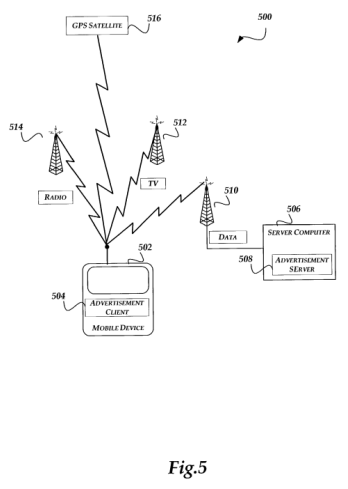
An embodiment depicted in Figure 5 of the ′414 patent (reproduced below) is “a functional block diagram generally illustrating an overview of system 500 for inserting advertisements provided by advertisement server 506 into streamed or broadcast content playing on a mobile device 502.” Id. at 9:12-15. “Advertisement client 504 is located on mobile device 502 and determines the information about the user… and provides this information to advertisement server 508.” Id. at 9:24-27. That information “may include any combination of physical location, preference, user behavior and demographic information.” Id. at 9:28-30.
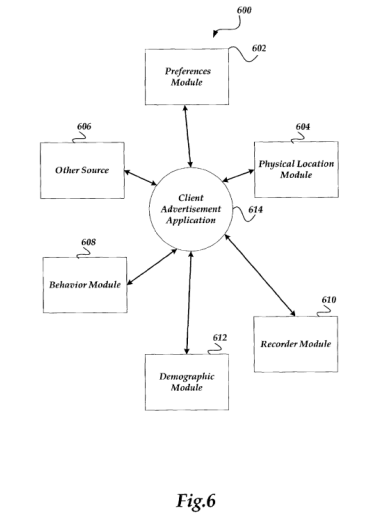
The system collects user information via the client advertisement application, which is depicted in Figure 6 below. The client advertisement application “is in communication with several other modules that provide different types of information, which in total are employed to generate information regarding [the] user.” Id. at 9:48-51. For example, “[d]emographic module 612 enables [collection of] the demographics of a user” and “[b]ehavior module 608” collects information regarding the “type and frequency” of the user's cellphone use. Id. at 10:7-24 (specification describing six modules: preferences, physical location, recorder, demographic, behavior, and other source). Of particular importance to this appeal is the “other source” module, about which the specification says the following:
Additionally, other source module 606 enables other sources to be used to provide information regarding the user, e.g., a message from another user of another mobile device that identifies characteristics of the current user of the mobile device. Also, information can be provided by others (or the actual user) from a remotely located stationary computing device about the mobile device user.
Id. at 10:18-24. Once collected, the totality of information is “used in determining advertisements to be played by the user's mobile device.” Id. at 11:20-21.
The parties agree claim 1 is representative of the four independent claims at issue here. It recites:
A method for playing content and advertisements on a cellular device, comprising:
autonomously providing to a server, by the cellular device, information associated with a user of the cellular device, the information taken by the cellular device from a message sent to the cellular device from another user of another cellular device, the message identifying characteristics of the user of the cellular device;
receiving from the server, by the cellular device, at least one advertisement to be played on the cellular device, wherein the at least one received advertisement is determined by the server based at least in part on the provided information;
if a determined time interval occurs, stopping playing of the content, by the cellular device, and playing the at least one of the determined advertisements, by the cellular device, the playing of the at least one determined advertisement comprising:
recording, by the cellular device, the content which playing was stopped, while the at least one determined advertisement is playing; and
when the playing of the at least one determined advertisement is completed, resuming the playing of the stopped content, by the cellular device, from where the stopping of the playing of the content occurred, using the recorded content.
Id. at 12:18-44 (emphasis added).
Claim 2 is illustrative of the challenged dependent claims, each of which adds a requirement that the information provided to the server “additionally include” at least one of the information types listed in the dependent claim. Claim 2 recites:
The method of claim 1, wherein the provided information additionally includes at least one of the group consisting of a preference of a user of the cellular device, a demographic data of the cellular device, content played on the cellular device, or a geographic location of the cellular device.
Id. at 12:45-50 (emphasis added).
The ′414 patent belongs to a family of patents, which claims priority to U.S. Provisional Patent Application No. 60/290,592 (the “′592 application”). In connection with prosecution of the ′592 application, the applicant submitted internal company documents describing the purported invention as a “[m]ethod of serving ads to a wireless phone,” by interspersing targeted advertisements during playback of songs recorded from the radio. J.A. 1088. The ′592 application does not indicate from where the claimed system obtains information to create a user profile and enable targeted advertising.
Similarly, original claim 1 of the application that produced the ′414 patent was agnostic as to the source of the user information used to identify targeted ads, referring broadly to “information associated with a user of the mobile device.” J.A. 907-08. The examiner rejected original claim 1 over the prior art reference Owensby. The examiner found Owensby teaches providing, to a server, user-based information from a mobile device, including user preferences, demographic data, user behavior, and content played by the user on the device – all categories of information that were enumerated in original claim 1 of the ′414 patent. In response to the rejection, the applicant removed the specific categories of information from independent claim 1 and moved them into dependent claim 2. In the same amendment, the applicant added to claim 1 the information “taken by the cellular device from a message sent to the cellular device” limitation at issue in this appeal. The applicant then argued that “Owensby targets ads based on information that originates from an affirmative act of the subscriber,” which is distinct from “the method of claim 1 [which] requires that the provided information originate from another source, in particular a message from another user of another cellular device.” J.A. 642 (emphasis omitted). The examiner allowed amended claim 1 to issue.
B
Google Inc. (“Google”) petitioned for inter partes review (“IPR”) of claims 1-7 and 9-14 of the ′414 patent based on a combination of three prior art references: Frerichs, Kawa-saki, and Kauffman. The Board instituted IPR; in its institution decision, the Board agreed with the parties that no claim terms required construction at that point. Wildseed, in its Patent Owner Response, raised a dispute about the claim term “information taken by the cellular device from a message.” Wildseed argued that the plain and ordinary meaning of this term is limited to verbatim extraction of information from a message, thereby excluding information that can be derived or generated from the message but is not explicitly contained in the message itself. Google countered that the plain and ordinary meaning of “taken” is broad enough to encompass information generated or derived from message text.
The difference between the parties' claim construction proposals is illustrated by the following example. A user receives a text message that reads: “Let's play Pebble Beach today.” In Wildseed's view, the system only extracts these exact words, so it does not discern from this message any indication that the user is likely interested in golf. In Google's view, by contrast, the system may derive from reference to “Pebble Beach,” a famous golf course, that the user is interested in golf, so it can send the word “golf” to the server, even though “golf” is not found in the text of the message itself.
The Board reviewed the claim language, specification, and prosecution history and rejected Wildseed's proposed construction. The Board observed that only one portion of the specification discusses the “other sources” module and refers directly to taking information from text messages, and that excerpt did not contain anything that would indicate to a person of ordinary skill in the art that “information taken by the cellular device from a message” is limited to verbatim extraction. With respect to the prosecution history, the Board explained that the applicant's amendment narrowed independent claim 1 by specifying a particular source of information, text messages, but found the amendment had nothing to do with whether information “taken” from the text messages includes or excludes derived information. Thus, to the Board, the amendment was irrelevant to resolution of the claim construction dispute. The Board further noted that Google's broader conclusion was consistent with dictionary definitions submitted by both parties. Applying its construction, the Board found all of the challenged independent claims obvious over Kawasaki, which it found discloses the claimed “information taken by the cellular device from a message.” J.A. 32-33.
The Board also sided with Google regarding the parties' dispute as to the meaning of “additionally include[d]” information that must be taken from a message as in claim 1, a term that appears in the challenged dependent claims. Applying Google's understanding of the term, the Board found the dependent claims unpatentable as obvious over Frerichs.
Wildseed timely appealed. We have jurisdiction under 28 U.S.C. §1295(a)(4)(A).
II
We review the Board's ultimate claim construction de novo and its subsidiary factual findings regarding extrinsic evidence for substantial evidence. See Personalized Media Commc'ns, LLC v. Apple Inc., 952 F.3d 1336, 1339 (Fed. Cir. 2020). Claims are generally construed according to their plain and ordinary meaning as understood by a person having ordinary skill in the art after reviewing the claim term in the context of the patent. See Phillips v. AWH Corp., 415 F.3d 1303, 1312-13 (Fed. Cir. 2005) (en banc).
“We review the Board's compliance with the procedural requirements of the [APA] de novo.” Axonics, Inc v. Medtronic, Inc., 75 F.4th 1374, 1380 (Fed. Cir. 2023). “The central inquiry is whether we can reasonably discern that the Board followed a proper path, even if that path is less than perfectly clear.” Medtronic, Inc. v. Teleflex Innovations S.a.r.l., 70 F.4th 1331, 1344 (Fed. Cir. 2023) (internal quotation marks and brackets omitted).
III
Wildseed challenges the Board's claim constructions with respect to two disputed terms: (a) “taken… from a message,” as used in illustrative independent claim 1; and (b) the “provided information additionally includes,” as used in illustrative dependent claim 2.
A
The Board agreed with the parties that it should apply the plain and ordinary meaning of the claim term “taken… from a message,” but it had to resolve the parties' dispute as to what that plain and ordinary meaning actually is. All agree that it includes extracting verbatim information from a text message. Google adds that it also includes information generated or derived from exact text. Wildseed does not. The Board agreed with Google's broader construction and we do as well.
Claim 1 recites a system for autonomously providing to a server information “taken by the cellular device from a message sent to the cellular device.” ′414 pat. 12:22-23. Nothing in the claim language, specification, or prosecution history would indicate to a skilled artisan that the information must be extracted verbatim from a text message.
Wildseed accuses the Board of improperly viewing the term “taken” in isolation, ignoring the context provided by the claims, which requires that the information be “taken by [a] cellular device from a message.” Wildseed further argues that the Board failed to appreciate the grammatical structure of the claim language, which Wildseed insists indicates that what is “taken” from a message must be preexisting and cannot, therefore, be deduced. Wildseed also argues that the claims elsewhere use the term “determine” or “determine based on” to denote the generation or derivation of new types of data, so the different term “taken” has to have a different, and narrower meaning.
We disagree with Wildseed. The claim language merely limits the source of the information, i.e., that it be “from a message,” but does not limit how the information obtained from that source is used. Wildseed's suggestion that the doctrine of claim differentiation supports its position is mistaken, as nothing about the Board's construction renders any claim term improperly superfluous. Under the Board's construction, “determined” includes only generated information, while “taken” includes both generative information and verbatim extraction, consistent with the presumption that different claim terms have different scope. See Seachange Int'l, Inc. v. C-COR, Inc., 413 F.3d 1361, 1368-69 (Fed. Cir. 2005).
Nor are we persuaded by Wildseed's suggestion that the Board's construction is somehow infected by hindsight, failing to appreciate the limitations of the technology that existed in 2001. A skilled artisan would understand that cell phones of that era were capable of effectively deducing or deriving information that is not expressly stated, for instance through database retrieval (e.g., an entry associating “Pebble Beach” with golf courses). See J.A. 2285-88 (Google's expert Dr. Henry Houh explaining that skilled artisan would be motivated to combine Frerich's 2001-era cellphone with Kawasaki's ability to apply “algorithms and rules,” without needing modern artificial intelligence or neural networks).
Turning to the specification, Wildseed relies primarily on what it labels “the key disclosure in column 10,” Open. Br. at 31-37, which is the only portion of the specification addressing information taken from a message. That disclosure is as follows: “other source module 606 enables other sources to be used to provide information regarding the user, e.g., a message from another user of another mobile device that identifies characteristics of the current user of the mobile device.” ′414 pat. 10:18-22 (emphasis added). Like the Board, all that we discern from this statement is that text messages received by the user are one exemplary source of information; it does not speak to the issue of verbatim extraction as opposed to generation of information. And, contrary to Wildseed's contention, the specification provides multiple examples of a system deriving information for provision to the server. See, e.g., id. at 9:48-51 (describing modules in embodiment of Figure 6 as being “employed to generate information regarding a user of the mobile device”) (emphasis added); id. at 9:58-64 (providing that module in Figure6 may “analyze[]” “GPS, Assisted GPS and/or triangulation of wireless signals” “to determine the physical location of the user's mobile device, e.g., at a sports stadium”); id. at 10:8-11 (demographic module of Figure 6 may “determine[]” user's spending habits through “various questionnaires or surveys”); id. at 10:16-17 (behavior module of Figure 6 can “determine[]” “type and frequency” of user's cell phone usage); id. at 10:45-47 (Figure 8 “illustrates… the process for generating information regarding the user of a mobile device.”).
Wildseed further focuses on Figure 8, a “flow chart that illustrates an overview… of the process for generating information regarding the user of a mobile device.” J.A. 79 (citing ′414 pat. 10:45-46 & Fig. 8). Wildseed argues that steps 802 through 820 involve the collecting of information about a user and providing it to the server, before the system “generate[s] information about [the] user of a mobile device for server.” J.A. 79 (capitalization normalized). We agree, however, with the Board that, even if the embodiment of Figure 8 restricts the “taking” steps from including generation or extrapolation from the exact text of messages, there is no basis to import that limitation into the claims. See Hill-Rom Servs., Inc. v. Stryker Corp., 755 F.3d 1367, 1371 (Fed. Cir. 2014) (“While we read claims in view of the specification, of which they are a part, we do not read limitations from the embodiments in the specifications into the claims.”).
Wildseed next contends that the prosecution history, and particularly the ′592 provisional application, to which the ′414 patent claims priority, supports its construction because it discloses only data extraction. To the contrary, the ′592 provisional application is of little, if any, relevance. While a portion of the ′592 application discloses a system in which pre-existing data (an identifier for a radio station) is extracted from an SMS message, it nowhere defines or discloses that pre-existing data must be extracted verbatim from the message or that derived information is excluded. In fact, varying degrees of extrapolation may be necessary to identify which radio station users are discussing. See, e.g., Google Br. at 40 (illustrating this point with examples of messages referring to “100.3,” “FM 100.3 MHz,” “FM 100.3,” and “WBIG-FM”).
The amendments made during prosecution of the ′414 patent also do not support Wildseed's proposed construction. The examiner initially rejected the claims as obvious over Owensby because that reference teaches sending information from a user's cellphone to an external server. In response, the applicant added the “from a text message” limitation to the independent claims, and distinguished Owensby because the information it was sending to the server “originates from an affirmative act,” while “the method of claim 1 requires that the provided information originate from… a message from another user.” J.A. 640-42. As the Board correctly explained, these limitations relate only to the sources of the information (whether from a text message or other source) and whether an affirmative act of the user is required to initiate the provisioning of the data to the server; they have nothing to do with the method of obtaining the information, i.e., extraction of particular words used in the messages or information derived in other ways from the same source.
Finally, Wildseed takes issue with the Board's citations to dictionary definitions submitted by the parties. Because we have resolved the parties' claim construction dispute based solely on the intrinsic evidence, we have no need to consider the extrinsic evidence. See Seabed Geosolutions (US) Inc. v. Magseis FF LLC, 8 F.4th 1285, 1287 (Fed. Cir. 2021) (“If the meaning of a claim term is clear from the intrinsic evidence, there is no reason to resort to the extrinsic evidence.”) (internal quotation marks and brackets omitted).
In sum, we agree with the Board that the correct construction of “taken… from a message” includes information generated or derived from the words used in a message, and is not limited to verbatim extraction. As Wildseed's appeal of the Board's obviousness determination regarding the challenged independent claims is based entirely on Wildseed's rejected claim construction, we affirm the Board's conclusion that the challenged independent claims (claims 1, 9, 12, and 14) of the ′414 patent are unpatentable.
B
With respect to the patentability of the challenged dependent claims (2-3, 10, 13), we again agree with the Board, which correctly included within the scope of “the provided information additionally includes” sources of information other than text messages.
To the extent Wildseed's position with respect to the dependent claims is based on its now-rejected proposed construction for the “taken” term we have already discussed, it follows from what we have already held that we must also reject its arguments concerning the dependent claims. Wildseed contends that: (i) the information disclosed in claim 1 is limited to a single source, text messages; (ii) claim 1 provides the antecedent basis for the information recited in claim 2; and (iii) therefore the information recited in claim 2 must be taken from that same, single source. As the premise for this logic lacks merit, so, too, does Wildseed's conclusion.
The specification further undermines Wildseed's challenge to the Board's analysis of the dependent claims. It describes several modules that function in preferred embodiments to collect various types of data (e.g., preferences, physical location, recorder, demographic, behavior, and other sources), revealing that text messages received by the user are only one source among many from which these modules pull information. See, e.g., ′414 pat. at 10:18-22 (“[O]ther source module 606 enables other sources to be used to provide information regarding the user, e.g., a message from another user of another mobile device that identifies characteristics of the current user of the mobile device.”). The prosecution history on which Wildseed further relies, see Open. Br. at 49 (citing J.A. 640), is no more relevant, and of no greater help to Wildseed, in connection with the dependent claims than it was in connection with the independent claims, as we discussed above.
Thus, the dependent claims, like the independent claims, require that some information be taken from the text messages received by the user, but they do not preclude taking information from other sources as well. We agree with the Board's construction of the disputed claim term. As Wildseed does not dispute that substantial evidence supports the Board's finding that the dependent claims are obvious when this construction is applied, we affirm the Board's finding that these claims are obvious.
C
Finally, Wildseed argues that the Board's obviousness analysis concerning dependent claims 2, 10, and 13 fails to satisfy APA requirements, as it does not enable our review. We disagree.
While we have acknowledged that it is not adequate for the Board to summarize and reject arguments without explaining why it accepts the prevailing argument, we have also repeatedly explained that the Board is not required to address every argument raised by a party or explain every possible reason supporting its conclusion. The central inquiry is whether we can reasonably discern that the Board followed a proper path, even if that path is less than perfectly clear.
Medtronic, 70 F.4th at 1344 (internal quotation marks and brackets omitted).
The Board's path with respect to these dependent claims is reasonably discernable. The Board extensively quoted the Petition, Patent Owner Response, and Reply, summarizing the parties' positions, and then explained that it “agree[d] with [Google] and reject[ed] [Wildseed's] argument as not supported by the claim language.” J.A. 58-60. Contrary to Wildseed's contentions, the Board cited intrinsic evidence for its conclusion and its analysis is sufficient to enable our review. Hence, there is no APA violation. See Outdry Techs. Corp. v. Geox S.p.A, 859 F.3d 1364, 1369-70 (Fed. Cir. 2017) (concluding Board satisfies APA when it clearly articulates and adopts arguments presented by litigant that are supported by record evidence and reasoned explanation).
IV
We have considered Wildseed's remaining arguments and find they lack merit. Accordingly, for the reasons provided above, we affirm the Board's conclusion that claims 1-7 and 9-14 of the ′414 patent are unpatentable as obvious.
AFFIRMED