

Patent Cases, YUKON PACKAGING, LLC, Plaintiff, v. JONES SUSTAINABLE PACKAGING, LLC, Defendant., U.S. District Court, W.D. North Carolina, (May 8, 2026)
YUKON PACKAGING, LLC, Plaintiff, v. JONES SUSTAINABLE PACKAGING, LLC, Defendant.
U.S. District Court, W.D. North Carolina, Statesville Division. 5:25-CV-00007-MEO-DCK. May 8, 2026.
Matthew E. Orso, District Judge
Matthew E. Orso, District Judge
MEMORANDUM & ORDER
THIS MATTER is before the Court on Plaintiff Yukon Packaging LLC's Motion for Preliminary Injunction. (Doc. No. 105). The Court has considered the Motion, the parties' briefs and exhibits, and oral argument presented during the hearing on April 24, 2026. For the reasons explained below, the Court will GRANT Plaintiff's motion.
The Court finds that Plaintiff is likely to succeed on its claim that Defendant is infringing on Plaintiff's Patent No. 12,595,110. Plaintiff will likely suffer irreparable harm if the injunction is not entered, the balance of equities and hardships favors Plaintiff, and the public interest is best served by an injunction. Therefore, the Court enjoins Defendant and all those acting in concert with it (including other members of its corporate family) from making, using, marketing or selling the insulated shipping container in dispute (or assisting any other person or entity in doing so).
I. LEGAL STANDARD
A preliminary injunction seeking to enjoin patent infringement “involves substantive matters unique to patent law, therefore, is governed by the law of” the Federal Circuit. Revision Mill., Inc. v. Balboa Mfg. Co., 700 F.3d 524, 525 (Fed. Cir. 2012); Pathway IP LLC v. Individuals, Corps., Ltd. Liab. Cos., P'ships, & Unincorporated Ass'ns Identified on Attached Schedule A, No. 24-CV-05218, 2025 WL 655237, at *4 (N.D. Ill. Jan. 30, 2025). While the Federal Circuit “review[s] the grant or denial of a preliminary injunction under the law of the regional circuit, here the Fourth Circuit[,]” the Federal Circuit “gives dominant effect to Federal Circuit precedent insofar as it reflects considerations specific to patent issues.” Natera, Inc. v. NeoGenomics Lab'ys, Inc., 106 F.4th 1369, 1374–75 (Fed. Cir. 2024) (quoting Murata Mach. USA v. Daifuku Co., 830 F.3d 1357, 1363 (Fed. Cir. 2016)).
Under both Federal Circuit and Fourth Circuit law, the grant or denial of a preliminary injunction is within the sound discretion of a district court. Id. at 1375; Biomedical Device Consultants & Lab'ys of Colo., LLC v. ViVitro Labs, Inc., No. 2023-2393, 2024 WL 1318251, at *3 (Fed. Cir. Mar. 28, 2024); see Metro. Regul. Info. Sys., Inc. v. Am. Home Realty Network, Inc., 722 F.3d 591, 595 (4th Cir. 2013). However, “[a] preliminary injunction is an extraordinary remedy never awarded as of right.” Winter v. Nat. Res. Def. Council, Inc., 555 U.S. 7, 24 (2008). To establish a right to a preliminary injunction, a party “must make a clear showing that [it] is likely to succeed on the merits, that [it] is likely to suffer irreparable harm in the absence of preliminary relief, that the balance of equities tips in [its] favor, and that an injunction is in the public interest.” Starbucks Corp. v. McKinney, 602 U.S. 339, 346 (2024) (quoting Winter, 555 U.S. at 20, 22).
The burden is on the patent owner to show it is likely to succeed on the merits as to both infringement and validity. See BlephEx, LLC v. Myco Indus., Inc., 24 F.4th 1391, 1398–99 (Fed. Cir. 2022); Amazon.com, Inc. v. Barnesandnoble.com, Inc., 239 F.3d 1343, 1350 (Fed. Cir. 2001). To show that likelihood, “a patentee must show ‘(1) it will likely prove infringement and (2) its infringement claim will likely withstand challenges to the validity and enforceability of the patents.’” Natera, 106 F.4th at 1375 (quoting Purdue Pharma L.P. v. Boehringer Ingelheim GMBH, 237 F.3d 1359, 1363 (Fed. Cir. 2001)). If the accused infringer “raises a substantial question concerning either infringement or validity, i.e., asserts an infringement or invalidity defense that the patentee cannot prove ‘lacks substantial merit,’ the preliminary injunction should not issue.” Amazon.com, 239 F.3d at 1350–51 (quoting Genentech, Inc. v. Novo Nordisk, A/S, 108 F.3d 1361, 1364 (Fed. Cir. 1997)); accord Biomedical Device Consultants, 2024 WL 1318251, at *3.
A party seeking a preliminary injunction must also show it is likely to suffer irreparable harm if the injunction is not granted. Luminara Worldwide, LLC v. Liown Elecs. Co., 814 F.3d 1343, 1352 (Fed. Cir. 2016). “Furthermore, a patentee must establish a causal nexus between the alleged infringement and the alleged harm.” Id. Where the alleged injury is not quantifiable, “the harm cannot be adequately compensated and is irreparable.” Metalcraft of Mayville, Inc. v. Toro Co., 848 F.3d 1358, 1368 (Fed. Cir. 2017).
If a preliminary injunction is found to be warranted, then “[c]rafting a preliminary injunction is an exercise of discretion and judgment, often dependent as much on the equities of a given case as the substance of the legal issues it presents.” Trump v. Int'l Refugee Assistance Project, 582 U.S. 571, 579 (2017). And “[i]t is well established … that a federal district court has wide discretion to fashion appropriate injunctive relief in a particular case.” Richmond Tenants Org., Inc. v. Kemp, 956 F.2d 1300, 1308 (4th Cir. 1992). Indeed, a court should “mold its decree to meet the exigencies of the particular case.” Trump, 582 U.S. at 580. In doing so, a court must ensure a preliminary injunction is “no more burdensome to the defendant than necessary to provide complete relief to the plaintiffs,” Madsen v. Women's Health Ctr, Inc., 512 U.S. 753, 765 (1994), and be mindful that “[t]he purpose of such interim equitable relief is not to conclusively determine the rights of the parties, but to balance the equities as the litigation moves forward.” Trump, 582 U.S. at 580 (citation omitted).
II. FACTUAL FINDINGS AND PROCEDURAL HISTORY
Plaintiff is the owner of patents related to the invention of a three-piece insulated shipping container, and Defendant Jones Sustainable Packaging, LLC (“Jones”) makes and sells competing insulated containers. See Yukon Packaging v. Jones Sustainable Packaging, No. 5:25-CV-00007-KDB-DCK, 2025 WL 1782582, at *1 (W.D.N.C. Apr. 2, 2025) (“Yukon I”). Both companies compete in the “‘cold chain packaging’ industry” and manufacture packaging designed to ship goods at a consistent temperature while in transit. Id. at *2.
On January 14, 2025, Yukon filed its Complaint in this matter, alleging that Jones's cold-chain insulated container (the “Accused Product”) infringed on its patents. (Doc. No. 1). On April 2, 2025, the Court entered a preliminary injunction enjoining Jones from “making, offering for sale, selling, using or advertising” its Accused Product. Yukon I, 2025 WL 1782582, at *14; (Doc. No. 73 at 27). In Yukon I, the Court summarized the procedural history of the case and made detailed findings of facts regarding the parties, their history, and the dispute. In the interest of brevity, the Court adopts and reincorporates those findings as if stated here. See Yukon I, 2025 WL 1782582, at *2–7.
Following the entry of a preliminary injunction in Yukon I, Jones began producing a new insulated three-piece shipping container (the “Accused Hinge-Break Product”). As explained below, Yukon now alleges the Accused Hinge-Break Product infringes on its new patent. (Doc. No. 105).
A. The ′110 Patent
On January 7, 2025, David Vance, Yukon's Vice President of Sales and Business Development, filed a continuation patent application with the United States Patent and Trademark Office (“USPTO”) concerning the method of forming container insulation. See (Doc. Nos. 105-2 at 4; 109 ¶1). On April 7, 2026, the USPTO issued Patent No. 12,595,110 (“the ′110 Patent”). (Doc. No. 105-2 at 4). The ′110 Patent consists of three claims.
• Claim 1
A method of forming container insulation comprising the steps of:
providing a quantity of post-industrial, pre-consumer cotton or synthetic waste fiber;
providing an airlay processing machine configured to process post-industrial, pre-consumer cotton or synthetic waste fiber into a continuous non-woven sheet having predetermined thickness and density;
providing a die-cut press configured to cut the non-woven continuous sheet into square or rectangular shapes thereby forming insulated pads, wherein each of the insulated pads has a top surface, a bottom surface, and four edge surfaces;
feeding the post-industrial, pre-consumer cotton or synthetic waste fiber into the airlay processing machine;
cutting the continuous sheet with the die-cut press to form a first insulated pad, a second insulated pad, and a third insulated pad, wherein the first insulated pad, the second insulated pad, and the third insulated pad each have a same predetermined thickness and density; and
wherein during the cutting step, the first insulated pad is configured to be positioned inside a rigid container in contact with at least a bottom of the rigid container, the second insulated pad is configured to be positioned inside the rigid container in contact with at least a top side of the rigid container, and the third insulated pad is configured to be positioned inside the rigid container in contact with at least a front side, a rear side, and a right side of the rigid container.
(Doc. No. 104-3 at 42, 9:12–10:15).
• Claim 2
The method of forming container insulation of claim 1, further comprising the step of encasing the first insulated pad, the second insulated pad, and the third insulated pad in poly-wrap.
Id. at 10:16-10:19.
• Claim 3
The method of forming container insulation of claim 1, further comprising the step of applying coffee filer paper, kraft paper, or fluted-corrugate paper to a surface of each of the first insulated pad, the second insulated pad, and the third insulated pad.
Id. at 10:20-10:25.
According to the USPTO Examiner's Reasons for Allowance, ′110 Patent's method is unique because the prior art references:
fail to teach or disclose the method wherein during the cutting step, the first insulated pad is configured to be positioned inside a rigid container. It would not have been obvious to modify [the prior art] with the aforementioned limitations because [the prior art] discloses the production of the claimed insulation, not the packaging steps required to place said insulation into the container…. Furthermore, [the prior art] teaches the step of placing an insulated pad in the container, but this does not occur during a cutting step.”
(Doc. No. 104-4 at 18).
B. The Accused Hinge-Break Product
After the Court issued the Yukon I preliminary injunction, Jones began offering the Accused Hinge-Break Product. According to Jones, the new product:
contains insulation pads within two poly bags placed inside a corrugated cardboard box with six sides. One insulation pad is placed adjacent to three interior sides of the box, one insulation pad is placed adjacent to two interior sides of the box, and one insulation pad is placed adjacent to one interior side of the box …. The insulation pads placed adjacent to two and one interior sides are both contained in the same poly wrap bag, with a seal separating the two insulation pads. The insulation pad placed adjacent to three interior sides of the box is contained in a second poly wrap bag. Because the insulation pads cover three, two, and one interior sides of the cold chain package, none of the insulation pads are interchangeable.
(Doc. No. 105-7 at 8). Jones asserts that its product “was specifically designed … to not infringe Yukon's patents.” (Doc. No. 108 at 8).
C. Yukon's Business
Prior to the Yukon I preliminary injunction, both Jones and Yukon sold three-piece cold chain containers to, among others, their primary mutual customer, Veritiv. See Yukon I, 2025 WL 1782582, at *11. Veritiv, a large distributor, then resold the products to third parties, including a health care company (“Customer 1”). Id. at *4. The Yukon I preliminary injunction enjoined Jones from selling its three-piece cold chain product to Vertiv. See id. at *14.
In October 2025, Yukon learned that Vertiv's contract with Customer 1 had been terminated. (Doc. No. 116-2 ¶31). By January 1, 2026, Yukon had lost all of its business for three-piece cold chain insolation for Customer 1. Id. Also in January 2026, Yukon learned that Jones had taken over Customer 1's business and was selling its Accused Hinge-Break Product. Id. ¶34. [1]
Since the loss of Customer 1's business, Yukon has faced a drastic decrease in revenue. See id. ¶¶31–39. Yukon has also scaled down the operations of its facilities and reduced its workforce by over 50%. See id. ¶¶40–56. Yukon anticipates continued decrease in its workforce and distribution centers absent injunctive relief. Id. ¶¶43, 54. Yukon has also suffered price erosion, with a potential new customer requesting pricing significantly lower than what Yukon has previously offered. See id. ¶¶57–63.
D. Second Motion for Preliminary Injunction
On April 7, 2026—the same day the USPTO issued the ′110 Patent—Yukon filed a Motion for Temporary Restraining Order and Preliminary Injunction. (Doc. No. 105). In its Motion, Yukon asserts that “[b]y selling and/or offering to sell the Accused Hinge-Break Product, Jones is directly and indirectly infringing” the ′110 Patent. Id. at 1–2. On April 24, 2026, the Court held a hearing on the Motion for Preliminary Injunction. [2] Yukon's Motion is now ripe for review.
III. ANALYSIS, FURTHER FACTUAL FINDINGS, AND CONCLUSIONS OF LAW
To grant Plaintiff's request for a preliminary injunction, the Court must consider each of the Winter factors. For the reasons discussed below, the Court finds that each factor supports granting Plaintiff's request for preliminary injunction.
A. Likelihood of Success on the Merits
Under the first Winter factor, Yukon “must make a clear showing that ‘[it] is likely to succeed on the merits.’” Starbucks, 602 U.S. at 346 (quoting Winter, 555 U.S. at 20). If the accused infringer “raises a substantial question concerning either infringement or validity, i.e., asserts an infringement or invalidity defense that the patentee cannot prove ‘lacks substantial merit,’ the preliminary injunction should not issue.” Amazon.com, 239 F.3d at 1350–51 (quoting Genentech, Inc. v. Novo Nordisk, A/S, 108 F.3d 1361, 1364 (Fed. Cir. 1997)). An accused infringer need not make out a case of non-infringement or actual invalidity to avoid a preliminary injunction. See Amazon.com, 239 F.3d at 1359. Rather, the relevant inquiry is whether the patentee has shown it is more likely than not to prevail over a noninfringement or invalidity challenge. Natera, 106 F.4th at 1376–77. Finally, because it is only a preliminary assessment of the merits, a “district court [does] not err by not engaging in explicit claim construction before evaluating the likelihood of infringement” and has “no obligation to definitively construe claims at the preliminary injunction stage.” Natera, 106 F.4th at 1375 (citing Sofamor Danek Grp., Inc. v. DePuy-Motech, Inc., 74 F.3d 1216, 1221 (Fed. Cir. 1996)).
The Court has reviewed the ′110 Patent, the Accused Hinge-Break Product, and the remaining record. As explained below, the Court finds the Accused Hinge-Break Product likely infringes upon Claims 1 and 2 of the ′110 Patent and that Jones has not met its burden at this stage on its validity challenge.
1. Infringement of the ′110 Patent
The parties do not disagree regarding the current method Jones uses to make the Accused Hinge-Break Product. Rather, the parties' infringement dispute centers on whether the Accused Hinge-Break Product follows every element of the claimed ′110 Patent. Yukon asserts that it does. (Doc. No. 105-1 at 16–21). Jones, on the other hand, argues that Yukon's infringement theory fails because Jones does not follow claim element [1f]. (Doc. No. 113 at 11). Claim element [1f] states:
wherein during the cutting step, the first insulated pad is configured to be positioned inside a rigid container in contact with at least a bottom of the rigid container, the second insulated pad is configured to be positioned inside the rigid container in contact with at least a top side of the rigid container, and the third insulated pad is configured to be positioned inside the rigid container in contact with at least a front side, a rear side, and a right side of the rigid container.
(Doc. No. 105-2 at 42, 10:6–15) (emphasis added). Specifically, Jones argues that it “does not ‘configure’ the accused product ‘during the cutting step.’” See (Doc. No. 113 at 11–14).
“[T]he words of a claim ‘are generally given their ordinary and customary meaning.’” Phillips v. AWH Corp., 415 F.3d 1303, 1312 (Fed. Cir. 2005) (first quoting Vitronics Corp. v. Conceptronic, Inc., 90 F.3d 1576, 1582 (Fed.Cir.1996), then citing Toro Co. v. White Consol. Indus., Inc., 199 F.3d 1295, 1299 (Fed. Cir. 1999)). In patent law “the ordinary and customary meaning of a claim term is the meaning that the term would have to a person of ordinary skill in the art in question at the time of the invention, i.e., as of the effective filing date of the patent application.” Id. at 1313. Claim terms must be interpreted within “the context of the entire patent, including the specification,” and not just where the disputed term appears. Id. “In some cases, the ordinary meaning of claim language as understood by a person of skill in the art may be readily apparent even to lay judges, and claim construction in such cases involves little more than the application of the widely accepted meaning of commonly understood words.” Id. at 1314. In other cases, the terms may have a particular meaning in the field of art and the court must look to “sources available to the public that show what a person of skill in the art would have understood disputed claim language to mean.” Id. (quoting Innova/Pure Water, Inc. v. Safari Water Filtration Sys., Inc., 381 F.3d 1111, 1116 (Fed. Cir. 2004)). Sources may “include ‘the words of the claims themselves, the remainder of the specification, the prosecution history, and extrinsic evidence concerning relevant scientific principles, the meaning of technical terms, and the state of the art.’” Id.
Here, both parties argue they are applying the ordinary and customary meaning of the claim terms. Citing to its usage throughout the patent specifications, Yukon asserts that “‘configured’ simply means ‘made.’” (Doc. No. 115 at 10). Thus, according to Yukon, when the claim says, “during the cutting step, the first insulated pad is configured to be positioned,” then it means that during the cutting step, the die-cutting press cuts or makes the insulated pad to the appropriate length and width so that it may later be positioned within the rigid container. See id. Jones, on the other hand, points to statements made by the Examiner in the Reasons for Allowance, as well as dictionary definitions and other courts' findings regarding the meaning of configured. (Doc. No. 113 at 12). According to Jones, these sources demonstrate that “‘configure’ is commonly understood to mean some kind of positioning or arrangement.” Id. Under Jones' suggested reading, the language means that the insulated pads are positioned inside a rigid container during the cutting step—and not at a later time. Id. at 11–12.
Here, the Court agrees with Yukon. Based on a holistic reading, the ordinary and customary meaning of “configured” is likely something close to “made.” See Trs. of Columbia Univ. in City of N.Y. v. Symantec Corp., 811 F.3d 1359, 1369 (Fed. Cir. 2016) (explaining that claims in the same patent family must be interpreted consistently). But ultimately, whether configured is closer to “made” or “arranged” is not dispositive. Rather, the crux of the issue is when the positioning of the pad occurs. Importantly, the claim uses two different temporal elements—”during” and “to be.” When read together, “during” indicates what is happening as part of the cutting step while “to be” refers to something that will happen in the future, after the cutting step occurs. A natural reading of “to be” in this statement is synonymous with the phrase “so that it may be.” Therefore, a plain way of restating the claim is that during the cutting step, the pad is made so that it may be positioned inside a rigid container.
Jones's argument to the contrary is not persuasive, as it would require the Court to rewrite the claim. In fact, in its brief, Jones attempted a rewrite of its own by repeatedly rearranging the order of the two temporal phrases so that “during” modifies “to be.” [3] But the claim does not say that the “first insulated pad is configured to be positioned during the cutting step.” In light of the claim's plain language, the Court also does not find the Examiner's Reasons for Allowance helpful to the claim construction analysis, as it also inverts the temporal element. See (Doc. No. 104-4 at 18) (“Furthermore, [the prior art] teaches the step of placing an insulated pad in the container, but this does not occur during a cutting step.”). While the Federal Circuit has made clear that certain case examiner statements “may be evidence of how one of skill in the art understood the term at the time of the application,” the Court is not bound by the statements. See Salazar v. Procter & Gamble Co., 414 F.3d 1342, 1347 (Fed. Cir. 2005) (explaining that an applicant is not precluded “from taking a position contrary to the examiner's statements when the claim terms are construed during litigation”); c.f. Program Rewards Sols. LLC v. Points Int'l Ltd., No. 10 CIV. 1561 RJS, 2012 WL 335660, at *8 (S.D.N.Y. Jan. 13, 2012) (“find[ing] that the plain language of the specification and the fact that [certain terms did not] appear[ ] in the claims outweigh the Examiner's unilateral comment about the invention's purpose”).
Therefore, the Court finds a likelihood that Yukon will succeed on the merits of its claim that the Accused Hinge-Break Product infringes the ′110 Patent.
2. Challenge to Validity of the′110 Patent
Jones also raises a challenge to the validity of the ′110 Patent based on obviousness. (Doc. No. 113 at 16–19). “[A]n issued patent comes with a statutory presumption of validity.” Titan Tire Corp. v. Case New Holland, Inc., 566 F.3d 1372, 1376 (Fed. Cir. 2009). “Because of this presumption, an alleged infringer who raises invalidity as an affirmative defense has the ultimate burden of persuasion [at trial] to prove invalidity by clear and convincing evidence, as well as the initial burden of going forward with evidence to support its invalidity allegation.” Id. When the question of validity is raised at the preliminary injunction stage, “the patent enjoys the same presumption of validity … as at other stages of litigation,” and “the burden is on the challenger to come forward with evidence of invalidity, just as it would be at trial.” Id. at 1377 (citing Canon Comput. Sys., Inc. v. Nu–Kote Int'l, Inc., 134 F.3d 1085, 1088 (Fed. Cir. 1998). Then “to avoid a conclusion that it is unable to show a likelihood of success, [the patentee] … has the burden of responding with contrary evidence ….” Id. The trial court must then weigh the “evidence both for and against validity that is available at this preliminary stage in the proceedings.” Id. at 1379.4 “Thus, when analyzing the likelihood of success factor, the trial court, after considering all the evidence available at this early stage of the litigation, must determine whether it is more likely than not that the challenger will be able to prove at trial, by clear and convincing evidence, that the patent is invalid.” Id. [4]
Under 35 U.S.C. §103, “[a] patent for a claimed invention may not be obtained … if the differences between the claimed invention and the prior art are such that the claimed invention as a whole would have been obvious … to a person having ordinary skill in the art to which the claimed invention pertains.” In its opposition, Jones identifies four prior art references: U.S. Patent Application Publication No. 2021/0347550 (“Vezina”), U.S. Patent Application Publication No. 2018/0257844 (“s, JR.”), U.S. Patent Application Publication No. 2018/0299059 (“McGoff”), and U.S. Patent Application Publication No. 2015/0330001 (“Coates”). According to Jones, Claim 1 and 2 of the ′110 Patent would have been obvious in light of the prior art.
However, it is “not enough… to merely demonstrate that elements of the claimed invention were independently known in the prior art.” Metalcraft of Mayville, 848 F.3d at 1367. Indeed, “[o]ften, every element of a claimed invention can be found in the prior art.” Id. Instead, Jones must “articulate a reason why a skilled artisan would have been motivated to use” the prior art. Natera, 106 F.4th at 1377. [5] Here, Jones offers a single paragraph of conclusory argument on why a person of ordinary skill in the art would have been motivated to combine the prior art. (Doc. No. 113 at 18–19); Cf. Natera, 106 F.4th at 1377 (argument “before the district court consisted of four paragraphs, in which it put forth little more than conclusory argument with no meaningful supporting documentation”). Jones relies on general statements, like: “[a] POSITA would have further recognized that the teachings of these references would all be useful ….” without further support. (Doc. No. 113 at 19). Jones also ignores that Vezina teaches away from the use of cotton, further undermining the motivation to combine. See Rembrandt Wireless Techs., LP v. Samsung Elecs. Co., 853 F.3d 1370, 1379 (Fed. Cir. 2017) (“[s]urely a showing that a prior art reference teaches away from a given combination is evidence that one of skill in the art would not have been motivated to make that combination to arrive at the claimed invention.”). Jones has not raised a substantial question as to validity.
Accordingly, the Court finds that Yukon is likely to succeed on the merits.
B. Irreparable Harm
Turning to the second Winter factor, Yukon must show that it is likely to suffer irreparable harm if Jones is not enjoined from selling the Accused Hinge-Break Product. A showing of a mere possibility of some future harm is not enough. Winter, 555 U.S. at 22. A party may not rely on “[c]onjecture, surmise, or a party's unsubstantiated fears of what the future may have in store.” Insulet Corp. v. EOFlow, Co., 104 F.4th 873, 883 (Fed. Cir. 2024) (quoting Charlesbank Equity Fund II v. Blinds To Go., Inc., 370 F.3d 151, 162 (1st Cir. 2004)). However, while irreparable harm cannot be speculative, it need not be certain or have already occurred before an injunction is granted. See Michigan v. U.S. Army Corps of Eng'rs, 667 F.3d 765, 788 (7th Cir. 2011). “Evidence of head-to-head competition and lost market share can support a showing of irreparable harm.” Natera, 106 F.4th at 1378 (citing TEK Glob., S.R.L. v. Sealant Sys. Int'l, Inc., 920 F.3d 777, 793 (Fed. Cir. 2019)). Moreover, a party must also establish a “causal nexus” between the harm and the alleged infringement in order to show irreparable harm. Apple Inc. v. Samsung Elecs. Co., 809 F.3d 633, 639 (Fed. Cir. 2015). This requirement ensures the harm stems from the defendant's wrongful conduct and not some other reason. Id. at 640.
Here, Yukon alleges that without injunctive relief, it will suffer irreparable harm because of loss of market share, price erosion, loss of business opportunities, loss of goodwill, and reputational harm. (Doc. Nos. 105-1 at 21–26; 115 at 15–18). The Court agrees. Yukon and Jones compete in a two-player market to sell three-piece insulated containers. See Yukon I, 2025 WL 1782582, at *6; (Doc. No. 116-2 ¶¶8–11). The record demonstrates that since Jones began offering the Accused Hinge-Break-Product, Yukon has suffered a substantial loss of revenue. Specifically, as depicted in the graph below, Yukon lost all of Customer 1's business for three-piece cold chain insulation, which accounted for the majority of Yukon's total 2025 business. (Doc. No. 116-2 ¶31).
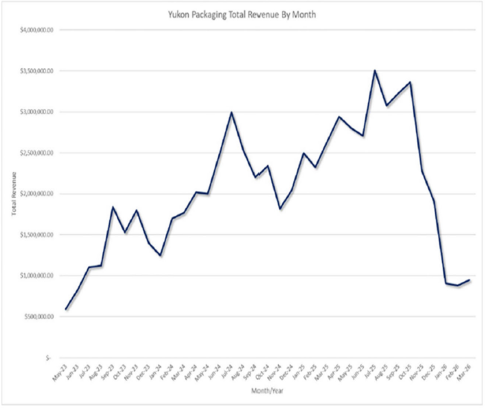
(Doc. No. 116-2 ¶36). [6] Yukon has also been forced to lay off over 50% of its workforce and scale down its operations at its three distribution centers. See id. ¶¶40–56. Additionally, at least one potential customer has requested significantly lower pricing than Yukon offered last fall. Id. ¶59.
Based on the record, the Court finds that, absent preliminary injunctive relief,there is a likelihood that Jones will continue competing with Yukon in selling three-piece insulated containers, and that as a result, Yukon will suffer loss of market share, price erosion, and loss of business opportunities. Additionally, being forced to compete in a market with another similar product will likely negatively “affect Yukon's investment, reputation, goodwill and ability to expand the market for its product.” See Yukon I, 2025 WL 1782582, at *11 (finding irreparable harm for substantially similar reasons); (Doc. No. 73 at 22).
The Court is not persuaded by Jones' arguments and addresses each argument in turn. First, Jones asserts that Yukon has failed to show a causal nexus between the alleged infringement and alleged harm. [7] (Doc. No. 113 at 25–26). According to Jones, Yukon's only evidence of alleged harm occurred before the ′110 Patent issued on April 7, 2026. (Doc. No. 113 at 25) (citing Novozymes A/S v. Danisco A/S, No. 10-CV-251-BBC, 2010 WL 3783682, at *3 (W.D. Wis. Sep. 24, 2010). Jones argues that Yukon cannot rely on pre-issuance harm to show a causal nexus because Jones was legally competing with Yukon at the time of the alleged harm. The Court disagrees.
Governing Federal Circuit authority demonstrates that pre-issuance harm may be relevant for the Court's analysis. See Tinnus Enters., LLC v. Telebrands Corp., 846 F.3d 1190, 1207 (Fed. Cir. 2017) (holding that irreparable harm “pre-dating the patent is, at the very least, circumstantial evidence demonstrating the possibility of identical harms once the patent issues”); BlephEx, LLC v. Myco Indus., Inc., 24 F.4th 1391, 1404 (Fed. Cir. 2022) (affirming district court's consideration of significant evidence of pre-issuance loss of goodwill and sales along with price erosion).
Further, Jones' reliance on Novozymes A/S is misplaced, because it is a district court case from a different circuit and factually inapposite. In that case, the plaintiffs were “not even using the claimed technology themselves and ha[d] identified no plans to do so.” 2010 WL 3783682, at *4. The district court cautioned that “the patent [may be] nothing more than a weapon to prevent defendants from competing with them.” Id. There are no similar allegations here.
In any event, the irreparable harm analysis does not depend solely on evidence predating the patent. Yukon also relies on a sealed declaration, dated April 23, 2026, which details Yukon's current financial situation, as well as the ongoing harm and anticipated effects of Yukon's loss of business. (Doc. No. 116-2). Although this post-issuance evidence may be less robust, when combined with the evidence of pre-issuance harm, the Court finds a causal nexus between the alleged infringement and harm. Specifically, the record demonstrates that demand for either party's product is driven by the three-piece design feature. See, e.g., (Doc. No. 116-2 ¶¶1217). Accordingly, the harm to Yukon stems from the alleged infringement. See Genband US LLC v. Metaswitch Networks Corp., 861 F.3d 1378, 1383 (Fed. Cir. 2017) (discussing the inference of causation when “the infringing features significantly increased the product's desirability”). [8]
Jones next argues that Yukon has failed to demonstrate price erosion or loss of market share because “Yukon's alleged irreparable harm relies heavily on the assumption that the circumstances and marketplace conditions from a year ago, including the supposed two-player market, exist today.” (Doc. No. 113 at 26). However, Jones' argument again misses the mark. As discussed above, pre-issuance harm may be relevant to the Court's analysis, and the Court finds that it is here. See Tinnus Enters., LLC, 846 F.3d at 1207–08 (“[T]he preTinnus issuance price erosion evidence may be relevant to show what would happen if [plaintiff's product] was no longer on the market.”). Prior to the issuance of the patent, Yukon lost a substantial part of its market share and suffered price erosion. And like in Tinnus, neither party has suggested that the issuance of the patent somehow eliminated the possibility of continued harm. See id. Additionally, Jones' argument that Yukon is “largely out of the market” and “not competing” is not borne out by the record. (Doc. No. 113 at 26, 30). Although Yukon has lost a substantial portion of its revenue and been forced to downsize its business, neither party has proffered evidence that Yukon has already been excluded from the market.
Jones contends that this is not a two-player market. (Doc. No. 113 at 28). But the record demonstrates that the relevant market—sales of three-piece cold chain containers—remains a two-player market. “While the existence of a two-player market may well serve as a substantial ground for granting an injunction—e.g., because it creates an inference that an infringing sale amounts to a lost sale for the patentee—the converse is not automatically true.” Robert Bosch LLC v. Pylon Mfg. Corp., 659 F.3d 1142, 1151 (Fed. Cir. 2011). Further, “that other infringers may be in the marketplace the presence of additional competitors “does not negate irreparable harm.” Pfizer, Inc. v. Teva Pharms. USA, Inc., 429 F.3d 1364, 1381 (Fed. Cir. 2005). Although Jones proffered an affidavit regarding possible substitute products, see (Doc. No. 113-18), Jones acknowledged at the hearing that it did not have evidence of any other manufacturer currently producing three-piece container. [9] But even if Jones had that evidence, it would not negate the overall evidence of irreparable harm.
Jones also challenges Yukon's ability to demonstrate irreparable harm to its reputation or goodwill because Yukon is rebranding its company. (Doc. No. 113 at 28–29). Jones cites no authority or evidence regarding the effect of rebranding in support of its argument. Yukon, on the other hand, submitted evidence demonstrating that it does business under both Yukon Packaging, LLC and ColdCorr, and that “ColdCorr is universally synonymous with Yukon within the industry.” (Doc. No. 116-2 ¶3). And even if Yukon is rebranding, goodwill and reputation amount to more than a name. For example, a company can lose customer goodwill if after price erosion, the company later makes an effort to restore the original price. See Celsis In Vitro, Inc. v. CellzDirect, Inc., 664 F.3d 922, 930 (Fed. Cir. 2012). Such harm may occur regardless of whether a product is marketed under one name or another. Here, as explained in Yukon I, “whether Yukon is able to promote and sell its three-piece insulated containers as the only company offering a patent-protected product or must instead compete with Jones in a market with two similar products is a fundamentally different market position that will presently affect Yukon's investment, reputation, goodwill and ability to expand the market for its product.” 2025 WL 1782582, at *11.
Finally, Jones argues that “Yukon is not entitled to a presumption of irreparable harm even if Yukon is able to show likelihood of success on the merits,” and that “lost sales alone” cannot support a finding of irreparable harm. (Doc. No. 113 at 29). Neither argument changes the Court's analysis. There is no presumption of irreparable harm upon a finding that a plaintiff is likely to succeed on the merits of a patent infringement claim. See Robert Bosch LLC, 659 F.3d at 1149; see also Metalcraft of Mayville, 848 F.3d at 1368. The Court is not applying a presumption of irreparable harm, and as discussed above, the record demonstrates that absent an injunction, Yukon is likely to suffer far more than lost sales alone.
Accordingly, the Court finds that there is a likelihood of irreparable harm sufficient to support a preliminary injunction.
C. Balance of the Equities and Hardships
Turning to the third Winter factor, the Court must balance the equities and hardships between the parties. Winter, 555 U.S. at 21. Here, the Court finds the third factor again favors Yukon. As the Court previously explained in Yukon I, because Yukon and Jones are direct competitors in a two-player market, the presence or absence of an injunction will affect both companies. Yukon and Jones both cite possible termination of employees and financial hardships as potential results of the Court's decision. While the Court in no way wishes to minimize the difficult business decisions Jones may face because of the injunction, absent Court intervention, Yukon faces more drastic effects, including possibly being forced to close its doors. (Doc. No. 116-2 ¶39). Additionally, as the Court noted in Yukon I, the balancing of the equities favors Yukon because Yukon has proven that Jones is likely infringing the ′110 Patent. Yukon is, therefore, in the more “equitable” position. See Yukon I, 2025 WL 1782582, at *12.
D. Public Interest
Finally, under the fourth Winter factor, the Court must consider whether the injunction is in the public interest. Winter, 555 U.S. at 21. In doing so, “the district court should focus on whether a critical public interest would be injured by the grant of injunctive relief.” Metalcraft of Mayville, 848 F.3d at 1369 (citing Hybritech Inc. v. Abbott Lab'ys, 849 F.2d 1446, 1458 (Fed. Cir. 1988)). Jones argues that this factor weighs heavily against the injunction because of the impact on third parties. (Doc. No. 113 at 31). Specifically, Jones focuses on one customer, Taylor's Corporation, and argues that “Taylor's Corporation's supply chain would experience major disruptions and it likely would be forced to undergo a RFP process to find an alternative supplier that would take weeks at a minimum.” Id. The Court is not persuaded by Jones's argument. Yukon indicates that it has enough product on hand and can scale up operations in time “sufficient to prevent any disruption in the marketplace.” (Doc. No. 116-2 ¶¶25–26). At the same time, Jones estimates that it could take up to three weeks before Taylor depletes its existing stock. (Doc. No.13-17 ¶16). [10] The Court finds that to the extent that there is a public interest in the availability of three-piece insulated containers, it can be met by Yukon. Additionally, as explained in Yukon I, there is a public “interest in protecting the rights of patent holders, which encourage and support innovation and commercial progress.” Yukon I, 2025 WL 1782582, at *13. Therefore, this factor weighs in favor of an injunction.
E. Preservation of the Status Quo
Separately, Jones also argues that granting an injunction will upset rather than preserve the status quo. (Doc. No. 113 at 8–9). The Court finds BlephEx, LLC v. Myco Indus., Inc., 24 F.4th 1391 (Fed. Cir. 2022) instructive. In BlephEx, LLC, the Federal Circuit explained that “preservation of the status quo is not the sole aim of preliminary injunctions,” nor is it “an overriding concern that trumps consideration of the four preliminary injunction factors.” 24 F.4th at 1405. Indeed, “[e]ven where a patent is applied for and granted after the allegedly infringing product enters the market, a preliminary injunction may still be used to prevent future trespasses on the patent, so long as the district court correctly applies the relevant factors.” Id. at 1404. Here, the Court finds Jones's status quo argument unavailing, especially considering that all four Winter factors weigh in favor of issuing an injunction.
For the reasons explained herein, a preliminary injunction is warranted.
IV. CONCLUSION
IT IS, THEREFORE, ORDERED that:
Defendant's Motion for Preliminary Injunction (Doc. No. 105) is GRANTED;
The Court hereby enters a preliminary injunction during the pendency of this matter as follows: Defendant and its agents, officers, employees, attorneys, and all persons in active concert or participation with Defendant, including but not limited to Jones Nonwovens and the Jones Family of Companies, Inc., are enjoined from making, offering for sale, selling, using or advertising the “Accused Hinge-Break Product” as described above (in any size); and
Unless otherwise agreed between the parties, Plaintiff shall post a bond in the amount of $10,000 as security to pay the costs and damages of any party found to be wrongfully enjoined or restrained.
SO ORDERED.
|
|