

Patent Cases, US PATENT NO. 7,679,637 LLC, Petitioner, v. GOOGLE LLC, Respondent., U.S. Supreme Court
US PATENT NO. 7,679,637 LLC, Petitioner, v. GOOGLE LLC, Respondent.
U.S. Supreme Court. No. 26.
On Petition for Writ of Certiorari to the United States Court of Appeals for the Federal Circuit
PETITION FOR A WRIT OF CERTIORARI
KJ Miller Counsel of Record 405 Oak Street Ypsilanti, MI 48198 (734) 904-6278 kjmiller2026@gmail.com Counsel for Petitioner
QUESTIONS PRESENTED
Under Alice Corp. Pty. Ltd. v. CLS Bank International, 573 U.S. 208 (2014) (“Alice”), a court asks first whether patent claims are “directed to” a patent-ineligible concept, such as an abstract idea, and second whether the claims' additional elements supply an “inventive concept.” An issued patent “shall be presumed valid.” 35 U.S.C. §282. In 35 U.S.C. §112 Congress prescribed what a patent's specification must disclose and how claims may be drafted.
In this case the Federal Circuit held the asserted claims ineligible at both steps of that framework, finding the claims do not “describe how” their goal is achieved, while declining to decide whether the district court's formulation of the abstract idea was an overgeneralization. The specification describes how in prose, in figures containing pseudo-code and C++ source code, and in a program listing appendix; the opinion mentions none of them. The specification also records that, at the time of the invention, “current web conferencing systems are unable to enable participants to asynchronously observe a live meeting.” One asserted claim recites its storage element in means-plus-function form, importing the disclosed structure by construction; no court construed it. The courts below resolved the case on the pleadings, faulting the complaint for lacking factual allegations of unconventionality and denying leave to add them as futile.
The questions presented are:
Whether a court applying Alice may hold patent claims ineligible at both steps because they do not describe how their result is achieved, so that the identity of the abstract idea has no effect on the outcome, converting 35 U.S.C. §101 into a disclosure inquiry that belongs to 35 U.S.C. §112, conducted without evidence, claim construction, or the challenger's burden of proof.
Whether a patent-infringement complaint may be dismissed because the patent owner did not plead facts negating ineligibility, an invalidity defense that 35 U.S.C. §282(b) requires the accused infringer to plead, and where leave to add those facts was denied as futile.
PARTIES TO THE PROCEEDINGS
Petitioner US Patent No. 7,679,637 LLC was plaintiff in the district court and appellant in the court of appeals.
Respondent Google LLC was defendant in the district court and appellee in the court of appeals.
Petitioner has no stock ticker symbol. Respondent Google LLC has no stock ticker symbol; it is an indirect subsidiary of Alphabet Inc., whose shares trade under the ticker symbols “GOOGL” and “GOOG.”
CORPORATE DISCLOSURE STATEMENT
Pursuant to this Court's Rule 29.6, petitioner US Patent No. 7,679,637 LLC states that it has no parent corporation, that no publicly held company owns 10 percent or more of its membership interests, and that it has no stock ticker symbol. Jeffrey Kohler, the inventor of the patent at issue, is the real party in interest.
RELATED PROCEEDINGS
US Patent No. 7,679,637 LLC v. Google LLC, No. 2:23-cv-00592-JHC (W.D. Wash.), order granting motion to dismiss and judgment entered January 25, 2024.
US Patent No. 7,679,637 LLC v. Google LLC, No. 2024-1520 (Fed. Cir.), opinion and judgment entered January 22, 2026; combined petition for panel rehearing and rehearing en banc denied March 25, 2026.
US Patent No. 7,679,637 LLC v. Google LLC, No. 25A1262 (U.S.), application to extend the time to file this petition granted May 15, 2026.
There are no other proceedings in state or federal trial or appellate courts, or in this Court, directly related to this case within the meaning of Rule 14.1(b)(iii).
TABLE OF CONTENTS
| Page | ||
QUESTIONS PRESENTED | i | ||
PARTIES TO THE PROCEEDINGS | iii | ||
CORPORATE DISCLOSURE STATEMENT | iv | ||
RELATED PROCEEDINGS | v | ||
TABLE OF CONTENTS | vi | ||
TABLE OF APPENDICES | x | ||
TABLE OF CITED AUTHORITIES | xii | ||
PETITION FOR A WRIT OF CERTIORARI | 1 | ||
OPINIONS BELOW | 1 | ||
JURISDICTION | 1 | ||
CONSTITUTIONAL AND STATUTORY PROVISIONS INVOLVED | 1 | ||
INTRODUCTION | 2 | ||
STATEMENT OF THE CASE | 6 | ||
A. The invention | 6 | ||
B. The examination of the patent | 8 | ||
C. The district court proceedings | 9 | ||
D. The court of appeals proceedings | 10 | ||
E. Rehearing and subsequent developments | 12 | ||
REASONS FOR GRANTING THE PETITION | 12 | ||
I. THE FEDERAL CIRCUIT ANSWERED BOTH STEPS OF THE ALICE FRAMEWORK WITH THE SAME OBSERVATION, AND NO FORMULATION OF THE ABSTRACT IDEA AFFECTED THE OUTCOME | 13 | ||
A. Alice prescribes two distinct, sequential inquiries | 13 | ||
B. One observation answered both steps … | 13 | ||
C. What began as evidence became a substitute | 16 | ||
D. This Court does not permit lower courts to merge the steps of its frameworks | 17 | ||
E. This Court has repeatedly corrected the Federal Circuit for substituting homegrown proxies for its frame-works | 17 | ||
F. The merger decided this case | 18 | ||
G. The Federal Circuit cannot hold its own line | 21 | ||
II. THE SUBSTITUTE INQUIRY IS SECTION 112'S, STRIPPED OF SECTION 112'S SAFEGUARDS | 22 | ||
A. Disclosure is Section 112's office | 22 | ||
B. The record refutes the premise: the patent describes how, down to source code | 24 | ||
C. The specification was read against the patentee | 25 | ||
D. The United States has said this conflation warrants review | 27 | ||
III. PRESUMPTIVELY VALID CLAIMS MAY NOT BE EXTINGUISHED ON THE PLEADINGS BY RESOLVING FACTUAL QUESTIONS AGAINST THE PATENTEE | 27 | ||
A. The statute, this Court's cases, and the Federal Rules all point the same way | 27 | ||
B. The amendment ruling was a trap with no exit | 29 | ||
C. The same court gives other patentees the process it denied here | 31 | ||
IV. THE QUESTIONS ARE IMPORTANT AND RECURRING, AND THIS CASE PRESENTS THEM CLEANLY | 32 | ||
A. The decision below is already reshaping eligibility litigation | 32 | ||
B. The candid ledger, and why this petition is different | 33 | ||
C. The record presents the questions cleanly | 34 | ||
D. At a minimum, the Court should call for the views of the Solicitor General | 36 | ||
CONCLUSION | 36 | ||
TABLE OF APPENDICES
Page | |
APPENDIX A & — OPINION OF THE UNITED STATES COURT OF APPEALS FOR THE FEDERAL CIRCUIT, FILED JANUARY 22, 2026 | 1a |
APPENDIX B & — JUDGMENT OF THE UNITED STATES COURT OF APPEALS FOR THE FEDERAL CIRCUIT, FILED JANUARY 22, 2026 | 16a |
APPENDIX C & — ORDER GRANTING DEFENDANT'S MOTION TO DISMISS OF THE UNITED STATES DISTRICT COURT FOR THE WESTERN DISTRICT OF WASHINGTON, AT SEATTLE, FILED JANUARY 25, 2024 | 18a |
APPENDIX D & — JUDGMENT IN A CIVIL CASE OF THE UNITED STATES DISTRICT COURT FOR THE WESTERN DISTRICT OF WASHINGTON, AT SEATTLE, DATED JANUARY 25, 2024 | 53a |
APPENDIX E & — ORDER OF THE UNITED STATES COURT OF APPEALS FOR THE FEDERAL CIRCUIT, FILED MARCH 25, 2026 | 55a |
APPENDIX F & — EXCERPTS OF THE PROSECUTION HISTORY OF U.S. | |
PATENT NO. 7,679,637 | 57a |
APPENDIX G & — CONSTITUTIONAL AND STATUTORY PROVISIONS INVOLVED | 85a |
TABLE OF PATENT APPENDIX
US PATENT NO. 7,679,637 | PV1 |
TABLE OF CITED AUTHORITIES
Cases | Page |
Aatrix Software, Inc. v. Green Shades Software, Inc., 882 F.3d 1121 (Fed. Cir. 2018) | 9, 20, 28-30, 34 |
Alice Corp. Pty. Ltd. v. CLS Bank International, 573 U.S. 208 (2014) | 9, 13, 17, 20, 33 |
American Axle & Manufacturing, Inc. v. Neapco Holdings LLC, 966 F.3d 1347 (Fed. Cir. 2020) (denial of rehearing en banc) | 21 |
American Axle & Manufacturing, Inc. v. Neapco Holdings LLC, 967 F.3d 1285 (Fed. Cir. 2020), cert. denied, 142 S. Ct. 2902 (2022) | 21, 23, 27, 33, 36 |
Astellas Pharma, Inc. v. Sandoz Inc., 117 F.4th 1371 (Fed. Cir. 2024) | 27-28 |
Athena Diagnostics, Inc. v. Mayo Collaborative Services, 927 F.3d 1333 (Fed. Cir. 2019) (denial of rehearing en banc) | 21 |
Barnes v. Felix, 605 U.S. 73 (2025) | 17 |
BASCOM Global Internet Services, Inc. v. AT&T Mobility LLC, 827 F.3d 1341 (Fed. Cir. 2016) | 15, 28 |
B.E. Technology, L.L.C. v. Google LLC, No. 20-622-GBW (D. Del. Apr. 16, 2026), appeal docketed, No. 26-1873 (Fed. Cir. May 26, 2026) | 32, 35 |
Bell Atlantic Corp. v. Twombly 550 U.S. 544 (2007) | 28 |
Berkheimer v. HP Inc., 881 F.3d 1360 (Fed. Cir. 2018), cert. denied, 140 S. Ct. 911 (2020) | 9, 28, 30, 33 |
Berkheimer v. HP Inc., 890 F.3d 1369 (Fed. Cir. 2018) (denial of rehearing en banc) | 34 |
Beteiro, LLC v. DraftKings Inc., 104 F.4th 1350 (Fed. Cir. 2024) | 3, 16, 18 |
Bilski v. Kappos, 561 U.S. 593 (2010) | 9, 13, 14, 18, 34 |
BSG Tech LLC v. Buyseasons, Inc., 899 F.3d 1281 (Fed. Cir. 2018) | 13, 15 |
Cellspin Soft, Inc. v. Fitbit, Inc., 927 F.3d 1306 (Fed. Cir. 2019) | 27 |
Contour IP Holding LLC v. GoPro, Inc., 113 F.4th 1373 (Fed. Cir. 2024) | 12, 21, 25, 35 |
Cooperative Entertainment, Inc. v. Kollective Technology, Inc., 50 F.4th 127 (Fed. Cir. 2022) | 20 |
DDR Holdings, LLC v. Hotels.com, L.P., 773 F.3d 1245 (Fed. Cir. 2014) | 20 |
Diamond v. Diehr, 450 U.S. 175 (1981) | 24, 28 |
eBay Inc. v. MercExchange, L.L.C., 547 U.S. 388 (2006) | 4, 18 |
Eibel Process Co. v. Minnesota & Ontario Paper Co., 261 U.S. 45 (1923) | 22 |
Electric Power Group, LLC v. Alstom S.A., 830 F.3d 1350 (Fed. Cir. 2016) | 3, 16 |
Elreich v. Waymo, LLC, No. 1:25-cv-00814 (E.D. Cal. June 22, 2026) (findings and recommendations) | 30, 32 |
Empower Tribe Commercial FZE v. Roland Corp., No. 2:25-cv-09658 (C.D. Cal. July 7, 2026) | 31 |
Enfish, LLC v. Microsoft Corp., 822 F.3d 1327 (Fed. Cir. 2016) | 2-3, 16 |
Etison LLC v. HighLevel, Inc., No. 2025-1711 (Fed. Cir. July 2, 2026) | 32 |
Foman v. Davis, 371 U.S. 178 (1962) | 30 |
GoTV Streaming, LLC v. Netflix, Inc., 166 F.4th 1053 (Fed. Cir. 2026) | 32 |
Halliburton Oil Well Cementing Co. v. Walker, 329 U.S. 1 (1946) | 22, 24 |
Halo Electronics, Inc. v. Pulse Electronics, Inc., 579 U.S. 93 (2016) | 4, 18 |
Hawk Technology Systems, LLC v. Castle Retail, LLC, 60 F.4th 1349 (Fed. Cir. 2023) | 3, 11, 16 |
In re Donaldson Co., 16 F.3d 1189 (Fed. Cir. 1994) (en banc) | 22-23 |
Interactive Wearables, LLC v. Polar Electro Oy, cert. denied, 143 S. Ct. 2482 (2023) (Kavanaugh, J., would grant) | 27, 33, 36 |
Johnson v. California, 545 U.S. 162 (2005) | 17 |
Jones v. Bock, 549 U.S. 199 (2007) | 27, 28 |
Kewanee Oil Co. v. Bicron Corp., 416 U.S. 470 (1974) | 34 |
KSR International Co. v. Teleflex Inc., 550 U.S. 398 (2007) | 18 |
Lime Green Lighting, LLC v. Brilliant NextGen Inc., No. 5:25-cv-00950 (N.D. Cal. Mar. 25, 2026) | 32 |
Mayo Collaborative Services v. Prometheus Laboratories, Inc., 566 U.S. 66 (2012) | 4, 13, 20, 23 |
Microsoft Corp. v. i4i Limited Partnership, 564 U.S. 91 (2011) | 5, 22, 27 |
Mobile Acuity Ltd. v. Blippar Ltd., 110 F.4th 1280 (Fed. Cir. 2024) | 30 |
Octane Fitness, LLC v. ICON Health & Fitness, Inc., 572 U.S. 545 (2014) | 18 |
Ollnova Technologies Ltd. v. ecobee Technologies ULC, Nos. 2025-1045, -1046 (Fed. Cir. June 4, 2026) | 3, 12, 20, 21, 26, 31 |
Optis Cellular Technology, LLC v. Apple Inc., 139 F.4th 1363 (Fed. Cir. 2025) | 3, 13, 21, 31 |
O'Reilly v. Morse, 56 U.S. (15 How.) 62 (1854) | 25 |
Orthokinetics, Inc. v. Safety Travel Chairs, Inc., 806 F.2d 1565 (Fed. Cir. 1986) | 22 |
Pearson v. Callahan, 555 U.S. 223 (2009) | 17 |
Purkett v. Elem, 514 U.S. 765 (1995) (per curiam) | 4, 17, 34 |
Recentive Analytics, Inc. v. Fox Corp., 134 F.4th 1205 (Fed. Cir. 2025), cert. denied, 146 S. Ct. 891 (2025) | 3, 16, 24 |
RJR Nabisco, Inc. v. European Community, 579 U.S. 325 (2016) | 17 |
Sanderling Management Ltd. v. Snap Inc., 65 F.4th 698 (Fed. Cir. 2023) | 29, 30 |
Strickland v. Washington, 466 U.S. 668 (1984) | 17 |
Tolan v. Cotton, 572 U.S. 650 (2014) (per curiam) | 29 |
Tropp v. Travel Sentry, Inc., cert. denied, 143 S. Ct. 2483 (2023) (Kavanaugh, J., would grant) | 33, 36 |
Trustees of Columbia University v. Gen Digital Inc., No. 2024-1243 (Fed. Cir. Mar. 11, 2026) | 25, 31 |
Two-Way Media Ltd. v. Comcast Cable Communications, LLC, 874 F.3d 1329 (Fed. Cir. 2017) | 25 |
Uniloc USA, Inc. v. LG Electronics USA, Inc., 957 F.3d 1303 (Fed. Cir. 2020) | 12, 26 |
United States v. Williams, 504 U.S. 36 (1992) | 34 |
Vineyard Investigations v. E. & J. Gallo Winery, No. 1:19-cv-01482 (E.D. Cal. July 2, 2026) | 32 |
Yee v. City of Escondido, 503 U.S. 519 (1992) | 35 |
Constitutional Provisions and Statutes
U.S. Const. art. I, & §8, cl. 8 | 1 |
28 U.S.C. & §1254(1) | 1 |
28 U.S.C. & §1295(a)(1) | 21 |
35 U.S.C. & §101 | 1, 2, 4, 21, 23, 24, 27, 28, 33, 34, 36 |
35 U.S.C. & §102 | 23 |
35 U.S.C. & §103 | 23 |
35 U.S.C. & §112 (2006 ed.) | 1, 4, 8, 9, 12, 21-24, 27, 36 |
35 U.S.C. & §112(f) | 23 |
35 U.S.C. & §282 | 4, 27, 8 |
35 U.S.C. & §282(a) | 27 |
35 U.S.C. & §282(b) | 27 |
Cited Authorities
Rules | Page |
Federal Rule of Civil Procedure 12(b)(6) | 5, 9, 28, 32 |
Federal Rule of Civil Procedure 12(d) | 31 |
Federal Rule of Civil Procedure 15(a)(2) | 30 |
Federal Rule of Civil Procedure 56(d) | 9, 10 |
Other Authorities
Brief for the United States as Amicus Curiae, American Axle & Manufacturing, Inc. v. Neapco Holdings LLC, No. 20-891 (U.S. 2022) | 27 |
Brief for the United States as Amicus Curiae, Interactive Wearables, LLC v. Polar Electro Oy, No. 21-1281, and Tropp v. Travel Sentry, Inc., No. 22-22 (U.S. Apr. 2023) | 27 |
Congressional Research Service, Patent-Eligible Subject Matter Reform: An Overview, IF12563 (updated Jan. 16, 2026) | 34 |
U.S. Patent and Trademark Office, 2019 Revised Patent Subject Matter Eligibility Guidance, 84 Fed. Reg. 50 (Jan. 7, 2019) | 34 |
U.S. Patent and Trademark Office, Manual of Patent Examining Procedure & §608.05(a) | 7, 35 |
PETITION FOR A WRIT OF CERTIORARI
US Patent No. 7,679,637 LLC respectfully petitions for a writ of certiorari to review the judgment of the United States Court of Appeals for the Federal Circuit.
OPINIONS BELOW
The opinion of the court of appeals (Pet. App. 1a-15a) is reported at 164 F.4th 1373. The order of the court of appeals denying panel rehearing and rehearing en banc (Pet. App. 55a-56a) is unreported. The opinion and order of the district court granting respondent's motion to dismiss (Pet. App. 18a-52a) is reported at 713 F. Supp. 3d 1024.
JURISDICTION
The court of appeals entered judgment on January 22, 2026, and denied a timely combined petition for panel rehearing and rehearing en banc on March 25, 2026. Pet. App. 55a-56a. On May 15, 2026, the Chief Justice extended the time within which to file this petition to and including August 22, 2026. No. 25A1262. This Court has jurisdiction under 28 U.S.C. §1254(1).
CONSTITUTIONAL AND STATUTORY PROVISIONS INVOLVED
The Patent Clause, U.S. Const. art. I, §8, cl. 8, and the pertinent text of 35 U.S.C. §§101, 112 (2006 ed.), [1] and 282 are reproduced at Pet. App. 85a-87a.
INTRODUCTION
In 2006, Jeffrey Kohler built a web-conferencing system whose participants could rewind a meeting while the meeting was still happening, then catch back up at faster playback with the speech still intelligible. The specification he submitted contains the implementation itself. Figure 3 of U.S. Patent No. 7,679,637 is pseudo-code for the playback module; Figure 4 is the server's frame-retrieval algorithm in C++; and a computer program listing appendix holds source code that “illustrate[s] an implementation of the invention.” The examiner allowed the claims only after amendments drew live-review and architecture distinctions. Kohler built time-shifted web conferencing in 2006, and he handed the public his source code.
Twenty years later, the Federal Circuit extinguished those claims under 35 U.S.C. §101, in a precedential opinion, on the pleadings, without evidence or claim construction. At step one of the framework prescribed by Alice, it held the claims directed to an abstract idea “because they do not ‘describe how the alleged goal of [asynchronous review] is achieved.’” Pet. App. 7a-8a. At step two, it rejected Kohler's inventive concepts because “the claims use result-oriented language with no specific implementation illustrating how to achieve the claimed results.” Id. 12a. One observation, the absence of “how,” was dispositive at both steps; the opinion's namings of the abstract idea differ, and the outcome was expressly held constant across them. The opinion never mentions Figure 3, Figure 4, or the code.
The decision is the endpoint of a decade of drift. Specificity began as evidence, Enfish, LLC v. Microsoft Corp., 822 F.3d 1327, 1336 (Fed. Cir. 2016), Electric Power Group, LLC v. Alstom S.A., 830 F.3d 1350, 1356 (Fed. Cir. 2016); became a test, Hawk Technology Systems, LLC v. Castle Retail, LLC, 60 F.4th 1349, 1357 (Fed. Cir. 2023); became a presumption, Beteiro, LLC v. DraftKings Inc., 104 F.4th 1350, 1356 (Fed. Cir. 2024); reached machine learning, Recentive Analytics, Inc. v. Fox Corp., 134 F.4th 1205, 1213 (Fed. Cir. 2025); and in this case became self-sufficient: dispositive at both steps, whatever the abstract idea may be.
The panel understood which question this case presented. The Chief Judge of the Federal Circuit agreed at argument that claim 2 suffers from a functional claiming problem, then asked: “is that a step one issue or a step two issue? … I'll be honest with you, I don't always know where that line is.” Arg. 11:03. [2] She laid out the candidate rubrics from the bench, asking whether the missing “how” “obviate[s] the need for identifying an abstract idea” or is instead “a separate vehicle for also evaluating ineligibility.” Arg. 13:09. Google's counsel supplied an answer: the court need not decide what the abstract idea is before applying the test. Arg. 15:22. The opinion enacted that answer, and the en banc court declined review.
Panels before and after this one reaffirmed that step two cannot proceed without the abstract idea fixed for the decisionmaker. Optis Cellular Technology, LLC v. Apple Inc., 139 F.4th 1363, 1380 n.11 (Fed. Cir. 2025); Ollnova Technologies Ltd. v. ecobee Technologies ULC, Nos. 20251045, -1046 (Fed. Cir. 2026).
The Chief Judge asked for “a rubric… for how these different concepts fit together under our 101 eligibility law.” Arg. 13:09. The Federal Circuit has not found one; only this Court can.
This petition accordingly does not ask the Court to define “abstract idea,” to overrule any decision, or to disturb specificity's role at step one. Evidence may be shared across steps; the questions may not be. What a court may not do is let one observation substitute for both. When lower courts have merged the steps of this Court's frameworks, this Court has corrected them. Purkett v. Elem, 514 U.S. 765, 768 (1995). And when the Federal Circuit has replaced one of this Court's frameworks with an administrable proxy, this Court has retired the proxy, from eBay through Halo. The rule applied below is the newest member of that family.
The substitute inquiry also has a statutory home. Whether a patent teaches how to make and use an invention is the office of §112, which answers it through the eyes of a skilled artisan, on evidence, after claim construction, with the burden on the challenger. Here it was answered by judges, on the pleadings, against the patentee, and wrongly, on a record containing the algorithms in the patent's figures and the inventor's working implementation. Sections 101 and 112 may overlap in application; Mayo said as much. Mayo Collaborative Services v. Prometheus Laboratories, Inc., 566 U.S. 66, 90-91 (2012). What one section may not do is stand in for the other, stripped of every safeguard Congress attached.
The second question is the procedural half of the same failure. Section 282 presumes issued patents valid and puts the burden of establishing invalidity, by clear and convincing evidence, on the challenger. Microsoft Corp. v. i4i Limited Partnership, 564 U.S. 91, 95 (2011). Yet the asserted claims here were extinguished on a Rule 12(b)(6) motion, without evidence or construction, on inferences drawn against the patentee from misread sentences of the specification. The district court faulted the complaint for lacking “concrete allegations” of unconventionality, then denied leave to add them as futile.
It will be said the panel was generous: it assumed a narrower abstract idea arguendo and affirmed anyway. But the assumption changed nothing, because the missing “how” decided both steps. Step two is defined by step one's output, and the formulations in play differ in exactly the elements that matter. Subtraction requires a subtrahend. A court whose result does not depend on which idea it names has not performed two inquiries; it has performed one inquiry twice.
It will also be said step two had a second ground: the specification's statements of conventionality. Those statements reach individual components, never the claimed combination; the one true admission, an off-the-shelf audio library, touches a component absent from claims 2 and 3; the rest are misreadings. Part II.C, infra. That ground cannot carry the judgment.
The decision is already being applied at every procedural stage. The time to review a new rule is while it is new. The petition should be granted.
STATEMENT OF THE CASE
A. The invention
By 2006, web conferencing let dispersed participants meet through shared streams of screen video, camera video, audio, chat, and documents. ′637 patent 2:38-43. Some systems could record a meeting for use afterward. Id. 2:44-50. The patent states the gap: “current web conferencing systems are unable to enable participants to asynchronously observe a live meeting, i.e., observe a previously recorded part of the meeting while the meeting is still in progress.” Id. 2:51-54.
Television had time-shifting, in what the specification calls “a separate field”: TiVo let a viewer rewind one linear broadcast stream on one device; while a conference transmits many concurrent streams through a server to observer applications. Id. 3:7-18.
Kohler's system decomposes a conference into discrete streams and each stream into frames stamped in “presentation time,” relative to the session's start. Id. 6:637:17. As frames arrive, the server writes an index entry for each: frame number, timestamp, key-frame or delta-frame status, and storage offset. Id. 6:18-28. The index is written while the session continues, so recording and retrieval are simultaneous: an observing client requests content by presentation time, and the server walks the index to return the last key frame at or before that time with the deltas that follow. Id. 7:26-44. Client playback logic computes the request from clock, rate, and offsets, so an observer can pause, seek, and change speed against a live recording. Id. 8:7-31.
The disclosure descends to code. Figure 3 is a pseudo-code listing of the playback module's logic: its state variables and its functions for pause, resume, seek, and rate change. Figure 4 is the server's frame-retrieval algorithm, RetrieveFrames, in C++. A computer program listing appendix, two compact discs whose forty-plus source files are inventoried in the specification, contains listings that “illustrate an implementation of the invention.” ′637 patent 1:16-2:27, 8:60-9:20; see MPEP §608.05(a).
Claims 2 and 7 were treated as representative below and reproduced in full at Pet. App. PV12-PV13. Claim 2's storage element and whereby clause frame the dispute:
(c) storage means for recording said computer screen video and said data stream, and
whereby said web conferencing system is able to simultaneously record said computer screen video and said data stream and allow said observing participant to sense current and previously presented parts of said computer screen video and said data stream.
′637 patent 12:32-61. Independent claim 7 recites the architecture from the server's side in the claim's own text: a “server application” “arranged to” “receive said data streams from said first client application and record” them “in a storage device,” and to “retrieve” and “send” them “to said second client application,” with a time-scale modification component, all so that streams “can be simultaneously recorded by and retrieved from said storage device” while the presenter “is sharing a current part of said data streams.” Id. 13:20-14:19. Every asserted claim requires live operation; a system that merely plays back recorded content does not practice them. Claim 2 recites its storage element in statutory means-plus-function form, importing the disclosed structure by construction. 35 U.S.C. §112 ¶6; infra Part II.A.
B. The examination of the patent
The file history is evidence, never weighed by any factfinder, of what was routine while the application was pending.
Kohler filed the application in October 2007, claiming the benefit of an October 2006 provisional, and prosecuted it himself. The examiner tested the claims against both fields the district court would later conflate: web-conferencing references and TiVo's own recorder patents. The claims were allowed over all of them.
The prosecution history records how. In interviews memorialized in the applicant's contemporaneous remarks, never questioned by the Office, the examiner “expressed a desire for the claims to more explicitly call out” the invention's aspects: “it should be made more clear that an observer can interact with the system while a conference is in progress (someone is presenting),” because otherwise “the Examiner felt that playback was a well known technique similar to that exemplified by a DVD player.” July 2009 Remarks 6-7 (Pet. App. 58a). Kohler amended the claims to draw the distinction.
After a further rejection came a third interview. The remarks record the examiner's agreement that in the principal reference, Culver, “you have to wait until the end of the recording to listen to the conference,” while in the applicant's system “you are able to listen to the conference while it's being recorded.” October 2009 Remarks 7 (Pet. App. 61a). Kohler filed the amendment, distinguishing the TiVo references (Barton, Vallone) by architecture. His remarks observed that, three years after his provisional filing, “no web conferencing systems are available that include time-shifting capabilities.” Pet. App. 80a. The claims were allowed in January 2010. The rejections were prior-art rejections, and the allowance predates Bilski and Alice.
C. The district court proceedings
Petitioner, the LLC that holds Kohler's patent, sued Google in the Western District of Washington in April 2023, alleging that Google's YouTube service infringes claims 2 through 5 and 7 through 9, every web-conferencing system claim in the patent. The amended complaint attached a twenty-six-page chart mapping each claim element to Google's products. C.A. App. 290-315.
Google moved to dismiss under Rule 12(b)(6), asserting ineligibility and an alternative pleading ground, and supported the motion with materials beyond the pleadings, including a prior-art patent. Petitioner opposed, invoking Berkheimer v. HP Inc., 881 F.3d 1360 (Fed. Cir. 2018), and Aatrix Software, Inc. v. Green Shades Software, Inc., 882 F.3d 1121 (Fed. Cir. 2018); arguing that Google offered no evidence that the claimed combination was conventional in 2006; identifying “storage means” and “time-scale modification component” as §112 ¶6 terms; submitting a Rule 56(d) declaration itemizing the discovery needed to answer Google's conventionality assertions, C.A. App. 249-252; and requesting leave to amend if any defect were found, C.A. App. 184.
The district court granted the motion without oral argument and dismissed with prejudice. Pet. App. 18a-52a. It held “the ′637 Patent is directed to the abstract idea of playing back recorded content,” reasoning that the web-conferencing problem the patent identified “is not an issue unique to the internet.” Id. 42a-43a. At step two it held the claims recite “generic computer functions.” Id. 48a. It distinguished Aatrix on the ground that petitioner “does not point to concrete allegations” that the elements and their combination are not well understood, routine, and conventional, id. 47a n.8, and in the same order denied leave to amend as futile. Id. 50a-51a. It conducted no claim construction, did not address the Rule 56(d) declaration, and, disclaiming reliance on Google's extra-pleading materials, declined to convert the motion. Id. 46a-47a n.7. Google's alternative ground was not reached. Id. 19a-20a n.1.
D. The court of appeals proceedings
The Federal Circuit heard argument on October 6, 2025, before Chief Judge Moore and Judges Hughes and Stoll. Chief Judge Moore said the district court's characterization “ignored the important claim language about being able to asynchronously observe a web-conference session while the session's still going on,” and, when Google's counsel adhered to it: “I kind of don't agree, and I think this is an over generalization.” Arg. 09:33, 10:19.
The Chief Judge agreed that claim 2 suffers from a “functional claiming problem” (“How is it arranged to allow?”), and pressed counsel on where that problem belongs in the framework. Arg. 11:03, 13:09.
The panel affirmed in a precedential opinion by the Chief Judge, without adopting or rejecting the district court's characterization. Pet. App. 1a-15a. It held: “Even if we were to narrow the district court's characterization of the claims, however, we would still conclude the claims are directed to the patent-ineligible abstract idea of allowing asynchronous review of presentations, rather than any specific technological improvement, because they do not ‘describe how the alleged goal of [asynchronous review] is achieved.’” Id. 7a-8a (quoting Hawk, 60 F.4th at 1357). It read the written description as “suggest[ing] the invention is nothing more than the abstract idea of applying known time-shifting functions to web-conferencing systems,” citing three passages of the specification, each about an individual component. Pet. App. 10a.
At step two, the opinion rejected both asserted inventive concepts, the two-application multi-stream architecture and the time-scale modification component, as resting on result-oriented language and as shown conventional by the specification. Pet. App. 12a-13a. Its final section announced that “[t]he abstract idea involves allowing asynchronous review of web conferencing presentations” and held amendment futile because “[n]o amendment to the complaint can alter what the ′637 patent itself states.” Pet. App. 14a.
The opinion does not mention Figure 3, Figure 4, or the source code appendix.
E. Rehearing and subsequent developments
Petitioner sought panel and en banc rehearing; the petition presented, module by module, the specification's capture, server, observer, and playback logic, and observed that “[t]he panel nowhere mentions the code nor explains why it can conclude that a patent that includes such code can nonetheless fail to explain how the invention operates.” C.A. Reh'g Pet. 2. It asked the full court to reconcile the panel's approach with Contour IP Holding LLC v. GoPro, Inc., 113 F.4th 1373 (Fed. Cir. 2024). The court denied the petition on March 25, 2026, without opinion. Pet. App. 55a-56a.
Ten weeks later, a different panel vacated a judgment in a similar case because the factfinder had been asked to decide Alice step two without being told the abstract idea. Ollnova, slip op. 17-23. Ollnova also held functionally drafted claims not abstract at step one, explained that “[c]laims need not articulate the advantages of the claimed combinations to be eligible,” and held conventionality of the claimed architecture a jury question. Id., slip op. 23-30 (quoting Uniloc USA, Inc. v. LG Electronics USA, Inc., 957 F.3d 1303, 1309 (Fed. Cir. 2020)).
REASONS FOR GRANTING THE PETITION
Both questions presented arise from the same event: the substitution of this Court's two-step framework with a single question, whether the claims recite “how,” answered by judges on the pleadings against a presumptively valid patent. Part I traces the substitution; Part II identifies the substitute as §112's inquiry stripped of §112's safeguards; Part III addresses the pleading stage; Part IV explains why review is warranted now, in a clean vehicle.
I. THE FEDERAL CIRCUIT ANSWERED BOTH STEPS OF THE ALICE FRAMEWORK WITH THE SAME OBSERVATION, AND NO FORMULATION OF THE ABSTRACT IDEA AFFECTED THE OUTCOME
A. Alice prescribes two distinct, sequential inquiries
This Court's framework is sequential by design. A court “must first determine whether the claims at issue are directed to a patent-ineligible concept.” Alice, 573 U.S. at 218. Only then may it “consider the elements of each claim both individually and ‘as an ordered combination’” in search of an “inventive concept” sufficient to make the patent “significantly more than a patent upon the [ineligible concept] itself.” Id. at 217-218 (quoting Mayo, 566 U.S. at 72-73, 78-79). Step one characterizes what the claim is about; step two takes that characterization as fixed and asks what the claim adds. The Federal Circuit agrees: the inventive concept must lie in limitations “other than the invention's use of the ineligible concept,” BSG Tech LLC v. Buyseasons, Inc., 899 F.3d 1281, 1290 (Fed. Cir. 2018), and a factfinder deciding step two “should be instructed what the abstract idea is.” Optis, 139 F.4th at 1380 n.11. This Court has itself fixed the concept first in every case: Bilski (risk hedging), Mayo (metabolite correlations), Alice (intermediated settlement). Step two cannot condemn until step one has produced its object.
B. One observation answered both steps
The opinion below resolved step one with step two's question. The claims were held directed to an abstract idea not because of what they are about, but “because they do not ‘describe how the alleged goal of [asynchronous review] is achieved.’” Pet. App. 7a-8a. Whether a claim describes a specific implementation rather than a bare result is, in the Federal Circuit's own architecture, the heart of the step two search. The opinion then answered step two with the same observation: “the claims use result-oriented language with no specific implementation illustrating how to achieve the claimed results.” Id. 12a. One criterion, applied twice, decided both steps. A framework in which a single observation is dispositive at each step is a one-step test, not the test this Court prescribed.
The shortcut was deliberate: its author laid out the candidate rubrics in open court, supra Introduction, and the opinion made the missing “how” suffice at step one, reused it at step two, and let the abstract idea formulation matter at neither. Elevating one criterion into the sole test of eligibility is what Bilski forbade. Bilski v. Kappos, 561 U.S. 593, 602-604 (2010).
The treatment of the abstract idea confirms that the framework stopped doing work. The district court held “the ′637 Patent,” not the claims, directed to “playing back recorded content.” Pet. App. 42a. At argument, Google's counsel repeated that formulation, then offered two more variants. Arg. 10:09-16:39. The opinion declined to endorse or reject that formulation and let variants accumulate. Pet. App. 7a-8a, 10a, 14a. The formulation it floated in a subjunctive clause was petitioner's own asserted improvement with the word “improvement” deleted; the entire distance between improvement and abstraction was “how.” Multiple formulations, none reconciled, and the outcome never changed: whatever the idea was, the claims lacked “how.”
The ready answer is that the opinion names an abstract idea twice. Each naming concedes the problem. The first is conditional: “[e]ven if we were to narrow the district court's characterization of the claims, however, we would still conclude” the claims ineligible, “because they do not ‘describe how.’” Pet. App. 7a-8a. It holds the outcome constant across formulations. The second arrives in the leave-to-amend section and differs from the formulation step one hypothesized: “[t]he abstract idea involves allowing asynchronous review of web conferencing presentations.” Id. 14a. Nothing in the opinion subtracts it, or any other candidate, from the claims. An identification that cannot change the result is not what the framework requires. Step two requires a subtraction, BSG Tech, 899 F.3d at 1290, and the opinion performed none against any formulation it named.
The step two discussion does contain a second sentence: “as the specification makes clear,” the client applications were “conventional, well-known components,” and the time-scale component “was a conventional component implemented using off-the-shelf algorithms.” Pet. App. 12a-13a. The statements concern individual components, never the ordered combination the claims recite, though an inventive concept can reside in precisely “the non-conventional and non-generic arrangement of known, conventional pieces.” BASCOM Global Internet Services, Inc. v. AT&T Mobility LLC, 827 F.3d 1341, 1350 (Fed. Cir. 2016). They rest on the misread passages addressed in Part II.C, infra; the one true admission reaches only the time-scale component of claims 4, 5, 7, 8, 9; claims 2 and 3 recite no such component. And they perform no subtraction, because the opinion never asks what the claims add beyond any identified idea. Built from the same misreadings, and measured against no identified idea, the second ground cannot stand on its own.
C. What began as evidence became a substitute
This petition does not ask the Court to disturb the role specificity has played at step one. Since Enfish, the Federal Circuit has asked whether claims focus on a “specific asserted improvement in computer capabilities” or instead on an abstract idea for which computers are “invoked merely as a tool,” and the way claims are drafted has informed that inquiry as evidence. 822 F.3d at 1335-1336. Electric Power Group did what the decision below would not: it fixed the abstract idea first, used the claims' result-oriented character as evidence, and separately asked what the claims added to that idea. 830 F.3d at 1353-1356. Each step kept its own question. Specificity was evidence within the framework, not the framework itself.
The cases that followed changed its role by increments, each citing the last. Hawk made the evidence a test: claims fail at step one where they do not “describe how the alleged goal… is achieved.” 60 F.4th at 1357. Beteiro made the test a presumption: functionally drafted claims “are almost always found to be ineligible.” 104 F.4th at 1356. Recentive carried the presumption into machine learning. 134 F.4th at 1213. And the decision below completed the progression, precedentially: the observation now suffices at both steps, and the outcome no longer depends on what the abstract idea is. The framework was replaced in increments too small for any single panel to arrest.
D. This Court does not permit lower courts to merge the steps of its frameworks
Outside patent law, the rule is enforced. When the Eighth Circuit “erred by combining Batson's second and third steps into one,” this Court summarily reversed. Purkett, 514 U.S. at 768. It reversed again when California resolved Batson's first step with the third step's standard. Johnson v. California, 545 U.S. 162, 168-173 (2005). It rebuffed a litigant who pressed the extraterritoriality framework's step two “focus” inquiry at the threshold. RJR Nabisco, Inc. v. European Community, 579 U.S. 325, 337-338 (2016). It enforced the rule again, unanimously, in Barnes v. Felix, 605 U.S. 73 (2025), where a totality inquiry had been reduced to a single question. This Court should enforce the same discipline on Alice's two steps.
This Court has relaxed the sequencing of its own frameworks only openly. Pearson v. Callahan, 555 U.S. 223 (2009); Strickland v. Washington, 466 U.S. 668, 697 (1984). It has never licensed silent departures below.
What happened below is not benign skipping of a dispositive prong: resolving step one with step two's criterion, then reusing it, decides everything while performing neither inquiry. Purkett and Johnson condemn precisely that.
E. This Court has repeatedly corrected the Federal Circuit for substituting homegrown proxies for its frameworks
This case also fits a pattern specific to the court below. Time and again, the Federal Circuit has compressed a flexible framework into a rigid, administrable proxy, and this Court has reversed: the injunction rule in eBay Inc. v. MercExchange, L.L.C., 547 U.S. 388, 393-394 (2006) (rejecting a “general rule,” “unique to patent disputes”); the teaching-suggestion-motivation test in KSR International Co. v. Teleflex Inc., 550 U.S. 398, 415 (2007) (“rejecting the rigid approach”); machine-or-transformation in Bilski, 561 U.S. at 602-604 (not “the sole test”); the Brooks Furniture fee standard in Octane Fitness, LLC v. ICON Health & Fitness, Inc., 572 U.S. 545, 553 (2014) (“unduly rigid”); and the Seagate willfulness test in Halo Electronics, Inc. v. Pulse Electronics, Inc., 579 U.S. 93, 103-104 (2016) (same).
The functional-language rule is the newest proxy. Under circuit law as the decision below states and applies it, claims “drafted using largely (if not entirely) result-focused functional language, containing no specificity about how the purported invention achieves those results… are almost always found to be ineligible.” Pet. App. 9a (quoting Beteiro, 104 F.4th at 1356). The rule is administrable as those proxies were, and it displaces the framework the same way: it makes the statutory question irrelevant whenever a judge can characterize the claim language as functional. The correction this petition seeks is the one this Court has issued five times: retire the proxy and apply the framework.
F. The merger decided this case
The panel's assumed abstract idea did not cure the merger, because step two is defined by step one's output. Nor was assuming a narrower idea a favor. At step two, favorability inverts: the narrower the idea, the more of the claims' substance it subsumes, so the assumption ran against the patentee. Under the district court's formulation, “playing back recorded content,” simultaneous recording and live review lie outside the idea: additional elements whose conventionality in 2006 is a question of fact on which Google offered no evidence. Under the opinion's subjunctive formulation, live review is subsumed but the web-conferencing architecture is not; under the amendment section's formulation, the architecture arguably is; and under the written-description formulation, “applying known time-shifting functions to web-conferencing systems,” nothing remains, because the word “known” decides the Berkheimer question by definition. Same claims, four formulations, four different step two inquiries. A court that never chooses among them has not performed the analysis this Court prescribed. And the remand is concrete: step two would ask whether simultaneous live review, through two client applications and a server that records while serving, recited in claim 7 and imported into claim 2 by its storage element, was conventional in 2006. Against the specification sentences Google cited, each about an individual component, stand the examiner's refusal to allow the claims until the live-review distinction was drawn, allowance over TiVo's own recorder patents, and the applicant's uncontradicted statement that no web-conferencing system offered time-shifting. A factfinder has never seen that dispute. Supra, Statement B.
The opinion's own background states, “undisputed by Google on appeal,” that the claims allow a participant “to go back and review one aspect of a multimedia presentation while another aspect is proceeding live.” Pet. App. 2a. The elements that move in and out of these formulations are the very distinctions the Patent Office required as the price of allowance, without which, the remarks record, the claims would describe a technique “exemplified by a DVD player.” Supra, Statement B. The characterizations the courts below employed erased the elements the agency demanded, and the substitute “how” rule ensured the erasure never mattered.
The Federal Circuit's own cases mark when an assumed idea is harmless, and this case is on the wrong side of that line. Ollnova acknowledged in a footnote that an abstract idea may be identified “by stipulation, assumption, or otherwise,” and that district courts may deny motions on step two factual disputes “without definitively ruling as to step one.” Slip op. 21 n.7. But every decision cited for that practice resolved the assumption in the patentee's favor: the claims survive under every candidate. DDR Holdings, LLC v. Hotels.com, L.P., 773 F.3d 1245, 1257 (Fed. Cir. 2014) (claims “satisfy Mayo/Alice step two” under “any of these characterizations”); Aatrix, 882 F.3d at 1126-1128; Cooperative Entertainment, Inc. v. Kollective Technology, Inc., 50 F.4th 127, 131 (Fed. Cir. 2022). Running the assumption against the patentee inverts that logic: because the formulation defines the additional elements, extinguishment on an assumed idea requires failure under every candidate tested, and no court here tested any. The footnote addresses when motions may be denied without fixing the idea; it says nothing about extinguishing a patent that way. Even Ollnova's caution, that an idea left unfixed invites a new trial, concedes that formulation controls outcome.
G. The Federal Circuit cannot hold its own line
The court of appeals is divided against itself, and the en banc court declined to intervene. On characterization: Contour IP reverses a district court for overgeneralizing claims, 113 F.4th at 1379; the decision below affirms without deciding whether “playing back recorded content” was such a description. On step discipline: Optis and Ollnova hold that step two cannot proceed without the abstract idea fixed for the decisionmaker, 139 F.4th at 1380 n.11; slip op. 17-23; the decision below held its outcome constant across every formulation in play, condemning on the pleadings what Ollnova sent to a jury. Slip op. 26-30. The author of the decision below saw this coming: dissenting in American Axle, she wrote that §101 is “monstrous enough,” and objected that her court was converting §101 into a disclosure inquiry belonging to §112. 967 F.3d 1285, 1307 (Fed. Cir. 2020) (Moore, J., dissenting), reh'g en banc denied, 966 F.3d 1347 (Fed. Cir. 2020) (6-6). When the judge who diagnosed the conflation authors the decision that completes it, and the en banc court declines to engage, Pet. App. 55a-56a, the problem is institutional and past self-correction. The silence is exhaustion, not agreement: Athena produced eight separate opinions pleading for intervention, American Axle five; the denial here produced none. Athena Diagnostics, Inc. v. Mayo Collaborative Services, 927 F.3d 1333 (Fed. Cir. 2019) (en banc denial). The Federal Circuit's jurisdiction is exclusive, 28 U.S.C. §1295(a)(1), so no circuit split will ever ripen; intra-circuit conflict is the only conflict patent law can produce, and it exists here.
II. THE SUBSTITUTE INQUIRY IS SECTION 112'S, STRIPPED OF SECTION 112'S SAFEGUARDS
A. Disclosure is Section 112's office
Patent law already assigns the “how” question a statute: §112. The statute requires the specification to describe the invention in terms exact enough “to enable any person skilled in the art… to make and use the same.” 35 U.S.C. §112 ¶1. Section 112 is enforced as an invalidity defense, proved by clear and convincing evidence, after claim construction, through the eyes of the skilled artisan. i4i, 564 U.S. at 95.
That division of labor is the patent bargain's oldest term: claims delimit the invention; the specification teaches it. This Court sustained a claim specifying only a “high” or “substantial” pitch for a papermaking wire because the specification taught the artisan the rest, Eibel Process Co. v. Minnesota & Ontario Paper Co., 261 U.S. 45, 65-66 (1923), and describing the invention “is the role of the disclosure portion of the specification, not the role of the claims.” Orthokinetics, Inc. v. Safety Travel Chairs, Inc., 806 F.2d 1565, 1576 (Fed. Cir. 1986). The contrary demand is new. Supra Part I.C.
Congress also spoke to the functional drafting style condemned below. After Halliburton Oil Well Cementing Co. v. Walker, 329 U.S. 1 (1946), invalidated functional claiming at the point of novelty, Congress rejected that rule in the 1952 Act: means-plus-function elements are permitted, on the condition that they be “construed to cover the corresponding structure… described in the specification.” 35 U.S.C. §112 ¶6; In re Donaldson Co., 16 F.3d 1189, 1192-1195 (Fed. Cir. 1994) (en banc) (the construction is mandatory). The statute builds the “how” into a functional claim by construction: the disclosed structure becomes a limitation as a matter of law. Even the American Axle majority recognized that a claim may supply “how” “by statutory incorporation of specification details under section 112(f).” 967 F.3d at 1302. Claim 2 recites its storage element in that statutory form, and its corresponding structure sits on the record's face: the indexed frame store and retrieval logic of Figures 1, 3, and 4, illustrated further in the program listing appendix. ′637 patent 6:18-28, 7:26-44. Petitioner identified “storage means” and “time-scale modification component” as §112 ¶6 terms below, C.A. App. 175-178; neither court construed them, each citing the absence of a proposed construction. Pet. App. 15a, 34a-35a. Construed as the statute directs, claim 2 recites structure, not a bare result; unconstrued, it was condemned for the very drafting form Congress authorized. That sequence is itself the inversion this petition describes. And claim 7 needs none of this: its storage element is a “storage device,” not a means clause, and its architecture, a server connected to two client applications, recording streams while simultaneously retrieving and sending them, is recited in the claim's own text.
None of this treats the sections as sealed compartments. Mayo said the inquiries “might sometimes overlap,” while refusing to shift §101's work onto §§102, 103, and 112. 566 U.S. at 90-91. The boundary runs both ways: the sections may share evidence; neither may absorb the other's inquiry. Here the substitution stripped every safeguard. The skilled artisan is replaced by a judge's reading of the cold document; the clear and convincing burden by no evidence at all; construction by a demand that the patentee volunteer constructions at the pleading stage; a defense the challenger must prove becomes a hurdle the complaint must clear to reach discovery. And it performs a dissection this Court forbids: claims “must be considered as a whole,” not condemned component by component. Diamond v. Diehr, 450 U.S. 175, 188 (1981). The choice between §112 and §101 chooses the procedure, and the procedure decides the case. The result is Halliburton's condemnation revived under §101, where the construction Congress prescribed as its cure never operates.
B. The record refutes the premise: the patent describes how, down to source code
By the opinion's own account, step one permits “analyzing whether the claims and written description ‘describe how [the] improvement was accomplished.’” Pet. App. 8a (quoting Recentive, 134 F.4th at 1213). If the test measured whether the patent explains how the invention works, this patent passes three ways at once: in prose (the capture, indexing, retrieval, and playback logic, ′637 patent 6:18-28, 6:63-7:17, 7:26-44, 8:7-31); in the figures (Figure 3, the playback algorithm in pseudo-code; Figure 4, the server's retrieval routine in C++); and in the appendix (forty-plus source files that “illustrate an implementation,” inventoried in the specification, id. 1:16-2:27). The opinion states that no technological improvement is “discernible to a skilled artisan from the patent or the prosecution history,” Pet. App. 9a, yet it mentions none of this. If source code does not describe “how,” nothing could.
The anticipated rejoinder, that unclaimed disclosure is irrelevant, indicts the opinion it defends, which consults “the claims and written description” and says the claim “need not explicitly recite the improvement.” Pet. App. 8a. Contour IP likewise found the improvement in the specification and reversed. 113 F.4th at 1379-1380.
Nor does O'Reilly v. Morse, 56 U.S. (15 How.) 62, 112113 (1854), answer this record: Morse's eighth claim covered printing at a distance by electromagnetism “however developed,” untethered from the machinery he disclosed. Kohler's claims run the opposite way. They are confined to web conferencing, to multiple concurrent streams, to two client applications joined by a recording server, and to live operation; record-then-replay systems, broadcast time-shifting, and single-stream tools all remain open to the world. That is a claim on a particular architecture, not a result. Claim 7 recites the architecture expressly, and claim 2 imports it through its storage element. Two-Way Media's rule that the inventive concept must appear in the claims is met, not evaded. 874 F.3d 1329, 1338 (Fed. Cir. 2017); Trustees of Columbia University v. Gen Digital Inc., No. 2024-1243 (Fed. Cir. Mar. 11, 2026) (same rule).
“[T]o the extent the claims do not claim a specific manner of achieving that goal, the patent specification does.” C.A. Reh'g Pet. 5.
C. The specification was read against the patentee
The opinion's contrary account, that the specification shows nothing more than known time-shifting functions, rests principally on three citations, each of which misdescribes its passage. It cites column 5 as “acknowledging data streams were ‘commonly used in the audio visual field.’” The sentence describes the key-frame and delta-frame scheme, not data streams, and the passage teaches extending that scheme to stream types where it had not been used. ′637 patent 5:35-44. It cites column 8 as stating that the display components “resemble those of similar components in existing web conferencing… applications.” The sentence begins “For the most part,” and the next sentence states exactly where the resemblance ends: playback rate. Id. 8:33-39. It cites column 10 as “disclosing known client applications.” That passage is an alternative-embodiments discussion of how the inventor's own applications might be packaged. Id. 10:20-29. Candid descriptions of embodiments were misread into admissions of conventionality, on a motion where every reasonable inference belonged to the patentee.
The same inversion produced a rule that punishes drafting candor twice over. Because the specification honestly discloses that one component of the first embodiment used an existing audio library, the component was held incapable of contributing to an inventive concept “as a matter of law.” Pet. App. 13a. And because the specification does not append the label “this is a specific technical improvement,” the architecture was held to embody none, drawing Judge Stoll's question at argument: “Does it have to say it's a specific technical improvement?” Arg. 20:03. Ollnova, quoting Uniloc, answers no: “Claims need not articulate the advantages of the claimed combinations to be eligible.” Slip op. 26. Eligibility should not turn on magic words; within the same circuit, today, it does and it does not.
D. The United States has said this conflation warrants review
In American Axle, a claim fell at step one for failure to specify how a natural law was applied; the en banc court split six to six; and the Solicitor General recommended certiorari, identifying confusion in the “directed to” inquiry and the entanglement of §101 with §112. Brief for the United States as Amicus Curiae, American Axle, No. 20-891 (2022). The Solicitor General then recommended granting both Interactive Wearables and Tropp, which asked whether §112 considerations may drive §101. Nos. 21-1281, 22-22 (Apr. 2023). What began as a driveshaft problem in 2022 is now the general law of software.
III. PRESUMPTIVELY VALID CLAIMS MAY NOT BE EXTINGUISHED ON THE PLEADINGS BY RESOLVING FACTUAL QUESTIONS AGAINST THE PATENTEE
A. The statute, this Court's cases, and the Federal Rules all point the same way
Section 282(a) commands that “[a] patent shall be presumed valid” and places “[t]he burden of establishing invalidity” on the challenger. This Court held in i4i that the burden is clear and convincing evidence, 564 U.S. at 95, and the Federal Circuit applies the presumption in eligibility cases, Cellspin Soft, Inc. v. Fitbit, Inc., 927 F.3d 1306, 1319 (Fed. Cir. 2019). Section 282 allocates as well as presumes: invalidity is a defense that “shall be pleaded” by the party asserting it. 35 U.S.C. §282(b). A complaint need not anticipate and negate an affirmative defense. Jones v. Bock, 549 U.S. 199, 216 (2007); cf. Astellas Pharma, Inc. v. Sandoz Inc., 117 F.4th 1371 (Fed. Cir. 2024) (§282 governs §101). An affirmative defense can support dismissal only where “the allegations in the complaint suffice to establish that ground,” Jones, 549 U.S. at 215. The complaint's allegations did not, because every specification passage in play concerns individual components, never the claimed combination. The decision below inverted the statute's allocation: the complaint was dismissed for failing to plead facts negating a defense assigned to the infringer. On a Rule 12(b)(6) motion, allegations are taken as true, Bell Atlantic Corp. v. Twombly, 550 U.S. 544, 555-556 (2007), and every reasonable inference runs to the plaintiff, a standard the order below recited. Pet. App. 20a.
The Federal Circuit holds that “[w]hether something is well-understood, routine, and conventional to a skilled artisan at the time of the patent is a factual determination,” Berkheimer, 881 F.3d at 1369, resolvable on the pleadings “only when there are no factual allegations that, taken as true, prevent resolving the eligibility question as a matter of law,” Aatrix, 882 F.3d at 1125.
None of that law operated here. Google introduced no evidence that the claimed combination was conventional in 2006; when pressed at argument for record support, its counsel offered two sentences of the specification about individual components. Arg. 17:49, 20:34. The courts below made a finding about what a “skilled artisan” would discern with no artisan in the record, treated misread specification sentences as binding concessions, supra Part II.C, and never analyzed the ordered combination beyond a conclusory sentence, contrary to Diehr, 450 U.S. at 188, and BASCOM, 827 F.3d at 1350. Nor is it an answer that eligibility is ultimately legal: the sub-question that decided this case, conventionality, is one the Federal Circuit itself classifies as factual, and here it was resolved against the patentee without evidence. Tolan v. Cotton summarily vacated a court that weighed disputed evidence against the non-movant. 572 U.S. 650, 656-660 (2014) (per curiam). The courts below did at the pleadings what Tolan forbade even at summary judgment.
B. The amendment ruling was a trap with no exit
The district court distinguished Aatrix on the ground that petitioner “does not point to concrete allegations” that the claim elements and their combination were not well understood, routine, and conventional. Pet. App. 47a n.8. In the same order, it denied leave to add those very allegations as futile. Id. 50a-51a. The court of appeals affirmed both rulings together: “[n]o amendment to the complaint can alter what the ′637 patent itself states regarding the conventionality of the client applications, data streams, and time-scale modification components.” Pet. App. 14a (citing Sanderling Management Ltd. v. Snap Inc., 65 F.4th 698, 706 (Fed. Cir. 2023)). That is a list of components, in a holding about allegations addressed to the combination. Each half assumes the other: the complaint fails for want of allegations and the allegations are futile because of what the patent “states.” Yet the patent states no such thing about the claimed combination.
What would petitioner have pled? The record answers. An amended complaint would have alleged, with support already in the intrinsic record, that the two-application multi-stream architecture indexed by presentation time was not well understood, routine, or conventional (′637 patent 6:18-28, 6:63-7:17); that no web-conferencing system permitted review while the session continued, as the specification stated in 2006 and the prosecution remarks repeated three years later (′637 patent 2:51-54; October 2009 Remarks 21); that the examiner allowed the claims over conferencing and TiVo patents only after the live-review and architecture distinctions were drawn (July 2009 Remarks 6-7; October 2009 Remarks 7). Those are among the “concrete allegations” the district court said were missing, and they speak to Berkheimer conventionality of the claimed combination, not to novelty. They were refused not as implausible but as futile. Petitioner will be candid about the sequence: the amended complaint did not plead unconventionality, the request for leave was a sentence, and no draft amendment was tendered. None of it mattered, because futility was declared from what the patent “states,” a ground indifferent to any pleading's content and reviewed de novo, Mobile Acuity Ltd. v. Blippar Ltd., 110 F.4th 1280, 1288 (Fed. Cir. 2024), and Part II.C shows the reading behind that ruling mistaken.
Rule 15(a)(2) requires leave to amend be freely given. Foman v. Davis, 371 U.S. 178, 182 (1962). Aatrix reversed a futility-based denial of leave to amend in an eligibility case. 882 F.3d at 1126-1130. Sanderling is not to the contrary: the amendments proposed there were “conclusory statements,” offered, evaluated, and found wanting, 65 F.4th at 706; here no proposed amendment was evaluated at all. A regime in which allegations are fatal to omit and futile to offer is simply a rule that patentees lose, whatever they plead. And the decision below is spreading: within months, district courts were invoking its futility holding against other patentees. Elreich v. Waymo, LLC, No. 1:25-cv-00814 (E.D. Cal. June 22, 2026) (findings and recommendations) (citing 713 F. Supp. 3d at 1041); Empower Tribe Commercial FZE v. Roland Corp., No. 2:25-cv-09658 (C.D. Cal. July 7, 2026) (quoting 164 F.4th at 1380).
C. The same court gives other patentees the process it denied here
Within thirteen months, the Federal Circuit gave the same factual question, conventionality of a claimed feature or combination, four different procedural fates: a dispute that “precludes judgment on the pleadings” in Columbia, seven weeks after the decision below; a jury in Ollnova, slip op. 23-26; a remand for step two in Optis, 139 F.4th at 1380 & n.11; and judgment on the complaint here, the Rule 56(d) declaration never addressed, the motion never converted. Fed. R. Civ. P. 12(d). Postures differ, and different records permit different inferences. But the variable across these cases was not the record; it was the question. Where a court asked whether the claimed combination, not merely its parts, was conventional, the dispute survived, past the pleadings in Columbia and to factfinders in Ollnova and Optis. Here statements about parts were treated as answering the question about the whole, and the claims died on the allegations in the complaint alone.
IV. THE QUESTIONS ARE IMPORTANT AND RECURRING, AND THIS CASE PRESENTS THEM CLEANLY
A. The decision below is already reshaping eligibility litigation
In seven months, the decision became a fixture of eligibility law. The Federal Circuit has applied it twice: in a precedential decision setting aside a jury verdict, GoTV Streaming, LLC v. Netflix, Inc., 166 F.4th 1053 (Fed. Cir. 2026), and in affirming a Rule 12(b)(6) dismissal, Etison LLC v. HighLevel, Inc., No. 2025-1711, slip op. 15 (Fed. Cir. July 2, 2026) (nonprecedential) (quoting Pet. App. 12a). District courts have invoked it to hold amendment futile, Elreich, supra; to grant summary judgment on the eve of trial, B.E. Technology, L.L.C. v. Google LLC, No. 20-622-GBW (D. Del. 2026); to reopen a settled eligibility ruling, Vineyard Investigations v. E. & J. Gallo Winery, No. 1:19-cv-01482 (E.D. Cal. 2026).
Courts applying the decision are already pulling in opposite directions. One district court quoted its statement that “the claim itself need not explicitly recite the improvement” and, looking to the specification, denied a §101 motion without prejudice. Lime Green Lighting, LLC v. Brilliant NextGen Inc., No. 5:25-cv-00950 (N.D. Cal. Mar. 25, 2026). The Federal Circuit has twice applied its demand for a specific implementation to condemn claims that recite functions. GoTV, 166 F.4th at 1067; Etison, slip op. 15. [3] Both readings are faithful to the opinion, which is the problem: it supplies no administrable rule for when an improvement “embodied” in the specification saves a claim and when its absence from the claims condemns it. A new precedential rule is disposing of verdicts, complaints, and settled rulings based on contradictory meanings in the decision.
B. The candid ledger, and why this petition is different
Petitioner will not pretend recent history away. This Court denied every §101 petition since Alice, including American Axle, Interactive Wearables, and Tropp over the Solicitor General's recommendations to grant. Four more petitions were denied in the last year alone. Those petitions asked what an abstract idea is or whether particular claims were eligible, questions requiring reentry into the definitional thicket. This petition asks something structural and small: whether the two-step framework this Court prescribed must be applied as two steps, and whether a statutory presumption of validity survives contact with a motion to dismiss. Both can be answered without defining “abstract idea” or overruling anything. The nearest denial came in Berkheimer itself: HP's petition, No. 18-415, asked whether step two's conventionality inquiry is factual, and the United States recommended denial while the substantive standard remained unsettled.
This petition does not re-ask that question. Petitioner invoked Berkheimer below, and the claims were extinguished on the complaint anyway, showing the law was denied its intended effect. No prior petition has presented the first question through this Court's framework-integrity decisions. The fix resembles Purkett more than Bilski: a correction of method.
Nor is there anywhere else for the questions to go. The en banc court denied review here without opinion, even as its members pleaded for intervention. Berkheimer v. HP Inc., 890 F.3d 1369, 1374 (Fed. Cir. 2018) (Lourie, J., concurring in denial of rehearing en banc) (“the law needs clarification by higher authority”). Congress has considered eligibility legislation for years without enacting any. Congressional Research Service, IF12563 (updated Jan. 16, 2026). The Patent Office examines under guidance that does not ask whether claims narrate “how,” 84 Fed. Reg. 50 (Jan. 7, 2019); the agency grants what the courts extinguish on the pleadings. The disclosure bargain at the heart of the system, Kewanee Oil Co. v. Bicron Corp., 416 U.S. 470, 484 (1974), fails if the most complete disclosure an inventor can make, source code, cannot keep his case alive to discovery.
C. The record presents the questions cleanly
The questions were pressed and passed upon: petitioner argued below that the district court had overgeneralized the claims and that Berkheimer, Aatrix, and i4i barred resolution on the pleadings, C.A. Br. 5, 23; C.A. App. 170-172; the panel decided both points in a precedential opinion. See United States v. Williams, 504 U.S. 36, 41 (1992) (cert is precluded only when the question was “not pressed or passed upon below”). The case ended on the pleadings, so the record is the complaint and the patent: legal questions, no findings to unwind. The §101 holding is the judgment's only basis; Google's alternative pleading argument, a claim-specific dispute neither question presented touches, remains open on remand without obstructing review. Pet. App. 19a-20a n.1. The claim-construction ruling below was an alternative holding that obstructs review of neither question presented. The methodology challenged in the first question could not have been objected to before it appeared in the opinion; its components were preserved, overgeneralization at step one and an unsupported step two, and on rehearing petitioner challenged the opinion's use of the missing “how” as irreconcilable with Contour IP, presenting the specification's logic modules and code; the court declined without comment. C.A. Reh'g Pet. 1-2, 4-9, 11-13. And a claim properly presented is not limited to “the precise arguments… made below.” Yee v. City of Escondido, 503 U.S. 519, 534 (1992). Nor is the record on the specification's disclosures an obstacle: the “discernible to a skilled artisan” holding is a determination about the intrinsic record; the figures were in the record; the patent before both courts describes and inventories the program listing appendix that is part of its specification, MPEP §608.05(a); the figures were pressed on appeal, C.A. Br. 6-9, and the appendix was walked module by module on rehearing; and the prosecution history is the patent's public file, about which the opinion itself made a holding. Pet. App. 9a.
No cleaner record is coming. B.E. Technology arrives on summary judgment and cannot present the pleading stage; a dismissal on the complaint alone is as clean as records get.
D. At a minimum, the Court should call for the views of the Solicitor General
Since 2019, this Court has called for the views of the Solicitor General in five §101 cases, and the United States recommended granting American Axle, Interactive Wearables, and Tropp. Its most recent submissions identified the two defects this petition presents: a “directed to” inquiry unmoored from any governing standard, and the migration of §112's disclosure concerns into §101. If the Court is not prepared to grant outright, it should invite the Solicitor General's views on whether the framework-integrity question supplies the narrow vehicle the United States has been asking for.
CONCLUSION
The petition for a writ of certiorari should be granted. If the Court prefers a narrower course, it may vacate and remand with instructions to apply the two steps of Alice as this Court has defined them. At a minimum, it should call for the views of the Solicitor General.
APPENDIX
TABLE OF APPENDICES
Page | |
APPENDIX A & — OPINION OF THE UNITED STATES COURT OF APPEALS FOR THE FEDERAL CIRCUIT, FILED JANUARY 22, 2026 | 1a |
APPENDIX B & — JUDGMENT OF THE UNITED STATES COURT OF APPEALS FOR THE FEDERAL CIRCUIT, FILED JANUARY 22, 2026 | 16a |
APPENDIX C & — ORDER GRANTING DEFENDANT'S MOTION TO DISMISS OF THE UNITED STATES DISTRICT COURT FOR THE WESTERN DISTRICT OF WASHINGTON, AT SEATTLE, FILED JANUARY 25, 2024 | 18a |
APPENDIX D & — JUDGMENT IN A CIVIL CASE OF THE UNITED STATES DISTRICT COURT FOR THE WESTERN DISTRICT OF WASHINGTON, AT SEATTLE, DATED JANUARY 25, 2024 | 53a |
APPENDIX E & — ORDER OF THE UNITED STATES COURT OF APPEALS FOR THE FEDERAL CIRCUIT, FILED MARCH 25, 2026 | 55a |
APPENDIX F & — EXCERPTS OF THE PROSECUTION HISTORY OF U.S . PATENT NO . 7,679,637 | 57a |
APPENDIX G & — CONSTITUTIONAL AND STATUTORY PROVISIONS INVOLVED | 85a |
TABLE OF PATENT APPENDIX
US PATENT NO . 7,679,637 | PV1 |
APPENDIX A — OPINION OF THE UNITED STATES COURT OF APPEALS FOR THE FEDERAL CIRCUIT, FILED JANUARY 22, 2026
UNITED STATES COURT OF APPEALS FOR THE FEDERAL CIRCUIT
2024-1520
US PATENT NO. 7,679,637 LLC, Plaintiff-Appellant, v. GOOGLE LLC, Defendant-Appellee.
Appeal from the United States District Court for the Western District of Washington in No. 2:23-cv-00592-JHC, Judge John H. Chun
Decided January 22, 2026
Before Moore, Chief Judge, Hughes and Stoll, Circuit Judges.
Moore, Chief Judge.
US Patent No. 7,679,637 LLC appeals an order of the United States District Court for the Western District of Washington granting Google LLC's (Google) motion to dismiss for failure to state a claim upon which relief can be granted. For the following reasons, we affirm.
BACKGROUND
Appellant owns U.S. Patent No. 7,679,637, which relates to web conferencing systems that include “time-shifting capabilities” enabling participants “to observe [a] session in real-time, delayed while the session is still in progress, or after the session has completed.” ′637 patent at abstract, 3:61-64; see also id. at 2:33-43. Participants can also observe the session at different playback rates while maintaining substantially consistent perceived audio quality. Id. at 3:64-67. According to Appellant, and undisputed by Google on appeal, the claims allow data streams (e.g., video, chat data, documents, web pages, and white-boarding sessions) to be viewed asynchronously, for example, to go back and review one aspect of a multimedia presentation while another aspect is proceeding live. Appellant Br. 29-30; see also Google Br. 3-4.
Independent claims 2 and 7 of the ′637 patent are representative. Claim 2 reads:
2. A web conferencing system comprising:
a first client application allowing at least one presenting participant to share computer screen video,
said first client application also being arranged to allow said presenting participant to share at least one data stream selected from the group consisting of chat data, documents, web pages and white-boarding session,
storage means for recording said computer screen video and said data stream, and
a second client application allowing at least one observing participant to sense said computer screen video and said data stream live,
said second client application also being arranged to allow said observing participant to selectively sense a previously presented and recorded part of said computer screen video and said data stream while said presenting participant is sharing a current part of said computer screen video and said data stream,
said second client application also being arranged to allow said observing participant to selectively sense a previously presented and recorded part of said computer screen video and said data stream after said presenting participant has finished sharing a said computer screen video and, said data stream
whereby said web conferencing system is able to simultaneously record said computer screen video and said data stream and allow said observing participant to sense current and previously presented parts of said computer screen video and said data stream.
′637 patent at 12:32-61.
Claim 7 reads:
7. A web conferencing system comprising:
a first client application that allows at least one presenting participant to share data streams comprised of audio data and computer screen video data
a second client application that allows at least one observing participant to sense said data streams
a server application operatively connected to said first client application and to said second client application, said server application arranged to:
receive said data streams from said first client application and record it in a storage device
retrieve said data streams from said storage device and send it to said second client application
a time-scale modification component operatively connected to said second client application which is able to maintain substantially consistent perceived audio quality at a plurality of playback rates
whereby said data streams from said first client application can be simultaneously recorded by and retrieved from said storage device, and said second client application allows said observing participant to sense said data streams in real-time, and said second client application also allows said observing participant to selectively sense a previously presented and recorded part of said data streams at a plurality of playback rates at the same time that said presenting participant is sharing a current part of said data streams and after said presenting participant has stopped sharing, and said observing participant will perceive substantially consistent audio quality.
Id. at 13:20-14:19.
Appellant sued Google for infringing claims 2-5 and 7-9 of the ′637 patent. J.A. 87-88. Google moved to dismiss the complaint under Federal Rule of Civil Procedure 12(b)(6), arguing the asserted claims are patent-ineligible under 35 U.S.C. §101. [4] J.A. 121-36. The district court granted Google's motion to dismiss and denied Appellant leave to amend its complaint based on futility. J.A. 1-25. US Patent No. 7,679,637 LLC appeals. We have jurisdiction under 28 U.S.C. §1295(a)(1).
DISCUSSION
We review a district court's Rule 12(b)(6) dismissal under the law of the regional circuit, here the Ninth Circuit. Bot M8 LLC v. Sony Corp. of Am., 4 F.4th 1342, 1353 (Fed. Cir. 2021). The Ninth Circuit reviews Rule 12(b)(6) dismissals de novo, accepting all factual allegations in the complaint as true and construing the pleadings in the light most favorable to the nonmoving party. Id. (citing Knievel v. ESPN, 393 F.3d 1068, 1072 (9th Cir. 2005)).
I. Patent Eligibility
Patent eligibility under 35 U.S.C. §101 is a question of law that may contain underlying factual issues. Interval Licensing LLC v. AOL, Inc., 896 F.3d 1335, 1342 (Fed. Cir. 2018). We review the district court's ultimate conclusion on patent eligibility de novo. Id. We assess patent eligibility using a two-part test. Alice Corp. v. CLS Bank Int'l, 573 U.S. 208, 217-18, 134 S.Ct. 2347, 189 L.Ed.2d 296 (2014). First, “[w]e must … determine whether the claims at issue are directed to a patent-ineligible concept,” such as an abstract idea (i.e., Alice Step One). Id. at 218, 134 S.Ct. 2347. If so, we must then “consider the elements of each claim both individually and ‘as an ordered combination’ to determine whether the additional elements ‘transform the nature of the claim’ into a patent-eligible application” (i.e., Alice Step Two). Id. at 217, 134 S.Ct. 2347 (quoting Mayo Collaborative Servs. v. Prometheus Lab'ys, Inc., 566 U.S. 66, 78-79, 132 S.Ct. 1289, 182 L.Ed.2d 321 (2012)). The Supreme Court has described Alice Step Two as “a search for an ‘inventive concept’—i.e., an element or combination of elements that is ‘sufficient to ensure that the patent in practice amounts to significantly more than a patent upon the ineligible concept itself.’” Id. at 217-18, 134 S.Ct. 2347 (citation modified) (quoting Mayo, 566 U.S. at 72-73, 132 S.Ct. 1289).
Applying the Alice test, the district court determined the asserted claims are patent-ineligible because they are directed to an abstract idea and do not include an inventive concept that makes the claims patent-eligible. J.A. 1-24. We agree the asserted claims are not eligible.
A. Alice Step One
Regarding Alice Step One, Appellant argues the district court erred in determining the asserted claims are directed to the abstract idea of “playing back recorded content.” Appellant Br. 21 (citing J.A. 18). According to Appellant, this is an over-generalization of the claims, which are directed to a “specific asserted improvement that allows a presentation to be reviewed asynchronously … at the same time.” Id. at 23-26. Even if we were to narrow the district court's characterization of the claims, however, we would still conclude the claims are directed to the patent-ineligible abstract idea of allowing asynchronous review of presentations, rather than any specific technological improvement, because they do not “describe how the alleged goal of [asynchronous review] is achieved.” Hawk Tech. Sys., LLC v. Castle Retail, LLC, 60 F.4th 1349, 1357 (Fed. Cir. 2023) (emphasis added).
“In cases involving software innovations, [the step-one] inquiry often turns on whether the claims focus on specific asserted improvements in computer capabilities or instead on a process or system that qualifies [as] an abstract idea….” Int'l Bus. Machs. Corp. v. Zillow Grp., Inc., 50 F.4th 1371, 1377 (Fed. Cir. 2022) (alterations in original). “While the §101 inquiry must focus on the language of the asserted claims themselves,” ChargePoint, Inc. v. SemaConnect, Inc., 920 F.3d 759, 767 (Fed. Cir. 2019) (citation modified), the claim itself need not explicitly recite the improvement. Rather, our precedent supports a variety of analytical approaches including, for example, (1) looking to the written description to understand the problem facing the inventor and what the patent describes as the invention, id. at 767-68; (2) considering whether any technological improvement is “embodied in the claims,” Visual Memory LLC v. NVIDIA Corp., 867 F.3d 1253, 1258 (Fed. Cir. 2017); and (3) analyzing whether the claims and written description “describe how [the] improvement was accomplished.” Recentive Analytics, Inc. v. Fox Corp., 134 F.4th 1205, 1213 (Fed. Cir. 2025), cert. denied, 146 S.Ct. 891 (2025).
We start our analysis with the claim language. Here, independent claim 2 recites that the first and second client applications are “arranged to allow” certain results and that the web conferencing system is “able to” achieve simultaneous recording and observing of current and previously presented parts of a computer screen video and data stream. ′637 patent at 12:32-61 (claim 2). Similarly, independent claim 7 recites that “a first client application … allows at least one presenting participant to share data streams comprised of audio data and computer screen video data” and “a second client application … allows at least one observing participant to sense said data streams” in real time and asynchronously. Id. at 13:2014:19 (claim 7) (emphases added). Neither these claims nor their dependent claims, however, disclose how the claimed results are achieved or embody any specific technological improvement discernible to a skilled artisan from the patent or the prosecution history. Accordingly, we agree with the district court that the asserted claims of the ′637 patent are directed to a patent-ineligible abstract idea. See Beteiro, LLC v. DraftKings Inc., 104 F.4th 1350, 1356 (Fed. Cir. 2024) (“[C]laims … drafted using largely (if not entirely) result-focused functional language, containing no specificity about how the purported invention achieves those results … are almost always found to be ineligible for patenting under Section 101.”).
Appellant argues the asserted claims are not result-oriented because they recite two client applications enabling the manipulation (e.g., the sharing, recording, reviewing, and sensing) of multiple data streams, and thus “expressly explain how the systems need to be set up to accomplish the improvement” of asynchronous presentation review. Appellant Br. 29-30; see Oral Arg. at 5:07-7:32. We do not agree. The claims are result-oriented because they do not explain how the client applications achieve the recited manipulation of the data streams to enable asynchronous review. ′637 patent at 12:32-61 (claim 2), 13:20-14:19 (claim 7). Moreover, the written description does not disclose any improvement to the underlying components to enable asynchronous review. See id. at 10:26-29 (disclosing known client applications); id. at 5:37-38 (acknowledging data streams were “commonly used in the audio visual field”); id. at 8:33-39 (stating “the workings of [the stream decompression and display] components resemble those of similar components in existing web conferencing … applications”). The written description does not suggest the use of two client applications and multiple data streams was a technical solution to any problem facing the inventor. See id. at 2:663:6, 3:61-64 (describing problem and invention). Instead, the written description suggests the invention is nothing more than the abstract idea of applying known time-shifting functions to web-conferencing systems to solve “great inefficiencies” resulting from participants waiting for others to join a presentation or from participants missing part of a presentation. Id. at 3:2-6.
For these reasons, this case is not like Contour IP Holding LLC v. GoPro, Inc., where the patent disclosed (and the claims reflected) “improving POV camera technology through specific means of generating high- and low-quality video streams in parallel and transferring a low-quality video stream to a remote device.” 113 F.4th 1373, 1380 (Fed. Cir. 2024). Instead, this case is like Hawk Technology Systems, where the claims at issue also involved the manipulation of multiple data streams but “fail[ed] to recite a specific solution to make the alleged improvement—conserving bandwidth while preserving quality—'concrete’” and were “recited at such a level of result-oriented generality that those claims amount[ed] to a mere implementation of an abstract idea.” 60 F.4th at 1358 (quoting Koninklijke KPN N.V. v. Gemalto M2M GmbH, 942 F.3d 1143, 1152 (Fed. Cir. 2019)).
Appellant additionally argues that, even if the asserted claims are result-oriented, Google similarly uses “functional claiming” in its own video conferencing patents and thus necessarily believes this approach to claim drafting does not result in subject matter ineligible claims. Appellant Br. 30-34. The subject matter eligibility of Google's patent claims is not before us and has no bearing on our analysis of the ′637 patent. Moreover, we reject the notion that the mere existence of factually distinguishable Google-owned patents somehow amounts to a sweeping concession by Google that all patents involving functional claiming approaches are necessarily patent-eligible.
Because we conclude the asserted claims of the ′637 patent are directed to a patent-ineligible abstract idea, we proceed to Step Two of the Alice test.
B. Alice Step Two
Appellant argues the district court erred in its application of Alice Step Two by overlooking two inventive concepts recited in the asserted claims that allegedly make them patent-eligible: (1) a two client application system allowing for the manipulation of multiple data streams and (2) a “time-scale modification component.” Appellant Br. 37-40. We do not agree either “transforms the nature of the claims into a patent-eligible application.” Alice, 573 U.S. at 217, 134 S.Ct. 2347 (citation modified).
First, Appellant largely repeats its Alice Step One arguments in pointing out the claims recite two client applications enabling the manipulation of distinct data streams. Appellant Br. 38. As explained above, the claims use result-oriented language with no specific implementation illustrating how to achieve the claimed results. “Merely describing the functions of the abstract idea itself, without particularity, … is simply not enough under step two.” Int'l Bus. Machs., 50 F.4th at 1382 (citation modified). Moreover, as the specification makes clear, the claimed client applications are conventional, well-known components, operating according to their ordinary functions to manipulate conventional data streams. See ′637 patent at 5:10-20, 5:23-39, 8:33-39, 10:20-29. This cannot amount to an inventive concept, which must “reflect[] something more than the application of an abstract idea using ‘well-understood, routine, and conventional activities previously known to the industry.’” Cellspin Soft, Inc. v. Fitbit, Inc., 927 F.3d 1306, 1316 (Fed. Cir. 2019) (quoting Aatrix Software, Inc. v. Green Shades Software, Inc., 882 F.3d 1121, 1128 (Fed. Cir. 2018)); see also Accenture Glob. Servs., GmbH v. Guidewire Software, Inc., 728 F.3d 1336, 1345 (Fed. Cir. 2013) (no inventive concept in system claims that “only contain generalized software components arranged to implement an abstract concept on a computer”). Nor can conclusory allegations to the contrary “alter what [the] patent itself states.” Sanderling Mgmt. Ltd. v. Snap Inc., 65 F.4th 698, 706 (Fed. Cir. 2023).
Second, Appellant points to claims 4 and 7 of the ′637 patent as allegedly supplying an inventive concept because they require an audio “time-scale modification component” able to maintain substantially consistent perceived audio quality (or aspects of audio quality) at a plurality of playback rates. Appellant Br. 39; ′637 patent at 13:1-10 (claim 4), 13:20-14:19 (claim 7). Again, there is no disclosed inventive concept used to accomplish the claimed result, and the specification confirms the timescale modification component was a conventional component implemented using off-the-shelf algorithms from related audio contexts including the “playback of recorded content.” ′637 patent at 3:19-32, 9:4-13. Under these circumstances, the time-scale modification component cannot, as a matter of law, constitute an inventive concept, which “must be more than well-understood, routine, conventional activity.” Affinity Labs of Tex., LLC v. DIRECTV, LLC, 838 F.3d 1253, 1262 (Fed. Cir. 2016) (citation modified).
We see no error in the district court's conclusion that claims 2-5 and 7-9 of the ′637 patent are patent-ineligible and affirm the dismissal.
II. Premature Dismissal
Appellant next argues that, as a procedural matter, the district court erred by deciding patent-eligibility at the motion to dismiss stage and should have granted Appellant leave to amend its complaint. Appellant Br. 40-44. We do not agree.
“A patent may be determined ineligible at the Rule 12(b)(6) stage ‘when there are no factual allegations that, taken as true, prevent resolving the eligibility question as a matter of law.’” Simio, LLC v. FlexSim Software Prods., Inc., 983 F.3d 1353, 1359 (Fed. Cir. 2020) (quoting Aatrix, 882 F.3d at 1125). And while “[t]he Ninth Circuit reviews a district court's denial of leave to amend a complaint for abuse of discretion,” “[t]he question of futility of amendment … is reviewed de novo.” Mobile Acuity Ltd. v. Blippar Ltd., 110 F.4th 1280, 1288 (Fed. Cir. 2024) (citation omitted).
The Appellant has made no factual allegations that would preclude dismissal in this case. The abstract idea involves allowing asynchronous review of web conferencing presentations, and an inventive concept “must be significantly more than the abstract idea itself.” BASCOM Glob. Internet Servs., Inc. v. AT&T Mobility LLC, 827 F.3d 1341, 1349 (Fed. Cir. 2016). No amendment to the complaint can alter what the ′637 patent itself states regarding the conventionality of the client applications, data streams, and time-scale modification components discussed in the eligibility analysis detailed above. See supra Discussion §I; Sanderling, 65 F.4th at 706. Accordingly, we see no error in the district court's conclusion that granting leave to amend here would be futile. J.A. 25.
Appellant additionally argues the district court should have (1) treated Google's motion to dismiss as a motion for summary judgment because Google improperly relied on facts outside the complaint to attempt to establish what was known, routine, or conventional, and (2) conducted claim construction before dismissal. Both arguments are unavailing. The district court was not obligated to treat Google's motion as a summary judgment motion because the court was clear it did not rely on any extra-pleading materials. See J.A. 22 n.7; Swedberg v. Marotzke, 339 F.3d 1139, 1146 (9th Cir. 2003) (“A Rule 12(b)(6) motion to dismiss supported by extraneous materials cannot be regarded as one for summary judgment until the district court acts to convert the motion by indicating … that it will not exclude those materials from its consideration.” (emphases added)). Nor was claim construction necessary because Appellant never proposed any constructions or explained how a proposed construction would change the patent-eligibility analysis. Mobile Acuity, 110 F.4th at 1293 (“To defeat a motion to dismiss based on the purported need for claim construction, a patentee must propose a specific claim construction … and explain why any dispute … must be resolved before the scope of the claims can be understood for §101 purposes.” (citation modified)).
CONCLUSION
We have considered Appellant's remaining arguments and find them unpersuasive. Because claims 2-5 and 7-9 of the ′637 patent are patent-ineligible and dismissal under Rule 12(b)(6) was appropriate, we affirm.
AFFIRMED
Costs
Costs to Google.
APPENDIX B — JUDGMENT OF THE UNITED STATES COURT OF APPEALS FOR THE FEDERAL CIRCUIT, FILED JANUARY 22, 2026
UNITED STATES COURT OF APPEALS FOR THE FEDERAL CIRCUIT
2024-1520
US PATENT NO. 7,679,637 LLC, Plaintiff-Appellant, v. GOOGLE LLC, Defendant-Appellee.
Appeal from the United States District Court for the Western District of Washington in No. 2:23-cv-00592-JHC, Judge John H. Chun
JUDGMENT
This Cause having been considered, it is
Ordered and Adjudged:
AFFIRMED
FOR THE COURT
/s/ Jarrett B. Perlow
Jarrett B. Perlow
Clerk of Court
January 22, 2026
Date
APPENDIX C — ORDER GRANTING DEFENDANT'S MOTION TO DISMISS OF THE UNITED STATES DISTRICT COURT FOR THE WESTERN DISTRICT OF WASHINGTON, AT SEATTLE, FILED JANUARY 25, 2024
UNITED STATES DISTRICT COURT WESTERN DISTRICT OF WASHINGTON AT SEATTLE
CASE NO. 2:23-cv-00592-JHC
US PATENT NO. 7,679,637 LLC, Plaintiff, v. GOOGLE LLC, Defendant.
Signed January 25, 2024
ORDER GRANTING DEFENDANT'S MOTION TO DISMISS
I INTRODUCTION
This patent matter comes before the Court on Google's Rule 12(b)(6) Motion to Dismiss the First Amended Complaint. Dkt. # 26. Plaintiff claims infringement of its patent. Google seeks dismissal, arguing ineligibility under Section 101 of the Patent Act. Applying the two-step test of Alice Corp. Pty. Ltd. v. CLS Bank Int'l, 573 U.S. 208, 134 S.Ct. 2347, 189 L.Ed.2d 296 (2014), for the reasons discussed below, the Court finds that (1) the representative claims of the patent are directed to an abstract idea; and (2) such claims do not contain an inventive concept sufficient for patent eligibility. Further, the Court concludes that amendment of the operative pleading would be futile. Accordingly, the Court GRANTS Defendant's motion and DISMISSES this matter with prejudice.
II BACKGROUND
On March 16, 2010, the United States Patent and Trademark Office issued U.S. Patent No. 7,679,637 (′637 Patent). Dkt. # 25 at 3. Plaintiff U.S Patent No. 7,679,637 LLC owns the ′637 Patent. Id. Plaintiff filed its complaint on April 18, 2023, Dkt. # 1, and its First Amended Complaint (FAC) on July 31, 2021, Dkt. # 25. Plaintiff claims that Google's YouTube Service directly infringes Claims 2, 3, 4, 5, 7, 8, and 9 of the ′637 Patent; and, in the alternative, that Google induces infringement of Claims 2, 3, 4, and 5 of the ′637 Patent. Id. at 3-4.
Defendant moves to dismiss Plaintiff's infringement claim under Rule 12(b)(6), arguing that the ′637 Claims are not directed to patent-eligible subject matter required by §101 of the Patent Act. 35 U.S.C. §101. Dkt. # 26. [5]
III PROCEDURAL & SUBSTANTIVE STANDARDS
A. Motion to Dismiss
A defendant may move to dismiss a claim under Rule 12(b)(6) when a pleading “fails to state a claim upon which relief can be granted.” Fed. R. Civ. P. 12(b)(6). When considering a motion to dismiss under Rule 12(b)(6), courts construe the complaint in the light most favorable to the nonmoving party. Livid Holdings Ltd. v. Salomon Smith Barney, Inc., 416 F.3d 940, 946 (9th Cir. 2005). Courts must accept all well-pleaded facts as true and draw all reasonable inferences in favor of the plaintiff. Wyler Summit P'ship v. Turner Broad. Sys., Inc., 135 F.3d 658, 661 (9th Cir. 1998). But courts are not required “to accept as true allegations that are merely conclusory, unwarranted deductions of fact, or unreasonable inferences.” Sprewell v. Golden State Warriors, 266 F.3d 979, 988 (9th Cir. 2001). “To survive a motion to dismiss, a complaint must contain sufficient factual matter, accepted as true, to ‘state a claim to relief that is plausible on its face.’” Ashcroft v. Iqbal, 556 U.S. 662, 678, 129 S.Ct. 1937, 173 L.Ed.2d 868 (2009) (quoting Bell Atl. Corp. v. Twombly, 550 U.S. 544, 570, 127 S.Ct. 1955, 167 L.Ed.2d 929 (2007)).
B. Section 101 Standards
Federal Circuit law applies to “substantive and procedural issues unique to and intimately involved in federal patent law.” Verinata Health, Inc. v. Ariosa Diagnostics, Inc., 830 F.3d 1335, 1338 (Fed. Cir. 2016).
Patent eligibility may be resolved on a motion to dismiss so long as there “are no plausible factual disputes after drawing all reasonable inferences from the intrinsic and Rule 12 record in favor of the non-movant.” Coop. Ent., Inc. v. Kollective Tech., Inc., 50 F.4th 127, 130 (Fed. Cir. 2022); see also ChargePoint, Inc. v. SemaConnect, Inc., 920 F.3d 759, 765 (Fed. Cir. 2019).
Section 101 of the Patent Act authorizes protection for “any new and useful process, machine, manufacture, or composition of matter, or any new and useful improvement thereof[.]” 35 U.S.C. §101. The Supreme Court has “long held that this provision contains an important implicit exception: Laws of nature, natural phenomena, and abstract ideas are not patentable.” Ass'n for Molecular Pathology v. Myriad Genetics, Inc., 569 U.S. 576, 589, 133 S.Ct. 2107, 186 L.Ed.2d 124 (2013) (quotation marks omitted).
In Alice Corp. Pty. Ltd., the Supreme Court outlined a two-step process for courts to use when assessing whether a claimed invention is an unpatentable abstract idea: first, the court asks whether the patent claims are directed to unpatentable subject matter, and second, if so, the court asks whether the patent includes an “inventive concept” implementing the abstract idea. 573 U.S. 208, 134 S.Ct. 2347, 189 L.Ed.2d 296.
When conducting an Alice analysis, the court must consider the “representative” claims of a patent. Berkheimer v. HP Inc., 881 F.3d 1360, 1365 (Fed. Cir. 2018). “Courts may treat a claim as representative in certain situations, such as if the patentee does not present any meaningful argument for the distinctive significance of any claim limitations not found in the representative claim or if the parties agree to treat a claim as representative.” Id.; see also Elec. Power Grp., LLC v. Alstom S.A., 830 F.3d 1350, 1352 (Fed. Cir. 2016) (affirming district court's finding of representativeness when patentee did not “present[] any meaningful argument for the distinctive significance of any claim limitations other than those included in” the representative claim). “A claim is not representative simply because it is an independent claim.” Berkheimer, 881 F.3d at 1365.
As touched on above, Alice step one requires the court to determine whether the representative claims are “directed to” one of the patent-ineligible concepts: laws of nature, natural phenomena, and abstract ideas. Alice Corp. Pty. Ltd., 573 U.S. at 217, 134 S.Ct. 2347. If the representative claims are not directed to any of these concepts, the court must find the claims are patent eligible under §101. When conducting this analysis, courts may “compare [the] claims at issue to those claims already found to be directed to an abstract idea in previous cases.” Enfish, LLC v. Microsoft Corp., 822 F.3d 1327, 1335 (Fed. Cir. 2016). And the Federal Circuit has approached this inquiry by asking “what the patent asserts to be the focus of the claimed advance over the prior art.” TecSec, Inc. v. Adobe Inc., 978 F.3d 1278, 1292 (Fed. Cir. 2020) (internal quotation marks and citations omitted). The court “must focus on the language of the Asserted Claims themselves … considered in light of the specification.” Id. (internal quotation marks and citation omitted). The court must “look to whether the [representative] claims in the patent focus on a specific means or method, or are instead directed to a result or effect that itself is the abstract idea and merely invokes generic processes and machinery.” Two-Way Media Ltd. v. Comcast Cable Commc'ns, LLC, 874 F.3d 1329, 1337 (Fed. Cir. 2017).
“In cases involving software innovations, this inquiry often turns on whether the [representative] claims focus on specific asserted improvements in computer capabilities or instead on a process or system that qualifies an abstract idea for which computers are invoked merely as a tool.” TecSec, Inc., 978 F.3d at 1293 (internal quotation marks and citation omitted). “[S]oftware can make patent-eligible improvements to computer technology, and related claims are eligible as long as they are directed to non-abstract improvements to the functionality of a computer or network platform itself.” Id. (internal quotation marks and citation omitted). The Federal Circuit has held software-related claims patent eligible when (1) “the focus of the claimed advance is on a solution to ‘a problem specifically arising in the realm of computer networks’ or computers, DDR Holdings, LLC v. Hotels.com, L.P., 773 F.3d 1245, 1257-58 (Fed. Cir. 2014)[,]” and (2) the claim identifies “a ‘specific’ improvement in computer capabilities or network functionality, rather than only claiming a desirable result or function, Uniloc [USA, Inc. v. LG Elecs. USA, Inc.], 957 F.3d [1303,] 1306, 1308-09 [(Fed. Cir. 2020)].” Id.
A claim is patent ineligible when it “applies a well-known idea using generic computers ‘to the particular technological environment of the Internet.’” Intell. Ventures I LLC v. Symantec Corp., 838 F.3d 1307, 1314 (Fed. Cir. 2016) (quoting DDR Holdings, LLC, 773 F.3d at 1259); see also Two-Way Media Ltd., 874 F.3d at 1337 (“Claims directed to generalized steps to be performed on a computer using conventional computer activity are not patent eligible.”); see also Affinity Labs of Texas LLC v. DIRECTV LLC, 838 F.3d 1253, 1259 (Fed. Cir. 2016) (“The Supreme Court and [the Federal Circuit] have repeatedly made clear that merely limiting the field of use of the abstract idea to a particular existing technological environment does not render the claims any less abstract.”). Finally, “a claim that merely describes an effect or result dissociated from any method by which it is accomplished is usually not directed to patent-eligible subject matter.” Int'l Bus. Machs. Corp. v. Zillow Grp. Inc., 50 F.4th 1371, 1378 (Fed. Cir. 2022) (internal quotation marks and citation omitted).
If the court determines the representative claims are directed to one of the patent-ineligible concepts, the court proceeds to Alice step two and determines whether the patent claims include an “inventive concept—i.e., an element or combination of elements that is sufficient to ensure that the patent in practice amounts to significantly more than a patent upon the [ineligible concept] itself.” Alice Corp. Pty. Ltd., 573 U.S. at 217, 134 S.Ct. 2347 (internal quotation marks and citation omitted) (alteration in original). To become patent-eligible, a claim directed to a patent-ineligible concept “requires more than simply stat[ing] the [abstract idea] while adding the words ‘apply it.’” ChargePoint, Inc., 920 F.3d at 773. When a claim “amount[s] to nothing significantly more than an instruction to apply [an] abstract idea … using some unspecified, generic computer and in which each step does no more than require a generic computer to perform generic computer functions” the abstract idea does not become patent-eligible “because claiming the improved speed or efficiency inherent with applying the abstract idea on a computer does not provide a sufficient inventive concept.” Intell. Ventures I LLC, 838 F.3d at 1316 (internal quotation marks and citations omitted).
Finally, a court may conduct a §101 analysis before formal claim construction if the patentee does not “explain how any proposed construction would change the §101 analysis.” Mortg. Application Techs., LLC v. MeridianLink, Inc., 839 F. App'x 520, 525 (Fed. Cir. 2021) (affirming §101 determination on a motion to dismiss before claim construction because plaintiff proposed no construction that would have changed the §101 analysis). A §101 analysis may be conducted before formal claim construction “only when there are no factual allegations that, taken as true, prevent resolving the eligibility question as a matter of law.” Aatrix Software, Inc. v. Green Shades Software, Inc., 882 F.3d 1121, 1125 (Fed. Cir. 2018). But when a party does not identify any claim construction issues that need to be resolved or any factual disputes that would affect a §101 analysis, the Federal Circuit has dismissed without conducting claim construction. Int'l Bus. Machs. Corp. v. Zillow Grp., Inc., No. 2022-1861, 2024 WL 89642, at *6 (Fed. Cir. Jan 9, 2024).
IV DISCUSSION
A. The ′637 Patent
According to the ′637 Patent abstract, it is,
[a] web conferencing system which, in one aspect has time-shifting capabilities. Session content is recorded so that participants are able to observe the session in real-time, delayed while the session is still in progress, or after the session has completed. Participants are also able to observe the session at normal, slower, or faster speeds, while maintaining substantially consistent perceived audio quality.
Dkt. # 27-2 at 2. The ′637 Patent specification [6] describes the system as a “multi-part software program comprised of a server application 110 running on a computer connected through a network 118 to multiple client applications 120a-120n, each running on a computer.” Id. at 9 (see FIG. 1 below). [7]
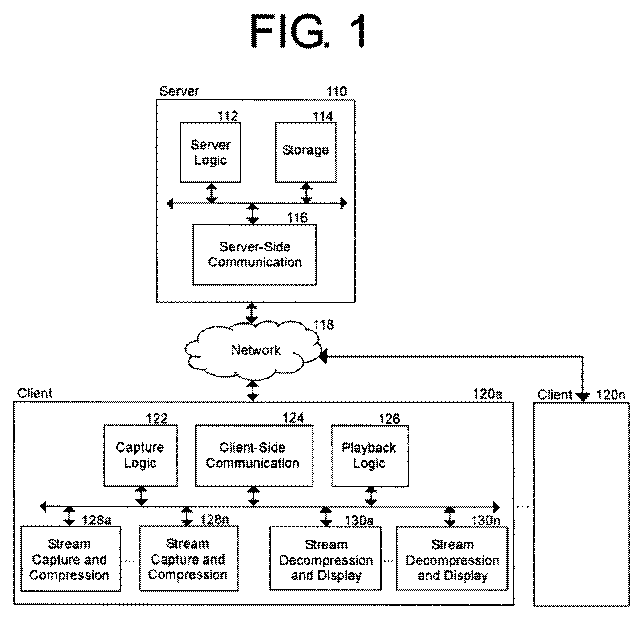
And the specification explains several advantages of the ′637 Patent:
A participant can enter a meeting after it has begun and either begin observing the live content or rewind and see the content that they missed
A participant can observe a meeting in real-time and be able to pause the content to deal with an interruption
A participant observing a meeting can easily replay an interesting segment
A participant can observe a live meeting at slower than real-time to more easily digest the content
A participant observing on a delay (from joining late, pausing, replaying, etc….) can observe the content faster than real-time[.]
Id.
Language of the Claims allegedly infringed— i.e., Claims 2-5 and 7-9
Claim 2 of the ′637 Patent provides:
A web conference system comprising:
A first client application allowing at least one presenting participant to share computer screen video,
said first client application also being arranged to allow said presenting participant to share at least one data stream selected from the group consisting of chat data, documents, web pages and white-boarding session,
storage means for recording said computer screen video and said data stream, and
a second client application allowing at least one observing participant to sense said computer screen video and said data stream live,
said second client application also being arranged to allow said observing participant to selectively sense a previously presented and recorded part of said computer screen video and said data stream while said presenting participant is sharing a current part of said computer screen video and said data stream,
said second client application also being arranged to allow said observing participant to selectively sense a previously presented and recorded part of said computer screen video and said data stream after said presenting participant has finished sharing a said computer screen video and, said data stream
whereby said web conferencing system is able to simultaneously record said computer screen video and said data stream and allow said observing participant to sense current and previously presented parts of said computer screen video and said data stream.
Id. at 13.
Claim 3 of the ′637 Patent provides:
The system of claim 2 wherein:
said first client application allows said presenting participant to share audio data
said storage means records said audio data, and
said second client application allows said observing participant to sense said audio data.
Id. at 13. Claim 3 depends on Claim 2. Dkt. # 25 at 13.
Claim 4 of the ′637 Patent provides:
The system of claim 3 wherein:
said web conferencing system includes an audio time-scale modification component,
said second client application also allows said participant to observe said computer screen video, said data stream, and said audio data at an adjustable rate of speed,
whereby said audio time-scale modification component maintains substantially consistent perceived aspects of audio quality at a plurality of chosen playback rates of speed.
Dkt. # 27-2 at 14. Claim 4 depends on Claim 3. Dkt. # 25 at 14.
Claim 5 of the ′637 Patent provides:
The system of claim 4 wherein said second client application also allows said observing participant to perform time-shifting operations comprising pausing, resuming and seeking.
Dkt. # 27-2 at 14. Claim 5 depends on Claim 4. Dkt. # 25 at 15.
Claim 7 of the ′637 Patent provides:
A web conferencing system comprising:
a first client application that allows at least one presenting participant to share data streams comprised of audio data and computer screen video data
a second client application that allows at least one observing participant to sense said data streams
a server application operatively connected to said first client application and to said second client application, said server application arranged to: i. receive said data streams from said first client application and record it in a storage device ii. retrieve said data streams from said storage device and send it to said second client application
a time-scale modification component operatively connected to said second client application which is able to maintain substantially consistent perceived audio quality at a plurality of playback rates
whereby said data streams from said first client application can be simultaneously recorded by and retrieved from said storage device, and said second client application allows said observing participant to sense said data streams in real-time, and said second client application also allows said observing participant to selectively sense a previously presented and recorded part of said data streams at a plurality of playback rates at the same time that said presenting participant is sharing a current part of said data streams and after said presenting participant has stopped sharing, and said observing participant will perceive substantially consistent audio quality.
Dkt. # 27-2 at 14.
Claim 8 of the ′637 Patent provides:
The system of claim 7 wherein said data streams also include data selected from the group consisting of chat data, documents, web pages and white-boarding session.
Id.
Claim 9 of the ′637 Patent provides:
The system of claim 8 wherein said second client application allows said observing participant to perform time-shifting operations comprising pausing, resuming and seeking said data streams.
Id. Claim 9 depends on Claim 8. Dkt. # 25 at 19
B. The Representative Claims
Defendant argues that Claims 2-5 are representative “because they recite substantially similar limitations and are drawn to the same abstract idea as [C]laims 7-9 with [C]laims 7-9 reciting a ‘server application.’” [8] Dkt. # 26 at 12, 27. The Court agrees.
In sum, Claim 2 focuses on the sharing of computer screen video; data stream information including “chat data, documents, web pages, and white-boarding session”; storing of such data; and a second client application enabling another user to observe such data, both live and previously recorded. Dkt. # 27-2 at 13. Claim 3 focuses on the sharing, storing, and observation of audio data between first and second client applications. Id. Claim 4 focuses on the time-scale modification component enabling the second client application to perceive aspects of the audio data at various rates of playback speed. Id. at 14. And Claim 5 focuses on the second client application's time-shifting operations of pausing, resuming, and seeking. Id.
In sum, Claim 7 focuses on the sharing of computer screen video and audio data; the recording and retrieval of such data from a server application; a time-scale modification component enabling the second client application to perceive audio data at various playback rates; and the selective observation and sensing of data streams, both live and previously recorded. Dkt. # 27-2 at 14. Thus, Claim 7 is represented by Claims 2, 3, and 4. Id. Claim 8 focuses on data stream information including “chat data, documents, web pages and white-boarding session[s]” and is, therefore, represented by claim 2. Id. Finally, Claim 9 focuses on the second client applications time-shifting operations of pausing, resuming, and seeking and is represented by Claim 5. Id.
Plaintiff responds that Defendant's argument is “conclusory” and that Google has not addressed the question “whether each claim has distinctive claim limitations (e.g., limitations not common to the other claims).” Dkt. # 27 at 11. But the Federal Circuit has explained that claims are representative when “the patentee does not present any meaningful argument for the distinctive significance of any claim limitations not found in the representative claim.” Berkheimer, 881 F.3d at 1365 (emphasis added). And Plaintiff has not done so here. Dkt. # 27 at 11-12. Thus, the Court finds Claims 2-5 representative for purposes of its §101 analysis.
C. Claim Construction
Plaintiff says that it would be premature for the Court to determine patent-eligibility at the motion to dismiss stage, and that the Court must conduct a claim construction hearing beforehand. Dkt. # 27 at 18. To support this assertion, Plaintiff says that two terms may be “functional” under §112(6): [9] “time-scale modification component” and “storage means.” Id. But Plaintiff merely contends that Google may make certain arguments about the functionality of these terms in a claim construction hearing—Plaintiff neither proposes constructions of these terms nor explain “how any proposed construction would change the §101 analysis.” Mortg. Application Techs., LLC, 839 F. App'x at 525. Therefore, the Court may proceed with a §101 analysis without conducting claim construction.
D. The Federal Circuit's application of the Alice Two-Step Framework
District courts may “compare [the] claims at issue to those claims already found to be directed to an abstract idea in previous cases[]” when considering a motion to dismiss under §101. Enfish, LLC, 822 F.3d at 1335. Below the Court summarizes instructive cases and then compares the representative claims of the ′637 Patent in its eligibility analysis.
1. Cases involving claims directed to ineligible subject matter under §101
In Hawk Tech. Sys., LLC v. Castle Retail, LLC, the Federal Circuit found patent claims “directed to a method of receiving, displaying, converting, storing and transmitting digital video ‘using result-based functional language’” to be ineligible under §101. 60 F.4th 1349, 1357 (Fed. Cir. 2023) (quoting Two-Way Media Ltd., 874 F.3d at 1337). At Alice step one, the Federal Circuit agreed with the district court's conclusion that the claims were “directed to the abstract idea of ‘storing and displaying video.’” Id. at 1356 (internal citations omitted). At Alice step 2, the Federal Circuit held that the claims “‘read in light of the specification, do not show a technological improvement in video storage and display because the limitations can be implemented using generic computer elements,’ and the ‘specification and claims do not explain or show how the monitoring and storage is improved, except by using already existing computer and camera technology.’” Id. at 1358. And even if the claims attained the patent-holder's purported solution of achieving the “benefit of transmitting the same digital image to different devices for different and perhaps divergent purposes, while using the same bandwith,” the Federal Circuit explained the claims use only “generic functional language” to do so and only require “conventional computer and network components operating according to their ordinary functions[.]” Id. at 1358 (internal quotation marks omitted) (citing Two-Way Media, 874 F.3d at 1339).
In Two-Way Media Ltd. v. Comcast Cable Commc'ns, LLC, the Federal Circuit found a claim ineligible under §101. 874 F.3d 1329. The claim recited “a method for routing information using result-based functional language.” Id. at 1337. The court found that the claim required “the functional results of ‘converting,’ ‘routing,’ ‘controlling,’ ‘monitoring,’ and ‘accumulating records,’ but [did] not sufficiently describe how to achieve these results in a non-abstract way.” Id. at 1337 (quoting Affinity Labs of Tex., 838 F.3d at 1258-59). At Alice step 2, the Federal Circuit held that “[m]erely reciting the use of a generic computer or adding the words ‘apply it with a computer’ cannot convert a patent-ineligible abstract idea into a patent-eligible invention.” Id. at 1338. The court held that the main problem with the claim was that it “—as opposed to something purportedly described in the specification—is missing an inventive concept.” Id. at 1339. And while the plaintiff said that “the claim solves various technical problems, including excessive loads on a source server, network congestion, unwelcome variations in delivery times, scalability of networks, and lack of precise recordkeeping … [the claim] here only uses generic functional language to achieve these purported solutions.” Id. at 1339. The court also saw “no inventive concept in the ordered combination of these limitations.” Id. at 1339.
In Interval Licensing LLC v. AOL Inc., the Federal Circuit found patent claims directed to “providing information to a person without interfering with the person's primary activity” to be ineligible under §101. 896 F.3d 1335, 1343 (Fed. Cir. 2018) (internal quotation marks and citation omitted). [10] The court determined that “[s]tanding alone, the act of providing someone an additional set of information without disrupting the ongoing provision of an initial set of information is an abstract idea” and “the collection, organization, and display of two sets of information on a generic display device is abstract[.]” Id. at 1344-45. At Alice step two, the Federal Circuit began its analysis by stating “[i]t is well-settled that placing an abstract idea in the context of a computer does not ‘improve’ the computer or convert the idea into a patent-eligible application of that idea.” Id. at 1346. And the court held that the claims at issue did not include the “kinds of limitations we have held to ‘solve a technology-based problem, even with conventional, generic components, combined in an unconventional manner.’” Id. at 1347 (quoting Amdocs (Israel) Ltd. v. Openet Telecom, Inc., 841 F.3d 1288, 1300 (Fed. Cir. 2016), cert. denied, 583 U.S. 996, 138 S.Ct. 469, 199 L.Ed.2d 356 (2017)). The Federal Circuit held that “the claims here do not offer a particular solution to a problem that, in [other cases], was unique to the internet.” Id. at 1347.
Finally, in International Business Machines Corporation, the Federal Circuit found two patents ineligible for patent protection under §101. 2024 WL 89642, at *1. The district court found the claims of the first patent “‘possess[ed] the following indicia of abstractness: (1) describing processes that can be performed with a pen and paper; (ii) using claim language that is result-oriented; and (iii) focusing on an intangible, namely information.’” Id. at *4 (quoting J.A. [Joint Appendix] 18). The district court concluded that the patent “‘merely mimics what humans do to search for information, with the added feature of conducting the entire exercise on a computer.’” Id. (quoting J.A. 18). The Federal Circuit agreed and held that the patent claims “do nothing more than improve a user's experience while using a computer application and are precisely the types of claims that we have held are abstract at step one” in previous cases. Id. The Federal Circuit held that plaintiff “fails to explain how the claims do anything more than ‘[i]dentify[], analyz[e], and present[] certain data to a user,’ which we explained in [a prior case] is ‘not an improvement specific to computing.’” Id. (quoting Int'l Bus. Machs. Corp., 50 F.4th at 1378). Because the claims “do not disclose any technical improvement to how computer applications are used[,]” the Federal Circuit agreed that the first patent is directed to an abstract idea. Id. As for the second patent, the Federal Circuit agreed with the district court that it was directed to an abstract idea because,
the claims are directed to improving a user's experience when viewing search results but do not contain any specific mechanism for doing so. For example, representative claim 14 uses results-oriented language, such as “receiving a resource response set of results,” “receiving a user context vector,” “mapping the user context vector,” and “controlling the presentation of the resource response set,” without any explanation for how these steps are carried out.
Id. at *5. At Alice step two, the Federal Circuit agreed with the district court's determination that “IBM's allegations of inventiveness ‘do[] not … concern the computer's or graphical user interface's capability or functionality, [but] relate[] merely to the user's experience and satisfaction with the search process and results.’” Id. at *4 (quoting J.A. 22). When the Federal Circuit recently found inventiveness, it highlighted that “the specification for those patents included a ‘specific implementation’ of improving search results, rather than a simple conceptual description of an improvement.” Id. (quoting Weisner v. Google LLC, 51 F.4th 1073, 1086 (Fed. Cir. 2022)). Thus, the first patent was not patent-eligible. Similarly, the Federal Circuit found the second patent was not inventive because the plaintiff's claims of inventiveness were not “in the specification or the claims.” Id.
2. Cases involving claims directed to eligible subject matter under §101
According to Plaintiff, DDR Holdings, LLC v. Hotels. com, L.P., controls the outcome here. 773 F.3d at 1257.
There, the Federal Circuit found the patented claims eligible under a §101 analysis because “the claimed solution [was] necessarily rooted in computer technology in order to overcome a problem specifically arising in the realm of computer networks.” Id. While the Federal Circuit cautioned that “not all claims purporting to address Internet-centric challenges are eligible for patent,” it found that the patent's claims at issue did not “broadly and generically claim ‘use of the Internet’ to perform an abstract business practice” and the claims “specif[ied] how interactions with the internet are manipulated to yield a desired result—a result that overrides the routine and conventional sequence of events ordinarily triggered by the click of a hyperlink.” Id. at 1258.
Plaintiff also cites Visual Memory LLC v. NVIDIA Corp., in which the Federal Circuit found patented claims eligible under a §101 analysis. 867 F.3d 1253 (Fed. Cir. 2017). The Federal Circuit found the patents at issue to be “directed to a technological improvement: an enhanced computer memory system.” Id. at 1258-59. According to the Federal Circuit, the patent's claims “focus on a ‘specific asserted improvement in computer capabilities’—the use of programmable operational characteristics that are configurable based on the type of processor—instead of ‘on a process that qualifies as an “abstract idea” for which computers are invoked merely as a tool.’” Id. at 1260 (quoting Enfish, LLC, 822 F.3d at 1336). The Federal Circuit also stated that the patent's specification “discusses the advantages offered by the technological improvement.” Id. at 1260. Therefore, the court found that “this is not a case where the claims recite … generalized steps to be performed on a computer using conventional computer activity.’” Id. at 1260 (quoting Enfish, LLC, 822 F.3d at 1338).
E. The Eligibility of the ′637 Patent's Representative Claims Under §101
1. Alice Step One
For three reasons, the Court concludes that the ′637 Patent is directed to the abstract idea of playing back recorded content.
First, Plaintiff does not say, and the claim language does not illustrate how, the claims focus “on a solution to a problem specifically arising in the realm of computer networks or computers.” TecSec, Inc., 978 F.3d at 1293 (internal quotation marks and citation omitted). Nor do the claims identify “a specific improvement in computer capabilities or network functionality, rather than only claiming a desirable result or function[.]” Id. (internal quotation marks and citation omitted).
Plaintiff says that “the patent claims an invention that is specifically addressed to a specific technical problem with web-based video conferencing, itself a highly technical field that requires all manner of technologies just to establish the conference, let alone have in operate in a manner consistent with the claims.” Dkt. # 27 at 17. But the Court struggles to discern what is the “specific technical problem with web-based video conferencing,” as Plaintiff does not elaborate on this. Elsewhere, Plaintiff says that the claims address the issue that “current web conferencing systems are unable to enable participants to asynchronously observe a live meeting, i.e., observe a previously recorded part of the meeting while the meeting is still in progress.” Dkt. # 27-2 at 8. If this is the “specific technical problem,” it is not an issue unique to the internet or “in the realms of computer networks”—it is an issue in most meetings, whether virtual or in-person.
Plaintiff highlights that “playing back of some recorded media was known in other technical fields prior to the invention, e.g., digital video recorders (DVRs) like TiVo, which the patent correctly explains is in ‘a separate field’ of ‘television viewing[.]’” Dkt. # 27 at 7. The ′637 Patent states,
Web conferencing systems, however, presented technical challenges that are different from television viewing, and [Plaintiff's] invention solved some of those technical issues, overcoming technological problems specifically arising in the realm of these web conferencing systems. For example, unlike a self-contained DVR, web conferencing systems of the kind claimed in the invention involved at least two distinct applications: one used by the presenter and separate applications used by other participants. The ′637 patent expressly claims the use of two different applications…. Second, unlike TV, web conferencing systems of the kind claimed in the invention use more than one data stream. The ′637 patent expressly claims the use of distinct data streams.
Id. at 8. But this merely summarizes the content of the claims, not any specific improvements. And while there very well may be different technological issues between web conferencing systems and “a self-contained DVR,” the Federal Circuit explained that “merely limiting the field of use of the abstract idea to a particular existing technological environment [i.e., web conferencing systems] does not render the claims any less abstract.” Affinity Labs of Texas LLC, 838 F.3d at 1259.
More to the point, Plaintiff says that the invention “solved some of those technical issues” but does not specify how the claims make the alleged improvements. Nor does the claim language identify the alleged improvements. Thus, the Court finds that the representative claims do not include a “specific implementation” of improving web-based conferencing. While “[t]he ′637 [Patent] explains that, unlike DVRs/TiVo with televisions, ‘current web conferencing systems are unable to enable participants to asynchronously observe a live meeting, i.e., observe a previously recorded part of the meeting while the meeting is still in progress[,]’” Dkt. # 27 at 8, this is merely a “simple conceptual description of an improvement.” Int'l Bus. Machs. Corp., 2024 WL 89642, at *4.
Second, the representative claims of the ′637 Patent “possess the following indicia of abstractness: … claim language that is result-oriented[.]” Int'l Bus. Machs. Corp., 2024 WL 89642, at *4. Plaintiff fails to explain how the claims do anything more than “share”; “store”; enable a user to “observ[e]” and “sense” the data; and enable “time-shifting” capabilities. Dkt. # 27-2 at 13-14; see Two-Way Media Ltd., 874 F.3d at 1337 (“the claim require[d] the functional results of ‘converting,’ ‘routing,’ ‘controlling,’ ‘monitoring,’ and ‘accumulating records,’ but [did] not sufficiently describe how to achieve these results in a non-abstract way.”). As the Federal Circuit has explained, “a claim that merely describes an effect or result dissociated from any method by which it is accomplished is usually not directed to patent-eligible subject matter.” Int'l Bus. Machs. Corp, 50 F.4th at 1378.
Third, the Federal Circuit previously found that “patent claims directed to ‘providing information to a person without interfering with the person's primary activity’ to be ineligible under §101.” Interval Licensing LLC, 896 F.3d at 1343. As in Interval Licensing LLC, the representative ′637 Patent claims merely provide the abstract idea of “collect[ing], organiz[ing], and display[ing] … two sets of information on a generic display device.” Id. at 1344-45. Moreover, the ′637 Patent describes its functions as the recording of session content “so that participants are able to observe the session in real-time, delayed while the session is still in progress, or after the session has completed.” Dkt. # 27-2 at 2. And unlike in DDR Holdings, the claims here do not offer a solution to an issue unique to the internet. 773 F.3d at 1257.
Finally, in Hawk Technology Systems, the Federal Circuit found patent claims “directed to a method of receiving, displaying, converting, storing and transmitting digital video ‘using result-based functional language[,]’” ineligible under §101. 60 F.4th at 1357. The representative claims of the ′637 Patent are similarly directed. Claim 2 outlines a “web conference system” allowing for an application to “share computer screen video” and other data; enabling “storage means for recording” said video and data; and a “second client application” enabling another participant to sense said live and previously recorded data. Dkt. # 27-2 at 13. Claim 3 builds on Claim 2 and provides for the “shar[ing],” “stor[ing],” and “observing” of audio data. Id. Claim 4 builds on Claim 3 and allows for “time-scale modification” of shared screen data, audio data, and the data stream. Id. at 14. Finally, Claim 5 enables the observing client application to pause, resume, and seek shared data. Id.
For these reasons, the Court finds the representative claims of the ′637 Patent to be directed to an abstract idea.
2. Alice Step Two
Because the Court finds the representative claims of ′637 Patent to be directed to an abstract idea, it must proceed to step two of the Alice framework. Defendant argues that the “[i]ndividual [e]lements and [o]rdered [c]ombination” of the representative claims of the ′637 Patent “[f]unction in a [c]onventional [w]ay and [d]o [n]ot [s]upply an [i]nventive [c]oncept.” Dkt. # 26 at 26 (in heading). The Court agrees. [11]
Plaintiff states that “[t]he asserted claims recite inventive concepts sufficient to render them patent-eligible.” Dkt. # 27 at 18. But Plaintiff does not explicitly identify these “inventive concepts” and neither the claim language nor the specification outlines these concepts. “Merely alleging inventiveness without tying those allegations to the patent is insufficient to survive a Rule 12 motion.” Int'l Bus. Machs. Corp., 2024 WL 89642, at *5. [12]
Assuming the ′637 Patent's inventive concept is the enablement of a user to “observe a previously recorded part of the meeting while the meeting is still in progress,” Dkt. # 27 at 8, this language does not sufficiently recite an inventive concept. It merely restates the “abstract goals of the invention; [it does] not teach how” a previously recorded part of the meeting can be observed while the meeting is still in progress. IBM v. Zillow, 549 F. Supp. 3d 1247, 1268 (W.D. Wash. 2021), aff'd, Int'l Bus. Machs. Corp. v. Zillow Grp., Inc., 50 F.4th 1371 (Fed. Cir. 2022); see also Dropbox Inc. v. Synchronoss Techs., Inc., 815 F. App'x 529, 538 (Fed. Cir. 2020) (finding that the plaintiff's claims that each patent solves “given technological problems, but never provide more support than a conclusory statement that ‘the inventions described and claimed … solved these problems,’ improved the art, ‘represented a significant advance over existing approaches[,] and were not well-known, routine, or conventional in the field’ at the time of patenting” were no more than a “series of legal conclusions” and “insufficient to survive a motion to dismiss.”).
Moreover, despite Plaintiff's assertion that the ′637 Patent provides inventive concepts, the representative claims “only use[] generic functional language to achieve these purported solutions.” Two-Way Media Ltd., 874 F.3d at 1339; see also BSG Tech. LLC v. Buyseasons, Inc., 899 F.3d 1281, 1290-91 (Fed. Cir. 2018) (“If a claim's only ‘inventive concept’ is the application of an abstract idea using conventional and well-understood techniques, the claim has not been transformed into a patent-eligible application.”). The representative claims are comprised of “generic computer functions.” Intell. Ventures I LLC, 838 F.3d at 1318. Claim 2 provides for the “shar[ing] of computer screen video[,]” “storage means for recording[,]” and receiving recorded content. Dkt. # 27-2 at 13. Claim 3 provides for “audio time-scale modification component.” Id. at 14. Claims 2 and 3 provide for recording computer screen video, data streams, and audio data. Id. at 13-14. Claims 2, 3, and 4 provide for sharing and sensing data streams, audio data, and computer screen video data. Id. And Claim 5 provides for time-shifting operations including pausing, resuming, and seeking. Id. at 14. The Federal Circuit held in Two-Way Media Ltd., that claims requiring the “processing of data streams, [and] transmi[ssion] … from an intermediate computer” as well as claims “receiving and transmitting a real-time media stream from an intermediate server, … and recording certain information about the steam” require nothing more “than conventional computer and network components operating according to their ordinary functions.” 874 F.3d at 1340-41 (internal quotation marks and citation omitted).
Finally, recent Federal Circuit cases determining §101 patent eligibility are instructive. As in Hawk Technology Systems, the representative claims of the ′637 Patent, read in light of the specification, “do not show a technological improvement in video storage and display because the limitations can be implemented using generic computer elements[.]” 60 F.4th at 1358. Nor do the claims “explain or show how the monitoring and storage is improved, except by using already existing computer and camera technology.” 60 F.4th at 1358. And compared to Visual Memory LLC, while the ′637 Patent's specification “discusses the advantages offered by” their patent claims, Dkt. # 27-2 at 9, it does not specify the technological improvement. 867 F.3d at 1260.
For these reasons, the Court finds that the representative claims of the ′637 Patent do not contain an inventive concept sufficient for patent eligibility under §101.
F. Dismissal With Prejudice
Plaintiff requests an opportunity to amend if this Court finds any defect in their FAC. Dkt. # 27 at 27. A district court must grant leave to amend unless one or more of these factors are present: (1) undue delay, (2) bad faith or dilatory motive, (3) repeated failure to cure deficiencies by amendment, (4) undue prejudice to the opposing party, or (5) futility of amendment. Eminence Cap., LLC v. Aspeon, Inc., 316 F.3d 1048, 1052 (9th Cir. 2003) (citing Foman v. Davis, 371 U.S. 178, 182, 83 S.Ct. 227, 9 L.Ed.2d 222 (1962)). Courts in this district have dismissed without leave to amend when amendment would be futile after determination of ineligibility under §101. See e.g., PTP OneClick, LLC v. Avalara, Inc., 413 F. Supp. 3d 1050, 1065 n.11 (W.D. Wash., 2019) (“Dismissal without leave to amend is appropriate only when the court is satisfied that the deficiencies in the complaint could not possibly be cured by amendment…. Here, no amendment can revive the eligibility of the ′915 Patent…. Accordingly, the court dismisses PTP's patent infringement claim without leave to amend.”); Appistry, Inc. v. Amazon. com, Inc., 195 F. Supp. 3d 1176, 1184 (W.D. Wash., 2016) (dismissal of complaint with prejudice where the court found the patents in question cover ineligible subject matter).
Also, based on futility, the Federal Circuit has affirmed district court dismissals without leave to amend under Ninth Circuit law. For example, in Sanderling Mgmt. v. Snap Inc., the Central District of California's dismissal of an infringement suit for lack of patent-eligible subject matter under 35 U.S.C. §101 and denial of plaintiff's motion for leave to amend complaint was appealed. 65 F.4th 698 (Fed. Cir. 2023). The Federal Circuit held,
[n]o amendment to a complaint can alter what a patent itself states. In this case, then, our agreement with the district court as to what the patent discloses, and our agreement with the court's application of the Alice test, leads inexorably to the conclusion that amendment of the complaint would have been futile. Sanderling's proposed amendment merely sought to add conclusory statements that the claimed steps were not well-known, routine, and conventional.
Id. at 706.
The Court finds that granting leave to amend would be futile. The claim language of ′637 Patent dictates the result of §101 ineligibility and amendment cannot rectify that. See Sanderling Mgmt., 65 F.4th at 706 (“[n]o amendment to a complaint can alter what a patent itself states.”).
V CONCLUSION
For these reasons, the Court GRANTS Defendant's Motion to Dismiss and DISMISSES the FAC with prejudice.
Dated this 25th day of January, 2024.
/s/ John H. Chun
John H. Chun
United States District Judge
APPENDIX D — JUDGMENT IN A CIVIL CASE OF THE UNITED STATES DISTRICT COURT FOR THE WESTERN DISTRICT OF WASHINGTON, AT SEATTLE, DATED JANUARY 25, 2024
UNITED STATES DISTRICT COURT WESTERN DISTRICT OF WASHINGTON
AT SEATTLE
CASE NUMBER 2:23-cv-00592-JHC
US PATENT NO 7,679,637 LLC, Plaintiff, v. GOOGLE LLC, Defendant.
JUDGMENT IN A CIVIL CASE
Jury Verdict. This action came before the Court for a trial by jury. The issues have been tried and the jury has rendered its verdict.
Decision by Court. This action came to consideration before the Court. The issues have been considered and a decision has been rendered.
THE COURT HAS ORDERED THAT
Defendant's Rule 12(b)(6) Motion to Dismiss the First Amended Complaint, Dkt. # 26, is GRANTED. Plaintiff's First Amended Complaint is dismissed with prejudice.
Dated January 25, 2024.
Ravi Subramanian
Clerk of Court
/s/Ashleigh Drecktrah
Deputy Clerk
APPENDIX E — ORDER OF THE UNITED STATES COURT OF APPEALS FOR THE FEDERAL CIRCUIT, FILED MARCH 25, 2026
UNITED STATES COURT OF APPEALS FOR THE FEDERAL CIRCUIT 2024-1520
US PATENT NO. 7,679,637 LLC, Plaintiff-Appellant, v. GOOGLE LLC, Defendant-Appellee.
Appeal from the United States District Court for the Western District of Washington in No. 2:23-cv-00592-JHC, Judge John H. Chun.
ON PETITION FOR PANEL REHEARING AND REHEARING EN BANC
Before Moore, Chief Judge, Lourie, Dyk, Prost, Reyna, Taranto, Chen, Hughes, Stoll, and Stark, Circuit Judges. [13]
Per Curiam.
ORDER
US Patent No. 7,679,637 LLC filed a combined petition for panel rehearing and rehearing en banc. The petition was first referred to the panel that heard the appeal, and thereafter the petition was referred to the circuit judges who are in regular active service.
Upon consideration thereof,
IT IS ORDERED THAT:
The petition for panel rehearing is denied.
The petition for rehearing en banc is denied.
March 25, 2026 Date
FOR THE COURT
/s/ Jarrett B. Perlow
Jarrett B. Perlow
Clerk of Court
APPENDIX F — EXCERPTS O THE PROSECUTION HISTORY OF U.S. PATENT NO. 7,679,637
Amendment C Remarks, July 9, 2009, Application No. 11/973,219
REMARKS – General
In response to telephone conversations with the Examiner, applicant has amended claims 9 and 23 to define the system more particularly and distinctly. Applicant has also reviewed the Canova reference (6,906,741) as suggested by the Examiner.
Claim Amendments
Applicant thanks the Examiner for the productive telephone conversations on June 24th and July 1st.
During these conversations, applicant reiterated several key aspects of the invention whose combination is novel, unobvious and represents a significant advance in the field of art:
Types of Data: The system allows for sharing and observing audio data, computer screen video data as well as other web conferencing data such as chat conversations, documents, web pages and collaborative white-boarding sessions.
Availability: The system outlined by applicant allows users to observe content live in real-time, delayed while it is still being presented, and post recording after it has been presented.
Time-Shifting: The system allows observers to pause, resume and seek through the content.
Variable Speed Playback and Audio Time-Scale Modification: The system allows observers to view the content at a plurality of speeds while maintaining consistent audio quality.
The Examiner expressed a desire for the claims to more explicitly call out these aspects. Specifically, it should be made more clear that an observer can interact with the system while a conference is in progress (someone is presenting) or after a conference has ended, and can observe content live, delayed while the conference is in progress or after the conference has ended.
Without this distinction, the Examiner felt that playback was a well known technique similar to that exemplified by a DVD player.
Applicant amended claims 9 and 23 to make this distinction as clear as possible. Applicant also reviewed independent claims 19 and 24, but felt that they already explicitly called out the ability to observe content live, delayed during a conference or after a conference has ended.
Canova Only Allows Simultaneous Observation
The Examiner also suggested reviewing Canova 6,906,741. Applicant has thoroughly reviewed this reference. Applicant submits that Canova's invention is in a similar field of endeavor, but that applicant's system still defines novel and unobvious subject matter.
Applicant discloses a time shifted web conferencing system. This system allows presenters to share audio data, computer screen video data as well as other web conferencing data such as chat conversations, documents, web pages and collaborative White-boarding sessions. Conferences can be observed live, delayed or post recording at variable speeds with consistent audio quality. Observers also have the ability to pause, resume and seek through a conference.
Canova describes a method of videoconferencing between multiple handheld computers. Participants can share video data, audio data, text data, and application data. This content can be shared and viewed by other participants “substantially simultaneously”.
Canova's system as described only allows for content to be viewed “substantially simultaneously”. Canova's system is designed entirely for real-time communication and has no recording component. Therefore, there is no provision for viewing content delayed while it is still being presented, or after the conference has ended. Additionally, there is no ability to perform time shifting operations or view content at variable speeds.
There might be some confusion on this point as Canova's specification does include a brief mention of sharing “previously stored video clips”. This describes the ability for a presenting participant to share a pre-recorded video clip. This mechanism is substantially different from the recording component described in applicant's system and does not afford any of the previously mentioned advantages of applicant's system.
Conditional Request for Constructive Assistance
Applicant has made a diligent effort to amend the claims of this application so that they define novel structure which is also unobvious. If, for any reason, the Examiner believes that the claims of this application are not yet in full condition for allowance, applicant respectfully requests her constructive assistance and suggestions pursuant to the spirit of MPEP §2173.02 and §707.07(j). This will enable the undersigned to place this application in fully allowable condition as soon as possible and without the need for further proceedings. The Examiner is authorized to make any needed minor corrections or changes.
Very respectfully,
/s/ Jeffrey Kohler
Jeffrey Kohler, Applicant Pro Se
6880 156th PL NE
Redmond, WA 98052
Telephone: 425-497-8783
I hereby certify that I will fax this amendment to Group 2614 of the Patent and Trademark Office, 571-273-8300, on the date below:
July 9, 2009
/s/ Jeffrey Kohler
Jeffrey Kohler
* * *
Amendment D Remarks, October 16, 2009, Application No. 11/973,219
REMARKS – General
Applicant has thoroughly reviewed the Examiner's last office action and the newly cited Barton and Vallone references. With the following remarks, Applicant seeks to explain why independent claims 9, 19 and 24 should be allowable.
Interview Summary
Applicant spoke with the Examiner by telephone on 9/17/09.
The previous office action relied on the Culver reference in the rejection of claim 9. The applicant pointed out that the examiner's summary of Culver was inaccurate as Culver actually described two disparate systems: telephones for listening to a conference live, and computers for listening to a conference that has ended.
The Examiner agreed with this assessment, and suggested modifying independent claims 9, 19 and 24 to more clearly make this distinction. Specifically, the Examiner wanted it to be made clear that with Culver you have to wait until the end of the recording to listen to the conference, but with Applicant's system, you are able to listen to the conference while it's being recorded.
Additionally, the Examiner suggesting modifying the preamble to claim 9 to further distinguish it from a DVD player.
The applicant asked what options were available after the last office action. The Examiner suggested that the applicant file an RCE with amended claims.
The examiner indicated that application disclosed patentable subject matter and that amending the claims would bring the application into allowance. The applicant requested additional assistance with the claims. The Examiner suggested that the applicant was in the best position to amend the claims as he was the one most familiar with the invention.
The Examiner committed that if the amended claims in the RCE were not allowable, the Examiner would submit an examiner amendment.
The Rejection on Culver, Chang and Barton under §103
Independent claim 9 was rejected under 35 U.S.C. 103(a) as being unpatentable over Culver in view of Chang and further in view of Barton.
Applicant discloses a web conferencing system that allows an observer to listen to presented audio live, delayed or post recording at variable speeds with consistent audio quality.
Culver describes a system for recording the audio from a teleconference with added timestamps. After the teleconference has finished, Culver's system allows an observer to listen to the audio on a computer through a web browser.
Chang describes a system for processing an audio recording into a multi-channel media file. Chang's system loads a previously recorded audio file into a tool where a user can encode the audio at a plurality of playback rates and package each of those playback rates into a new multi-channel media file. After the user creates this multi-channel media file, an observer can listen to audio from this file at a variety of playback rates with consistent audio quality.
Barton describes a system for recording and playback of a television broadcast. With Barton's system, an observer can view a television broadcast live, delayed or post recording and perform trick play features.
Culver does not disclose capabilities the Examiner described
The Examiner contends that Culver discloses:
9. A method of presenting audio data comprising:
(j) providing an input means which allows at least one presenting participant to share audio data,
(k) providing a storage means which is able to record said audio data and is operatively connected to said input means,
(l) recording said audio data with said storage means,
(m) providing an output means which is operatively connected to said storage means and allows at least one observing participant to listen to said audio data,
(n) providing an interface means which can receive instructions and which allows said observing participant to:
pause, resume, and seek said audio data, and
adjust the playback rate of said audio data,
(o) providing a time scale modification means which is able to maintain substantially consistent perceived audio quality at a plurality of playback rates,(p) retrieving said audio data from said storage means in accordance with said instructions given to said interface means,
(q) manipulating said audio data with said time scale modification means in accordance with said instructions given to said interface means,(r) providing said audio data to said observing participant with said output means, whereby said observing participant can
provide said instructions to said interface means at the same time said presenting participant is sharing said audio data, allowing said observing participant to selectively listen to said audio data live or listen to said audio data at a plurality of playback rates at the same time that said presenting participant is sharing said audio data, and said observing participant will perceive substantially consistent audio quality.
However, this is not an accurate representation of the system described by Culver. The system described by Culver does not provide these capabilities.
Culver's system employs two distinct mechanisms for observing a teleconference. (Col 2, line 45-50, and Fig 2) The first mechanism is a telephone system. Telephones in Culver's system can only present live audio data. The second mechanism is a “multimedia computer for playing back all or part of the teleconference after it is recorded.”
The first telephone mechanism does allow observers to listen to said audio data live. However, it does not provide (d) “an output means which is operatively connected to said storage means”, or (e) “an interface means which can receive instructions and which allows said observing participant to: (i) pause, resume and seek said audio data”.
The second computer playback mechanism does allow observers to listen to audio retrieved from the storage means, and does provide and interface allowing them to pause, resume and seek. However, the computer playback mechanism does not allow the observer to “listen to audio data live”. In fact, due to the design of Culver's system, the computer playback mechanism only allows observers to listen to audio data after the conference has ended and the system processes the recording (Col 4, line 26-35)
Chang cannot be combined with Culver (or any reference) to enable manipulation of live content
Chang describes a system for processing an audio recording into a multi-channel media file that an observer can listen to at a variety of playback rates with consistent audio quality. The Examiner contends that this capability can be combined with the systems described by Culver and Barton to allow “observing participants [to] listen to said audio data at a plurality of playback rates at the same time that said presenter is sharing audio data”.
However, due to the nature of the system that Chang describes, such a combination is not possible. Central to Chang's system is a multi-channel media file format (Figs 2A – 2E).
This format is explicitly designed to be created after the entire original recording has finished, and viewed after the entire media file has been written.
Creating a multi-channel media file according to Chang's design could not be performed until after the entire original recording has finished. This is because each audio and data channel in the file is stored sequentially and an index to the start of each channel is stored at the beginning of the file. If this file were created while the original recording were in progress, the size of each channel's data would not be known, the indexes couldn't be calculated, and the system wouldn't know where to write each channel's data.
Similarly, it is not possible to playback one of Chang's multi-channel media files before it has been completely written out (for instance, at the end of a conference). In order to interpret one of Chang's files, a player reads in channel indexes from the beginning of the file, from those indexes seeks to positions in the file to read in frame indexes and from those indexes, seeks to positions to read audio data. However, if the recording is still in progress, the required indexes either won't be available or will be constantly changing.
Culver and Barton Cannot be Operatively Combined
The last Office Action suggests that Culver in view of Chang could be modified with Barton teaching in order to allow participants to listen to audio data at a plurality of playback rates at the same time that the presenter is sharing the audio data. However, Culver and Barton use distinct, mutually exclusive architectures for storing and playing back audio. These distinct architectures defy combination.
Culver describes processes that run on a central server. First a teleconference is recorded. After the teleconference ends, the recording is processed and saved as an audio file suitable for playback. Next, the system creates a static HTML page that includes links to computed time offsets within the recording. The audio file and static HTML page are then stored on the web server. (Col 4, lines 25-35) Next users have the option of manually editing the generated HTML page. (Col 5, lines 18-32) Only after all of these processes have been completed can an observer listen to the finished recording.
Barton utilizes a completely different arrangement. Barton stores content on a local device. Barton uses a system of circular buffers and event buffers which can be used to stream content directly to or from disk. This arrangement relies on hardware support for direct memory access which allows large amounts of data to be streamed without touching the CPU.
Firstly, the central server architecture of Culver's system is hard to reconcile with the local device architecture of Barton. Culver's central server is key to enabling the system's stated goal of archiving, retrieving and playing teleconference recordings from the desktop using a conventional multimedia computer (Col 2, lines 23-26). Likewise, local device storage is critical to Barton's design. The mechanism by which Barton is able to stream content to and from disk and achieve asynchronous playback relies on local hardware support.
Additionally, the multiple post processing steps and nature of Barton's playback mechanism cannot be combined with Barton's streaming architecture. As mentioned above, after a conference has completed Barton creates an audio file and a static HTML page, allows the user to edit them, and then stores them on a web server. Later an observer, requests the audio file and HTML page from the server. This is how observers are able to see and jump to the different time indexes that are a key part of Barton's innovation. Contrastingly, Barton deals with continuous, streams of data. Dealing with data in this way is the key to Barton's time-shifting capabilities.
Applicant contends that these two approaches cannot be combined without destroying their original intended functions. However, even if somehow a way could be found to combine the systems, it would require a series of separate, awkward combinative steps that are not taught in the prior art and are too involved to be considered obvious.
Combination of Culver, Chang and Barton is not Justified
Obviousness can only be established by combining or modifying the teachings of the prior art to produce the claimed invention where there is some teaching, suggestion or motivation to do so found either in the references themselves or in the knowledge generally available to one of ordinary skill in the art.
Applicant contends that there is no teaching, suggestion or motivation to combine the references. The last Office Action does not cite any such teaching, suggestion or motivation other than to state that “it would have been obvious to one with ordinary skill in the art to modify Culver in view of Chang with Barton teaching in order to maximize the system ability, so to improve the system and yield more predictable results.”
In addition to there being no teaching or suggestion to combine the references, there is no motivation to do so, because the references themselves are individually complete. Each reference is complete and functional in itself, so there would be no reason to use parts from or add or substitute parts to any reference.
Further arguing against the case for obviousness of combining Culver, Chang and Barton teachings is that the references take significantly different approaches. For instance, Culver discusses recording a live teleconference, by sending the audio data to a central server to be stored. After a teleconference has completed and the server processes the recording, observers can download and listen to the recording on their computer with a preexisting audio player “such as the ReadAudio [sic] Player by RealNetworks”. Contrastingly Barton describes recording a live television broadcast by storing it in the content database of a personal video recorder that allows simultaneous recording and playback through a connected television. The references can't be legally combined because they take mutually exclusive paths to reach different solutions to a problem, and, therefore, by implication each teaches away from combining itself with the other.
Culver, Chang and Barton are each from substantially different fields from the applicant's system. The applicant's system is from the field of web conferencing, Culver is from teleconferencing, Chang is concerned with creating multimedia presentations, and Barton is from the consumer video space.
Most significantly, there are severe intrinsic differences in structure and function between the applicant's web conferencing system and Barton's DVR. Structurally, the systems have a completely different architecture. In the applicant's web conferencing system, multiple presenters are sharing content, this content is sent to a central server where it is recorded. Multiple observers request content from the central server which retrieves the content and sends it to the observers. In Barton's system, a television broadcast is sent to multiple DVRs, the DVRs locally record the content to disk and stream the content from disk to be displayed on a television. In addition to the high level architectures being distinct, the technologies and components involved differ significantly. Applicant's system deals with screen video, audio data, chat conversations, documents, web pages and whiteboarding sessions passed along a computer network between software applications running on computers. Barton's system deals with television signals broadcast from a television station being stored on a dedicated set top box, and displayed on a television set.
The Rejection on Canova, Baba and Vallone under §103
Independent claim 19 was rejected under 35 U.S.C. 103(a) as being unpatentable over Canova in view of Baba and further in view of Vallone.
Applicant discloses a web conferencing system that allows an observer to view presented computer screen video and other data live, delayed or post recording.
Canova describes a method of videoconferencing between multiple handheld computers. Participants can share video data, audio data, text data, and application data. This content can be shared and viewed by other participants “substantially simultaneously”.
Baba describes a system for recording teleconferences and video conferences with added topic based indexes and notifications. Observers can listen to the content of the conference delayed while the conference is in progress or after the conference has ended.
Vallone describes a system for recording and playback of a television broadcast. With Barton's system, an observer can view a television broadcast live, delayed or post recording.
Canova offers no recording capability
The last Office Action contends that Canova discloses “(e) said second client application also being arranged to allow said observing participant to selectively sense a previously stored video/live broadcast document presentation slide show presented part of said computer screen video and said data stream while said presenting participant is sharing a current part of said computer screen video and said data stream”. The distinction the Examiner made by altering the wording of the applicant's claim is very significant.
Canova does mention the ability to view “previously stored video clips” (Col 5, lines 48-49). However, Canova makes no mention of any recording capability. To further put this in context, Canova also mentions “A wide variety of other applications may be available using the functionality present with the handheld computer. For example, still photos stored in the memory of the handheld computer can easily be presented during the video conference. Similarly, documents stored in the memory of a handheld computer can be shared.” (Col 7, lines 40-45)
In this context, Canova can be understood to indicate that videos clips, photos and documents that are already stored on the handheld computer can be shared during a conference. Again, since Canova made no reference to any sort of recording capability, we have to assume that these video clips, photos and documents were recorded via some other mechanism outside of their system.
Adding recording capability to Canova is not obvious
The last Office Action asserted that “Although Canova does not explicitly teach recording the video conference, sensing a previously presented part ‘a recorded part of the conference’ while/after said presenting participant is/has finished sharing a current part of said computer screen video and data stream. It obvious to do so because the device has the playback ability which obviously means that the device able to record the conferencing, and the device also retrieved a pre-stored data to view it while the conferencing is taking a place.”
This is a huge leap and far from obvious. For example, a DVD player, like Canova's system, has the ability to present previously stored video clips. However a DVD player, has no ability to record video.
Additionally, the applicant specifically called out the ability to store and present computer screen video data. Capturing and recording computer screen video data is a rather specialized functionality. Canova's system deals specifically with handheld computers. While several handheld computers are known to support capturing and recording video from video cameras (Fig 2), the applicant is not aware of any references which teach capturing and recording computer screen video data on a handheld computer.
Even with recording capability, Canova would be deficient
Even if Canova were to add the ability to record video clips, this would not enable the functionality that the applicant claims. Canova's own language of “previously stored video clips” implies that video would be recorded by some means, the video clip would be completed, and then it could be played. This could conceivably allow for viewing after the presenter has finished sharing, but it would not allow for viewing while the presenter is sharing.
Baba and Vallone cannot be operatively combined
The last Office Action suggested that the applicant's claims could be achieved by using the recording component from Baba's system with Vallone's teaching. However, Baba and Vallone use fundamentally different approaches to storing and retrieving content that makes them mutually exclusive. Due to the nature of the systems they describe, Baba and Vallone cannot be operatively combined.
Baba utilizes a central server where content is recorded, and broken into clips of a predetermined length by a “segmentation buffer” (Figure 2, element 18). These clips are then passed to and transformed by an encoding module, and analyzed by indexing modules. Finally, the transformed and analyzed clips are stored in a playback system where they can be retrieved and played.
Vallone utilizes a completely different arrangement. Vallone stores content on a local device. Vallone uses a system of circular buffers and event buffers which can be used to stream content directly to or from disk. This arrangement relies on hardware support for direct memory access which allows large amounts of data to be streamed without touching the CPU.
Firstly, the central server storage utilized by Baba and the local device storage used by Vallone is hard to reconcile. The central server storage is critical to Baba's design. Baba's main claimed innovation is the ability to provide indexes allowing users to search across large corpuses of recorded conferences, or subscribe to notifications about conferences that they are not participating in. This is only viable with central server storage. Likewise, local device storage is critical to Vallone's design. The mechanism by which Vallone is able to stream content to and from disk and achieve asynchronous playback relies on local hardware support.
Additionally, Baba's use of a segmentation buffer cannot be reconciled with Vallone's streaming architecture. Baba segments recordings into clips of a predetermined length. This is central to Baba's design, because each of the subsystems is designed around manipulating or examining discrete clips. For instance the indexing subsystem at the heart of Baba's system will take in a discrete clip and generate a list of words that were spoken during that part of the recording. Contrastingly, Vallone deals with continuous streams of data. Dealing with data in this way is the key to Vallone's time-shifting capabilities. As the applicant discussed in a previous amendment, Baba's use of segmentation, severely hobbles any potential time-shifting capabilities. For example, according to Baba, “in the preferred embodiment the segmentation interval is set to 3-minute intervals”. Because audio is only sent to the playback subsystem after the segment is recorded, this means that the observer would be listening to audio that is delayed by a minimum of three minutes (even assuming that the encoding and indexing introduce negligible delays).
No Suggestion to Combine Canova, Baba and Vallone
Obviousness can only be established by combining or modifying the teachings of the prior art to produce the claimed invention where there is some teaching, suggestion or motivation to do so found either in the references themselves or in the knowledge generally available to one of ordinary skill in the art.
The last Office Action claims that “it would have been obvious to one with ordinary skill in the art to modify Canova with Baba teaching in order to record the on going conference, so to improve the system and increase the participant's convenience.” However, the applicant can find no teaching, suggestion or motivation to do so. For example, Canova never mentions the possibility of adding recording capability. Likewise, Baba never mentions that their recording approach could be extended to record web conferences.
The last Office Action also claims that “it would have been obvious to one with ordinary skill in the art, at the time the invention was made to modify Canova in view of Baba with Vallone teaching in order to improve the system and increase the user convince[sic]”. However, the Examiner does not cite any teaching, suggestion or motivation to do so. Presumably, the Examiner is implying that the motivation is to add Vallone's capabilities (simultaneously viewing a program, recording the program and performing trick play on whatever amount of content has been downloaded) to a web conferencing system. However, the applicant contends that this motivation was not acknowledged by people having ordinary skill in the art at the time the invention was made.
Canova, Baba, and Vallone are Individually Complete
Each reference is complete and functional in itself, so there would be no reason to use parts from or add or substitute parts to any reference. Canova describes a functionally complete web conferencing system. Baba describes a functionally complete teleconferencing and indexing system. Vallone describes a functionally complete digital video recording system. Canova is perfectly functional as described without the addition of Baba's recording mechanism. Likewise, Baba is perfectly functional without the addition of Vallone's advanced time-shifting capabilities.
Canova, Baba and Vallone Teach Away from the Suggested Combination
Canova explicitly discusses what options could be available after a conferencing session has ended. They suggest that the system provide suggestions for follow up meeting times. They go on to state that the preferred arrangement would be to present possible times based on information stored in the user's calendar. (Col 7, lines 21-40) Not once does Canova mention the possibility of reviewing the recorded session. In fact, Canova's suggestions actually imply that the only options for getting value out of their web conferencing system is by setting up another live conference. This suggests away from adding any sort of recording capability.
Also, as described previously, Canova, Baba and Vallone take mutually exclusive paths which prevent their combination. In addition to preventing them from being functionally combined, this also implicitly teaches away from their combination. For instance, Canova discloses conducting a web conference on an ad hoc network without any central server. (Col 8, line 25 – 37) Baba requires teleconferences to be conducted through a central server in order to perform the recording function. Likewise, Baba performs recording and retrieval on a central server while Vallone performs those functions on a local device. Additionally, Baba segments recordings into multiple individual clips while Vallone treats a program as a continuous data stream.
Each of these differences in approach are substantial. The architectural differences suggest away from combining the references as it would not be logical to combine them.
Vallone is from a Very Different Field
The Vallone reference is “nonanalogous art” as it is from a very different technical field. Applicant's system is in the field of web conferencing. Vallone describes a digital video recorder designed for the field of consumer television.
The MPEP 2141.01(a) states that “the similarities and differences in structure and function of the inventions” carry the greatest weight in determining what is analogous prior art for the purpose of analyzing the obviousness of the subject matter at issue.
In this case, there are severe intrinsic differences in structure and function between the applicant's web conferencing system and Vallone's DVR. Structurally, the systems have a completely different architecture. In the applicant's web conferencing system, multiple presenters are sharing content, this content is sent to a central server where it is recorded. Multiple observers request content from the central server which retrieves the content and sends it to the observers. In Vallone's system, a television broadcast is sent to multiple DVRs, the DVRs locally record the content to disk and stream the content from disk to be displayed on a television. In addition to the high level architectures being distinct, the technologies and components involved differ significantly. Applicant's system deals with screen video, audio data, chat conversations, documents, web pages and whiteboarding sessions passed along a computer network between software applications running on computers. Vallone's system deals with television signals broadcast from a television station being stored on a dedicated set top box, and displayed on a television set.
Lack of Implementation Speaks to Unobviousness
The last Office Action claims that it would be obvious to combine Canova, Baba and Vallone to create a time-shifted web conferencing system. However, the applicant contends that this was an unrecognized need and the motivation to do so as well as the knowledge for how to create such a system was not available to those with ordinary skill in the art at the time the invention was made.
Web conferencing is a huge business bringing in serious revenue and dominated by giants of the tech industry like Microsoft, Adobe, Cisco and Citrix. As a point of reference, in 2007 Cisco acquired WebEx for a reported 3.2 billion dollars. As the applicant discusses in his disclosure, adding time-shifting capabilities to a web conferencing system affords significant end user benefits. These benefits would confer a substantial advantage in a fiercely competitive, highly lucrative market. However, to this date, no web conferencing systems are available that include time-shifting capabilities.
The applicant contends that this means that either existing players have not recognized the need for such capabilities, or they have lacked the necessary knowledge. Either of these reasons, speaks to unobviousness.
The Rejection on Canova, Baba, Vallone and Chang under §103
Independent claim 24 was rejected. The rejection referenced the rejection of claims 19 and 21. Independent claim 19 was rejected under 35 U.S.C. 103(a) as being unpatentable over Canova in view of Baba and further in view of Vallone. Dependent claim 21 was rejected under 35 U.S.C. 103(a) as being unpatentable over Canova in view of Baba and further in view of Vallone and further in view of Chang.
Chang cannot be combined with Canova, Baba and Vallone
The Examiner asserts that “Chang discloses audio time scale modification. Therefore, it would have been obvious to one with ordinary skill in the art at the time the invention was made to modify with Chang teaching in order to improve the system and yield more predictable results.”
As applicant discussed above, due to the nature of Chang's design, the system cannot be operatively combined with any reference to allow time scale manipulation of live content.
No References Teach Modifying Time-Scale of Audio Currently Being Presented
Chang's teaching can not provide the audio time scale modification of audio currently being presented. Additionally, it is worth noting that no references teach modifying time-scale of audio currently being presented.
Rayskiy, Choi, Chang and other references do disclose an audio time-scale modification which maintains substantially consistent perceived aspects of audio quality at a plurality of chosen playback rates of speed. However, all of these references deal with listening to audio data after the original recording has completed.
No references suggest the ability to observe an in progress conference at a variable speed with audio time-scale modification. In fact, in many cases the references specifically teach away from such an arrangement. For example, Chang's system would be inoperative with live content. Additionally, Choi's preferred embodiment features the audio data coming from an “MPEG file source” (Figure 1). Such arrangements prohibit and suggest against allowing observation of in progress content.
No Suggestion to Combine Chang with Canova, Baba and Vallone
As was discussed earlier, applicant can find no suggestion to combine Canova, Baba and Vallone. Additionally, there is no justification for suggesting combining Chang with Canova, Baba and Vallone should be considered obvious.
The last Office Action simply claims that “Chang discloses audio time scale modification. Therefore it would have been obvious to on with ordinary skill in the art at the time the invention was made to modify with Chang teaching in order to improve the system and yield more predictable results.”
However, applicant contends that there is no prior teaching, suggestion or motivation to use Chang's system to add audio time scale modification to a time-shifted web conferencing system. As a point of proof, commercial digital video recorders are at the forefront of innovation in time-shifting capabilities, and yet no commercially available DVR offers audio time scale modification capabilities.
The Dependent Claims are A Fortiori Patentable
Applicant submits that the dependent claims are a fortiori patentable since they incorporate all of the limitations of the independent claims and add additional limitations and thus define the invention even further over the cited prior art.
The References of Interest
The cited but not applied references have been studied, but are submitted to be less relevant than the relied-upon references.
Conditional Request for Constructive Assistance
Applicant has made a diligent effort to amend the claims of this application so that they define novel structure which is also unobvious. If, for any reason, the Examiner believes that the claims of this application are not yet in full condition for allowance, applicant respectfully requests her constructive assistance and suggestions pursuant to the spirit of MPEP §2173.02 and §707.07(j). This will enable the undersigned to place this application in fully allowable condition as soon as possible and without the need for further proceedings. The Examiner is authorized to make any needed minor corrections or changes.
Very respectfully,
/s/ Jeffrey Kohler
Jeffrey Kohler, Applicant Pro Se
6880 156th PL NE
Redmond, WA 98052
Telephone: 425-497-8783
I hereby certify that I will send this amendment by first class mail to Mail Stop RCE, P.O. Box 1450 Alexandria, VA 22313-1450 on the date below:
October, 11th 2009
/s/ Jeffrey Kohler
Jeffrey Kohler
APPENDIX G — CONSTITUTIONAL AND Appendix G STATUTORY PROVISIONS INVOLVED
The application that issued as U.S. Patent No. 7,679,637 was filed before September 16, 2012. The version of 35 U.S.C. §112 in force before the Leahy-Smith America Invents Act therefore governs; its text is reproduced from the 2006 edition of the United States Code.
U.S. Const. art. I, §8, cl. 8
The Congress shall have Power… To promote the Progress of Science and useful Arts, by securing for limited Times to Authors and Inventors the exclusive Right to their respective Writings and Discoveries.
35 U.S.C. §101. Inventions patentable
Whoever invents or discovers any new and useful process, machine, manufacture, or composition of matter, or any new and useful improvement thereof, may obtain a patent therefor, subject to the conditions and requirements of this title.
35 U.S.C. §112 (2006 ed.). Specification Section 112 provided in relevant part:
The specification shall contain a written description of the invention, and of the manner and process of making and using it, in such full, clear, concise, and exact terms as to enable any person skilled in the art to which it pertains, or with which it is most nearly connected, to make and use the same, and shall set forth the best mode contemplated by the inventor of carrying out his invention.
* * *
An element in a claim for a combination may be expressed as a means or step for performing a specified function without the recital of structure, material, or acts in support thereof, and such claim shall be construed to cover the corresponding structure, material, or acts described in the specification and equivalents thereof.
35 U.S.C. §282. Presumption of validity; defenses
In General.—A patent shall be presumed valid. Each claim of a patent (whether in independent, dependent, or multiple dependent form) shall be presumed valid independently of the validity of other claims; dependent or multiple dependent claims shall be presumed valid even though dependent upon an invalid claim. The burden of establishing invalidity of a patent or any claim thereof shall rest on the party asserting such invalidity.
Defenses.—The following shall be defenses in any action involving the validity or infringement of a patent and shall be pleaded:
Noninfringement, absence of liability for infringement or unenforceability.
Invalidity of the patent or any claim in suit on any ground specified in part II as a condition for patentability.
Invalidity of the patent or any claim in suit for failure to comply with—
any requirement of section 112, except that the failure to disclose the best mode shall not be a basis on which any claim of a patent may be canceled or held invalid or otherwise unenforceable; or
any requirement of section 251.
Any other fact or act made a defense by this title.
|
|