Go to Wolters Kluwer VitalLaw.comGo to Wolters Kluwer VitalLaw.com
VitalLaw®
  • Find answers to your questions
  • Log in to access your subscriptions
In depth. On point.
In depth. On point.
  • Home
  • Legal Directory
  • Home
  • Legal Directory
In depth. On point.
  • Articles
  • Articles
    • ZOOMINFO TECHNOLOGIES LLC, Plaintiff, v. ZENLEADS INC., d/b/a APOLLO.IO, Defendant., U.S. District Court, D. Delaware, (May 6, 2026)
    • ZOOMINFO TECHNOLOGIES LLC, Plaintiff, v. ZENLEADS INC., d/b/a APOLLO.IO, Defendant., U.S. District Court, D. Delaware, (Dec. 15, 2025)
    • ZIP TOP, INC., Plaintiff-Appellant v. SC JOHNSON & SON INCORPORATED, Defendant-Appellee, U.S. Court of Appeals, Federal Circuit, (Dec. 30, 2025)
    • DUKE W. ZINSER, Plaintiff, v. VIVINT, LLC and VIVINT, INC., Defendants., U.S. District Court, E.D. Texas, (Aug. 27, 2026)
    • ZILKR CLOUD TECHNOLOGIES, LLC, Appellant v. CISCO SYSTEMS, INC., Appellee, U.S. Court of Appeals, Federal Circuit, (Aug. 26, 2026)
    • YUKON PACKAGING, LLC, Plaintiff, v. JONES SUSTAINABLE PACKAGING, LLC, Defendant., U.S. District Court, W.D. North Carolina, (May 8, 2026)
    • WYETH LLC, Plaintiff-Appellant v. ASTRAZENECA PHARMACEUTICALS LP, ASTRAZENECA AB, Defendants-Appellees, U.S. Court of Appeals, Federal Circuit, (Jul. 9, 2026)
    • WOODWAY USA, INC., Plaintiff-Appellant v. LIFECORE FITNESS, INC., DBA ASSAULT FITNESS, Defendant-Appellee, U.S. Court of Appeals, Federal Circuit, (Jul. 21, 2026)
    • WOODWAY USA, INC., Appellant v. LIFECORE FITNESS, LLC, DBA ASSAULT FITNESS, Appellee, U.S. Court of Appeals, Federal Circuit, (Jul. 17, 2026)
    • WONDERLAND SWITZERLAND AG, Plaintiff-Cross-Appellant v. EVENFLO COMPANY, INC., Defendant-Appellant, U.S. Court of Appeals, Federal Circuit, (Dec. 17, 2025)
    • WOLVERINE BARCODE IP LLC, Plaintiff, v. ALBERTSONS COMPANIES, INC., Defendant., U.S. District Court, N.D. Texas, (Jul. 9, 2026)
    • WIRELESSWERX IP, LLC, Plaintiff, v. AUDI OF AMERICA, INC., Defendant., U.S. District Court, E.D. Michigan, (Mar. 26, 2026)
    • WINVIEW IP HOLDINGS, LLC, Plaintiff, v. FANDUEL, INC., et al., Defendants., U.S. District Court, D. New Jersey, (Jun. 9, 2026)
    • WILLIS ELECTRIC CO., LTD., Plaintiff-Appellee v. POLYGROUP LTD. (MACAO COMMERCIAL OFFSHORE), POLYGROUP MACAU LIMITED BVI, POLYTREE (HK) CO. LTD., POLYGROUP TRADING LTD., Defendants-Appellants, U.S. Court of Appeals, Federal Circuit, (Feb. 17, 2026)
    • WILDSEED MOBILE, LLC, Appellant v. GOOGLE LLC, Appellee, U.S. Court of Appeals, Federal Circuit, (Apr. 30, 2026)
    • WEPLE IP HOLDINGS LLC, Plaintiff, v. META PLATFORMS, INC., Defendant., U.S. District Court, W.D. Washington, (Jan. 9, 2026)
    • VLSI TECHNOLOGY LLC, Plaintiff-Appellant v. INTEL CORPORATION, Defendant-Appellee, U.S. Court of Appeals, Federal Circuit, (Apr. 14, 2026)
    • VL COLLECTIVE IP, LLC, Appellant v. UNIFIED PATENTS, LLC, Appellee, U.S. Court of Appeals, Federal Circuit, (Feb. 20, 2026)
    • VL COLLECTIVE IP, LLC, Appellant v. NETFLIX, INC., Appellee, U.S. Court of Appeals, Federal Circuit, (Aug. 10, 2026)
    • VIR2US, INC., Plaintiff – Appellee, v. SOPHOS INC.; INVINCEA, INC., Defendants – Appellants, and SOPHOS LIMITED; SOPHOS GROUP PLC, Defendants., U.S. Court of Appeals, Fourth Circuit, (Jun. 23, 2026)
    • VINEYARD INVESTIGATIONS, Plaintiff, v. E. & J. GALLO WINERY, Defendant., U.S. District Court, E.D. California, (Jul. 2, 2026)
    • VINCENT SYSTEMS GMBH, Plaintiff, v. FILLAUER COMPANIES, INC. and MOTION CONTROL, INC., Defendants., U.S. District Court, E.D. Tennessee, (Jul. 30, 2026)
    • VIAVI SOLUTIONS INC., Plaintiff-Appellant v. PLATINUM OPTICS TECHNOLOGY INC., Defendant-Appellee, U.S. Court of Appeals, Federal Circuit, (Sept. 8, 2026)
    • VIASAT, INC., Appellant v. WESTERN DIGITAL TECHNOLOGIES, INC., Appellee, U.S. Court of Appeals, Federal Circuit, (Jan. 7, 2026)
    • VERTEX PHARMACEUTICALS INC., Plaintiff, v. LUPIN LIMITED and LUPIN PHARMACEUTICALS, INC, Defendants., U.S. District Court, D. Delaware, (Aug. 24, 2026)
    • VDPP, LLC, Plaintiff-Appellant v. VOLKSWAGEN GROUP OF AMERICA, INC., Defendant-Appellee, U.S. Court of Appeals, Federal Circuit, (Aug. 19, 2026)
    • VALTRUS INNOVATIONS LTD., et al., Plaintiffs, v. GOOGLE LLC, Defendant., U.S. District Court, N.D. California, (Aug. 10, 2026)
    • VALTRUS INNOVATIONS, LTD., Plaintiff, v. GOOGLE LLC, Defendant., U.S. District Court, N.D. California, (Mar. 16, 2026)
    • LAURI VALJAKKA, Plaintiff, v. NETFLIX, INC., Defendant., U.S. District Court, N.D. California, (Jul. 13, 2026)
    • EDWARD VALDEZ and WILD WEST SECURITY SHUTTERS, LLC, Plaintiffs, v. DANIEL HAMILTON and GERBRIG VANDERWOUDE, Defendants., U.S. District Court, M.D. Florida, (Aug. 20, 2026)
    • US PATENT NO. 7,679,637 LLC, Petitioner, v. GOOGLE LLC, Respondent., U.S. Supreme Court
    • US PATENT NO. 7,679,637 LLC, Plaintiff-Appellant v. GOOGLE LLC, Defendant-Appellee, U.S. Court of Appeals, Federal Circuit, (Jan. 22, 2026)
    • US INVENTOR, INC., INVENTOR'S ASSOCIATION OF SOUTH CENTRAL KANSAS, INVENTORS NETWORK OF MINNESOTA, SAN DIEGO INVENTORS FORUM, INC., MERCEXCHANGE, L.L.C., PAUL MORINVILLE, Plaintiffs-Appellants v. JOHN A. SQUIRES, UNDER SECRETARY OF COMMERCE FOR INTELLECTUAL PROPERTY AND DIRECTOR OF THE UNITED STATES PATENT AND TRADEMARK OFFICE, UNITED STATES PATENT AND TRADEMARK OFFICE, Defendants-Appellees, U.S. Court of Appeals, Federal Circuit, (Aug. 21, 2026)
    • UNIVERSAL ELECTRONICS, INC., Appellant v. ROKU, INC., Appellee, U.S. Court of Appeals, Federal Circuit, (May 13, 2026)
    • UNIVERSAL ELECTRONICS, INC., Appellant v. ROKU, INC., Appellee, U.S. Court of Appeals, Federal Circuit, (Apr. 10, 2026)
    • UNIVERSAL CONNECTIVITY TECHNOLOGIES INC., Plaintiff, v. HP INC., Defendant., U.S. District Court, N.D. California, (Feb. 9, 2026)
    • TWINSTRAND BIOSCIENCES, INC. & UNIVERSITY OF WASHINGTON, Plaintiffs, v. GUARDANT HEALTH, INC., Defendant., U.S. District Court, D. Delaware, (Jun. 16, 2026)
    • THE TRUSTEES OF COLUMBIA UNIVERSITY IN THE CITY OF NEW YORK, Plaintiff-Appellee v. GEN DIGITAL INC., FKA SYMANTEC CORPORATION, FKA NORTONLIFELOCK, INC., Defendant QUINN EMANUEL URQUHART & SULLIVAN, LLP, Sanctioned Party-Appellant, U.S. Court of Appeals, Federal Circuit, (Mar. 11, 2026)
    • THE TRUSTEES OF COLUMBIA UNIVERSITY IN THE CITY OF NEW YORK, Plaintiff-Appellee v. GEN DIGITAL INC., FKA SYMANTEC CORPORATION, FKA NORTONLIFELOCK, INC., Defendant-Appellant, U.S. Court of Appeals, Federal Circuit, (Mar. 11, 2026)
    • TREE DEFENDER, LLC, Plaintiff, v. MIKE HURST CITRUS SERVICE, INC., Defendant., U.S. District Court, M.D. Florida, (Feb. 11, 2026)
    • TRACKTIME, LLC, Plaintiff-Appellant v. AMAZON.COM SERVICES LLC, AUDIBLE, INC., Defendants-Appellees, U.S. Court of Appeals, Federal Circuit, (Jul. 2, 2026)
    • T-MOBILE US, INC., T-MOBILE USA, INC., Plaintiffs-Appellants v. KAIFI LLC, Defendant-Appellee, U.S. Court of Appeals, Federal Circuit, (Aug. 28, 2026)
    • TJTM TECHNOLOGIES, LLC, Plaintiff-Appellant v. GOOGLE LLC, Defendant-Appellee, U.S. Court of Appeals, Federal Circuit, (May 5, 2025)
    • TIR TECHNOLOGIES LTD., Plaintiff, v. COMCAST CABLE COMMUNICATIONS, LLC, COMCAST CABLE COMMUNICATIONS MANAGEMENT, LLC, NBCUNIVERSAL MEDIA, LLC, AND PEACOCK TV LLC, Defendants., U.S. District Court, D. Delaware, (Jun. 24, 2026)
    • TIANMA MICROELECTRONICS CO., LTD., Petitioner, v. LG DISPLAY CO., LTD., Patent Owner., U.S Patent and Trademark Office, Trademark Trial and Appeal Board, (Mar. 18, 2026)
    • TEVA PHARMACEUTICALS USA, INC., Plaintiff-Appellant, v. ELI LILLY AND COMPANY, Defendant-Appellee., U.S. Court of Appeals, Seventh Circuit, (Jul. 13, 2026)
    • TEVA PHARMACEUTICALS INTERNATIONAL GMBH, TEVA PHARMACEUTICALS USA, INC., Plaintiffs-Appellants v. ELI LILLY AND COMPANY, Defendant-Appellee, U.S. Court of Appeals, Federal Circuit, (Apr. 16, 2026)
    • TESLA, INC., Appellant v. CHARGE FUSION TECHNOLOGIES, LLC, Appellee, U.S. Court of Appeals, Federal Circuit, (Feb. 25, 2026)
    • TESLA, INC., Appellant v. CHARGE FUSION TECHNOLOGIES, LLC, Appellee, U.S. Court of Appeals, Federal Circuit, (Mar. 31, 2026)
    • TECHNOLOGY IN ARISCALE, LLC, Plaintiff-Appellant v. RAZER USA LTD., Defendant-Appellee, U.S. Court of Appeals, Federal Circuit, (Jan. 6, 2026)
    • TAPP MFG, INC., Plaintiff, v. SPEED UTV, LLC, Defendant., U.S. District Court, M.D. North Carolina, (Jan. 27, 2026)
    • SYNQOR, INC., Plaintiff-Appellee v. VICOR CORPORATION, Defendant-Appellant, U.S. Court of Appeals, Federal Circuit, (Feb. 13, 2026)
    • SYNOPSYS, INC., Plaintiff, v. REAL INTENT, INC., Defendant., U.S. District Court, N.D. California, (Aug. 10, 2026)
    • SYNGENTA LIMITED et al., Plaintiffs, v. JOHN A. SQUIRES, Defendant., U.S. District Court, E.D. Virginia, (Sept. 10, 2026)
    • SUNOCO PARTNERS MARKETING & TERMINALS L.P., Plaintiff-Appellant v. POWDER SPRINGS LOGISTICS, LLC, MAGELLAN MIDSTREAM PARTNERS L.P., Defendants-Cross-Appellants, U.S. Court of Appeals, Federal Circuit, (Jan. 16, 2026)
    • STRYKER EUROPEAN OPERATIONS HOLDINGS LLC and HOWMEDICA OSTEONICS CORP., Plaintiffs, v. TREACE MEDICAL CONCEPTS, INC., Defendant., U.S. District Court, D. Delaware, (Jan. 29, 2026)
    • ST CASE1TECH, LLC, Appellant v. JOHN A. SQUIRES, UNDER SECRETARY OF COMMERCE FOR INTELLECTUAL PROPERTY AND DIRECTOR OF THE UNITED STATES PATENT AND TRADEMARK OFFICE, Intervenor, U.S. Court of Appeals, Federal Circuit, (Feb. 18, 2026)
    • ST CASE1TECH, LLC, Appellant v. JOHN A. SQUIRES, UNDER SECRETARY OF COMMERCE FOR INTELLECTUAL PROPERTY AND DIRECTOR OF THE UNITED STATES PATENT AND TRADEMARK OFFICE, Intervenor, U.S. Court of Appeals, Federal Circuit, (Feb. 18, 2026)
    • SPIN MASTER, LTD, Plaintiff, v. AOMORE-US ET AL., Defendants., U.S. District Court, S.D. New York, (Jan. 27, 2026)
    • SPACETIME3D, INC., Appellant v. APPLE INC., GOOGLE LLC, Appellees, U.S. Court of Appeals, Federal Circuit, (Aug. 31, 2026)
    • SOUND VIEW INNOVATIONS, LLC, Plaintiff-Appellant v. HULU, LLC, Defendant-Appellee, U.S. Court of Appeals, Federal Circuit, (Jan. 29, 2026)
    • SOLBELLO, INC., Plaintiff, v. SHORESHADE, LLC, Defendant., U.S. District Court, S.D. Georgia, (May 18, 2026)
    • SOCKET SOLUTIONS, LLC, Plaintiff-Appellee v. IMPORT GLOBAL, LLC, Defendant-Appellant, U.S. Court of Appeals, Federal Circuit, (Aug. 4, 2026)
    • SMITH INTERFACE TECHNOLOGIES, LLC, Plaintiff, v. APPLE INC., Defendant., U.S. District Court, S.D. California, (Sept. 3, 2026)
    • SMITH INTERFACE TECHNOLOGIES, LLC, Plaintiff, v. APPLE INC., Defendant., U.S. District Court, S.D. California, (Jan. 28, 2026)
    • SLINGSHOT PRINTING LLC, Appellant v. CANON U.S.A., INC., CANON INC., Appellees, U.S. Court of Appeals, Federal Circuit, (Jul. 21, 2026)
    • SLINGSHOT PRINTING LLC, Appellant v. CANON U.S.A., INC., CANON INC., Appellees, U.S. Court of Appeals, Federal Circuit, (Apr. 23, 2026)
    • SLINGSHOT PRINTING LLC, Appellantit v. CANON U.S.A., INC., CANON INC., Appellees, U.S. Court of Appeals, Federal Circuit, (Jul. 16, 2026)
    • SLINGSHOT PRINTING LLC, Appellant v. CANON U.S.A., INC., CANON INC., Appellees, U.S. Court of Appeals, Federal Circuit, (Jul. 16, 2026)
    • SLICK SLIDE LLC, Plaintiff, v. ZACHARY WITTMAN and V2 ADVENTURE PRODUCTS USA, LLC, Defendants., U.S. District Court, E.D. Wisconsin, (Feb. 25, 2026)
    • Signify North America Corporation, et al., Plaintiffs v. Lepro Innovation Inc., et al., Defendants, U.S. District Court, D. Nevada, (Aug. 7, 2026)
    • SIGHT SCIENCES, INC., Plaintiff, v. IVANTIS, INC., ALCON RESEARCH LLC, ALCON VISION, LLC, and ALCON INC., Defendants., U.S. District Court, D. Delaware, (Mar. 27, 2026)
    • SHOPIFY INC., SHOPIFY (USA) INC., Plaintiffs-Appellees v. EXPRESS MOBILE, INC., Defendant-Appellant, U.S. Court of Appeals, Federal Circuit, (Dec. 8, 2025)
    • SHENZHEN JISU TECHNOLOGY CO., LTD., Plaintiff-Appellant v. THE ENTITIES AND INDIVIDUALS IDENTIFIED IN ANNEX A, VHJWPDYD DRONE, STORES FOKELYI, MYSTIGUE, ADXSHOP, BRILLIRARE, CHIDA3D, CRAWFORD RICH, ERLEEQING, FLUFUNM, GDQ STORE, GEOLINCA, GONGYI, JAMONXI, KASX-US, KEKEROSE, MARCHSAN, MRWALK DIRECT, NEZYLAF, OMNIGOODS STORE, ONECASE, PRIME DIRECT NY, RAY-US, STORE NO. 9, SUBLIME_SHOP, V&JGLOBAL BUSINESS LLC, AMOUSA, DENGMORE, KAWELL, KIPLYKI, MAG DEPARTMENT STORE LLC, MANNYA CO., LTD., MSNF CO. LTD., OAVQHLG3B, POMOKO, QILIAN TRADING CO., LTD., ROYALLOVE, SGDL HOLDINGS INC., SHENZHEN COLOR SHENG LONG SILK TRADING CO., LTD., SHENZHEN HONGFU WUZHOU TECHNOLOGY CO., LTD., SHENZHEN HUI XI TECHNOLOGY CO., LTD., SHENZHEN QUSHI TECHNOLOGY CO., LTD., SYNERGY INC., WSBDENLK CLEARANCE, YOHOME PRODUCTS, KWSKY, MMWUS, MEIBEIBEAUTY, BEAUTYSALON, E-EMALL, COOL ELECTRONICS SHENZHEN, HXSTARTINGLINE, WUXIAO2, BABAQINL009, XHGSM3-32, GAIATOP DIRECT, BEST LIFE NEED, SPLENDID ENERGY LIGHTING, SILDURX THI, SWEETFULL TECHNOLOGY, EKOUSN, ENTASSER, FIUDX CO. LTD., FRSARA, HELDIG, JSQBD, B BREATHTAKING, CHENPULUOS, COLORED FLAG, DO MORE WITH LESS, HONHEY DIRECT, MILTONRE, NARDENM, PRIYAITTAL, RIANLEY, SHENZHEN HONGHAO RUIXIN TECHNOLOGY CO., LTD., SPARK INNOVATORS, TANOMI, VITONG, WOPE, COMERSS, ICOLORFULED, Defendants ZHOUTY, KAZEBLAST, ZSLST, SHENZHEN MAIMI ELECTRONIC TECHNOLOGY CO., LTD., XINYI LIU, Defendants-Appellees, U.S. Court of Appeals, Federal Circuit, (Jul. 22, 2026)
    • SEOUL SEMICONDUCTOR CO., LTD., SEOUL VIOSYS CO., LTD., Plaintiffs v. FINELITE, INC., Defendant/Third Party Plaintiff-Appellant v. SAMSUNG SEMICONDUCTOR, INC., Third-Party Defendant-Appellee, U.S. Court of Appeals, Federal Circuit, (May 13, 2026)
    • SCILEX PHARMACEUTICALS INC., ITOCHU CHEMICAL FRONTIER CORP., OISHI KOSEIDO CO., LTD., Plaintiffs-Appellants v. AVEVA DRUG DELIVERY SYSTEMS, INC., Defendant-Appellee, U.S. Court of Appeals, Federal Circuit, (Aug. 4, 2026)
    • SCHMEISSER GMBH, Plaintiff-Appellant v. AC-UNITY D.O.O., Defendant-Appellee, U.S. Court of Appeals, Federal Circuit, (Jul. 30, 2026)
    • SCALE BIOSCIENCES, INC. and ROCHE SEQUENCING SOLUTIONS, INC., Plaintiffs, v. PARSE BIOSCIENCES, INC., Defendant., U.S. District Court, D. Delaware, (Aug. 18, 2026)
    • SCALE BIOSCIENCES, INC. and ROCHE SEQUENCING SOLUTIONS, INC., Plaintiffs, v. PARSE BIOSCIENCES, INC., Defendant., U.S. District Court, D. Delaware, (Aug. 4, 2026)
    • SCALE BIOSCIENCES, INC. and ROCHE SEQUENCING SOLUTIONS, INC., Plaintiffs, v. PARSE BIOSCIENCES, INC., Defendant., U.S. District Court, D. Delaware, (Jun. 17, 2026)
    • STANLEY A. SANSONE, Plaintiff-Appellant v. UNITED STATES PATENT AND TRADEMARK OFFICE, UNITED STATES PATENT AND TRADEMARK OFFICE DIRECTOR, JOHN A. SQUIRES, UNDER SECRETARY OF COMMERCE FOR INTELLECTUAL PROPERTY AND DIRECTOR OF THE UNITED STATES PATENT AND TRADEMARK OFFICE, Defendants-Appellees, U.S. Court of Appeals, Federal Circuit, (Jun. 24, 2026)
    • MARK H. SANDSTROM, Appellant v. INTERNATIONAL TRADE COMMISSION, Appellee XENOGENIC DEVELOPMENT LLC, Intervenor, U.S. Court of Appeals, Federal Circuit, (Jan. 9, 2026)
    • SAMESURF, INC., Appellant v. INTUIT INC., Appellee, U.S. Court of Appeals, Federal Circuit, (May 21, 2026)
    • SAMESURF, INC., Plaintiff, v. INTUIT INC., Defendant., U.S. District Court, S.D. California, (May 28, 2026)
    • ROBERT BOSCH LLC, MERCEDES-BENZ USA, LLC, Appellants V. WESTPORT FUEL SYSTEMS CANADA INC., Appellee, U.S. Court of Appeals, Federal Circuit, (Aug. 18, 2026)
    • THE RIDGE WALLET, LLC, Plaintiff, -against- BEMMO INC., Defendant., U.S. District Court, E.D. New York, (Dec. 9, 2025)
    • RIDGE CORP., COLD CHAIN, LLC, Plaintiffs-Appellees v. KIRK NATIONALEASE CO., TRUCK & TRAILER PARTS SOLUTIONS, INC., ALTUM LLC, Defendants-Appellants, U.S. Court of Appeals, Federal Circuit, (Jul. 13, 2026)
    • RICOH COMPANY, LTD., Plaintiff, v. ZOOM COMMUNICATIONS, INC., Defendant., U.S. District Court, D. Delaware, (May 1, 2026)
    • RFC LENDERS OF TEXAS, LLC, Plaintiff-Appellant v. SMART CHEMICAL SOLUTIONS, LLC, Defendant-Appellee, U.S. Court of Appeals, Federal Circuit, (Apr. 29, 2026)
    • RENSSELAER POLYTECHNIC INSTITUTE, CF DYNAMIC ADVANCES LLC, Plaintiffs-Appellants v. AMAZON.COM, INC., Defendant-Appellee, U.S. Court of Appeals, Federal Circuit, (Feb. 24, 2026)
    • REGENXBIO INC., TRUSTEES OF THE UNIVERSITY OF PENNSYLVANIA, Plaintiffs-Appellants v. SAREPTA THERAPEUTICS, INC., SAREPTA THERAPEUTICS THREE, LLC, Defendants-Appellees, U.S. Court of Appeals, Federal Circuit, (Feb. 20, 2026)
    • THE REGENTS OF THE UNIVERSITY OF MICHIGAN, Plaintiff-Appellant v. LEICA MICROSYSTEMS, INC., Defendant-Appellee, U.S. Court of Appeals, Federal Circuit, (Jul. 31, 2026)
    • THE REGENTS OF THE UNIVERSITY OF CALIFORNIA, UNIVERSITY OF VIENNA, and EMMANUELLE CHARPENTIER Junior Party (Applications 15/947,680; 15/947,700; 15/947,718; 15/981,807; 15/981,808; 15/981,809; 16/136,159; 16/136,165; 16/136,168;16/136,175; 16/276,361; 16/276,365; 16/276,368; and 16/276,374), v. THE BROAD INSTITUTE, INC., MASSACHUSETTS INSTITUTE OF TECHNOLOGY, and PRESIDENT AND FELLOWS OF HARVARD COLLEGE, Senior Party (Patents 8,697,359; 8,771,945; 8,795,965; 8,865,406; 8,871,445; 8,889,356; 8,895,308; 8,906,616; 8,932,814; 8,945,839; 8,993,233; 8,999,641, 9,840,713, and Application 14/704,551)., U.S Patent and Trademark Office, Trademark Trial and Appeal Board, (Mar. 26, 2026)
    • RECOR MEDICAL, INC., Plaintiff-Appellee v. MEDTRONIC IRELAND MANUFACTURING UNLIMITED CO., Defendant-Appellant MEDTRONIC VASCULAR, INC., MEDTRONIC, INC., Defendants, U.S. Court of Appeals, Federal Circuit, (May 19, 2026)
    • RAVIN CROSSBOWS, LLC, Appellant v. JOHN A. SQUIRES, UNDER SECRETARY OF COMMERCE FOR INTELLECTUAL PROPERTY AND DIRECTOR OF THE UNITED STATES PATENT AND TRADEMARK OFFICE, Intervenor, U.S. Court of Appeals, Federal Circuit, (Aug. 6, 2026)
    • RANGE OF MOTION PRODUCTS, LLC, Plaintiff-Appellant v. ARMAID COMPANY INC., Defendant-Appellee, U.S. Court of Appeals, Federal Circuit, (Feb. 2, 2026)
    • RANGE OF MOTION PRODUCTS, LLC, Plaintiff-Appellant v. ARMAID COMPANY INC., Defendant-Appellee, U.S. Court of Appeals, Federal Circuit, (Aug. 11, 2026)
    • RANDOM CHAT, LLC, Plaintiff, v. ALTRA FEDERAL CREDIT UNION, Defendant., U.S. District Court, E.D. Texas, (Mar. 6, 2026)
    • RALLY AG LLC, Plaintiff, v. APPLE, INC., Defendant., U.S. District Court, D. Delaware, (Aug. 7, 2026)
    • Q TECHNOLOGIES, INC., Plaintiff-Appellant v. WALMART, INC., Defendant-Appellee, U.S. Court of Appeals, Federal Circuit, (Feb. 5, 2026)
  • Articles
  • Articles

    Patent Cases, ST CASE1TECH, LLC, Appellant v. JOHN A. SQUIRES, UNDER SECRETARY OF COMMERCE FOR INTELLECTUAL PROPERTY AND DIRECTOR OF THE UNITED STATES PATENT AND TRADEMARK OFFICE, Intervenor, U.S. Court of Appeals, Federal Circuit, (Feb. 18, 2026)

    ST CASE1TECH, LLC, Appellant v. JOHN A. SQUIRES, UNDER SECRETARY OF COMMERCE FOR INTELLECTUAL PROPERTY AND DIRECTOR OF THE UNITED STATES PATENT AND TRADEMARK OFFICE, Intervenor

    U.S. Court of Appeals, Federal Circuit. 2023-2388. Decided: February 18, 2026.

    Note: This disposition is nonprecedential.

    Appeal from the United States Patent and Trademark Office, Patent Trial and Appeal Board in No. IPR2022-00281.

    Andrew Peter DeMarco, Devlin Law Firm LLC, Wilmington, DE, argued for appellant. Also represented by Timothy Devlin, Robert J. Gajarsa, Jason Mitchell Shapiro.

    Omar Farooq Amin, Office of the Solicitor, United States Patent and Trademark Office, Alexandria, VA, argued for intervenor. Also represented by Mai-Trang Duc Dang, Nicholas Theodore Matich, IV, Robert J. McManus.

    Before Reyna, Taranto, and Stark, Circuit Judges.

    Stark, Circuit Judge.

    ST Case1Tech, LLC (“ST1”) appeals from a final written decision (“FWD”) of the Patent Trial and Appeal Board (“Board”) in an inter partes review (“IPR”) of U.S. Patent No. 9,270,244 (the “′244 patent”), which generally relates to systems for and methods of automatically adjusting audio levels in user-worn devices in order to improve the user's situational awareness. In its FWD, the Board found claims 1-4, 6, 13, 14, 17-19, and 25-27 of the ′244 patent invalid as obvious. In making that determination, the Board adopted a claim construction ST1 challenges on appeal. Because we agree with the Board's construction, we affirm.

    I

    The ′244 patent is directed to systems and methods that allow a user listening to audio content through earphones to hear nearby conversations without having to manually adjust the volume of the audio content. This automation is achieved by way of a processor and an ambient sound microphone that detects voice activity. When voice activity is detected, the system adjusts the volume of the audio content and employs a “voice timer” to maintain the adjusted volume during conversational gaps in voice activity, so that the device does not rapidly alter volume levels during short conversational pauses. The following limitation from representative claim 1 is relevant to this appeal:

    [A]djusting a mixing gain of an audio content signal delivered to the earphone with the ambient sound pass-through during a voice timer pending voice activity; and wherein the audio content is one of a voice signal, music content, or audible sound delivered to the internal speaker for audible reproduction.

    J.A. 57 at 13:50-55 (emphasis added).

    Petitioner, who has since withdrawn from this appeal, [1] petitioned for IPR of all 30 claims of the ′244 patent, arguing that U.S. Patent App. Pub. No. 2007/0189544 (“Rosenberg”), alone or in combination with other references not pertinent to this appeal, rendered all challenged claims obvious. Rosenberg discloses an “Ambient Sound Responsive Media Player” that detects certain “characteristic forms” in an ambient audio signal–such as another person speaking the user's name, the user's own voice, or an alarm–and upon such detection automatically reduces the volume of media content being output so that the user can better hear the ambient sound. J.A. 518. In one embodiment, Rosenberg's processor captures ambient audio, processes it to detect a characteristic form, reduces media volume upon detection, and then performs a “time delay” that maintains the reduced volume for a selected period. J.A. 525 at ¶50.

    The Board found that Rosenberg rendered claims 1-4, 6, 13, 14, 17-19, and 25-27 of the ′244 patent obvious. Its determination was primarily based on a construction of “adjusting a mixing gain of an audio content signal delivered to the earphone with the ambient sound pass-through during a voice timer pending voice activity,” that does not require the step of “adjusting” the mixing gain (i.e., volume) to occur after the activation of a voice timer. J.A. 5, 10. Specifically, the Board found that “the claims do not require performing the ‘activating/activate’ step before the ‘adjusting/adjusts’ step, nor that a singular act of ‘adjusting/adjusts’ must occur during a voice timer.” J.A. 10.

    Applying that construction, the Board determined that Rosenberg disclosed every step of the challenged claims: (i) monitoring ambient audio via a microphone, (ii) automatically initiating a voice timer upon detection or cessation of voice activity (wherein Rosenberg's “time delay” functions as the claimed “voice timer”), and (iii) adjusting and maintaining the adjustment to the volume during the timer.

    ST1 timely appealed. We have jurisdiction under 35 U.S.C. §141(c) and 28 U.S.C. §1295(a)(4)(A).

    II

    “Claim construction is a question of law with underlying questions of fact.” Wasica Fin. GmbH v. Cont'l Auto. Sys., Inc., 853 F.3d 1272, 1278 (Fed. Cir. 2017). Where “the intrinsic record fully governs the proper construction of a term,” our review is de novo. Id.

    III

    The sole dispute we need to resolve in this appeal is whether the challenged limitation in claim 1 –“adjusting a mixing gain of an audio content signal delivered to the earphone with the ambient sound pass-through during a voice timer pending voice activity” –requires that the adjusting of a mixing gain of audio content occur after the activation of the system's voice timer. See J.A. 57 at 13:50-55. ST1 insists that it must; in its view, the adjusting must take place “during a voice timer,” which cannot happen if the adjusting is done prior to the activation of the voice timer. Id. (emphasis added). The Director, by contrast, defends the Board's conflicting view, which is that “the ‘adjusting/adjusts’ includes maintaining and delivering relative levels of adjusted gains ‘during a voice timer pending voice activity,’ even if the actual moment the first adjustment is made occurs before activation of the voice timer.” J.A. 14. We agree with the Board.

    “Although the language of a method claim does not generally require that its steps be undertaken in the listed order, sometimes either logic or grammar mandates a particular order of steps.” Dionex Softron GmbH v. Agilent Techs., Inc., 56 F.4th 1353, 1359 (Fed. Cir. 2023). Such can be the case “where the claim implicitly requires order, for example, if the language of a claimed step refers to the completed results of the prior step.” Kaneka Corp. v. Xiamen Kingdomway Grp. Co., 790 F.3d 1298, 1306 (Fed. Cir. 2015). When assessing whether claimed steps require an order, we avoid constructions that would result in superfluous limitations. See Intel Corp. v. Qualcomm Inc., 21 F.4th 801, 810 (Fed. Cir. 2021) (“It is highly disfavored to construe terms in a way that renders them void, meaningless, or superfluous.”) (citation omitted).

    Neither grammar nor logic warrant reading ST1's claim as requiring an order of steps such that the adjusting of the mixing gain occur only after the activating of the voice timer. ST1's only syntactical contention is to dispute the Director's reliance on the last antecedent rule, [2] which the Director argues means that the “during a voice timer pending voice activity” term modifies only “deliver[y] [of the audio content signal] to the earphone,” and does not also modify the “adjusting” said mixing gain. Even assuming, without deciding, that the Director is wrong about the application of the last antecedent rule here, the result is only that some adjusting must occur “during a voice timer.” But nothing about such a view of the grammar limits adjusting to gain-altering actions occurring after the voice timer starts, to the exclusion of the maintaining of (earlier set) gain levels during the voice timer.

    That over-time process of changing and maintaining is an available meaning of “adjusting,” and as the Board found, that meaning is the best one in the present context: the claim term “adjusting a mixing gain” encompasses not only the initial act of changing gain levels but also maintaining those changed levels over time. For instance, Figure 2B, depicted below, shows that, after initial gain adjustments are made (steps 253-254), the system may
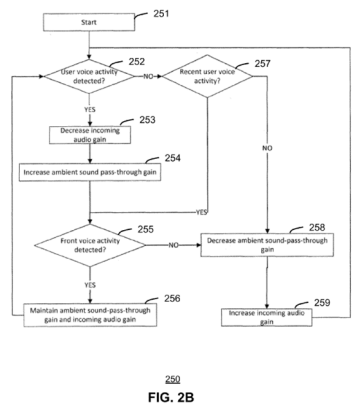
    loop back and “maintain” those gains at step 256 if front voice activity continues to be detected. J.A. 43.

    Throughout this iterative process, the system is continuously “adjusting” the mixing gain by either changing the relative sound levels or maintaining previously adjusted levels. See J.A. 53 at 6:4-13 (“If at step 255 front voice activity from the second individual is detected, then the gain of the incoming audio signal is maintained (or decreased) and the ambient sound pass-through gain is maintained (or decreased) at step 256…. The method then continues back to step 252 to monitor for user voice activity.”). In some instances, the specification even describes equivalency between “maintain[ing]” and “decreas[ing]” gain, showing that maintenance of a previously adjusted gain is a form of adjustment in the context of the ′244 patent. See id. at 6:5-7 (“[T]he gain of the incoming audio signal is maintained (or decreased) and the ambient sound pass-through gain is maintained (or decreased) at step 256.”) (emphasis added). Other specification passages further suggest inclusion of maintaining within adjusting. See id. at 7:24-36, 8:6-10. As such, even if grammar were to require that “adjusting” only happen during the voice timer, such adjustments can be achieved in the system through maintaining and delivering a previously adjusted volume level.

    ST1's reliance on logic fares no better. The Board correctly explained that the purpose of the voice timer is to “bridge gaps” between voice activity to prevent the earphone from constantly adjusting sound signals up and down between individual spoken words in a conversation. J.A. 13; see also J.A. 54 at 7:36-39; J.A. 58-59 at 16:66-17:3. The timer serves this function equally well whether the gain adjustment happens immediately before, simultaneously with, or after the voice timer's activation, provided the adjusted levels are maintained into some portion of the timer's duration. See J.A. 13 (“[N]othing in the specification … suggests the order of activating the voice timer and adjusting the relevant gains is important or even relevant to the invention.”).

    The intrinsic evidence fully supports an unordered reading of the claims. The specification contemplates embodiments in which adjustments are made and thereafter maintained and treats them as examples of adjustments occurring during the voice timer. See J.A. 54 at 7:24-36 (“The method … includes decreasing the audio content signal and increasing the ambient sound pass-through … starting a voice activity timer … and maintaining ambient sound pass-through level and audio content signal level during the combined voice activity.”). For example, the embodiment depicted in Figure 2B (shown above) demonstrates that adjustments can occur before timer activation. See J.A. 43. Steps 253-254 show decreasing incoming audio gain and increasing ambient sound pass-through gain upon detection of user voice activity. Id. The specification then states: “When user voice activity ceases, a user voice activity timer is started prior to step 255.” J.A. 53 at 5:58-60. The specification does not, however, identify when, prior to step 255, the timer is started. Thus, in this embodiment, gain adjustments at steps 253-254 can occur before the timer is activated. J.A. 43.

    Nothing in the specification compels the rigid order of steps ST1 advocates. See, e.g., J.A. 43 at Fig. 2B; J.A. 53 at 6:4-7 (describing embodiment wherein the activation of the voice timer need not occur prior to adjusting). Neither side claims to find support for its position in the prosecution history. And there is no need here to consult the extrinsic evidence, which cannot change the construction compelled by the intrinsic evidence. See Kara Tech. Inc. v. Stamps.com Inc., 582 F.3d 1341, 1348 (Fed. Cir. 2009) (“[E]xtrinsic evidence like expert testimony cannot overcome more persuasive intrinsic evidence.”).

    Contrary to ST1's suggestion, the Board's construction, which we too have now adopted, does not render “activating a voice timer” impermissibly superfluous. J.A. 57 at 13:47; see also generally Mformation Techs., Inc. v. Rsch. in Motion Ltd., 764 F.3d 1392, 1399 (Fed. Cir. 2014) (rejecting construction whereby “the separate sub-step for [‘]establishing a connection[’] would become ‘superfluous’”). Without the “activating a voice timer” requirement, the claims could encompass an embodiment in which the adjusting begins and ends without any voice timer at all. The claims' requirement that adjustment occur “during a voice timer” renders such an embodiment outside the scope of the claims. When the adjusting occurs before the voice timer is activated, the claims are only practiced if that adjusting is maintained until at least some time after the voice timer activates, which, of course, requires there to be an activated voice timer.

    Finally, while it is true that a district court in parallel litigation adopted a construction consistent with ST1's proposal here, requiring an order of steps including that the adjusting occur before the activating of the voice timer, that construction is not binding on the Board. The Board considered the district court construction and did not find it persuasive. See J.A. 10-11. That is all it was required to do. See ParkerVision, Inc. v. Vidal, 88 F.4th 969, 977-78 (Fed. Cir. 2023); 37 C.F.R. §42.100(b) (“Any prior claim construction determination concerning a term of the claim … that is timely made of record in the inter partes review proceeding will be considered.”).

    ST1 does not dispute that the Board had substantial evidence for the factual findings underpinning its determination of obviousness under the Director's preferred construction. Accordingly, we affirm.

    IV

    We have considered ST1's remaining arguments and deem them without merit. The decision of the Board is affirmed.

    AFFIRMED

    Footnotes

    1

    The Director of the Patent and Trademark Office intervened and filed a brief to defend the decision of the Board. ECF Nos. 48, 53.

    2

    The last antecedent rule provides that "a limiting clause or phrase should ordinarily be read as modifying only the noun or phrase it immediately follows." Apple Inc. v. United States, 964 F.3d 1087, 1096 (Fed. Cir. 2020) (internal citation and ellipsis omitted).

    © 2026 CCH Incorporated and its affiliates and licensors. All rights reserved.

    • Manage Cookie Preferences
    • Privacy Statement
    • Terms of Use