

Patent Cases, MOTOROLA SOLUTIONS, INC., Plaintiff, v. HYTERA COMMUNICATIONS CORPORATION LTD., Defendant., U.S. District Court, N.D. Illinois, (Apr. 8, 2026)
MOTOROLA SOLUTIONS, INC., Plaintiff, v. HYTERA COMMUNICATIONS CORPORATION LTD., Defendant.
U.S. District Court, N.D. Illinois, Eastern Division. No. 17-cv-01972. April 8, 2026.
Judge Franklin U. Valderrama
Franklin U. Valderrama, District Judge
Redacted Memorandum Opinion and Order [1]
Plaintiff Motorola Solutions, Inc. (Motorola) owns Patent No. 6,591,111 (the ′111 Patent). The ′111 Patent is directed to a group radio communication system which implements point-to-multipoint communications between independent radio sub-networks coupled together through a group controller to form an overall network. Motorola sued Defendant Hytera Communications Corporation Ltd. (Hytera), asserting that it infringes the ′111 Patent through its Legacy, i-Series, and H-Series products (Accused Products or Smart Dispatch). See generally R. 78, Am. Compl. [2] Before the Court is Hytera's motion for Partial Summary Judgment of Non-Infringement of the ′111 Patent. R. 447, Mot. Summ. J. [3] For the following reasons, the Court grants in part and denies in part Hytera's motion for partial summary judgment.
Background [4]
Motorola owns the ′111 Patent, which is directed to two-way digital radio technologies and related infrastructure. Am. Compl. ¶¶35–56. Figure 1 of the ′111 Patent below shows a group radio communication system. R. 447-1, Memo. Summ. J. at 4. Motorola has asserted Claims 11, 13, and 15 of the ′111 Patent against Hytera. R. 445-3, Am. FIC at 2 (HytSJAppx 1445 [5] ).
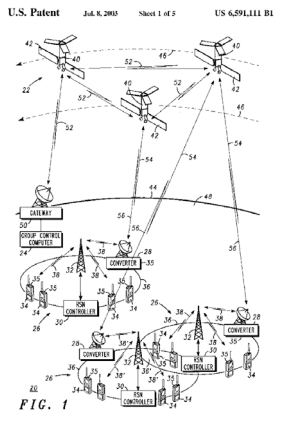
The ′111 Patent is directed toward “a group radio communication system which implements point-to-multipoint communications.” Memo. Summ. J. at 3 (citing HytSJAppx 1). Motorola asserts that it is the owner and sole assignee of the ′111 Patent and that it has the full right to enforce and license the ′111 Patent. Am. Compl. ¶55. The ′111 Patent was filed on December 10, 1999, and was issued on July 8, 2003. Id. ¶54. The ′111 Patent expired on December 10, 2019. DSOF ¶18; Pl.'s Resp. DSOF ¶18.
Claim 11 of the ′111 Patent
Claim 11 of the ′111 Patent is a dependent system claim, based on Claim 1, that reads as follows when read in its entirety with Claim 1:
A group radio communication system comprising:
a first radio sub-network configured to implement point-to-multipoint communication sessions within said first radio sub-network;
a second radio sub-network configured to implement point-to-multipoint communication sessions within said second radio sub-network;
a group controller in data communication with said first radio sub-network and said second radio sub-network, said group controller being configured to manage a common point-to-multipoint communication session involving said first radio sub-network and said second radio sub-network;
a packet switched data communication network coupled between said first radio sub-network and said group controller and between said second radio sub-network and said group controller;
a radio sub-network controller associated with each of said first and second radio sub-networks and a plurality of subscriber radios in communication with said radio sub-network controller, and
each of said radio sub-network controllers is configured to resolve conflicts between substantially concurrent requests from said plurality of subscriber radios in communication with said radio sub-network controller to be origination points for a point-to-multipoint monolog and to provide subscriber traffic distribution to said plurality of subscriber radios in communication with said radio sub-network controller;
said first and second radio sub-networks have overlapping radio coverage areas; and
said first and second radio sub-networks have incompatible communication protocols.” [6]
HytSJAppx 12; see also Am. FIC, Ex. B.
Claim 13 of the ′111 Patent
Claim 13 of the ′111 Patent is an independent method claim that reads as follows:
A method of implementing a common point-to-multipoint communication session involving first and second radio sub-networks, said method comprising:
coupling said first radio sub-network to a packet switched communication network;
coupling said second radio sub-network to said packet switched communication network;
coupling a group controller to said data communication network;
routing a point-to-multipoint monolog from said first radio sub-network through said group controller to said second radio sub-network;
converting said point-to-multipoint monolog into packets for distribution through said packet switched data communication network and said group controller;
receiving said point-to-multipoint monolog at a first converter configured to communicate in said first radio sub-network using a communication protocol established for said first radio sub-network; and
transmitting said point-to-multipoint monolog as packets over said packet switched data communication network using a protocol established for said packet switched data communication network.”
HytSJAppx 13; see also Am. FIC, Exh. B.
Claim 15 of the ′111 Patent
Claim 15 of the ′111 Patent is a dependent method claim that reads as follows:
A method as claimed in claim 13 additionally comprising:
implementing said first and second radio sub-networks to have overlapping radio coverage areas; and
implementing said first and second radio sub-networks to have incompatible communication protocols.”
Am. FIC, Exh. B.
Hytera is incorporated in the People's Republic of China with its principal place of business in Shenzhen, China. DSOF ¶2. Hytera manufactures Digital Mobile Radio (DMR) devices, which comprise portable and mobile radios as well as infrastructure products, including repeaters, that allegedly infringe the Motorola Patents. Am. FIC at 2 (HytSJAppx 1445). Hytera's allegedly infringing products include the Legacy, [7] i-Series, [8] and H-Series [9] products. DSOF ¶35. Hytera contends that it launched its i-Series products in November 2018. Id. ¶32. Motorola disputes this and contends that the sales of i-Series products began in December 2018. Pl.'s Resp. DSOF ¶32. Hytera announced the launch of the first of the accused H-Series products on October 27, 2021. DSOF ¶11.
On January 13, 2023, Motorola served its Amended Final Infringement Contentions, which alleged that Hytera's Legacy, i-Series, and H-Series products were infringing on the Motorola Patents. DSOF ¶3. Specifically, with respect to the ′111 Patent, Motorola identifies the following products from Hytera that allegedly infringe Claims 11, 13, and 15 of the ′111 Patent: (a) Mobiles and Portables products including MD65, MD78, MD612i, MD622i, MD652U, MD652G MD782G, MD782U, MD782V, MD782i, BD302, BD302i, BD502, BD502i, BD552i, PD60, PD60-EX, PD66, PD68, PD68-EX, PD70, PD70-EX, PD71-EX, PD71-XIS, PD75, PD75-EX, PD78, PD78-EX, PD79-EX, PD79-XIS, PD98, PD98-EX, PD362, PD362i, PD402i, PD412, PD412i, PD502, PD502i, PD562, PD562i, PD602/PD602G, PD602i, PD662, PD662G, PD662i, PD682, PD682G, PD682i, PD702, PD702G, PD702G UL913, PD702i, PD752, PD752G, PD752i, PD782, PD782G, PD782 UL913, PD782i, PD792 EX, PD792i, PD982, PD982i, PDC760, X1e, X1ei, X1p, X1pi, PDC760, and all variants thereof, and (b) Infrastructure products, including RD622, RD622U, RD622V, RD662i, RD962, RD962i, RD982, RD982S, RD982SU, RD982SV, RD982U, RD982V, RD982i, RD982i-S RD982S, RD982Si, RD982AN, Hytera Smart Dispatch System, SmartOne System, and all variants thereof. Am. FIC, Exh. A at 1 (HytSJAppx 1518).
Motorola sued Hytera, Hytera America, Inc. (Hytera America), and Hytera Communications America (West), Inc. (Hytera West), asserting claims for direct, contributory, and induced infringement of the ′111 Patent under 35 U.S.C §271(a), 35 U.S.C §271(b), and 35 U.S.C §271(c) respectively. Am. Compl. ¶¶198–99. The only remaining defendant, Hytera, moves for partial summary judgment on the basis that the Accused Products do not infringe the ′111 Patent as a matter of law. See generally Memo. Summ. J.
Legal Standard
Summary judgment must be granted “if the movant shows that there is no genuine dispute as to any material fact and the movant is entitled to judgment as a matter of law.” Fed. R. Civ. P. 56(a). The party seeking summary judgment has the initial burden of showing that there is no genuine dispute and that they are entitled to judgment as a matter of law. Carmichael v. Village of Palatine, 605 F.3d 451, 460 (7th Cir. 2010); see also Celotex Corp. v. Catrett, 477 U.S. 317, 323 (1986); Wheeler v. Lawson, 539 F.3d 629, 634 (7th Cir. 2008).
If this burden is met, the adverse party must then “set forth specific facts showing that there is a genuine issue for trial.” Anderson v. Liberty Lobby, Inc., 477 U.S. 242, 256 (1986). A genuine issue of material fact exists if “the evidence is such that a reasonable jury could return a verdict for the nonmoving party.” Id. at 248. In evaluating summary judgment motions, courts must view the facts and draw reasonable inferences in the light most favorable to the non-moving party. Scott v. Harris, 550 U.S. 372, 378 (2007). The Court may not weigh conflicting evidence or make credibility determinations, Omnicare, Inc. v. UnitedHealth Grp., Inc., 629 F.3d 697, 704 (7th Cir. 2011), and must consider only evidence that can “be presented in a form that would be admissible in evidence.” Fed. R. Civ. P. 56(c)(2).
“Since the ultimate burden of proving infringement rests with the patentee, an accused infringer seeking summary judgment of noninfringement may meet its initial responsibility either by providing evidence that would preclude a finding of infringement, or by showing that the evidence on file fails to establish a material issue of fact essential to the patentee's case.” Novartis Corp. v. Ben Venue Lab'ys, Inc., 271 F.3d 1043, 1046 (Fed. Cir. 2001).
Analysis
I. Non-Infringement with Respect to H-Series Products
In Count VII of the Amended Complaint, Motorola alleges that Hytera directly and indirectly infringes the ′111 Patent. Am. Compl. ¶¶198-199. Hytera moves for partial summary judgment for non-infringement of the ′111 Patent with respect to the H-Series products. Memo. Summ. J. at 1. Hytera advances two arguments in support. First, it is undisputed that the ′111 Patent expired on December 10, 2019, before the H-Series products were released and therefore, there can be no infringement as a matter of law by the H-Series products. Memo. Summ. J. at 8–9 (citing DSOF ¶¶11, 18); see also Pl.'s Resp. DSOF ¶¶11, 18. Second, Hytera does not directly infringe the ′111 Patent because it does not sell the claimed networks. Memo. Summ. J. at 9.
Motorola responds that it has never alleged that Hytera's H-Series products infringe the ′111 Patent and therefore, the Court should deny Hytera's motion for summary judgment on the issue of non-infringement of the ′111 Patent as moot. R. 489, Resp. at 2–3.
As the Court stated in its December 8, 2025 Order granting in part and denying in part Hytera's partial motion for summary judgment of non-infringement for the H-Series products, it construed Motorola's response, in which it concedes that it does not allege that Hytera's H-Series products infringe the ′991, ′972, and ′111 Patents, to be a request to withdraw those counts. R. 555, 12/8/2025 Order at 7. Therefore, the Court deemed Motorola's Amended Complaint to be amended to remove an infringement claim relating to the H-Series products regarding the ′111 Patent in Count VII, and dismisses this claim with prejudice. Id. at 7–8 (citing McReaken v. Kellerman, 2024 WL 4298900, at *2 (S.D. Ill. Sept. 26, 2024)). That leaves Hytera's motion for summary judgment for non-infringement of the ′111 Patent with respect to the Legacy and i-Series products.
II. Direct Infringement Under §271(a)
In Count VII of the Amended Complaint, Motorola alleges that Hytera directly infringes the ′111 Patent. Am. Compl. ¶198. Section 271(a) of the Patent Act provides in relevant part that “whoever without authority makes, uses, offers to sell, or sells any patented invention, within the United States or imports into the United States any patented invention during the term of the patent therefor, infringes the patent.” 35 U.S.C. §271(a) (emphasis added); see also, e.g., Halo Electronics, Inc. v. Pulse Electronics, Inc., 831 F.3d 1369, 1376 (Fed. Cir. 2016). “It is the general rule under United States patent law that no infringement occurs when a patented product is made and sold in another country.” Microsoft Corp. v. AT&T Corp., 550 U.S. 437, 441 (2007).
Hytera argues that it does not directly infringe the ′111 Patent because it does not sell the claimed networks. Memo. Summ. J. at 9. At most, asserts Hytera, it “sells hardware and software that end users (not Hytera) could potentially configure in a way that would meet the claims.” Id. Hytera maintains that Motorola has not adduced any evidence of any act by Hytera that meets the elements of the asserted claims. Id.
Motorola counters that direct infringement under §271(a) extends to not just sales of an accused product, but also to the making and using of the accused product. Resp. at 3 (citing 35 U.S.C. §271(a)). Motorola contends that it has presented “significant evidence” that Hytera infringes the asserted claims through other activities, including installing and testing the systems for customers, and as part of that process, Hytera's presales engineers have configured the Accused Products at end-customer sites in the process of teaching Hytera's authorized dealers how to install and configure the Accused Products. Id. (citing PSOAF ¶¶29–30). Therefore, according to Motorola, a question of fact exists on the issue of Hytera's direct infringement, rendering summary judgment inappropriate. Id. at 4 (citing CenTrak, Inc. v. Sonitor Techs., Inc., 915 F.3d 1360, 1373 (Fed. Cir. 2019)).
In reply, Hytera notes that the claimed system requires not just physical components, but also specific operating networks between them that must be set up and created by an end user. R. 524, Reply at 3. But there is no evidence, from Hytera's perspective, that it ever “used, manufactured, or sold those networks.” Id. In fact, submits Hytera, Motorola later admits that Hytera “dealers installed, configured and set up, the accused products.” Id. As for Centak, that case, from Hytera's perspective, actually supports its motion for summary judgment, as the court found sufficient evidence that the defendant completed the system. Id. Hytera argues that Centillion Data Systems, LLC v. Qwest Communications International, Inc., 631 F.3d 1279 (Fed. Cir. 2011), rather than Centak is the more applicable case. Reply. at 3–4. The Court agrees with Hytera.
In CenTrak, the accused infringer made hardware products and installed them by connecting them to an existing network. 915 F.3d at 1371. The plaintiff asserted that the defendant directly infringed on a claim because, even though the defendant did not make some of the existing network components, it infringed the claimed system when it installed its own hardware onto the existing network, thereby completing the claimed system.” Id. The Federal Circuit reversed the district court's grant of defendant's motion for summary judgment, finding a triable issue of fact of whether the defendant was the “final assembler” of the claim system. Id. Although the defendant's conduct did not include all the elements of the asserted claims, there was evidence that the defendant installed the accused product for its customers. Id. The Federal Circuit explained that “as long as a defendant adds the final limitations to complete a claimed combination, the defendant infringes.” Id. at 1372.
The Court agrees with Hytera that Centak does not compel denial of the motion for summary judgment. Here, unlike Centak, there is no evidence that Hytera performed the final act in setting up any accused system. The only evidence, as correctly noted by Hytera, adduced by Motorola involves training and presale configuration of parts. The evidence before the Court is that the “final act” would be performed by Hytera's customers (or dealers), not Hytera. The Court finds Centillion more on point.
In Centillion, the patent at issue disclosed a “system for collecting, processing, and delivering information from a service provider, such as a telephone company, to a customer.” 631 F.3d at 1281. The issue in Centillion was infringement “for ‘use’ of a system that includes elements in the possession of more than one actor.” Id. at 1283. The Federal Circuit held that “to ‘use’ a system for purposes of infringement, a party must put the invention into service, i.e., control the system as a whole and obtain benefit from it.” Id. at 1284. However, explained the court, the control contemplated is not direct or physical control over each individual element of the system, but rather the ability to make the system elements “work for their patented purpose and thus ‘use[]’ every element of the system by putting every element collectively into service.” Id. In Centillion, even though the defendant made three of four claim elements and provided software to make the fourth element, the defendant did not “combine all of the claim elements.” Id. at 1288. The system, noted the court, was not complete until “[t]he customer … provid[ed] the ‘personal computer data processing means’ and install[ed] the client software.” Id. The court found that where a customer completes the system by providing a claim element and installs the software, the customer controlled the system and therefore, the software manufacturer does not directly infringe. Id. 1288.
Here, as in Centillion, its Hytera's clients—the dealers or customers—and not Hytera itself, that takes the steps to “complete the system” by finishing any necessary steps. Centillion, 631 F.3d at 1288.
In sum, the Court finds that Motorola has not presented evidence that would allow a reasonable jury to return a verdict in favor of Motorola on the issue of direct infringement of the ′111 Patent, Anderson, 477 U.S. at 248. Accordingly, the Court grants Hytera's motion for summary judgment as to the issue of direct infringement of the ′111 Patent under §271(a). The Court now turns to the indirect infringement claims.
III. Indirect Infringement Under §271(b) and §271(c)
In Count VII of the Amended Complaint, Motorola also alleges that Hytera indirectly infringes the ′111 Patent. Am. Compl. ¶199. Section 271 specifies two kinds of indirect infringement: contributory infringement and induced infringement. 35 U.S.C. §271(b)–(c). Both contributory infringement and induced infringement require: (a) an act of direct infringement by someone, see Linear Tech. Corp. v. Impala Linear Corp., 379 F.3d 1311, 1326 (Fed. Cir. 2004) (“There can be no inducement or contributory infringement without an underlying act of direct infringement”); see also Limelight Networks, Inc. v. Akamai Techs., Inc., 572 U.S. 915, 921 (2014), and (b) knowledge of the patent, see Marposs Societa Per Azioni v. Jenoptik Auto. N. Am., LLC, 262 F. Supp. 3d 611, 618, 620 (N.D. Ill. 2017) (a showing of induced infringement under §271(b) requires that “the alleged infringer knowingly induced infringement and possessed specific intent to encourage another's infringement” and a showing of contributory infringement under §271(c) requires that “that the accused infringer had knowledge of the patent”).
Beyond these threshold requirements, induced infringement requires that there is “evidence of active steps taken [by the alleged infringer] to encourage direct infringement.” Barry v. Medtronic, Inc., 914 F.3d 1310, 1334 (Fed. Cir. 2019) (cleaned up). Moreover, to establish contributory infringement, the patent owner also must show that that the component that is the subject of contributory infringement has no substantial non-infringing uses. Fujitsu Ltd. v. Netgear, Inc., 620 F.3d 1321, 1326 (Fed. Cir. 2010); see also Vita-Mix Corp. v. Basic Holding, Inc., 581 F.3d 1317, 1327 (Fed. Cir. 2009) (holding that “non-infringing uses are substantial when they are not unusual, far-fetched, illusory, impractical, occasional, aberrant, or experimental”).
A. Act of Direct Infringement
“Liability for either active inducement of infringement or for contributory infringement is dependent upon the existence of direct infringement.” Linear Tech., 379 F.3d at 1326 (cleaned up); see also Radiation Stabilization Solutions LLC v. Accuray, Inc., 2012 WL 212344, at *3 (N.D. Ill. Aug. 21, 2012) (“There can be no inducement or contributory infringement without an underlying act of direct infringement.” (cleaned up)).
Hytera contends that there is no evidence of direct infringement by Hytera or its customers. As discussed above, see supra Section II, the Court agrees with Hytera that Motorola has not presented evidence of direct infringement by Hytera. As to infringement by customers, Hytera denies that Hytera's customers infringe the ′111 Patent. Memo. Summ. J. at 10. Hytera points to the testimony of Motorola's expert in which he admitted that “Hytera customers can configure Smart Dispatch in a manner that does not infringe.” Id. True, argues Hytera, Motorola's expert posits that Smart Dispatch is capable of being setup in an infringing way; however, the “sale or use of a product capable of infringement is not infringement.” Id. (emphasis in original) (citing Embrex, Inc. v. Servs. Eng'g Corp., 216 F.3d 1343, 1349 (Fed. Cir. 2000)). The Court considers the evidence proffered by both parties with respect to Claims 13, 11, and 15 below.
1. Claim 13
Claim 13 contains a claim limitation of “packet switched data communications network.” HytSJAppx 13. Hytera contends that Motorola's expert testified that it is possible to use Smart Dispatch without a packet-switched data network, thus not infringing Claim 13 of the ′111 Patent that requires a packet-switched data network. Memo. Summ. J. at 10 (citing DSOF ¶20). Motorola disagrees and points to the same testimony in which its expert “acknowledged that generally it is possible to use non-packet switched data communications networks, not that it is possible to use Smart Dispatch without a packet-switched data communications network.” Resp. at 5 (emphasis in original) (citing Pl.'s Resp. DSOF ¶20). The Court finds that at the very least there exists a genuine question of material fact as to whether Smart Dispatch can be used with or without a packet-switched data communications network—a key limitation of Claim 13 of the ′111 Patent. Based on the evidence presented by both parties, a reasonable jury could find that Hytera's customers directly infringed the ′111 Patent with respect to Claim 13.
2. Claim 11
Like Claim 13, Claim 11 also contains a limitation of “packet-switched data communications network.” HytSJAppx 12. For the same reasons as explained above, the Court finds that there exists a genuine issue of material fact as to whether it is possible to use Smart Dispatch without a packet-switched data communications network.
Claim 11 also contains a claim limitation of “overlapping radio coverage areas.” HytSJAppx 12. Hytera argues that Motorola's expert concedes that with respect to the ′111 Patent, Smart Dispatch could be deployed “without overlapping coverage areas,” thus defeating a key limitation of Claim 11. Memo. Summ. J. at 10 (citing DSOF ¶20). Again, Motorola disagrees with Hytera's characterization of its expert's testimony. Pl.'s Resp. DSOF ¶20. Furthermore, Motorola provides a fuller context of the expert testimony where Motorola's expert testifies that “[one] might be able to deploy those radios in a scenario where that functionality need not be utilized by putting the radios far enough apart from each other” without mentioning the ′111 Patent. Id. Additionally, Motorola cites to testimony from one of Hytera's authorized dealers that one of its customers uses “Roaming among their multiple networks as if they were one, i.e., with overlap.” Resp. at 5–6 (citing PSOAF ¶30). And there exists circumstantial evidence that Hytera customers actually use Smart Dispatch in an infringing manner, including having overlapping coverage areas, including Hytera's published Application Notes, “which give a ‘rough description’ of Hytera's roaming feature, point users to their dealer for more information, and describe the three different modes intended to use overlapping coverage areas.” Id. at 6 (citing PSOAF ¶32; Sunrise Techs., Inc. v. Cimcon Lighting, Inc., 219 F. Supp. 3d 260, 265 (D. Mass. 2016) (providing “a description of the functionality of the accused products and the intended use of such products” is “sufficient to support an inference that there is at least one direct infringer”)). The Court finds that there exists a genuine dispute of material fact about whether Smart Dispatch could be deployed “without overlapping coverage areas” that could lead a reasonable jury to find in favor of either party with respect to Claim 11.
3. Claim 15
Finally, because Claim 15 is dependent on Claim 13, for the same reasons as above, the Court finds that a reasonable jury could find that Hytera's customers directly infringed the ′111 Patent with respect to Claim 15. Claim 15, like Claim 11, also has a claim limitation of “overlapping radio coverage areas.” HytSJAppx 13. For the same reasons as explained above with respect to Claim 11, the Court finds that there exists a genuine dispute of material fact that could lead a reasonable jury to find in favor of either party with respect to Claim 15.
B. Hytera's Knowledge of the ′111 Patent
Having addressed the question of an act of direct infringement, the Court moves to the knowledge requirement of an indirect infringement claim.
Hytera argues that Motorola has not provided any evidence that Hytera knew of the ′111 Patent. Memo. Summ. J. at 10. Instead, asserts Hytera, Motorola “attempts to portray an inference of knowledge through (1) Hytera's alleged knowledge that Motorola has a patent portfolio and (2) evidence that Hytera allegedly copied source code and documents relating to the alleged functionalities.” Id. at 10–11. Both of these contentions, according to Hytera, are deficient as a matter of law.
Not so, argues Motorola, pointing to evidence that Hytera copied Motorola's patented products and features over the years. Resp. at 7–8 (citing PSOAF ¶31). Although Motorola has not provided specific evidence with respect to the ′111 Patent, given that “the litigants are competitors in the same industry is a fact that makes knowledge of the patent at issue more plausible.” See Trading Techs. Int'l, Inc. v. BCG Partners, Inc., 2011 WL 3946581, at *4 n.5 (N.D. Ill. Sept. 2, 2011).
Hytera correctly notes that numerous district courts have “held that neither general knowledge of a patent portfolio nor actual knowledge of a patent application or of related patents, without more, is sufficient even to plausibly allege knowledge of a particular asserted patent.” SiOnyx, LLC v. Hamamatsu Photonics K.K., 330 F. Supp. 3d 574, 608 (D. Mass. 2018) (collecting cases). However, in SiOnyx, the court observed that the Federal Circuit in WCM Industries, Inc v. IPS Corp., 721 F.App'x 959 (Fed. Cir. 2018), has cast significant doubt on that authority. 330 F.Supp.3d at 608.
As for its second argument, Hytera maintains that Motorola's evidence of copying also fails because “the alleged act of copying is so expansive that it is clearly unrelated to the ′111 [P]atent.” Memo. Summ. J. at 11. Even assuming that Motorola's assertion that within the information copied was some material related to the functionalities of the ′111 Patent, from Hytera's point of view, this is not evidence that Hytera knew Motorola had a patent related to the feature or what the claims of that patent might cover. Id. Motorola retorts that it has advanced evidence of Hytera's pre-suit knowledge of its infringement of the ′111 Patent sufficient to support an indirect infringement claim and to preclude summary judgment. Resp. at 8–9. The Court agrees with Motorola.
For starters, the Court agrees with Hytera that its general knowledge of Motorola's patent portfolio alone is insufficient as a matter of law. But this argument is a non-starter because Motorola does not argue that Hytera merely had knowledge of Motorola's patent portfolio. Rather, it argues that it has presented evidence that “Hytera perpetrated a massive and intentional theft of Motorola's source code and technical documents.” Resp. at 8–9. Hytera does not deny that Malaysian engineers took Motorola's confidential information to Hytera in China. See Reply at 7–8. But Hytera insists that a jury could not infer that “these engineers had knowledge of Motorola's United States patents at the time they allegedly took Motorola engineering materials.” Id. at 8. But this presents a quintessential question of fact for the jury. Based on the evidence presented by both parties, a reasonable jury could find that Hytera had knowledge of the ′111 Patent. Thus, the Court moves on to the respective requirements for contributory infringement and induced infringement below.
C. Contributory Infringement Under §271(c)
Having addressed the threshold requirements for both contributory and induced infringement, the Court turns to the specific requirements for contributory infringement. Section 271(c) requires that for a plaintiff to establish contributory infringement, the plaintiff must show that the defendant “offers to sell or sells within the United States or imports into the United States a component of a patented machine, manufacture, combination or composition, or a material or apparatus for use in practicing a patented process, constituting a material part of the invention, knowing the same to be especially made or especially adapted for use in an infringement of such patent, and not a staple article or commodity of commerce suitable for substantial noninfringing use, shall be liable as a contributory infringer.” 35 U.S.C. §271(c).
Hytera argues that Motorola's claim for contributory infringement fails because the Smart Dispatch feature is capable of non-infringing uses and therefore Motorola cannot prove that it is a non-staple article. Memo. Summ. J. at 12–13. Specifically, Hytera points to the testimony of Motorola's expert, who Hytera contends admitted that “the accused Smart Dispatch feature may or may not infringe depending on how the customer sets up their network.” Id. at 13 (citing DSOF ¶20).
Motorola responds, as an initial matter, that Hytera is incorrect in its contention that contributory infringement requires proof that the accused feature has no use except through practice of the patented method and because Smart Dispatch has some non-infringing use, there is no contributory infringement. Memo. Summ. J. at 11. According to Motorola, this is not the law. Id. Rather, Hytera must show that there is a “substantial non-infringing use.” Id. (citing Vita-Mix Corp, 581 F.3d at 1327). The Court agrees that Federal Circuit law is clear that “the question of contributory infringement turns on whether the non-infringing use is substantial.” Vita-Mix Corp, 581 F.3d at 1327.
Hytera does not argue that the use of Smart Dispatch feature has a substantial non-infringing use; rather, it merely argues that “Smart Dispatch clearly has non-infringing use because it can be used in networks without overlapping coverage areas and/or incompatible protocols.” Memo. Summ. J. at 13. Thus, the Court finds Hytera's argument about whether the non-infringing use is substantial to be underdeveloped, and therefore waived. Rodriguez v. Dep't of Veterans Affs., 8 F.4th 1290, 1305 (Fed. Cir. 2021) (“An issue that is merely alluded to and not developed as an argument in a party's brief is deemed waived”).
Waiver aside, the Court finds that there exists a genuine issue of material fact with respect to Hytera's assertion as to why Smart Dispatch could have a substantial non-infringing use. Hytera contends that Smart Dispatch has a non-infringing use because it can be used in networks without overlapping coverage areas and incompatible protocols. Memo. Summ. J. at 13. Motorola disagrees, arguing that Hytera's assertion of Smart Dispatch's non-infringing use is based on Hytera's misunderstanding of Claim 13 of the ′111 Patent, which does not include the claim limitations of overlapping coverage areas and incompatible protocols. Resp. at 12 (citing Pl.'s Resp. DSOF ¶19). Moreover, Motorola points out that “simply because the Accused Products could technically have another non-infringing use using its other features or components, the infringing feature is still subject to liability and is not considered to have ‘substantial non-infringing use.’” Id. (citing Koninklijke Philips N.V. v. Zoll Medical Corp., 656 F. App'x. 504, 523–24 (Fed. Cir. 2016)). Here, according to Motorola, a reasonable trier of fact could find that the accused infringing feature of Smart Dispatch (e.g., enabling overlapping coverage areas, incompatible protocols, and using a packet switched data network)—which Hytera's user manuals, brochures, and instructional materials show is how the product is designed and configured—is separate and distinct from any supposedly non-infringing feature a customer might hypothetically utilize. Id. (citing Pl.'s Resp. DSOF ¶20; PSOAF ¶32). The Court agrees. Thus, the Court denies Hytera's motion for summary judgment for a finding of no contributory infringement of the ′111 Patent.
D. Induced Infringement Under §271(b)
Finally, the Court turns to the question of induced infringement. “Whoever actively induces infringement of a patent shall be liable as an infringer.” 35 U.S.C. §271(b). “Inducement can be found where there is evidence of active steps taken to encourage direct infringement.” Barry, 914 F.3d at 1334 (cleaned up). These “active steps” include “advertising an infringing use,” “instructing how to engage in an infringing use,” and assisting in performing an infringing use. Id. at 1334 (cleaned up) (identifying the defendant's employees, who provided technical support for customers performing the infringing acts, as evidence supporting induced infringement); see also Tinnus Enters., LLC v. Telebrands Corp., 846 F.3d 1190, 1204–05 (Fed. Cir. 2017) (identifying “instruction manuals” that taught an infringing uses to demonstrate both the defendant's intent to induce infringement and as circumstantial evidence that the defendant's customers were actually induced to directly infringe); Golden Blount, Inc. v. Robert H. Peterson Co., 438 F.3d 1354, 1362–63 (Fed. Cir. 2006) (“instruction sheets” provided by the defendant); Motiva Patents, LLC v. Sony Corporation, 408 F. Supp. 3d 819, 828 (E.D. Tex. 2019).
Hytera argues that there is no evidence of any affirmative act by Hytera to encourage infringement. Memo. Summ. J. at 12. The only acts of encouragement cited by Motorola, like “training materials and technical support,” do not constitute encouragement to infringe, because Smart Dispatch can be configured in a non-infringing way. Id. Thus, according to Hytera, Motorola has not provided evidence of acts of encouragement that are legally sufficient to support an inducement claim. Id.
Motorola predictably disagrees, pointing to evidence that Hytera's pre-sales engineers taught Hytera's customers—the dealers—how to configure Smart Dispatch in an infringing matter. Resp. at 10 (citing PSOAF ¶32). ***** The Court agrees with Motorola that there are genuine issues of material fact that preclude summary judgment of no induced infringement. See, e.g., Arthrocare Corp. v. Smith & Nephew, Inc., 406 F.3d 1365, 1377 (Fed. Cir. 2005) (affirming jury's induced infringement verdict where defendant distributed “sales literature” and “manuals” that instructed how to use product in infringing manner). Thus, the Court denies Hytera's motion for summary judgment for no induced infringement of the ′111 Patent with respect to the Legacy and i-Series products.
In sum, the Court denies Hytera's motion for summary judgment for finding no contributory infringement and no induced infringement of the ′111 Patent with respect to the Legacy and i-Series products.
Conclusion
For the foregoing reasons, the Court grants in part and denies in part Hytera's motion for summary judgment. The Court deems Motorola's Amended Complaint to be amended to remove the infringement claim relating to the H-Series products regarding the ′111 Patent in Count VII, and dismisses that claim with prejudice. See R. [555]. The Court grants Hytera's motion for summary judgment finding no direct infringement of the ′111 Patent under §271(a) with respect to the Legacy and i-Series products. The Court denies Hytera's motion for summary judgment of no induced infringement and contributory infringement of the ′111 Patent under §271(b) and §271(c), respectively, as to the Legacy and i-Series products.
Dated: March 12, 2026
|
|