

Patent Cases, Kohler Co., Plaintiff, v. Signature Plumbing Specialties LLC, Defendant., U.S. District Court, S.D. New York, (Jul. 24, 2026)
Kohler Co., Plaintiff, v. Signature Plumbing Specialties LLC, Defendant.
U.S. District Court, S.D. New York. 23-cv-9686 (AS). July 24, 2026.
Arun Subramanian, District Judge
ARUN SUBRAMANIAN, District Judge
OPINION AND ORDER
In this opinion, the Court addresses post-trial motions following the jury's verdict that the asserted patent was invalid based on a prior sale. For the following reasons, plaintiff's motion for judgment as a matter of law, or, in the alternative, for a new trial is DENIED, and defendant's motion for an award of attorney's fees is GRANTED IN PART and DENIED IN PART.
BACKGROUND
Plaintiff Kohler Company (Kohler) sued defendant Signature Plumbing Specialties LLC (Signature) alleging that Signature infringed a series of Kohler's patents covering bathtubs, faucets, and other plumbing fixtures. Dkt. 5. Kohler's amended complaint added state-law claims for tor-tious interference with economic advantage and unfair competition. Dkt. 33.
Signature moved for judgment on the pleadings, seeking to dismiss Kohler's complaint. Dkt. 37. The Court granted the motion in part, dismissing the state-law claims and two of the patent claims but allowing the remainder to proceed. Kohler Co. v. Signature Plumbing Specialties LLC, 2024 WL 4880069 (S.D.N.Y. Nov. 25, 2024).
As the case progressed, Kohler voluntarily dismissed with prejudice all but one of its patent claims. Dkts. 95, 104. The only patent that proceeded to summary judgment was U.S. Design Patent No. D678,487, which covered the design of a bathtub. Kohler alleged that Signature's BT2092 bathtub infringed the patent. Dkt. 33 ¶84.
After Signature argued that the patent was invalid as anticipated by a prior sale, offer for sale, or public availability of a product that encompassed the ′487 patent, the Court bifurcated discovery on that issue. Dkt. 78. Following discovery, Signature moved for summary judgment on the invalidity argument. Dkt. 96. It argued that it sold a bathtub, the BT2006, more than one year before Kohler applied for the patent. Dkt. 97 at 29–34. Signature argued that the BT2092 is simply the ADA-compliant version of the BT2006, and the two models differ only by one inch in height. Because the designs were indistinguishable as a matter of law, said Signature, the BT2006's prior sale invalidated the ′487 patent. Id. at 30. Signature highlighted what it said were sales to the Georgica building on Manhattan's Upper East Side as early as May 2008, well before the ′487 patent's critical date in 2011. Id.
The Court denied Signature's motion. Kohler Co. v. Signature Plumbing Specialties LLC, 2025 WL 3292467 (S.D.N.Y. Nov. 26, 2025). In short, the Court agreed with Kohler that Signature's argument for invalidity rose and fell on the credibility of the testimony of its founder and president Keith Kugler, so a genuine dispute of material fact existed as to whether the prior sale happened. Id. at *2. The Court then ordered a trial on the question of invalidity. Id.; see also Fed. R. Civ. P. 42(b) (allowing for bifurcated trials on separate issues).
Kohler sought to vacate the order setting the invalidity issue for trial. Dkt. 122. It sought to resume discovery on its claim of infringement, and for the claim and Signature's defenses to be tried together. Id. at 2–4. It primarily raised efficiency arguments, making only conclusory references to prejudice without any explanation or analysis. Id. The Court denied the motion, concluding that it would be more efficient to try a single issue that could expedite the termination of the case, and finding that Kohler had not demonstrated any prejudice. Dkt. 123 at 1.
More than three weeks later, Kohler moved for reconsideration of the denial. Dkt. 142. It argued that the bifurcated trial violated its Seventh Amendment rights since Signature's invalidity argument assumed infringement, but Signature was reserving the right to challenge Kohler's infringement allegations in a subsequent trial. Id. The Court denied the motion, principally on the grounds that the motion was untimely, and that the arguments were forfeited. Dkt. 145 at 1. But the Court noted that even if the arguments were timely and hadn't been forfeited, the motion would be denied. Id. at 2–3.
After a two-day trial, the jury found for Signature on the question of the prior sale. Dkt. 160. The Court entered judgment in line with the verdict. Dkt. 162.
Following the entry of judgment, Kohler moved for judgment as a matter of law, or in the alternative, for a new trial. Dkt. 173. Signature moved for an award of attorney's fees. Dkt. 169.
LEGAL STANDARDS
Cases involving patents are governed by a mix of law from the regional circuit and the Federal Circuit. “[I]ssues of substantive patent law and certain procedural issues pertaining to patent law” are governed by Federal Circuit precedent, but “the law of the regional circuits” applies “on non-patent issues.” Utah Med. Prods., Inc. v. Graphic Controls Corp., 350 F.3d 1376, 1381 (Fed. Cir. 2003). Post-trial motions are analyzed “under regional circuit law, the Second Circuit in this case.” Whitserve, LLC v. Comput. Packages, Inc., 694 F.3d 10, 18 (Fed. Cir. 2012).
To grant a motion for judgment as a matter of law under Federal Rule of Civil Procedure 50, “the Court must find that a reasonable jury would not have a legally sufficient evidentiary basis to find for the non-movant.” Perry v. City of New York, 78 F.4th 502, 517 (2d Cir. 2023) (cleaned up). That is, the Court must deny the motion “unless there is such a complete absence of evidence supporting the verdict that the jury's findings could only have been the result of sheer surmise and conjecture, or the evidence in favor of the movant is so overwhelming that reasonable and fair minded persons could not arrive at a verdict against it.” Id. (citation omitted). “The burden on the movant is particularly heavy where, as here, the jury has deliberated in the case and actually returned its verdict.” Id. (internal quotation marks omitted).
In evaluating the Rule 50 motion, the Court “consider[s] the evidence in the light most favorable to the non-moving party and give[s] that party the benefit of all reasonable inferences that the jury might have drawn in that party's favor.” Id. (cleaned up). “The court cannot assess the weight of conflicting evidence, pass on the credibility of the witnesses, or substitute its judgment for that of the jury, and must disregard all evidence favorable to the moving party that the jury is not required to believe.” ING Glob. v. United Parcel Serv. Oasis Supply Corp., 757 F.3d 92, 97 (2d Cir. 2014) (internal quotation marks omitted).
Under Rule 59, the Court “may grant a new trial for any reason for which a new trial has heretofore been granted in an action at law in federal court, including if the verdict is against the weight of the evidence. A decision is against the weight of the evidence if and only if the verdict is (1) seriously erroneous or (2) a miscarriage of justice.” Raedle v. Credit Agricole Indosuez, 670 F.3d 411, 417–18 (2d Cir. 2012) (cleaned up). For a Rule 59 motion, “the trial judge may weigh the evidence and the credibility of witnesses and need not view the evidence in the light most favorable to the verdict winner.” Id. at 418. But the Court should rarely exercise this power when the verdict hinges on witness credibility. Id.
And the Court should not grant a new trial just because it disagrees with the jury's verdict. See Bevevino v. Saydjari, 574 F.2d 676, 685 (2d Cir. 1978). Instead, “[t]he trial judge, exercising a mature judicial discretion, should view the verdict in the overall setting of the trial; consider the character of the evidence and the complexity or simplicity of the legal principles which the jury was bound to apply to the facts; and abstain from interfering with the verdict unless it is quite clear that the jury has reached a seriously erroneous result. The judge's duty is essentially to see that there is no miscarriage of justice. If convinced that there has been then it is his duty to set the verdict aside; otherwise not.” Id. at 684 (citation omitted). In a word, “the court should only grant such a motion when the jury's verdict is egregious.” DLC Mgmt. Corp. v. Town of Hyde Park, 163 F.3d 124, 134 (2d Cir. 1998) (internal quotation marks omitted).
The district court can award attorney's fees in patent cases that are “exceptional.” 35 U.S.C. §285. “[A]n ‘exceptional’ case is simply one that stands out from others with respect to the substantive strength of a party's litigating position (considering both the governing law and the facts of the case) or the unreasonable manner in which the case was litigated.” Octane Fitness, LLC v. ICON Health & Fitness, Inc., 572 U.S. 545, 554 (2014). The Court exercises discretion in determining whether a case is “exceptional,” considering the totality of the circumstances. Id.
DISCUSSION
There are motions by both parties before the Court. Kohler moved for judgment as a matter of law or, in the alternative, for a new trial. Dkt. 173. Signature moved for an award of attorney's fees under 35 U.S.C. §285. The Court addresses both parties' motions in turn.
I. Kohler's motion for judgment as a matter of law is meritless
Kohler first argues that it is entitled to judgment as a matter of law on the question of invalidity based on the evidence adduced at trial. It makes three arguments: first, that the evidence is simply insufficient; second, that the evidence consists solely of uncorroborated self-interested testimony, which fails to show invalidity as a matter of law; and third, that Signature did not present sufficient evidence to establish that the BT2006's design was ready for patenting. All three arguments fail.
A. The evidence was sufficient to support the jury's verdict
Kohler argues that the evidence was insufficient to support the jury's verdict, pointing to certain aspects of Kugler's testimony. But Kohler's argument consists solely of cherry-picking potentially weak aspects of his testimony concerning whether an invalidating prior sale had been made—that some of his descriptions of the tub installed at the Georgica were vague, that he didn't measure the tub when he visited the Georgica prior to trial, and that he failed to perform any analysis of the tub's composition. Dkt. 174 at 4–5. But at best, that proves that there was a genuine dispute of material fact on the prior-sale issue.
In its opposition, Signature points to testimony and other evidence that (1) Signature did not change its designs once a model number was assigned; (2) invoices showed that the BT2006 was sold to the Georgica in 2008; and (3) Kugler confirmed visually during his pretrial visit to the Georgica that the tubs were the BT2006. Dkt. 177 at 4–5. Kohler does not meaningfully address this evidence in its reply brief, and it is sufficient to support the jury's verdict.
B. Signature corroborated Kugler's testimony
Kohler next argues that Signature's case fails as a matter of law because it consisted of only uncorroborated testimony of an interested witness. The Federal Circuit has held that it is insufficient as a matter of law for an invalidity case to consist solely of oral testimony of a witness. Finnigan Corp. v. Int'l Trade Comm'n, 180 F.3d 1354, 1367–70 (Fed. Cir. 1999).
Kohler's argument misses the mark. Finnigan dealt with a situation where there was nothing to corroborate oral testimony but an ambiguous document that the court did not find to be relevant. Id. That's not the case here, where Signature introduced dozens of invoices, diagrams, and photos that it argued corroborated Kugler's testimony. Kohler's effort to avoid crediting that evidence is hard to follow, but broadly construed it appears to make two arguments: one, that the corroborating evidence is insufficient, and two, that Signature should have introduced evidence from third parties, like the bathtub manufacturer.
Kohler pokes holes in some of the corroborating evidence, citing, for example, the fact that some of the defense exhibits were undated and that Signature did not have contemporaneous photos. Dkt. 174 at 6. But Kohler confuses the absence of corroborating evidence with the absence of evidence that might independently confirm invalidity. In evaluating the legal sufficiency of the evidence, the Court looks to whether the testimony and other evidence “taken collectively” is sufficient. Price v. Symsek, 988 F.2d 1187, 1196 (Fed. Cir. 1993). Put another way, “[t]he law does not impose an impossible standard of ‘independence’ on corroborative evidence by requiring that every point of a reduction to practice be corroborated by evidence having a source totally independent of the inventor.” Knorr v. Pearson, 671 F.2d 1368, 1374 (C.C.P.A. 1982). Although the evidence in this case might not have been perfect—the Court denied Signature's summary judgment motion, after all—it is certainly sufficient taken collectively to sustain the jury's verdict.
Kohler's effort to fault Signature for not getting corroborating evidence from third parties, like the manufacturer or architectural design firm, also fails. Finnigan's logic was rooted in the need to have more than a single witness's oral testimony, not the need for evidence from uninterested parties. In fact, the court there said that its skepticism of uncorroborated testimony was based on the fact that “invalidating activities” are “normally documented by tangible evidence such as devices, schematics, or other materials that typically accompany the inventive process.” Finnigan, 180 F.3d at 1366. In other words, the Finnigan court expected the party with oral testimony to itself also have other evidence, which is exactly the case here.
C. Signature introduced sufficient evidence that the BT2006 was ready for patenting
Kohler finally argues that there was insufficient evidence to establish that the BT2006's design was ready for patenting before the ′487 patent's critical date. The “ready for patenting” requirement “may be satisfied in at least two ways: by proof of reduction to practice before the critical date; or by proof that prior to the critical date the inventor had prepared drawings or other descriptions of the invention that were sufficiently specific to enable a person skilled in the art to practice the invention.” Pfaff v. Wells Elecs., Inc., 525 U.S. 55, 67–68 (1998). Kohler's argument here largely rehashes the same points that the Court has addressed above. Kohler cites the lack of dates on the specification sheets, but the specification sheets in conjunction with Kugler's testimony and the contemporaneous invoices are sufficient to support the jury's verdict.
In short, all three of Kohler's arguments for judgment as a matter of law fall far short of carrying its heavy burden to reverse the jury's verdict. At their core, Kohler's arguments appear to be rooted in a belief that Kugler's testimony was not credible notwithstanding the corroborating evidence. But it is the province of the jury, not the Court, to judge credibility.
II. Kohler's motion for a new trial is denied
In the alternative, Kohler argues that it is entitled to a new trial on several grounds. The Court addresses each argument in turn.
A. The Court properly applied Vanmoor in its pretrial rulings
Kohler's first two arguments stem from its dissatisfaction with the Court's Vanmoor rulings. As Kohler sees it, the Court should not have treated the BT2006 and BT2092 as having the same design, and should have allowed Kohler to contest the identity of the products at trial. The Court first summarizes the relevant law and facts on this issue.
In the “typical case,” a defendant alleging invalidity based on a prior sale “must demonstrate that this device [previously sold] actually embodied or rendered obvious the patented invention.” Vanmoor v. Wal-Mart Stores, Inc., 201 F.3d 1363, 1366 (Fed. Cir. 2000) (quoting Evans Cooling Sys. Inc. v. General Motors Corp., 125 F.3d 1448, 1451 (Fed. Cir. 1997)). But where the invalidity defense stems from the accused product itself, defendants can “conced[e] infringement for purposes of … [their] on sale defense[] [and] properly ple[a]d in the alternative.” Id. That's because the requirement to show that the prior-sale product embodied the patent-in-suit is “satisfied by [the plaintiff's] allegation that the accused [products] infringe the … patent.” Id. (emphasis added).
The upshot is as follows. Typically, a defendant who is claiming invalidity based on a prior sale must demonstrate that the product sold previously embodied the claim entirely, or that it rendered the claim obvious. But where the product sold previously is the same as the product accused of infringement, the defendant can accept the plaintiff's allegation of infringement solely for the purposes of the invalidity defense—since “[t]hat which infringes, if later, would anticipate, if earlier.” Peters v. Active Mfg. Co., 129 U.S. 530, 537 (1889). And under Vanmoor, that's true even if the defendant also contests infringement. 201 F.3d at 1366.
In this case, Kohler accused the BT2092 of infringement. Signature did not claim that it sold the BT2092 before the critical date, but it did claim it sold the BT2006. The jury found that Signature did, in fact, sell the BT2006 (as depicted in DX-1 and DX-2) prior to the critical date. Dkt. 160. So the key question is whether the BT2006 and the BT2092 tubs have the same design. If they do, then Vanmoor applies and Signature prevails on its invalidity defense. [1] If they are different, then Kohler is correct that Signature had not proven its defense, since Vanmoor does not apply to products that are merely similar.
The record in this case showed that the dimensions of the two tubs were identical in all respects, except for a one-inch difference in height for ADA compliance:
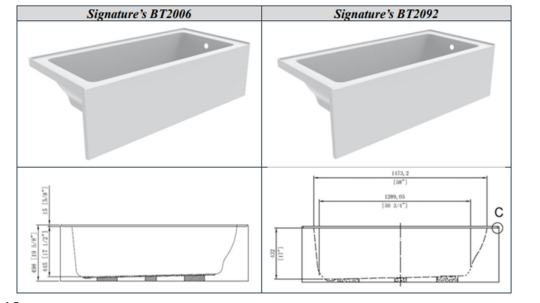
Kohler repeatedly argues that the tubs are different, so Vanmoor does not apply. But its rationale as to why they are different is hard to pin down. Kohler neither focuses on the one-inch height difference nor does it point to other potential differences. It just repeatedly insists that the tubs are different, without explaining why. Given Kohler's heavy burden on this motion, its failure to clearly explain the basis for its argument is itself fatal. Nonetheless, the Court construes Kohler's briefing liberally to try to find what differences between the tubs it could point to, and then proceeds to consider whether there is any difference in design.
1. Kohler failed to show any difference between the BT2006 and the BT2092 be-yond the one-inch difference in height
The Court first considers what potential arguments Kohler might have for the designs of the tubs being distinct. At the summary judgment stage, Kohler conceded that the dimensions of the two tubs were the same apart from the one-inch height difference. Dkt. 109 ¶23. Kohler argues in this motion that the admission (1) was only for the purposes of summary judgment and should not have extended to trial, and (2) only applied to the dimensions and not to other elements of the design. Dkt. 174 at 14–16.
While it is true that a party may concede a fact solely for the purpose of summary judgment, believing that there are sufficient other facts in dispute to defeat the motion, Kohler does not point to any suggestion in its briefing at the summary-judgment stage that any admission was solely for the purposes of summary judgment. Instead, the Court surmises that Kohler did not recognize the magnitude of its concession at the time, and it tried to withdraw the admission after the Court's subsequent rulings.
But whether the concession was solely for the purpose of summary judgment is ultimately immaterial. Instead, Kohler's argument fails for the simple reason that it has failed to point to any other elements of the designs of the two tubs that differ. At no point has Kohler ever relied on a single other difference in its briefing. Not at summary judgment, not in its multiple pretrial motions, and not in its current moving brief. The closest it ever got was during a pretrial conference, where Kohler suggested that there might have been differences in the slope of the two bathtubs. See Dkt. 156 at 13:22–14:9. But Kohler at the time cited nothing more than speculation. And to date, it has pointed to no actual evidence of any other differences. [2] The slope argument has been forfeited many times over. Nevertheless, the Court has conducted its own independent review of the record and has found no evidence of any differences between the BT2006 and BT2092 besides the one-inch difference in height.
To the extent that Kohler believed that there were differences between the tubs beyond the conceded one-inch height difference, it should have sought discovery over the matter and introduced whatever relevant evidence it gathered into the record. While infringement discovery was stayed, the Court explicitly permitted discovery into invalidity, and Signature made no secret—even at the pleadings stage, more than a year before discovery closed—of its attempt to argue that the ′487 patent was invalidated by the prior sale of the BT2006. See Dkt. 26 at 18–19 (Signature making this argument in support of its motion for judgment on the pleadings). And Signature said from the very beginning that the BT2006 and the BT2092 had the same design and were the same tub, apart from the one-inch difference in height to allow for ADA compliance. Id. In fact, Signature from the beginning signaled that it would make the Vanmoor argument (accepting Kohler's infringement contention for the purpose of proving invalidity), stating that “[t]o the extent Kohler maintains that the ADA-compliant tub, BT2092[], infringes the ′487 patent, then the 2008 sale of the BT2006[], which differs only in the height of the tub, renders the ′487 patent invalid.” Id. at 19 (emphasis added). So Kohler has long been on notice that it would have to defend against this very argument for invalidity.
In its reply brief, Kohler complains that the discovery stays inhibited its ability to gather evidence. That argument is forfeited for Kohler's failure to raise it in its moving brief. See Chevron Corp., 325 F. Supp. 3d at 379 n.21. But even if it were not, it is meritless. The Court explicitly permitted discovery on invalidity to proceed. Dkt. 78. And the discovery period was even extended. Dkt. 86. Kohler never argued that it needed more time for invalidity discovery, nor did it file any motion to compel discovery on the topic. So the record contains no indication that Kohler was prevented from seeking any discovery relevant to the issue, and Kohler does not explain how any stay affected its ability to gather evidence.
It is not clear to the Court whether Kohler failed to diligently pursue evidence that the two tubs were distinct, or whether it did, and there simply is no evidence that the tubs are different. But ultimately, it does not matter to the Court's analysis. Kohler had every opportunity to acquire evidence that the tubs were distinct, and it has presented none. So, without any other evidence to consider, the Court proceeds on the understanding that the tubs are identical apart from the one-inch difference in height.
2. The one-inch difference in height does not remove this case from Vanmoor
With no other differences in design to consider, the Court proceeds to consider the effect of the one-inch difference in height. The Court notes at the outset that Kohler never argues in its moving brief that the one-inch difference alone is sufficient, so any reliance on that difference alone is forfeited. But even considering the argument, it fails.
As this is a case about a design patent, what matters is the design of the product. Of course, the designs of the BT2006 and BT2092 must be the same for Vanmoor to apply. But the Court looks to the design, and the design alone. There's no indication that a one-inch difference in height, standing alone, renders the BT2092 to have a different design from the BT2006. [3] After all, a size-12 shoe can share a design with a size-8 shoe, even if they are not interchangeable (as anyone who has tried to put on shoes that are the wrong size can attest). Between (1) the extremely small difference in a single dimension; (2) Signature's uncontroverted assertion that the difference in height was solely for ADA compliance; and (3) Kohler's lack of argument that the one-inch difference makes any design difference, the record compels the conclusion that the designs are identical as a matter of law.
This decision is in accord with other cases where courts have applied Vanmoor to products with identical patented features, even if the products themselves were not exactly the same. See FMC Techs., Inc. v. OneSubsea IP UK Ltd., 412 F. Supp. 3d 706, 714 & n.9 (S.D. Tex. 2019) (applying Vanmoor where a product “not materially different” from the accused product was sold prior to the critical date); Seoul Viosys Co. v. P3 Int'l Corp., 2018 WL 4759744, at *9 (S.D.N.Y. Sept. 30, 2018) (applying Vanmoor where there was no dispute of fact that the accused product and the product sold prior to the critical date shared the same patented features), aff'd, 810 F. App'x 903 (Fed. Cir. 2020). While Kohler tries to distinguish those cases by claiming that it argued in this case that there is a genuine dispute of material fact over whether the BT2006 and BT2092 share the same design, it once again fails to actually point to any difference in design (or cite any evidence) that would suggest that the designs are different. And “baselessly saying that a genuine issue of fact exists—without identifying a real disputed fact—does not make it true.” Salter v. Cheniere Energy, Inc., 2021 WL 5968652, at *3 (5th Cir. Dec. 15, 2021) (brackets and internal quotation marks omitted).
In response, Kohler relies on IXYS Corp. v. Advanced Power Tech., Inc., 2004 WL 540513 (N.D. Cal. Mar. 18, 2004), but that case is distinguishable. As an initial matter, the IXYS court recognized that Vanmoor and Evans Cooling apply where “there exist[s] no logical space between plaintiff's infringement allegation and defendant's invalidity defense; the facts could not support one without identically buttressing the other.” Id. at *5. As discussed above, that is precisely the situation in this case. The reason why that doctrine was inapplicable in IXYS was because the defense was based on a different line of products with a different design than the accused products. Id. at *5–6. Indeed, the Court ultimately held that summary judgment on anticipation was properly denied because of evidence that the alleged invalidating products did not meet the elements of the asserted patent claims. Id. at *6–9. In that context, the court rejected the defendant's attempt to sweep evidence of differences under the rug by virtue of Vanmoor, solely based on the “gotcha” argument that the plaintiff's infringement claim targeted “any and all products manufactured, used, sold, or offered for sale by” the defendant “that are designed in substantially the same way, or function in substantially the same way” as the accused products. Id. at *4 (emphasis deleted). That's not what is happening here. As discussed above, Signature's defense is based on the same tub design, and the only differences in the record are indisputably irrelevant: a one-inch height difference and a different model number.
Nor does Zenith Elecs. Corp. v. PDI Commc'n Sys., Inc., 522 F.3d 1348 (Fed. Cir. 2008), help Kohler. In that case, the defendant, PDI, argued that to the extent that its televisions practiced the patented method, so did a television made by a non-party, RCA, that predated the patent. This, the court held, was a classic “practic[ing] the prior art” argument that failed to carry PDI's moving burden on summary judgment with respect to invalidity. Id. at 1363. Along these lines, the court noted that PDI had “provided no evidence whatsoever” that the RCA television satisfied two limitations of the asserted claim. Id. In Zenith, the two televisions were unquestionably different products (made by two different manufacturers no less), and the only argument was that they had materially identical features. But this isn't a case about third-party prior art. In contrast to Zenith, but just as in Vanmoor, Signature isn't trying to compare its product to prior art and skirt its invalidity burden in the process. Instead, it is using Kohler's allegation of infringement—and not any prior art—to satisfy its burden. Signature alleged that it sold the exact design Kohler accused of infringement in the BT2006. In this context, Kohler was free to respond with evidence to rebut that contention, but Zenith offers no solace.
Taken together, Kohler's arguments that the Court misapplied Vanmoor fail. Kohler's arguments rest on the presumption that there was a difference in design between the BT2006 and BT2092, but Kohler has yet to explain what differences exist, let alone point to any evidence in the record that would support such a claim. So with no real dispute that the BT2006 and BT2092 utilized the same design, the jury's verdict that Signature sold the BT2006 prior to the critical date renders this a straightforward application of Vanmoor.
B. Kohler fails to show any error in the bifurcation of trial
Kohler next argues that the Court erred in bifurcating trial on Signature's invalidity defense from Kohler's infringement claim. This argument largely rehashes arguments that the Court rejected before trial, but for clarity and in the interest of broadly construing Kohler's arguments, the Court will address them once more.
District courts have the authority to “order a separate trial of one or more separate issues, claims, crossclaims, counterclaims, or third-party claims.” Fed. R. Civ. P. 42(b). And the decision to bifurcate is “typically well within the discretion of [the] district court[].” In re Sept. 11 Litig., 802 F.3d 314, 339 (2d Cir. 2015).
1. Any inconsistency in defenses did not require a unified trial
Kohler first argues that it was error to bifurcate the trial because Signature's contention that the BT2006 anticipated the ′487 patent is at odds with its contention that the BT2092 did not infringe the ′487 patent.
Since there is no evidence in the record that the BT2006 and BT2092 have any design differences, it's true that it would be impossible for the BT2006 to anticipate the ′487 patent without the BT2092 infringing on the same patent. But that ultimately doesn't help Kohler. For one, Signature is explicitly allowed to raise inconsistent defenses. See Fed. R. Civ. P. 8(d)(3) (“A party may state as many separate claims or defenses as it has, regardless of consistency.”). And nothing stops a party from advancing inconsistent defenses even at trial. See Whitt v. E. I. DuPont de Nemours & Co., 461 F.2d 1152, 1154 (6th Cir. 1972) (permitting factually inconsistent theories to be presented to a jury). But more fundamentally, Kohler's argument is at odds with Vanmoor. There, the Federal Circuit explicitly allowed the defendants to deny liability for infringement, while conceding infringement for the purpose of their invalidity defense. Vanmoor, 201 F.3d at 1366.
And for a similar reason, Kohler's argument that it could not impeach Kugler's testimony because of the bifurcation also fails. Kohler argued it was “unable to confront Signature with its positions concerning the design of the BT2092 and its denial of infringement, even though those positions bore directly on whether the BT2006 embodied the claimed design.” Dkt. 174 at 17. But Signature was not required to prove that the BT2006/BT2092 design embodied the design in the ′487 patent. Instead, “that burden was satisfied by [Kohler's] allegation that the accused [bathtubs] infringe the [′487] patent.” Vanmoor, 201 F.3d at 1366 (emphasis added).
2. Kohler's Seventh Amendment argument is forfeited, untimely, and would fail in any case
Kohler once again argues that the bifurcated trial violated the Seventh Amendment. This argument fails both procedurally and substantively.
Procedurally, this argument is both forfeited and untimely. Kohler raised this argument only on a motion for reconsideration of the Court's order setting the invalidity defense for trial. Dkt. 142. But “[a] motion for reconsideration is not the place to raise new arguments that could have been raised in the first instance.” Trundle & Co. Pension Plan v. Emanuel, 2020 WL 5913285, at *5 (S.D.N.Y. Oct. 6, 2020). That motion for reconsideration was itself untimely, as the Court previously noted. Dkt. 145. And “[u]ntimeliness in filing a motion for reconsideration is grounds for its denial.” First Horizon Bank v. Moriarty-Gentile, 2013 WL 6271840, at *3 (E.D.N.Y. Dec. 4, 2013). So as the Court previously stated, these arguments can be rejected on those bases alone. Dkt. 145.
Kohler's moving brief does not acknowledge, let alone attempt to excuse, either its failure to raise the arguments prior to the motion for reconsideration or its tardiness in filing the motion for reconsideration. In its reply brief, Kohler attempts to explain away the procedural failures by saying that its “challenge is also based on prejudice that was further revealed only at trial, including the ways in which Kohler was prejudicially precluded from impeaching Mr. Kugler on core trial issues.” Dkt. 181 at 6–7. First, that argument is forfeited since it appears first in the reply brief. See Chevron Corp., 325 F. Supp. 3d at 379 n.21. Second, even if the Court were to accept it, it does not address the failure to timely file the motion for reconsideration. And lastly, Kohler does not explain how the argument is connected to the Seventh Amendment, which does not mention impeachment, nor is it immediately apparent to the Court. [4]
But even if the Court were to ignore the procedural infirmities with Kohler's argument, it would fail on the substance as well. Kohler's contention is that accepting the infringement contentions for purposes of the invalidity defense would lead to a Seventh Amendment violation because infringement would be “re-examined” when the defendant challenges infringement directly. But this argument shows the same misunderstanding of Vanmoor as addressed above. A defendant who accepts infringement for purposes of the invalidity defense is not conceding infringement; it is simply accepting it for a limited purpose. See Vanmoor, 201 F.3d at 1366.
And even if subsequently evaluating Kohler's infringement contentions constituted an improper “re-evaluation” under the Seventh Amendment, Kohler's argument would fail because the Court never held a trial on Kohler's infringement allegations (since the invalidity defense was dispositive). So even if Kohler's argument did not conflict with Vanmoor, Kohler could at most argue there was a possibility of a Seventh Amendment violation at a second infringement trial had it prevailed at the trial on the invalidity defense. The alleged violation would seemingly be ripe only once a second trial commenced. But since Signature prevailed, there's no longer a possibility of any fact being reexamined—let alone a ripe Seventh Amendment claim. So Kohler's Seventh Amendment challenge fails on the merits as well.
C. Kohler's challenges to the jury instructions fail
Kohler raises two challenges to the jury instructions in this case. Neither is persuasive.
1. The embodiment instruction merely rehashes Kohler's arguments against Vanmoor
Kohler first argues that it was error to instruct the jury that the BT2006 embodied the design of the ′487 patent. This is just a rehash of Kohler's arguments about Vanmoor. As the Court has explained why Kohler's arguments conflict with Vanmoor, this challenge fails.
2. Kohler's challenge to the Helsinn instruction is forfeited, and would fail on the merits
Kohler also challenges the instruction that “it is [not] required that the terms of the sale disclose the details of the design, as long as the subject of the sale is in fact the claimed design.” Dkt. 166 at 273:9–11. This instruction was based on the Supreme Court's decision in Helsinn Healthcare S.A. v. Teva Pharms. USA, Inc., 586 U.S. 123 (2019). This challenge is forfeited due to Kohler's failure to object and would in any event fail on the merits.
The language the Court used was initially proposed by Kohler itself. Dkt. 129-4 at 38. Kohler later argued that the language could create jury confusion, claiming that the jury could think that the design in the BT2006 diagram was unimportant. Dkt. 164 at 129:24–130:9. So to assuage Kohler's concern, the Court added a sentence that made clear that the subject of the sale had to be the claimed design. Dkt. 172-3 at 140:12–19.
Kohler forfeited any objection to the revised instruction, since it did not object to the new language. In fact, its briefing does not even acknowledge the fact that the sentence was added specifically to assuage Kohler's concerns. Kohler instead appears to be arguing that the prior in-struction—which the Court did not deliver to the jury and instead modified at Kohler's request—was invalid. Obviously, Kohler cannot prevail on an objection to an instruction that the Court never delivered.
To the extent that Kohler is challenging the instruction as revised, such a challenge is forfeited for failure to raise it before the jury was instructed. It also fails because Kohler has not explained why the Court's additional clarification, which was added at Kohler's request, would not assuage any concerns about jury confusion. This is especially true given that Kohler has repeatedly acknowledged that the instruction was itself legally accurate even without the added clarification. Dkts. 164 at 129:24; 174 at 21, 181 at 10. So this challenge also fails.
D. Kohler's evidentiary challenges fail
Kohler next raises two evidentiary challenges. Neither has merit.
1. Kugler had personal knowledge of the email loss
Kohler first argues that the Court erred in admitting Kugler's testimony about his emails that were deleted during a purported data breach of his email provider. It argues that the testimony should have been stricken because it believes Kugler lacked personal knowledge of the data breach. Fed. R. Evid. 602.
At trial, Kugler testified that he had corresponded via email with the factory overseas that he had hired to manufacture the BT2006 and the architect responsible for the New York building where it was installed. Dkt. 166 at 199:3-16, 201:8-11, 204:6-12. He said that those emails had been lost when Rackspace, his email service provider, suffered a “data breach” in 2022. Id. On cross examination, he said that he was “not really computer savvy” and couldn't provide more detail. Id. at 200:21.
While it is true that Kugler readily admitted that he lacked a technical understanding of any email loss, that's not the same thing as a lack of personal knowledge of the incident. A person whose computer crashes right in front of their eyes might lack any understanding of why a blue error screen appeared, but the person certainly would have personal knowledge of the fact that it did crash. So too here. Kugler might have lacked an understanding of why he lost his emails (beyond the fact that it was labeled a “data breach” or “data crash” by the provider). But he understood that something happened to his email provider that caused him to lose the emails. That's all he testified to, and that was well within his personal knowledge.
Kohler's cited cases are inapposite because they involve situations where the object of the testimony was something the witness could not have known without another person informing them of the subject. See United States v. Lang, 589 F.2d 92, 97–98 (2d Cir. 1978); Turubchuk v. S. Illinois Asphalt Co., Inc., 958 F.3d 541, 554 (7th Cir. 2020). By contrast, Kugler would have personally seen the fact that his emails were deleted and would have heard the email provider take responsibility for it. [5]
2. The Court properly excluded the metadata associated with the documents
Kohler next challenges the Court's ruling on Signature's motion in limine to exclude metadata tied to Signature's specification sheets. Kohler argues that it was probative to show that the documents in question were created after the critical date.
Kohler's argument runs into several problems. Most significantly, the metadata was of limited relevance. Kugler conceded that the documents introduced at trial were not the same as the ones that were used contemporaneously with the BT2006 sales to the Georgica, as the company logos had changed in the interim. Dkts. 172-3 at 193:11–23; 172-8 at 75:6–14. Instead, Kugler said that schematic was identical to what would have been used at the time, since Signature never changed any element of the tub's design once a model number was assigned. Dkt. 172-3 at 156:19–21. So the metadata would have, at best, confirmed the concession that Signature already made—and would not have had any logical impact on Kugler's explanation as to why the dimensions would have been the same during the sale to the Georgica.
And that limited relevance was outweighed by the significant prejudice to Signature. Kohler failed to retain any fact or expert witness who could explain the significance of the metadata. As best the Court can tell, Kohler's plan was to have the jury figure out for itself what the significance of the metadata was. The jury might have misunderstood the metadata to conclusively establish that the design of the tub was created only on the date of the document timestamp, rather than to establish the date of the specific file. While the prejudice might have been sufficiently mitigated with expert testimony to explain what the metadata does and does not show, without such a witness the potential for unfair prejudice to Signature outweighed the very limited probative value of the evidence. See Fed. R. Evid. 403.
E. No claim construction was necessary
Kohler's final argument for a new trial is that the Court erred in not resolving the claim construction of the ′487 patent. This argument also fails.
Kohler's argument is difficult to parse. Kohler argues that the Court should have gone through the typical claim construction procedures, but it does not make clear how that would have affected the trial. As best as the Court can understand, Kohler is arguing that the claim construction was necessary to conclude that the BT2006 embodied the ′487 patent. But as the Court has explained above, “that burden was satisfied by [Kohler's] allegation that the accused [bathtubs] infringe the [′487] patent.” Vanmoor, 201 F.3d at 1366. So no claim construction was necessary for that issue.
To the extent that Kohler is seeking to argue that the claim construction would have affected some other part of the case, its argument is even harder to grasp. The only other relevant issues are (1) whether the BT2006 and BT2092 share the same design, which the Court discussed exhaustively above, and (2) whether the BT2006 was sold prior to the critical date, which was the question before the jury. Neither of those are at all affected by the construction of the ′487 patent. [6]
F. As there was no error, there is no cumulative error
Kohler finally argues that the combination of errors it cited rises to the level of cumulative error. Dkt. 174 at 28. But the Court has analyzed each of Kohler's arguments and has found no error. As a result, there can be no cumulative error. See United States v. James, 712 F.3d 79, 107 (2d Cir. 2013).
***
In sum, all of Kohler's challenges to the jury's verdict fail. With a few exceptions, Kohler's challenges fall into one of two categories: (1) dissatisfaction with Vanmoor or (2) a belief that the BT2006 and BT2092 are different tubs. But the Court is, of course, bound by Vanmoor as an on-point, precedential opinion of the Federal Circuit. And while Kohler might believe that the BT2006 and BT2092 are different tubs, it has failed repeatedly in every stage of this litigation to plausibly allege—let alone demonstrate with evidence—any relevant difference in their design. Kohler's motion for judgment as a matter of law or for a new trial is therefore denied.
III. Signature is entitled to attorney's fees on some, but not all, of the counts
The Court next turns to Signature's motion for attorney's fees. In an “exceptional” patent case, “[t]he court … may award reasonable attorney fees to the prevailing party.” 35 U.S.C. §285. “[A]n ‘exceptional’ case is simply one that stands out from others with respect to the substantive strength of a party's litigating position (considering both the governing law and the facts of the case) or the unreasonable manner in which the case was litigated.” Octane Fitness, 572 U.S. at 554. Courts have interpreted this test to involve a totality-of-the-circumstances inquiry:
In directing courts to consider the totality of the circumstances, the Octane Fitness Court provided guidance as to the factors to be applied. The Court pointed to a similar fee shifting provision of the Copyright Act, 17 U.S.C. §505, and explained that under that provision, courts consider a “nonexclusive” list of factors, including “‘frivolousness, motivation, objective unreasonableness (both in the factual and legal components of the case) and the need in particular circumstances to advance considerations of compensation and deterrence.’” This articulation of a non-exclusive list of factors does not displace other factors relevant to the inquiry, including “a determination of what pre-filing preparation, if any, was done by” the plaintiff.
Lumen View Tech., LLC v. Findthebest.com, Inc., 24 F. Supp. 3d 329, 335 (S.D.N.Y. 2014), aff'd, 811 F.3d 479 (Fed. Cir. 2016) (internal citations omitted).
As this complex case involved several patents asserted against a series of products, the Court looks to each claim to see if an award of fees is justified.
A. Signature is the prevailing party on all counts of the amended complaint, but not the two counts dropped from the original complaint
Section 285 permits the award of fees only to a “prevailing party.” Signature contends that it is the prevailing party with respect to all counts of the amended complaint. Dkt. 170 at 15–16. Kohler does not contest that in its opposition brief, but states that Signature is not the prevailing party on two counts that were in Kohler's original complaint but were dropped in the amended complaint. Dkt. 179 at 7. Signature does not challenge that argument in its reply.
Taken together, it appears uncontested that (1) Signature can properly be considered the prevailing party on each claim within the amended complaint, but (2) Signature is not the prevailing party with respect to the two claims that were dropped from the original complaint. The Court thus proceeds to consider only the claims present in the amended complaint to see whether they merit an “exceptional” finding.
B. Signature is entitled to fees for Count I
The Court first considers the first count of the amended complaint, covering United States Design Patent No. D767,732, which was voluntarily dismissed a week before Signature filed its summary-judgment motion. Dkt. 95. The patent covers the design of a faucet. See Dkt. 33 at 8–9. Signature contended that the patent was invalidated by several prior art references. See Dkt. 84-1 at 7–8. Of course, even “a single prior art reference can render a claim obvious,” invalidating the patent. SIBIA Neurosciences, Inc. v. Cadus Pharm. Corp., 225 F.3d 1349, 1356 (Fed. Cir. 2000). So if Kohler were litigating this claim to prevail, rather than to cause needless expense and delay (as Signature contends), it would have sought discovery into all of the alleged prior art.
One of the prior art references was from a 2014 brochure from a company called Porcelanosa. Dkt. 27-11. At the pleading stage, Kohler argued that the brochure was unauthenticated and thus not susceptible to judicial notice. Dkt. 46 at 14. The Court agreed with Kohler at that stage. See Kohler Co. v. Signature Plumbing Specialties LLC, 2024 WL 4880069, at *4 (S.D.N.Y. Nov. 25, 2024). At that point, nothing would appear exceptional about Kohler's conduct.
But despite resisting Signature's attempt at judgment on the pleadings on the ground that the Porcelanosa brochure was potentially unreliable evidence, it appears that Kohler made no effort to try to verify or undermine its veracity. Signature notes—without any response from Kohler—that Kohler never pursued any third-party discovery that would have shed light on the issue. Dkt. 170 at 16.
Kohler does not raise any relevant argument in opposition. It simply says that it deposed Signature's president and argues that Signature was slow to produce documents in response to discovery requests. Dkt. 179 at 7–9. But even if so, that is irrelevant. Kohler's argument was that a third party's document was potentially uncorroborated, which has little to do with any deposition of Signature's president or any documents that Signature could produce. In other words, even accepting that there were delays in Signature's discovery production, it is not clear how Kohler could have expected any relevant production when the critical issue was third-party discovery.
The closest Kohler gets to explaining its failure to conduct any third-party discovery on the critical issue of the authenticity of the Porcelanosa catalog is saying that it planned to “evaluat[e] any authentication that Signature might obtain from third parties.” Dkt. 179 at 8. But that does not suggest that Kohler had any plans to actually defend its patent at trial. True, on a motion for summary judgment, Kohler might have been able to survive by pointing to potential reasons that a reasonable jury could doubt Signature's evidence, as Signature would be the moving party. But a party that is litigating to actually win the case at a subsequent trial would have sought discovery of its own to try to affirmatively defend against the invalidity contention. Kohler does not appear to have done so and offers no explanation as to why it did not. That suggests that it simply wanted to increase discovery costs to Signature without making much of an effort itself.
Moreover, it appears that Kohler did not conduct any investigation of the European Union Intellectual Property Office Design Database. Kohler does not dispute Signature's contention that Kohler (unlike Signature) has hundreds, if not thousands, of registrations in the database and is thus very familiar with it. Signature argues that any search by Kohler of the database would have revealed that it could not prevail in any lawsuit. Dkt. 170 at 17. Kohler does not respond. While Kohler's patent is, of course, entitled to the statutory presumption of validity, it is curious why Kohler did not search a database that it knew existed, either before filing suit or after Signature raised its invalidity contentions.
Kohler's only other argument is to point to Shady Recs., Inc. v. Source Enters., Inc., 371 F. Supp. 2d 394, 399 (S.D.N.Y. 2005), where that court noted that the Second Circuit has generally disfavored awards of attorney's fees in cases where the plaintiff voluntarily dismissed its case. But the Second Circuit case that Shady relies on involved attorney's fees awarded under a court's inherent power, not under a statutory allowance. See Colombrito v. Kelly, 764 F.2d 122, 133 (2d Cir. 1985) (denying an award of fees under a court's inherent power after finding fees were not justified under 42 U.S.C. §1988). So it is inapposite.
Taken together, the record shows that Kohler failed to conduct any relevant discovery into a dispositive issue in the case, which suggests that Count I warrants an “exceptional case” finding. Making things worse, it appears to have never conducted an investigation into a tool it is eminently familiar with and which would have demonstrated the futility of the claim, either before filing suit or after the invalidity contentions were raised. The Court finds that Signature is entitled to fees for defending against Count I.
C. Signature is entitled to fees for Counts II and III
Signature next argues that it is entitled to fees for Counts II and III as both were exceptionally weak on the merits. The Court agrees.
Count II was based on United States Design Patent No. D823,988, which covers the design of a faucet. The patent covered two parts of the design—the handle and the solid portion of the baseplate. See Kohler Co. v. Signature Plumbing Specialties LLC, 2024 WL 4880069, at *3. Kohler's claim was fundamentally flawed because neither of the patented features were anything like the infringed product. The Court need not repeat its entire analysis; it remains clear that the designs are still “plainly dissimilar.” Id.
Kohler's litigation of Count II was made worse because it “d[id]n't even engage with Signa-ture's arguments” in its briefing. Id. at *4. Although it argued that Signature's alleged differences were insubstantial, it did not offer any explanation as to why the design differences were insubstantial, id., despite the Court's gentle suggestion at oral argument.
Signature is entitled to fees for Count III for a similar reason. This covered United States Design Patent No. D613,824, which covers a faucet handle. Id. Like Count II, the accused product looked nothing like the patent—with one a square and one an octagon. Id. And here, too, Kohler did not even engage with the argument, simply stating that the difference between a square and an octagon was not significant. Id.
Kohler's primary argument in opposition is that a losing claim is not necessarily an exceptionally weak one that would justify a fee award. That's true as far as it goes. But the issue with these claims was not just that they could be dismissed on the pleadings, but that they were so weak that Kohler could not even muster a direct response to Signature's arguments for dismissal.
So, for the reasons stated in the Court's prior opinion, the Court finds that Kohler's Counts II and III were exceptionally weak on the merits. For that reason, those claims “stand out” and Signature is entitled to attorney's fees for defending against them.
D. Signature is not entitled to attorney's fees for Count IV
Signature next argues that it is entitled to attorney's fees for Count IV. This count was based on United States Design Patent No. D959,614, which covers a faucet. Signature argued that its prior sales invalidated the patent. The Court finds that this count does not merit an exceptional case finding.
First, some background. Signature argued that it had sold the allegedly infringing products in question prior to the critical date, which would have invalidated the patent. The alleged sales were in 2007, ten years before the priority date, to the apartment building 77 Hudson. Dkt. 97 at 8. Signature moved for summary judgment on that ground; Kohler subsequently moved to voluntarily dismiss its claim with prejudice and did not respond to the summary judgment motion with respect to Count IV. See Dkts. 97, 104, 105.
Signature argues that its evidence that the patent was invalid was overwhelming, and that Kohler should not have waited until after discovery to dismiss its claim when Signature presented its evidence to Kohler at the outset. Dkt. 170 at 21. Kohler tells a different story; it argues that it dismissed the claim after Kugler testified in his deposition that there were no sales during the damages period (presumably because the damages from a mere offer for sale would be minimal), and Kugler's deposition was delayed because of Signature's tardiness in turning over financial information. Dkt. 179 at 12.
Both parties point to the record for support. Signature did send evidence of invalidity to Kohler early in the case. Dkt. 99-2. But it also is true that Signature was slow to present its financials to Kohler, requiring the Court to grant Kohler's motion to compel. See Dkt. 91. The key question is whether the evidence that Signature sent was so overwhelming that it would have been clear to Kohler that continuing was futile.
Kohler argues that “Signature's invalidity theory rested on the same type of prior-sale evidence later presented for the ′487 patent—evidence the Court found raised credibility disputes requiring trial. That same need for factual development existed as to the ′614 patent.” Dkt. 179 at 12. The Court agrees that Kohler's desire to probe Signature's less-than-perfect record-keeping would not have been unreasonable, and it was under no obligation to simply accept Signature's selective document production at face value.
However, Signature's summary judgment motion pointed to more than just that kind of evidence; it also highlighted a 2010 YouTube video of the 77 Hudson building that showcased the faucets. Dkt. 97 at 11. That video would presumably show that the faucets were installed well before the patent's priority date. But it's not clear from the record and briefing whether Signature provided this video to Kohler at the outset.
Given the lack of clarity from the record, the Court cannot conclude that Kohler's litigation of this count was exceptional. Kohler's argument that its delay in dismissing the case was a product of Signature's tardy disclosures and the resulting delay in deposing Kugler is consistent with the record and reflects litigation conduct within the bounds of reasonableness. The Court therefore denies Signature's request for fees on Count IV.
E. Signature is not entitled to fees for Count V
Signature also seeks attorney's fees for Count V, which ultimately went to trial. Signature primarily criticizes Kohler's litigation tactics. [7] The Court finds that while some of Kohler's tactics were unreasonable, the totality of the circumstances does not favor an award of fees.
Some of the tactics that Signature points to are not exceptional. While some of Kohler's motions in limine did not advance the strongest arguments, they fell within the bounds of reasonableness. And while Kohler's question to Clayton Garrels about the number of patents he has was clearly out of bounds given the Court's pretrial rulings, that single question was not so egregious in the context of the whole trial. Further, Kohler's decision to try to impugn Kugler's credibility was not just permissible, it was likely Kohler's strongest defense to invalidity. Kugler had a clear motive to not tell the truth about his prior sales, and Kohler was well within its rights to challenge him.
The Court also puts little weight on Kohler's decision not to inspect the Georgica tubs. The parties dispute the sequence of events, and whether Kohler could have reasonably believed at the time it declined that Kugler had visited the apartments under false pretenses. But ultimately that is immaterial. It's not clear that the visit would have changed matters. The tubs were not marked and did not designate the date of installation, so it is unclear that any visit would have been dispositive.
Kohler's pretrial motions, on the other hand, at times did place its tactics outside of the norm. Its requests for claim construction, despite its inability to explain how claim construction was relevant to the issue before the Court, appear dilatory. Its filing of a very tardy motion for reconsideration with new arguments was improper. But the Court views those motions in the broader context of a multi-year litigation, where Kohler's defense against the invalidity claim was sufficient to survive a motion for summary judgment and reach the jury. So, the totality of the circumstances does not suggest that Count V “stands out.”
F. Signature is not entitled to fees for the state-law tort claims
Finally, Signature seeks fees for Kohler's state-law tort claims. It argues that the Court has the power to award fees under Section 285, and in the alternative contends that the Court should award fees using its inherent power.
1. Section 285 does not permit an award of fees for the state-law claims
Turning first to the statutory claim, the Court lacks power under Section 285 to award fees. Signature's sole cited authority for the ability to award fees for a state-law claim under Section 285 is Interspiro USA, Inc. v. Figgie Int'l Inc., 18 F.3d 927 (Fed. Cir. 1994). There, the Federal Circuit held that fees could be awarded in a case where a breach-of-contract claim was brought for a violation of a settlement agreement concerning a patent-infringement claim. Id. at 929, 933. Although contract claims are, of course, a matter of state law, the fundamental issue before the Interspiro court was whether the defendant had infringed on the patent in question. Id. at 933. So while it was not a patent claim per se, it turned on a question of patent rights, which the Federal Circuit held permitted an award of fees under Section 285.
By contrast, Kohler's state-law claims did not rest on any patent right. While there may have been factual overlap between the claims, that does not mean that the tort claims rested on any patent right (given that they did not require Kohler to hold any valid or enforceable patent). As a result, Interspiro is inapposite, and the Court holds that Signature cannot seek fees under Section 285 for Kohler's state-law claims.
2. The Court declines to award fees under its inherent power
Next, the Court turns to Signature's argument in the alternative that an award of fees is justified under the Court's inherent power to award fees. “It is well established that a court may award attorneys' fees under its inherent power to sanction parties and their attorneys … where the party or the attorney has acted in bad faith, vexatiously, wantonly, or for oppressive reasons.” Brit. Marine PLC v. Aavanti Shipping & Chartering Ltd., 2014 WL 12834772, at *1 (E.D.N.Y. Jan. 22, 2014) (internal quotation marks omitted). The Court concludes that no award is justified.
Signature argues that a fee award is justified because Kohler's state-law claims were frivolous, and that demonstrates that it was acting in bad faith by adding them. The Court disagrees. New York courts have interpreted torts like tortious interference and unfair competition broadly, and it was not frivolous to think that such claims could survive a motion to dismiss. While the Court maintains that Kohler's pleading was “woefully deficient,” Kohler Co. v. Signature Plumbing Specialties LLC, 2024 WL 4880069, at *5, it is possible that, had Kohler sought leave to amend the state-law contentions, they could have survived the pleading stage. Kohler elected not to amend, therefore terminating the litigation over the state-law claims (and any expenditure of resources on them by Signature). So the Court finds that Kohler's litigation conduct with respect to the state law claims does not meet the standard for the award of fees under the Court's inherent power. (And for the same reason, even if the Court had the power to award fees under Section 285 for these claims, it would decline to do so.)
***
Signature is entitled to a fee award for Counts I, II, and III, but not the remaining counts. The Court will refer the question of the proper amount of fees for a report and recommendation from Magistrate Judge Stewart Aaron. In recommending the proper fee amount, Judge Aaron is respectfully requested to consider, in light of the Court's holdings above, which activities on Signature's billing log it may seek compensation for. Further, Judge Aaron is requested to consider whether Signature's counsel's billing rates were reasonable.
CONCLUSION
Kohler's motion for judgment as a matter of law or for a new trial is DENIED. Signature's motion for attorney's fees is GRANTED IN PART and DENIED IN PART. The Court refers the determination of the proper amount of fees to Judge Aaron for a report and recommendation.
The Court will delay the entry of an amended judgment pending the report and recommendation and objections by either party, if any. As the amount of fees has not yet been conclusively determined, the deadline to file a notice of appeal will continue to be tolled under Federal Rule of Civil Procedure 58(e) until the amended judgment is issued. See Dkt. 161.
The Clerk of Court is respectfully directed to terminate Dkts. 169 and173.
SO ORDERED.
|
|