

Patent Cases, IRONBURG INVENTIONS LTD., Plaintiff-Appellee v. VALVE CORPORATION, Defendant-Appellant, U.S. Court of Appeals, Federal Circuit, (Jun. 18, 2026)
IRONBURG INVENTIONS LTD., Plaintiff-Appellee v. VALVE CORPORATION, Defendant-Appellant
U.S. Court of Appeals, Federal Circuit. 2024-2088. Decided: June 18, 2026.
Opinion for the Court filed by Circuit JudgeHughes.
Concurring opinion filed by Circuit JudgeStark.
Appeal from the United States District Court for the Western District of Washington in No. 2:17-cv-01182-TSZ, Senior Judge Thomas S. Zilly.
Gregory S. Tamkin, Dorsey & Whitney LLP, Denver, CO, argued for plaintiff-appellee. Also represented by Erin Kolter, Seattle, WA.
Patrick A. Lujin, Shook, Hardy & Bacon, LLP, Kansas City, MO, argued for defendant-appellant. Also represented by Mary Peal, Basil Trent Webb; Tanya L. Chaney, Houston, TX.
Before Chen, Hughes, and Stark, Circuit Judges.
Hughes, Circuit Judge.
Valve Corporation appeals from a supplemental partial judgment of the United States District Court for the Western District of Washington. The district court ruled that Valve was estopped under 35 U.S.C. §315(e)(2) from asserting two invalidity grounds, which had not been included in a 2016 petition for inter partes review, against several claims of U.S. Patent No. 8,641,525. Because we conclude that the district court relied on insufficient evidence to estop one ground, and because the district court failed to adequately account for hindsight bias in estopping the other ground, we reverse and remand for further proceedings not inconsistent with this opinion.
I
A
.
Ironburg Inventions, Ltd. (Ironburg) owns U.S. Patent No. 8,641,525, which is directed to a video game controller with “one or more additional controls located on the back of the controller in a position to be operated by the user's other fingers” while the thumb and forefinger rest on the top and front of the controller. ′525 Patent, 1:49–58. In one embodiment, these back controls are described as “inherently resilient” and “elongate in shape.” Id. 3:33, 3:51. An embodiment of the claimed controller is shown below:
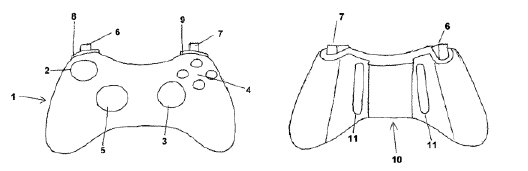
Id. figs. 1, 2.
Claim 2 is illustrative for the purposes of this appeal. Claim 2, along with cancelled claim 1 from which it depends, is reproduced below:
1. (cancelled) A hand held controller for a game console comprising:
an outer case comprising a front, a back, a top edge, and a bottom edge, wherein the back of the controller is opposite the front of the controller and the top edge is opposite the bottom edge; and
a front control located on the front of the controller;
wherein the controller is shaped to be held in the hand of a user such that the user's thumb is positioned to operate the front control; and
a first back control and a second back control, each back control being located on the back of the controller and each back control including an elongate member that extends substantially the full distance between the top edge and the bottom edge and is inherently resilient and flexible.
2. The controller of claim 1, further having a top edge control located on the top edge of the controller and wherein the controller is shaped such that the user's index finger is positioned to operate the top edge control.
Id. 4:41–59.
Ironburg sued Valve Corporation (Valve) in 2015, alleging that Valve's Steam® Controller infringed claims 2, 4, 7, 9–11, and 18 of the ′525 patent. Prior to trial, in April 2016, Valve filed an IPR petition challenging the ′525 patent, which the Patent Trial and Appeal Board partially instituted prior to the Supreme Court's decision in SAS Institute Inc. v. Iancu, 584 U.S. 357 (2018). This IPR, Number IPR2016-00948 (′948 IPR), culminated in a final written decision in September 2017.
During the pendency of the ′948 IPR, Valve filed a second IPR petition challenging the ′525 patent based on a prior art reference that Valve contended was newly discovered, Wörn. [1] After the Board issued its final written decision in the ′948 IPR, Ironburg moved to terminate this second IPR, Number IPR2017-00136 (′136 IPR), based on estoppel under 35 U.S.C. §315(e)(1). In January 2018, the Board granted Ironburg's motion to terminate, finding that Ironburg had proven that “a skilled searcher conducting a diligent search reasonably could have been expected to discover Wörn.” J.A. 3845. Reviewing the evidence, the Board specifically found that manual searches of the prior art using patent classifications and subclassifications, [2] as well as using keywords to further narrow the search results to a prior art set small enough to manually review, would have located Wörn.
A third party, Collective Minds Gaming Co. Ltd. (CMG), also filed an IPR petition challenging the ′525 patent in January 2018. CMG's petition raised two new grounds of obviousness, based on four references (the CMG Grounds). One invalidity ground was based on U.S. Published Patent Application No. 2010/0298053 (Kotkin). The other invalidity ground consisted of the combination of U.S. Patent No. 6,760,013 (Willner); Japanese Patent Application No. JP-A H10-020951 (Koji); and U.S. Patent No. 5,773,769 (Raymond) (collectively, Willner-Koji-Ray-mond). The Board instituted CMG's IPR on all grounds, but the IPR was eventually terminated due to a settlement between CMG and Ironburg.
After the filing of CMG's IPR, Valve amended its invalidity contentions in the pending district court litigation to raise the CMG Grounds. In September 2018, Ironburg filed a motion for IPR estoppel under §315(e)(2), arguing that Valve should be estopped from asserting the CMG Grounds. In November 2019, the district court granted Ironburg's motion, estopping Valve from asserting either Kotkin or Willner-Koji-Raymond at trial. The district court found that, since Willner was cited on the face of the ′525 patent and because CMG was able to locate Kotkin, Koji, and Raymond for its own IPR petition, “a skilled searcher could have been reasonably expected to find all of these references.” J.A. 4461–63. The district court action then proceeded to trial on infringement, and in February 2021, the jury returned a complete verdict for Ironburg, finding willful infringement of claims 2, 4, 7, 9–11, and 18, and awarding $4,029,533.93 in damages. An initial appeal to this court followed. See Ironburg Inventions Ltd. v. Valve Corp., 64 F.4th 1274 (Fed. Cir. 2023) (Ironburg I).
B
We affirmed-in-part, vacated-in-part, and remanded. Id. at 1301. As pertinent here, we held that the district court erred by “improperly plac[ing] the burden of proof on Valve, to show that it could not ‘reasonably … have raised’ the [CMG] Grounds in its petition.” Id. at 1297. Instead, we held, “the burden of proof rests with Ironburg to prove that these were grounds Valve ‘reasonably could have raised’ during the IPR.” Id. We further adopted the district court's conclusion that “an IPR petition ‘reasonably could have raised’ any grounds that ‘a skilled searcher conducting a diligent search reasonably could have been expected to discover.’” Id. at 1298 (citation omitted). This skilled searcher standard, we found, was “consistent with the statutory requirement that a petitioner be estopped from asserting ‘any ground that the petitioner … reasonably could have raised during … inter partes review.” Id. (alterations in original) (quoting §315(e)(2)).
We then turned to the evidence considered by the district court and criticized its use of CMG's petition as proof against Valve. That was because no evidence had been entered into the record as to the reasonable diligence of CMG's pre-petition search. Id. at 1298–99. If, after all, CMG “employed ‘scorched earth’ tactics to find the references making up the [CMG] Grounds, then its experience may be irrelevant to a determination of what would have been discovered by an ordinarily skilled searcher acting with merely reasonable diligence.” Id. at 1299. We therefore found this evidence insufficient to support a finding of estoppel, and since Ironburg offered no other evidence and bore the burden of proof, we vacated and remanded “for the district court to determine whether Ironburg [could] meet its burden.” Id. On remand, we left it to the district court “to address related issues that may arise, such as whether to reopen the record and permit discovery” and “the relevance of Valve's own search efforts.” Id. at 1300.
C
On remand, the district court permitted limited additional discovery, allowing Ironburg to procure “declarations from individuals with personal knowledge about the efforts used by [CMG] to search for and locate Kotkin and/or Willner-Koji-Raymond,” as well as “an expert opinion concerning whether an appropriately skilled person conducting a diligent search would have reasonably been expected to discover Kotkin and/or Willner-Koji-Raymond.” J.A. 5945. Ironburg then filed a renewed motion for IPR estoppel, submitting evidence that it had asked Cardinal IP, a search company, to perform searches for Kotkin and Will-ner-Koji-Raymond and contending that these grounds would have been discoverable to a skilled searcher exercising reasonable diligence. Valve opposed, relying in part on evidence of the searches that its own search agent, Landon IP, had conducted before the filing of the ′948 IPR petition.
On May 3, 2024, the district court again granted Ironburg's motion for IPR estoppel. Ironburg Inventions Ltd. v. Valve Corp., No. C17-1182, 2024 WL 2091177, at *12 (W.D. Wash. May 3, 2024) (IPR Estoppel Order). Regarding Valve's own search efforts, the district court determined the evidence showed that Kotkin and Koji were reasonably discoverable. The district court noted that “eleven classification searches and 45 keyword searches” were conducted by the Landon IP team in 2014 prior to the filing of the ′948 IPR petition. Id. at *5. This evidence showed that in the classification searches run by the Landon IP team, the exact codes under which Kotkin and Koji were indexed were included. Thus, because Kotkin would have been in the readouts returned from searching these classifications, the court concluded it was reasonably discoverable. For Koji, the district court went a step further, discussing in a lengthy footnote how the application of date restrictions and keyword search terms within Landon IP's searches would have returned only 137 search results, within which Koji would have been reasonably discoverable. See id. at *6 & n.8.
The district court also considered evidence offered by Ironburg and its Cardinal IP searchers. As regards Raymond, the court considered two sets of searches run by Cardinal IP, one of which included forward-and-backward citation queries, [3] to locate the reference. The court struck one of the forward-and-backward citation searches because it found that certain forward references this search would have returned were created after Valve's ′948 IPR petition, therefore implicating a hindsight concern. As to the other search, however, the court found that Cardinal IP's techniques were conventional, culminating in 368 search results within which Raymond appeared. The court therefore concluded that Raymond was discoverable without “extraordinary measures” or “scorched earth” tactics. Id. at *9.
The district court then entered a supplemental partial judgment containing its estoppel findings against Valve pursuant to Fed. R. Civ. P. 54(b). Valve appeals. We have jurisdiction pursuant to 28 U.S.C. §1295(a)(1).
II
On appeal, Valve primarily argues: (1) that its pre-petition Landon IP search evidence does not demonstrate that Kotkin and Koji were discoverable under a proper articulation of the skilled searcher standard, and (2) that the Cardinal IP evidence offered by Ironburg is irrelevant to the skilled searcher inquiry. We address each argument in turn.
A
We first consider Valve's argument that the district court misapplied the skilled searcher standard to the Landon IP evidence to conclude that Kotkin and Koji were reasonably discoverable.
“Interpretation of the IPR estoppel statute, an issue unique to patent law, is a question of law we review de novo applying Federal Circuit law.” Ironburg I, 64 F.4th at 1296 (citation omitted). The estoppel statute provides, in relevant part, that a petitioner in an IPR that results in a final written decision cannot later assert in a civil action an invalidity theory based on “any ground that the petitioner raised or reasonably could have raised during … inter partes review.” 35 U.S.C. §315(e)(2) (emphasis added). Consistent with our holding in Ironburg I, we agree with the parties that this statutory language requires a focus on what reasonably, rather than possibly, could have been raised prior to the filing of a relevant IPR petition. See Ironburg I, 64 F.4th at 1297–98. This timing point has a necessary corollary—when evidence is introduced that sheds light on what a skilled searcher may have discovered only after the time of the relevant IPR petition, such evidence is likely irrelevant to the skilled searcher inquiry. [4]
Still, there are two open disputes regarding the standard. First, we have not fully addressed whether the skilled searcher inquiry poses a question of law, reviewable de novo, or a question of fact, reviewable for clear error. We do not opine on this issue here because we conclude that the district court's error regarding the Landon IP evidence is apparent under either standard of review.
Separately, we have not yet had the opportunity to take a conclusive stance on what “discover[y]” within the skilled searcher inquiry entails. Ironburg I, 64 F.4th at 1298. Valve argues that a searcher must read and understand a reference to “discover” it, raising the District of Massachu-setts's decision in Palomar: “[I]t is not enough simply to locate a reference; that reference must be read, and interpreted, and understood in the context of the patent.” 2020 WL 2115625, at *14. Ironburg argues in response that requiring the proponent of estoppel to prove “discovery” of the basis for a petitioner's invalidity combination places an impossible burden on that proponent—i.e., requiring them to show that a skilled searcher would recognize the invalidity of their own patent. Ultimately, however, because we conclude that Kotkin was not discoverable on this evidence under any conception of what the skilled searcher inquiry requires, we also find it unnecessary to resolve this question.
We therefore turn directly to the evidence before us of the Landon IP search.
i
On remand, evidence of Valve's pre-petition search efforts involving Landon IP was limited. The district court primarily considered a declaration from Jamila Williams, a prior art searching professional with Landon, who had assisted with Valve's 2014 prior art searches leading up to the ′948 IPR. This declaration, which had been initially offered prior to Ironburg I and was reoffered on remand, included two appendices of search queries as exhibits. The first list of queries had a cut-off date of June 17, 2011, and it included 76 searches within a U.S. patent database. J.A. 7613 ¶9; J.A. 7616–18. This list of search queries was not provided with the results. The second list of search queries consisted of 11 searches within a Japanese patent database, completed with the same cutoff date, which included the numbers of results alongside the search queries. J.A. 7613 ¶9; J.A. 7620–21 (Japanese Language Search); J.A. 7622–24 (Translated Search). The search evidence considered on remand by the district court therefore consisted of classification searches and the number of results returned from one of these searches.
ii
Valve argues that the district court erred when it concluded that Kotkin and Koji were discoverable merely because they are located in “classifications that Valve's own consultant believed were relevant.” IPR Estoppel Order, 2024 WL 2091177, at *6. Specifically, Valve contends that such an understanding of discovery completely ignores the number of references returned by the classification search and, as a result, whether they were understood by the searcher.
Regarding Kotkin, the district court's analysis ended after simply noting that the exact IPC and CPC classifications containing Kotkin and Koji were searched. This is notwithstanding that Landon IP's search strings reveal that 26,333 references were returned by the Japanese-language database when searched for classifications containing both Kotkin and Koji. The district court purported to rely on classification searches based on the Board's application of §315(e)(1) estoppel in the ′136 IPR, which primarily looked to classification searches in identifying the reasonable discoverability of Wörn. The district court also found that classification searching satisfied the standard of reasonableness set forth in certain district court cases to consider the issue of IPR estoppel: “One way to show what a skilled search would have found would be (1) to identify the search string and search source that would identify the allegedly unavailable prior art and (2) present evidence, likely expert testimony, why such a criterion would be part of a skilled searcher's diligent search.” IPR Estoppel Order, 2024 WL 2091177, at *6 (citation omitted); see Clearlamp, LLC v. LKQ Corp., No 12 C 2533, 2016 WL 4734389, at *9 (N.D. Ill. Mar. 18, 2016). Thus, no other analysis was conducted by the district court regarding Kotkin.
The district court's conclusion regarding Kotkin was error. First, as noted above, the Board in the ′136 IPR did not consider mere classification searches, without more, to be the endpoint of its analysis; rather, it went on to consider that these classifications would be manually searched, or that keyword searching could have been used to narrow the classification search results down further to an amount capable of manual review. Similarly, we conclude that the Clearlamp standard relied upon by the district court does not go far enough when an unreviewably large number of references are returned by a skilled searcher's diligent search. We do not hold that manual review of search results will in all instances be necessary to establish discovery. We also do not go so far as to endorse Valve's vision of the discoverability standard, though we note the normative force of Valve's argument that thousands of sources, not further narrowed in any way, likely cannot be considered discovered for estoppel purposes under §315(e)(2). We hold only that something more is required for estoppel when a classification search alone returns an unreviewable number of search results—a demand not met here.
This conclusion is in line with preponderant evidence of record in this case, which indicates that keyword searches or other narrowing techniques would be used after an initial classification search. See IPR Estoppel Order, 2024 WL 2091177, at *5 (district court acknowledging but not considering in its analysis that “45 keyword searches” were performed by Landon IP); J.A. 6179–81 (Cardinal IP searcher mentioning both keyword and citation searches as complementary to classification searches); J.A. 7545–46 (Landon IP professional declaring that a skilled searcher would have performed sequential citation-based searches and classification-based searches until a “search query result list small enough to manageably review” is returned). Because the district court was confronted with thousands of references in the Landon IP Kotkin search results yet still found that no narrowing was required for Kotkin to be deemed discovered, we conclude that the district courterred.
Further, we determine this error warrants reversal on the issue of estoppel. As noted, Landon IP's search efforts were not meaningfully developed further on remand to include more than Ms. Williams's classification search results already in evidence. Since we have found this evidentiary basis insufficient to support a finding of discovery under the skilled searcher test, “nothing of record warrants a further exercise of the fact-finding function or indicates any possibility that the appealed judgment might be sustained by such exercise.” Panduit Corp. v. Dennison Mfg. Co., 810 F.2d 1561, 1565–66 (Fed Cir. 1987). We therefore reverse the judgment of the district court insofar as it estopped Valve from raising the Kotkin ground of invalidity based on Landon IP's search evidence. [5] On remand, the district court shall consider the invalidity of the ′525 patent in light of Kotkin.
B
We next consider Valve's argument that the Cardinal IP searches offered on remand by Ironburg are irrelevant to the skilled searcher inquiry as tainted by hindsight bias.
i
The district court considered extensive evidence from Cardinal IP on remand. Among this evidence was testimony from Seth Greenia, a search professional at Cardinal, and testimony from Brian Hameder, a project manager with Cardinal.
In his declaration, Mr. Greenia reported being able to locate Kotkin, Koji, and Raymond across two phases of search conducted in 2023: an initial search—inclusive of both classification and citation searches—and a supplemental classification search focused on “the use of an inherently resilient and flexible paddle or elongated member.” J.A. 6178 ¶¶8–11; J.A. 6180–82 ¶¶20–28. The district court noted that Mr. Greenia conducted this supplemental search because Raymond, which arises not from the video game context but in the amateur radio context, was located but considered only of “peripheral relevance” after the initial search. IPR Estoppel Order, 2024 WL 2091177, at *8 (quoting J.A. 6182 ¶27). Mr. Greenia also represented that the references in question were not made available to him prior to his search, which the district court credited as evidence of a lack of hindsight bias, see IPR Estoppel Order, 2024 WL 2091177, at *10 n.17.
Mr. Hameder submitted two declarations on remand. In the first, Mr. Hameder testified to the cost of Mr. Greenia's initial and supplemental searches. See J.A. 7370–71 ¶¶8–10. In the second, submitted after his deposition in the matter, Mr. Hameder purported to address a potential issue in Mr. Greenia's initial search by applying date filters to exclude any results from after the time of Valve's ′948 IPR petition. See J.A. 8247–48 ¶¶3–6. Mr. Hameder's bottom-line conclusion in his second declaration is that Kotkin, Koji, and Raymond would have all been discoverable from Mr. Greenia's initial search, regardless of whether proper date filtering had been applied. See J.A. 8248 ¶7.
ii
Valve's major arguments against the relevance of Cardinal IP's evidence are twofold: (1) that Mr. Greenia's initial search, including later corrections by Mr. Hameder, incorporates hindsight information; and (2) that the supplemental classification search conducted by Mr. Greenia was motivated entirely by hindsight.
a
We first address Mr. Greenia's initial search. As noted, insofar as it was initially offered to show the discoverability of Raymond by a skilled searcher, the district court struck a certain search string, number 34, from this search because it was a forward-and-backward citation search, which would have revealed patents and other publications that arose after Valve's 2016 petition in the ′948 IPR. See IPR Estoppel Order, 2024 WL 2091177, at *8. These include, for instance, a design patent, U.S. Patent No. D983,269 S, issued to Ironburg in 2023, which cites Raymond—likely because Raymond was raised as part of the CMG Grounds in CMG's IPR. At the same time, the district court did not consider Mr. Greenia's evidence that his initial search uncovered Kotkin and Koji on remand considering its conclusions regarding the Landon IP evidence. Ironburg offers this evidence on appeal, however, as an alternative ground for affirmance given Mr. Hameder's corrections.
Valve argues that Mr. Hameder's second declaration was a belated attempt to control adequately for hindsight bias in Mr. Greenia's search results. Valve also argues that the district court failed to contend with the ways that hindsight bias infected Mr. Greenia's initial search methodology from the very beginning. We agree on both points.
Mr. Hameder's second declaration fails to adequately account for the hindsight bias in Mr. Greenia's initial searches and is therefore not probative regarding the dis-coverability of Kotkin, Koji, or Raymond to a skilled searcher exercising reasonable diligence at the time of Valve's ′948 IPR petition. This, as Valve points out, is because it was not just the search string number 34 that made use of forward-and-backward citation searching without date restrictions: one of Mr. Greenia's early searches, number 3, also made use of forward-and-backward citation searching that would have pulled in later arising patents and publications that cite Kotkin, Koji, and Raymond. J.A. 6204 (showing that search number 3 is a “cta” search like number 34). Based on the sources returned by this early citation search, Mr. Greenia then crafted keywords and selected additional classifications to guide his subsequent iterative searches. J.A. 7645, 7658–59. We therefore hold that the district court's finding that Mr. Greenia's searches were not infected with hindsight bias—based on his mere testimony that he had not been shown the references before searching—was error.
Given that Mr. Greenia's first search was affected by hindsight bias from an early point, we conclude that Mr. Hameder's corrections in his second declara-tion—namely, applying date filters to only the citation search struck by the district court—do not go far enough to render Mr. Greenia's initial set of classification and citation searches probative to the skilled searcher inquiry at the relevant time. Instead, Mr. Hameder's corrections, which were revealed five months after Mr. Greenia completed his initial search, are “too little too late.” Appellant Br. 56. Mr. Greenia's initial classification and citation search is therefore not probative regarding a skilled searcher's discovery of Kotkin, Koji, or Raymond at the time of Valve's IPR petition.
b
Finally, we turn to Valve's argument that Mr. Greenia's supplemental search, which also purports to have located Raymond, was motivated solely by hindsight bias. Valve argues that this supplemental search epitomizes hindsight bias because of deposition testimony from Mr. Hameder suggesting that the search was only conducted “because there was another reference that had not yet been found.” J.A. 7665. Ironburg responds, citing Mr. Greenia's declaration testimony, that supplemental searches are “common practice,” and that nothing in the record suggests that this supplemental search was tainted by hindsight. Appellee Br. 52 (citing J.A. 6178 ¶8).
Again, we agree with Valve. Ironburg does not provide sufficient reasoning that excuses Mr. Hameder's unequivocal admission that the supplemental search was only undertaken in the first instance because of the need to locate Raymond—clear evidence of hindsight bias. As with Mr. Greenia's initial searches, this hindsight-driven supplemental search cannot be considered probative regarding the discovery of Raymond at the relevant time for the skilled searcher inquiry.
Thus, as a whole, the Cardinal IP evidence fails to establish the discoverability of Kotkin, Koji, and Raymond to a skilled searcher at the time of Valve's IPR petition because it is tainted by hindsight. To the extent the district court relied on the Cardinal IP evidence to estop the Will-ner-Koji-Raymond ground, its judgment must also be reversed. On remand, the district court shall also consider the invalidity of the ′525 patent in light of Willner-Koji-Raymond.
III
We have considered the parties' remaining arguments and find them unpersuasive. The judgment of the district court is reversed. The district court's estoppel of the Kotkin ground was based on undeveloped, overgeneralized evidence, and its estoppel of the Willner-Koji-Raymond ground failed to adequately account for hindsight concerns. We therefore remand for further proceedings not inconsistent with this opinion.
REVERSED AND REMANDED
Costs
Costs to Appellant.
Stark, Circuit Judge, concurring.
As district courts have noted, we have not provided them, nor the Patent and Trademark Office's Patent Trial and Appeal Board (“Board”), much guidance on how the skilled searcher test is to be applied. See, e.g., GeigTech E. Bay LLC v. Lutron Elecs. Co., 2023 WL 8827572, at *5 (S.D.N.Y. Dec. 21, 2023) (“[T]he Federal Circuit has not refined exactly what facts or circumstances qualify as a ‘skilled searcher conducting a diligent search.’”); EIS, Inc. v. IntiHealth Ger GmbH, 2023 WL 6797905, at *3 (D. Del. Aug. 30, 2023) (“[T]he Federal Circuit has not expanded on the facts or circumstances that constitute a ‘skilled searcher conducting a diligent search.’”). As an appellate court, with no factfinding role, we necessarily limit our decisions (with rare exceptions not applicable here) to the issues fairly presented to and crystallized by the tribunals we review. See generally Ironburg Inventions Ltd. v. Valve Corp., 64 F.4th 1274, 1299 (Fed. Cir. 2023) (“Ironburg I”) (deciding only that the burden to prove what a skilled searcher would have reasonably discovered rests with the party asserting estoppel). And, to be sure, the skilled searcher issue has arisen so far in only a handful of appeals. See, e.g., Ingenico Inc. v. IOENGINE, LLC, 136 F.4th 1354, 1365 (Fed. Cir. 2025); Ironburg I, 64 F.4th 1274; Intuitive Surgical, Inc v. Ethicon LLC, 25 F.4th 1035 (Fed. Cir. 2022). These realities exacerbate the “challenging” task courts and the Board confront when asked to address IPR estoppel disputes governed by 35 U.S.C. §315(e). Ironburg I, at 1298.
Our opinion resolving the case before us today, which I join in full, does not, of course, fill in all the details of IPR estoppel. See Op. at 10-11 (“[W]e have not yet had the opportunity to take a conclusive stance on what ‘discover[y]’ within the skilled searcher inquiry entails … [and] find it unnecessary to resolve this question [here].”) (internal quotation marks omitted; first, third, and fourth bracketed alterations added). We do, however, make several important contributions to the ongoing development of the skilled searcher test. I write separately to highlight them.
I
Prior to our opinion in Ingenico, 136 F.4th at 1365, district courts had sometimes focused the skilled searcher inquiry on whether “a skilled searcher would have been able to find a particular reference.” EIS, 2023 WL 6797905, at *3 (emphasis added); see also Clearlamp, LLC v. LKQ Corp., 2016 WL 4734389, at *9 (N.D. Ill. Mar. 18, 2016) (“In accordance with the §315(e)(2) standard, the datasheet can be used in civil litigation only if it could not have been found by a skilled searcher performing a diligent search.”) (emphasis added). Then, in Ingenico, 136 F.4th at 1365, we made clear that “a[n] [invalidity] ground is not the prior art asserted during an IPR.” As the court's opinion reaffirms today, “Section 315(e)(2) speaks in terms of ‘ground[s],’ not prior art references.” Op. at 14 n.5. Consequently, for purposes of the skilled searcher test, the patentee's burden to show discoverability of invalidity grounds is not automatically satisfied by proving the findability of the prior art ref-erence(s) on which the invalidity ground is based.
In my view, then, a patentee relying on the skilled searcher test to estop a challenger, pursuant to §315(e)(2), from pressing a particular ground of invalidity in district court, must prove at least the following: (i) the prior art reference(s) at issue were findable by a skilled searcher conducting a diligent search and (ii) the skilled searcher also reasonably would have been expected to discover, based on the reference(s) found, the invalidity ground the challenger seeks to assert in court.
Today's case centers on the first step of this analysis: whether the prior art references on which Valve relies were reasonably findable. Valve does not separately challenge the second step; that is, Valve does not contend that, even if all of its references were findable, the grounds for invalidity were somehow not reasonably discoverable. Thus, today's opinion, properly, does not evaluate what may be required to show a ground for invalidity would have been reasonably discoverable once a skilled searcher is presented with one or more findable references. [6]
II
The court's opinion does have something to say about the first step I identified above. Specifically, it holds that, in at least some circumstances, “something more” than proving the mere accessibility [7] of a prior art reference is required in order to establish a skilled searcher performing a diligent search would have found the reference. [8] Op. at 13. Determining precisely when “something more” must be demonstrated to meet the burden at step one, and in those instances discerning what that “something more” must be, calls for context-dependent analysis. What might suffice to establish that a skilled searcher reasonably could have been expected to find a prior art reference will vary based on factors like the field of the invention, the state of the prior art, and the search strategies a diligent searcher in the space would have employed. See Ironburg I, 64 F.4th at 1298. Because this inquiry is fact-specific, we must largely leave development of the “something more” requirement to the district courts and the Board.
Today's case does, nonetheless, provide helpful examples of findability, one where “something more” is not present and one where it is. As the court holds, “something more” than accessibility is not demonstrated when, as with the Kotkin reference, the only evidence in the record is that a skilled searcher would have undertaken a classification search that yielded, in addition to the reference now being asserted by the patent challenger, tens of thousands other references. Op. at 12-13. In contrast, “something more” may be satisfied where, as with a different reference Valve is estopped from asserting invalidity grounds based upon, [9] the reference is expressly cited on the face of the patent being challenged. See J.A. 14-15 (“Indeed, Willner was actually identified by a skilled searcher, and the reference appears on the face of the [asserted] patent.”) (emphasis added); see also J.A. 5964. These examples, while far from exhaustive, may prove to be useful guideposts as courts and the Board encounter IPR estoppel issues in an unpredictable array of specific scenarios.
|
|