

Patent Cases, NOVAPLAST CORPORATION, Plaintiff, v. INPLANT, LLC, et al., Defendants., U.S. District Court, D. New Jersey, (Dec. 15, 2025)
NOVAPLAST CORPORATION, Plaintiff, v. INPLANT, LLC, et al., Defendants.
U.S. District Court, D. New Jersey. Civil Action No. 20-cv-7396 (JXN)(JBC). December 15, 2025.
Honorable Julien Xavier Neals, District Judge
Honorable Julien Xavier Neals, District Judge
OPINION
In this patent infringement case, Defendants Inplant, LLC and Proximate Concepts, LLC (“Defendants”) moved for summary judgment (ECF No. 154) and to exclude Plaintiff Novaplast Corporation's (“Plaintiff”) infringement expert, Bo Bowman (“Bowman”) (ECF No. 156). Plaintiff opposed (ECF Nos. 163-64), and Defendants replied (ECF Nos. 169-70). Plaintiff moved to enforce Magistrate Judge Clark's October 10, 2023 Order and sanction Defendants. (ECF No. 162.) Defendants opposed (ECF No. 171), and Plaintiff replied (ECF No. 172). The Court has carefully considered the parties' submissions and decides this matter without oral argument pursuant to Federal Rule of Civil Procedure 78 and Local Civil Rule 78.1. For the reasons set forth below, Defendant's motion for summary judgment (ECF No. 154), Defendants' motion to exclude (ECF No. 156), and Plaintiff's motion to enforce and sanction Defendants (ECF No. 162) are DENIED.
I. BACKGROUND [1]
A. The ′213 Patent
Plaintiff owns U.S. Patent No. 10,105,213 (“′213 Patent”), a “Prosthetic Implant Delivery Device and Method.” (See Pl.'s Statement of Undisputed Material Facts (“SUMF”) ¶4, ECF No. 163-1; Am. Compl. Ex. 3 (“′213 Patent”), ECF No. 29 at *28–41. [2] ) The ′213 Patent is for an implant funnel. (See ′213 Patent col. 1 l. 13–22.) A surgeon using an implant funnel places a prosthetic implant—like a breast implant—in the wide end of the funnel (“proximal end”) and squeezes it out of the narrow end (“distal end”) into the patient's body. (Id. col. 1 l. 41–51.)
′213 Patent Claims 1 and 5 are for:
1. A delivery system adapted to facilitate insertion of a prosthetic implant through a surgical opening, the system comprising:
a flexible elongated member defining a proximal end and a distal end, the proximal end, formed opposite the distal end and defining a closed end, the distal end defining a longitudinal opening;
the distal end including a first longitudinal edge and a second longitudinal edge, the first longitudinal edge and second longitudinal edge further defining the longitudinal opening, at least one first fastener formed on the elongated member adjacent the first longitudinal edge, and a second fastener formed on the elongated member adjacent the second longitudinal edge;
the second fastener matingly engage with the at least first fastener to close the longitudinal opening, whereby a predetermined size distal opening is formed based on the engagement of the second [fastener] with the at least one first fastener, the distal opening sized to allow the prosthetic implant to be urged therethrough.
….
5. The delivery system of claim 1, each of the at least one first, fastener further comprising a channel, the second fastener defining a shoulder, the shoulder adapted to be received within and secured with the channel of at least one of the first fasteners.
(Id. col. 8 l. 13–64.)
A picture is worth a thousand words (and probably ten thousand in a patent application), so here is one possible configuration for the distal end of the ′213 Patent:
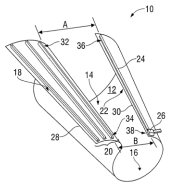
(′213 Patent fig. 1, ECF No. 29 at *30.)
B. The Accused Products
Defendant manufactured and sold two implant funnels (“Accused Product 1” and “Accused Product 2”; collectively, “Accused Products”). (Am. Compl. ¶¶67–75.) Accused Product 1, pictured below, has a first and second fastener running from the middle of the funnel down to the distal end:
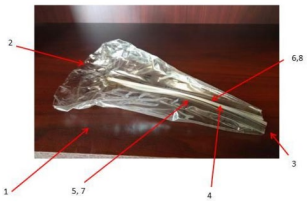
(See Am. Compl. Ex. 6 at 4, ECF No. 29 at *52.)
Plaintiff sent a cease-and-desist letter to Defendants in September 2018, claiming Accused Product 1 infringed on the ′213 Patent. (See id. at 1–2.) Following the cease-and-desist letter, Defendants manufactured and sold Accused Product 2. (See Am. Compl. Ex. 7 at 1–2, ECF No. 29 at *54–55.)
Accused Product 2, pictured below, also has a first and second fastener running down the middle of the funnel to the distal end:
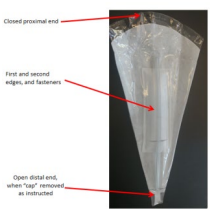
(See Am. Compl. Ex. 7 at 2, ECF No. 29 at *55.) Unlike Accused Product 1, the distal end of Accused Product 2 is sealed by a perforated cap. (Id.)
C. Litigation
Plaintiff sued Defendants in this District for patent infringement, alleging the Accused Products directly and indirectly infringed on the ′213 Patent claims 1 and 5. (See Am. Compl. ¶¶66–76.) The Court held a Markman hearing and concluded:
In claim 1, “at least one first fastener” means “one or more than one first fastener(s)”.
In claim 5, “each of the at least one first fastener” means “each of the one or more than one first fasteners.”
In claim 5, “the first fasteners” means “the more than one first fasteners”. Taking B and C together, claim 5 covers only multiple-fastener embodiments.
In claim 1, “based on the engagement of the second fastener with the at least one first fastener” means “based on the engagement of the second fastener with the one or more first fastener(s).”
In claim 1, “formed on the elongated member” requires no further interpretation, but, for clarity, should be understood as not excluding an affixed fastener or fasteners.
NovaPlast Corp. v. Inplant, LLC, No. 20-7396, 2023 WL 4760466, at *17 (D.N.J. July 26, 2023).
Relevant here, the Court observed “[t]he phrase ‘predetermined size opening’ does not undermine [Plaintiff's] position that claim 1 encompasses both (nonadjustable) single-first-fastener and (adjustable) multiple-first-fastener embodiments. Any engagement of the first fastener (whether single, or one of many) with the second fastener would necessarily create some size of distal opening.” Id. at *13. To further assert the ′213 Patent's distal opening required multiple first fasteners, Defendants “point[ed] to the word ‘sized’ and argue[d] that claim 1 requires the capacity for ‘sizing,’ in the sense of ‘adjusting,’ the distal opening, which would imply multiple first fasteners.” Id. The Court disagreed, stating:
The shift is somewhat subtle, but the term in the claim is not “sizing” but “sized.” And the word “sized,” says [Plaintiff], does not refer to the process of adjustment by the user; rather it simply means that the opening must be of a size sufficient to allow the prosthetic implant to be urged through. Consequently, it is not inconsistent with a single first fastener embodiment. [The Court] agree[s] that “sized,” read in context, is not an active verb invoking the process of adjusting the opening. Rather, it is a modifier describing the distal opening as being of a size sufficient “to allow the prosthetic implant to be urged therethrough.”
Id.
D. Defendants' Non-Infringement Contentions
Pursuant to Local Patent Rule 3.2A, Defendants served their original non-infringement contentions in May 2022. (See Defs.' Opp'n to Sanctions 1, ECF No. 171.) For Accused Product 1, Defendants originally asserted:
NovaPlast's Infringement Contentions fail to identify “specifically where each limitation of each asserted claim is found in the Accused Instrumentalities” as required by Local Patent Rule 3.1(c). NovaPlast has therefore failed to meet its burden of proof on infringement.
This element is not met by Accused Product 1.
In Accused Product 1, closing the “Glide Track” is not the basis for a predetermined size distal opening being formed.
In Accused Product 1, the distal opening is provided with a default size as manufactured. Alternatively, the size of the distal opening can be manually enlarged by a user cutting the device to provide a distal opening at the desired larger size.
….
This element recites a process for producing a structure. Accused Product 1 does not have a structure that is made by the claimed process.
(Original Non-Infringement Contentions at *3, ECF No. 171-2; see also First Proposed Am. Non-Infringement Contentions at 10–11, ECF No. 76-2.) For Accused Product 2, Defendants originally claimed:
As manufactured and sold by Defendants, the distal end of Accused Product 2 does not include a “distal opening sized to allow the prosthetic implant to be urged therethrough,” as claimed. Rather the Accused Product 2 narrows to a pointed distal end. To the extent the distal end of Accused Product 2 has an opening, it is not sized “based on the engagement of the second fastener with the at least one first fastener” and it is not sized “to allow the prosthetic implant to be urged therethrough,” as claimed.
In the In-Use Configuration of Accused Product 2, closing the “Glide Track” is not the basis for a predetermined size distal opening being formed.
In the In-Use Configuration of Accused Product 2, the distal opening is provided with a default size as manufactured. In addition, the closing (and opening) of the Glide Track is unrelated to and has no bearing on any opening at the distal end, let alone “the distal opening sized to allow the prosthetic implant to be urged therethrough” as required by the asserted claims.
In the In-Use configuration of Accused Pro[d]uct 2, a distal opening is formed by the user removing the perforated tab at the distal end ….
(Original Non-Infringement Contentions at *4.)
In August 2023, following the Court's Markman hearing, Defendants sought leave to amend their original contentions. (Mot. for Leave to Amend, ECF No. 76.) The amendments did not change the above-cited non-infringement contentions. (See First Proposed Am. Non-Infringement Contentions at 10–11, 40–43.)
The following month, Defendants filed a supplemental motion for leave to amend. (Supp. Mot. for Leave to Amend, ECF No. 88.) Defendants' Second Proposed Amended Non-Infringement Contentions modified the original non-infringement contentions to add that: (1) the distal end of Accused Product 1 “is not a distal opening, but is a perforated opening located in an area above the closed distal point of the original funnel” (Second Proposed Am. Non-Infringement Contentions at 31–32, ECF No. 88-2); and (2) in Accused Product 2, “the original distal point shown above at the pull-tab shown (not an opening) is not a distal opening, as required by the claim[.]” (id. at 94).
Judge Clark denied the supplemental motion to amend in an October 10, 2023 Order. (See Oct. 10 Order, ECF No. 92.) On June 6, 2024, Judge Clark granted Defendants' initial motion for leave to amend their non-infringement contentions. (June 6 Order, ECF No. 114.)
E. Instant Motions
Defendants moved for summary judgment (see Mot. Summ. J., ECF No. 155) and to exclude Bowman's testimony under Daubert v. Merrell Dow Pharmaceuticals, Inc., 509 U.S. 579 (1993) (see Daubert Mot., ECF No. 157). Shortly thereafter, Plaintiff moved to enforce Judge Clark's October 10, 2023 Order and sanction Defendants. (Mot. to Enforce, ECF No. 162.)
II. DAUBERT MOTION
Bowman is Plaintiff's sole expert on literal infringement. (SUMF ¶19.) She concluded the Accused Products literally infringe on the ′213 Patent, stating the following:
Defendants have argued that closing the “Glide Track” fastener(s) of Accused Product 1 is not the basis for a predetermined size distal opening being formed and is unrelated to the size of any opening at the distal end. However, my inspection shows that when the first fastener and the second fasteners for each of Accused Product 1 and Accused Product 2 are engaged with one another, that a predetermined size opening is formed, and that it is of a size that would allow a certain size prosthetics through.
(Id. ¶¶20-21 (quoting Daubert Mot. Ex. D (“Bowman Report”) at 22, ECF No. 155-6).)
Defendants move to exclude Bowman's testimony under Daubert v. Merrell Dow Pharmaceuticals., Inc., 509 U.S. 579, 589–95 (1993), arguing (1) Bowman was unqualified to give an expert opinion, and (2) Bowman's opinion is unreliable because she did not observe an implant get pushed through the distal ends of either Accused Product. (See Daubert Mot.)
A. Legal Standard
Under Federal Rule of Evidence 702, a witness qualified as an expert may provide expert testimony if: (a) “the expert's scientific, technical, or other specialized knowledge will help the trier of fact to understand the evidence or to determine a fact in issue”; (b) “the testimony is based on sufficient facts or data”; (c) “the testimony is the product of reliable principles and methods”; and (d) “the expert's opinion reflects a reliable application of the principles and methods to the facts of the case.” Fed. R. Evid. 702. Thus, Federal Rule of Evidence 702 imposes a “trilogy of restrictions on expert testimony: qualification, reliability and fit.” Ford v. Ford Motor Co., 311 F. Supp. 3d 667, 673 (D.N.J. 2017) (quoting Calhoun v. Yamaha Motor Corp., 350 F.3d 316, 321 (3d Cir. 2003)). The Court must exercise its gatekeeping role to “ensure that any and all scientific testimony or evidence admitted is not only relevant, but reliable.” Daubert, 509 U.S. at 589.
B. Discussion
i. Whether Bowman is Qualified
A witness “must be qualified to testify as an expert.” Ford, 311 F. Supp. 3d at 673 (quoting Calhoun, 350 F.3d at 321). This is a liberal requirement. In re Paoli R.R. Yard PCB Litig. (“Paoli II”), 35 F.3d 717, 741 (3d Cir. 1994). “[A] broad range of knowledge, skills, and training qualify an expert as such,” id., including “practical experience as well as academic training and credentials.” Daiichi Pharm. Co., Ltd v. Apotex, Inc., No. 03-937, 2005 WL 7979497, at *2 (D.N.J. Nov. 1, 2005) (quoting Elcock v. Kmart Corp., 233 F.3d 734, 741 (3d Cir. 2000)).
Here, Bowman possesses the minimum qualifications to testify as an expert. She graduated from Carnegie Mellon University in 2017 with a Bachelor of Science in Materials Science and Engineering. (SUMF ¶25.) She then worked for two years as an engineer at a medical device company. (Id. ¶26; Bowman Dep. at 17:20–18:25, ECF No. 163-3.) In 2023, Bowman earned a Master's Degree in Medical Engineering from the Massachusetts Institute of Technology (“MIT”). (SUMF ¶27.) While at MIT, Bowman was a research assistant at two laboratories developing medical devices. (See Bowman Dep. at 48:19–49:13.) Bowman has personally developed several medical devices used in surgeries. (Id. at 13:11–14, 16:3–17, 22:21–22:2.) Bowman currently works as a research and development engineer for two medical device companies, including Johnson & Johnson, (id. at 28:7–23), where she has worked on at least four medical devices, (id. at 30:17–21).
Defendants argue Bowman is not qualified because, she has never testified as an expert before, (SUMF ¶30); is not a professional engineer or medical doctor, (id. ¶31); has never developed an implant funnel, (id. ¶32); has never been part of a surgical team inserting a breast implant, (id. ¶33); and has not published any articles relevant to implant funnels, (id. ¶34). But “insist[ing] on a certain kind of degree or background is inconsistent with our jurisprudence.” In re Paoli R.R. Yard PCB Litig. (“Paoli I”), 916 F.2d 829, 855 (3d Cir. 1990). “If the expert meets liberal minimum qualifications, then the level of the expert's expertise goes to credibility and weight, not admissibility.” Kannankeril v. Terminix Int'l, Inc., 128 F.3d 802, 809 (3d Cir. 1997). Indeed, “it is an abuse of discretion to exclude testimony simply because the trial court does not deem the proposed expert to be the best qualified or because the proposed expert does not have the specialization that the court considers most appropriate.” Holbrook v. Lykes Bros. S.S. Co., 80 F.3d 777, 782 (3d Cir. 1996). Bowman has an academic and professional background in medical device design. So, Bowman surmounts the low bar to be qualified as an expert. That she could be more qualified, i.e., her level of expertise, is an issue of credibility and weight, not admissibility.
ii. Whether Bowman's Opinion is Reliable
Expert testimony is admissible if “the process or technique the expert used in formulating the opinion is reliable.” Kannankeril, 128 F.3d at 806 (quoting Paoli II, 35 F.3d at 742). Reliable testimony is “based on the ‘methods and procedures of science,’ rather than on ‘subjective belief or unsupported speculation.’” Id. (quoting Paoli II, 35 F.3d at 742). “[T]he expert must have ‘good grounds’ for his or her belief.” Paoli II, 35 F.3d at 742. The question is whether a “particular opinion is based on valid reasoning and reliable methodology.” Kannankeril, 128 F.3d at 806. Factors the Court must consider in evaluating the reliability of expert testimony include:
(1) whether a method consists of a testable hypothesis; (2) whether the method has been subject to peer review; (3) the known or potential rate of error; (4) the existence and maintenance of standards controlling the technique's operation; (5) whether the method is generally accepted; (6) the relationship of the technique to methods which have been established to be reliable; (7) the qualifications of the expert witness testifying based on the methodology; and (8) the non-judicial uses to which the method has been put.
Paoli II, 35 F.3d at 742 n.8. But “these factors are neither exhaustive nor applicable in every case.” Kannankeril, 128 F.3d at 806–07. Courts have “considerable leeway” in determining the reliability of expert testimony. Smart Vent, Inc., 193 F. Supp. 3d at 410 (quoting Simmons v. Ford Motor Co., 132 F. App'x 950, 952 (3d Cir. 2005)).
Based on inspecting and handling the Accused Products, Bowman concluded “when the first fastener and the second fasteners for each of Accused Product 1 and Accused Product 2 are engaged with one another, … a predetermined size opening is formed, and … it is of a size that would allow a certain size prosthetics through.” (SUMF ¶21.) But she did not perform “an experiment or test where she observed a prosthetic being pushed through the distal opening of Accused Products 1 and/or 2.” (Id. ¶36.) According to Defendants, Bowman's failure to test the Accused Products makes her opinion unreliable and inadmissible.
This is unpersuasive. “Although a testable hypothesis is one factor a Court should consider in assessing the reliability of an expert, testing is not always applicable.” Glielmi v. Raymond Corp., No. 09-5734, 2012 WL 924844, at *6 (D.N.J. Mar. 19, 2012). Courts do not mechanically “require an expert to base his or her opinions on independent data collection or field research.” Jaasma v. Shell Oil Co., 412 F.3d 501, 514 (3d Cir. 2005). Indeed, “testing is not required in every case, particularly where, as here, the expert conducted an examination of the physical evidence.” Glielmi, 2012 WL 924844, at *6 (D.N.J. Mar. 19, 2012) (quoting Jacobs v. Tricam Indus., Inc., 816 F. Supp. 2d 487, 493 (E.D. Mich. 2011)).
Bowman inspected and handled the Accused Products. She engaged the fasteners, which formed distal ends. She observed the distal ends were large enough to “allow … certain sized prosthetics through.” (SUMF ¶21.) The mere fact that Bowman did not herself squeeze a prosthetic through the Accused Products is not determinative. She merely observed a prosthetic smaller than the distal end would go through. The proposition that a smaller object can fit through a bigger opening does not require a scientific test, at least in this case. Because Bowman is qualified and her opinion is reliable, the Court denies Defendants' motion to exclude her testimony.
III. SUMMARY JUDGMENT
A. Legal Standard
“Summary judgment is as appropriate in a patent case as it is in any other case.” In re Gabapentin Pat. Litig., 393 F. Supp. 2d 278, 286 (D.N.J. 2005) (quoting C.R. Bard, Inc. v. Advanced Cardiovascular, Inc., 911 F.2d 670, 672 (Fed. Cir. 1990)). The Court must grant summary judgment if the moving party shows “there is no genuine dispute as to any material fact and the movant is entitled to judgment as a matter of law.” Fed. R. Civ. P. 56(a). A fact is material if it “might affect the outcome of the suit under the governing law.” Anderson v. Liberty Lobby, Inc., 477 U.S. 242, 248 (1986). A dispute is genuine “if the evidence is such that a reasonable jury could return a verdict for the nonmoving party.” Id. The moving party has the burden of showing no genuine dispute of material fact exists. Celotex Corp. v. Catrett, 477 U.S. 317, 323 (1986). The burden then shifts to “the nonmoving party to go beyond the pleadings and by her own affidavits, or by the ‘depositions, answers to interrogatories, and admissions on file,’ designate ‘specific facts showing that there is a genuine issue for trial.’” Id.
The Court may not make credibility determinations or weigh evidence. Anderson, 477 U.S. at 255. “All facts and inferences are construed in the light most favorable to the non-moving party.” Boyle v. County of Allegheny, 139 F.3d 386, 393 (3d Cir. 1998). The Court's role is to “determine whether there is a genuine issue for trial.” Anderson, 477 U.S. at 249. No genuine dispute of material fact exists, however, if the non-moving party “fails to make a showing sufficient to establish the existence of an element essential to that party's case.” Celotex, 477 U.S. at 322.
Defendants argue summary judgment is warranted because (1) the Accused Products do not infringe on the ′213 Patent, and (2) Plaintiff cannot prove damages.
B. Discussion
i. Infringement
Direct patent infringement occurs when “whoever without authority makes, uses, offers to sell, or sells any patented invention, within the United States or imports into the United States any patented invention during the term of the patent therefor, infringes the patent.” 35 U.S.C. §271(a). Indirect patent infringement occurs when someone “actively induces infringement of a patent.” 35 U.S.C. §271(b).
Patent infringement follows a two-step analysis. MBO Labs., Inc. v. Becton, Dickinson & Co., 474 F.3d 1323, 1329 (Fed. Cir. 2007). First, the Court construes the asserted patent claims. Markman, 517 U.S. at 372–74. This is a question of law. Vita-Mix Corp. v. Basic Holding, Inc., 581 F.3d 1317, 1324 (Fed. Cir. 2009). Second, the Court determines whether “the accused device falls within the scope of the claims as interpreted.” MBO Labs., 474 F.3d at 1329. This is a question of fact. Kustom Signals, Inc. v. Applied Concepts, Inc., 264 F.3d 1326, 1332 (Fed. Cir. 2001).
“To prove an accused product literally infringes the patent in suit, the product must contain each and every limitation of the asserted claim(s).” Trebro Mfg., Inc. v. Firefly Equip., LLC, 748 F.3d 1159, 1166 (Fed. Cir. 2014). “In other words, literal infringement requires … one-to-one correspondence between the patented invention and the accused device.” Smart Vent, Inc., 193 F. Supp. 3d at 416 (citing Transocean Offshore Deepwater Drilling, Inc. v. Maersk Drilling USA, Inc., 699 F.3d 1340, 1356 (Fed. Cir. 2012)). “[A] patentee may establish infringement under the doctrine of equivalents if an element of the accused product ‘performs substantially the same function in substantially the same way to obtain the same result as the claim limitation.’” Id. (quoting Spectrum Pharm., Inc. v. Sandoz Inc., 802 F.3d 1326, 1337 (Fed. Cir. 2015)). “The patentee has the burden of proving infringement by a preponderance of the evidence.” Eli Lilly & Co. v. Hospira, Inc., 933 F.3d 1320, 1328 (Fed. Cir. 2019). Under either theory, “summary judgment may be granted only if the undisputed factual evidence points to only one reasonable conclusion regarding infringement.” Smart Vent, 193 F. Supp. 3d at 417.
Defendants argue the Accused Products “do not meet each and every claim limitation of Claim 1.” (Mot. Summ. J. at 4.) The last paragraph of claim 1 requires:
the second fastener matingly engage with the at least first fastener to close the longitudinal opening, whereby a predetermined size distal opening is formed based on the engagement of the second [fastener] with the at least one first fastener, the distal opening sized to allow the prosthetic implant to be urged therethrough.
(′213 Patent col. 8 l. 27–33.) Defendants argue the Accused Products do not meet this limitation because prosthetic implants cannot be urged through the funnel without cutting, trimming, or removing the perforated cap from the distal ends. (Mot. Summ. J. at 4–7.)
Plaintiff responds that Defendants misinterpret this limitation in two ways. First, in Plaintiff's telling, the limitation requires a distal opening to be “formed” based on the engagement of fasteners, not that it be “sized” based on such engagement. (Pl.'s Opp'n to Summ. J. at 5, ECF No. 163.) Second, Plaintiff argues the Court's Markman decision forecloses Defendants' interpretation of the word “sized.” Plaintiff notes the Court construed “sized” as “a modifier describing the distal opening as being of a size sufficient ‘to allow the prosthetic implant to be urged therethrough.’” (Id. at 5 (quoting Novaplast, 2023 WL 4760466, at *13).) It was “not an active verb invoking the process of adjusting the opening.” (Id. (quoting Novaplast, 2023 WL 4760466, at *13).) So too, Plaintiff argues “sized” is not “an active verb invoking the process of exposing the opening.” (Id. (emphasis added).)
The Court agrees. The plain language of claim 1 requires one fastener to engage another, “whereby a predetermined size distal opening is formed.” (′213 Patent col. 8 l. 29–32 (emphasis added).) While the distal opening must be “sized to allow the prosthetic implant to be urged therethrough,” (id. col. 8 l. 32–33), the Court already concluded “sized” describes the size of the distal opening and does not refer to active functions, like adjusting, cutting, trimming, or removing a perforated cap, NovaPlast, 2023 WL 4760466, at *13. Put more simply, what matters is that a pair of fasteners creates a hole for a prosthetic to fit through. It does not matter that the hole later needs to be adjusted, cut, trimmed, or uncovered. Because Bowman testified that the distal ends of the Accused Products form openings sized to allow a prosthetic to be pushed through, Plaintiff has demonstrated a genuine dispute of material fact as to infringement. Celotex, 477 U.S. at 323.
ii. Damages
“Under 35 U.S.C. §284, a finding of infringement ‘establishes the fact of damage because the patentee's right to exclude has been violated.’” Promega Corp. v. Life Techs. Corp., 875 F.3d 651, 659–60 (Fed. Cir. 2017) (quoting Lindemann Maschinenfabrik GmbH v. Am. Hoist & Derrick Co., 895 F.2d 1403, 1406 (Fed. Cir. 1990)). The patent damages statute, however, “does not require an award of damages if none are proven that adequately tie a dollar amount to the infringing acts.” Rex Med., L.P. v. Intuitive Surgical, Inc., 156 F.4th 1289, 1299 (Fed. Cir. 2025) (quoting TecSec, Inc. v. Adobe Inc., 978 F.3d 1278, 1291 (Fed. Cir. 2020)). The patentee has the burden of proving damages by evidence. Promega Corp., 875 F.3d at 660 (first quoting Lucent Techs., Inc. v. Gateway, Inc., 580 F.3d 1301, 1324 (Fed. Cir. 2009); and then quoting Philp v. Nock, 84 U.S. 460, 462 (1873)).
A patentee can seek infringement damages equal to lost profits or “the reasonable royalty he [or she] would have received through arms-length bargaining.” Lucent Techs., Inc., 580 F.3d at 1324. A reasonable royalty is “the floor below which damages shall not fall.” Id. (quoting Bandag, Inc. v. Gerrard Tire Co., 704 F.2d 1578, 1583 (Fed. Cir. 1983)). There are several methods to calculate a reasonable royalty. “The first, the analytical method, focuses on the infringer's projections of profit for the infringing product.” Id. “The second, more common approach, called the hypothetical negotiation or the ‘willing licensor-willing licensee’ approach, attempts to ascertain the royalty upon which the parties would have agreed had they successfully negotiated an agreement just before infringement began.” Id.
“The hypothetical negotiation tries, as best as possible, to recreate the ex ante licensing negotiation scenario and to describe the resulting agreement.” Id. at 1325. “In other words, if infringement had not occurred, willing parties would have executed a license agreement specifying a certain royalty payment scheme.” Id. This approach “necessarily involves an element of approximation and uncertainty.” Unisplay, S.A. v. Am. Elec. Sign Co., 69 F.3d 512, 517 (Fed. Cir. 1995). But there must be “some factual basis for a determination of a reasonable royalty.” Id.
One way to find a reasonable royalty is through the factors identified in Georgia-Pacific Corp. v. U.S. Plywood Corp., 318 F. Supp. 1116, 1120 (S.D.N.Y. 1970). See Exmark Mfg. Co. Inc. v. Briggs & Stratton Power Prods. Grp., LLC, 879 F.3d 1332, 1349 (Fed. Cir. 2018); AstraZeneca AB v. Apotex Corp., 782 F.3d 1324, 1332 (Fed. Cir. 2015) (noting Georgia-Pacific factors are “frequently cited” for reasonable royalty analyses). Georgia-Pacific lists fifteen factors “relevant, in general, to the determination of the amount of a reasonable royalty”:
The royalties received by the patentee for the licensing of the patent in suit, proving or tending to prove an established royalty.
he rates paid by the licensee for the use of other patents comparable to the patent in suit.
he nature and scope of the license, as exclusive or non-exclusive; or as restricted or non-restricted in terms of territory or with respect to whom the manufactured product may be sold.
he licensor's established policy and marketing program to maintain his patent monopoly by not licensing others to use the invention or by granting licenses under special conditions designed to preserve that monopoly.
he commercial relationship between the licensor and licensee, such as, whether they are competitors in the same territory in the same line of business; or whether they are inventor and promoter.
he effect of selling the patented specialty in promoting sales of other products of the licensee; that existing value of the invention to the licensor as a generator of sales of his non-patented items; and the extent of such derivative or convoyed sales.
he duration of the patent and the term of the license.
he established profitability of the product made under the patent; its commercial success; and its current popularity.
he utility and advantages of the patent property over the old modes or devices, if any, that had been used for working out similar results.
The nature of the patented invention; the character of the commercial embodiment of it as owned and produced by the licensor; and the benefits to those who have used the invention.
The extent to which the infringer has made use of the invention; and any evidence probative of the value of that use.
The portion of the profit or of the selling price that may be customary in the particular business or in comparable businesses to allow for the use of the invention or analogous inventions.
The portion of the realizable profit that should be credited to the invention as distinguished from non-patented elements, the manufacturing process, business risks, or significant features or improvements added by the infringer.
The opinion testimony of qualified experts.
The amount that a licensor (such as the patentee) and a licensee (such as the infringer) would have agreed upon (at the time the infringement began) if both had been reasonably and voluntarily trying to reach an agreement; that is, the amount which a prudent licensee—who desired, as a business proposition, to obtain a license to manufacture and sell a particular article embodying the patented invention—would have been willing to pay as a royalty and yet be able to make a reasonable profit and which amount would have been acceptable by a prudent patentee who was willing to grant a license.
318 F. Supp. at 1120. Courts do not require witnesses to use “any or all of the Georgia–Pacific factors when testifying about damages in patent cases.” Whitserve, LLC v. Comput. Packages, Inc., 694 F.3d 10, 31 (Fed. Cir. 2012). If a witness analyzes the Georgia-Pacific factors, however, they may not merely “recit[e] each factor and mak[e] a conclusory remark about its impact on the damages calculation.” Id. “Expert witnesses should concentrate on fully analyzing the applicable factors, not cursorily reciting all fifteen.” Id. “And, while mathematical precision is not required, some explanation of both why and generally to what extent the particular factor impacts the royalty calculation is needed.” Id.
Plaintiff used William Polash (“Polash”) as a damages expert. (See Pl.'s Ex. H (“Polash Report”), ECF No. 155-10.) To calculate damages, Polash first determined sales of the Accused Products and then estimated a reasonable royalty based on comparable license agreements. (Id. at 5–7.) In calculating sales of the Accused Products, Polash adjusted the sale price of the Accused Products to $120 per unit because the Accused Products improved the dominant implant funnel on the market, and “[i]n a duopoly environment, a superior product should be priced at or above the price of the competing product and not priced at a level in which the company producing the competing product is consistently unprofitable.” (Id. at 6.)
To find a reasonable royalty, Polash first noted he “considered all of the Georgia-Pacific factors in [his] analysis,” but considered factor fifteen (the amount the parties would have agreed upon in a hypothetical pre-infringement negotiation) to be particularly important. (Id. at 7.) Polash compiled seventy-five publicly available licensing agreements for medical products. (Id.) Polash eliminated agreements involving non-disposable products, because the ′213 Patent and Accused Products are single-use. (Id. at 8.) Polash then narrowed the field to only exclusive agreements, assuming “a hypothetical license … would be an exclusive license,” meaning that “only the Defendants would have the right to use the Patent-in-Suit.” (Id.) Polash ruled out any licensing agreement that “contained a provision for up-front costs paid to the licensor or … a per-unit cost.” (Id.) He assumed a hypothetical licensing agreement would not include such provisions because “finding and calculating these types of costs is difficult due to the availability of detailed information in the license agreements.” (Id.) Finally, Polash eliminated any royalty rate determined as part of a litigation matter. (Id.) This left Polash with eight comparable licensing agreements, which had third-quartile royalty rates of 10.5%. (Id.) A third-quartile royalty rate was reasonable, according to Polash, because with “a limited number of participants in a marketplace, … the licensor can command a higher royalty rate than average.” (Polash Dep. 109:18–25, ECF No. 155-9.)
Defendants argue Polash failed to prove damages because he (1) considered only one of the fifteen Georgia-Pacific factors, (2) examined factors not articulated in Georgia-Pacific, and (3) did not rely on any peer-reviewed or authoritative literature in selecting the eight sample licensing agreements. (See Mot. Summ. J. at 11–15.) These arguments fail to persuade. At the outset, Polash was not required to employ all the Georgia-Pacific factors. Whitserve, 694 F.3d at 31. Instead, Polash needed to “fully analyz[e] the applicable factors” and provide “some explanation of both why and generally to what extent” he considered a particular factor. Id. The record indicates Polash explained why and to what extent he considered the Georgia-Pacific factors:
a. Royalties Received by Patentee
Polash testified he did not consider this factor because Plaintiff had not entered into any other licenses for the ′213 Patent. (Polash Dep. 115:5–9; ECF No. 155-9.)
b. Rates Paid by Licensee for Comparable Patents
Polash testified he did not consider this factor because Defendants had not entered into any licensing agreements for comparable patents. (Id. at 122:22–25.)
c. Nature and Scope of License
Polash testified that, based on interviews with Plaintiff's employees, he considered Plaintiff's hypothetical license would be exclusive and cover the United States, but could “probably” be worldwide. (Id. at 127:8–15.) As Plaintiff notes, at the time of a hypothetical negotiation, Plaintiff had an international patent pending for the ′213 Patent. (Prosthetic Implant Delivery Device and Method, U.S. Patent Application No. 15/389,194, at 1 (filed Dec. 22, 2016), published as U.S. Patent Application Pub. No. 2017/0181841 A1 (June 29, 2017)).
d. Licensor's Policy and Marketing Program to Maintain Patent Monopoly
Polash testified he did not consider this factor because Plaintiff had no policy or marketing program to maintain its patent monopoly. (Polash Dep. 129:14–22.)
e. Whether the Licensor and Licensee are Competitors
Polash testified he considered this factor. (Id. at 130:24–133:2.) But he afforded that factor limited weight because the “main consideration” in his analysis was the hypothetical negotiation and whether the license agreement would have been exclusive to Defendants. (Id. at 132:20–24.)
f. Effect of Selling Patented Product on Sales of Licensee's Other Products
Polash testified that he considered this factor but gave it limited weight because he predominantly considered the hypothetical negotiation factor. (Id. at 137:3–25.)
g. Duration of Patent and Term of License
Polash testified he considered this factor. (Id. at 139:10–14.) He assumed that, in a hypothetical negotiation, the parties would seek a long-term license, based primarily on comparable licensing agreements. (Id. at 139:15–141:9.)
h. Established Profitability of Patented Product
Polash testified this was not a “major factor” in his analysis because Plaintiff had not sold any products using the ′213 Patent. (Id. at 145:2–11.)
i. Utility and Advantages of Patented Product
Polash testified he considered this factor, but did not give it significant weight because no products besides the Accused Products used similar technology. (Id. at 152:10–22.) Polash, however, opined the advantages of the Accused Products compared to other implant funnels on the market. (Polash Report at 6.)
j. Commercial Nature, Character, and Benefits of Patented Product
Polash testified he considered this factor but assigned it limited weight because Plaintiff had not sold or marketed the ′213 Patent. (Polash Dep. 155:4–12.)
k. Extent to Which Infringer Has Made Use of Invention
Polash testified he considered this factor based on the assumption that Defendants infringed on the ′213 Patent to produce the Accused Products. (Id. at 156:10–25.)
l. Customary Portion of Profit to Allow for Use of Invention
Polash testified that he considered this factor. (Id. at 159:3–13.) Because Plaintiff did not have any sales or licensing agreements, Polash looked at royalty rates in comparable licensing agreements. (Id. at 159:17–25.)
m. Portion of Profit That Should be Credited to Invention Compared to Non-Patentable Elements
Polash testified he considered this factor and assumed the Accused Products infringed on the ′213 Patent in its entirety. (Id. at 160:2–21.)
n. Opinion Testimony of Qualified Experts
Polash testified he did not consider the testimony of other experts. (Id. at 171:9–18.)
o. Amount Licensor and Licensee Would Have Agreed Upon in Pre-Infringement Agreement
“In determining a reasonable royalty, parties frequently rely on comparable license agreements.” Bio-Rad Labs., Inc. v. 10X Genomics Inc., 967 F.3d 1353, 1372 (Fed. Cir. 2020). “Assessing the comparability of licenses requires a consideration of whether the license at issue involves comparable technology, is economically comparable, and arises under comparable circumstances as the hypothetical negotiation.” Id. at 1372–73. But “the fact that a license is not perfectly analogous generally goes to the weight of the evidence, not its admissibility.” Ericsson, Inc. v. D-Link Sys., Inc., 773 F.3d 1201, 1227 (Fed. Cir. 2014)
Here, Polash winnowed seventy-five licensing agreements down to eight comparable licensing agreements. Like the ′213 Patent, the comparable agreements were all for single-use medical devices. (See Polash Report at 7–9.) Based on Polash's assumption that the parties would negotiate for an exclusive agreement, all the comparable agreements were exclusive. (Id.) He excluded up-front or per-unit costs given the availability of detailed information in the licensing agreements. (Id.) And because a hypothetical negotiation would take place pre-infringement, he removed any licensing agreements whose royalty rates were decided as part of litigation. (Id.) As the implant funnel market had a limited number of players, Plaintiff could negotiate for a higher royalty. So, Polash chose a royalty on the higher end of the spectrum, 10.5%. (Id.) In short, Polash compared the technology, economics, and circumstances of the licensing agreements to the ′213 Patent. His conclusions were tethered to the facts of the case. So, Defendants' argument that Polash did not adequately consider the Georgia-Pacific is unpersuasive.
Defendants' objection to Polash's use of factors outside the Georgia-Pacific test is similarly unavailing. The Georgia-Pacific factors are not exhaustive. Georgia-Pac. Corp., 318 F. Supp. at 1120 (“The following are some of the factors mutatis mutandis seemingly more pertinent to the issue herein.” (emphasis added)). Likewise, Defendants cite no authority requiring Polash to calculate a reasonable royalty using peer-reviewed or authoritative literature. To the contrary, “the fact-based nature of [Polash's] damages testimony [may make] it impractical, if not impossible, to subject the methods to peer review and publication.” Summit 6, LLC v. Samsung Elecs. Co., 802 F.3d 1283, 1298 (Fed. Cir. 2015). Such review goes “to the weight of the evidence, not to its admissibility.” Id. at 1299. In sum, Defendants have failed to prove there is no genuine dispute of material fact as to damages.
The Court, therefore, denies Defendants' summary judgment motion.
IV. MOTION TO ENFORCE AND SANCTION
Defendants served their original non-infringement contentions in May 2022. (See Defs.' Opp'n to Sanctions 1.) Following the Markman hearing, Defendants twice sought leave to amend their non-infringement contentions. (See Mot. for Leave to Amend; Supp. Mot. for Leave to Amend.) Judge Clark denied the second motion (see Oct. 10, 2023 Order), but later granted the first (June 6, 2024 Order).
As discussed above, Defendants moved for summary judgment, arguing the Accused Products do not have distal openings “sized to allow the prosthetic implant to be urged therethrough.” (Mot. Summ. J. at 1.) Plaintiff claims Defendants never made this argument in their original non-infringement contentions. (Mot. to Enforce at 4.) Even further, Plaintiff claims Judge Clark specifically rejected Defendants' arguments in his October 10, 2023 Order. (Mot. to Enforce at 1-2.) Plaintiff asserts the Court should (1) bar the non-infringement arguments in Defendants' summary judgment motion, (id. at 5); and (2) hold Defendants in civil contempt for violating the October 10 Order, (id. at 5–7).
A. Legal Standards
i. Infringement Contentions
Local Patent Rule 3.2A(a) “require[s] a party accused of patent infringement to submit a disclosure stating ‘[t]he written basis for its Non–Infringement Contentions and responses.’” Impax Labs., Inc. v. Actavis Labs. FL, Inc., No. 15-6934, 2018 WL 1863826, at *7 (D.N.J. Apr. 18, 2018) (quoting L. Pat. R. 3.2A). Amending non-infringement contentions “may be made only by order of the Court upon a timely application and showing of good cause.” L. Pat. R. 3.7.
The Local Patent Rules “further the goal of full, timely discovery and provide all parties with adequate notice and information with which to litigate their cases.” TFH Pubs., Inc. v. Doskocil Mfg. Co., 705 F. Supp. 2d 361, 365 (D.N.J. 2010). To that end, the Local Patent Rules “are designed to require parties to crystallize their theories of the case early in the litigation and to adhere to those theories once they have been disclosed.” Id. at 366 (citation omitted). But the Local Patent Rules are “not a straitjacket into which litigants are locked from the moment their contentions are served.” Id. (citation omitted). “Therefore, while the Local Patent Rules strive to have a party establish their contentions early on, it is important to recognize that ‘preliminary infringement contentions are still preliminary.’” Id. (citation omitted). A party waives arguments it did not raise in its non-infringement contentions. See Smart Vent, Inc., 193 F. Supp. 3d at 399 n.4 (finding defendant waived non-infringement argument not identified in non-infringement contentions).
ii. Civil Contempt
“[C]ourts possess the inherent authority to hold persons in contempt.” United States v. Harris, 582 F.3d 512, 514 (3d Cir. 2009). To prove civil contempt, the Court must find, by clear and convincing evidence, that “(1) a valid court order existed, (2) the defendant had knowledge of the order, and (3) the defendant disobeyed the order.” Harris v. City of Philadelphia, 47 F.3d 1311, 1326 (3d Cir. 1995). This is a high bar. “Clear and convincing evidence is such evidence that produces ‘an abiding conviction that the truth of [the] factual contentions are highly probable.’” Janssen Prods., L.P. v. Lupin Ltd., 109 F. Supp. 3d 650, 656 (D.N.J. 2014) (quoting ActiveVideo Networks, Inc. v. Verizon Commc'ns, Inc., 694 F.3d 1312, 1327 (Fed. Cir. 2012)). “[A]mbiguities must be resolved in favor of the party charged with contempt.” John T. ex rel. Paul T. v. Del. Cnty. Intermediate Unit, 318 F.3d 545, 552 (3d Cir. 2003).
B. Discussion
Plaintiff claims Defendants never argued in their original non-infringement contentions that the Accused Products do not have distal openings large enough to push through a prosthetic implant. (Mot. Summ. J. at 1.) And, because Judge Clark denied Defendants leave to amend their non-infringement contentions, Plaintiff asserts that making this new non-infringement argument violates Judge Clark's October 10, 2023 Order.
Not so. Defendants originally claimed “Accused Product 1 does not have a structure”—a distal opening sized to allow the prosthetic implant to be urged therethrough— “that is made by the claimed process”—the engagement of fasteners. (Original Non-Infringement Contentions at *3.) As for Accused Product 2, Defendants originally contended:
As manufactured and sold by Defendants, the distal end of Accused Product 2 does not include a “distal opening sized to allow the prosthetic implant to be urged therethrough,” as claimed. Rather the Accused Product 2 narrows to a pointed distal end. To the extent the distal end of Accused Product 2 has an opening, it is not sized “based on the engagement of the second fastener with the at least one first fastener” and it is not sized “to allow the prosthetic implant to be urged therethrough,” as claimed.
(Id. at *4 (emphasis added).) Defendants' summary judgment motion asserts the distal ends of the Accused Products are not sized to allow a prosthetic to be urged therethrough. The words are different; the arguments are the same. The original non-infringement contentions thus adequately identified and preserved Defendants' summary judgment arguments. Consequently, Defendants did not violate Judge Clark's October 10, 2023 Order. And, in any event, Judge Clark ultimately granted Defendants leave to amend their non-infringement contentions. (See June 6, 2024 Order.) Accordingly, Plaintiff fails to prove, by clear and convincing evidence, that Defendants violated the October 10, 2023 Order. The Court, therefore, denies Plaintiff's motion to enforce and sanction.
V. CONCLUSION
For the foregoing reasons, Defendants' motion for summary judgment (ECF No. 154), Defendants' motion to exclude Bowman's testimony (ECF No. 156), and Plaintiff's motion to enforce the October 10, 2023 Order and sanction Defendants (ECF No. 162) are DENIED. An appropriate Order accompanies this Opinion.
|
|