

Patent Cases, MAGNOLIA MEDICAL TECHNOLOGIES, INC., Plaintiff, v. KURIN, INC., Defendant., U.S. District Court, D. Delaware, (Sept. 9, 2026)
MAGNOLIA MEDICAL TECHNOLOGIES, INC., Plaintiff, v. KURIN, INC., Defendant.
U.S. District Court, D. Delaware. Civil Action No. 24-1124-CFC. September 9, 2026.
Rodger D. Smith II and Anthony D. Raucci, MORRIS, NICHOLS, ARSHT & TUNNELL LLP, Wilmington, Delaware; Ashok Ramani, Micah G. Block, Serge A. Voronov, Elaine M. Anderson, Keon Zemoudeh, Natalie Stoecklein, and Elazar Chertow, DAVIS POLK & WARDWELL LLP, Redwood City, California; David Jiang, DAVIS POLK & WARDWELL LLP, New York, New York
Counsel for Plaintiff
Kelly E. Farnan and Sara M. Metzler, RICHARDS, LAYTON & FINGER, P.A., Wilmington, Delaware; Gregg F. LoCascio, Sean M. McEldowney, Matthew J. Mclntee, Kelly Tripathi, Ashley Cade, Katie Chang, and M. Houston Brown, Jr., KIRKLAND & ELLIS LLP, Washington, D.C.; Jonathan Hangartner, X-PATENTS, APC, La Jolla, California
Counsel for Defendant
Colm F. Connolly, Chief Judge
Colm F. Connolly, Chief Judge
MEMORANDUM OPINION
I held a six-day jury trial in this patent infringement case brought by Plaintiff and Counterclaim-Defendant Magnolia Medical Technologies, Inc. (Magnolia) against Defendant and Counterclaim-Plaintiff Kurin, Inc. (Kurin). Magnolia asserted at trial claims of three patents: U.S. Patent No. 11,529,081 (the #081 patent), U.S. Patent No. 11,653,863 (the #709 patent), and U.S. Patent No. 11,903,709 (the #709 patent, and collectively with the #081 patent and the #863 patent, the Magnolia patents). Kurin asserted at trial claims of one of its patents: U.S. Patent No. 12,138,052 (the #052 patent).
The jury found that Kurin directly infringed all twelve of the asserted claims of the Magnolia patents by making, selling, using, and offering for sale in the United States a blood-collection device called the Kurin Jet (the Jet). D.I. 424 at 2. The jury also found that Kurin induced others to infringe two claims of the #081 patent. D.I. 424 at 3. The jury found that none of the asserted claims was invalid as anticipated, obvious, or for lack of written description. D.I. 424 at 4-6. And the jury awarded Magnolia a damages award of $40,000 in lost profits and $1,547,531 in reasonable royalties, at a stated rate of $1.25 per unit. D.I. 424 at 9.
The jury found that Magnolia did not directly or indirectly infringe any of the asserted claims of the #052 patent. D.I. 424 at 10-11. And the jury found that none of the asserted claims of the #052 patent was invalid for lack of written description. D.I. 424 at 12.
Pending before me are Kurin's Motions for Judgment as a Matter of Law Under Rule 50(b) and for a New Trial Under Rule 59. D.I. 457. Kurin seeks by its motions: (1) a judgment of infringement of the asserted claims of the #052 patent; (2) a judgment of noninfringement of the asserted claims of the Magnolia patents; and (3) a judgment of invalidity of the asserted claims of the Magnolia patents for (a) anticipation, (b) obviousness, and (c) lack of adequate written description; and (4) that I hold as a matter of law that Magnolia is not entitled to reasonable royalties. D.I. 457 at 1. In the alternative, Kurin asks for a new trial on all issues, including all damages awarded to Magnolia. D.I. 457 at 1-2.
I. THE ASSERTED PATENT CLAIMS
A. The #052 Patent
Kurin asserted three claims of the #052 patent at trial: claims 1, 10, and 12. Claim 1 of the #052 patent claims:
A device comprising:
an inlet port for receiving a blood sample;
an outlet port;
a chamber connected with the inlet port and configured to collect a first portion of the blood sample when under a drawing force applied from
the outlet port from a blood sample collection device;
a sampling channel connected with the inlet port and configured to convey a subsequent portion of the blood sample to the outlet port; and
a housing that defines the inlet port, the sampling channel, and the outlet port.
#052 patent at claim 1. Claims 10 and 12 depend from claim 1. Claim 10 claims “[t]he device in accordance with claim 1, further comprising a patient needle and the blood sample collection device.” #052 patent at claim 10. Claim 12 claims “[t]he device in accordance with claim 1, wherein the chamber has a volume of less than 1.5 cubic centimeters.” #052 patent at claim 12.
B. The Magnolia Patents
Magnolia asserted at trial six claims of the #081 patent, three claims of the #863 patent, and three claims of the #709 patent. It asserted claims 12, 13, 15, 16, 17, and 18 of the #081 patent; claims 26, 27, and 28 of the #863 patent; and claims 12, 16, and 17 of the #709 patent. Magnolia did not assert claim 11 of the #081 patent, but it is the independent claim from which all the asserted claims of the #081 patent depend. Claim 11 of the #081 patent claims:
A fluid control device, the device comprising:
a housing having an inlet and an outlet, the housing at least partially defining each of a containment channel and a sampling channel between the inlet and the outlet;
a selectively permeable blood barrier disposed in the housing between the containment channel and the outlet, the blood barrier configured to allow a gas to flow from the containment channel to the outlet in response to a pressure differential between the inlet and the outlet such that a volume of blood flows from the inlet into the containment channel; and
a moveable plug disposed in the housing between at least a portion of the sampling channel and the inlet when in a first position, the moveable plug in the first position configured to prevent the volume of blood from flowing from the inlet to the outlet, the moveable plug configured to move from the first position to a second position in response to an increase in a pressure differential between the moveable plug and the outlet as a result of the volume of blood in the containment channel such that a subsequent volume of blood is drawn from the inlet through the sampling channel and to the outlet.
#081 patent at claim 11. Claim 12 claims “[t]he device of claim 11, further comprising: the inlet configured to be fluidically coupleable to a patient; and the outlet configured to be fluidically coupleable to a syringe such that manipulation of the syringe generates the pressure differential between the inlet and the outlet.” #081 patent at claim 12. Claim 13 claims “[t]he device of claim 11, further comprising: the inlet configured to be fluidically coupleable to a patient; and the outlet configured to be fluidically coupleable to a sample bottle that is at least partially evacuated to generate the pressure differential between the inlet and the outlet.” #081 patent at claim 13. Claim 15 claims “[t]he device of claim 11, wherein the moveable plug in the second position is configured such that the subsequent volume of blood is drawn from the inlet to the outlet via the sampling channel while at least a portion of the volume of blood is contained in the containment channel.” #081 patent at claim 15. Claim 16 claims “[t]he device of claim 11, wherein the moveable plug is formed of an elastomeric material.” #081 patent at claim 16. Claim 17 claims “[t]he device of claim 11, wherein the pressure differential in at least the portion of the sampling channel between the moveable plug and the outlet exerts a force on a surface of the moveable plug to move the moveable plug to the second position.” #081 patent at claim 17. And claim 18 claims “[t]he device of claim 11, wherein the moveable plug is configured to be at least temporarily locked in the second position.” #081 patent at claim 18.
Magnolia did not assert claim 22 of the #863 patent, but it is the independent claim from which the asserted claims of the #863 patent depend. Claim 22 of the #863 patent claims:
A fluid control device, the device comprising:
a housing having an inlet fluidically coupleable to a patient and an outlet fluidically coupleable to a fluid collection device, the housing at least partially defining each of a containment channel and a sampling channel between the inlet and the outlet;
a selectively permeable blood barrier at a proximal end portion of the containment channel, the blood barrier configured to allow a gas to flow from the containment channel to the outlet in response to a pressure differential between the inlet and the outlet such that a volume of blood is drawn from the patient and into the containment channel; and
a moveable plug disposed within the housing, the moveable plug configured to move from a first position to a second position in response to a pressure differential in at least a portion of the sampling channel between the moveable plug and the outlet exceeding a threshold pressure as a result of the volume of blood in the containment channel, the moveable plug in the first position configured to prevent the blood from flowing from the inlet to the outlet via the sampling channel, the movable plug in the second position configured to allow blood to flow from the patient through the sampling channel to the outlet.
#863 patent at claim 22. Claim 26 claims “[t]he device of claim 22, wherein the moveable plug is formed of an elastomeric material.” #863 patent at claim 26. Claim 27 claims “[t]he device of claim 22, wherein the pressure differential in at least the portion of the sampling channel between the moveable plug and the outlet exerts a force on a surface of the moveable plug to move the moveable plug to the second position.” #863 patent at claim 27. And claim 28 claims “[t]he device of claim 22, wherein the moveable plug is configured to be at least temporarily locked in the second position.” #863 patent at claim 28.
Finally, Magnolia did not assert claim 10 of the #709 patent, but it is the independent claim from which the asserted claims of the #709 patent depend. Claim 10 of the #709 patent claims:
A fluid control device, the device comprising:
a housing having an inlet and an outlet, the housing at least partially defining each of a containment channel and a sampling channel between the inlet and the outlet;
a selectively permeable blood barrier disposed at least partially in the housing in fluidic communication with the containment channel and the outlet, the blood barrier configured to allow a gas to flow from the containment channel to the outlet in response to a pressure differential between the inlet and the outlet such that a volume of blood flows from the inlet into the containment channel; and
a valve disposed at least partially in the housing between at least a portion of the sampling channel and the inlet, the valve in a first state configured to prevent the volume of blood from flowing from the inlet to the outlet, the valve configured to transition from the first state to a second state in response to an increase in a pressure differential between the valve and the outlet as a result of the volume of blood in the containment channel such that a subsequent volume of blood is drawn from the inlet through the sampling channel and to the outlet.
#709 patent at claim 10. Claim 12 claims “[t]he device of claim 10, wherein the valve is a one-way valve.” #709 patent at claim 12. Claim 16 claims “[t]he device of claim 10, wherein the valve in the second state is configured such that the subsequent volume of blood is drawn from the inlet to the outlet via the sampling channel while at least a portion of the volume of blood is contained in the containment channel.” #709 patent at claim 16. And claim 17 claims “[t]he device of claim 10, wherein the valve is formed of an elastomeric material.” #709 patent at claim 17.
II. LEGAL STANDARDS
A. Judgment as a Matter of Law (JMOL)
“The grant or denial of a JMOL motion is a procedural issue not unique to patent law, reviewed under the law of the regional circuit in which the appeal from the district court would usually lie.” TI Grp. Auto. Sys. (N. Am.), Inc. v. VDO N Am., L.L.C., 375 F.3d 1126, 1133 (Fed. Cir. 2004). JMOL “may be granted under Fed. R. Civ. P. 50(b) only if, as a matter of law, the record is critically deficient of that minimum quantity of evidence from which a jury might reasonably afford relief.” In re Lemington Home for the Aged, 777 F.3d 620, 626 (3d Cir. 2015) (quoting Trabal v. Wells Fargo Armored Serv. Corp., 269 F.3d 243, 249 (3d Cir. 2001)). In resolving such a motion, “all evidence and inferences most favorable to the party against whom the motion is made must be indulged.” Mihalchak v. Am. Dredging Co., 266 F.2d 875, 878 (3d Cir. 1959). “[T]he court may not weigh the evidence, determine the credibility of witnesses, or substitute its version of the facts for the jury's version.” Kars 4 Kids Inc. v. Am. Can!, 8 F.4th 209, 218 n.8 (3d Cir. 2021) (quoting Lightning Lube, Inc. v. Witco Corp., 4 F.3d 1153, 1166 (3d Cir. 1993)).
The standards that govern a motion pursuant to Federal Rule of Civil Procedure 50(b) “vary according to whether the movant has the burden of proof” Fireman's Fund Ins. Co. v. Videfreeze Corp., 540 F.2d 1171, 1177 (3d Cir. 1976). For the party with the burden of proof, entry of judgment as a matter of law after a jury verdict is “rare” and “reserved for extreme circumstances.” Id. To grant judgment as a matter of law in favor of a party with the burden of proof, the court “must be able to say not only that there is sufficient evidence to support the finding [sought by the moving party] … but additionally that there is insufficient evidence for permitting any different finding.” Id. (citation omitted).
A party that does not have the burden of proof is entitled to judgment as a matter of law “only if, viewing the evidence in the light most favorable to the nonmovant and giving it the advantage of every fair and reasonable inference, there is insufficient evidence from which a jury reasonably could find liability.” Lightning Lube, 4 F.3d at 1166.
B. Motion for a New Trial
Rule 59(a) permits a district court judge, “on motion,” to grant a new trial “for any reason for which a new trial has heretofore been granted in an action at law in federal court.” Fed. R. Civ. P. 59(a)(1)(A). A district court has the discretion to order a new trial when the verdict is contrary to the evidence and a miscarriage of justice would result if the jury's verdict were left to stand, the court believes the verdict resulted from confusion, or the verdict “cries out to be overturned or shocks [the] conscience.” Williamson v. Consol. Rail Corp., 926 F.2d 1344, 1353 (3d Cir. 1991); Blancha v. Raymark Indus., 972 F.2d 507, 512 (3d Cir. 1992).
III. DISCUSSION
A. Judgment of Infringement of the #052 Patent as a Matter of Law
Kurin argues that “[t]he trial evidence confirms [Magnolia's blood-collection device the Steripath] Micro infringes [and] [n]o reasonable jury could find otherwise.” D.I. 460 at 2. But the evidence Kurin cites in support of its argument is not so overwhelming that it precludes a finding of noninfringement.
The Steripath Micro (Micro) is a “blood culture collection device designed to reduce false positive sepsis test results.” 12.8.25 Trial Tr. (docketed as D.I. 447) 267:25-268:2. To use the Micro, a health care professional connects a syringe to the outlet side of the bladder, which is in an upward state as shown in red in Figure 1 below. DTX-054.18; 12.8 Tr. 268:11-13.
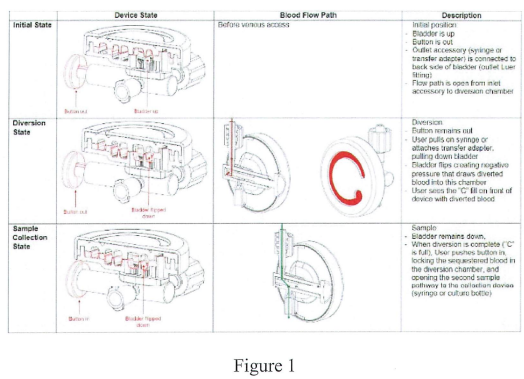
DTX-054.18. The patient is on the inlet side. As the professional pulls back on the syringe, the bladder flips down and negative pressure draws an initial sample of blood into the C-shaped chamber, shown above in red in Figure 1. DTX-054.18; 12.8 Tr. 268:11-13. Once the initial sample of blood has filled the C-shaped chamber, the professional pushes the button on the side of the Micro in, locking the initial sample of blood in the C-shaped chamber and opening a second pathway for the blood to flow into the syringe or culture bottle through the sampling channel shown in green in Figure 1. DTX-054.18; 12.8 Tr. 268:14-16; see also 12.10.25 Trial Tr. (docketed as D.I. 449) 786:21-25.
The parties dispute whether the Micro contains “a chamber … configured to collect a first portion of the blood sample when under a drawing force applied from the outlet port” (the chamber limitation) and “a housing that defines the inlet port, the sampling channel, and the outlet port” (the housing limitation). See #052 patent at claim 1 (21:59-61, 21:66-67) (emphasis added). I did not construe any terms in the chamber limitation, but I instructed the jury that the term “a housing that defines” means “a casing that fixes or marks the limits of.” 12.15.25 Trial Tr. (docketed as D.I. 452) 1887:9-13 (jury instruction).
1. The Chamber Limitation
Kurin argues that Magnolia consultant Shan Gaw admitted that the Micro practices the chamber limitation, and that Magnolia's own marketing video (PTX-124) and internal checklist for the Micro (PTX-076.32) also prove infringement. D.I. 460 at 2-3. But whether Kurin could prove infringement with that evidence is irrelevant. The relevant question is whether there was sufficient evidence to permit a reasonable jury to find that Kurin failed to prove infringement by a preponderance of the evidence. There was.
Magnolia argued that the bladder—not the outlet—of the Micro applies the relevant drawing force and thus that the Micro does not infringe. A Magnolia internal document describing how the Micro works states that the “[b]ladder flips creating negative pressure that draws diverted blood into this chamber.” DTX-054.18. And Magnolia's technical expert Professor Carl Meinhart testified: “So the vacuum [i.e., the syringe] flips the bladder, and it's the bladder that creates the drawing force that pulls in the blood sample.” 12.12.25 Trial Tr. (docketed as D.I. 451) 1597:21-23. Moreover, Gaw testified: “And that bladder then flips, and when that flips, it creates a small pocket of air on the other side. It's that pocket of air and the displacement of that volume of air that then starts to draw blood into the product.” 12.12 Tr. 1447:4-8. This evidence permitted the jury to find that the bladder—not the outlet—applies the drawing force.
Kurin argues that Magnolia, by suggesting that the bladder applies the drawing force, improperly imported a direct-causation requirement into the claims. D.I. 460 at 4-5. But “[w]hen a claim limitation, like the one at issue here, is not expressly construed, a jury is entitled to give that limitation any reasonable meaning in determining, as a factual matter, what comes within its scope.” Akamai Techs., Inc. v. MediaPointe, Inc., 159 F.4th 1370, 1380 (Fed. Cir. 2025) (emphasis in the original); see also VLSI Tech. LLC v. Intel Corp., 87 F.4th 1332, 1341 (Fed. Cir. 2023) (“When a claim phrase is not construed, [the Court] defer[s] to the jury's view of the claim element unless that view is contrary to the only reasonable view of the claim element.”). And, here, the chamber limitation can reasonably be understood to mean that the force must come from the outlet, not from other components that may be connected to the outlet, such as the bladder.
To the extent the jury understood the chamber limitation to require direct causation, i.e., that the outlet directly applies the drawing force, Kurin does not provide evidence that that interpretation was unreasonable. And it is Kurin's burden to show “not only that there is sufficient evidence to support the finding [it seeks] … but additionally that there is insufficient evidence for permitting any different finding.” See Fireman's Fund Ins., 540 F.2d at 1177. Moreover, Gaw, Meinhart, and Magnolia co-founder Greg Bullington all testified that the bladder regulates the drawing force to ensure the pressure is gentle and the patient's vein does not collapse. See 12.12 Tr. 1449:5-16, 1598:1-14; 12.8 Tr. 269:6-15. The jury could interpret this testimony to mean that the bladder applies the relevant drawing force and that the outlet neither directly nor indirectly does so. It could thus conclude that the Micro does not meet the chamber limitation under either party's understanding of the plain and ordinary meaning.
2. The Housing Limitation
Next, Kurin argues that Gaw “outright admitted infringement” with respect to the housing limitation. D.I. 460 at 5-6 (citing 12.12 Tr. 1501:16-20, 1502:6-14). In support of its argument, it cites the following testimony by Gaw:
Q. Sir, the sampling channel is surrounded by this white back housing at all times, correct, sir? It's surrounded by the housing at all times, correct, sir?
A. This — it plays a role in this — yes.
Q. And the outer limits of where that sampling channel is are all, in this picture we're looking at, inside of the housing, correct?
A. Only with the presence of a button.
Q. Now, if you delivered the device in a way it's not intended to be used, then the sampling channel wouldn't be entirely within the housing. That's your testimony, if you left the button out?
A. The button is required to make up the sampling channel.
Q. And the housing, sir, defines the inlet port and the outlet port and marks the limits of the outer boundaries of the sampling channel, true?
A. I think putting a clarifier it's the outer boundaries, it's fair.
Q. If I wanted to know where is the sampling channel in its broadest, biggest day, when it runs through the Steripath Micro, it is always inside the housing, agreed?
A. Agreed.
12.12 Tr. 1501:16-1502:14 (Gaw). But it is undisputed that the button is not part of the housing. See 12.12 Tr. 1601:16-17 (“[T]he button is definitely not part of the housing.”) (Magnolia's expert); 12.11.25 Trial Tr. (docketed as D.I. 450) 1296:7-9 (“Q. Okay. Your opinion is that the button of the Steripath Micro is not part of the housing, correct? A. That is correct.”) (Kurin's expert). A reasonable jury thus could have interpreted Gaw's testimony to be that pressing the button creates the sampling channel and that because the button is not part of the housing, the housing does not define the sampling channel.
Kurin further argues that Magnolia's expert “Meinhart did not even apply the construction the jury was provided when opining on non-infringement.” D.I. 460 at 7. “[A] housing that defines” means “a casing that fixes or marks the limits of.” 12.15 Tr. 1887:9-13 (jury instruction). And Meinhart testified: “We've agreed upon a definition. The term ‘a housing that defines,’ and our agreed definition is ‘a casing that fixes or marks the limits of.’” 12.12 Tr. 1600:8-10. That Meinhart, like every other witness in this case, also used other words to explain orally at trial why the Micro does not meet the limitation does not mean he did not apply the correct construction, especially where, as here, he explicitly stated the correct construction to be applied.
Finally, Kurin argues that the button's role in facilitating blood flow through the Micro is irrelevant because the sampling channel “always ‘exists,’” reasoning that “[i]t is simply blocked by the button in one state, and open in another.” D.I. 460 at 7-8. But here, too, the jury was free to apply any reasonable interpretation of “sampling channel” because I did not construe the limitation. See Akamai Techs., 159 F.4th at 1380. And the jury could reasonably conclude, based on Gaw's testimony, that the sampling channel does not exist until the Micro's button is pressed. See 12.12 Tr. 1502:4-5 (“The button is required to make up the sampling channel.”).
In sum, Magnolia presented sufficient evidence for the jury to conclude that the Micro does not meet the chamber and housing limitations of the #052 patent. “[V]iewing the evidence in the light most favorable to [Magnolia] and giving it the advantage of every fair and reasonable inference,” I do not find that “there is insufficient evidence from which a jury reasonably could find” noninfringement of the #052 patent. See Lightning Lube, 4 F.3d at 1166. I will therefore deny Kurin's motion insofar as it seeks a judgment of infringement of the #052 patent as a matter of law.
B. Judgment of Noninfringement of the Magnolia Patents as a Matter of Law
Kurin argues that “Magnolia presented legally insufficient evidence that”: (1) the Jet contains a “moveable plug configured to move … in response to an increase in a pressure differential between the moveable plug and the outlet” (the pressure differential limitation); [1] (2) the Jet is “temporarily locked in the second position” (the temporarily locked limitation); and (3) Kurin induces infringement of claims 12 and 13 of the #081 patent. D.I. 460 at 8-9; e.g., #081 patent at claims 11 (73:54-57), 18 (74:28-29). I will address each in turn.
The Jet is a “fully automatic” blood-collection device. 12.10 Tr. 786:15-17. To use the Jet, a health care professional attaches a vacuum source such as a syringe or blood culture bottle to the outlet side of the device. 12.9.25 Trial Tr. (docketed as D.I. 448) 480:14-481:1. The patient is on the inlet side of the device. See 12.9 Tr. 479:11-23. Blood then begins to flow into the containment channel because of the pressure differential between the vacuum on the outlet side and the patient's blood pressure on the inlet side. 12.9 Tr. 480:3-8. Once the containment channel is full, pressure begins to build in the device such that the stopper separating the containment channel from the sampling channel pops out of its original position, opening a path to the sampling channel and allowing blood to flow to the syringe or blood culture bottle. 12.9 Tr. 482:4-184:4.
1. The Pressure Differential Limitation
The parties vigorously dispute the pressure differential limitation. The parties agree that the limitation requires taking the difference in pressures at two locations but disagree over where on the accused device those locations should be. See D.I. 390 at 4 (citing D.I. 280 at 1; D.I. 307 at 2). Kurin originally asked me to construe the term to mean the “pressure differential … in the space that separates the [moveable plug/valve] and the outlet” (i.e., in the sampling channel), and Magnolia originally asked me not to construe the term). and give the term its plain and ordinary meaning. See D.I. 279 at 1 (omission and alteration in the original). After reviewing the parties' briefing and hearing oral argument at the pretrial conference, I concluded that the parties' dispute did not concern the scope of the claims but the application of the claims to the accused device and thus decided not to construe the term. Specifically, I stated:
I'm not construing it. I'm giving [the term] its plain and ordinary meaning. But the plain and ordinary meaning is “the difference between pressure at the movable plug valve and the pressure at the outlet.” All right? I am open to the possibility that during the trial, it may be that we are asked to revisit it, and I will have to address it then.
11.13.25 Hr'g Tr. (docketed as D.I. 381) 59:9-15. After hearing additional argument about the term during trial (outside the presence of the jury), I asked the parties whether they wanted me to construe the term. See 12.11 Tr. 1333:7-18. At this point, both Magnolia and Kurin changed their respective positions.
THE COURT: … Is it plain and ordinary meaning or do you want me to constru[e] it?
[MAGNOLIA'S COUNSEL]: Construe the terms, Your Honor.
THE COURT: You think I need to construe the term? [MAGNOLIA'S COUNSEL]: Yes, Your Honor.
THE COURT: All right. Your position[,] [Kurin]? Since you thought I needed to construe it in the first place, is that still your position?
[KURIN'S COUNSEL]: Our position is not, it's plain and ordinary meaning at this point, Your Honor.
12.11 Tr. 1333:5-18. I ultimately decided not to construe the term. See 12.15 Tr. 1886:24-1888:1 (jury instruction on claim constructions). Magnolia argued to the jury that the relevant pressure differential is between the locations labeled 5 and 9 in Figure 2 (depicting the Jet) below, and Kurin argued that the relevant pressure differential is between the locations labeled 7 and 9. See, e.g., 12.15 Tr. 1791:17-1792:20, 1835:13-1837:22.
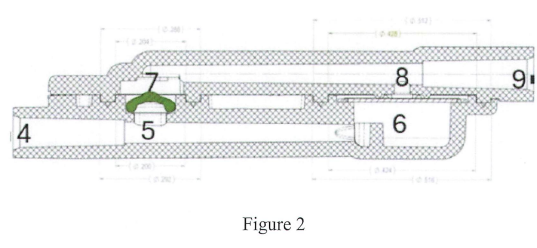
DDX-004.3 (annotating DTX-093.2).
Kurin now argues that there is insufficient evidence to support the jury's finding of infringement because Magnolia's “infringement theory rest[ed] on measuring the differential between 5 and 9” but the plain and ordinary meaning of the term requires the differential be between the locations labeled 7 and 9 in Figure 2. See D.I. 460 at 10. I expressed serious doubt at the pretrial conference that the plain and ordinary meaning, as applied to the Jet, would enable the jury to rely on a pressure differential between 5 and 9 to find infringement. See, e.g., 11.13 Tr. 45:13-18. Having now had the benefit of additional argument and expert testimony, I conclude that the jury was free to rely on a measurement between 5 and 9 within the plain and ordinary meaning of the pressure differential term.
First, for the reasons I explained at the pretrial conference and in the November 17, 2025 Order, the plain and ordinary meaning of the term is the “difference … between a pressure at the [moveable plug/outlet] and a pressure at the outlet.” See D.I. 390 at 1 (omission and alteration in the original). The jury was thus free to conclude that the location labeled 5 in Figure 2 is “at the moveable plug” in the Jet. Meinhart testified how he “measure[d] the pressure at the valve,” i.e., at the location labeled 5 in Figure 2, 12.9 Tr. 558:22-559:9, and showed the jury videos demonstrating how the pressure at 5 builds until the plug pops open, at which point the pressure begins to decrease, 12.9 Tr. 526:21-531:14; PTX-220 (normal-speed video); PTX-221 (high-speed video).
Meinhart also testified that the bottom of the Jet plug (depicted in green in Figure 2) is “within the sampling channel,” and the jury was free to accept that testimony. See 12.9 Tr. 632:16-633:3; see also 12.9 Tr. 541:19-542:3, 551:17-552:1. Thus, even under Kurin's understanding of the plain and ordinary meaning, the jury could conclude that the Jet meets the limitation.
Kurin further argues that even assuming the jury was free to rely on a pressure differential between 5 and 9 in the Jet to find infringement, Magnolia failed to adduce evidence of a pressure differential between those two locations sufficient to move the plug. It argues that Meinhart conflated the two pressure differentials recited in the claims (i.e., the pressure differential between the inlet and the outlet and the pressure differential between the movable plug and the outlet) by relying on the same measurement for both. D.I. 460 at 11-12. Meinhart explained, however, why it was appropriate to use the pressure at the inlet labeled 3 in Figure 3 below to infer the pressure at the bottom of the plug labeled 5.
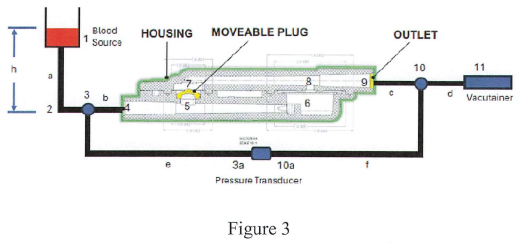
PDX-002.39 (annotating PTX-160.2). Meinhart explained that he used a pressure transducer to measure the pressure at 3a because “if [one] detect[s] the pressure at 3a [and there] is no net flow, that's the same as a pressure at 3. And if there is no net flow between 3 and 4, it is the same as the pressure at 4. And if there's no net flow between 4 and 5, those pressures are the same.” 12.9 Tr. 525:8-526:7. He then used normal-and high-speed videos to show how the pressure changes in the Jet as blood begins to flow into the device and used a pressure graph to depict how the pressure differential changes over time in the device. See 12.9 Tr. 526:21-531:8; see also PTX-220 (normal-speed video); PTX-221 (high-speed video); PDX-002.42-44 (slides containing the videos and graph). “[V]iewing the evidence in the light most favorable to [Magnolia] and giving it the advantage of every fair and reasonable inference,” this evidence was sufficient for a reasonable jury to conclude that the Jet meets the pressure differential limitation. See Lightning Lube, 4 F.3d at 1166.
2. The Temporarily Locked Limitation
Kurin argues that “Magnolia failed to put forward sufficient evidence from which a reasonable jury could find the Jet's plug is ‘temporarily locked’ under any plausible plain-and-ordinary meaning.” D.I. 460 at 13. The temporarily locked limitation appears in claim 18 of the #081 patent and claim 28 of the #863 patent.
Here, too, Kurin's argument is merely an attempt to relitigate a losing claim construction position. At the July 10, 2025 claim construction hearing, I ruled: “For the ‘temporarily locked’ term, I agree with Magnolia, it should be afforded its plain and ordinary meaning.” 7.10.25 Hr'g Tr. (docketed as D.I. 240) 273:21-23. Magnolia had taken the position that the term should be given its plain and ordinary meaning, and Kurin had proposed a construction of “[t]emporarily substantially prevented from being moved.” D.I. 125 at 58. Having lost on that issue at claim construction, Kurin cannot now take a second bite at the apple.
Meinhart testified at trial to his understanding of the plain and ordinary meaning:
Temporarily locked is when something is put in a position and it stays there for a period of time. That's what I mean by temporarily locked. A good example is the faucet, right? So you can take the faucet in your house, turn it on, and it can lock on it. It can be moved in a position where it's on and it continues to flow. That's one simple example of temporarily locked.
12.9 Tr. 543:19-25 (Meinhart). And he applied that understanding to the Jet using the high-speed video. 12.9 Tr. 544:1-16.
This is the high-speed video. You can see [the plug] move. Right? So you see it move from the first position to the second position, the plug, movable plug, and then it stays there. So it doesn't, like, float into the sampling channel and flow down and move out into the collection bottle. It just goes to the second position and remains in that second position. And this is Exhibit PTX-221.
12.9 Tr. 544:2-8 (Meinhart) (citing PTX-221). The jury was free to conclude from this evidence that the Jet meets the temporarily locked limitation.
Kurin argues that Meinhart's understanding of the term's plain and ordinary meaning is “absurdly broad” because it does not require that an object is “actually locked.” D.I. 460 at 14. But Kurin fails to provide any evidence in support of its argument. Its failure is likely because its own expert Dr. Erik Antonsson agreed “that the plain and ordinary meaning of ‘temporarily locked’ in these claims is … ‘temporarily maintained in a desired position, state, arrangement, and/or configuration, which does not require action/prevention by a locking member:’” See 12.11 Tr. 1223:25-1224:6.
Kurin's only response is that Dr. Antonsson's statement was claim construction testimony that Magnolia improperly elicited. D.I. 460 at 14; D.I. 487 at 7. It is well established, however, that a party may introduce at trial evidence of a term's plain and ordinary meaning and may cross examine another party's expert witness on his understanding of the term. See Avid Tech., Inc. v. Harmonic Inc., 2014 WL 7206301, at *4 (D. Del. Dec. 17, 2014) (“It was not improper for [Defendant] to offer its view of the plain and ordinary meaning to the jury.”); see also id. (“[Plaintiff] could have challenged [Defendant's expert's] interpretation of the plain and ordinary meaning of [the term] on cross-examination, as is the usual practice.”); TQ Delta, LLC v. ADTRAN, Inc., 2019 WL 5626638, at *1 (D. Del. Oct. 31, 2019) (“When a court does not construe a term or orders that the ordinary meaning applies, expert testimony on the understanding of a skilled artisan is appropriate to assist the jury.”); Apple, Inc. v. Samsung Elecs. Co., 2014 WL 660857, at *3 (N.D. Cal. Feb. 20, 2014) (“At trial, parties may introduce evidence as to the plain and ordinary meaning of terms not construed by the Court to one skilled in the art[.]”) (internal quotation marks, brackets, and citation omitted). The evidence Magnolia offered in support of its contention that the Jet meets the temporarily locked limitation was thus proper and sufficient to support the jury's verdict.
3. Induced Infringement
Finally, Kurin argues that Magnolia failed to prove that Kurin knew Jet users infringed claims 12 and 13 of the #081 patent and thus no reasonable jury could find that Kurin induces infringement of the #081 patent. D.I. 460 at 15. “[I]nduced infringement … requires [among other things] knowledge that the induced acts constitute patent infringement.” Global-Tech Appliances, Inc. v. SEB S.A., 563 U.S. 754, 766 (2011).
Bob Rogers, Kurin's chief executive officer, testified, however, that the #081 patent “suggests Jet.” 12.9 Tr. 468:10-16.
Q. Why do you say that it looks like this [#]081 patent is attempting to cover the Jet?
A. I just look at the claims.
Q. Doesn't that suggest to you that the Jet infringes the [#]081 patent?
A. The third element is a movable plug disposed in the housing. Yes, that suggests Jet.
Q. So it's your understanding, again, as a layperson but as CEO of Kurin, that this [#]081 patent covers the Jet?
A. I disagree. I think it's trying to patent something that already existed.
Q. But looking at this patent today, in this deposition, under oath, your first reaction was it covers the Jet, right?
A. Yeah. My reaction was that it looks like it's trying to cover something that's already publicly available.
Q. That's the Kurin Jet?
A. Right.
Q. The Kurin Jet uses a movable plug?
A. Yes.
12.9 Tr. 468:10-469:4 (Rogers). The jury could reasonably infer from this testimony that Kurin knew that individuals using the Jet infringe the #081 patent. Whether the jury could have interpreted Rogers's testimony differently is irrelevant. Viewing Rogers's testimony in the light most favorable to Magnolia and drawing all reasonable inferences in favor of Magnolia, there is sufficient evidence from which a jury could conclude that Kurin knew that individuals using the Jet infringe the #081 patent.
C. Judgment of Invalidity of the Magnolia Patents as a Matter of Law
Kurin next argues that the “clear and convincing evidence confirms” the Magnolia patents are invalid for anticipation, obviousness, and lack of adequate written description. D.I. 460 at 16, 31 (capitalization removed). But again, that is not the relevant inquiry. The question is not whether a jury could find for Kurin on invalidity by clear and convincing evidence, it is whether “there is insufficient evidence for permitting any different finding.” See Fireman's Fund Ins., 540 F.2d at 1177. “Because the burden rests with the alleged infringer to present clear and convincing evidence supporting a finding of invalidity, granting judgment as a matter of law for the party carrying the burden of proof is generally ‘reserved for extreme cases,’ such as when the opposing party's witness makes a key admission.” Core Wireless Licensing S.A.R.L. v. LG Elecs., Inc., 880 F.3d 1356, 1364 (Fed. Cir. 2018).
1. Anticipation and Obviousness
At trial, Kurin advanced two anticipation and obviousness theories: First, it argued that Figure 24 of U.S. Patent Application No. 2018/0177445 (Rogers #445) anticipates or renders obvious in connection with other prior art all the asserted claims of the Magnolia patents. Second, it argued that another of its products, the Kurin Lock (the Lock), renders obvious all the asserted claims of the Magnolia patents in light of Figure 23 of U.S. Patent No. 9,820,682 (Rogers #682). Magnolia disputed each theory on the same three grounds, arguing that the prior art does not disclose (1) a moveable plug or valve; (2) a pressure differential between the moveable plug or valve and the outlet; and (3) that the movable plug is formed of elastomeric material.
An asserted patent claim is invalid as anticipated if the accused infringer presents “clear and convincing evidence that a single prior art reference discloses, either expressly or inherently, each limitation of the claim.” In re Cruciferous Sprout Litig., 301 F.3d 1343, 1349 (Fed. Cir. 2002).
An asserted patent claim is invalid as obvious “if the differences between the claimed invention and the prior art are such that the claimed invention as a whole would have been obvious before the effective filing date of the claimed invention to a person having ordinary skill in the art to which the claimed invention pertains.” 35 U.S.C. §103. Obviousness is assessed based on the perspective of an artisan of ordinary skill at the time of the invention. Unigene Labs., Inc. v. Apotex, Inc., 655 F.3d 1352, 1360 (Fed. Cir. 2011). The ultimate question is “whether there was an apparent reason [for an artisan of ordinary skill] to combine [at the time of the invention] the known elements in the fashion claimed by the patent at issue.” KSR Int'l Co. v. Teleflex Inc., 550 U.S. 398, 418 (2007). A claim is obvious if an artisan of ordinary skill “would have had reason to combine the teaching of the prior art references to achieve the claimed invention, and … would have had a reasonable expectation of success [in] doing so.” In re Cyclobenzaprine Hydrochloride Extended-Release Capsule Pat. Litig., 676 F.3d 1063, 1068-69 (Fed. Cir. 2012).
a. Rogers #445
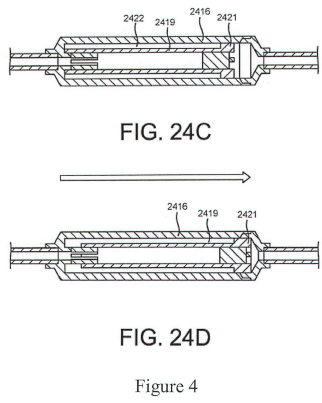
Rogers #445 is a Kurin patent application directed toward a blood-collection device that reduces skin contaminants in blood samples. See DTX-007.1, 12.11 Tr. 1113:1-5. Figure 24 of Rogers #445 is reproduced below as Figure 4.
|
|
DTX-007 at Figs. 24C, 24D.
1) Moveable Plug
Kurin argues that the “inner chamber housing 2419” shown in Figures 24C and 24D in Figure 4 above discloses a moveable plug. D.I. 460 at 17-18. Meinhart testified at trial, however, that the inner chamber housing 2419 is not a plug.
A…. I don't think Rogers [#]445 discloses — it does not disclose a movable plug. Dr. Antonsson was calling [the inner chamber housing 2419] a movable plug, and the movable plug would move from a first position to a second position.
Q. And why do you disagree that the … inner chamber housing 2419 is not a movable plug?
A. Yeah, it just can't be. Dr. Antonsson, in his own words, said that when it's in the first position, this body is covering the slots, keeping blood from flowing out radially, right? So out this way and out this way. Now, a plug doesn't cover something. A plug plugs a hole. A plug inserts into something. A good analogy is — in daily life is — I think this analogy was used before, that you could put ear plugs in your ears, right, plug your ears. They go inside. But if you're covering your ears with earmuffs, they're just covered, right? So earmuffs are not ear plugs; ear plugs are not earmuffs. They are fundamentally different. So this is fundamentally not a plug.
12.12 Tr. 1572:1-21 (Meinhart). In support of his testimony, Meinhart cited the written description of Rogers #445 and noted that nowhere in Rogers #445 is the inner chamber housing depicted in Figure 24 called a plug. See 12.12 Tr. 1572:22—1573:2. The jury was free to accept this testimony and conclude that Figure 24 does not disclose a plug.
Kurin further argues that Meinhart's testimony was “inconsistent with how he applied the ‘moveable plug’ term for infringement.” D.I. 460 at 19. In support of this argument, Kurin cites Meinhart's testimony that the stopper in the Jet functions as both a plug and a valve. D.I. 460 at 19 (citing 12.9 Tr. 522:17-20, 557:15-18). But it is unclear why Meinhart's testimony about a different component in a different device contradicts his testimony about Figure 24.
2) Pressure Differential Between the Moveable Plug and the Outlet
Kurin next argues that “there is no question” that Figure 24 discloses the pressure differential limitation. D.I. 460 at 20. But for the reasons described above, the jury was free to conclude that Figure 24 lacks a moveable plug, and thus also lacks a pressure differential between the moveable plug and the outlet. Moreover, Meinhart testified that physics and the written description of Rogers #445 teach that it is actually a pressure differential between the blood barrier and the outlet that causes the device to move.
A. My analysis is that there's a pressure differential between the — between the barrier, this blood barrier, and the outlet that forces it in that direction. Because force is — pressure can only create a force that's normal to a surface. Not tangential, just normal. So pressure, as Dr. Antonsson pointed out, can push up, and it can push down here because it's normal to this member and this member. But the blood barrier, the pressure exerts a normal force, and that's the only horizontal force that can be exerted. So it has — based on physics, it has to be a pressure differential … between the barrier and the outlet. That's the only pressure differential that can move this object.
Q. Based on your analysis, what was your conclusion as to whether or not Rogers [#]445 discloses the pressure differential between the movable plug/valve and the outlet?
A. Based upon my analysis, Rogers [#]445 does not disclose the pressure differential between the movable plug/valve and the outlet.
12.12 Tr. 1570:23-1571:18 (Meinhart).
Kurin suggests that Meinhart tried “to confuse the jury” by focusing this part of his testimony on “force” rather than “pressure,” D.I. 460 at 21, but Rogers #445 itself discusses “force,” including in the parts of the written description that Kurin cites, see, e.g., DDX-004.38 (quoting DTX-007 [0142]) (“The inner chamber housing 2419 and/or housing 2416 can include a locking mechanism … to maintain the inner chamber housing 2419 in the first position until the blood sequestration chamber 2418 is filled, providing force to overcome the locking mechanism[.]”) (emphasis added); D.I. 460 at 20 (citing DTX-007 [0142])
Kurin also suggests that the jury should have relied on the testimony of Kevin Nason, Vice President of Research and Development at Kurin. See D.I. 460 at 21; D.I. 487 at 9. But the jury was free to make its own credibility determinations, and I “may not weigh the evidence, determine the credibility of witnesses, or substitute [my] version of the facts for the jury's version.” Kars 4 Kids, 8 F.4th at 218 n.8. In any event, there was evidence that Nason himself could not “tell exactly how” Figure 24 works. See 12.12 Tr. 1570:2-6; see also PDX-006.19.
3) Elastomeric Material
Finally, Kurin argues that Figure 24 of Rogers #445, either alone or in combination with an artisan of ordinary skill's knowledge as shown in U.S. Patent No. 3,848,579 (Villa-Real), teaches a moveable plug made of elastomeric material. D.I. 460 at 21-22. Again, the jury was free to conclude that Rogers #445 did not teach a moveable plug, let alone a moveable plug made of elastomeric material.
Kurin argues that its expert's testimony was “largely unrebutted,” in part because Magnolia's expert Meinhart opined on Figure 23 of Rogers #445 in combination with Villa-Real, not Figure 24. D.I. 460 at 22-23. Meinhart, however, testified that “[#]445 Rogers does not disclose a plug formed of an elastomeric material,” and thus that Rogers #445 does not anticipate the elastomeric material limitation in the Magnolia patents. See 12.12 Tr. 1574:17-19. Meinhart went on to testify that an artisan of ordinary skill would have no motivation to combine Rogers #445 with Villa-Real because they solve different problems. 12.12 Tr. 1574:17-1575:21. According to Meinhart, Rogers #445 aims to sequester blood to reduce contaminants in a sample of blood, whereas Villa-Real aims to slow the flow of blood during a blood draw to avoid damaging the blood cells. 12.12 Tr. 1574:21-1575:21. And contrary to Kurin's assertion, Meinhart did address Figure 24 of Rogers #445 in combination with Villa-Real and directly rebutted Antonsson's conclusion.
Q. And if I could just return to the previous slide where there's — or previous two slides where there's an image of Figure 24 [in Rogers #445]. How, if at all, would that impact your analysis of whether you could combine Figure 24 and Villa-Real?
A. When you're looking at this figure in Villa-Real, I have no idea how to combine it. I don't know how I could take the valve of Villa-Real and put it in Figure 24.
Q. So if we continue on to Slide 33, what was your conclusion as to whether Rogers [#]445, alone or with Villa-Real, discloses the elastomeric material requirement?
A. Based upon my analysis, [#]445 Rogers, by itself or in combination with Villa-Real, does not disclose a movable plug formed of an elastomeric material.
12.12 Tr. 1576:23-1577:12 (Meinhart). The jury was free to accept this testimony and conclude that Rogers #445 does not anticipate or render obvious, in combination with Villa-Real, the moveable plug made of elastomeric material.
b. The Lock and Rogers #682
Next, Kurin argues that the Lock renders obvious all the asserted claims of the Magnolia patents in light of Figure 23 of Rogers #682. D.I. 460 at 23-25. The Lock is another Kurin product and a passive blood-collection device. It is depicted in Figure 5 below.
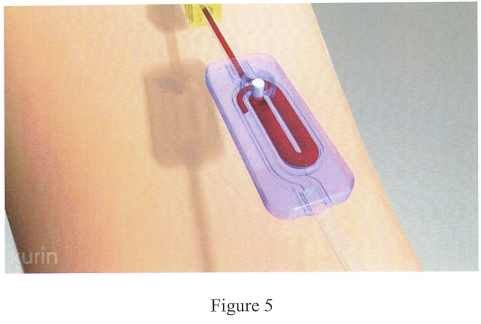
DTX-015 at 00:52. When the needle connected to the inlet side of the Lock is inserted into a patient's vein, blood begins to flow into the U-shaped channel depicted above in red in Figure 5. DTX-015 at 0:14-0:30; 12.10 Tr. 890:5-10. “When in contact with blood, the [white] seal material is activated to lock the channel so that blood cannot exit and air cannot enter, locking the initial blood and contaminants in place.” DTX-015 at 0:34-0:45; see also 12.10 Tr. 893:13-17, 893:25-894:4. Once the U-shaped channel is filled with blood, the blood flowing from the inlet enters the sample channel and eventually comes to rest. See DTX-015 at 0:46-1:01; 12.10 Tr. 894:9-17. At this point, the health care professional must attach a sample collection bottle to the outlet side, causing blood to flow from the inlet through the sample channel to the outlet and into the collection bottle. See DTX-015 at 0:58-1:13; 12.10 Tr. 895:9-896:2.
Rogers #682 is a Kurin patent directed to a blood-collection device to reduce skin contaminants in blood samples. Figure 23 of Rogers #682 is reproduced in Figure 6 below.
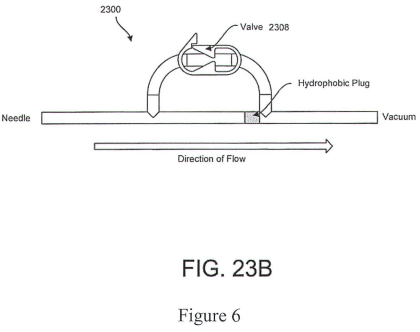
DTX-011 at Fig. 23B.
1) Motivation to Combine
Kurin argues that “[t]he evidence establishes a[n] [artisan of ordinary skill] would have been motivated to modify the Lock in view of Figure 23.” D.I. 460 at 25. Perhaps, but irrelevant. For Kurin to succeed on the instant motion, it must show there is insufficient evidence from which a reasonable jury could find that Kurin did not prove by clear and convincing evidence that the Magnolia patents are invalid over the Lock and Rogers #682. And Nason's testimony that he was, in fact, motivated to modify the Lock in light of Figure 23 of Rogers #682 is not dispositive. See D.I. 460 at 26 (citing 12.10 Tr. 897:25-900:12, 903:25-904:18).
Meinhart testified that “a person of ordinary skill would not combine the Kurin Lock with Rogers [#]682 for a number of reasons.” 12.12 Tr. 1579:17-19. He explained in detail one of these reasons—that the Lock is a passive device and Figure 23 of Rogers #682 is an active device. He began by explaining that the Lock “is a passive device, so blood flows in initially based on venous pressure of the patient that pushes it into the contamination channel.” 12.12 Tr. 1578:20-23. He then explained that Figure 23 is “a blood sample optimization system, and this is an active device, so in order to collect the initial sample of blood, the initial volume, it has to be connected to a vacuum source to draw the blood in to go to the hydrophobic plug.” 12.12 Tr. 1579:2-6. Meinhart concluded based on these observations that “a person of ordinary skill would not combine the Kurin Lock with Rogers [#]682 …. One reason is that the Lock is a passive device for the initial volume. Rogers [#]682 is an active device. So they fundamentally work differently, so that would be very difficult to combine.” 12.12 Tr. 1579:17-22. This testimony is not conclusory, and Kurin does not dispute that the Lock is passive and Figure 23 is active.
2) Moveable Plug
Kurin argues that Meinhart's testimony that neither the Lock nor Figure 23 discloses a moveable plug or valve is “legally insufficient to support the jury's verdict of non-obviousness.” D.I. 460 at 28-29. In support of its argument, Kurin cites Palo Alto Networks, Inc. v. Centripetal Networks, LLC, 122 F.4th 1378 (Fed. Cir. 2024), for the proposition that obviousness opinions that attack the prior art references individually—rather than in combination—”lack merit.” D.I. 460 at 28 (quoting Palo Alto, 122 F.4th at 1385-86). In Palo Alto, however, the Federal Circuit concluded that the Patent Trial and Appeal Board (PTAB) erred because it “look[ed] at the references individually,” i.e., it analyzed whether each reference “alone” met all the limitations of the claim. 122 F.4th at 1386. That is not what Meinhart did here. Meinhart testified that neither reference discloses a moveable plug, meaning that even assuming an artisan of ordinary skill was motivated to combine the two references, the resulting combination would lack a moveable plug because a moveable plug is not disclosed at all, in either reference. Palo Alto is thus unlike this case.
This case is more like Medtronic, Inc. v. Barry, 891 F.3d 1368 (Fed. Cir. 2018). There, the Federal Circuit held that the PTAB “reasonably found that neither reference discloses or suggests a device or system with [the limitation at issue] that performs the … functions as recited by the challenged claims.” Id. at 1378. In light of this finding, and that there were “significant differences” between the prior art references that “undercut” the petitioner's argument that an artisan of ordinary skill would be motivated to combine them, the Federal Circuit concluded that substantial evidence supported the PTAB's determination that the claims were not obvious. Id. at 1377-78. In other words, each limitation must be disclosed somewhere in the prior art for a claim to be obvious.
Meinhart testified that neither the Lock nor Figure 23 discloses a moveable plug. 12.12 Tr. 1580:16-20,1580:25-1581:16. Nason agreed that Figure 23 does not disclose a moveable plug, 12.12 Tr. 1581:24-1582:2; see also PDX-006.47, and Rogers agreed that the Lock does not have a moveable plug, 12.10 Tr. 833:24-834:1. Tellingly, nowhere in Kurin's opening brief does it say, let alone cite evidence, that either the Lock or Rogers #682 discloses a movable plug. That makes sense because the plug does not move in either the Lock or Rogers #682. For the first time in its reply brief, Kurin argues that “[t]he Lock has a moveable, one-way plug/valve,” but none of the evidence it cites says the plug is moveable. D.I. 487 at 13 (citing DTX-019; 12.10 Tr. 896:5-897:17; 12.12 Tr. 1628:10-15); DTX-019 (describing a “transparent” “valve, umbrella” and “plug, hydrophilic self sealing”); 12.10 Tr. 897:3-17 (describing the valve as “an umbrella valve,” “a common valve,” “a one-way valve” and made of “silicone rubber”); 12.12 Tr. 1628:10-15 (discussing “an elastomeric valve”). Again, Rogers agreed that the Lock does not have a moveable plug. 12.10 Tr. 833:24-834:1.
Nason's “modified Lock” prototype does not get Kurin across the finish line. It is undisputed that the modified Lock prototype is not prior art. Although the factfinder “may consider non-prior art evidence … in considering the knowledge, motivations, and expectations of a[n] [artisan of ordinary skill] regarding the prior art,” Yeda Rsrch. v. Mylan Pharms. Inc., 906 F.3d 1031, 1041 (Fed. Cir. 2018), the non—prior art evidence cannot make up for a total lack of disclosure of a limitation in the prior art references. There was insufficient evidence to support a finding that the moveable plug limitation was obvious.
3) Pressure Differential Between the Moveable Plug and the Outlet
Kurin next argues that its expert testified that the pressure differential limitation was obvious and Magnolia's “only response” was “legally insufficient” in light of Palo Alto. D.I. 460 at 29. For the reasons described above, the jury was free to conclude that the moveable plug was not obvious because neither the Lock nor Figure 23 discloses a moveable plug. Because neither reference discloses a moveable plug, neither reference discloses a pressure differential between the moveable plug and the outlet either. Either way, Kurin's own evidence suggests that external, manual forces—not a pressure differential between the plug and the outlet—facilitate blood flow through the Lock and the device depicted in Figure 23. For example, Rogers explained that Figure 23 “required the user to actuate the clamp or a valve or something of that nature to allow the fluid, the clean sample, to go into the vacuum bottle.” 12.10 Tr. 792:9-12. And Kurin's marketing video for the Lock demonstrates that the user must wait for blood to stop flowing in the device before attaching the collection bottle to draw the clean sample. DTX-015 at 0:54-1:12.
Antonsson's testimony to the contrary is conclusory: He twice agreed with his counsel's suggestion that the prior art references would render the limitation obvious by simply saying “yes.” 12.11 Tr. 1158:23-1159:11. When prompted to explain how the combination of the Lock and Rogers #682 met the limitation under Meinhart's understanding of the claim language, Antonsson said:
Dr. Meinhart's view of this claim language is that between — the locations identified for the pressure difference to exist between the movable plug and the outlet include locations that would be, in essence, on the far side of the movable plug, and that is the condition that would be required in order for the modification I described of the Kurin Lock to function.
12.11 Tr. 1159:13-19 (Antonsson). I am unsure what, if anything, a jury could take from this testimony. Most of it simply summarizes Meinhart's understanding of the pressure differential term, which leaves: “that is the condition that would be required in order for the modification I described of the Kurin Lock to function.” See 12.11 Tr. 1159:17-19. This statement is insufficient to support a finding, by clear and convincing evidence, that the Magnolia patents are obvious.
4) Elastomeric Material
Kurin merely rehashes the arguments it made with respect to Rogers #445 and Villa-Real in support of its argument that the Lock and Rogers #682 render obvious an elastomeric plug. See D.I. 460 at 29-30. As I explained above, the jury was free to accept Meinhart's testimony that an artisan of ordinary skill would not be motivated to combine Villa-Real with the Rogers prior art references because they are directed to solving different problems. And, as I also explained above, Palo Alto does not help Kurin here. Meinhart did not testify that all the limitations must be in a single prior art reference; he testified that each of the limitations must be disclosed somewhere in the prior art references. Having concluded that the moveable plug was not, Meinhart was free to conclude that the Magnolia patents were not obvious.
2. Lack of Adequate Written Description
Kurin next argues that no reasonable jury could conclude that the Magnolia patents were not invalid because the written description of the Magnolia patents does not support a moveable plug configured to move in response to a pressure differential. D.I. 460 at 31.
The specification of a patent must “contain a written description of the invention.” 35 U.S.C. §112(a). To satisfy this requirement, a patent's written description must “reasonably convey[] to those skilled in the art that the inventor had possession of the claimed subject matter as of the filing date.” Ariad Pharms., Inc. v. Eli Lilly & Co., 598 F.3d 1336, 1351 (Fed. Cir. 2010). In other words, the patent's specification must “clearly allow persons of ordinary skill in the art to recognize that [the inventor] invented what is claimed.” Id. (alteration in the original) (quoting Vas-Cath Inc. v. Mahurkar, 935 F.2d 1555, 1563 (Fed. Cir. 1991)).
In support of its argument, Kurin notes that “moveable plug” appears nowhere in the written description the Magnolia patents share and “plug” appears only twice. D.I. 460 at 31. Column 66 of the #081 patent, however, repeatedly discusses a “moveable member” and states that “the moveable member can be, for example, an elastomeric plug.” #081 patent at 66:20-30, 66:50-51; see also 12.12 Tr. 1590:20-1591:15. Moreover, the written description discusses “an amount of negative pressure exerted on a surface of the movable member or the like may build until a magnitude of the negative pressure is sufficient to pull or move the movable member out of the opening, thereby allowing a flow of bodily fluid through the opening.” #081 patent at 66:41-45; see also 12.12 Tr. 1590:20-1591:15. Meinhart walked the jury through this portion of the written description and opined that “a person of ordinary skill in the art reading the [written description] at the time that it was filed would have recognized that [it] described the invention as claimed.” 12.12 Tr. 1589:7-10, 1590:20-1591:15.
Kurin next argues that Magnolia's “real-world” evidence that it possessed the concept claimed in the patents is irrelevant because the inquiry is not whether the patentee actually possessed the invention but whether an artisan of ordinary skill would have understood from the disclosure in the written description that the patentee possessed the invention. D.I. 460 at 31-32. True, but Meinhart's testimony about the disclosure in column 66 of the #081 patent is sufficient to support the jury's verdict.
Finally, Kurin argues that column 66 of the #081 patent does not provide sufficient written description support for the claimed invention because it discusses the pressure pulling—not pushing—the plug. D.I. 460 at 33. The written description, however, says that the pressure builds until it is “sufficient to pull or move the movable member out of the opening.” #081 patent at 66:43-44 (emphasis added). And Meinhart testified that the quoted language is “talking about [the movable member] moving in response to a pressure differential that's exerting on a surface.” 12.12 Tr. 1590:20-1591:5 (emphasis added). The jury thus did not need to conclude that the pressure pulls the plug in the claimed invention to find that it was adequately supported.
In any event, Rogers testified that “[i]t's [his] understanding” that “it's … the vacuum source pulling that causes the movable plug in the Jet to move.” 12.9 Tr. 471:3-5. And the jury, having concluded that the Jet infringes the Magnolia patents, could have concluded that the invention described in column 66 works similarly.
Accordingly, I will deny Kurin's motion insofar as it seeks a judgment that the Magnolia patents are invalid as a matter of law.
D. Judgment that Magnolia is Not Entitled to Reasonable Royalty Damages as a Matter of Law
Kurin argues that Magnolia is not entitled to reasonable royalty damages as a matter of law because it “failed to provide the jury with a sufficient factual basis to apportion damages.” D.I. 460 at 38. I disagree.
“[A] reasonable royalty award must be based on the incremental value that the patented invention adds to the end product.” Exmark Mfg. Co. v. Briggs & Stratton Power Prods. Grp., LLC, 879 F.3d 1332, 1348 (Fed. Cir. 2018). “[T]he patent owner must apportion or separate the damages between the patented improvement and the conventional components of the multicomponent product.” Id.
Magnolia's damages expert Brian Napper explicitly apportioned his reasonable royalty calculation down to the cost of the Jet chamber: “[W]e've apportioned down to what that part of the [Jet] is that relates to the accused functionality.” 12.10 Tr. 708:22-24. He explained that “the advantages of [the] patented functionality over old mode[s] or devices” were “lower false positives, lower contamination, and therefore, lower cost to the buyer or hospitals.”
12.10 Tr. 700:9-11, 700:19-23. He continued:
I have been guided by this by Professor Meinhart, as I note here at the bottom of the slide. That the functionality-you heard his testimony on this — rests in what's called the Jet chamber portion of the Kurin Jet and the Jet assembly cost to make that chamber portion. So the materials that go into it and the cost to assemble it. Those would represent the costs to make the functionality related to the asserted patents.
12.10 Tr. 703:18-25 (Napper). When pressed on cross examination about his opinion that the Jet chamber was the inventive aspect, and thus the appropriate unit to apportion to, Napper elaborated.
Q. And it's your opinion that everything that's here in this chamber is tied to the incremental value of the invention, right?
A…. It's Professor Meinhart's observation that that is-that that chamber is where the accused functionality resides and its primary existence is to execute the invention.
Q. Okay. So you don't have an opinion on that? You relied on whatever Professor Meinhart said to use this entire assembly as part of your damages analysis, right?
A. Yes, he directed me to that.
12.10 Tr. 726:11-24 (Napper). Nothing prevents Napper from relying on Meinhart's expertise in forming his opinion—in fact, Kurin agrees that Napper lacks the technical expertise necessary to form an independent opinion on the device's technical functionality. Cf. Fed. R. Evid. 703 (“An expert may base an opinion on facts or data in the case that the expert has been made aware …. If experts in the particular field would reasonably rely on those kinds of facts or data …, they need not be admissible for the opinion to be admitted.”). And Napper appropriately disclosed to the jury what materials he relied on in forming his opinion. See 12.10 Tr. 700:25-701:2 (“I spoke with Mr. Bullington, and Professor Meinhart describing the advantages to me, and then PTX-001, PTX-003, and PTX-005.”); see also 12.10 Tr. 699:25-700:4 (explaining that he relied on “PTX-134, PTX-157, PTX-202, PTX-209, PTX-217, PTX-291, PTX-293, PTX-295, Kevin Nason's deposition transcript, Mr. Bullington, and Professor Meinhart” when comparing the Jet to the Lock, which was not accused of practicing the Magnolia patents).
In its reply, Kurin suggests (for the first time) that Napper's reasonable royalty opinion is no different than that of its own damages expert Carrie Distler, whom I precluded from offering at trial a reasonable royalty opinion on the Magnolia patents for failure to apportion. D.I. 487 at 18-19 (citing D.I. 369 (Memorandum Order granting in part Magnolia's motion to exclude Distler's damages opinions)). Apparently realizing that Napper did, in fact, apportion, Kurin takes issue with some of Napper's word choice—i.e., his testimony that he apportioned down to the Jet chamber because it is “related to,” rather than is, the inventive aspect. D.I. 487 at 18-19 (citing 12.10 Tr. 703:23-25, 708:9-709:1). Napper did use the phrase “related to” on at least two occasions, see 12.10 Tr. 703:23-25, 708:17-709:1, but on at least two occasions he did not, see 12.10 Tr. 703:19-21 (“[T]he functionality — you heard [Meinhart's] testimony on this-rests in what's called the Jet chamber portion of the Kurin Jet[.]”); 12.10 Tr. 726:18-19 (“[T]hat chamber is where the accused functionality resides[.]”). The jury was free to rely on the latter statements to support its damages award. Moreover, Distler's opinion is distinguishable. Distler opined that the stopper in the Jet “relates to” the inventive aspect while explicitly describing the Jet's inventive aspect as something other than the stopper. See D.I. 369 at 7-8 (citing D.I. 259-14 ¶¶189, 193). At trial, Napper consistently identified the Jet chamber as the inventive aspect because, in his view, it is responsible for the incremental benefits and inventive aspects. See, e.g., 12.10 Tr. 703:19-25, 708:9-709:1, 726:17-20. There was thus sufficient evidence to support the jury's reasonable royalty damages award to Magnolia.
E. Motion for a New Trial
For the reasons discussed above with respect to Kurin's motion for judgment as a matter of law, I will not grant Kurin's motion for a new trial. Moreover, because I will not enter judgment as a matter of law or grant a new trial on infringement or invalidity, damages do not need to be reduced or retried in connection with those issues.
Kurin also argues that I “should grant a new trial on Magnolia's patent infringement claims (including Kurin's noninfringement and invalidity defenses) to prevent a miscarriage of justice” because Magnolia “intentionally flouted [my] guidance and the plain-and-ordinary meaning of the” pressure differential term, “culminat[ing] in intentional misdirection at trial, [and] causing significant jury confusion and prejudice to Kurin.” D.I. 460 at 34, 36-37.
As I explained above, the parties hotly contested the pressure differential term. Kurin originally asked me to construe the term, but I decided at the pretrial conference that I would not construe it because the parties' dispute concerned the application—not the scope—of the claims and I thus was not required to construe the term under 02 Micro International Ltd. v. Beyond Innovation Technology Co., 521 F.3d 1351 (Fed. Cir. 2008). See 11.13 Tr. 26:3-7 (“[W]hat we have is a dispute of fact. And it's where on the plug do you take the measurement. And that's a fact. It doesn't go to the scope of the claim. It's a fact-finding thing that should just go to the jury.”); 11.13 Tr. 28:2-7 (“[A]s I understand 02 Micro claim construction is if there's a dispute about the scope of the claim, I have to construe it. But if there's not, and it's just a difference of fact in applying the claim construction, I don't have to construe it, and it goes to the jury.”); see also 02 Micro, 521 F.3d at 1360 (“When the parties raise an actual dispute regarding the proper scope of [the] claims, the court, not the jury, must resolve that dispute.”) (emphasis added).
I made very clear, however, that “I [was] open to the possibility that during the trial, it may be that we are asked to revisit it, and I [would] have to address it then.” 11.13 Tr. 59:13-15. Indeed, the morning of the first day of trial, I stated, again, that “I was leaving open the possibility that … I would have to construe the term” and that “I can always change my mind.” 12.8 Tr. 8:11-15, 9:10. I explained that I had “already telegraphed that I think what I understand [Magnolia] to articulate as the plain and ordinary meaning is the plain and ordinary meaning.” 12.8 Tr. 9:3-5. And that “there's going to be some risk if [Kurin] c[a]me in at trial with something different.” 12.8 Tr. 9:6-7. I thus made very clear what I intended to do; and I did just that. I ultimately stuck with my original decision not to construe the term, but I repeatedly heard the parties on the issue—at side bar, during morning objections, and at the charge conference.
Kurin thus cannot claim that it was prejudiced by my decision not to construe the term before trial. First, as I have explained, the term did not need to be construed. District courts are not required to construe every limitation; courts only have a duty to construe claim limitations when parties present “a fundamental dispute regarding the scope of a claim term.” 02 Micro, 521 F.3d at 1362. Indeed, the Federal Circuit has held “[t]here is not necessarily an 02 Micro issue … whenever further claim construction could resolve the parties' dispute.” LifeNet Health v. LifeCell Corp., 837 F.3d 1316, 1322 (Fed. Cir. 2016). “For example, courts should not resolve questions that do not go to claim scope, but instead go to infringement[.]” Eon Corp. IP Holdings v. Silver Spring Networks, 815 F.3d 1314, 1319 (Fed. Cir. 2016). That was the case here. As I explained in the November 17 Order:
The parties agree that a pressure differential is “a difference between pressures at two locations or components,” D.I. 280 at 1; D.I. 307 at 2, and that “a pressure differential [is] assessed by comparing pressures at the two locations or components identified immediately after the word between,” D.I. 280 at 6-7; D.I. 307 at 2 (alteration in original). That agreement should have ended the matter because it gives the plain and ordinary meaning to all the claim language at issue.
D.I. 390 at 4 (alteration in the original). Where, on the accused device, the plug is—and relatedly, where an artisan of ordinary skill would measure a pressure at the plug goes to how to apply the claims to Kurin's product, a question of fact for the jury.
Second, if I had construed the term, I made clear that I would not have adopted Kurin's proposed meaning. As I wrote in the November 17 Order: “[T]43 the extent the parties believe a dispute remains, the written description counsels against adopting Kurin's proposed construction—i.e., ‘pressure differential … in the space that separates the [moveable plug/valve] and the outlet.’” D.I. 390 at 4 (omission and alteration in the original). Kurin thus would have arguably been worse off if I had construed the term.
Third, as I explained above, I repeatedly told the parties what my intentions were. They were on full notice—beginning a month before trial in mid-November 2025 and in practically real time moving forward—of where my thinking was on the issue and whether and when I planned to construe the term. Kurin thus had ample time to adjust its trial strategy to take my decision into account.
Moreover, to the extent Kurin argues that I should have construed the term after the close of evidence and before sending the case to the jury, Kurin waived that argument. On the fourth day of trial, I explicitly asked each party what its position was on whether I should construe the term, and Kurin's counsel replied that it had changed its position, it did not want me to construe the term, and that “it's [the] plain and ordinary meaning at this point.” 12.11 Tr. 1333:7-18.
Kurin further argues that Magnolia improperly engaged in claim construction with the jury. D.I. 460 at 36-37. Kurin is correct that “[a]llowing the experts to make arguments to the jury about claim scope [is] erroneous.” NobelBiz, Inc. v. Global Connect, L.L.C., 701 F. App'x 994, 997 (Fed. Cir. 2017). Parties can, however, adduce evidence of their view of the plain and ordinary meaning, including by cross examination of the opposing party's expert witness. See Avid Tech., 2014 WL 7206301, at *4. To be sure, there is a fine line between offering a view of the plain and ordinary meaning and arguing claim construction to the jury. And it is not always clear where, exactly, that line is.
As I explained above, much of the testimony Kurin complains of was permissible because the expert was simply offering his understanding of the plain and ordinary meaning of the term. For example, Magnolia's counsel asked Antonsson on cross examination, “You say — as you understand the plain and ordinary meaning of the terms, your understanding is that you have to measure the pressure at the top of the plug, right?” 12.11 Tr. 1234:9-12. And Antonsson responded: “Between the plug and the outlet, yes.” 12.11 Tr. 1234:13. Later, the exchange continued:
Q. Sir, you're talking about the space between, the space that begins at the top of this plug and ends at the outlet, the space between them. That's how you understand the plain and ordinary meaning, right?
A. Yes, it is.
Q. And you relied on that plain and ordinary meaning, that understanding of the plain and ordinary meaning in forming your opinions in this case?
A. Yes.
12.11 Tr. 1234:25-1235:8 (Antonsson). “When a court does not construe a term or orders that the ordinary meaning applies, expert testimony on the understanding of a skilled artisan is appropriate to assist the jury.” TQ Delta, 2019 WL 5626638, at *1. This testimony was not improper.
To the extent some testimony did cross the line into claim construction, it was invited and harmless error. Kurin, for example, offered videotaped deposition testimony of Bullington, in which its counsel asked Bullington several questions about the pressure differential term—what it means, how pressure differentials work, whether the pressure differential causes the plug in the device to move, and where the sampling channel is. See 12.11 Tr. 1078:7-1081:16. Kurin's counsel explained the next day at sidebar that he had “asked [Bullington] if he understood the claims of his own patent” and that the testimony was “absolutely relevant to validity.” 12.12 Tr. 1462:7-18. Kurin thus cannot complain that Magnolia did the same, when its counsel asked Gaw, a named inventor like Bullington on the Magnolia patents, how he understood the same claim language. See 12.12 Tr. 1461:2-23, 1463:1 6, 1463:15-1464:4. Indeed, as I explained at sidebar, I overruled Kurin's objection to Gaw's testimony “because I [thought] it's relevant for the same reasons I allowed the Bullington testimony in.” 12.12 Tr. 1463:4-6. Antonsson, too, offered his “reading” of the claims on his direct examination, testifying: “the claim language says that the pressure is to be between the movable plug and the outlet, and to my reading, a plain and ordinary reading, that would be in the … sample channel, in this region.” 12.11 Tr. 1094:19-23. Kurin, of course, did not object to this testimony by its own expert. Nor did Kurin object to some of the testimony Magnolia elicited about which it now complains. See, e.g., 12.9 Tr. 524:9-525:7, 560:8-20.
In sum, the verdict is not contrary to the evidence for the reasons described above. Nor is the verdict likely the product of confusion. The jury heard from both parties' experts on their understandings of the plain and ordinary meaning of the pressure differential term and was free to reach the verdict it did based on its determinations of the credibility of the witnesses, the evidence each witness brought in support of his opinions, and its own common sense. Nor is the verdict a miscarriage of justice. Kurin was on notice of how I intended to address the dispute over the pressure differential term and had numerous opportunities to adjust its strategy, object, and/or ask me again to construe the term. Instead, Kurin ultimately asked me not to construe the term Kurin does not get a second bite at the apple merely because it lost at trial and regrets its choice. Accordingly, I will deny Kurin's motion for a new trial.
The Court will issue an Order consistent with this Memorandum Opinion.