

Patent Cases, NEONODE SMARTPHONE LLC, Plaintiff, v. APPLE INC, Defendant., U.S. District Court, N.D. California, (Jun. 8, 2026)
NEONODE SMARTPHONE LLC, Plaintiff, v. APPLE INC, Defendant.
U.S. District Court, N.D. California. Case No. 21-cv-08872-EMC, Docket No. 183. June 8, 2026.
Before Edward M. Chen, District Judges
Edward M. Chen, District Judge
ORDER GRANTING EARLY SUMMARY JUDGMENT MOTION
This is a patent infringement action brought by Plaintiff Neonode Smartphone LLC against Defendant Apple Inc. Neonode owns United States Patent No. 8,095,879 (the “’879 Patent”), issued January 10, 2012. Neonode alleges that Apple's iPhones infringe this patent, which concerns, inter alia, the activation of functions on a touch-sensitive screen with a gliding motion. Apple moves for early summary judgment, contending that the ′879 Patent's Claim 1 is invalid for lack of written description.
For the reasons stated below, Apple's motion is GRANTED.
I. BACKGROUND
A. The ′879 Patent
The ′879 Patent “relates to a user interface for a mobile handheld computer unit, which computer unit comprises a touch sensitive area, which is divided into a menu area and a display area (3). The computer unit is adapted to run several applications simultaneously and to present an active application on top of any other application on the display area (3).” ′879 Patent, 1:6-13. “[T]he menu area 2 is adapted to present a representation of a first 21, second 22, and a third 23 predefined function. The first function 21 is a general application dependent function, the second function 22 is a keyboard function, and the third function 23 is a task and file manager.” Id. At 4:1-6. “[A]ny one of those three functions 21, 22, 23 can be activated when the touch sensitive area 1 detects a movement of an object 4 with its starting point A within the representation of the function on the menu area 2 and with a direction B from the menu area 2 to the display area 3.” Id. at 2:11-14.
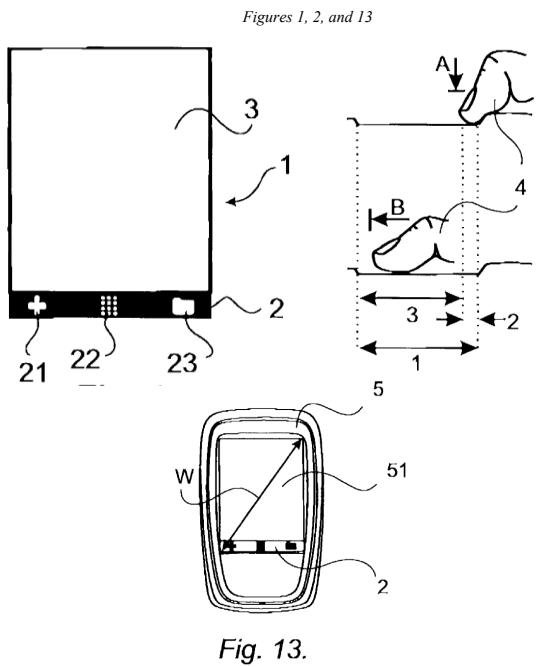
In other words, the patent describes a hand-held computer unit with a touch screen. The touch screen contains a menu area that contains “representations of functions,” e.g., icons that stand for a particular application. A user may activate these applications by touching the icon with an object — a finger, stylus, etc. — and gliding away. In one preferred embodiment, pictured in Figure 13, “the unit is covered with an enclosure 5, which is provided with an opening 51 for the display area 3, and where the representation of the menu area 2 is printed on top of the enclosure 5. It should be understood that the opening 51 might be a transparent part of the enclosure 5 or that it might be an open aperture depending on among other things technical considerations pertaining to the touch sensitive area 1.” ′879 Patent at 6:18-24.
At issue in this motion is Claim 1 of the patent, which reads:
“1. A non-transitory computer readable medium storing a computer program with computer program code, which, when read by a mobile handheld computer unit, allows the computer to present a user interface for the mobile handheld computer unit, the user interface comprising:
a touch sensitive area in which a representation of a function is provided, wherein the representation consists of only one option for activating the function and wherein the function is activated by a multi-step operation comprising (i) an object ouching the touch sensitive area at a location where the representation is provided and then (ii) the object gliding along the touch sensitive area away from the touched location, wherein the representation of the function is not relocated or duplicated during the gliding.” (emphasis added). Id. at. 6:45-59.
The ‘relocated or duplicated’ clause was a late addition to the patent, which was originally filed on December 10, 2002. Dkt. No. 181-1, Ex. 2 at NEONODE0000001. The original patent application did not have a claim describing the relocation or duplication of functions. On June 9, 2011, the examiner recommended as an amendment the limitation “wherein the representation of the function is not relocated or duplicated during the gliding” limitation. Id. at NEONODE0000610-11. On October 6, 2011, the applicant authorized this amendment. Id. at NEONODE0000611. Following this acceptance, the examiner issued a notice of allowability, stating that the “prior art was silent” as to the claim as amended. Id. at NEONODE0000612.
B. Procedural History
On March 10, 2026, Apple sought leave to file a motion for early summary judgment for lack of written description. Dkt. No. 175. The Court allowed Apple to file, on the condition that its proposed 10-page motion would be deducted from its later summary judgment page count if the motion failed. Dkt. No. 178. Neonode was subject to no such page restrictions. The Court heard oral argument on May 7, 2026. The parties have lodged the slides presented at argument. Dkt. Nos. 210, 211.
II. LEGAL STANDARD
Section 112(a) provides that “The specification [of a patent] shall contain a written description of the invention[.]” 35 U.S.C. §112(a). “Compliance with the written description requirement [of 35 U.S.C. §112(a)] is a question of fact but is amenable to summary judgment in cases where no reasonable fact finder could return a verdict for the nonmoving party.” D Three Enters., LLC v. SunModo Corp., 890 F.3d 1042, 1047 (Fed. Cir. 2018) (quoting PowerOasis, Inc. v. T-Mobile USA, Inc., 522 F.3d 1299, 1307 (Fed. Cir. 2008). An inadequate written description must be shown by clear and convincing evidence. Hynix Semiconductor Inc. v. Rambus Inc., 645 F.3d 1336, 1351 (Fed. Cir. 2011).
In assessing the sufficiency of a written description, the Court looks to “the four corners of the specification” to discern whether the inventor had possession of the invention. Ariad Pharms., Inc. v. Eli Lilly & Co., 598 F.3d 1336, 1351 (Fed. Cir. 2010) (en banc). “[E]xpert testimony that is inconsistent with unambiguous intrinsic evidence should be accorded no weight.” Bell & Howell Document Mgmt. Prods. Co. v. Altek Sys., 132 F.3d 701, 706 (Fed. Cir. 1997).
III. DISCUSSION
“[T]he quid pro quo of a patent [is]; one describes an invention, and, if the law's other requirements are met, one obtains a patent.” Ariad Pharms., Inc. v. Eli Lilly & Co., 598 F.3d 1336, 1345 (Fed. Cir. 2010). The Patent Act provides that a patent application shall include a specification that contains “a written description of the invention.” 35 USCS §112(a). While the specification must “describe how to make and use the invention (i.e., enable it),” the Federal Circuit has held that the requirement to describe the invention is “separate from enablement.” Ariad, 598 F.3d. at 1345, 1351. “The written description requirement prevents patentees from claiming more than they have actually invented and disclosed to the public, as measured by the written description of the invention provided with their patent applications.” Trading Techs. Int'l, Inc. v. Open E Cry, LLC, 728 F.3d 1309, 1319 (Fed. Cir. 2013). The requirement thus “ensure[s] that the scope of the right to exclude, as set forth in the claims, does not overreach the scope of the inventor's … patent specification.” Reiffin v. Microsoft Corp., 214 F.3d 1342, 1345 (Fed.Cir.2000); accord Janice M. Mueller, Patent Misuse Through the Capture of Industry Standards, 17 Berkeley Tech. L.J. 623, 638 (2002) (“The [written description] requirement operates as a timing mechanism to ensure fair play in the presentation of claims after the original filing date and to guard against manipulation of that process by the patent applicant.”).
To satisfy the written description requirement, a patent's specification must “reasonably convey[ ] to those skilled in the art that the inventor had possession of the claimed subject matter as of the filing date.” Novartis Pharms. Corp. v. Accord Healthcare, Inc., 38 F.4th 1013, 1016 (Fed. Cir. 2022) (quoting Ariad, 598 F.3d at 1351). “Possession,” as used here, does not refer to physical ownership but mental ownership — the possession of knowledge. In other words, to satisfy the written description standard “the specification must describe an invention understandable to that skilled artisan and show that the inventor actually invented the invention claimed.” Ariad, 598 F.3d at 1351.
Possession is shown through “disclosure” in the specification. Id. A claimed invention that is “an obvious variant of that which is disclosed in the specification” must still be disclosed. Novartis, 38 F.4th at 1016 (quoting Lockwood v. Am. Airlines, Inc., 107 F.3d 1565, 1572 (Fed. Cir. 1997)). While the “knowledge of ordinary artisans may be used to inform what is actually in the specification,” it may not “teach limitations that are not in the specification, even if those limitations would be rendered obvious by the disclosure in the specification.” Rivera v. Int'l Trade Comm'n, 857 F.3d 1315, 1322 (Fed. Cir. 2017).
Negative claim limitations — which describe what an invention must not do, rather than what it must do — are subject to the same written description requirements as positive claim limitations: they must be disclosed. “While a negative limitation need not be recited in the specification in haec verba, there generally must be something in the specification that conveys to a skilled artisan that the inventor intended the exclusion, such as a discussion of disadvantages or alternatives.” Novartis, 38 F.4th at 1017. Disclosure of a negative limitation might look like “discussion of disadvantages or alternatives,” but the requirement “cannot be met through simple disregard of the presence or absence of a limitation” or generally through “silence.” Id.
Where the specification is silent as to the negative limitation, the written description requirement may be satisfied only if “it can be established that a skilled artisan would understand a negative limitation to necessarily be present in a disclosure.” Id. at 1020 (emphasis added); accord In re Butler, No. 2023-2380, 2025 WL 2658308, at *3 (Fed. Cir. Sept. 17, 2025) (where specification was silent as to claimed negative limitation, patent owner had to show “that a skilled artisan would always understand that [the disputed negative limitation] should be necessarily excluded”) (emphasis in original).
The Novartis case concerned a written description challenge to a negative claim limitation — the absence of a loading dose. Novartis, 38 F.4th at 1015. A loading dose is a “higher-than-daily dose … usually given as the first dose.” Id. The patent's specification “disclose[d] neither the presence nor absence of a loading dose. Loading doses—whether to be used or not—[were] simply not discussed.” Id. at 1018. The patent owner proffered expert testimony that the lack of discussion of a loading dose in certain portions of the specification would have made clear to a skilled artisan that no loading dose was intended to be included. Id. at 1020. The Federal Circuit found this testimony insufficient to show a valid written description. The panel emphasized that the patent owner needed to provide “evidence that a skilled artisan would understand silence regarding a loading dose to necessarily exclude a loading dose.” Id. (emphasis in original). Without such evidence, the specification's “silence” on the negative claim limitation failed to satisfy the written description requirement. Id.
Butler similarly concerned the sufficiency of a written description for a negative claim limitation — this time, an exclusion of germanium from an alloy composition. In re Butler, No. 2023-2380, 2025 WL 2658308 (Fed. Cir. Sept. 17, 2025). There, the patent owner argued that his patent disclosures identified “various advantages of the preferred alloy” over an alternative alloy that was germanium-based. Id. at *2. Accordingly, he contended that a skilled artisan would have had “ample reason to omit germanium from a tarnish resistant sterling alloy.” Id. However, the original disclosure never explicitly distinguished germanium from other elements or linked performance advantages of the claimed alloy to the absence of germanium. Id. at *2, *3. The panel found that while the application “disclose[d] a preferred alloy that does not list germanium, the Board reasonably concluded that it does not provide a reason to exclude germanium or otherwise reasonably convey possession of the claimed germanium-free alloy at its time of filing.” Id. at *4. The claim was thus invalid for lack of a written description.
Here, it is undisputed that the ′879 Patent's specification does not contain explicit discussion of the “relocation or duplication” of any representations of functions. See generally ′879 Patent; see also Dkt. No. 183-2 (Andre Dep. Tr.) at 37:19-25 (Neonode's expert confirming that the specification contains no such explicit discussion). The specification is entirely silent on this topic. Under Novartis and Butler, then, the question becomes whether the other disclosures in the patent “necessarily exclude” the relocation or duplication of the representation of a function during gliding.
They do not.
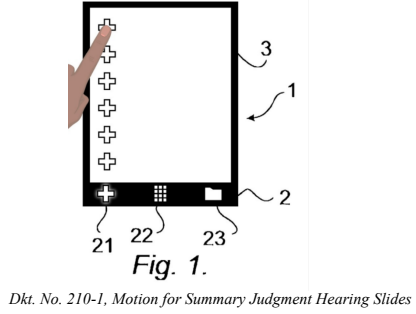
First, on a technical level, nothing prevents the representation of a function from being relocated or duplicated across the screen during gliding. While the patent provides that after the multi-step gliding operation completes, the activated function will open such that it covers the whole screen, this takes place after the gliding and so would not prevent any relocation or duplication during the gliding. As discussed at the hearing herein and discussed below, the device can be designed such that the representation is duplicated along the gliding path until the finger is released. Relocation or duplication is not necessarily excluded.
Neonode relies on the preferred embodiment of the invention pictured in Figure 13, where the representations of the menu area are printed on the top of the enclosure. Neonode argues that (1) the representations being printed on the menu area means that they physically cannot be relocated or duplicated during gliding and (2) that if they cannot be relocated or duplicated in this embodiment, then we should conclude that relocation or duplication of representations was necessarily excluded from the patent. Neither step of Neonode's reasoning follows. While the representations being printed on the embodiment may prevent their relocation [1] , it certainly does not prevent their duplication on the touch screen. And even if it did, the fact that one embodiment excludes a negative limitation does not necessarily teach this negative limitation for the invention as a whole. See In re Butler, 2025 WL 2658308, at *4. Neonode provides no technical reason why relocation or duplication cannot occur.
Second, there are affirmative reasons why an inventor might choose to have representations of functions move or duplicate during the activation process. Consider a user who wishes to activate the general task manager function pictured as[21] in the patent. The user touches the menu area and glides away. However, the user has unwittingly touched the area of the menu that corresponds to the keyboard function. The user has no way of knowing she has selected the wrong function until the application opens on the screen. Imagine instead, however, that when the user touched a representation of a function and began to glide, that function duplicated along the glide path, as pictured below. The user would be able to tell immediately whether she had successfully selected the correct function, a tangible design benefit.
Neonode and Neonode's expert Dr. Anthony Andre proffer many reasons why replication or duplication of the function icons would not be good design, given the other goals of the patent. For example, Dr. Andre notes that the invention is intended to provide a “simple to use” user interface and that relocation or duplication would “complicate rather than simplify” the interface. Dkt. No. 190-1, (Andre Decl.), ¶35. Dr. Andre's declaration establishes that, in his view, a POSITA in 2002 would have considered excluding replication or duplication of the function icons to be the best or most obvious option. But the obviousness of the purported superiority of a negative limitation is not the inquiry. See In re Butler, 2025 WL 2658308, at *2 (insufficient to show that the limitation was “an obvious variant”); Novartis, 38 F.4th 1013, 1017 n.2 (Fed. Cir. 2022) (“[A]n implicit disclosure [] that would render the limitation obvious to a skilled artisan … cannot under our precedent satisfy the written description requirement”); Rivera v. Int'l Trade Comm'n, 857 F.3d 1315, 1322 (Fed. Cir. 2017) (POSITA may not teach limitations not in specification, “even if those limitations would be rendered obvious by the disclosure in the specification”); see also Trans Video Elecs., Ltd. v. Sony Elecs., Inc., 822 F. Supp. 2d 1020, 1027 (N.D. Cal. 2011) (J. Chen) (“The written description requirement [] differs from the question of obviousness.”). Instead, unless otherwise expressly disclosed, the limitation must necessarily be excluded. Novartis, 38 F.4th at 1020 (emphasis in original); See In re Butler, No. 2023-2380, 2025 WL 2658308, at *4. Neonode has failed to proffer any facts supporting such a showing.
Despite this, Neonode contends that that the Court cannot grant Apple summary judgment because Neonode's expert report is “uncontradicted evidence” that a POSITA would have recognized that the inventor had possession of the claimed subject matter as of the filing date, which creates a dispute of fact sufficient to survive summary judgment. But an expert may only provide factual testimony, not conclusions of law. See Nationwide Transp. Fin. v. Cass Info. Sys., Inc., 523 F.3d 1051, 1058 (9th Cir. 2008) (“[A]n expert witness cannot give an opinion as to [his] legal conclusion, i.e., an opinion on an ultimate issue of law.”). As discussed, Dr. Andre's factual testimony goes to obviousness, not necessity. Beyond conclusory statements, his testimony does not show that the limitation at issue was necessarily excluded. Moreover, his testimony is inconsistent with both “the four corners of the specification,” Ariad Pharms., 598 F.3d at 1351, and the intrinsic evidence of the prosecution history. During prosecution, the Patent Examiner suggested that the relocation or duplication limitation be added to distinguish the invention from the prior art. It was this claim amendment that allowed Neonode — after ten years — to receive its patent. In other words, the Patent Examiner, adopting the perspective of a POSITA, did not find the exclusion of replication or duplication to be so obvious it went without saying. While the Court does not rely on this prosecution history, it is certainly suggestive and informative.
Ultimately, the written description inquiry is not a complicated one. It requires disclosure. If, instead of disclosure, there is silence, the written description only suffices if it necessarily discloses the claimed limitation. Apple has shown by clear and convincing evidence that the ′879 Patent's specification is silent as to the relocation and duplication exclusion and that the patent does not necessarily disclose this limitation, and Neonode has failed to rebut this evidence. Apple's motion for summary judgment for lack of a valid written description is GRANTED. Since this invalidates Claim 1, the only asserted independent claim of the ′879 Patent, it is case dispositive. Accordingly, the Clerk of Court is directed to enter a final judgment.
IV. CONCLUSION
Apple's Motion for Summary Judgment is GRANTED. Apple's pending motion for Leave to Amend Invalidity Contentions and the parties’ case schedule stipulation are DENIED AS MOOT. Dkt. No. 189, 213.
The Motions to Consider Whether Another Party's Material Should Be Sealed at Dkt. Nos. 185 and 191, for which no declaration in support was filed by the designating third-party Neonode Inc., are DENIED. The filing parties shall refile their motions in unredacted form by June 22, 2026.
IT IS SO ORDERED.
|
|