

Patent Cases, MOTOROLA SOLUTIONS, INC., Plaintiff, v. HYTERA COMMUNICATIONS CORPORATION LTD., Defendant., U.S. District Court, N.D. Illinois, (May 14, 2026)
MOTOROLA SOLUTIONS, INC., Plaintiff, v. HYTERA COMMUNICATIONS CORPORATION LTD., Defendant.
U.S. District Court, N.D. Illinois, Eastern Division. No. 17-cv-01972. March 30, 2026 Redacted: May 14, 2026.
Judge Franklin U. Valderrama
Franklin U. Valderrama, District Judge
Redacted Memorandum Opinion and Order [1]
Plaintiff Motorola Solutions, Inc. (Motorola) owns Patent No. 8,116,284 (the ′284 Patent). The ′284 Patent is directed to a method, device, and system for temporarily selecting a time division multiple access (TDMA) timeslot by a radio communication device to communicate, through at least one repeater station, with a talkgroup of other radio communication devices. R. 445-1, ′284 Patent at 2:48–52 (HytSJAppx 47 [2] ). Motorola alleges that Hytera Communications Corporation Ltd. (Hytera) infringes the ′284 Patent through its Legacy, i-Series, and H-Series products (Accused Products). R [3] . 78, Am. Compl. ¶¶65–85. Before the Court is Hytera's motion for summary judgment of non-infringement for the Accused Devices [4] in relation to the ′284 Patent. R. 449, Mot. Summ. J. [5] For the following reasons, the Court denies Hytera's motion for partial summary judgment.
Background
Motorola owns the ′284 Patent, which is directed to a method, device, and system for temporarily selecting a TDMA timeslot by a radio communication device to communicate, through at least one repeater station, with a talkgroup of other radio communication devices. ′284 Patent at 2:48–52 (HytSJAppx 47); Am. Compl. ¶¶36–38. Hytera, a Chinese corporation, manufactures Digital Mobile Radio (DMR) devices, which comprise portable and mobile radios as well as infrastructure products, including repeaters. R. 445-3, Am. FIC at 2 (HytSJAppx 1445). Hytera's allegedly infringing products include the Legacy, [6] i-Series, [7] and H-Series [8] products. DSOF ¶35. Motorola sued Hytera, Hytera America, Inc. (Hytera America), and Hytera Communications America (West), Inc. (Hytera West) alleging that that they had infringed Motorola's patents relating to digital, two-way radio technologies. DSOF ¶13. Motorola alleges that the Accused Products infringe the ′284 Patent literally and under the doctrine of equivalents. Am. Compl. ¶¶67, 71. The only remaining defendant, Hytera, moves for partial summary judgment on the basis that the Accused Products do not infringe the ′284 Patent as a matter of law, either literally or under the doctrine of equivalents. See generally R. 449-1, Memo. Summ. J.
The ′284 Patent was issued on February 14, 2012, and Motorola is the owner and sole assignee of the ′284 patent. Am. Compl. ¶¶36–37. Am. Fin. Infring. Cont. at 3 (HytSJAppx 1446). The ′284 Patent specification describes a TDMA wireless communication system 200 with a plurality of radio communication devices, i.e., subscribers 100, 230, 240, 250. ′284 Patent 3:50–53, Fig. 2 (HytSJAppx 45, 48). The subscriber radios 100, 230, 240, 250 are in a talkgroup and communicate with each other through a repeater station 210 using a traffic channel provided by radio links 220. Id. ′284 Patent 3:54–56 (HytSJAppx 48).
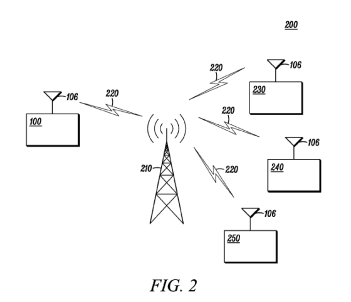
′284 Patent Fig. 2 (HytSJAppx 45).
The specification also describes a method 300 for temporarily selecting a TDMA timeslot by a radio communication device, such as subscriber radio 100, to communicate through repeater station 210 with a talkgroup of other radio subscribers 230, 240, 250. ′284 Patent 4:4–9, Fig. 3 (HytSJAppx 46, 48).
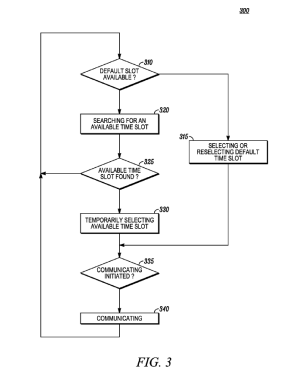
′284 Patent Fig. 3 (HytSJAppx 46). The subscriber radio 100 has an assigned default timeslot for communicating with the talkgroup, and determines whether the default timeslot is available to communicate with the talkgroup. Id. 4:9–22 (HytSJAppx 48). The subscribers use a common announcement channel (CACH) to determine whether a channel is available. Id. 4:23–26. If the default timeslot is unavailable, the radio communication device “searches” for an available timeslot by “processing information” from repeater station 210 (e.g., reading the CACH), and then transmits or receives the communication using the temporary group timeslot. Id. 4:23–50. The above steps repeat “if no communication has been initiated … or upon completion of the communication.” Id. 4:48–50.
Independent claims 1, 9, and 15 recite this method by determining if “an assigned default timeslot” is available, temporarily selecting another timeslot if the assigned default timeslot is not available, and “when the default timeslot becomes available … reselect[ing] the default timeslot for communicating with the talkgroup.” ′284 Patent 6:26–27, 6:37–39, 6:61–62, 7:10–14, 8:1–6, 8:14–16 (HytSJAppx 49–50).
Motorola has asserted Claims 7, 9, 13, 14, and 15 (the Asserted Claims) against Hytera. R. 445-3, Am. FIC (HytSJAppx 1446). As stated above, Motorola contends that the Accused Products infringe the ′284 Patent either literally or under the doctrine of equivalents under 35 U.S.C. §271(a). Am. Compl. ¶¶67, 71. Hytera denies any such infringement and moves for partial summary judgment. See generally Memo. Summ. J. After the motion was fully briefed, the Court issued its claim construction order with its rulings as to the disputed claim terms. R. 553, Claim Const. Order. Many of the parties' arguments depend on the Court's claim construction rulings.
Legal Standard
Summary judgment must be granted “if the movant shows that there is no genuine dispute as to any material fact and the movant is entitled to judgment as a matter of law.” Fed. R. Civ. P. 56(a). The party seeking summary judgment has the initial burden of showing that there is no genuine dispute and that they are entitled to judgment as a matter of law. Carmichael v. Village of Palatine, 605 F.3d 451, 460 (7th Cir. 2010); see also Celotex Corp. v. Catrett, 477 U.S. 317, 323 (1986); Wheeler v. Lawson, 539 F.3d 629, 634 (7th Cir. 2008).
If this burden is met, the adverse party must then “set forth specific facts showing that there is a genuine issue for trial.” Anderson v. Liberty Lobby, Inc., 477 U.S. 242, 256 (1986). A genuine issue of material fact exists if “the evidence is such that a reasonable jury could return a verdict for the nonmoving party.” Id. at 248. In evaluating summary judgment motions, courts must view the facts and draw reasonable inferences in the light most favorable to the non-moving party. Scott v. Harris, 550 U.S. 372, 378 (2007). The Court may not weigh conflicting evidence or make credibility determinations, Omnicare, Inc. v. UnitedHealth Grp., Inc., 629 F.3d 697, 704 (7th Cir. 2011), and must consider only evidence that can “be presented in a form that would be admissible in evidence.” Fed. R. Civ. P. 56(c)(2).
“Since the ultimate burden of proving infringement rests with the patentee, an accused infringer seeking summary judgment of noninfringement may meet its initial responsibility either by providing evidence that would preclude a finding of infringement, or by showing that the evidence on file fails to establish a material issue of fact essential to the patentee's case.” Novartis Corp. v. Ben Venue Lab'ys, Inc., 271 F.3d 1043, 1046 (Fed. Cir. 2001).
Analysis
In Count I, Motorola alleges Hytera continues to directly infringe one or more claims of the ′284 Patent, literally or through the doctrine of equivalents. Am. Compl. ¶¶65–85. Hytera moves for summary judgment with regards to the non-infringement of the ′284 Patent, arguing that the Accused Products do not meet any claim limitations, literally or under the doctrine of equivalents. Memo Summ. J. at 2.
Section 271(a) of the Patent Act provides in relevant part that “whoever without authority makes, uses, offers to sell, or sells any patented invention, within the United States or imports into the United States any patented invention during the term of the patent therefor, infringes the patent.” 35 U.S.C. §271(a); see also, e.g., Halo Electronics, Inc. v. Pulse Electronics, Inc., 831 F.3d 1369, 1376 (Fed. Cir. 2016). To infringe, every claim limitation must be found in an accused product or process exactly or by a substantial equivalent. See Liqui-Box Corp. v. Scholle IPN Corp., 449 F. Supp. 3d 790, 797 (N.D. Ill. 2020) (citing Southwall Techs., Inc. v. Cardinal IG Co., 54 F.3d 1570, 1575 (Fed. Cir. 1995); Nalco Co. v. Chem-Mod, LLC, 883 F.3d 1337, 1354 (Fed. Cir. 2018)). “[I]t has often and clearly been held that unauthorized use, without more, constitutes infringement.” Aro Mfg. Co. v. Convertible Top Replacement Co., 377 U.S. 476, 484 (1964). Direct infringement can be proven either by literal infringement or through the doctrine of equivalents. See Cross Med. Prods., Inc. v. Medtronic Sofamor Danek, Inc., 424 F.3d 1293, 1310 (Fed. Cir. 2005). The Court starts with literal infringement.
I. Literal Infringement
To literally infringe a patent claim, an accused product or process must have or perform every limitation of the claim. Engel Industries, Inc. v. Lockformer Co., 96 F.3d 1398, 1405 (Fed. Cir. 1996) (no literal infringement where accused device did not meet every claim limitation). Here, the parties agree that the Accused Products always use the last-used timeslot if it is available. R. 485, Resp. at 1; R. 527, Reply at 3. The parties dispute, however, whether the claims of the ′284 Patent cover the Accused Product's process.
Hytera argues that it is entitled to summary judgment of non-infringement of the ′284 Patent because the Accused Devices do not meet any of the claim limitations. Memo. Summ. J. at 1. Hytera prefaces its argument by suggesting that if the Court had agreed with Hytera's proposed claim constructions, all disputes of fact would have been resolved. Reply at 1. After briefing had concluded on this motion, however, the Court entered its Claim Construction Order adopting Motorola's proposed constructions. R. 553, Claim Const. Order at 59–66. The Court will not re-address claim construction arguments that have since been settled in the Claim Construction Order. That said, the Court's holding in the Claim Construction Order does not necessarily preclude the Court from finding in favor of Hytera here. In response, Motorola argues that Hytera's Accused Products literally infringe the “assigned default timeslot” and the “re-selecting limitation” requirement under the prescribed claim construction. Resp. at 7–10. Motorola further advocates that there is at least a genuine dispute of material fact about whether the Accused Devices meet every claim limitation of the ′284 Patent. Id. at 7.
As an initial matter, Hytera posits the Court should adopt the International Trade Commission's (ITC) holding that the i-Series devices did not meet the “assigned default timeslot” limitation and therefore did not infringe the ′284 Patent. Memo. Summ. J. at 2. Although ITC rulings may be persuasive, the Federal Circuit has stated that “Congress did not intend decisions of the ITC on patent issues to have preclusive effect.” Texas Instruments Inc. v. Cypress Semiconductor Corp., 90 F.3d 1558, 1569 (Fed. Cir. 1996). Therefore, the Court will take the ITC's ruling into consideration but does not find it binding. Id. First, Hytera argues the Accused Products do not infringe the “assigned default timeslot” limitation because there is “no such timeslot the Accused Devices will use unless another is selected, as there is no preference for either timeslot.” Memo. Summ. J. at 2. The Accused Products, point out Hytera, do not have a timeslot that they always use; instead, after a communication ends, the Accused Devices first look to see whether they most recently used timeslot is available and select it if it is, rather than returning to an “assigned default timeslot” when that is available. Id. at 6–7 (citing DSOF ¶¶45–47) (the parties' experts agree the Accused Devices “first check the most recently used timeslot”).
Motorola counters that Hytera's argument “at best boils down to a dispute between the parties' experts.” Resp. at 7. In support, Motorola points to Dr. Wicker's Opening Report, in which he describes an exemplary scenario in which the Accused Devises are used in Extended Pseudo Trunk Mode (XPT). Id. at 5–6 (citing R. 445-1, Wicker Rpt. ¶¶529–532 (HytSJAppx 428–429)). Specifically, *****. Id. at 6 (citing Wicker Rpt. ¶538 (HytSJAppx 433)). ***** Id. (citing Wicker Rpt. ¶¶530–532, 538, 554–560 (HytSJAppx 428–430, 433, 438–441)). Dr. Wicker explained that ***** Id. (citing Wicker Rpt. ¶¶554–560 (HytSJAppx 438–442)). ***** Id. (citing Wicker Rpt. ¶573 (HytSJAppx 447)). According to Dr. Wicker (and, accordingly, Motorola), ***** Resp. at 9; id. at 6 (citing Wicker Rpt. ¶573 (HytSJAppx 447)). Further, Motorola asserts that, “merely because Hytera's devices might produce unlikely results in an unlikely situation is no reason to find noninfringement as a matter of law.” Id. at 8–9.
The Court agrees with Motorola that a reasonable jury could find, at least in some circumstances, that the Accused Devices literally infringe the “default timeslot” limitation of the ′284 Patent. See Omega Pats., LLC v. CalAmp Corp., 920 F.3d 1337, 1344 (Fed. Cir. 2019) (evidence that the accused product operated in an infringing manner about 5% of the time was sufficient to support jury's infringement verdict). Motorola has adduced evidence through Dr. Wicker's Opening Report to create a question of fact as to the literal infringement of the “assigned default timeslot” limitation. Dr. Wicker's Report raises questions of fact as to how the accused subscriber radios in XPT mode switch timeslots, as well as whether the last-used timeslot is a “default timeslot.” Wicker Rpt. ¶¶554–560, 571–572 (HytSJAppx 446–447, 438–441). Thus, viewing all facts and reasonable inferences in the light most favorable to Motorola—as the Court must, the Court finds that Motorola presents evidence to create a reasonable dispute of material fact that the Accused Products infringe the “default timeslot” limitation of the ′284 Patent.
Second, and relatedly, Hytera argues that the Accused Products do not perform the “re-selecting” limitation.” Memo. Summ. J. at 5–6. Hytera again prefaces this argument that if the Court adopted Hytera's claim construction, there would be no infringement here. However, as stated above, the Court adopted Motorola's proposed construction for the claim phrase “re-select[ing] the default timeslot … when the default timeslot becomes available”; namely that the term “default timeslot” means the timeslot that is used unless another timeslot has been selected—the Court rejected Hytera's argument that all the radios must re-select the default timeslot immediately once it becomes available. Claim Const. Order at 67–69.
Hytera contends the Accused Devices do not infringe because they “do not select any timeslot when it ‘becomes available’ … but instead select timeslots when the products are ready to make a call.” Memo. Summ. J. at 5, 8 (citing DSOF ¶¶55–56). Motorola responds that Hytera's interpretation is incorrect and contradictory to the ′284 Patent. Resp. at 11 (citing ′284 Patent at 4:57–60 (HytSJAppx 48); R. 445-4, Wicker Dep. at 117:17–118:3 (HytSJAppx 2422)). Specifically, Motorola points to Dr. Wicker's explanation that the Accused Devices in “Pseudo Trunk or XPT mode meet the [re-selecting] limitation.” Resp. at 11 (citing Wicker Rpt. ¶¶569–575 (citing HytSJAppx 446–448)). Dr. Wicker's states in his Opening Report that ***** Wicker Rpt. ¶569 (HytSJAppx 446). The Report further explains ***** Id. ¶¶569–575 (HytSJAppx 446–448). Motorola also emphasizes that Hytera's expert did not dispute “this operation of the devices” presented by Dr. Wicker. Resp. at 11 (citing DSOF ¶¶55–56).
The Court finds that Motorola adduces evidence to demonstrate a dispute of material fact as to whether the Accused Products infringe the “re-selecting” limitation of the ′284 Patent. Dr. Wicker's Report raises questions of fact as to whether the ***** Wicker Rpt. ¶569 (HytSJAppx 446). Further, Dr. Wicker's Report raises factual question about if the Accused Devices in Pseudo Trunk or XPT mode ***** Resp. at 11 (citing Wicker Rpt. ¶¶569–575 (HytSJAppx 446–448); DSOF ¶¶55–56). This question is best left for the jury to decide.
Although the Court could end its analysis here, as it finds that Motorola has presented a question of fact as to direct infringement via literal infringement, for the sake of completeness, it also addresses the parties' arguments as to the doctrine of equivalents.
II. Doctrine of Equivalents
The doctrine of equivalents asks whether “the accused product or process contain elements identical or equivalent to each claimed element of the patented invention?” Warner-Jenkinson Co. v. Hilton Davis Chem. Co., 520 U.S. 17, 40 (1997). To establish direct infringement through the doctrine of equivalents, an objective inquiry applied on an element-by-element basis must be done. Id. Under the all-elements rule, “there can be no infringement under the doctrine of equivalents if even one limitation of a claim or its equivalent is not present in the accused device.” Lockheed Martin Corp. v. Space Systems/Loral, Inc., 324 F.3d 1308, 1321 (Fed. Cir. 2003). There are two substantive tests for showing equivalents used in practice: the insubstantial difference test and the function-way-result test.
The parties both employ the function-way-result test; accordingly, so does the Court. The theory of the function-way-result test is “if two devices do the same work in substantially the same way, and accomplish substantially the same result, they are the same, even though they differ in name, form or shape.” Graver Tank & Mfg. Co., v. Linde Air Products Co., 339 U.S. 605, 608 (1950) (cleaned up). For there to be equivalence, “the context of the patent, the prior art, and the particular circumstances of the case” must be considered. Graver Tank & Mfg. Co. 339 U.S. at 609 (affirming infringement under doctrine of equivalents because one of skill in the art would know that the accused product's difference performed the same function, way, and result as the patent claim.). A finding of equivalence is a question of fact. Id. at 609–10.
Again, as an initial matter the Court first addresses Hytera's ITC argument. Hytera relies on the ITC's holding that the i-Series Accused Products did not infringe the ′284 Patent under the doctrine of equivalents. Memo. Summ. J. at 10. In response, Motorola argues that the ITC's ruling is inapplicable to these proceedings for several reasons. That is, in this case, compared to the ITC proceeding, there has been additional discovery and infringement arguments, such as “that the last-used timeslot is the ‘default timeslot.’” Resp. at 14. Motorola asserts that the considerable evidence created in this case disfavors summary judgment and the jury is entitled to assess the additional discovery that has been presented by both parties. Id. As above with regard to literal infringement, the Court considers the ITC's holding as to the doctrine of equivalents but does not find it to be binding on the Court. Texas Instruments, 90 F.3d at 1569 (“The district court can attribute whatever persuasive value to the prior ITC decision that it considers justified.”). According to Hytera, Motorola fails to provide legally sufficient support to enable the Court to find infringement through the doctrine of equivalents for several reasons. Memo. Summ. J. at 9–10.
First, Hytera contends that the function, way, and result of the Accused Devices identified by Dr. Wicker are not the function, way, and result of the “default timeslot.” Memo. Summ. J. at 9 (citing DSOF ¶44; ′284 Patent at 5:45–50 (HytSJAppx 43–51)). According to Hytera, the ′284 Patent explains that the function of a default timeslot is to allow each device in a talkgroup to “individually, but concurrently, [determine] which timeslot to select.” Id. (quoting ′284 Patent at 5:43–44 (HytSJAppx at 49).
Motorola retorts that Hytera's mischaracterizes Motorola's evidence. Resp. at 11. That is, argues Motorola, Hytera fails to look to Dr. Wicker's complete opinion: “‘[t]he function of the default timeslot in the ′284 Patent (under either Motorola's or Hytera's proposed construction) is to serve as the timeslot that a subscriber uses for a new transmission if the timeslot is available.’” Resp. at 11–12 (quoting Wicker Rpt. ¶542 (HytSJAppx 434)). Motorola also contends the part of the ′284 Patent cited by Hytera is for the benefit of the invention and is not the description for the “default timeslot” as asserted by Hytera. Resp. at 12. Compare ′284 Patent at 5:43–44 (HytSJAppx 49) (“… individually, but concurrently, which timeslot to select.”), with ′284 Patent at HytSJAppx 49 at 5:40–44 (“Advantageously, the present invention alleviates the need for timeslot (channel) assignment by common or system level controllers since each radio communication device in a talk group determines individually, but concurrently, which timeslot to select.”). Rather according to Motorola, reading the entirety of portion cited of the ′284 Patent shows the function of the subscribers. Resp. at 12. Moreover, Motorola contends that Hytera's disagreement with Dr. Wicker's opinions creates a factual question best left to the jury, rendering summary judgment inappropriate. Resp. at 12, 15.
Second, Hytera argues there is no testimony connecting the function, way, and result Dr. Wicker offered to the ′284 Patent because Motorola offers only conclusory statements, apart from Dr. Wicker “establishing that g_RecordIdleSlotInPseudoTrunk is set prior to a subsequent transmission and showing Hytera's XPT function.” Memo. Summ. J. at 9. Motorola, in Response, points to the record citing evidence from Dr. Wicker explaining the “function” of the “default timeslot,” in addition to the “way” and “results” prongs for the doctrine of equivalents analysis. Resp. as 12–13 (citing Wicker Rpt. ¶¶542–544 (HytSJAppx 434)). Specifically in Dr. Wicker's Report, he explains that the “function of the default timeslot in the ′284 Patent” is “to serve as the timeslot that at subscriber uses for a new transmission if the timeslot is available.” Id. at 12 (quoting Wicker Rpt. ¶542 (HytSJAppx 434)). Dr. Wicker states ***** . Id. at 12–13 (quoting Wicker Rpt. ¶542 (HytSJAppx 434)). As for the ***** Wicker Rpt. ¶543 (HytSJAppx 434). Dr. Wicker compares the Accused Devices with the ′284 Patent and states the Accused Products’ ***** Id. (although the ′284 Patent ***** ). Dr. Wicker further opines ***** Id.
Third, Hytera contends Dr. Wicker's testimony is nothing more than unsupported and “legally insufficient” conclusory statements of infringement. Memo. Summ. J. at 9–10 (citing DSOF ¶53). Motorola, in response, points to Dr. Wicker's identification of source code in the Accused Devices with “substantially the same function, way, and result as the ‘default timeslot’ in the patent and specifically tied that analysis to the patent.” Resp. at 13–14.
Fourth and finally, Hytera asserts Motorola's doctrine of equivalents analysis is incomplete because the “default timeslot” is not the only element missing from the Accused Products and Motorola's experts offer no analysis for the additional elements missing in the Accused Products. Memo. Summ. J. at 10. Motorola answers that Dr. Wicker does not need to rely on every claim limitation for his doctrine of equivalents analysis when he has “offered opinions as to why the Accused Devices literally meet the other limitations of the Asserted Claims.” Resp. at 14 (citing Wicker Rpt. ¶¶545–575 (HytSJAppx 434)).
The Court finds, viewing all facts and reasonable inferences in the light most favorable to Motorola, that Motorola has provided record evidence which creates a reasonable dispute of material fact as to whether the Accused Products infringe the ′284 Patent through the doctrine of equivalents. Motorola adduces evidence that raises questions of material fact regarding whether the Accused Devices meet the “default timeslot” limitation under the doctrine of equivalents through the “function-way-result” test, primarily through Dr. Wicker's Report and testimony. Specifically, Dr. Wicker opines that the Accused Devices in Pseudo Trunk and XPT modes perform the same “function” as the ′284 Patent. See Wicker Rpt. ¶542 (HytSJAppx 434). Dr. Wicker further opines that the Accused Devices ***** Id. at ¶543. In his argument, Dr. Wicker at the least creates a question of fact as to whether a POSITA would understand the that the “default timeslot” is not limited in the ′284 Patent and thus may change over time.” Id. (citing ′284 Patent at 1:27–57, 5:40–44 (HytSJAppx 43–50)). Finally, Dr. Wicker opines, with support, that the result is the same in the Accused Devices and the ′284 Patent regardless of whether the “default timeslot is always fixed” or not. Id. at ¶544. Accordingly, the Court finds that Motorola creates a reasonable dispute of material fact as to whether the Accused Devices perform substantially the same function, way, and result at the ′284 Patent's requisite limitations for a finding of infringement through the doctrine of equivalents. Graver Tank & Mfg. Co. 339 U.S. at 609 (1950) (A finding of equivalence is a question of fact.). The issue is best left to a jury to resolve. Thus, the Court denies Hytera's motion for summary judgment of non-infringement of the ′284 Patent through the doctrine of equivalents.
Conclusion
The Court finds that Motorola has presented evidence to create a genuine dispute of material fact. These issues must be resolved by the trier of fact. For the foregoing reasons, the Court denies Hytera's motion for summary judgment of non-infringement for the ′284 Patent [449], under both literal infringement and through the doctrine of equivalents.
|
|