

Patent Cases, MITII, INC., Plaintiff, v. OPENAI OPCO, LLC, Defendant., U.S. District Court, N.D. California, (May 8, 2026)
MITII, INC., Plaintiff, v. OPENAI OPCO, LLC, Defendant.
U.S. District Court, N.D. California. Case No. 5:26-cv-00191-NW, Re: ECF No. 40. May 8, 2026.
Noël Wise, District Judge
Noël Wise, District Judge
ORDER GRANTING MOTION TO DISMISS WITHOUT LEAVE TO AMEND
On January 16, 2026, Defendant OpenAI OpCo, LLC (“OpenAI”) filed a motion to dismiss Plaintiff MITII, Inc.'s (“MITII”) amended complaint. ECF 40. [1] Having considered the parties' briefs, oral arguments, and the relevant legal authority, the Court GRANTS the motion to dismiss without leave to amend.
I. BACKGROUND
On October 9, 2025, MITII sued OpenAI Global, LLC for patent infringement in the Central District of California. ECF No. 1. On November 5, 2025, MITTI filed a first amended complaint naming current Defendant OpenAI OpCo, LLC and terminating OpenAI Global, LLC. First Amend. Compl. (“FAC”), ECF No. 14. The parties stipulated to transfer the case to this District in early January 2026. ECF No. 23.
MITII is an intellectual property holding company with a patent portfolio that includes patents directed to text-to-video technology. MITII owns United States Patents Nos. 9,397,972 (the “′972 patent”), 9,667,574 (the “′574 patent), 10,616,157 (the “′157 patent), and the 11,005,796 (the “′796 patent) (collectively “asserted patents”). FAC ¶2, 8-11. The ′574, ′157, and ′796 patents are all continuations of the ′972 Patent.
The asserted patents describe a “text-to-video technology [] developed to help children with autism [b]y including well-known characters in the text-to-video media.” Id. ¶7. Per the shared patent specification:
The present invention offers a simple, yet efficient, alternative to existing technologies by incorporating methods of voice synthesization and image animation to transform texts into what might be called a very short film!
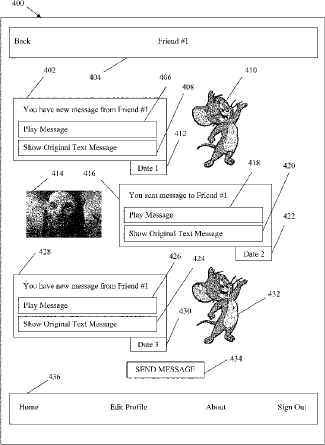
′972 pat.,7:40-44. [2] In particular, the asserted patents “allow a user to compose an electronic message and associate an animation character with the message. The recipient of the message receives the massage [sic] and the message is presented through the animation character. As such, the message is transformed into a video of the animation character uttering the text.” Id. at 7:52-57. Below is Figure 4 from the specification, showing a possible user interface:
Claim 1 of the ′972 patent encompasses:
1. A machine implemented method of communicating, comprising:
(i) composing an electronic message, via a first device having a processing unit and program code stored on a storage device of said first device;
(ii) selecting a well-known animation character, via the first device;
(iii) transmitting the electronic message, via the first device;
(iv) transmitting the well-known animation character, via the first device;
(v) receiving the electronic message, via a server having a processing unit and program code stored on a storage device of said server;
(vi) receiving the well-known animation character, via the server;
(vii) converting the electronic message into speech using one of synthesized voice of the well-known animation character and actual voice of the well-known animation character, via the server;
(viii) generating moving images of the well-known animation character, via the server;
(ix) transmitting the speech, via the server;
(x) transmitting the moving images, via the server;
(xi) receiving the speech, via a second device having a processing unit and program code stored on a storage device of said second device;
(xii) receiving the moving images, via the second device;
(xiii) outputting the speech, via the second device; and
(xiv) displaying the moving images, via the second device
′972 pat., cl. 1. MITII alleges that OpenAI, through its text-to-video app Sora [3] , infringes the asserted claims of its asserted patents.
On January 16, 2026, OpenAI moved to dismiss the complaint on the ground that the asserted patents are ineligible for patent protection under 35 U.S.C. §101. ECF No. 40. MITII opposed and OpenAI filed a reply. ECF Nos. 45, 46, 47. The Court heard oral argument on May 6, 2026.
II. LEGAL STANDARD
A. Motion to Dismiss
To survive a motion to dismiss, a plaintiff must plead “enough facts to state a claim to relief that is plausible on its face.” Bell Atl. Corp. v. Twombly, 550 U.S. 544, 570 (2007). The Court must “accept all factual allegations in the complaint as true and construe the pleadings in the light most favorable to the [plaintiff].” Knievel v. ESPN, 393 F.3d 1068, 1072 (9th Cir. 2005). However, “the tenet that a court must accept a complaint's allegations as true is inapplicable to threadbare recitals of a cause of action's elements, supported by mere conclusory statements.” Ashcroft v. Iqbal, 556 U.S. 662, 678 (2009).
If the Court dismisses the complaint, it must then decide whether to grant leave to amend. The Ninth Circuit has “repeatedly held that a district court should grant leave to amend even if no request to amend the pleading was made, unless it determines that the pleading could not possibly be cured by the allegation of other facts.” Lopez v. Smith, 203 F.3d 1122, 1130 (9th Cir. 2000) (citations and internal quotation marks omitted).
B. Section 101 Patent Eligibility
Patent eligibility “is a question of law, based on underlying facts” that “may be, and frequently has been, resolved on a Rule 12(b)(6) … motion.” SAP Am., Inc. v. InvestPic, LLC, 898 F.3d 1161, 1166 (Fed. Cir. 2018). Dismissal is appropriate “where the undisputed facts, considered under the standards required by [Rule 12(b)(6)], require a holding of ineligibility under the substantive standards of law.” Id. Courts in this district have regularly granted motions to dismiss under such circumstances. LookSmart Grp., Inc. v. Google, LLC, No. 24-CV-07147-JST, 2025 WL 1785343 (N.D. Cal. June 26, 2025); LaVoult.com, LLC v. Meta Platforms, Inc., 777 F. Supp. 3d 1072 (N.D. Cal. 2025).
Section 101 “defines the subject matter that may be patented.” Bilski v. Kappos, 561 U.S. 593, 601 (2010). Under Section 101, patentable subject matter includes “any new and useful process, machine, manufacture, or composition of matter, or any new and useful improvement thereof.” 35 U.S.C. §101. “These categories are broad, but they are not limitless.” Twilio, Inc. v. Telesign Corp., 249 F. Supp. 3d 1123, 1136 (N.D. Cal. 2017). “Laws of nature, natural phenomena, and abstract ideas are not patentable,” Alice Corp. Pty. v. CLS Bank Int'l, 573 U.S. 208, 216 (2014), because “they are the basic tools of scientific and technological work,” which are “free to all … and reserved exclusively to none.” Mayo Collaborative Servs. v. Prometheus Lab'ys, Inc., 566 U.S. 66, 71 (2012) (cleaned up). Allowing patent claims for such purported inventions “might tend to impede innovation more than it would tend to promote it.” Id.
But courts must “tread carefully in construing this exclusionary principle lest it swallow all of patent law.” Alice Corp. Pty., 573 U.S. at 217. “At some level, all inventions embody, use, reflect, rest upon, or apply laws of nature, natural phenomena, or abstract ideas.” Id. (cleaned up). So, “in applying the §101 exception, [the Court] must distinguish between patents that claim the ‘building blocks’ of human ingenuity and those that integrate the building blocks into something more, thereby ‘transforming’ them into a patent-eligible invention.” Id. (cleaned up).
To draw this distinction, the Court engages in a two-step “Alice” analysis. First, the Court “determine[s] whether the claims at issue are directed to a patent-ineligible concept.” Id. at 218. If so, the Court then assesses “whether the elements of each claim, both individually and as an ordered combination[,] … transform the nature of the claim into a patent eligible application.” Id. at 217 (cleaned up). This second step of the analysis is “a search for an inventive concept—i.e., an element or combination of elements that is sufficient to ensure that the patent in practice amounts to significantly more than a patent upon the ineligible concept itself.” Id. at 217-18 (cleaned up).
III. DISCUSSION
A. Representative Claim
The parties dispute whether independent claim 1 of the ′972 patent is representative of all claims of all four asserted patents. ECF No. 40 at 9. OpenAI argues that the asserted claims, which all relate to “composing electronic messages and converting the messages into moving images of an animated character who utters the message,” differ only in “which hardware performs particular steps.” Id. MITII asserts that while the asserted patents “have substantially the same specification … their independent claims vary to cover different embodiments.” ECF No. 45 at 11.
The Court need not individually analyze every claim under the Alice rubric if certain claims are “representative.” Twilio, 249 F. Supp. 3d at 1141 (citing Alice, 573 U.S. at 224). “Limiting the analysis of a §101 challenge to representative claims is proper when the claims at issue are ‘substantially similar and linked to the same’ ineligible concept.” Mobile Acuity Ltd. v. Blippar Ltd., 110 F.4th 1280, 1290 (Fed. Cir. 2024) (quoting Cleveland Clinic Found. v. True Health Diagnostics LLC, 859 F.3d 1352, 1360 (Fed. Cir. 2017) and citing Content Extraction & Transmission LLC v. Wells Fargo Bank, Nat. Ass'n, 776 F.3d 1343, 1348 (Fed. Cir. 2014)). Therefore, a court “may treat a claim as representative in certain situations, such as if the patentee does not present any meaningful argument for the distinctive significance of any claim limitations not found in the representative claim.” Berkheimer v. HP Inc., 881 F.3d 1360, 1365 (Fed. Cir. 2018).
Here, MITTI fails to make meaningful arguments as to the distinctive significance of all the asserted claims, dependent and independent, across all four asserted patents. At best, MITII argues that “[i]n one aspect, the claims are directed to a process,” and “[i]n another aspect, the claims are directed to a computer network system that implements the aforementioned process.” ECF No. 45 11-12. Not only does MITII's high-level statement fail to identify which claims encompass the process and which claims encompass the system that implements the process, but MITII fails to explain why this distinction renders the process and system claims distinct for purposes of patent eligibility. Overall, MITII fails to address each asserted patent's asserted claims individually, repeatedly referring instead to the “invention.” This is insufficient and accordingly, the Court treats claim 1 of the ′972 patent as representative.
B. Alice Step One
The Court begins with step one of the two-step Alice patent eligibility inquiry, which asks whether the claim is directed to a patent-ineligible abstract idea. At this step, courts consider “what the patent asserts to be the focus of the claimed advance over the prior art.” TecSec, Inc. v. Adobe Inc., 978 F.3d 1278, 1292 (Fed. Cir. 2020).
1. The “directed to” inquiry
At Alice step one, the court evaluates “the focus of the claimed advance over the prior art to determine if the character of the claim as a whole, considered in light of the specification, is directed to [an abstract idea].” Trading Techs. Int'l, Inc. v. IBG LLC, 921 F.3d 1084, 1092 (Fed. Cir. 2019) (citation modified). Finding a claim's “focus” requires a delicate balancing act. While the process necessarily requires some high-level description, the Court must articulate “what the claims are directed to” with “enough specificity to ensure the step one inquiry is meaningful.” Thales Visionix Inc. v. United States, 850 F.3d 1343, 1347 (Fed. Cir. 2017); see also Enfish, LLC v. Microsoft Corp., 822 F.3d 1327, 1337 (Fed. Cir. 2016) (“[D]escribing the claims at such a high level of abstraction and untethered from the language of the claims all but ensures that the exceptions to §101 swallow the rule.”).
The asserted patents relate to “methods of communication, … where text is converted into a moving image with voice.” ′972 pat. 1:30-34. Specifically, “the methods… allow the users to compose electronic messages and select an animation character, and the message is converted into voice and moving images of the animation character is displayed on a screen in motion uttering the message.” Id. at 1:34-39.
OpenAI argues that the asserted patent claims are directed at the “generation of an animation based on a message.” ECF No. 40 at 12. OpenAI asserts the the claim language and specification support this focus because the goal of the invention is to “enhance creativity by allowing users to choose characters to deliver their message.” Id. OpenAI thus contends that the asserted claims are directed to an abstract idea. Id. at 13.
MITII asserts that OpenAI oversimplified the patent claims. Instead, MITII argues that the claims are directed to, and focused on:
transforming an electronic message into a short film, implemented on a computer network system, where the video has been created by a user using his own device to (1) compose the text of the electronic message, (2) select the well-known animation character, (3) use the synthesized or actual voice of the well-known character, (4) select the animation type, (5) select the background music, and sharing it with other users using their own devices, where the users’ devices and the server are connected through a communication network in a client-server architecture.
ECF No. 45 at 17-18 (emphasis in original).
The Court agrees with MITII that the focus is on the claim language. Trinity Info Media, LLC v. Covalent, Inc., 72 F.4th 1355, 1363 (Fed. Cir. 2023). But the focus of the claims is not a mere recitation of the claim language with a step-by-step description of exactly how the patented invention operates. Rather, what is required is a narrower inquiry into what is the “focus of the claimed advance over the prior art.” Affinity Labs of Texas, LLC v. DIRECTV, LLC, 838 F.3d 1253, 1258 (Fed. Cir. 2016). The claim language and the specification indicate that the advancement of the asserted patents over the prior art is the user's ability to compose an electronic message, select an animated character, and have that message “converted into voice and moving images of the animation character … displayed on a screen in motion uttering the message.” ′972 pat. 1:36-38.
Therefore, representative claim 1 is directed to a method of composing an electronic message, selecting an animation character, converting the message into speech, generating moving images of the animation character, and displaying the images while outputting the speech.
2. The “abstract idea” inquiry
Next, the Court determines whether this focus is an abstract idea. “Neither the U.S. Supreme Court nor the Federal Circuit has set forth a bright line test separating abstract ideas from concepts that are sufficiently concrete so as to require no further inquiry under the first step of the Alice framework.” Twilio, Inc., 249 F. Supp. 3d at 1137 (citing Alice Corp. Pty., 573 U.S. at 221). That a claim is directed to “mental processes that can be performed in the human mind or using a pencil and paper” is a sign of abstraction. PersonalWeb Techs. LLC v. Google LLC, 8 F.4th 1310, 1316 (Fed. Cir. 2021) (cleaned up). Likewise, “[a] claimed method's similarity to fundamental … practices long prevalent is yet another clue that the claims may be abstract and unpatentable.” Beteiro, LLC v. DraftKings Inc., 104 F.4th 1350, 1356 (Fed. Cir. 2024) (cleaned up). To determine whether a claim's focus is an abstract idea, courts also “compare claims at issue to those claims already found to be directed to an abstract idea in previous cases.” Enfish, LLC, 822 F.3d at 1334.
Representative claim 1 of the ′972 patent is directed to an abstract idea. The claimed method involves fourteen steps for “communicating.” ′972 pat., cl. 1. Without construing the claims, in summary the steps include (1) composing an electronic message, (2) selecting a well-known animation character, (3) transmitting the electronic message, (4) transmitting the well-known animation character, (5) receiving the electronic message, (6) receiving the well-known animation character, (7) converting the electronic message into speech, (8) generating moving images of the well-known animation character, (9) transmitting the speech, (10) transmitting the moving images, (11) receiving the speech, (12) receiving the moving images, (13) outputting the speech, and (14) displaying the moving images. Id. Steps 1 to 4 (of composing, selecting, and transmitting) occur via a first device. Id. Steps 5 through 10 (of receiving, converting, generating, and transmitting) occur via a server. Id. Finally, steps 11 to 14 (of receiving, outputting, and displaying) happen via a second device. Id.
Notably, claim 1 does not specify how an electronic message is converted into speech or moving images of a well-known animation character are generated. All the patent specifies is that an electronic message is converted “into speech using one of synthesized voice of the well-known animation character and actual voice of the well-known animation character, via the server.” ′972 pat., cl. 1. This detail does not “confine[] the claim to a particular solution to an identified problem.” Affinity Labs of Tex., LLC v. Amazon.com Inc., 838 F.3d 1266, 1269 (Fed. Cir. 2016); see also LookSmart Grp., Inc. v. Google, LLC, 2025 WL 1785343, *4 (finding claims directed to the abstract idea of “collecting, storing, indexing, and ranking” information patent-ineligible for lack of specificity); LaVoult.com, LLC, 777 F. Supp. 3d at 1080 (finding claims that toggle between two modes of communication and automatically delete messages in one mode did not “improve the functioning of a computer”). Instead, representative claim 1 “simply add[s] conventional computer components,” like a server and electronic devices, “to well-known business practices,” like transmitting, receiving, converting, and generating data. Enfish, LLC v. Microsoft Corp., 822 F.3d 1327, 1338 (Fed. Cir. 2016).
“Allowing a claim that functionally describes a mere concept without disclosing how to implement that concept risks defeating the very purpose of the patent system.” Recentive Analytics, Inc. v. Fox Corp., 134 F.4th 1205, 1213 (Fed. Cir. 2025), cert. denied, 146 S. Ct. 891 (2025). “[T]he patent system represents a carefully crafted bargain that encourages both the creation and the public disclosure of new and useful advances in technology.” Pfaff v. Wells Elecs., Inc., 525 U.S. 55, 63 (1998). This has been a feature of federal patent law since inception; the system must strike a “balance between the interest in motivating innovation and enlightenment by rewarding invention with patent protection on the one hand, and the interest in avoiding monopolies that unnecessarily stifle competition on the other.” Id.
MITII argues that “if the animation is tied to specific rules where by [sic] practicing the claims the need for an artist is eliminated, then the claim is not directed to patent ineligible abstract idea under Alice step one.” ECF No. 45 at 19 (relying on McRO, Inc. v. Bandai Namco Games Am. Inc., 837 F.3d 1299 (Fed. Cir. 2016)). This argument is unavailing. First, the claims at issue in McRO, Inc., were “limited to rules with specific characteristics,” McRO, Inc., 837 F.3d at 1313. In particular, “[t]he rules are limiting in that they define morph weight sets as a function of the timing of phoneme sub-sequences.” Id. The key inquiry is “whether the claims in the[] patents focus on a specific means or method that improves the relevant technology or are instead directed to a result or effect that itself is the abstract idea and merely invoke generic processes and machinery.” Id. at 1314. Ultimately the Federal Circuit found the claims in McRO, Inc. were focused on a specific means or method that improved the relevant technology, rather than a result.
Here, representative claim 1 is not focused on a specific means or method that improves animation, but rather are directed to a result. As noted above, representative claim 1 is directed to a method of composing an electronic message, selecting an animation character, converting the message into speech, generating moving images of the animation character, and displaying the images while outputting the speech. What claim 1 of the ′972 patent lacks is “limiting detail that confines the claim to a particular solution to an identified problem.” Affinity Labs of Texas, LLC, 838 F.3d at 1269. Instead of disclosing “a specific implementation of a solution to a problem in the software arts,” Enfish, LLC, 822 F.3d at 1339, or “a specific means or method that solves a problem in an existing technological process,” Koninklijke KPN N.V. v. Gemalto M2M GmbH, 942 F.3d 1143, 1150 (Fed. Cir. 2019), the only thing claim 1 of the ′972 patent discloses is the use of conventional computer equipment, like servers and electronic devices, to allow a user to generate a video of an animated character uttering a message.
To be patentable, claims must be specific enough to transform “a claim from one claiming only a result to one claiming a way of achieving it.” SAP Am., Inc., 898 F.3d at 1167. Here, claim 1 of the ′972 patent lacks that specificity. It does not “focus on an improvement in computers as tools, but on certain independently abstract ideas that use computers as tools.” Id. at 1168 (citation modified).
Relatedly and relying again on McRO, MITII argues that representative claim 1 does not preempt the field of electronic messaging. MITII's argument misses the mark. Claim 1 “fails to recite a practical way of applying an underlying idea”—the idea of generating a talking animated character from a text message—and is “drafted in such a result-oriented way that it amounts to encompassing the principle in the abstract no matter how implemented.” Free Stream Media Corp. v. Alphonso Inc., No. 2019-1506, 2021 WL 1880931, at *1363 (Fed. Cir. May 11, 2021) (citation modified). Rather than address these issues, MITII assert that “the conversion of text into speech is limited to use of the voice of a well-known animation character, not voices of all types; use of the image of a well-known character, not characters of all types; use of a user-selected type of animation, not animations of all types, and use of a user-selected background music, not background music of all types.” ECF No. 45 at 24. But representative claim 1 does not describe, in any manner, how the result of “outputting the speech” and “displaying the moving images” is achieved through the other twelve generic steps of transmitting, receiving, converting, and generating in the method of communicating.
MITII also argues that the patent claims offer an “improvement to traditional electronic messaging by transforming them into short films” and are therefore not abstract. ECF No. 45 at 20. MITII emphasizes how the “claims of the asserted Patents apply the Rules to allow users to create realistic animated videos and the Computer System Configuration allows users to readily share the videos.” Id. at 22.
MITII's argument fails. “The analysis at step one ‘must focus on’ the claim language.” Hawk Tech. Sys., LLC v. Castle Retail, LLC, 60 F.4th 1349, 1357 (Fed. Cir. 2023) (citation omitted). Here, claim 1 does not disclose “[r]ules to allow users to create realistic animated videos.” ECF No. 45 at 22. Instead, claim 1 discloses a “method of communicating” that includes the generic steps of transmitting, receiving, converting, and generating. ′972 pat., cl. 1. In other words, claim 1 of the ′972 patent does not identify specific rules to create animated videos, but rather lists the vague steps of “converting the electronic message” and “generating moving images” via a nonspecific sever. Nor does claim 1 describe how the “Computer System Configuration allows users to readily share the videos.” ECF No. 45 at 20. Instead, the claim includes the nondescript verbs of transmitting, receiving, outputting, and displaying. ′972 pat., cl. 1. This is too lacking in detail to “confine[] the claim to a particular solution to an identified problem.” Affinity Labs of Texas, LLC, 838 F.3d at 1269. Indeed, the Federal Circuit has “made clear that mere automation of manual processes using generic computers does not constitute a patentable improvement in computer technology.” Credit Acceptance Corp. v. Westlake Servs., 859 F.3d 1044, 1055 (Fed. Cir. 2017). Similarly, claim 1 of the ′972 patent is not focused on an improvement in computers as tools, but rather, is focused on an abstract idea that uses a computer as a tool. Id. (citing cases).
In this way, claim 1 of the ′972 patent is like the claims at issue in Hawk Tech. Sys., LLC. 60 F.4th at 1357. There, the Federal Circuit found patent claims “directed to a method of receiving, displaying, converting, storing, and transmitting digital video” patent-ineligible. Id. In addition to “using result-based functional language,” the claims at issue did not disclose performing a specific implementation of digitizing and converting data nor did they describe how to achieve the alleged goal of “conserving bandwidth while preserving data.” Id. Further, the claims at issue in Hawk Tech. Sys., LLC, like claim 1 of the ′972 patent, failed to “explain what the claimed parameters are or how they should be manipulated.” Id. (citation modified).
Drawing all reasonable inferences in MITII's favor, representative claim 1 of the ′972 patent fails Alice step 1 as a matter of law because it is directed to an abstract idea.
C. Alice Step Two
Because representative claim 1 of the ′972 patent is directed to an abstract idea, the Court proceeds to step two of the Alice inquiry. Step two asks “whether the claimed elements— ‘individually and as an ordered combination’—recite an inventive concept.” Cellspin Soft, Inc. v. Fitbit, Inc., 927 F.3d 1306, 1316 (Fed. Cir. 2019) (quoting Alice Corp. Pty., 573 U.S. at 217). “An inventive concept reflects something more than the application of an abstract idea using ‘well-understood, routine, and conventional activities previously known to the industry.’” Id. Such a concept “must be significantly more than the abstract idea itself, and cannot simply be an instruction to implement or apply the abstract idea on a computer.” Bascom Glob. Internet Servs., Inc. v. AT&T Mobility LLC, 827 F.3d 1341, 1349 (Fed. Cir. 2016); see also Savvy Dog Sys., LLC v. Pennsylvania Coin, LLC, No. 2023-1073, 2024 WL 1208980, at *3 (Fed. Cir. Mar. 21, 2024) (determining that alleged inventive steps “are abstract ideas themselves—whether viewed as part of a set of rules for playing a game or part of a game previewed to the player before committing to playing—and thus cannot be an inventive concept under Alice step two.”).
Here, there is no inventive concept transforming claim 1's abstract idea into a patent-eligible application. Just as the claim fails to elaborate on specific improvements to computer capabilities at Alice step 1, claim 1 of the ′972 patent fails as a matter of law at Alice step 2 for the same reasons. See Enfish, LLC, 822 F.3d at 1339 (explaining the step 1 and step 2 inquiries can blend when software patents are at issue).
MITII's counter arguments are unavailing. First, MITII contends that the claimed “features are not conventional because unauthorized use of the likeness of well-known characters without consent carries civil liabilities, making this type of animation unorthodox.” ECF No. 45 at 28. Yet, not only is it unclear how this contention is an “inventive concept,” but it is untethered from representative claim 1. The language of claim 1 of the ′972 patent does not address civil liabilities, or the licensed use of well-known characters. See e.g. ′972 pat., cl. 1.
Second, MITII argues that the “creation of a video using the likeness of a well-known character is not ‘the routine or conventional’ use of internet-based animation/CGI [computer-generated imagery].” ECF No. 45 at 30. But MITII fails to explain why the concept of video generation using a well-known character's likeness is not routine or conventional, particularly when representative claim 1 uses only generic computer components, like servers and electronic devices. The law requires more; an inventive concept must be “significantly more than the abstract idea itself.” Bascom Glob. Internet Servs., Inc., 827 F.3d at 1349. What MITII supplies as an “inventive concept” is merely “an instruction to implement or apply the abstract idea on a computer.” Id.
Third, MITII asserts that the functionality of the asserted patents “arise[s] from the specific Rules that shape the asserted claims.” ECF No. 45 at 31. As stated above, representative claim 1 is not directed to a specific rule or particular technological solution, but instead is results-oriented and uses a computer as a tool. In other words, MITII's alleged inventive steps are abstract ideas themselves, and thus cannot be an inventive concept under Alice step two. See Savvy Dog Sys., LLC, 2024 WL 1208980, at *3.
Finally, MITII's reliance on DDR Holdings, LLC v. Hotels.com, L.P., 773 F.3d 1245 (Fed. Cir. 2014) is misplaced. In DDR Holdings, LLC, “the claims at issue … specify how interactions with the Internet are manipulated to yield a desired result—a result that overrides the routine and conventional sequence of events ordinarily triggered by the click of a hyperlink.” Id. at 1258. As discussed above, representative claim 1 of the ′972 patent does not specify how an electronic message is converted into speech or moving images of a well-known animation character are generated. Instead, the claim employs techniques that existed at the time of the patent's filing—including text-to-speech technology and computer animation—to generate a video of an animated character speaking. This result does not override the routine and conventional use of these well-known techniques.
Nothing in the complaint, patent specification, or representative claim supports a plausible inference that claim 1 of the ′972 patent improves computer functionality. Viewing the facts in the light most favorable to MITII, claim 1 fails to provide an inventive concept
D. Leave to Amend
At the end of its opposition, MITII requests leave to amend its complaint should the Court grant the motion to dismiss. Yet MITII fails to identify or propose any amendment that would render the asserted patents' abstract idea patent eligible. Plus, “[n]o amendment to a complaint can alter what a patent itself states.” Sanderling Mgmt. Ltd. v. Snap Inc., 65 F.4th 698, 706 (Fed. Cir. 2023).
Therefore, because amendment would be futile, dismissal with prejudice is appropriate. Cervantes v. Countrywide Home Loans, Inc., 656 F.3d 1034, 1041 (9th Cir. 2011); see also Juniper Networks, Inc. v. Shipley, 643 F.3d 1346, 1352 (Fed. Cir. 2011) (applying Ninth Circuit law to find “dismissal with prejudice is only appropriate when it is clear on de novo review ‘that the complaint could not be saved by amendment.’”) (citation omitted).
IV. CONCLUSION
For the foregoing reasons, Defendant's motion to dismiss is GRANTED without leave to amend.
IT IS SO ORDERED.
|
|