

Patent Cases, LKQ Corporation and Keystone Automotive Industries, Inc., Plaintiffs, v. General Motors Company, GM Global Technology Operations LLC, and General Motors LLC, Defendants., U.S. District Court, N.D. Illinois, (Sept. 28, 2026)
LKQ Corporation and Keystone Automotive Industries, Inc., Plaintiffs, v. General Motors Company, GM Global Technology Operations LLC, and General Motors LLC, Defendants.
U.S. District Court, N.D. Illinois, Eastern Division. No. 1:21-cv-05854. September 28, 2026.
Judge Jorge L. Alonso
Hon. Jorge L. Alonso, District Judge
MEMORANDUM OPINION AND ORDER
LKQ Corporation and Keystone Automotive Industries, Inc. (together, “LKQ”) brought suit against General Motors Company, GM Global Technology Operations LLC, and General Motors LLC (together, “GM”), seeking a declaratory judgment of non-infringement. GM counterclaimed, asserting patent infringement claims. Now before the Court are LKQ's motion for partial summary judgment on the counterclaims; both parties' motions for sanctions; and the parties' motions in limine to exclude the testimony of various experts.
Background
GM is an automobile manufacturer which manufactures and distributes vehicles and vehicle parts. ECF 41 at ¶¶3-5. GM owns Design Patent Nos. D818,406 (the “'406 Patent”) and D828,256 (the “'256 Patent”) (together “the Patents-in-Suit”), which claim the 2018-2019 Chevrolet Traverse fender and the 2019 GM Sierra fender, respectively:
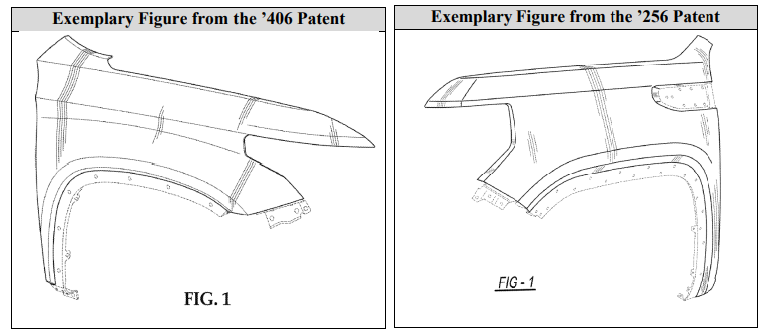
ECF 387 at ¶1; ECF 41 at ¶¶23, 38. LKQ imports and sells aftermarket automotive replacement and repair parts. ECF 1 at ¶¶1-2. On November 2, 2021, LKQ initiated this action against GM, seeking a declaratory judgment of non-infringement and invalidity concerning the Patents-in-Suit. Id. On April 25, 2022, GM filed counterclaims, alleging that LKQ sells products that infringe on the Patents-in-Suit. ECF 41. Fact discovery concluded on July 31, 2024, see ECF 101; and expert discovery concluded on January 10, 2025, see ECF 182. LKQ now moves for summary judgment on GM's claim for pre-counterclaim damages and for willful infringement; LKQ moves to bar GM's claim for disgorgement damages and GM moves to strike certain opinions of LKQ's damages expert, both based on purported discovery disclosure violations by the other party; and both parties seek to exclude the testimony of various experts.
Motion for Partial Summary Judgment
LKQ moves for partial summary judgment on pre-counterclaim damages and willful infringement. For the reasons discussed below, LKQ's motion is granted as to pre-counterclaim damages and denied as to willful infringement.
A. Legal Standard
“The court shall grant summary judgment if the movant shows that there is no genuine dispute as to any material fact and the movant is entitled to judgment as a matter of law.” Fed. R. Civ. P. 56(a). In considering such a motion, the court construes the evidence and all inferences that reasonably can be drawn therefrom in the light most favorable to the nonmoving party. See Wesbrook v. Ulrich, 840 F.3d 388, 391 (7th Cir. 2016); Kvapil v. Chippewa Cty., 752 F.3d 708, 712 (7th Cir. 2014). “Summary judgment should be denied if the dispute is ‘genuine’: ‘if the evidence is such that a reasonable jury could return a verdict for the nonmoving party.’” Talanda v. KFC Nat'l Mgmt. Co., 140 F.3d 1090, 1095 (7th Cir. 1998) (quoting Anderson v. Liberty Lobby, Inc., 477 U.S. 242, 248 (1986)); see also Bunn v. Khoury Enters., Inc., 753 F.3d 676, 681-82 (7th Cir. 2014). The court will enter summary judgment against a party who does not “come forward with evidence that would reasonably permit the finder of fact to find in [its] favor on a material question.” Modrowski v. Pigatto, 712 F.3d 1166, 1167 (7th Cir. 2013).
B. Discussion
LKQ seeks summary judgment on two issues: (a) that GM is not entitled to damages prior to the date it asserted its counterclaims; and (b) that LKQ did not willfully infringe GM's patents.
1. Pre-Counterclaim Damages
Under 35 U.S.C. §287, if “a patentee makes or sells a patented article and fails to mark in accordance with §287, the patentee cannot collect damages until it either begins providing notice or sues the alleged infringer—the ultimate form of notice—and then only for the period after notification or suit has occurred.” Arctic Cat Inc. v. Bombardier Recreational Prods. Inc., 950 F.3d 860, 864 (Fed. Cir. 2020). The parties here do not dispute that GM failed to mark its product. See ECF 448 at ¶2. In the absence of marking, “the patentee … cannot recover damages against infringers of the patent, unless he has given notice of his right … to the particular defendants, by informing them of his patent, and of their infringement of it.” Dunlap v. Schofield, 152 U.S. 244, 247-48 (1894). For purposes of determining whether a patentee provided actual notice, “[i]t is irrelevant … whether the defendant knew of the patent or knew of his own infringement. The correct approach … must focus on the action of the patentee, not the knowledge or understanding of the infringer.” Amsted Industries Inc. v. Buckeye Steel Castings Co., 24 F.3d 178, 187 (Fed. Cir. 1994). Notice must be “specific,” not “merely informational”: it “must be of ‘the infringement,’ not merely notice of the patent's existence or ownership. Actual notice requires the affirmative communication of a specific charge of infringement by a specific accused product or device.” Id.; see also SRI Intern., Inc. v. Advanced Tech. Laboratories, Inc., 127 F.3d 1462, 1470 (Fed. Cir. 1997) (actual notice given where “the recipient is informed of the identity of the patent and the activity that is believed to be an infringement”).
“[C]ompliance with the marking statute, 35 U.S.C. §287(a), is a question of fact.” Gart v. Logitech, Inc., 254 F.3d 1334, 1339 (Fed. Cir. 2001). The parties do not dispute any facts material to this inquiry. GM sent a letter to CCC, a third party, on March 1, 2019, informing CCC that certain of LKQ's parts infringed on GM's patents. See ECF 448 at ¶¶3-4; ECF 470 at 6. CCC then sent an email to LKQ on March 4, 2020, informing LKQ that GM's parts were patented and that it appeared that LKQ's parts may infringe on those patents. See ECF 448 at ¶¶3-4; ECF 470 at 6. On March 13, 2020, LKQ informed CCC that it had obtained GM's March 1, 2019 letter to CCC. See ECF 448 at ¶¶3-4; ECF 470 at 6. LKQ filed a declaratory judgment action on November 2, 2021. ECF 1. GM filed counterclaims on April 25, 2022. ECF 41. GM's filing of its counterclaims provided LKQ with actual notice as a matter of law, see 35 U.S.C. §287(a); but the parties dispute whether LKQ received actual notice earlier, either through GM's March 1, 2019 letter or LKQ's declaratory judgment action. See ECF 448 at ¶¶3-4. Importantly, the parties do not dispute the contents of either GM's March 1, 2019 letter or CCC's March 4, 2020 email. See ECF 448 at ¶¶3-4; ECF 470-1; Gart, 254 F.3d at 1346 (holding that summary judgment is appropriate where contents of notice are not in dispute). As such, “this issue is properly decided upon summary judgment when no reasonable jury could find that the patentee either has or has not provided actual notice to the ‘particular defendants by informing them of his patent and of their infringement of it.’” Id. at 1339. For the reasons discussed below, the Court finds that no reasonable jury could find that GM provided actual notice to LKQ via GM's March 1, 2019 letter or LKQ's declaratory judgment action.
First, LKQ's declaratory judgment action cannot constitute actual notice. Though the Federal Circuit appears to have not squarely addressed this issue, it has repeatedly held that the determination of whether a patentee provided an alleged infringer with actual notice “cannot take into consideration the knowledge or understanding of the alleged infringer, but must focus on the action of the patentee.” Gart, 254 F.3d at 1346 (citing Amsted, 24 F.3d at 187 (“[I]t is irrelevant … whether the defendant knew of … his own infringement.”)). This is in large part because “[t]he policy of §287 is to encourage marking, not merely to discourage the sale of unmarked products.” Arctic Cat, 950 F.3d at 865. LKQ cites Lucent Techs. Inc. v. Gateway, Inc., 470 F. Supp. 2d 1163 (S.D. Cal. 2007) in support of its argument. There, the Southern District of California held that a declaratory judgment does not meet the standards for actual notice under Section 287 because “[i]ts purpose is a declaration of no infringement; the party bringing the action for declaratory relief believes that the activity in question is not an infringement. It is not an action taken by the patentee. A declaratory judgment also is not proposal to abate the infringement, but rather a statement of intent by the party filing the action to continue the activity in question.” Id. at 1171 (citing SRI Intern., Inc. v. Advanced Technology Laboratories, Inc., 127 F.3d 1462, 1470 (Fed. Cir. 1997)). This Court finds this reasoning persuasive, and adopts it here.
Both parties misinterpret the Federal Circuit's holding in SRI to support their respective arguments for this Court to adopt or not adopt the Lucent Court's reasoning. In SRI, the Federal Circuit held that “[t]he criteria for actual notice under §287(a) are not coextensive with the criteria for filing a declaratory judgment action … Actual notice may be achieved without creating a case of actual controversy in terms of 28 U.S.C. §2201 … [T]he actual notice requirement is met when the recipient is notified, with sufficient specificity, that the patent holder believes that the recipient of the notice may be an infringer.” SRI, 127 F.3d at 1470. GM argues that Lucent is distinguishable because SRI stands for the proposition that the threshold for actual notice is less than what is needed for a case or controversy, such that “[i]t cannot be that GM's actions provided notice sufficient to create a case or controversy in November 2021, but not actual notice sufficient to start accruing damages until April 2022.” ECF 446 at 20. But SRI actually holds that a letter from a patentee to an alleged infringer need not assert actual claims of infringement in order to provide actual notice; not, as GM argues, that the threshold for actual notice is necessarily satisfied by circumstances meeting the higher standard for a case or controversy—affirmative action by the patentee is still required. LKQ argues that GM did not provide actual notice until the filing of its counterclaims because GM represented to LKQ and the Court that “GM has made no claim of infringement to LKQ relating to the patents-in-suit.” ECF 470 at 9. But the Federal Circuit clarified in Gart that, “as long as the communication from the patentee provides sufficient specificity regarding its belief that the recipient may be an infringer, the statutory requirement of actual notice is met. Thus, the requirement of ‘a specific charge of infringement’ set forth in Amsted does not mean the patentee must make an ‘unqualified charge of infringement.’” Gart, 254 F.3d at 1346.
Second, a reasonable jury could not find that GM's letter to CCC constitutes actual notice. GM asserts that, on March 1, 2019, it sent a letter to CCC, which identified “certain aftermarket seller's products” that “are infringing GM's registered design patents.” ECF 448 at ¶¶3-4. The letter stated “[n]either LKQ Corporation, nor any other entity, is licensed under the design patents listed in the attached Exhibit B.” Id. Exhibit B listed the relevant patents, including the Patents-in-Suit, and the corresponding part. Id. The letter stated that “parts covered by the patents listed on Exhibit B are unauthorized and therefore infringing.” Id. The parties dispute whether GM may provide LKQ with actual notice by directing that notice to a third party, CCC. Under Federal Circuit precedent, it may not. The Federal Circuit has “addressed situations where notification came from someone associated with the alleged infringer and concluded that ′notice of infringement must … come from the patentee, not the infringer.” Lans v. Digital Equipment Corp., 252 F.3d 1320, 1327 (Fed. Cir. 2001). Even notice by the alleged infringer's own counsel is not sufficient to alleviate the patentee of its obligation to provide actual notice in the absence of marking under the statute. See id. (citing Am. Med. Sys., Inc. v. Med. Eng'g Corp., 6 F.3d 1523, 1537 n. 18 (Fed. Cir. 1993) (notice to the alleged infringer by its own counsel “is clearly not what was intended by the marking statute”)). For this reason, no reasonable jury could find that GM's March 1, 2019 letter to CCC—a third party not affiliated with GM or LKQ—constitutes actual notice to LKQ.
GM argues that “Section 287 requires only—in the passive voice—‘proof that the infringer was notified of the infringement and continued to infringe thereafter’” and that LKQ did receive actual notice because it eventually obtained a copy of the letter sent to CCC. ECF 446 at 19. Sometime between March 1, 2019, and March 13, 2020, LKQ obtained a copy of GM's March 1, 2019 letter. On March 4, 2020, LKQ received a letter from CCC stating that “[a]ccording to General Motors (GM),” “‘[c]ertain GM collision parts are protected by United States design patents. This means that unlicensed making, using, and/or selling of a protected part could constitute an infringement of a GM design patent.’” ECF 448 at ¶¶3-4. The letter notified LKQ that “it appears your company is selling Aftermarket/Non-OEM parts that appear on GM's patented parts list” and asked LKQ to remove any parts “where applicable design patents have not been licensed from GM.” Id. The letter added “[i]f you feel your parts do not infringe on GM design patents, please provide specifics that can be shared with GM or contact General Motors directly.” Id. On March 13, 2020, LKQ replied to CCC, disputing GM's allegations, and attached a copy of GM's March 1, 2019 letter. See ECF 448-3, ECF 448-4.
But GM's argument, and a finding of actual notice on these facts, is only workable if one ignores more than a century and a half of patent law holding that “[t]he clear meaning of [the marking statute] is that the patentee … cannot recover damages against infringers of the patent, unless he had given notice of his right … to the particular defendants, by informing them of his patent and of their infringement of it.” Dunlap, 152 U.S. at 247-48 (emphasis added). The fact that LKQ managed to obtain a copy of the March 1, 2019 letter is beside the point; knowledge of the alleged infringer is outside the scope of the notice inquiry. See Amsted, 24 F.3d at 187. And CCC's email, standing alone, is “merely informational.” See id. Even assuming, but not deciding, that the contents of the March 1, 2019 letter were indeed sufficiently specific, that specificity was lost in transmission: CCC's email does not identify any of GM's patents nor any of LKQ's parts. See, e.g., id.; SRI, 127 F.3d at 1470. If GM wished to simply notify the public writ large about its patents, it should have marked its products; but because it did not, it was obligated to provide actual notice to LKQ.
As LKQ's filing of its declaratory judgment action and GM's letter to CCC are insufficient as a matter of law to constitute actual notice under Section 287, the Court finds that GM did not effect actual notice of infringement until the filing of its counterclaims on April 25, 2022. The Court grants LKQ's motion for summary judgment with respect to pre-counterclaim damages. GM is not entitled to damages prior to April 25, 2022.
2. Willful Infringement
“[T]he concept of ‘willfulness’ requires a jury to find no more than deliberate or intentional infringement.” SRI International, Inc. v. Cisco Sys. Inc., 14 F.4th 1323, 1329-30 (Fed. Cir. 2021) (citing Halo Elecs., Inc. v. Pulse Elecs., Inc., 579 U.S. 93, 103-04 (2016) and differentiating between conduct warranting a finding of willful infringement by a jury and enhanced damages by a district court). The patentee must only prove subjective willfulness, meaning that the alleged infringer acted despite a risk of infringement that was “either known or so obvious that it should have been known to the accused infringer.” Arctic Cat, 876 F.3d at 1371. This is “quintessentially a question of fact, for it depends on findings of culpable intent and deliberate or negligent wrongdoing.” Biotec Biologische Naturverpackungen GmbH & Co. KG v. Biocorp, Inc., 249 F.3d 1341, 1356 (Fed. Cir. 2001); see also WBIP, LLC v. Kohler Co., 829 F.3d 1317, 1341 (Fed. Cir. 2016) (holding that “the factual components of the willfulness question should be resolved by a jury” and collecting cases). In determining willfulness, a jury considers the “totality of the circumstances.” Comark Communications, Inc. v. Harris Corp., 156 F.3d 1182, 1190 (Fed. Cir. 1998). A jury may consider whether the alleged infringer: intentionally copied a product covered by a patent-in-suit; reasonably believed it did not infringe or that the patent was valid, including its reliance on an opinion of counsel; made a good faith effort to avoid infringing; and/or tried to cover up its infringement. See Eko Brands, LLC v. Adrian Rivera Maynez Enters., Inc., 946 F.3d 1367, 1377-79 (Fed. Cir. 2020); Omega Patents, LLC v. CalAmp Corp., 920 F.3d 1337, 1353 (Fed. Cir. 2019).
a. Post-Suit Conduct
The material facts here are not in dispute. On May 24, 2021, LKQ's outside counsel, Reid Huefner, presented his opinion to LKQ, including its Senior Vice President and President of North American Wholesale Operations, Justin Jude, that the Patents-in-Suit were likely invalid because they were anticipated or obvious over the prior art. ECF 387 at ¶¶13, 25; ECF 448 at ¶¶13, 25. Among other things, Mr. Huefner determined that the ′406 Patent was obvious over the 2016 Mitsubishi Pajero and/or a combination of the 2016 Mitsubishi Pajero with the 2015 Toyota Tundra; and that the ′256 Patent was obvious over the 2015 Chevy Colorado and/or a combination of the 2015 Chevy Colorado and U.S. Patent No. D614, 100. ECF 387 at ¶¶26, 29; ECF 448 at ¶¶26; 29. Mr. Huefner presented his opinion orally at a meeting with Mr. Jude with the aid of a slideshow presentation, with one slide dedicated to Mr. Huefner's opinion on each Patent-in-Suit. ECF 387 at ¶¶27, 30; ECF 448 at ¶¶27; 30. Mr. Jude relied on Mr. Huefner's opinion as part of the basis for his decision to begin selling the accused fenders. ECF 387 at ¶32; ECF 448 at ¶32.
On these facts, a reasonable jury could find that LKQ's infringement was willful. LKQ argues that it had a subjective good faith belief in the invalidity of the Patents-in-Suit as evidenced by its opinion of counsel. But good faith belief, standing alone, is insufficient; an opinion of counsel “must be ‘competent’ or it is of little value in showing the good faith belief of the infringer.” Comark, 156 F.3d at 1191. “A written opinion may be incompetent on its face by reason of its containing merely conclusory statements without discussion of facts or obviously presenting only a superficial or off-the-cuff analysis.” Read Corp. v. Portec, Inc., 970 F.2d 816, 829 (Fed. Cir. 1992), abrogated in part on other grounds by Markman v. Westview Instruments, Inc., 517 U.S. 370 (1996). Additionally, while written memorialization of the opinion is not a prerequisite to a finding of competency, the fact that an opinion was presented orally raises credibility determinations within the province of the jury. See Eli Lilly & Co. v. Zenith Goldline Pharmaceuticals, Inc., 2001 WL 1397304, at *24-26 (S.D. Ind. Oct. 29, 2021) (collecting cases, including Minnesota Min. and Mfg. Co. v. Johnson & Johnson Orthopaedics, Inc., 976 F.2d 1559, 1580 (Fed. Cir. 1992) (holding that “[oral] opinions carry less weight, for example, because they have to be proved perhaps years after the event, based only on testimony which may be affected by faded memories and the forces of contemporaneous litigation”)).
GM identifies several key aspects of the substantive analysis that are missing from the written opinion contained on the slideshow presentation. See ECF 446 at 17. For example, GM asserts that the substantive analysis of the Patents-in-Suit consisted of two slides stating, without any written explanation, that “[a] reasonable jury should find this patent to be invalid as anticipated or obvious.” Id. LKQ argues that the substantive analysis supporting this conclusion was presented orally. See ECF 386 at 16. But LKQ does not argue that the written portion of its opinion of counsel could be found to be competent notwithstanding the oral opinion. As such, if a jury were to determine that testimony concerning the oral opinion was not credible, it would not be unreasonable for that jury to find that the remaining portions of the written opinion were flawed as a result. For this reason, LKQ fails to carry its burden on summary judgment; and the Court need not reach the parties' copying and attempts to license arguments.
b. Pre-Suit Conduct
LKQ also argues that it is entitled to summary judgment of no pre-suit willful infringement because it did not sell the accused products prior to the filing of its declaratory judgment action. See ECF 386 at 10. As an initial matter, the Federal Circuit has held that, in a declaratory judgment action such as this one, the “relevant date for determining which conduct is pre-suit is the date of the patentee's affirmative allegation of infringement,” i.e., the date of the infringement counterclaim. Mentor Graphics Corp. v. EVE-USA, Inc., 851 F.3d 1275, 1295 (Fed. Cir. 2017). The parties do not dispute that GM filed its counterclaims on April 25, 2022 or that LKQ imported the accused products in November 2021—i.e., pre-suit. See ECF 41; ECF 448 at 54; ECF 470-1 at 25-26. However, GM—likely led astray by LKQ's misuse of the term “pre-suit” in this context—misunderstands LKQ's argument. LKQ is not requesting a finding of no pre-suit willful infringement whatsoever; rather, LKQ argues that it is entitled to a finding of no willful infringement before the filing of its declaratory judgment action on November 2, 2021, which coincides with its import of the accused products in November 2021. That is to say, LKQ argues that it did not infringe on GM's patents prior to November 2, 2021, and thus, in the absence of any infringement, no reasonable jury could find that LKQ's conduct was willful. See Bayer Healthcare LLC v. Baxalta Inc., 989 F.3d 964, 988 (Fed. Cir. 2021) (“[E]vidence of infringement is necessary … for a finding of willfulness.”). While the parties agree that LKQ did not make, use, sell, offer for sale, or import any of the accused products prior to “the fourth quarter of 2021,” they do dispute whether “the fourth quarter of 2021” includes dates prior to November 4, 2021. See ECF 387 at ¶12; ECF 448 at ¶12; ECF 470-1 at ¶5. In light of this genuine dispute of material fact, the Court denies LKQ's motion on this issue.
* * *
LKQ's motion for summary judgment is granted as to pre-counterclaim damages and denied as to willful infringement.
Motions for Sanctions
Both LKQ and GM allege that the other party failed to make disclosures required under Federal Rule of Civil Procedure 26 with respect to GM's claim for disgorgement damages, and seek sanctions: LKQ moves to bar GM's claim for disgorgement damages and GM moves to strike certain opinions of LKQ's damages expert. As both motions describe disputes that should have been raised during fact discovery, they are denied.
A. Legal Standard
Federal Rule of Civil Procedure 26(a) provides that “a party must, without awaiting a discovery request, provide to the other parties,” among other things, “the name … of each individual likely to have discoverable information—along with the subjects of that information—that the disclosing party may use to support its claims or defenses” and “a computation of each category of damages claimed by the disclosing party.” Fed. R. Civ. P. 26(a)(1)(A)(i), (iii). To ensure compliance with these discovery requirements, Federal Rule of Civil Procedure 37 provides that, “[i]f a party fails to provide information or identify a witness as required by Rule 26(a) …, the party is not allowed to use that information or witness to supply evidence on a motion, at a hearing, or at a trial, unless the failure was substantially justified or is harmless.” Fed. R. Civ. P. 37(c)(1).
“[T]he sanction of exclusion is automatic and mandatory unless the sanctioned party can show that its violation of Rule 26(a) was either justified or harmless.” David v. Caterpillar, Inc., 324 F.3d 851, 857 (7th Cir. 2003). However, “[w]hether a failure to comply with Rule 26(a) … is substantially justified, harmless, or warrants sanctions is left to the broad discretion of the district court.” Dynegy Mktg. & Trade v. Multiut Corp., 648 F.3d 506, 514 (7th Cir. 2011). “A district court need not make explicit findings concerning the existence of a substantial justification or the harmlessness of a failure to disclose.” David, 324 F.3d at 857. The following factors guide the court's discretion: “(1) the prejudice or surprise to the party against whom the evidence is offered; (2) the ability of the party to cure the prejudice; (3) the likelihood of disruption to the trial; and (4) the bad faith or willfulness involved in not disclosing the evidence at an earlier date.” Id.
B. Motion to Bar GM's Claim for Disgorgement Damages
LKQ moves to bar GM's claim for disgorgement damages due to its failure to provide the computation of those damages pursuant to Federal Rule of Civil Procedure 26(a)(1)(A)(iii). Under the disgorgement theory of damages under Section 289 of the Patent Act, a patentee may seek recovery of an infringer's “total profit” associated with the accused products. See 35 U.S.C. §289. “Total profit” is calculated by deducting certain allowable costs from the alleged infringer's gross revenue. See Nike, Inc. v. Wal-Mart Stores, Inc., 138 F.3d 1437, 1447 (Fed. Cir. 1998). GM's counterclaim seeks “all damages to which it is entitled, but in no event less than a reasonable royalty, under 35 U.S.C. §§284 and/or 289.” ECF 41 at 25. GM's initial disclosures, served on December 31, 2021, did not include a computation, or even a theory, of any damages. See ECF 373-1 at 5. GM did not disclose that it would seek disgorgement damages, in the first instance, until October 11, 2022. See ECF 373-3 at 4. In response to an interrogatory requesting, inter alia, that GM state its damages theory or theories and its damages calculation(s), GM stated that “[p]ursuant to 35 U.S.C. §289, GM will seek the extent of LKQ's total profit for its infringement of the Challenged GM Design Patents.” Id. at 5. GM also objected to this interrogatory on the basis that it sought premature expert discovery. Id. at 5. However, on April 11, 2022, GM served discovery requests on LKQ seeking, among other things, financial information concerning the revenue and profitability realized by LKQ from sales of the products at issue. ECF 425-1 at RFP No. 15; ECF 425-2 at Interrogatory No. 5.
On December 8, 2022, LKQ produced the underlying financial documents necessary for GM to provide its computation of damages for its disgorgement claim. ECF 373 at ¶14. On January 17, 2023, GM supplemented its response to LKQ's Interrogatory No. 7, directing LKQ to certain documents produced in the course of discovery pertinent to its disgorgement damages theory. ECF 373-4 at 7. On February 17, 2023, GM served its first amended initial disclosures, but did not amend its disclosures to include either a theory or computation of damages. See ECF 373-2 at 5. On August 28, 2025—almost thirteen months after the close of fact discovery on July 31, 2024, see ECF 101—GM disclosed its computation of disgorgement damages through service of an expert report. ECF 372 at 3.
The parties do not dispute that GM failed to disclose its disgorgement damages calculation until more than a year after the close of fact discovery, a facial violation of Federal Rule of Civil Procedure 26. However, the Court finds that GM's failure to comply with Rule 26 was substantially justified and/or harmless. GM disclosed its intent to seek disgorgement damages twenty-one months prior to the close of fact discovery; it has provided a calculation of its disgorgement damages before trial, and no date for trial has been set; and the calculations are based on LKQ's own documents. See Kenall Manufacturing Company v. Cooper Lighting, LLC, 723 F. Supp. 3d 640, 661-62 (N.D. Ill. 2024) (citing Assaf v. Trinity Med. Ctr., 696 F.3d 681 (7th Cir. 2012)); contrast with Paramount Media Group, Inc. v. Village of Bellwood, 2015 WL 5307483, at *2-3 (N.D. Ill. Sept. 10, 2015) (plaintiff changed damages theory only after close of fact discovery); Lancelot Investors Fund, L.P. v. TSM Holdings, Ltd., 2008 WL 1883435, at *5-6 (N.D. Ill. April 28, 2008) (plaintiff revised damages from $400,000 to $2 million near the very close of fact discovery); Design Strategy, Inc. v. Davis, 469 F.3d 284, 293 (2d 2006) (plaintiff disclosed damages theory only after close of fact and expert discovery); Pittsfield Development, LLC v. City of Chicago, 2021 WL 8314423, at *6 (N.D. Ill. Nov. 15, 2021) (plaintiff did not provide damages computation prior to the close of fact discovery or by way of expert discovery).
LKQ does not compellingly argue that it was prejudiced by GM's violation. It asserts that GM's failure to disclose its calculation until expert discovery “prevent[ed] LKQ from taking discovery necessary to respond to GM's refusal to (a) deduct any costs other than cost of goods sold from LKQ's revenue associated with the accused products; and (b) to allocate any costs to the unpatented components of the accused parts.” ECF 463 at 9. In particular, LKQ argues that GM failed “to provide discovery LKQ sought regarding GM's own cost allocations claiming that its costs are not relevant.” Id. at 14. But if LKQ did indeed seek that information during fact discovery, then it could not have been prejudiced by GM's failure to provide its disgorgement calculation; instead, the dispute LKQ describes is one that should have been raised during fact discovery on a motion to compel. And it does not flow from GM's position that that information was not relevant that GM was “implying that it was not pursuing a disgorgement damages computation,” see id.; the reasonable inference in light of GM's other discovery responses is that GM was simply disputing what information is relevant to the disgorgement computation. LKQ also states that GM's computation was “a simple mathematical computation … based on two documents LKQ produced showing LKQ's cost of goods sold for the accused party and apply that to the sales of the accused parts.” Id. at 8 (emphasis removed). It is difficult to square LKQ's claims of prejudice with its description of the computation.
Lastly, to the extent either party relies on the parallel case LKQ Corporation et al v. General Motors Company et al, No. 1:20-cv-02753 (filed on November 2, 2021) (“LKQ I”), their arguments are not compelling. The facts at issue in this case differ from those at issue in LKQ I, see ECF 463 at 10-11; and the parties are not relieved of their obligations under the Federal Rules of Civil Procedure in this case merely by virtue of their fulfillment in LKQ I, see ECF 424 at 14.
C. Motion to Strike Opinions of LKQ's Damages Expert
GM moves to strike certain opinions of Joanne Johnson, LKQ's damages expert, that rely on statements by a fact witness that LKQ allegedly did not disclose during discovery. ECF 403 at 5. During discovery, LKQ asserted that “GM is not entitled to the portion of LKQ's profits allocated to the B-side of the Accused Products, including any bracket or other portion not claimed in the Patents-in-Suit.” ECF 403-4. Tong Yang Group (“TYG”) is LKQ's supplier for the allegedly infringing fenders. ECF 440 at 4. GM sought information relating to TYG's manufacturing through various discovery requests, including requesting that LKQ identify for each accused product “the costs associated with making … each such product” and requesting “documents related to the production, manufacture, and/or design” of the accused products, including to the extent they were “designed or manufactured by a third party.” ECF 403-5, ECF 403-6.
GM argues that LKQ disclosed for the first time in Ms. Johnson's expert report the identity of and information obtained from Eric Lin, a sales director at Tong Yang Group, LKQ's supplier for the accused products. During a phone call, Mr. Lin relayed to Ms. Johnson information about “the direct material and direct labor costs incurred by Tong Yang Group … in connection with its sale of the Accused Fender Parts to LKQ,” including the costs associated with a sheet metal component and a reinforcement bracket, which are assembled into the accused fender parts. ECF 403-1 at ¶42. Ms. Johnson testified at her deposition that no documents were exchanged and that she “relied on” Mr. Lin for this information. ECF 403-2 at 38:2-39:4. Ms. Johnson then utilized Mr. Lin's information to opine that LKQ's “total profit” under Section 289 of the Patent Act should be reduced “proportional to the costs that relate to unclaimed elements of the Patents-in-Suit (i.e., the reinforcement bracket).” ECF 403-1 at ¶44; see also id. at ¶¶12, 42-44, 63-64, Figs. 1 & 12, Exhibits 3.1, 3.1.1, 3.1.2, 9.1.
LKQ argues that it did disclose TYG and Mr. Lin early in fact discovery, and that GM simply failed to follow up. LKQ states that it identified TYG as its supplier of the accused fenders in interrogatory responses and in its first amended initial disclosures; that it identified, by Bates number, communications with TYG, including communications with Mr. Lin, in interrogatory responses; and that two of its Rule 30(b)(6) witnesses identified TYG as LKQ's supplier for the accused fenders and specifically identified Mr. Lin as LKQ's primary contact at TYG. See ECF 440 at 13-14. LKQ also argues that GM subpoenaed an affiliate of TYG, but did not subpoena TYG itself. Id. at 14. But LKQ does not argue that it disclosed Mr. Lin directly, or that it had otherwise produced to GM, either through interrogatory responses, document discovery, or deposition testimony, the facts communicated by Mr. Lin to Ms. Johnson. For this reason, LKQ's argument fails. While LKQ's disclosures and other discovery responses may have arguably put GM on notice as to the existence of Mr. Lin, such notice does not constitute “disclosure” under Rule 26.
However, the Court finds that LKQ's failure to disclose this information and the identity of Mr. Lin was harmless. GM does not convincingly argue that it was prejudiced by LKQ's violation. It asserts that LKQ “surprise[ed] GM with new facts that GM specifically requested during fact discovery.” ECF 403 at 5. In particular, GM states that LKQ argued that “GM is not entitled to the portion of LKQ's profits allocated to the B-side of the Accused Products, including any bracket or other portion not claimed in the Patents-in-Suit.” Id. at 7 (quoting ECF 403-4). GM asserts that, “[i]n order to address this argument, GM made at least ten attempts via separate Interrogatories and Requests for Production to obtain information relating to Tong Yang Group's manufacturing.” Id. This is the crux of the problem: the dispute GM describes is one that should have been raised during fact discovery. This is underscored by the fact that GM subpoenaed TYG's American affiliate, rather than TYG, a Taiwanese company not subject to the Hague Convention and beyond the subpoena power of this Court; failed to obtain the information it sought from TYG from the American affiliate; and then made no attempt to obtain that information from TYG itself. Taking LKQ at its word, Mr. Lin was LKQ's primary contact with TYG, and presumably would have been offered as a witness by TYG or would have otherwise been involved in preparing discovery responses on behalf of TYG. One reading of these facts is that GM was not willing to undertake the hurdle to obtain discovery from TYG, and, unable to overcome this hurdle through a motion to compel, is now seeking, misguidedly, to circumvent that process by asking this Court to place the burden to produce Mr. Lin on LKQ.
Independent of, but related to, the Rule 26 disclosure issue, GM argues that Ms. Johnson's opinion should be stricken insofar as it relies on Mr. Lin's hearsay statements. However, Federal Rule of Evidence 703 permits “[a]n expert [to] base an opinion on facts or data in the case that the expert has been made aware of … If experts in the particular field would reasonably rely on those kinds of facts or data in forming an opinion on the subject, they need not be admissible for the opinion to be admitted.” GM does not argue that it would be unreasonable for Ms. Johnson to rely on the facts and data communicated to her by Mr. Lin, and instead argues that Ms. Johnson is simply parroting Mr. Lin's out-of-court statements. See ECF 403 at 8-9. But Ms. Johnson's report is a far cry from the circumstances courts have found to constitute an attempt to circumvent the Federal Rules of Evidence. For example, the court in Loeffel Steel Products, Inc. v. Delta Brands, Inc., 387 F. Supp. 2d 794 (N.D. Ill. 2005) found that an expert who vouched for the methodology of two other experts, without any knowledge as to whether the underlying theory is valid or reliable, was “hiding behind” other experts and acting as their “mouthpiece.” Id. at 808. This is not what Ms. Johnson is proposing to do here. Rather, her proposed testimony is more closely aligned with the expert testimony in U.S. v. Brownlee, 744 F.3d 479 (7th Cir. 2014). There, an ATF agent's expert testimony at trial was based in part on information she had learned during a phone call she had with the manager of a gun manufacturing plant. Id. at 480-81. The Seventh Circuit stated that the ATF agent “would not have been [parroting an out-of-court statement] in quoting what the manager told her in their phone conversation.” Id. at 482.
GM's motion to strike certain opinions of Ms. Johnson is denied.
Motions in Limine
LKQ moves to exclude the testimony of Suzanne Thompson, GM's disgorgement damages expert, and of Craig Metros, GM's design expert; and GM moves to exclude the testimony of Meredith Martin Addy, LKQ's legal clearance opinion expert. For the reasons discussed below, LKQ's motion concerning Ms. Thompson is denied; LKQ's motion concerning Mr. Metros is granted in part and denied in part; and GM's motion concerning Ms. Addy is granted in part and denied in part.
A. Legal Standard
Federal Rule of Evidence 702 provides that a witness “who is qualified as an expert by knowledge, skill, experience, or education may testify … if”: “(a) the expert's scientific, technical, or other specialized knowledge will help the trier of fact to understand the evidence or to determine a fact in issue; (b) the testimony is based on sufficient facts or data; (c) the testimony is the product of reliable principles and methods; and (d) the expert's opinion reflects a reliable application of the principles and methods to the facts of the case.” It is the Court's responsibility to “ensure that any and all scientific testimony or evidence admitted is not only relevant, but reliable.” Daubert v. Merrell Dow Pharm., Inc., 509 U.S. 579, 589 (1993). “[W]here such testimony's factual basis, data, principles, methods or their application are called sufficiently into question, … the trial judge must determine whether the testimony has ‘a reliable basis in the knowledge and experience of [the relevant] discipline.’” Kumho Tire Co. v. Carmichael, 526 U.S. 137, 149 (1999) (alteration in original) (quoting Daubert, 509 U.S. at 592). Specifically, the Court must “determine whether the expert is qualified in the relevant field,” “examine the methodology the expert has used,” and “consider whether the testimony will assist the trier of fact.” Smith v. Ford Motor Co., 215 F.3d 713, 718 (7th Cir. 2000) (citing Kumho, 526 U.S. at 153). “The court, in its role as gatekeeper, must exclude expert testimony that is not reliable and not specialized, and which invades the province of the jury to find facts and that of the court to make ultimate legal conclusions.” Sundance, Inc. v. DeMonte Fabricating Ltd., 550 F.3d 1356, 1364 (Fed. Cir. 2008).
B. Discussion
1. Suzanne Thompson
LKQ moves to exclude testimony by Suzanne Thompson, GM's proposed expert witness on disgorgement damages under 35 U.S.C. §289. As discussed above, under 35 U.S.C. §289, a patentee may seek disgorgement of an infringer's “total profit” associated with the accused products, which is calculated by deducting certain allowable costs from the alleged infringer's gross revenue. See Nike, 138 F.3d at 1447. LKQ's basis for exclusion is narrow: it argues only that Ms. Thompson's opinion conflicts with the law insofar as her calculation of LKQ's total profits deducts only those costs that are incremental specifically to the accused products, rather than both variable and fixed costs that are attributable to the accused products, from LKQ's gross revenue. See ECF 395 at 3-4; see also Loeffel, 387 F. Supp. 2d at 806 (“Expert opinions that are contrary to law are inadmissible.”).
To support its argument, LKQ relies on two cases; but neither purports—and indeed, both expressly disclaim any attempt—to establish a general rule of law concerning fixed expenses. First, LKQ relies on Sunbeam Prods., Inc. v. Wing Shing Prods. (BVI) Ltd., 311 B.R. 378 (S.D.N.Y. 2004), aff'd 153 Fed App'x 703, 711 (Fed. Cir. 2005). There, a patentee argued that the infringer should not be allowed to deduct any portion of a fixed cost since, by definition, the fixed cost would have been incurred regardless of the infringement. Id. at 401. The bankruptcy court decided that portions of fixed costs are deductible in calculating profit to the extent those portions can be attributed to the infringing product, and the Southern District of New York affirmed. Id. But the Southern District of New York also reiterated the Second Circuit's holding in Hamil that “[t]he reasonableness of the proffered overhead allocation formula is a question of fact in all cases.” Id. (quoting Hamil Am., Inc. v. GFI, Inc., 193 F.3d 92, 105 (2d Cir. 1999)). Second, LKQ's citation to Schnadig Corp. v. Gaines Mfg. Co., Inc., 620 F.2d 1166 (6th Cir. 1980) fares no better. There, the Sixth Circuit observed that “[a]lthough the proper treatment of fixed expenses can be viewed as a question of law, most courts have perceived the real question to be the relationship between the particular fixed costs and the infringing production in each case, and this has been treated as a question of fact.” Id. at 1175. The Sixth Circuit adopted this approach, holding that, “[a]though a clear-cut rule may be more comforting to litigants,” an approach that considers “the factual relationship between the infringing production and the claimed expenses … is a realistic one.” Id. Federal Circuit precedent is in line with the holdings of Sunbeam and Schnadig that the allocation of overhead costs is a fact-specific determination. See Nike, 138 F.3d at 1447 (affirming district court's total profit calculation which deducted “the direct cost of freight-in and the indirect costs of customer returns, shrinkage, and attributable indirect expenses,” but not the overhead expenses for which the accused infringer failed to present any supporting evidence).
As such, Ms. Thompson's decision not to deduct certain of LKQ's expenses because she was “not aware of any evidence that any of these costs or expenses … are incremental specifically to the Accused Products” is not contrary to law. See ECF 395 at 6; see, e.g., Hamil, 193 F.3d at 106 (infringer “must still carry its burden of demonstrating a sufficient nexus between each expense claimed and the sales of the unlawful goods”). Contrary to LKQ's assertions, Ms. Thompson did not “categorically” exclude expenses that were not incremental specifically to the Accused Products. See ECF 395-1. Instead, Ms. Thompson did so due to the “facts and circumstances” specific to this case. See id. at ¶37. In particular, Ms. Thompson stated that she based her calculation on evidence that “[t]he Accused Products are an immaterial portion of LKQ's total revenue and operations,” accounting for less than 0.03% of LKQ's US wholesale total revenue. Id. at ¶35. Additionally, as GM notes, Ms. Thompson's calculation did deduct certain fixed costs, including warehousing and transportation costs. See ECF 418 at 14 n.3. And LKQ asserts that it “is not challenging Ms. Thompson's allocation of costs.” ECF 457 at 7.
As such, LKQ's motion to exclude the testimony of Suzanne Thompson is denied.
2. Craig Metros
LKQ moves to exclude testimony by Craig Metros, GM's design expert, related to LKQ's business, GM's business, and his interpretation of the term “record-based” under the new design patent obviousness standard. In his opening report, Mr. Metros states that he has been retained “to provide my opinions concerning whether LKQ infringes the GM Design Patents and whether GM's products practice the GM Design Patents.” ECF 412-1 at ¶1. In his report, Mr. Metros offers four opinions: (1) GM's products 84679031 and 84679032, which may be used on GM's 2018-2023 Chevrolet Traverse, embody the ′406 Patent, such that an ordinary observer would find them to be substantially the same; (2) LKQ infringes the ′406 Patent because an ordinary observer would find LKQ Part Nos. GM1240409C and GM1241409C are substantially the same as the ′406 Patent; (3) GM's products 84496744 and 84496745, which may be used on GM's 2019-2023 GMC Sierra, embody the ′256 Patent, such that an ordinary observer would find them to be substantially the same; and (4) LKQ infringes the ′256 Patent because an ordinary observer would find LKQ Part Nos. GM1240413C and GM1241413C are substantially the same as the ′256 Patent. Id. at ¶101. LKQ does not challenge the admissibility of these opinions.
As part of his expert report, Mr. Metros provides “[b]ackground regarding GM,” id. at ¶¶20-23, and “[b]ackground regarding LKQ,” id. at ¶¶24-31. Regarding GM, Mr. Metros discusses GM's history and contributions to the economy, the number of GM facilities and employees, GM's sales and research and development investments, and the scope of GM's intellectual property portfolio. Id. at ¶¶23. Regarding LKQ, Mr. Metros states that LKQ manufactures its GM replacement parts by working with manufacturers to reverse engineer those parts; that LKQ is in the business of selling copies of GM parts; and that LKQ does not invest in product development. See id. at ¶¶24-31. As part of this background, Mr. Metros highlights a letter from LKQ's counsel to Customs and Border Patrol, wherein LKQ discusses how it is “essential” that a part have the same appearance as the “original” part (the “CBP letter”). Id. at ¶26.
In his rebuttal report, Mr. Metros purports to offer expert testimony on the validity of the Patents-in-Suit. See ECF 412-2. In particular, he offers several opinions on the obviousness of the Patents-in-Suit, including that “[o]bjective factors of non-obviousness, such as copying, support a finding that the Patents-in-suit are not obvious.” Id. at ¶6. In support of this opinion, Mr. Metros discusses how LKQ's business practices are evidence of copying. See id. at ¶¶225-234.
LKQ challenges Mr. Metros's assertions concerning LKQ's business, Customs and Border Patrol, and GM's business, arguing that Mr. Metros's opinions are speculative, untethered from scientific principle, and/or that Mr. Metros does not have sufficient expertise to offer opinions on these topics. But Mr. Metros is not opining on LKQ's business practices; Mr. Metros is not opining on Customs and Border Patrol; and Mr. Metros is not opining on GM's business. Contrast with Sloan Valve Co. v. Zurn Indus., Inc., 2013 WL 5497247, at *2-4 (N.D. Ill. Oct. 3, 2013) (two of four opinions offered by expert directly concerned reverse engineering); Obrycka v. City of Chicago, 2011 WL 2456539, at *10 n. 5 (N.D. Ill. June 16, 2011) (expert purported to opine on the Chicago Police Department). As GM argues, these statements by Mr. Metros are simply (purportedly) factual assertions, not expert opinions; LKQ's arguments about scientific principle and expertise are misplaced.
But neither does GM meet its burden to demonstrate that Mr. Metros's assertions on these topics are admissible. GM argues that Mr. Metros is simply stating the factual assertions underlying his ultimate expert opinion. This argument fails for two reasons. First, several of Mr. Metros's assertions are supported only by citations to the parties' pleadings. See ECF 412-1 at ¶¶24-25 (citing ECF 28 (LKQ's amended complaint); ECF 41 (GM's answer and counterclaim pleadings)). This testimony is not admissible because it is not based on evidence. Second, GM does not successfully argue that the facts concerning GM's history are at all relevant to Mr. Metros's expert opinion. Instead, GM merely argues that these facts are relevant to the overall case. See ECF 430 at 17-18. This is not enough; the factual assertions must be relevant to the expert opinion. See LG Elecs. U.S.A., Inc. v. Whirpool Corp., 2010 WL 3397358, at *6 (N.D. Ill. Aug. 24, 2010) (factual assertions were admissible where they formed the basis for the expert's opinion). To the extent GM wishes to introduce such evidence at trial, it cannot do so through Mr. Metros.
GM also does not meet its burden to show that the facts concerning LKQ's business practices are relevant to Mr. Metros's infringement opinion. In support of its argument, GM cites a single sentence, also contained in the background section of Mr. Metros's opening report; this is not sufficient. See ECF 430 at 14. GM asserts that Mr. Metros's testimony is admissible because Mr. Metros draws these facts from the record, Mr. Metros is not being offered to prove these facts, and other witnesses will establish these facts as true at trial. See id. at 15. But the fact that other witnesses will testify to these facts is precisely the problem: GM must show that Mr. Metros's expertise is necessary for the jury to evaluate the evidence for his testimony to be admissible. See Aponte v. City of Chicago, 2011 WL 1838773, at *2 (N.D. Ill. May 12, 2011) (“Expert testimony does not assist the trier of fact when the jury is able to evaluate the same evidence and is capable of drawing its own conclusions without the introduction of a proffered expert's testimony.”).
However, GM does meet its burden to show that the assertions concerning LKQ's business are relevant to Mr. Metros's validity opinion in his rebuttal report. See ECF 430 at 12-13. LKQ's argument that these facts are not relevant to the case fail. To the extent LKQ has an established practice of reverse engineering vehicle parts, this evidence “has a tendency” to make the fact that LKQ copied GM's designs “more … probable than it would be without evidence.” Fed. R. Evid. 401(a). LKQ cites to Sonos, Inc. v. D & M Holdings, Inc., 297 F.Supp.3d 501 (D. Del. 2017) in support of its argument that Mr. Metros is merely providing unhelpful restatements of fact. However, the court there considered a motion to strike an expert's opinion on copying, and determined that the “jury would not be aided by expert testimony in that regard.” Id. at 520-22. But LKQ does not seek to exclude Mr. Metros's opinion on copying, only the factual assertions underlying it. For this reason, Mr. Metros may offer testimony on LKQ's business practices only insofar as it supports his opinion on copying.
LKQ additionally argues that Mr. Metros's opinion that LKQ does not point to any “record-based” evidence should be excluded. In particular, LKQ notes that the Federal Circuit in LKQ Corp. v. GM Global Technology Operations LLC, 102 F.4th 1280 (Fed. Cir. 2024) held that “there must be some record-supported reason (without hindsight) that an ordinary designer in the field of the article manufacture would have modified the primary reference with the feature(s) from the secondary reference(s) to create the same overall appearance as the claimed design.” Id. at 1299 (emphasis added). LKQ asserts that Mr. Metros plans to opine at trial that “LKQ does not point to any record-based motivation” as to why a designer of ordinary skill and ability would modify the primary reference in LKQ's obviousness assertions. ECF 412 at 16 (quoting ECF 412-2 at ¶¶67-69 (Metros Rebuttal Report)) (emphasis added). LKQ argues that its expert, Jason Hill, “cites in his Initial Expert Report … to extensive evidence supporting his opinions,” and thus, to the extent Mr. Metros plans to opine otherwise, this is factually incorrect and misstates the applicable law. ECF 412 at 17. But LKQ takes Mr. Metros's phrasing too literally. Nowhere does Mr. Metros indicate that he plans to testify that Mr. Hill's conclusions are not drawn from evidence in the record. Rather, and in view of the text surrounding the phrase “record-based,” Mr. Metros disagrees with Mr. Hill's conclusion that the evidence on the record supports a motivation as to why a designer would modify the primary reference. “At the end of the day, the two experts analyzed the same data, but came to different conclusions about its meaning.” Think Green limited v. Medela AG, 2025 WL 1826137, at *10 (N.D. Ill. Jul. 2, 2025). This is a typical “battle of the experts” that must be resolved by the jury. See id.
As such, LKQ's motion to exclude the testimony of Craig Metros is granted in part, denied in part. Mr. Metros may not offer testimony on GM's business, and may only offer testimony on LKQ's business to the extent it supports his validity opinion.
3. Meredith Martin Addy
GM moves to exclude testimony by Meredith Martin Addy, LKQ's expert on best practices for legal clearance opinions in support of its advice of counsel defense to willful infringement. First, GM challenges Ms. Addy's qualifications, arguing that Ms. Addy's experience with clearance opinions is extremely limited and out of date. Whether a witness qualifies as an expert is “determined by comparing the area in which the witness has superior knowledge, skill, experience, or education with the subject matter of the witness's testimony.” Gayton v. McCoy, 593 F.3d 610, 616 (7th Cir. 2010). “The question we must ask is not whether an expert witness is qualified in general, but whether his qualifications provide a foundation for him to answer a specific question.” Id. at 617. Specifically, courts first “must look at each of the conclusions [the expert] draws individually to see if he has the adequate education, skill, and training to reach them.” Id.
Ms. Addy holds a Bachelor of Science in electrical engineering and a Bachelor of Arts in fine arts from Rice University; a JD from the University of Georgia Law School; an LLM in intellectual property from the University of Illinois at Chicago; and an MBA from the University of Chicago Booth School of Business. See ECF 391 at ¶9. Ms. Addy states that she has practiced patent law for over thirty years, including preparing clearance opinions. Id. at ¶10. She is currently the president and co-founder of AddyHart, a law firm that specializes in handling complex intellectual property litigation and assisting entrepreneurial companies through all phases of their growth and development. Id. at ¶14. During her deposition, Ms. Addy stated that she “do[es] not … do very much counseling on freedom to operate opinions. I'm a litigator.” ECF 391-15 at 22:2-13. She has “offered less than 10 clearance opinions,” “supervised approximately 20 clearance opinions,” and “evaluated approximately 20 opinions.” Id. at 21:4-18, 74:1-12, 75:3-5. The last time she supervised a clearance opinion was over 10 years ago. Id. at 75:3-5.
Ms. Addy states in her expert report that she was retained by LKQ to render an opinion on “whether the clearance opinion of counsel provided to LKQ in May of 2021 (hereinafter, ‘the Opinion’) was consistent with standard industry practices and whether LKQ's reliance on the Opinion was consistent with best practices.” ECF 391 at ¶1. Ms. Addy offered six opinions in her report: (1) it is consistent with standard practices to provide an oral opinion and for a client to rely upon an oral opinion under the circumstances of this case; (2) it is standard practice for opinions of counsel to be provided by counsel and relied upon by executives that are not persons of ordinary skill in the art; (3) it is not standard practice for counsel who provide opinions to update those opinions once the patent is involved in litigation; (4) it is consistent with best practices to rely on an opinion of counsel, even if that counsel was involved in previous unsuccessful validity challenges on different patents; (5) it is consistent with standard practice to not discuss secondary considerations of non-obviousness when providing an opinion to a client; and (6) it is consistent with standard practice to opine only on invalidity and to rely upon invalidity alone, especially when there has been no product introduced into the market. See generally ECF 391.
The Court finds that Ms. Addy is qualified to offer an opinion on best practices for legal clearance opinions. Ms. Addy is a patent litigator who, by virtue of her experience with approximately 45-50 clearance opinions over the course of her career, has specialized knowledge regarding industry practices on clearance opinions. By contrast, the experts in the authorities GM relies upon had no experience with the issues on which they were retained to provide an opinion. See Columbia Ins. Co. v. Simpson Strong-Tie Co., 2025 WL 1635677, at *7 (N.D. Cal. June 9, 2025) (“[T]he Court finds Simpson has not established that Mr. Hirshfeld is an expert in the field of invalidity searching specifically. Neither Mr. Hirshfeld's opening nor rebuttal report indicates that he has conducted invalidity searches, and Mr. Hirshfeld confirmed in his deposition that during his time at the patent office, he ‘would not have been doing invalidity searches.’”); U.S. v. Lupton, 620 F.3d 790, 799 (7th Cir. 2010) (expert had no experience with the statutes at issue). Ms. Addy's experience with clearance opinions is sufficient to qualify her to opine on best practice for clearance opinions. The alleged deficiencies in Ms. Addy's qualifications GM asserts—such as the length of time since Ms. Addy has supervised a clearance opinion—go to the weight the jury is to place on her opinion, not the admissibility of her opinion in the first instance.
GM also moves to exclude Ms. Addy's substantive opinion testimony on two bases. First, GM argues that Ms. Addy's opinions concerning whether LKQ's reliance on the opinion of counsel was reasonable and her opinions regarding LKQ's state of mind impermissibly invade the province of the jury. See ECF 381 at 12-15. LKQ argues that Ms. Addy does not offer any such opinions, and instead only opined on whether LKQ's reliance on the opinion of its counsel was “consistent with best practices.” See ECF 437 at 12-17. Ms. Addy states in her report that “it is consistent with standard practices … for a client to rely upon an oral opinion under the circumstances of this case.” ECF 391 at §V.A. But the substantive portion of that section discusses whether, in view of the level of detail of the opinion and the experience of the businessperson receiving the opinion, it was consistent with best practices for LKQ's counsel to deliver its opinion orally. See id. at ¶35 (“Because the Opinion was sufficiently detailed and the businessperson receiving the Opinion was experienced with both the subject of the claimed designs and design patent law generally, it was consistent with standard practices for the Opinion to be an oral opinion.”). Likewise, Ms. Addy states in her report that “it is standard practice for opinions of counsel to be … relied upon by executives that are not persons of ordinary skill in the art,” id. at §V.B, but the substantive portion of her opinion states that “it is my opinion that [LKQ's counsel] was qualified to provide the Opinion and [LKQ's CEO] was sufficiently knowledgeable to receive the Opinion,” id. at ¶40.
Despite the phrasing of Ms. Addy's topic headings, the substance of her opinions concerns, in essence, a matter of professional responsibility, a not insignificant consideration in determining whether an attorney's opinion is consistent with best practices. Attorneys are obligated to provide competent representation, which includes communicating to the extent necessary to permit the client to make informed decisions. See Model Rules of Professional Conduct R. 1.4 (2026). Where, as here, the client is a corporation which can act only through its constituents, the attorney must determine which constituent is the appropriate recipient for his opinion, for the purpose of fulfilling his duty to communicate and his duty to maintain confidentiality, among others. Id. at R. 1.4, 1.6; see also id. at Comment 6 to R. 1.6 (“When the client is an organization or group … the lawyer should address communications to the appropriate officials of the organization.”); Upjohn Co. v. United States, 449 U.S. 383, 391-92 (1981). This may reasonably involve assessing the relevant technical experience or knowledge of the constituent. GM conflates LKQ's state of mind with its counsel's knowledge of that state of mind. But that the jury must assess an alleged infringer's state of mind in determining willfulness does not mean that an alleged infringer's counsel's knowledge of the alleged infringer's knowledge, in relation to that counsel's ethical duties, is an improper consideration in determining whether a patent attorney's opinion and delivery of that opinion was consistent with best practices. Thus, Ms. Addy's testimony may touch on LKQ's knowledge or understanding insofar as it relates to its counsel's understanding of that knowledge in accordance with best practices for delivering clearance opinions.
But certain aspects of Ms. Addy's proffered testimony cross the line into testifying directly as to LKQ's knowledge. For example, Ms. Addy opines that “[LKQ's CEO] was sufficiently knowledgeable to receive the Opinion” due to his “wealth of experience in the repair parts industry, including physically working with fenders” and “knew as part of the opinion process that [LKQ's counsel] had consulted persons of ordinary skill in the art as necessary as part of his analysis of the Patents-in-Suit.” ECF 391 at ¶40. But she does not indicate that she relied on evidence that LKQ's counsel had an understanding of this knowledge or experience. Additionally, Ms. Addy's opinion that “it is consistent with best practices to rely on an opinion of counsel, even if that counsel was involved in previous unsuccessful validity challenges on different patents” cannot be said to concern whether LKQ's counsel complied with best practices in delivering his opinion. Rather, it concerns whether it was reasonable for LKQ to rely on his advice in the first instance given his professional track record. LKQ fails to demonstrate that these facts are not readily understandable by an average person. In sum, Ms. Addy may offer opinion testimony on whether the formation and delivery of the opinion of LKQ's counsel was consistent with best practices for a clearance opinion; but she may not offer opinion testimony as to whether it was reasonable for LKQ to rely on that opinion or testify as to LKQ's knowledge or state of mind.
Second, GM argues that Ms. Addy's opinion that it is “consistent with standard practice” to not discuss objective indicia in a legal clearance opinion is contrary to law. Federal Circuit precedent has held that objective indicia must be considered, in every case, “when present.” See Adapt Pharma Ops. Ltd v. Teva Pharms. USA, Inc., 25 F.4th 1354, 1372 (Fed. Cir. 2022) (“Objective indicia ‘must always when present be considered’ in the overall obviousness analysis.”); WBIP, 829 F.3d at 1328 (“[O]bjective considerations of non-obviousness must be considered in every case.”) (citing Transocean Offshore Deepwater Drilling Inc. v. Maersk Drilling USA, Inc., 699 F.3d 1340, 1349 (Fed. Cir. 2012) (“[E]vidence rising out of the so-called ‘secondary considerations’ must always when present be considered en route to a determination of obviousness.” (emphasis added))); Stratoflex, Inc. v. Aeroquip Corp., 713 F.2d 1530, 1538 (Fed. Cir. 1983) (“It is jurisprudentially inappropriate to disregard any relevant evidence on any issue in any case, patent cases included. Thus evidence rising out of the so-called ‘secondary considerations’ must always when present be considered en route to a determination of obviousness.”).
LKQ argues that Ms. Addy does not propose to testify that it is consistent with best practices to not discuss objective indicia in every instance. However, Ms. Addy states, without qualification, that “[i]t is consistent with standard practice not to discuss secondary considerations of non-obviousness when providing an oral opinion.” ECF 391 at ¶53. LKQ does not cite to any authority holding that the Federal Circuit's requirement that objective indicia must always when present be considered is specific to the form of the opinion. As such, Ms. Addy may not offer such testimony.
The remaining testimony on this topic Ms. Addy proposes is not contrary to law. Ms. Addy asserts that secondary considerations of non-obviousness may not be considered where they are not relevant to the patent or where they involve evidence that is not available to the attorney at the time of drafting the opinion. See id. at ¶¶54-55. Ms. Addy then concludes that, based on the evidence, secondary considerations of non-obviousness were either plainly not relevant or the information necessary to evaluate them was not available. This is not contrary to law. See Transocean, 699 F.3d at 1349 (“[E]vidence rising out of the so-called ‘secondary considerations’ must always when present be considered en route to a determination of obviousness.” (emphasis added)). To the extent GM disputes that evidence of objective indicia were present such that the opinion of LKQ's counsel is flawed, that is a question of fact for the jury.
As such, GM's motion to exclude testimony by Meredith Martin Addy is granted in part, and denied in part. Ms. Addy may offer opinion testimony on whether the formation and delivery of the opinion of LKQ's counsel was consistent with best practices for a clearance opinion; but she may not offer opinion testimony as to whether it was reasonable for LKQ to rely on that opinion or testify as to LKQ's knowledge or state of mind. Ms. Addy also may not testify that an oral opinion need not discuss secondary considerations of non-obviousness when such objective indicia are present.
Conclusion
LKQ's motion for summary judgment [378] is granted as to pre-counterclaim damages and denied as to willful infringement. LKQ's motion to bar GM's claim for disgorgement damages [372] is denied. GM's motion to strike certain opinions of Joanne Johnson [400] is denied. LKQ's motion to exclude the testimony of Suzanne Thompson [390] is denied. LKQ's motion to exclude the testimony of Craig Metros [408] is granted in part and denied in part. GM's motion to exclude the testimony of Meredith Martin Addy [375], [376] is granted in part and denied in part. By October 12, 2026, the parties shall submit a joint status report providing proposed next steps in this litigation.
SO ORDERED.