

Labor & Employment Law Daily Wrap Up, NAA CORNER—College sports: it ain’t just sports, (Oct 7, 2026)
Organizations Mentioned:National Academy of Arbitrators
By Lisa Dublin; edited by James Cooper, NAA Member
Three legal experts in the arena of student athletics shared their experiences at the National Academy of Arbitrators National Meeting held in Chicago in May 2026.
The panelists wrestled with the growth and evolution of “name image likeness” commerce (“NIL”) in college sports. The session title “It Ain’t Just Sports” was an understatement! Joshua Nadreau of Fisher & Phillips, LLP,[1] introduced NIL and its interplay with antitrust law, employment law, and labor relations. Adam Abrahms of Morgan Lewis & Bockius, LLP, fresh off the bench from representing USC and Dartmouth in groundbreaking litigation on this very subject, brought his perspective as university legal counsel and father of a son playing youth sports. Professor Michael LeRoy, LER Alumni Professor, School of Labor and Employment Relations, and College of Law, at University of Illinois,[2] leveled the playing field with his perspective as a faculty member on a Big 10 campus and his eight years of service on the university’s athletic board. The consensus: NIL at this time is a rather sticky wicket.
Round One—Early Beginnings
Professor LeRoy took us back to the 1890s when 17-year-old Amanda Roberson sat for a portrait, exposing her neck, which was “edgy” for the Victorian era. The scheming photographer kept the negative, thinking he could market it, and when Roberson’s image ended up on flour sacks that sold like crazy, she sued for violation of privacy. In a 4-3 decision, the highest appellate court in New York said there was no privacy right with respect to one’s image.[3] Thereafter the New York assembly passed the first publicity rights law in America. According to Professor LeRoy, NIL is a version of a publicity right covered by the Lanham Act[4], and a substitute for an employment relationship and collective bargaining relationship.
Back again to the 1890s, Professor LeRoy explained that football and baseball were very popular. So popular that when several football players were killed playing football, it got national attention. With such a national outcry, President Theodore Roosevelt convened a conference of university leaders, and tasked them with “getting their house in order.” Out of this crisis arose the National Collegiate Athletic Association (“NCAA” or “the Conference”), the Indianapolis-based conference running most collegiate athletics today. The Conference learned that Princeton and Rutgers Universities provided professional football players, baseball players, wrestlers, and boxers with their jerseys. These professional players then played in college games as ringers, such that men were playing boys without equipment, leading to catastrophic injuries. The NCAA, founded in 1906,[5] engaged the principle of amateurism, in part to protect players, but also to address the concern that players were being bought for gambling purposes.
Years later, a 1928 study by the Carnegie Foundation detailed over 300 schools that had “all sorts of sneaky ways,” said Professor LeRoy, to pay people to play football for their school, including selling advertising in the yearbook and inflating compensation to the athletes.
Professor LeRoy also shared the history of the term “student athlete.” In the 1950s, Walter Byers, then Executive Director of the NCAA, was concerned, along with the leadership of college athletics, that injured players would file workers compensation lawsuits claiming workers compensation benefits. Hence, Byers invented the term “student athlete” as a “litigation blunting device.”
Round Two—Name Image Likeness (“NIL”) Today
According to attorney Joshua Nadreau, NIL at its most basic is “student athletes earning compensation because they are student athletes, but not in exchange for playing sports,” exemplified by Bob’s Used Cars having the local football team’s star quarterback come down to the dealership on Saturday, for a fee, to promote the dealership by signing autographs. This kind of individual endorsement scenario has evolved over time to include booster- or donor-backed entities, or collectives, as sponsors, who pool money and resources on behalf of institutions, often supplanting legitimate third-party organizations. This matters due to different rules that apply to institutions versus third parties. Nadreau described his understanding of the interplay between NIL, antitrust, employment law and labor relations, with a Venn diagram “of imperfect circles.”
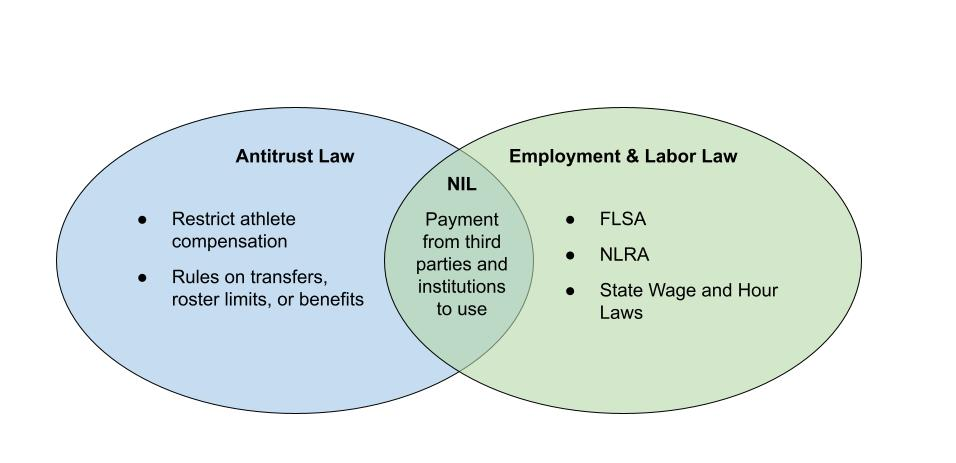
In one circle is antitrust law and eligibility, and the issue of whether the NCAA, some other conference, and schools can collectively restrict athlete compensation, and set rules that impact an athlete’s ability to earn compensation, such as transfer rules, roster limits, or the benefits athletes are eligible for. In the other circle is federal and state employment and labor laws including the FLSA, NLRA, and state wage and hour laws. Unresolved questions include “Are these student/college athletes employees?”; “If so, can/should they organize a union?”; “Who is the employer?”; “What does a bargaining unit look like?”; and, “What law applies?” Caught in the middle is NIL, and whether athletes can receive payment from third parties and from the institutions they play sports for, as compensation for the use of their NIL. In addition, where is the line between NIL transactions and “pay-for-play,” which violates the concept of amateurism and which the NCAA has outlawed?
On the antitrust side, Professor LeRoy told the story of a UCLA basketball player named Ed O’Bannon who, in exchange for essentially a scholarship, agreed to the NCAA’s rules, including waiving compensation for his NIL. While in a garage playing a popular video game with a friend, he saw his own image on the screen, for which he never received a penny. In 2009, he sued, and in 2015, the U.S. Court of Appeals for the Ninth Circuit found the NCAA’s restrictions on student athlete NIL compensation in broadcast and video games violated the Sherman Antitrust Act.[6] According to Professor LeRoy, this opened the floodgates for NIL today. In 2019, the state of California passed landmark legislation that prohibited the NCAA and any athletic conference at any school from penalizing a student athlete for accepting money for NIL.
Not long after, the U.S. Supreme Court in NCAA v. Alston[7] unanimously found that certain NCAA restrictions on education-related benefits violated antitrust laws. The Court did not address NCAA restrictions on non-education-related benefits. However, Nadreau noted the concurrence in Alston where Justice Kavanaugh said the NCAA’s model, including restricting non-education-related benefits, is flatly illegal and would be illegal anywhere. According to Justice Kavanaugh, the NCAA cannot get around antitrust scrutiny by defining its product as free labor: “[N]owhere else in America can businesses get away with agreeing not to pay their workers a fair market rate on the theory that their product is defined by not paying their workers a fair market rate.... The NCAA is not above the law.”[8] This has led to a tidal wave of state-by-state NIL laws stating athletes are entitled to earn non-education-related benefits, with every state regulating this differently and states often competing with each other. For example, some states are proposing they will not tax NIL income. In Nadreau’s opinion, this system isn’t working. In Professor LeRoy’s opinion, the relevance of the Alston decision is how the unanimous decision panned the notion of amateurism; “it took off the mask and said we don’t know what this is but it sure isn’t amateurism anymore.”
In yet other antitrust litigation, the parties’ settlement in House v. NCAA[9], approved by the United States District Court for the Northern District of California in June 2025, established that student athletes can earn NIL income from third parties, and that schools can directly share revenue with their athletes. According to Professor LeRoy, the House case involved a concept called Broadcast NIL (“BNIL”). Similar to O’Bannon, the athletes were not getting NIL pay for their broadcasted image. The case settled for $2.8 million in damages and produced a cap framework allowing institutions to give a designated percentage of their annual athletic revenue to student athletes with an increasingly higher cap each year. According to Nadreau, allowing institutions to provide economic compensation to their players is a huge shift for the NCAA away from grounding notions of amateurism and that schools cannot pay their players with sponsorship or otherwise. This settlement led to the creation of the College Sports Commission (“CSC”), which is a third-party commission designed to vet NIL deals as part of enforcing the settlement provisions. According to attorney Abrahms, although this settlement is currently under appeal, “everyone is operating like it’s not.”
According to Professor LeRoy, the whole point, from the NCAA’s perspective, was to put a cap on compensation, which the power conference schools have heretofore disrespected. Over the past few years, schools have partnered with multimedia rights companies (“MMR”s) and others to use MMR money to get paid and fund NIL deals. The schools believed this would fall outside the House settlement because MMRs are for-profit entities, and it was unclear whether an associated, yet outside, entity would be treated as internal to or part of the college. However, a very recent May 2026 arbitration decision on this subject involving the University of Nebraska, per Professor LeRoy, said two major things: (1) MMR at University of Nebraska, like other institutions, is under the House settlement. The associated entity was internalized, so NIL deals have to be reported to the CSC and approved; and (2) these NIL deals are warehoused, such that the MMR and university can decide how to use NIL at some point in the future when the timing is advantageous. According to Professor LeRoy, “This is a correct, sound ruling.” It honors the “direct activation” NIL deal, meaning direct payment for services rendered, and in Professor LeRoy’s opinion, amounts to employment between the athlete and the MMR. According to Professor LeRoy, “When you say the only way we’re going to get a deal is for me to sign an autograph, post for social media, or sit for a media shoot, that’s employment.”
On the labor law side of the Venn diagram, Nadreau noted several NLRB cases starting with Northwestern University and College Players Athletes Association (CAPA)[10] in 2014. This case involved scholarship football players at Northwestern University who sought to unionize. The University took the position that the football players were not “employees” under the NLRA. After an initial decision by the Board’s regional director finding that Northwestern’s football players were employees under Section 2(3) of the NLRA with the right to unionize, the Board in 2015 ultimately determined it did not have jurisdiction over the matter, and dismissed the players’ petition.[11] According to Nadreau, the Board’s decision found that it served neither the purposes of the NLRA nor labor relations concepts of stability to have an individual bargaining unit of Northwestern football players in the greater context of NCAA Division One college football. From his perspective as a management-side attorney, Nadreau opined that this “was the right decision.”
Nadreau also described the case of Dartmouth University basketball players who filed a petition in 2024 to organize. The NLRB regional director granted this petition, finding that Dartmouth’s varsity basketball players were employees under the NLRA.[12] An election ensued that the union, the SEIU Local 560, won 13-2. The Dartmouth men’s varsity basketball team thus became the first U.S. collegiate athletes to unionize.[13] The University appealed the regional director’s decision to the NLRB, where it sat pending at the time of the 2024 Presidential election. Shortly thereafter, the affected players withdrew their petition out of concern, Nadreau and others surmise, that a Republican NLRB would rule against it, thus undermining the precedent set.
Attorney Abrahms represented Dartmouth in its appeal. According to Abrahms, “the Biden NLRB had nine months with our brief to say, ‘Hey, Dartmouth, was that the right decision,’ and if they thought it was, they would have acted.” Abrahms also believed that, “the reality was, under the law, and the status at the time, [the players] needed to go antitrust because they don’t actually meet the definition of employees.”
Nadreau identified two unspecified ULP cases filed with the NLRB before the Dartmouth petition, challenging certain work rules at the University of Southern California (USC) and University of California Los Angeles (UCLA), the latter of which he represented. These cases were also withdrawn.
Outside the labor context, Nadreau referenced the case of Johnson v. NCAA[14], a case brought by an athlete at Villanova University under the Fair Labor Standards Act (FLSA) challenging whether student athletes in all Division One sports should be classified as employees under federal wage and hour law. Ruling on a motion to dismiss, the U.S. District Court for the Eastern District of Pennsylvania determined they might be.[15] On interlocutory appeal, the Third Circuit held that some student athletes may be employees of their universities under the FLSA, and remanded the matter to federal district court for the application of a different analysis of employee status than the one initially applied by the federal district court. That matter had not been resolved as of the date of the panel presentation. According to Professor LeRoy, plaintiff’s counsel was seeking class certification in that case.[16] Professor LeRoy: “It’s a very slow boat to employment; no one knows how it will end.” According to Nadreau, federal legislation right now “is kind of a mess.” He did not believe there would be any movement on legislative efforts this legislative session, as “we’re running out of time,” with the session ending shortly.
Round Three—What Do We Do Now?
At this point, the learned panel weighed the considerations of each model. Regarding antitrust, according to Abrahms, the message is clear that student athletes want better treatment and better compensation. However, an antitrust rubric is difficult because we want and need the competition to be centrally governed. “You have to have one set of rules or it’s not really competition.” The NCAA’s lack of Congressional antitrust protection “has left this whole nature of college, this uniquely American foundation of college athletics, that doesn’t really exist anywhere else in the world, has left the entire scene kind of open.”
Nadreau noted that athletes using antitrust law to advance their well-being is not new. Historically, professional athletes have used it to bring about change in their leagues. Various pieces of legislation give minor exemptions. For example, the Sports Broadcasting Act of 1961 allowed leagues to pull their media rights, which was a big issue because they were under antitrust scrutiny. In addition, Major League Baseball has a Supreme-Court-created antitrust exemption, while the U.S. Supreme court case of American Needle v. NFL[17] involved licensing apparel deals.
However, the main place that all professional sports leagues derive most of their antitrust exemptions is from their collective bargaining relationship with the unionized employees the rules are imposed on. In Nadreau’s opinion, the NCAA recognizing a union does not necessarily mean its troubles are over. For example, most big college football and basketball teams are located in states that range from “tepid” at best, to “overtly hostile” at worst about accepting bargaining rights. When the organizing at Northwestern took place, some states, home to Big Ten universities, amended their public sector statutes to explicitly say student athletes are not employees. Other states, including a number of members of the Southeastern Conference, have declared public sector collective bargaining illegal. According to Nadreau, uniform application of labor law rights will be one of the biggest challenges for universities and the NCAA using a collective bargaining model in order to gain antitrust exemption, especially in states that do not currently have public sector collective bargaining, let alone the issues of taxation, trademark/intellectual property protection, and state politics.
To Professor LeRoy, the NLRA is an antitrust law, even though it does not specifically say so. Prior to 1935, unions were prosecuted criminally and civilly under state antitrust laws as criminal conspiracies in restraint of trade. The NLRA is just a carve-out. It federalizes collective bargaining and generally preempts state antitrust laws used specifically against unions. Antitrust and NLRA: they’re “two sides of the same coin.” Labor unions in the athletic sphere, just like in the private sector generally, “are permitted to form a cartel.” An effective union is inherently a monopoly; it is inherently acting in restraint of trade. But it has a bargaining partner at the other end of the table. By adopting a collective bargaining model, parties avail themselves of an antitrust exemption.
On the status of student athletes as employees, Abrahms argued against a “myopic” focus on control, and whether the institutions control student athletes, in determining whether they are employees. Student athletes are certainly controlled like employees; you can tell employees to show up here and do this work at this time, just like you tell student athletes to show up for this practice with these requirements to stay on the team. But that is not enough, as the same control applies to kids in amateur athletics like T-ball, youth club sports, and high school athletics. Nadreau agreed you do not think about a little league game as employment. “Some little leagues make money too, and little league is on tv. But no one would say these little leaguers should be employees and we should pay them minimum wage.”
Professor LeRoy, on the other hand, reflected on watching Dorothy in Wizard of Oz growing up, and on the many children employed by the entertainment industry making money. In light of this, he surmised that the notion of an employed and unionized little league may not be too far afield. Professor LeRoy recounted how he goes to work usually six days a week on campus, arriving at 7:30 a.m., and on the way, passing the football practice facility. According to Professor LeRoy, the parking lot is full every morning with football players in the fall, spring, and summer. “Those guys work harder than me.” To Professor LeRoy, this is control to the point where athletes have to compromise their education. And it’s not just football, it’s not just men’s basketball, and it’s not just Division One. Nadreau added that you cannot have a functioning interscholastic athletic program without exhibiting some level of control. Someone needs to tell the basketball team what time practice is, what time the game is, and what time to leave for the bus. But from a school perspective, it can’t be all or nothing.
Nadeau noted that the 3d Circuit in Johnson tried to step back from the binary question, “are you an employee or are you not,” calling student athletes sui generis, i.e. their own thing, and then came up with a “primary beneficiary” test, which Nadreau considers essentially a different version of the existing test. Nadreau questioned whether the primary beneficiaries are the student athletes or the institutions. It may be that a Division One football player primarily benefits the institution, but it might not be, because that student athlete is getting access to the training, nutrition, notoriety, and NIL deals that come with having, say, “Alabama” or “Notre Dame” on his jersey. According to Nadreau, “there is value to the student athlete who gets the exposure and can take his/her talents to the professional status.” Yet, there are benefits to institutions from all levels of interscholastic athletics. Data shows that when a team plays in a national championship, whether it is the NCAA Men’s Basketball Final Four or lacrosse or field hockey, admissions increase as a result. Young people want to go to places that have really good athletic programs. How to discern who is getting the benefit in collegiate sports, especially in those sports with no professional outlet, is the challenge.
Abrahms, stating that he thought teen actress Judy Garland was probably a SAG member, gave the audience a view from the bleachers into his 30-day hearing in the USC matter, which hit home in this audience. Abrahms emphasized that, if you are a Division One, Two, or Three student athlete, especially a football player, you are working out a lot. However, in court, when student athletes took the stand and he asked them about having to work out before and after class, and wake up at 5:00 a.m. to work out, their honest response was that it was a privilege. “So these things, they’re doing them, but they’re wanting to do them, they’re choosing to do them, they’re not forced to do them.” For all of these athletes, playing collegiate sports was their dream; it is what they wanted to do. Like his son, who he lovingly shared was not going to end up an all-star athlete in baseball, but who wanted to be there and play nonetheless. Abrahms admitted his favorite witness in the entire trial was the band director of the world-famous USC marching band, who testified about the kids in their cool sunglasses, showing up early to practice, getting yelled at and told what to do, and having to wear a uniform. It reinforced the point that student athletes and others like them are different and worthy of thinking outside the box for, especially when it comes to their NIL.
Round Four—Room on the Team for Arbitration?
Looking at the end game, and arbitrators’ role in it, from Abrahms’ perspective, we need to recognize two things: (1) the broader impact to the loss of women’s sports and Olympic sports from the direction we’re going, and (2) whatever direction that ultimately is, arbitrators need to find a way to be involved. According to Abrahms, people think that colleges are making millions of dollars on athletics. However, USC lost $20 million in one year on their athletics; they were doling out $20 million out of their general fund to keep their athletic programs going. Most years (not every year) their football program made money. Some years the men’s and women’s basketball teams made money. But none of the other teams made money, and that’s the majority of the other athletes. And in 2024, only about 22 out of about 177 schools made money. These programs are at risk if you’re looking at this like a business.
Professor LeRoy agreed that most athletic departments are losing money. He attributed this to their paying coaches $8 to $10 million a year, and athletic directors double that. Abrahms echoed the other panelists in stating we cannot look at student athletics like a business; we need to find a different way, a way that includes arbitrators. Abrahms anticipates that some year, some resolution of this mess will result in student athletes having some kind of bargaining right, which should include some kind of arbitration right.
Nadreau believed there is room for arbitrators, starting with NIL clearinghouse deals. Central to the CSC’s expedited arbitral review of decisions is determining whether a deal is for “fair market value,” the logic being that schools or third parties cannot dress up NIL deals in ways that are merely direct cash payments to athletes. A million dollars in exchange for two hours signing autographs probably will not fly with the CSC. This is happening right now, and Nadreau imagines there are arbitrations happening on an individual basis about whether deals are fair or not.
Nadreau also envisioned, if we do end up in a collective bargaining model, that a grievance arbitration provision could arise. In states that have public sector bargaining statutes such rights will include interest arbitration. Nadreau believed arbitrators could make the tough calls on what contractual articles should look like for groups of schools, or a singular school, in a bargaining unit.
Following the end of the presentation, a question from the audience involved two of the CSC’s 12 factors in determining the fairness of NIL deals: (1) athletes’ marketability and social media reach, and (2) athletic performance and public profile. The question concerned the prevention of unintentional bias based upon race, gender, and other cultural differences. Abrahms acknowledged this concern’s validity, given the breadth of social media and the coaching that student athletes receive about what they should and should not post. Professor LeRoy added that he learned of an NIL valuation algorithm that resets to exclude rejected deals and include accepted deals. While this may serve a valid business purpose, it may also consequently have built-in racial bias, given that approximately 70% of power conference football players are Black. Nadreau weighed in, stating it comes down to how we are training these models, and that only using the accepted, verifiable deals simply reaffirms the decision-making that’s already happening. Any algorithm or AI tool needs to account for that bias, and he hopes this concern is under consideration.
Another question asked, from an interest arbitration standpoint, about the status of a collective bargaining relationship between a rotating group of students versus long-term university professionals with institutional memory. Professor LeRoy’s response: “The average length of an NFL career is 3.5 years. They turn over about as often as the NCAA school turns over. The union has institutional memory; the players don’t.”
Additional commentary from athletic counsel emphasized concern for the impact on Olympic sports and female athletes under a collective bargaining model, as NIL deals increase costs to university athletic departments, and it is very costly to support all athletes while retaining a large volume of sports programming. She too believes in helping college students achieve their dream of playing a sport in college. Her plea: Give us rules and we’ll follow them, with the understanding that continuing to maintain 36 sports may be a losing game.
Abrahms acknowledged her concern, and the value of the athletic tradition that is part of the American college experience. But he countered that an employment model could be even more expensive than collective bargaining by the time you factor in the cost of complying with the wage and hour laws of every state the students play in, not to mention taxes, benefits, and other employment costs, and the resulting swell of athletic departments.
Responding to the sustainability of 36 college sports on campus, Nadreau made the point that we often rely on our college institutions to train Olympic athletes, and if these sports continue to get cut, the country will need answers to questions on how to continue to compete internationally and win gold medals. Professor LeRoy mentioned a proposal from Michael Baumgartner, U.S. Representative from the state of Washington, to limit compensation for coaches to ten times the institution’s base tuition rate. According to Professor LeRoy, “if that ever really became a law, there would be plenty of money to fund Olympic sports.”
Lastly, a question arose about the impact of NIL on Title IX, especially in light of the U.S. Supreme Court’s acceptance of the case filed by former Georgia Tech women’s basketball coach Michelle Joseph claiming the men’s team received greater resources than the women’s team. Nadreau’s response—“We’re going to need another hour”—brought out widespread chuckles. He acknowledged this is another area of concern, especially under a collective bargaining model if men’s sports are organized and negotiate a better economic package, while women’s sports are not organized. Abrahms echoed this, opining that the House settlement itself is a Title IX violation and consequently a risk to women’s sports.
In sum, while deliberations continue about the best way to support student athletes as they navigate the evolving field of NIL commerce, Nadreau, Professor LeRoy, and Abrahms are manning the bases, and recognize the value of labor arbitration in successful outcomes for all involved.
About the authors: Lisa Dublin is a labor arbitrator and industrial appeals judge in Washington State. She serves as an administrative law judge for the Washington State Office of Administrative Hearings. James Cooper, an NAA member, has been Chairman of the Massachusetts Labor Relations Commission and a Staff Attorney for the Massachusetts Commission Against Discrimination.
[1] Joshua Nadreau is the author of “Whistles, Wages, and the Workplace: Student-Athlete Amateurism in the Crosshairs of Employment Law,” 2025 American Bar Association Midwinter Meeting, Puerto Vallarta, Mexico.
[2] Professor Michael LeRoy is the author of “The Reverse Logic of College NIL Contracts: A Legal Guide for the Perplexed,” 51 Journal of College and University Law 1 (April 15, 2026).
[3] Roberson v. Rochester Folding Box Company, 171 N.Y. 538 (1902). Daniel J. Kornstein, The Roberson Privacy Controversy, 4 The Historical Society of the Courts of the State of New York 3 (2006).
[4] 15 U.S.C. Sec. 1501 et seq.
[5] The NCAA began in 1906 as the Intercollegiate Athletic Association of the United States (IAAUS), and took its current name in 1910.
[6] O’Bannon v. NCAA, 802 F.3d 1049 (9th Cir. 2015). (“O’Bannon”)
[7] NCAA v. Alston, 594 U.S. 69, 141 S.Ct. 2141 (2021).
[8] Id. at 2169.
[9] Case Nos. 4:20-cv-03919 CW, 4:20-cv-04527 CW (“House”)
[10] Northwestern University and College Players Athletes Association (CAPA), Case No. 13-RC-121359 (2014).
[11] Northwestern University, 362 NLRB 1350, 1352 (2015).
[12] Trustees of Dartmouth College and Service Employees International Union, Local 560, Case No. 01-RC-325633 (2024).
[14] Johnson v. National Collegiate Athletic Association, 108 F.4th 163 (3d Cir. 2024).
[15] Johnson v. The National Collegiate Athletic Association, No. 22-1223 (3d Cir. 2024) :: Justia
[16] SeeJohnson v. NCAA: The Implications of Employee Status on College Athletes
[17] American Needle, Inc. v. National Football League, 560 U.S. 183 (2010).
Companies: National Academy of Arbitrators
MainStory: Arbitration IndustryNewsTrends LitigationNewsTrends