

IP Law Daily, TOP STORY: High Court hears arguments on when errors should invalidate a copyright registration, (Nov 8, 2021)
Law Firms Mentioned:Doniger / Burroughs APC | Haynes and Boone, LLP | Nixon Peabody LLP | Orrick, Herrington & Sutcliffe LLP | Stris and Maher LLP
Organizations Mentioned:Doniger Burroughs, APC | H&M Hennes & Mauritz, L.P. | Haynes & Boone, LLP | Nixon Peabody, LLP | Orrick Herrington | Register of Copyrights | Stris & Maher, LLP | Unicolors, Inc.
By Thomas Long, J.D.
However, some Justices showed concern that the case was improvidently granted because the petitioner appeared to address different issues in its brief from its petition for review.
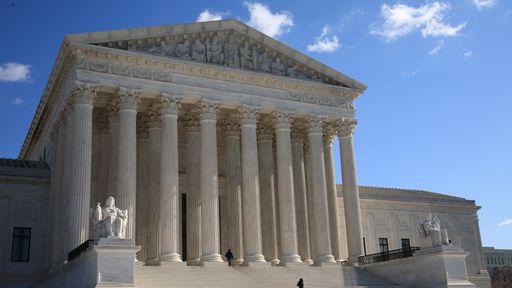
The U.S. Supreme Court today heard arguments in a case that could significantly affect copyright owners’ ability to enforce their rights via infringement suits, when minor or inadvertent errors are found in copyright registration filings. The Court’s decision also could put administrative strains on the Copyright Office if the Court adopts the lenient “mental state” standard set forth by the U.S. Court of Appeals for the Ninth Circuit for referring cases to the Register of Copyrights for possible invalidation of the underlying registrations.
Textile design company Unicolors is before the High Court seeking review of a Ninth Circuit decision that vacated a jury’s verdict and award of over $800,000 in favor of Unicolors for a retailer’s infringement of a copyrighted fabric design. The Ninth Circuit ordered the district court on remand to seek a determination from the Register of Copyrights regarding whether inaccurate information that Unicolors had supplied in its underlying copyright application would have changed the Office’s decision to issue the registration, which consisted of 31 separate designs.
Complicating the situation before the Court is a change—or mere rephrasing, depending on which party is characterizing it—in the question presented in the petition for certiorari and the petitioner’s brief. According to the respondent, retailer H&M Hennes & Mauritz L.P., the Court should dismiss the case because the question as framed in the brief was not properly raised. This argument seemed to find some traction with Justice Thomas, who asked several questions about whether the case should be disposed of as improvidently granted.
As to the merits, the Justices wrangled with distinctions between knowledge of falsity and intent to defraud, actual knowledge and constructive knowledge, factual errors and legal errors, and the “object” of error and the “scope” of error. Although some of the Justices expressed concern that individual artists and poets—who lacked the benefit of expert counsel—might be punished for inadvertent mistakes in a complicated area of law, they also seemed concerned that sophisticated rights owners and “copyright trolls” could take advantage of a lenient standard here.
Copyright dispute. Unicolors creates designs for use on textiles and garments. A frequent litigant sometimes branded as a “copyright troll,” Unicolors sued H&M in a California federal district court, alleging that H&M sold garments that infringed Unicolors’ copyright in a design it created in 2011 and sold in 2015. In 2011, Unicolors had obtained a copyright registration for two-dimensional artwork that consisted of 31 separate designs, including the design that was the subject of the lawsuit. The designs were registered together as a single-unit registration, apparently to save money on registration costs. At trial, the jury found in favor of Unicolors and awarded it just under $850,000.
Validity challenge. In a post-trial motion, H&M contended that the registration was invalid, and therefore the infringement claims should be dismissed. According to H&M, Unicolors secured the registration by including known inaccuracies, namely, using a single copyright registration for 31 separate works. Unicolors argued that H&M could not register the works together as a collection unless it offered all 31 designs for sale in some integrated way. At least nine of the 31 designs had been sold separately and exclusively to certain customers who had paid for that right, and thus those designs had not been offered for sale on the same day as the other 22 designs. The district court rejected that argument, holding that: (1) to invalidate the registration, Unicolors needed to demonstrate an intent to defraud, which it had not done; and (2) the fact that nine of the designs were sold separately did not mean that they were not made available on the same day. The Ninth Circuit concluded that the lower court was wrong on both counts.
Intent to defraud. With respect to the first point, the Ninth Circuit acknowledged that several of its opinions had implied that an intent to defraud was a requirement for registration invalidation. However, the court also had recently explicitly stated that no intent-to-defraud requirement existed. In the Ninth Circuit’s view, Unicolors erred when it sought to register a collection of works that were not initially published as a singular, bundled collection. Furthermore, Unicolors included the inaccurate information knowing that it was inaccurate. This did not automatically render judgment in favor of H&M, the appellate court said. Rather, it required the district court to stop the proceedings and to ask the Register of Copyrights to advise the court whether the inaccurate information, if known, would have caused the Register to refuse registration. Because the district court never took that statutorily required step, the court concluded that the case had to be remanded to allow the court to make the request.
Question presented. The grant of certiorari is limited to the first of two questions posed by Unicolors’ petition: whether the Ninth Circuit erred in holding that 17 U.S.C. § 411 requires referral to the Copyright Office when there is no indicia of fraud or material error as to the work at issue in the subject copyright registration. (Unicolors also asked for, but was not granted, High Court review of whether the Ninth Circuit misapplied the publication standard by applying Copyright Office requirements that were not in place at the time of registration and by analyzing publication as of the date of registration as opposed to the later registration application date.)
“Subjective knowledge” contention in petitioner’s brief. In its brief, Unicolors backed away from relying on an intent-to-deceive standard (which the parties now apparently agree is not required) and contended that the statutory text requires subjective awareness of the inaccurate information in the filing. According to Unicolors, that requirement is not satisfied when the applicant makes an innocent mistake. Citing the statutory terms, Unicolors reasons that under Section 411(b) an applicant who makes an innocent mistake of law does not have “knowledge” that the “information” is “inaccurate.” Unicolors also argues that Congress could not have intended to establish a rule that would severely override copyright holders’ rights and remedies and disrupt infringement litigation.
In H&M’s view, this reframing of the question was not properly before the Court, and even if it was, the Court should rule against Unicolors because Section 411(b) is triggered by either actual or constructive knowledge of the inaccuracy. Moreover, H&M argues, Section 411(b) does not excuse mistakes of law.
Petitioner’s argument. E. Joshua Rosenkranz of Orrick, Herrington & Sutcliffe LLP argued for Unicolors. According to Rosenkranz, the question was “what state of mind a copyright infringer must prove to establish that an applicant included inaccurate information ‘with knowledge that it was inaccurate’” (quoting 17 U.S.C. 411(b)(1)(A)). “The answer,” he said, “is that it requires subjective awareness of the inaccuracy itself,” adding, “you don't know that information is inaccurate if you honestly believe it to be accurate.” He also pointed out, “No court in a century had invalidated a copyright registration based upon an innocent legal error. And Congress is presumed not to have radically changed that rule by hiding that change in the word ‘knowledge.’”
Rosenkranz said that Congress was more interested in giving creators “an effective remedy against IP thieves” than demanding “perfect compliance with complex legal requirements in a form,” predicting that the Ninth Circuit’s approach, if applied broadly, would “wreak havoc.” The petitioner’s position was that the group registration requirements were unsettled and difficult to understand, and any mistake by Unicolors in its filing should not invalidate the registration.
Justice Alito entered the fray with the observation that “the question that you and the [Solicitor General] have now decided to address [is] not exactly the question on which you sought cert and that we agreed to review.” Although Rosenkranz responded by saying that the question presented “has always been about state of mind under 411(b)(1)’s text,” Justice Alito disagreed: “[I]n the petition, it was about indicia of fraud or material error. And now it's been changed into something else.” Rosenkranz responded to this point by asserting that “indicia of fraud” encompassed a number of things, including “a knowing misstatement of material fact.” Counsel also disagreed that the original question was about intent and pointed out that the petition repeatedly mentioned knowledge and subjective awareness.
Justice Thomas expressed his own concern about the question presented, opining that the question in the petition for review and the issue as framed in the brief were different questions. And, therefore, “Why shouldn’t we dismiss this as improvidently granted, since the initial focus in the original QP was on fraud not on knowledge?” Rosenkranz reiterated the position that the question presented involved “indicia of fraud,” contending that Section 411(b), while not using the word “fraud,” contained “all of the core elements of fraud: a knowing misstatement of fact that is material.” Rosenkranz explained that the change in language in the brief was not a statement of a new question but an effort to focus “on the key vulnerabilities of the Ninth Circuit's opinion.”
Counsel also assured Justice Alito that the altered verbiage in the brief did not contradict the original question’s contention that there was a “dire circuit division” that the Court should address, between the Ninth and Eleventh Circuits. The Eleventh Circuit case he referred to was Roberts v. Gordy (2017), in which the appellate court held that a district court erred in invalidating copyright registrations for a song because errors in the registrations were not made with the necessary scienter. The fact that the errors were “errors of law” rather than fact did not affect the result, the Eleventh Circuit said.
Speaking more to the merits, Justice Sotomayor cautioned that, while Rosenkranz was talking about errors made by artists and poets, “there's an argument here that your client is not an artist or poet, that your client is a patent [sic] troll.” And if this is so, “how do I [distinguish] a truly innocent mistake of law from one in which a sophisticated party with the capacity to confer with lawyers makes a mistake that they could have easily checked?” Rosenkranz answered the question by arguing that if H&M had evidence of constructive knowledge or willful blindness, it could have presented it, but it did not. Time did not permit Rosenkranz to speak more fully about “trolls.”
Government’s argument. Melissa N. Patterson, Assistant to the Solicitor General, appeared as amicus curiae, supporting the petitioner. “Congress has set out a default rule to preserve the validity of copyright registrations even if they contain some inaccurate information,” Patterson said. “Under Section 411(b), such a registration remains adequate to support an infringement action unless the registrant has included inaccurate information in its application to the Copyright Office with knowledge that it was inaccurate.” Patterson characterized the Ninth Circuit’s holding—i.e., that a registrant’s knowledge of an inaccuracy is decided by looking at the registrant's factual knowledge, even if the inaccuracy arises solely because of an interpretation of law—as “unprecedented,” and that it “could jeopardize many thousands of copyright registrations under conditions never before thought to give rise to a risk of invalidation.” Patterson explained that the government’s view was that “a registrant needs to actually be aware that it's submitting an inaccuracy and that that is just as true of legal inaccuracies as it is of factual ones.”
Responding to a question by Justice Kagan, Patterson opined that “constructive” knowledge was not enough, based on the statutory text and the context in which Congress enacted Section 411(b). She noted that elsewhere in Title 17, Congress included language indicating a “constructive knowledge” standard, but it did not do so here. Responding to a query by Justice Alito, she said that “willful blindness” would qualify as a form of actual knowledge.
Respondent’s argument. Peter K. Stris of Stris and Maher LLP appeared on behalf of H&M. “Unicolors convinced the Copyright Office to register an ineligible collection by inaccurately listing a single date of publication for 31 unrelated designs that were published separately on different dates,” Stris told the Court. “Yet, here, Unicolors insists that it should retain its litigation privileges because its inaccuracies were allegedly the result of its mistaken understanding of the law.” Even if that argument were properly presented—and Stris contended it was not—it’s wrong on the merits, he argued, because Section 411(b) doesn’t excuse mistakes of law. The general rule, he pointed out, is that mistake or ignorance of law is no defense unless a statute explicitly says otherwise, which Section 411(b) does not do. “It would remove the incentive for applicants to engage diligently with the Copyright Office” if such mistakes were excused, he said.
As to the controversy over the question presented, Stris responded to a question from Justice Thomas by explaining that H&M’s position was that “Unicolors knowingly misrepresented that all 31 designs were published on January 15, 2011.” Because the appellate court concluded that some of the designs were not put on display in Unicolors’ showroom on that date, there was a factual discrepancy in the application. Or, rather, there were two: not only were the designs not all published on the same date, as required to register a collection in a single registration, they were not published together, which is another requirement for such a registration (known as “bundling”). Unicolors now claims that it misunderstood the bundling requirement, Stris said. “The cert petition cannot be fairly read, with all due respect, as encompassing this knowledge question.”
Practitioner commentary. Responding to a question from IP Law Daily about the dispute over the question presented to the court, Haynes Boone associate Abbey Gauger said, “There is a chance that the Supreme Court will dismiss the petition as improvidently granted, or at least skip the knowledge question raised by Unicolors, Inc.’s appeal brief.”
“The Supreme Court granted cert on whether ‘17 U.S.C. § 411 requires referral to the Copyright Office where there is no indicia of fraud or material error as to the work at issue in the subject copyright registration,’” she explained. “However, Unicolors’ appeal brief raised whether an inaccuracy in a registration application resulting from ‘the applicant’s good-faith misunderstanding of a principle of copyright law’ is a sufficient basis to deny the application under Section 411(b). H&M argues that one could have knowledge of an application inaccuracy without the intent to defraud, so long as the inaccuracy is immaterial. The parties also disagree as to whether the Ninth Circuit made any ruling on knowledge, and the Court indicated that it was unclear whether, if they accept Unicolors’ argument, the appropriate remedy would be to remand to determine knowledge or simply reverse the Ninth Circuit’s decision. The Court dug into this issue with Unicolors during argument, but did not give much indication as to how it would rule.”
On public policy concerns raised by the petitioner, Gauger stated, “The Justices’ primary concern appears to be what will happen to the hundreds of thousands of copyright registrations currently on file if innocent or technical mistakes are not protected by Section 411(b). There is no telling how many applications contain minor technical errors or mistakes of law (made unknowingly by an applicant acting in good faith) that could be invalidated under this rule.”
“Furthermore,” she added, “if good faith legal errors (as opposed to factual errors) are a basis for invalidation, then artists and creatives who lack copyright law expertise could be disproportionately affected. The Justices discussed policy concerns with a system that would prevent everyday artists from access to relief for infringement (but would leave more sophisticated parties, including copyright trolls, largely unaffected).”
Speaking to the case’s potential impact, Gauger said, “The Court’s decision absolutely has the ability to change the landscape of copyright defense litigation, at all stages of the proceeding. H&M did not challenge Unicolors’ copyright registration until after the close of trial. If technical errors or mistakes of law are a basis to invalidate a registration, there are likely to be many referrals to the Copyright Office, seeking to invalidate registrations, both before and after litigation.”
Although the Justices spent time discussing factual matters—including whether the textile designs at issue were actually “published” for purposes of the Copyright Act—Gauger said she believe it won’t be a dispositive issue because there was general agreement that not all of the designs were published on the same date. “Thus, this issue may be a means for the Court to narrowly tailor its decision to the facts presented, but is unlikely to give the Court an opportunity to avoid some of the larger legal questions posed by Section 411(b),” she said.
Attorneys: E. Joshua Rosenkranz (Orrick, Herrington & Sutcliffe LLP) and Scott Alan Burroughs (Doniger / Burroughs APC) for Unicolors, Inc. Staci Jennifer Riordan (Nixon Peabody LLP) and Peter K. Stris (Stris and Maher LLP) for H&M Hennes & Mauritz, L.P. Melissa N. Patterson, Assistant to the Solicitor General, Department of Justice, Washington, D.C., for the United States. Abbey Gauger (Haynes and Boone, LLP).
Companies: Unicolors, Inc.; H&M Hennes & Mauritz, L.P.
MainStory: TopStory Copyright GCNNews