

IP Law Daily, PATENT—Fed. Cir.: PTAB’s obviousness finding reversed; Board applied erroneous standard to analysis of secondary considerations, (Jun 6, 2023)
Law Firms Mentioned:Baker Botts LLP | Lowe Graham Jones PLLC
Organizations Mentioned:Baker & Botts, LLP | Lowe Graham Jones, PLLC | MacNeil IP LLC | Yita LLC
By Robert Margolis, J.D.
The Board had found secondary considerations overcame conclusion that prior art had disclosed a feature of the patent for WeatherTech vehicle floor mats.
The U.S. Court of Appeals for the Federal Circuit has reversed the Patent Trial and Appeal Board’s inter partes decision and held that claims of MacNeil IP, LLC’s patent for WeatherTech vehicle floor mats are unpatentable as obvious, agreeing with challenger Yita LLC that a feature of the claims was disclosed in prior art. The court affirmed a separate Board decision finding that the claims of a related patent are not unpatentable, rejecting Yita’s appeal on that second patent (Yita LLC v. MacNeil IP LLC, June 6, 2023, Taranto, R.).
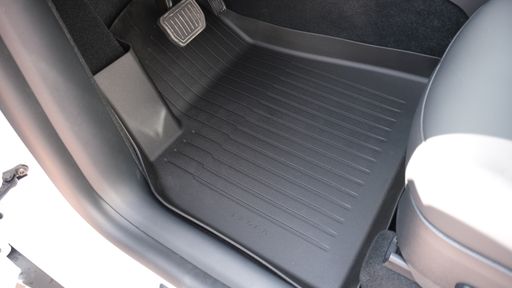
MacNeil is the assignee of two U.S. Patents, Nos. 8,382,186 and 8,833,834 (the ’186 and ’834 patents), addressing a “vehicle floor tray … thermoformed from a polymer sheet of substantially uniform thickness.” According to the specification, the design permits MacNeil’s WeatherTech foot trays to have a “more exact fit to the vehicle foot well” and to “stay[] in place once it is installed,” to avoid the problem of ending bunched up or folded over, and/or “occluding the gas, brake, or clutch pedals.” The specification describes the process for achieving this, involving taking a digital scan of the vehicle’s foot well, and then using a thermoform process to give a polymer sheet the shape of the scan.
Inter partes reviews. Yita petitioned for inter partes reviews of the ’186 and ’834 patents, challenging all claims of each on obviousness grounds. In its written decision concerning the ’186 patent, the Board found that a relevant artisan would have been motivated and had a reasonable expectation of success in combining three prior art references—Rabbe, Yung, and Gruenwald—to arrive at the patent’s claims. However, the Board rejected Yita’s obviousness challenge, concluding that MacNeil produced compelling evidence of secondary considerations that were indicative of non-obviousness. The Board found that the WeatherTech trays “embody the claimed invention and are coextensive with the claims,” and the coextensiveness contention necessarily rendered insignificant any difference between the invention and the recitation in the claims, meeting the disclosed “close conformance” limitation. The close conformance was not “well-known” so as to render the ’186 obvious, according to the Board. The Board then found that three secondary considerations—commercial success, long-felt but unsolved need, and industry praise—also were persuasive of non-obviousness.
On the other hand, the Board found the challenged claims of the ’834 patent to be unpatentable for obviousness, finding the secondary considerations unpersuasive. That finding was made despite Yita’s argument, unchallenged by MacNeil, that the secondary-consideration evidence was identical for both patents. The Board found that this evidence related to close conformity of the foot tray to the vehicle foot well, which are not features recited in the claims of the ’834 patent. As to other claims of the ’834 patent, the Board rejected Yita’s challenge at the prima facie stage of the analysis, finding a limitation in those claims to be undisclosed in any of the prior art references.
Yita appealed from both Board decisions.
Obviousness. Yita made two arguments on appeal. As to the decision on the ’186 patent, it argued that the Board made a legal error in its analysis of the secondary-consideration evidence. As to the ’834 patent, it argued that the Board abused its discretion by not considering an argument that Yita had raised in a footnote of its reply brief. The appellate court agreed with Yita’s argument as to the ’186 patent, but rejected the argument as to the ’834 patent, thus finding the ’186 patent unpatentable as obvious.
As to the ’186 patent, the appellate court found convincing Yita’s argument that the Board committed legal error in evaluating the secondary-consideration evidence. The Board had found that a skilled artisan would have been motivated and have a reasonable expectation of success in combining the prior art teachings, but that the secondary considerations were “compelling.” Secondary considerations are relevant only where there is a sufficient “nexus” between them and the claimed invention. Such a nexus is presumed when a commercial product is the invention disclosed and claimed in the patent. The Board found such a presumption, but then determined that the disclosure in one prior art reference of the “close conformance” limitation did not undermine the determination of the nexus. The appellate court found this to be legally erroneous on two grounds.
First, the Board found that the prior art disclosure did not establish that “close conformance” was “well-known.” But the prior art disclosure need only be “known in the prior art,” not necessarily “well-known.” As the appellate court explained, where prior art teaches a feature such that a relevant artisan would be motivated to combine it with other prior art with a reasonable expectation of success to arrive at the claimed invention, a secondary consideration related to that particular feature does not logically undermine the inference that the claimed invention would have been obvious from the prior art, simply because that feature was “known” but not “well-known.”
Second, the Board erred when it relied on language in a prior Federal Circuit decision related to the “inventive combination of known elements” serving as a nexus for secondary considerations, rather than secondary evidence related entirely to a particular feature. In a case such as this, where secondary considerations relate exclusively to a single feature in the prior art, and as noted above, that feature was disclosed in prior art, evidence related to “inventive combination” of other features does not undermine the Federal Circuit law denying force to the secondary considerations.
Footnote argument. The appellate court found no abuse of discretion by the Board when it failed to consider an argument Yita made as to the ’834 patent because that argument was made only in a footnote of Yita’s reply brief. The Board’s rules of practice preclude an IPR petitioner from making new arguments in reply briefs, unless they respond to arguments made in the patent owner’s response to the IPR petition. Here, the Board did not abuse its discretion in finding that a Yita argument that it would have been obvious to a relevant artisan to modify Rabbe to arrive at one of the ’834 patent’s limitations was a new argument. The argument was different from those Yita raised in its petition that relied solely on what Rabbe disclosed, not on how it could be modified. Similarly, MacNeil’s response discussed only what Rabbe disclosed, not how it could be modified.
The Case is No. 22-1373.
Attorneys: Mark P. Walters (Lowe Graham Jones PLLC) for Yita LLC. David G. Wille (Baker Botts LLP) for MacNeil IP LLC.
Companies: Yita LLC; MacNeil IP LLC
MainStory: TopStory Patent FedCirNews GCNNews USPTO