

Labor & Employment Law Daily Wrap Up, LABOR—UNFAIR LABOR PRACTICES—9th Cir.: Work-preservation defense did not defeat Section 8(b)(4)(D) charge in jurisdictional dispute, (Aug 21, 2026)
Law Firms Mentioned:Barnard Iglitzin & Lavitt | Bush Gottlieb | Law Offices of Robert Remar | Leonard Carder | Morgan Lewis & Bockius | Weinberg Roger & Rosenfeld | Zimmer Citron & Clarke
Organizations Mentioned:International Association of Machinists and Aerospace Workers, District 160, Local Lodge 289 | International Longshore and Warehouse Union | International Longshore and Warehouse Union, Local 19 | Kinder Morgan | Leonard Carder, LLP | Morgan Lewis & Bockius, LLP | Pacific Maritime Association | Port of Seattle | Weinberg Roger & Rosenfeld, PC
By Ronald Miller, J.D.
There is no dispute that both unions were entitled to the work under their contracts, and the parties further agreed that the employer cannot award the work to one union without breaching its contractual obligations to the other.
The Ninth Circuit, in an en banc decision, held that an ILA work-preservation is not a defense to an unfair labor practice charge under Section 8(b)(4)(D), and overruled the passage in Kinder Morgan that stated otherwise. The appeals court observed that allowing the ILA work-preservation defense to defeat a Section 8(b)(4)(D) charge for failing to abide by a Section 10(k) decision would frustrate the scheme that Congress enacted to conclusively resolve jurisdictional disputes. Accordingly, the appeals court denied petitions for review by the ILWU and the Pacific Maritime Association and granted the NLRB’s cross-petition for enforcement of its order awarding the right to perform maintenance and repair work for SSA Terminals to the IAM (International Longshore and Warehouse Union v. NLRB, Nos. 23-632, 23-658, 23-780, and 23-793 (9th Cir. Aug. 20, 2026)).
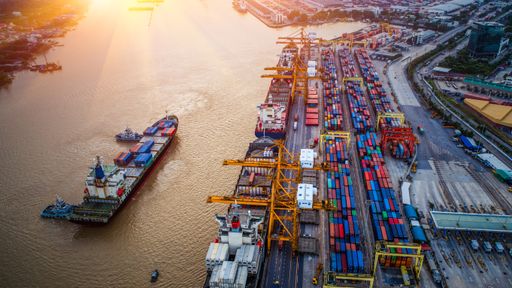
SSA Terminals operates container terminals in the Port of Seattle. The terminal uses specialized equipment to load and unload cargo from large container ships. The terminal is responsible for maintaining the specialized equipment and assigns that work to union-represented employees pursuant to separate collective bargaining agreements.
Maintenance and repair work. SSA Terminals’ CBA with the Machinists (IAM) union gave IAM-represented mechanics the right to perform the maintenance and repair work at the employer’s Puget Sound Region container terminals. This agreement anticipated modernization by requiring that any future work created by advancements in technology would continue to be performed by the employees covered by this agreement.
SSA Terminals is a member of the Pacific Maritime Association (PMA), a multiemployer association, and the PMA has a collective bargaining agreement with Longshoremen (ILWU). As a PMA-member employer, SSA Terminals is bound by the agreement. That agreement permitted PMA-member employers to introduce automation at their terminals. In exchange, the agreement expanded the scope of ILWU’s jurisdiction to cover installation, reinstallation, removal, maintenance, and repair of new technologies.
Terminal 5 maintenance work. Prior to 2018, SSA Terminals employed workers represented by ILWU and IAM at container terminals it operated in the Port of Seattle. ILWU stevedores moved cargo to and from the vessels. IAM-represented mechanics maintained and repaired equipment at the terminals. IAM performed maintenance and repair work for a different operator at Terminal 5, which functioned as a container terminal until it closed in 2014.
In 2018, SSA Terminals decided to reopen Terminal 5, modernize it, and relocate some operations there. The reopening of Terminal 5 triggered SSA Terminals’ contractual obligations under both collective bargaining agreements.
SSA Terminals assigned the Terminal 5 work to ILWU. IAM threatened to picket and strike if the work was not reassigned to its members. Thereafter, SSA Terminals invoked Section 8(b)(4)(D) and asked the NLRB to decide which union should be awarded the work.
ILWU grievance. Following a Section 10(k) hearing, the Board awarded the Terminal 5 maintenance and repair work to IAM. ILWU responded by pursuing a grievance and arbitration against the terminal. That prompted a new proceeding before the Board in which SSA Terminals and IAM accused ILWU of pursuing a grievance to coerce SSA Terminals to reassign the work to ILWU in contravention of the Board’s Section 10(k) decision.
Work-preservation defense. Before an administrative law judge, ILWU did not dispute that pursuing its grievance in defiance of the Section 10(k) award may violate Section 8(b)(4)(D). Instead, it argued that the arbitration was permissible work-preservation activity because it sought to pressure SSA Terminals to comply with its contractual obligation to assign the Terminal 5 work to ILWU. The ALJ rejected ILWU’s work-preservation defense, and the Board affirmed that ruling.
ILWU and PMA petitioned for review, challenging the Board’s Section 8(b)(4)(D) ruling and its underlying Section 10(k) award. IAM filed a separate petition challenging the adequacy of relief ordered by the Board.
A three-judge panel of the Ninth Circuit vacated the Board’s order because it was bound by the appeals court’s decision in International Longshore & Warehouse Union v. National Labor Relations Board (Kinder Morgan), 978 F.3d 625 (9th Cir. 2020). ILWU asserted a “work-preservation” defense, as described by the Supreme Court in National Labor Relations Board v. International Longshoremen’s Association (ILA), 447 U.S. 490, 504 (1980). The appeals court ruled that Kinder Morgan allowed ILWU to assert an ILA work-preservation defense in response to the Section 8(b)(4)(D) unfair labor practice charge. Thereafter, the Board and IAM were granted petitions for en banc review.
Jurisdictional disputes. Jurisdictional disputes arise when multiple unions seek to enforce irreconcilable contractual rights to perform the same work for the same employer, such that the employer cannot assign the work to one union without breaching its obligations to the other.
Congress has empowered the NLRB to decide which of the competing unions shall be awarded the work. Congress deemed the failure of the non-prevailing union to respect the Board’s decision an unfair labor practice.
Section 8(b)(4)(D) charge. A complaint filed pursuant to Section 8(b)(4)(D) triggers a process described in Section 10(k) that requires the Board to award contested work so long as three conditions are met. Specifically, the Board must verify that there is reasonable cause to believe that (1) a union has used a proscribed means to enforce its claim to the work in dispute; (2) there are competing claims to the disputed work between rival groups of employees; and (3) there is no agreed-upon method for resolving the dispute voluntarily.
Here, the Board deemed these three conditions satisfied because IAM had threatened to strike if the Terminal 5 maintenance and repair work was not reassigned to it, and the other two conditions were uncontested.
ILWU contended that by pursuing its grievance and arbitration, it merely sought to preserve work it was contractually entitled to perform, not to extract additional work from SSA Terminals. The sole issue before the en banc court was whether a union charged with violating Section 8(b)(4)(D) may invoke the ILA work-preservation defense.
In ILA, the Supreme Court acknowledged that the work-preservation defense can defeat an accusation of secondary activity in violation of Section 8(b)(4)(B). The Court has not extended this defense to a Section 8(b)(4)(D) charge, however. And although ILA work-preservation can be a defense to a Section 8(b)(4)(B) charge, it does not necessarily follow that the defense applies to a Section 8(b)(4)(D) charge because “the theoretical bases for each charge are different.”
The Supreme Court has explained that Congress enacted Section 8(b)(4)(D) and Section 10(k) as intertwined provisions “to protect employers and the public from the detrimental economic impact of ‘indefensible’ jurisdictional strikes.” Allowing an ILA work-preservation defense to a Section 8(b)(4)(D) charge would accordingly undermine Congress’s intent to solve the problem of wasteful work stoppages due to jurisdictional disputes, the Ninth Circuit concluded.
The appeals court was thus persuaded that the ILA work-preservation defense is inapplicable to a Section 8(b)(4)(D) charge. The petitions of ILWU and PMA challenging the Board’s order were denied, and the Board’s cross-petition for enforcement was granted.
The cases are Nos. 23-632, 23-658, 23-780, and 23-793.
Judge: Christen, M.
Attorneys: Kathleen Foley (Zimmer Citron & Clarke), Michael E. Kenneally (Morgan Lewis & Bockius), Robert S. Remar (Law Offices of Robert Remar), Kirsten Donovan, ILWU Coast Longshore Division, Ira L. Gottlieb (Bush Gottlieb), Robert H. Lavitt (Barnard Iglitzin & Lavitt), and Lindsay R. Nicholas (Leonard Carder) for International Longshore and Warehouse Union and International Longshore and Warehouse Union, Local 19. Micah P.S. Jost for the NLRB. David A. Rosenfeld (Weinberg Roger & Rosenfeld) for International Association of Machinists and Aerospace Workers, District 160, Local Lodge 289.
Companies: International Longshore and Warehouse Union; International Longshore and Warehouse Union, Local 19; International Association of Machinists and Aerospace Workers, District 160, Local Lodge 289; Pacific Maritime Association
MainStory: TopStory Labor UnionsMembers UnfairLaborPractices AgencyNews AlaskaNews ArizonaNews CaliforniaNews HawaiiNews IdahoNews MontanaNews NevadaNews OregonNews WashingtonNews GCNNews