

IP Law Daily, COPYRIGHT—S.D. Fla.: How many ways can a banana be duct-taped to a wall?, (Jun 13, 2023)
Law Firms Mentioned:Kane Kessler, P.C.
Organizations Mentioned:Kane Kessler, PC
By Matthew Hersh, J.D.
Not enough, a court finds—and that brings an end to a fruit-forward copyright case.
A Canadian visual artist who conceived of the idea of duct-taping a banana to a wall as part of an art exhibit was not entitled to protection for his work because the manner in which he aligned the duct tape with the fruit was not creative but rather “the obvious choice,” the federal court for Miami has held. The court, in granting summary judgment in favor of an Italian artist who created a work with a similar element, also found that the Italian artist created his work independently and without access to the original (Morford v. Cattelan, June 12, 2023, Scola, R.).
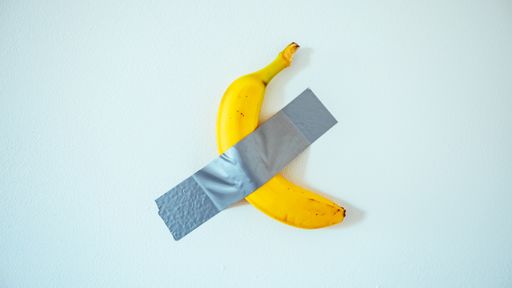
The lawsuit involves a dispute between two visual artists who created abstract works involving fruit. Joe Morford, a visual artist from Canada, created a work in 2001 that he titled Banana & Orange. The work, which is visible on the artist’s Facebook page, depicts a banana and an orange that have been taped against a green background by a single piece of duct tape. Mauricio Catelan, an Italian artist, created his own fruit-and-gravity based work, entitled Comedian. That work, which he created for the Art Basel Miami art fair in 2019, contains only a single banana attached to a wall with a piece of duct tape. (A picture of the artwork, accompanied by an article explaining the “banana phenomenon” the Miami display apparently unleashed, can be found here).
The Canadian artist sued the Italian artist, contending that he had recreated, and thus purloined, the banana component of his 2001 work. The court denied the Italian artist’s motion to dismiss, finding that the Canadian artist had adequately alleged access and substantial similarity. The Italian artist then moved for summary judgment once discovery was concluded, leading to this opinion.
Access. The court granted summary judgment in favor of the Italian artist. Before turning to the more difficult question of substantially similarity, the court first addressed the more straightforward question of access—the low hanging fruit, as it were. Here, the court easily found, the record simply did not present a triable case. The Canadian artist showed only that his works had been available on the internet—YouTube, Facebook, and Blogspot—for roughly a decade before the Italian artist created his work. “But mere availability, and therefore possibility of access,” the court noted, “is not sufficient.” Here, the court noted, there was no meaningful evidence that the Canadian’s work had enjoyed any particular or meaningful level of popularity. “In fact,” the court noted, “the evidence cited supports the opposite finding, that it remained a relatively obscure work with very limited publication or popularity.” Thus, the claim failed on lack of access alone.
Substantial similarity. The court also found that even if the access issue could be overcome, the works were not sufficiently similar to support a finding of infringement. The challenge for the Canadian artist was that the two works varied in a wide range of respects. For example, the Canadian artist’s work used an orange and a banana, while the Italian’s used only a banana; the Canadian’s work used plastic fruit replicas, while the Italian’s used the real thing; and the Canadian’s work came with a green background, while the Italian’s had no background at all but simply specified a particular height at which the banana should be affixed to the wall. Ultimately, the court found, the only overlap between the two pieces was that each contained a banana duct taped to the wall. Was that enough to constitute infringement? The court found that it was not.
The Italian’s use of the duct-taped-banana could not have infringed the Canadian’s rights, the court found, because the very idea of a banana duct taped to a wall was not itself protectible. To be sure, the court noted, if there had been a large number of ways that an artist could duct-tape a banana to a wall, then perhaps the selection of any one of those ways might have involved a creative choice. But there was not. The method chosen by both artists was to arrange the tape and the banana perpendicular to one another, in an “X” shape. But that was not a creative choice, the court observed, but rather, “to put it bluntly, the obvious choice.” After all, the court noted, “placing the tape parallel with the banana would cover it. Placing more than one piece of tape over the banana, at any angle, would necessarily obscure it. An artist seeking to tape a banana (or really, any oblong fruit or other household object) to a wall is therefore left with only a few ways of visually presenting the idea—all of which involve a piece of tape crossing the banana at some non-parallel angle.” This aspect of the Canadian artist’s creation—the only aspect allegedly copied—was therefore not protectible.
Independent creation. The court also found, for good measure, that the Italian artist had shown convincingly that he created his own fruit assembly independently. His declaration, the court noted, provided “a detailed description of the circumstances under which he created Comedian” for the Miami art exhibition—a description that was backed by one of his employees. The Canadian artist came forward with nothing to rebut this evidence, leaving the court with no meaningful factual dispute. On this ground too, the court found, the Italian artist was entitled to summary judgment.
The Case is No. 1:21-cv-20039-RNS.
Attorneys: Joe Morford, pro se. Adam M. Cohen (Kane Kessler, P.C.) for Maurizio Cattelan.
MainStory: TopStory Copyright FloridaNews GCNNews