

IP Law Daily, COPYRIGHT NEWS: Will ‘a stupid banana taped to a wall’ make it to the Supreme Court?, (Jan 9, 2025)
By Matthew Hersh, J.D.
Aggrieved artist wants the high court to weigh in on the inverse-ratio rule and the standard for assessing striking similarity.
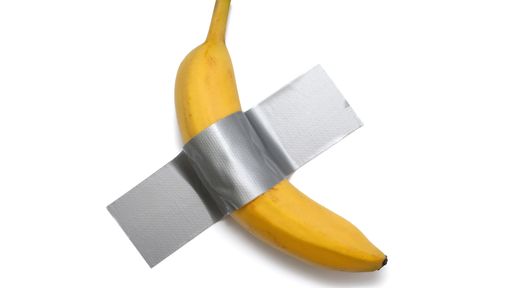
“Yeah, it’s just a stupid banana taped to a wall. But if copyright is only for works that are popular or successful, then there is no such thing as copyright protection.” With these words the artist behind a piece of banana taped to a wall has filed a petition for certiorari asking the Supreme Court to review his copyright case. The colorfully written pro se brief asks the Court to weigh in on circuit splits involving the inverse-ratio rule—a highly contentious rule that requires a higher level of similarity where there is a lower level of proof of access—as well as the proper standard for determining whether there is “striking similarity” between works that consist of compilations (Morford v. Cattelan, No. 24-711 (U.S. Dec. 31, 2024)).
The lawsuit involves a dispute between two visual artists who created abstract works involving fruit. Joe Morford, a visual artist from Canada, created a work in 2001 that he titled Banana & Orange. The work, which is visible on the artist’s Facebook page, depicts a banana and an orange that have been taped against a green background by a single piece of duct tape. Mauricio Cattelan, an Italian artist, created his own fruit-and-gravity based work, entitled Comedian. That work, which he created for the Art Basel Miami art fair in 2019, contains only a single banana attached to a wall with a piece of duct tape. (A picture of the artwork, accompanied by an article explaining the “banana phenomenon” the Miami display apparently unleashed, can be found here). Cattelan’s work sold at auction in November of last year for a whopping $6.2 million.
Morford sued Cattelan, contending that he had recreated, and thus purloined, the banana component of his 2001 work. A federal court in Miami granted summary judgment in favor of Cattelan on several bases. For one, the court found, in light of the work’s “very limited publication or popularity,” there was no meaningful evidence that Cattelan had been aware of Marford’s work before he made his own. For another, the court found, there was nothing particularly protectable about the manner in which Morford and Cattelan duct-taped their bananas to the wall—the sole element of similarity between the two works. (“The method chosen by both Morford and Cattelan—the ‘X’ shape of the duct tape crossing the banana in a perpendicular manner—essentially merges with the concept of taping a banana to a wall,” the court noted. “It is, to put it bluntly, the obvious choice.”) Finally, the court noted, Cattelan provided sufficient evidence that he came up with his own artwork independently.
The Eleventh Circuit, in a brief unpublished opinion, affirmed the decision below. In his appeal to the court of appeals, Morford argued that the district court incorrectly decided the issue of access and that the two works were in any event “strikingly similar” such that evidence of access was not necessary. The court of appeals rejected both arguments. As to access, the court held, the mere fact that the work was available on Morford’s Facebook and YouTube pages was not enough. “Banana and Orange’s mere availability on the internet, without more, is too speculative to find a nexus between Mr. Cattelan and Mr. Morford to satisfy the factual copying prong of his infringement claim,” the court found. As to striking similarity, the court held, the differences between the two pieces ruled that out as well. “Although the use of the same two incongruous items (a banana and duct tape) are indeed similar,” the court concluded, “there are sufficient differences in the two displays to preclude a finding of striking similarity. For example, Banana and Orange contains both a banana and an orange held by duct tape, while Comedian only contains a banana held by duct tape.”
Morford’s colorfully written petition asks the High Court to review both of the Eleventh Circuit’s conclusions. As to the issue of access, Morford argues that the Eleventh Circuit applied (presumably sub silentio, as the court of appeals actually did not use the term) what is known as the “inverse ratio rule.” That rule, which has been a subject of considerable debate among courts, holds that the amount of similarity necessary to demonstrate copying varies inversely with the amount of access the alleged infringer had to the work. Quoting Skidmore v. Led Zeppelin, the Ninth Circuit case which abrogated the rule in that circuit, the petition asserts that “nothing in copyright law suggests that a work deserves stronger legal protection simply because it is more popular or owned by better-funded rights holders.”
The petition also argues that the Eleventh Circuit applied the wrong standard in determining whether there was striking similarity between the works. In rejecting his appeal, Morford argues, the court of appeals wrongly applied the so-called “bodily appropriation” standard which requires that, in the case of compilations, the entire work must have been effectively appropriated. Unlike in the Eleventh Circuit, Morford argues, “other circuits have identified striking similarity in portions of work consisting of a combination of otherwise protectable elements.”
The questions presented are: (1) Can portions of artwork establish striking similarity? and (2) Must artwork be popular, prosperous or promoted to be reasonably accessible online?
The Case is Dkt. No. 24-711.
Attorneys: Joe Morford, pro se.
MainStory: TopStory Copyright GCNNews